Pages

Showing posts with label autobiography. Show all posts

Sunday, July 2, 2017

Tender at the Bone - Ruth Reichl

Tender at the Bone: Growing Up at the Table
I live in a magic neighborhood where people leave books out on their yard walls for passerby to take.  While heading to the convenience store for a sugar fix this weekend, I stumbled across a house that had so many books out!  Among them were a bunch of food memoirs, including this one.  I love books, I love food, I love books about food, so of course it found its way into my bag, along with about fifteen other ones.  How lucky that I took the bag with me!

I've come to the decision that I really like Ruth Reichl.  While her memoir about her time as a food critic at the New York Times, Garlic and Sapphires, wasn't a home run, it was still good, and her novel Delicious! was, in fact, delicious.  Now, I've moved on to Tender at the Bone, which is basically a memoir (albeit an embroidered one) about how Reichl grew up to love food and managed her crazy family.  Born in New York City, Reichl's mother suffered from bipolar disorder (though they didn't know this when Reichl was young) and went through manic stages that turned Reichl's life upside down.  Her mother was also a terrible cook.  However, Reichl loved food and found good food in plenty of other places, and came to learn to cook first as a necessity and then as a passion.  Watching this journey as she grows was fascinating, and I would have never thought that Reichl had such a tumultuous past!  From being shipped off to a boarding school in Montreal because of a passing comment about how she wished she spoke French to essentially living on her own when she was in high school to living in what was basically a hippie commune, it was all fascinating.

Was it all true?  Well... Reichl states in the preface to the book that embroidering, reordering, and sometimes just making up stories is a family tradition, and that she's done some altering to this memoir in order to make it flow better as a solid narrative.  I do appreciate that this one was in chronological order; if I recall correctly, Garlic and Sapphires jumped around a bit, which was disorientating.  But embroidered or not, I think this is a good memoir that makes the author more of a real person.  She suffered from imposter syndrome at various points, feeling like she was a fake, which is something I think we all struggle with sometimes.  And while I appreciated that her mother had a mental illness, I could also empathize with Reichl's yearning to sometimes just slap her mother upside the head and tell her to get over it; no matter how much you tell yourself it's not their fault, sometimes it just grates on your nerves.  The memoir is also interspersed with recipes that Reichl encountered for developed throughout her life.  These are at the beginnings of chapters, which is a little weird and led to some whacky formatting in the book, but I still appreciated them.  I might even try my hand at a lemon souffle someday.

Overall, this was a poignant and mouth-watering memoir, even embroidered as it is--and honestly, I don't mind a little embroidering as long as the author owns up to it, which Reichl did before she even got started.  I can't wait to read her other memoir, Comfort Me With Apples.

4 stars out of 5.

Monday, January 2, 2017

Born a Crime - Trevor Noah

Born a CrimeA few weeks ago, my boyfriend was going out for drinks with a friend at a local bookstore and cafe.  I was invited, but am a total homebody and told him have fun, but bring me a book.  He brought back Born a Crime and Neil Gaiman's new nonficton, The View from the Cheap Seats.  Born a Crime was shorter, so I started that first.

Born a Crime is exclusively about Noah's life before he left South Africa, and it's largely about his life before he got into comedy--comedy is only mentioned a handful of times, at best.  The majority of the book takes place during his childhood and teens, when he lived with his mother and, later, his stepfather and younger brother.  During his early childhood, apartheid was still in effect in South Africa, and later on its effects were still being felt even after it was officially abolished.  As a mixed-race child (black South African mother, white Swedish/German father) Noah was literally born a crime, and his anecdotes are about race, discrimination, and the fluidity of identity during apartheid and after.  As a mostly basic white girl, these things were fascinating to read about, because it's a culture I will never be a part of, but something I dearly want to understand in order to be a more educated, worldly, and tolerant individual.

Floating around in the background of many of the anecdotes is Noah's home life, which practically vanishes from the page after his mother marries his stepfather.  This lends a very strange dynamic to the book, because you can tell there's something to do with that, and abuse, floating around in the background, but it seems like Noah's avoiding it.  Which is totally his right, if wants to, but it's a strange feel.  Well, he's not avoiding it.  He comes out with it all in the last chapter of the book, and I can see why.  While much of the book has touching moments, that final chapter is definitely the one with the strongest emotional impact.  It adds so much context that was missing in the rest of the book and makes a lot of things much clearer in hindsight.

Noah has an extremely readable style.  While he's a comedian, this book is frequently poignant rather than laugh-out-loud funny, though a few of his signature jokes are in there--like how, during apartheid, he couldn't walk with his mother when police were around because mixed-race relationships were illegal, and when cops would appear she would drop him like a bag of weed so that they wouldn't be harassed.  Each chapter is prefaced by a shorter section that says something about apartheid and how it affected and still affects the people in South Africa.  He shows both how far South Africa has come, and how far it still has to go, in a variety of ways--from racial equality (not that the United States is exactly a beacon of excellence in this area) to things such as basic sanitation.  But at the same time, he includes touching stories of his relationship with his mother (this book was infinitely better than Maya Angelou's Mom & Me & Mom in that regard) and of finding himself.  It's a great book, an easy read but one that packs a punch at the same time in a lot of areas, and I highly recommend it.

5 stars out of 5.

Monday, December 19, 2016

Mom & Me & Mom - Maya Angelou

Mom & Me & MomMom & Me & Mom was Emma Watson's November/December pick for her feminist book club, so I picked it up to read over Thanksgiving Break.  It is, to my understanding, the seventh autobiographical work written by Angelou, and it focuses on her relationship with her mother and (to a lesser extent) her grandmother, and how these relationships allowed her to grow into an empowered woman despite rocky spots along the way.

I think this book both showed how women can be supportive of each other, and also served as a terrible example for feminism.  (Which is, let's remember, about equality, not superiority.)

Over the course of the book, Angelou works on showing how her mother, who sent her away to be raised by her grandmother from ages three to thirteen.  While Angelou had a very strong relationship with her grandmother, she obviously didn't have one with her mother when she returned to her as a teenager.  She was so distanced from her that she wanted to call her "Lady" instead of "Mother."  But over the years, Angelou shows how her mother was there for her during tough situations, and eventually came to be the person that she called upon whenever she needed support.  Of course, the relationship wasn't entirely flowers and sunshine; there were fights, rocky periods, stony silences, and even an incident where Vivian hit Maya so hard that it messed Maya's face up--so bad that her brother wanted them to leave.  There are also some questionable parenting techniques, like letting her leave school to be a streetcar conductor.  Angelou tries to tie lessons to these, but I think some of the lessons are rather undermined by the context that they're in.  For example, there's a line about how "A woman needs to support herself before she asks anyone else to support her," but this message is embedded in an episode in which Vivian almost shoots a guy because he cheated on her.  Now, if the gender roles were flipped here, would this seem like an empowered individual...or someone who's being abusive towards their significant other?  This seems to be the case throughout much of the book.  Vivian's "empowerment" often comes as the cost of others, and not in an "equality" sense.

I also wasn't exactly a fan of the writing here.  It seems very short and jerky, taking much of the emotion out of the story, and jumps from topic to topic without transitions; this combined with a progressively more non-linear format often made the narrative hard to follow as a whole.  Maya Angelous is so lauded by so many that I really expected more here, but from some other reviews I've seen, it seems like maybe her earlier works flowed a bit better than this one.

Overall, I didn't like this book or the message that it put forth.  Yes, it was nice to see a pair of women who helped and supported each other, rather than tearing each other down, which women are prone to doing...but then again, this is the way a mother/daughter relationship is supposed to work.  And that support often came, at least on Vivian's end, by tearing down other people and toting around a gun in case anyone pissed her off.  That's not feminism; that's not being a strong woman.  That is perpetuating abusive relationships in which the abuse is perpetrated by the woman, and presenting them as being beneficial to women.  It's not okay for men to be abusive (and there are some terrible portrayals of abuse by men here, of physical and emotional varieties) and it's not okay for women, either.  Trying to gloss over that is not okay, and I'm very disappointed that's what I found in this book.

1.5 stars out of 5.

Saturday, October 29, 2016

Papillon - Henri Charriere

6882Papillon was my choice for an autobiography for my 2016 reading challenge--and it's a notably interesting one because, while author Henri Charriere insisted its contents were true up until his death, there's some definite room for doubt about large chunks of the book.  Similarities to an earlier book along with the sheer incredibility of some of the events Charriere relates definitely seem to lend themselves to the theory that Papillon is, ultimately, an autobiographical framework (Charriere really was sentenced to life in the French penal colony of French Guiana, and he really did escape and eventually become a Venezuelan citizen) with a lot of narrative embellishments, many of which are suspected to be lifted from the aforementioned earlier work, or perhaps from other inmates with whom Charriere became acquainted during his time in the penal colony.

Basically, Papillon is about a guy who gets sentenced to hard labor for life in French Guiana, and who stages a series of escapes of various levels of elaborateness, sometimes succeeding and sometimes failing, but ultimately never being punished as severely as one would think for his failures.  I mean, think about, the guy's escaped from various prisons four or five times, and you're going to let him just wander around the islands?  Doubtful.  While each incident that Charriere relates is interesting and an adventure in and of itself, all of it added up together, along with the fact that everyone seems to love him--from his guards to the prison wardens to all of the inmates he encounters to a tribe of Native Americans that apparently kill every white person they encounter--really does strain the bounds of incredulity.  It does read like a memoir put together years after the events it depicts actually happened; while there is dialogue included, it seems like it's more rough outlines of conversations than actual conversation, which makes sense, but then at the same time other details that probably wouldn't spring to memory seem to proliferate.  It's a strange imbalance, and it does make me believe that while some of the parts of it are real, others are embellished, lifted, or straight-up invented.

I did still like the book, though.  Honestly, it reads to me like the best parts of The Count of Monte Cristo.  The most interesting bits of that book, to me, were when Edmund was imprisoned in the Chateau D'If and when he made his mistake, before the time-jump to his revenge.  And actually, Papillon references Monte Cristo, though Charriere is referring to Edmund's desire to get revenge on those who wronged him.  Still, it seems like this was a blown-up version of the "imprisonment and escape" sequence, and set in Central and South America rather than France.  I can definitely see the influence there, as well as that of the sources mentioned above.  At the same time, though, it's somewhat of a pity that Charriere apparently felt the need to mash all of these stories into one book.  One would think that the story of an actual escape would be much more riveting for its very truth than a book that's pretty obviously been cobbled together and inflated to make its narrator seem like more of a genius and model person than he really was.  But hey, maybe that story wouldn't have sold well in the time that this book was published, though it almost certainly would have been preferred to audiences of today.

I am going to keep this as my autobiography selection for the reading challenge, because it's presented as such and for a long time it was (and by many, still is) accepted to be a true story.  But I side with the doubters--as much as one wants this to be true, I just can't bring myself to believe that more than a fragment of it actually is.  It's almost as if Jules Verne had taken a day trip on a submarine, written Twenty Thousand Leagues Under the Sea...but then named his main character Jules Verne and insisted that all the events of the book were true, you know?  Still, a good adventure story, and I enjoyed reading it even if I did side-eye it a bit.

3.5 stars out of 5.

Wednesday, October 26, 2016

Stolen Lives: Twenty Years in a Desert Jail - Malika Oufkir and Michele Fitoussi

Stolen Lives: Twenty Years in a Desert JailWow.  What a story.  Stolen Lives was my pick for "A book from Oprah's Book Club" for my 2016 reading challenge, and it was amazing.  It's the story of Malika Oufkir, the daughter of a Moroccan general who was close with the king--until he tried to assassinate the king, and was executed in turn.  Malika, her mother, and her siblings were placed under house arrest and eventually locked away in a desert jail for over a decade.  All together, they spent twenty years imprisoned for something they hadn't done.  What makes the story even more astounding is that Malika had been adopted by the previous king and raised alongside his daughter, and has fond memories of living in the palace with King Hassan II (the one her father tried to assassinate and who ordered her family imprisoned), though she did always miss her family and the freedom of life outside the palace.

The story is a very simplistic style, which I think is explained somewhat in the prologue.  Malika wrote the book with her friend Michele Fitoussi, who she met in Paris.  Fitoussi explains in the prologue that they recorded Malika telling the story of her life, and Fitoussi did the writing based off that.  The writing style definitely sounds like the oral recitation of a story, so I think that Fitoussi probably did a good job there--and that the person who translated it into English (I don't recall the name and it's not on the cover, I'm sorry) did a good job of bringing that style over into another language.  The simplicity helps highlight the immense changes Malika's life went through, without playing anything up.  In fact, the years of her family's imprisonment actually come across as less severe than I'm sure they were.  While she certainly relates the many difficulties they faced--the rats, the starvation, the separation--it wasn't until she began relating the many physical and mental health problems that plagued the family even after they were released that I truly began to realize the severity of their plight.

One thing that I wish had been highlighted a bit more was Malika's life after her family was released.  She talks about how they still weren't truly welcome in Morocco, despite the support many people expressed for them; no one wanted to be so open about their support that they risked difficulty with the government.  But Malika never actually relates anything past meeting her husband, and I would have liked to know some about how she actually came to leave Morocco and go to France, as she mentions towards the end that the family wasn't allowed to leave.

I had never known that the political situation in Morocco was so fraught, and that the problem of the "disappeared" had been such a large one.  I knew about this issue in other countries around the same time period (in various places in South America, particularly) but not about Morocco!  This book was enlightening, heartbreaking, and uplifting all at the same time.  It's a wonderful autobiography (I think it definitely falls into this category) that tells a story that I don't think many people (thankfully) have to offer, and it is definitely a change from the comedian-authored autobiographies I've read recently.  This is the compelling material that I think a good autobiography truly demands, and it makes the trials of the rich and famous really pale in comparison.

4 stars out of 5.

Monday, September 19, 2016

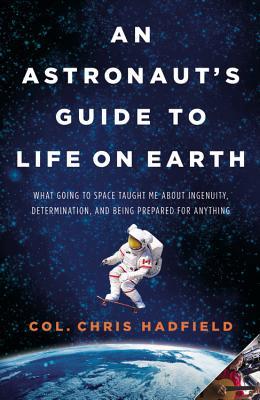
An Astronaut's Guide to Life on Earth - Colonel Chris Hadfield

An Astronaut's Guide to Life on EarthFor me, this book was much like its author: completely off my radar until this year, 2016, when it was suddenly everywhere. This is strange because the book is copyrighted to 2013, and Hadfield himself completed his last space mission (the one he became well-known for) in 2013 as well.  So why did this all suddenly come across my desk this year?  I have no idea.  And actually, I had no idea that the two (book and person) were connected until I Googled Hadfield and realized yes, I did know who this person was, though (again) I only became aware of him recently.  He's the guy who made all those space videos!  I would have figured this out if I'd just read the book, because he talks about making them, but it was nice knowing who was doing the talking as I went all the way through; it made it resonate more.

So, I picked this up because a few people had it posted on lists of self improvement books, and that's a category I needed to fill for my reading challenge and one that sounded utterly awful because self improvement books as a rule are.  While I don't think Hadfield intended this to be a self improvement book, I can definitely see why it's ended up being considered as one, in addition to being a cool autobiography and book about being an astronaut in general.  The reason that it's floated into the SI sphere seems to be this: Hadfield has a lot of advice to offer without actually seeming like he's offering it, and definitely without shoving it down your throat.  He's a very personable guy, someone I felt I could get along with even though we pretty much have nothing in common but speaking English.  He uses his own experiences in his career, both on his path to become an astronaut and while he was "deployed" as one, to exhibit little mindsets and behaviors that really anyone can use for trying to improve life.  He turns a lot of pithy little sayings on their heads; instead of "Don't sweat the small stuff," Hadfield thinks that you really should, at least in some situations, because those neglected little details can really come back around bite you later.  Planning ahead isn't worrying over nothing, it's planning so that you know what you'll do if different things (such as problems caused by those little details you neglected) arise later.  Striving to make zero impact gives you the opportunity to make a positive impact while also reducing the possibility that you'll make an ass of yourself trying to show off and make a positive one.

All of these little lessons are generally applicable to the population at large.  I didn't see anything in here that was astronaut-specific.  And that's the point, isn't it?  I mean, it's not much of a guide to life on earth if you're only giving out info that astronauts can use.  And all of these things are gently folded in among amusing, poignant, and sometimes heartbreaking stories about the joys, trials, and disasters that come with what is, really, an extremely dangerous occupation.  Most of us don't have to worry about seven of our friends being blown up when their car loses a piece of insulation, as happened with Hadfield's friends and coworkers when the Columbia exploded in 2003, but we can still take the lessons he's learned from various points in his life and career and apply them to our own.  It's also a rather quirky look at what being an astronaut is like, because most of us quite frankly have no idea, and I like that Hadfield was able to make it so much more real for the average person like me, who has absolutely zero chance of ever setting foot in space.

Overall, this was a fast, light read with some good stories and spot-on observations about life, and lessons that we can all learn from.  I would have liked to know a bit about the other space missions Hadfield went on, in addition to the one to the ISS--he only briefly mentions them--but the ISS one was the longest by far so I can see why the focus was there.

4 stars out of 5.

Monday, September 5, 2016

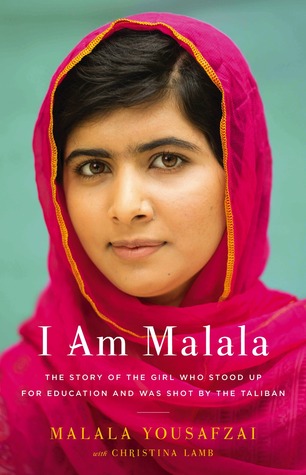
I Am Malala - Malala Yousafzai

I Am Malala: The Story of the Girl Who Stood Up for Education and Was Shot by the TalibanSo, let me show my uneducated American-ness for a second here.  I confess that, prior to Malala Yousafzai being shot, I had no idea who she was.  Even after she was shot I had no idea who she was, and I honestly had no idea why it was such a big deal.  Because, in my ignorance, I was under the impression that the Taliban was off shooting schoolgirls all the time.  This, apparently, was not the case.  Malala is a bit of a special instance, due to her advocacy for girls' education--though the Taliban insists that she was shot because she was going against Islam, not because of her stances on education.  Either way, her experiences were the reason I turned to this as my pick for a political memoir for my reading challenge this year.  I didn't really want to read about a run-of-the-mill politician, so Malala's memoir seemed like a good alternative.

Now, this didn't end up being as political as I had anticipated, as Malala basically recounts her entire life story up until the time she was shot, and a period of time afterwards when she was recovering.  It was written before she won the Nobel Peace Prize and before she became such a huge force in advocacy for education around the world.  Still, you can see the seeds of that in this, and definitely see her political origins in Swat, Pakistan, the valley where she grew up.  Her father was definitely a big influence on her, and she emphasizes again and again that no matter how much she admired her father and no matter how much he worked with her on her advocacy, it was still her decision to make her speeches and put herself out there.  She's definitely a strong young woman, and someone to be admired for her firm stance even in the face of being assaulted by the Taliban.

My issue with this was pretty much exactly the opposite of the issue I had with the last memoir I read, Climbing the Mango Trees.  In CtMT, I found that the writing was good, sometimes even beautiful, but the content just didn't interest me.  In I Am Malala, the content is amazing and inspiring, but the writing...well, it reads like a teenage girl wrote it.  Malala has a co-writer listed (Christina Lamb; the listing is unusual, but I like it) but I would definitely say that she was heavily involved in this book because of the way it reads.  It really does sound like a high school essay at many points.  Now, I completely understand that yes, Malala was still in school when she wrote it, but the downside of this authenticity of voice means that the writing oftentimes isn't very engaging.  The life she describes and her growth to an active advocate for education is fascinating, but the writing lends a certain distance to this that, at times, almost makes it read more like a Wikipedia article than a memoir.

Malala is an amazing young woman with an important cause, and I really admire her for that.  I'm glad that I read this, because it gave me a deeper understanding of where she came from and exactly why she's advocating for education--even before the Taliban became involved, she wanted everyone to be able to go to school.  The writing wasn't the most riveting I've ever seen, but I'm still very happy with this as a selection for my reading challenge.

3.5 stars out of 5.