Pages

Showing posts with label e. a. copen. Show all posts

Saturday, February 11, 2017

Chasing Ghosts - E. A. Copen (Judah Black #3)

Chasing Ghosts (Judah Black Novels Book 3)These Judah Black novels are some of my favorite paranormal fantasy ones right now.  They follow the eponymous Judah Black, a federal paranormal enforcement/regulatory/investigative agent who lives and works on the paranormal reservation of Paint Rock in Concho County, Texas.  She has a "real" job and a son, and now she even has a boyfriend--the werewolf Sal, who lives next door and is part of the local pack, and who Judah kissed in the last book, which I guess makes him her boyfriend even though they never actually discussed anything or went out and just kissed once during a fight?  I dunno, that seemed kind of strange--I love some romance in a book, but there seemed to be a leap here that didn't really connect properly.

Anyway.  this book picks up immediately after the last one.  Judah is told by local vampire higher-up Marcus Kelley to investigate a paranormal illness plaguing a toddler--said toddler being the daughter of wendigo Zoe, featured in the first book.  And it turns out that the little girl's father isn't another wendigo, as Judah had thought, but Sal--because Zoe is Sal's ex-wife.  Oh boy... She wants to tell Sal, but also doesn't, because it's kind of Judah's fault (a little) that this situation happened, and she's afraid that it'll drive him away.  Meanwhile, she also tries to balance her new relationship with Sal with his involvement in a biker club of questionable legality and with her son Hunter.

While Hunter was an integral part of the first book, he continues to be shoved aside in this one, constantly left with minor side characters or even stuck in a hospital room, unconscious.  Though Judah is a busy woman, it does rather feel like Copen didn't know what to do with a kid in this situation, so she just sidelined him.  How Hunter was actually a character in the first book was one of its big draws to me, so I'm extra disappointed to see the sidelining of the second book continued here.

The plot itself also wasn't as compelling to me.  Copen used this as a "relationship" book, and it felt like that came at the expense of a strong central plot, which doesn't have to be the case--you really can have both!  But the main plot and the "big bad" here seemed, for the most part, pretty apparent from the beginning.  There were a few minor surprises that popped up, but nothing that really made my jaw drop or made me re-examine other parts of the book.  It was more like, "Ah, yes," moments, than "Aha!" moments, if that makes any sense.  I did, however, like the integration of the spirit world and how Marcus and his family played into the plot here.  It made him much more "human," for a vampire, and also gave me a much better understanding of how vampires work in Copen's world.  So that was very well done.

Overall, I liked this, but not as much as the previous books.  I do think that, now that Copen's got some of the relationship stuff out of the way (I say relationship and not romance, because it's not really a romance at all) she might come back with a stronger focus and better balance in the next book.

3 stars out of 5.

Friday, August 5, 2016

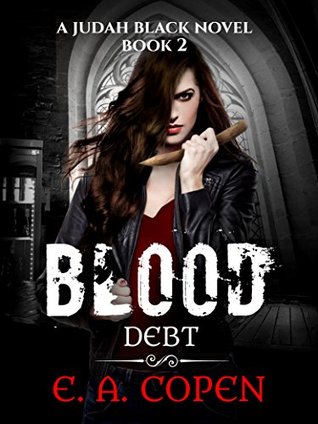
Blood Debt - E. A. Copen (Judah Black #2)

Blood Debt (Judah Black Novels Book 2)Blood Debt is the second Judah Black novel, following Guilty by Association, which I read back in May and loved.  GBA really reminded me of a Rachel Caine book, specifically one of the Weather Warden series, and that was the case here, too.  I think the writing styles are very similar, and Judah and Joanne (Caine's heroine) have a lot in common, too, in that they're both humans with special abilities, but whose abilities still don't even rate on the same scale as the things they're up against.  Now, Joanne is always getting turned into crazy things and so far that hasn't happened to Judah, but honestly, I think that's for the best, because it makes Judah's struggles seem all the more real.

BD starts about six months after GBA.  In that time, Judah has had to deal with a slew of illegal fae immigrants, several of whom have gone missing, and has also picked up a mentee through a new program the BSI is piloting to mentor young folks with special abilities.  Judah's mentee is Mara, a college girl with rainbow hair and an attitude problem that probably relates strongly to how her parents treated their gifted daughter.  And when this book starts, Judah has just landed another problem: a double-murder with some definite supernatural signs about it, and it's connected to a very powerful clan of vampires.  If Judah wants to avoid a blood debt-related slaughter, she needs to catch the murderer, fast.  But dead bodies are coming back to life and the BSI isn't happy with her.  In fact, they're sending down someone to pull her back into line.  Meanwhile, things with Sal are getting a little tense, and Hunter still hasn't been admitted to Paint Rock's werewolf pack, something that's clearly imperative if he's going to become someone even relatively well-adjusted.

I think this was a worthy follow-up to GBA; second books are often duds, and I don't think that was the case here.  That said, I also don't think it was quite as strong as GBA, for a few reasons.  First, Hunter has been totally sidelined, very much making him into a prop more than an important character.  I totally get that Judah has a busy, important job, but the first book managed to integrate Hunter into that while she still performed admirably.  Second, the creepy factor is mostly missing from this book.  In the first book, we didn't know what the monster was for much of the book.  There were some hints, and I did zero in on it earlier than it was actually said, but the big bad here is made very evident pretty early on.  What's not immediately clear is who, or what, is controlling it.  I think that Copen did a pretty good job concealing that, and when the information comes out, it's both surprising and makes a lot of sense.  Second, I had a few conceptions trailing over from the first book that I thought would be picked up in this one, but weren't.  The one that immediately comes to mind is Patsy, who was (I believe) the head of the vampire coven in Paint Rock.  When I saw this book was going to more strongly incorporate vamps, I thought Patsy and her peeps would definitely play more of a part, and yet the Paint Rock vampires weren't brought into the story at all.

Things that I did like: I liked Mara.  I think she was a well-developed character given her background, and while I can't say that she featured prominently in this book, I think she was well-integrated.  She kind of ends up as a damsel in distress who doesn't want to be, but she's still not a weak character, and Copen makes that abundantly clear.  I think that's a difficult line to toe, but Copen did it with aplomb.  I liked Sal.  I was disappointed in the relative lack of Sal, to be sure, but he remained awesome, and I liked how Copen added more dimension to his character in the later part of the book, with how Sal balances the stresses of pack life with having, well, a life of his own.  Chanter remained awesome, too, and I'll be sad to see him go when the time comes.  And I liked how Copen is building some sort of menace in the background.  The end of the book tied up a little too neatly for my tastes, but I'm hoping that's because it's going to lead to greater drama and consequences in the books to come.  The fae are also integrated a little more here, and I want to believe that that's going to tie in again, too, but after Patsy and the Paint Rock vampires didn't feature at all in a book that revolved heavily around vamps, I honestly can't be sure.

Finally, I like how Copen has continued to integrate different, unusual magical creatures into her works.  I love books about the plain ol' Seelie and Unseelie fae, who look mostly human but are badass; Holly Black's Tithe books are some of my favorites in this category.  But after a wendigo in the first book and now some spreading into Norse mythology in this one, and not in a Thor direction, I'm glad that Copen's trend of pulling from more obscure mythological lines has carried through to this volume, and that's something that I definitely hope to see more of in the future.

And then there's Sal and Judah.  Hmmmm....

Overall, I think this was a strong follow-up, but honestly not quite as good as the first.  If writing patterns are to be believed, though, I expect Copen to come back stronger than ever in the third book, and I'm honestly super pleased that the second book wasn't a total flop, as second books so often and tragically are.

3.5 stars out of 5.

Friday, May 6, 2016

Guilty By Association - E. A. Copen (Judah Black #1)

Guilty by Association (Judah Black, #1)
This book brought me fond memories of my teenage years watching Charmed, which was my favorite show in all the world.  Why is this?  Because one of the characters fairly early on talks about a wendigo!  Dedicated Charmed watches will remember that in Season 1, Piper got turned into a wendigo (because the sisters were always getting turned into some sort of magical creature) and then there was the original wendigo running around and the other sisters didn't know which was which and they had to shoot the real one in the heart with a flare gun to kill it, which, let's face it, was pretty bad-ass.  Piper, of course, escaped the chilling fate of being stuck as a wendigo forever because she hadn't yet eaten someone, or something like that.  It's been a while, and so I don't remember the specifics, but trust me, I remember that "wendigo getting shot with a flare gun" thing like it was yesterday.  In fact, I think after this review I'm going to go watch some Charmed for old times' sake.

Anyway.  Guilty by Association is E. A. Copen's first book and also the first in a series focusing on a paranormal regulatory/investigative agent named Judah in a world where supernatural creatures are out in the open.  She works for a government agency called the BSI, and I do not remember what that stands for, but they handle all issues relating to vampires, werewolves, and fae, and probably some other creatures we haven't encountered yet.  Judah is also a code name, hinting that name magic is something to be taken seriously in this world.  Anyway, Judah has just moved to Paint Rock, Texas with her eleven-year-old son, Hunter, after something went down in their old home in Cleveland to get her reassigned.  Paint Rock was once a normal town but was emptied of most of its human inhabitants and turned into a reservation for the area's paranormals, including a vampire coven, a werewolf pack, and a handful of fae.  The book opens with Judah discovering a dead werewolf in the laundromat, and it gets crazier from there as she tries to solve both the murder and what appears to be a connected series of kidnappings.

This was a great book.  In style and general feel, the thing it reminds me of most is Rachel Caine's Weather Warden series.  I'm not sure why this is, precisely, because the two aren't actually very similar in content at all other than that they're paranormal fantasies.  Maybe it's the writing style?  I've always found Caine's writing style to be very engaging, and that was definitely the case here.  All of Copen's characters were fully fleshed-out and served their purpose without seeming superfluous.  The most superfluous one I can think of was Patsy, but I suspect she'll be a bigger player in future books.  (I do hope there will be future books.)  At first, I really didn't like that Judah had a kid because 1) I do not like children and 2) The last book I read that heavily featured a child of the main character featured long and detailed descriptions of the child-friendly playlists they listened to and then ended in a ridiculous kidnapping plot.  That didn't happen here.  I think Hunter fit very well into the story, and his background and character development lend themselves heavily to the plot as a whole.  That was great; it's so annoying when children are featured as characters just as "wallpaper" for the sake of them being there, without them actually having any impact on the story.  Hunter had impact, and that makes him A-okay in my book!

The world building here was also well-done, though a little confusing when I think about it a bit more in depth.  The basic story is that vampires came "out of the coffin" to steal a Sookie Stackhouse phrase, and they dragged the werewolves and fae out with them in order to help share the heat.  That made sense.  What also made a lot of sense to me was the rampant discrimination against these "new" types of being.  Having them being forced out of their regular homes and onto a reservation was a very clear comparison to historical discrimination seen in the United States and I thought the point was very clearly made, though occasionally handled with some well-deserved lightheartedness, like when one character mentions that the cops manning the checkpoints between the reservation and the outside world are racist and another goes "Against werewolves or Indians?" or something like that.  What was a little more confusing was the way humans with magic are treated.  Judah has some magic, though not a lot, and it's implied that some humans have a lot more.  (Does Father Reed fall into this category or not?  He would seem to, but I have a suspicion that he's not actually human... Hm...)  But these humans, despite their supernatural abilities, don't seem to face any discrimination at all.  Judah faces a little bit of jibing when she first breaks out her abilities, but after that no one questions or avoids her due to them.  I wonder why humans with magic weren't lumped into a different sort of "other" group and also persecuted, though maybe not to the extent that the beings who very obviously are not human were.

I'll tell you what I missed in this book: a romantic subplot.  I know, I know, I am not obligated one, but I think it's the whole "this reminded me of Rachel Caine" thing that had me looking for one around every corner, because romance features pretty heavily in her books.  Did this book need a romantic subplot?  No.  Judah is a strong independent woman who don't need no man.  I can see where a romantic plotline, had there been one, could have been seen as pandering.  (But then, I like being pandered to.)  Did this suffer for not having a romance?  No... But come on, Sal was so awesome, how could you not be hoping they would hook up the entire time?  Granted, that might have made the whole episode in the Ways a little weirder, but still.  I wanted it.

This is getting a bit long, so I'll wrap it up with this: overall, this was a great book, and I would definitely read the next one.  I think Judah and the other inhabitants of Paint Rock have a lot of potential, and that there's probably some "big bad" brewing in the middle distance for them to face, if the end was any indication.  It's one of those books that wraps up all the plot points and has closure, but still leaves plenty of room for more.  Was it one of my absolute favorite books that I'll reach for over and over and over again?  Probably not; those books are few and far between.  But I would recommend it to anyone who likes a good, developed paranormal fantasy with a strong female character as the lead.

Also, I received a free copy of this book in return for an honest review--but I liked it so much I went out and bought a copy afterward, so that probably speaks for itself!

A solid 4 stars out of 5.