Pages

Showing posts with label jeffrey cook. Show all posts

Friday, June 3, 2016

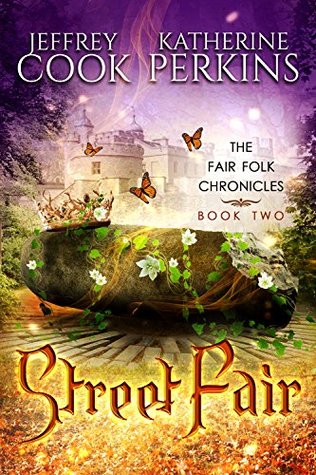
Street Fair - Jeffrey Cook and Katherine Perkins (Fair Folk Chronicles #2)

Street Fair (Fair Folk Chronicles, #2)Street Fair is the second book in Jeffrey Cook and Katherine Perkins' Fair Folk Chronicles.  It follows Megan, a teenager who has recently discovered that she's a half-faerie princess, and her friends as the Goblin Market comes to town, and brings with it a host of unforeseen trouble that deals with Gaelic mythology, particularly that of Balor and the Fomoiri.

I had some difficulty with the first of the Fair Folk Chronicles because it really made faeries much more sugary-sweet than they are traditionally said to be.  That's still the case here; despite a bit of a bloodthirsty toast at one point, even the Unseelie court is kind of like a bunch of teenagers who just like to hang around and play pranks on each other rather than be menacing in any meaninful way.  The Seelie court is basically all sweetness and light.  Ashling the pixie continues to annoy me beyond all reason.  However, the story as a whole appealed to me and agreed with me much more, and that's because of the topic.  The integration of the Fomoiri and Balor really hit a sweet spot for me, and I can tell you exactly why: because I associate it with Diane Duane's Young Wizards series, and specifically the fourth book, A Wizard Abroad, which deals with the same subject though in a different way.  That actually really helped re-orient myself regarding how to look at this book.  Until that topic started to come in, I was looking at the Fair Folk books as young adult books, but they're really not.  I can't remember exactly how old the main characters are (though Lani can drive, so they must be about sixteen), but in writing and subject, these books are much more middle-grade than young adult.  There is very light kissing, but also a lot of parental supervision and the whole thing is very clean, which is really more characteristic of the middle-grade than the young-adult age group these days.  The same goes for the Young Wizards books.

As for the book itself... This is obviously much more of a "series" book than the first one is.  It has a plot of its own, albeit one that involves a lot of running around and not actually doing a much, The integration of these parts of Gaelic mythology are pretty cool, and I think it would be a good way to get younger readers interested in such topics.  But it also sets up for a continuance, which the first book in the series didn't.  Book 3 (A Fair Fight) will clearly deal with the set-up from here, and I'm curious to see if the fourth book (All's Fair) will continue on from Book 3 or if it will be more of a standalone story like the the first volume was.  Seeing Megan gain some more control of her abilities, and realize some of the repercussions of dealing with faeries, was pretty neat.  At the same time, though, much of the book did end up reading like set-up for the next one.  Some of the elements also didn't seem to fit for me.  For example, the main villain is known as the Butterfly Collector to the main characters, and apparently is the person who was behind the ruination of Ashling's wings.  But he doesn't seem to have done this more than once; now, I'm not saying that it's not bad to have only done it once, because clearly it was, but why Collector?  That indicates multiple times.  Was this something that was brought up in Book 1 but that I forgot?  If so, disregard, but it was a bit discordant to me.  Also, as I mentioned before, the plot seems to involve a lot of running around and fight scenes, but very little of that actually advanced the plot.  It was more filler until the higher-ups decided to do something--and most of it was incredibly stupid of the characters to do in the first place, something that they acknowledged but then proceeded on with anyway because "there weren't other options" even though there really were.

I'm interested to see where the next book here goes; there are definitely indications that all chaos is about to break loose.  Now that I've been able to re-orient my view of these books, they do agree with me more, and I think these would be good options for middle-grade students interested in mythology-based fantasy--but I would not go so far as to put them as young adult, given that the heavier themes characteristic of young adult books are pretty much entirely absent in this series.

3.5 stars out of 5.

Thursday, September 10, 2015

Foul is Fair - Jeffrey Cook and Katherine Perkins (Fair Folk Chronicles #1)

Foul is Fair (Fair Folk Chronicles Book 1)Guys, I believe that I'm actually legally obliged to say this: I received a free copy of this book in exchange for an honest review.  (How exciting is that?  No one's ever given me something to review before!)

Now that that's out of the way, let's begin.  Foul is Fair is a book about a high school student with ADHD (or some variant) who quickly turns out to be a faerie princess and needs to rescue her father the Unseelie King before the seasons change on Halloween.  If she doesn't, everything is going to go very, very wrong in Faerie and on Earth.  And so Megan (our heroine) sets off with her friend Lani (who is a half-faerie, just like Megan is; both have faerie fathers and human mothers), the pixie Ashling, and the crow Count to rescue her father and save two worlds.

Now, let me get one thing straight right away: Megan's family are not "bad guys."  The description of the book says that "if Megan's getting the terminology straight, it sounds like her family aren't even supposed to be the good guys."  Whether Megan's family is actually bad is never really a serious question to be considered, because as soon as it comes up, it's easily put to rest.  Megan's family is not bad.  Faeries are not bad in general, just different.  That one kind of rubbed me the wrong way, a little, because faeries traditionally come in two varieties, and those are evil and more evil.  Well "evil" might be the wrong word.  "Chaotic" might be more on point, and that faeries love chaos is brought up here (and the definitions do eventually get a little more complicated).  But when it's hinted that the heroine might be more of an antiheroine...well, that's what I expect.  Megan's not an antiheroine.  She's much too "sweetness and light" for that.  It didn't make me dislike her, or lower her in my esteem, but it did leave me feeling rather lackluster towards her.  There's a reason for this, and that reason is one word: Tithe.  Tithe is a book by Holly Black about a girl who turns out to be a changeling faerie and quickly becomes entangled in faerie politics.  That heroine, Kaye, is much more ambiguous in her morals and actions and I think that makes her a more compelling character than Megan.  There are a lot of similarities between Tithe and Foul is Fair, and the main thing that came to my mind, again and again, while reading FiF was that it's Tithe, but meant for a younger audience.  You see, Tithe is marketed at young adults, but I think it really reads more as a new adult fantasy, or maybe even a light adult one.  Foul is Fair shares many of the same central plot points but has younger, lighter main characters and adds in a quest for good measure--and lacks the romantic subplot, too.  Again, this isn't a bad thing, but it means that if you've read other books in the genre, Foul is Fair is going to come off as very, very similar.  I think that's just a problem with the genre, not necessarily with the writing.  If you're going to write faeries, you're (generally) going to have to stick to certain tropes, or people will cry foul that you're "not doing it right."  (Hahaha.  Cry foul.  Like the title.  Get it?  I'm so funny.)  It also has this weird humor element that was also present in Eternal Vows, which made it sometimes feel like a parody more than a serious story.

One thing I did really like about this was that the authors (Are they both authors?  I'm not actually sure.  Books with more than one name on the cover confuse me.) include supernatural mythologies that aren't necessarily British or Irish.  Lani, for example, is a half-menehune, which I gather is a type of Hawaiian supernatural being that really likes to build things.  Mythologies like gods and titans are also tied in, though they aren't present; they're explained as being "sealed away," though how faeries bested gods I'm not really sure.  That was a bit unclear.  But it does work to explain why some "supernatural" things are present and others aren't: in this world, they're all real, they're just not all there.  And of course, trying to include everything would have probably just resulted in a hot mess.

I'm also probably a weird person, because my favorite character in this wasn't even a main character and was definitely a bad character--as bad you can get in this one, at least.  Peadar.  Peadar is a redcap.  He, at one point, tries to kill Megan.  He'd probably like to kill Megan (and company) at other points, too.  I loved him.  Not because I wanted him to kill Megan, but because he came off as the most faerie-like faerie in the whole book to me.  H'es not evil, per say, but what he's built to do is not what we humans would define as good.  He's willing to work with others, for the right price, but there's a general menace about him that I absolutely loved.  I wish he'd had more page time or that other characters had the same lurking menace about them.  That's what I look for when humans (or even partial humans, or faeries who didn't know they were faeries) get involved with faeries, because those intruders are so terribly, terribly out of their league.  With Megan and company, everything just seemed very...easy.  I mean, objectively it's not easy to get an enchanted sword from a bunch of iron golems, but it still seemed easy.  They got a little beat up, sure.  Someone dislocated an arm at one point.  Another person got slashed by a golem and another got burned by iron.  But it still had the feeling of it being easier than it should have been.  Again, maybe this is just because of the age group the book is aimed at.  Maybe I'm too old for these types of stories now.  But everyone they encountered seemed to want to help in one way or another, at some point in time.  Some of these people had ulterior motives, but none of them were really that menacing, and we never really had to fear that things wouldn't turn out right.

So, what did I think overall?  I liked it.  It was a light read, a fast one (it only clocked about three hours total, though I split that up over several sessions due to other stuff going on) and it was well-written, without a lot of glaring mistakes or plot holes.  But it did lack the dark edge that I absolutely crave in faerie stories, and everything came across as just a little bit too easy to me.  I will reiterate: this may be because I'm not in the target audience.  This comes across as a book aimed at the younger end of the young adult spectrum, and I don't quite fit there anymore.  So yes, it was good.  Terribly memorable to me?  Not really.  If I was going to pick up something like this again, I'd probably reach for Tithe before this one.  But it certainly wasn't bad.

A solid 3 stars--with a note that Cook also authors a steampunk series, which might be more up my alley.  I have the first book of that, and am looking forward to it.