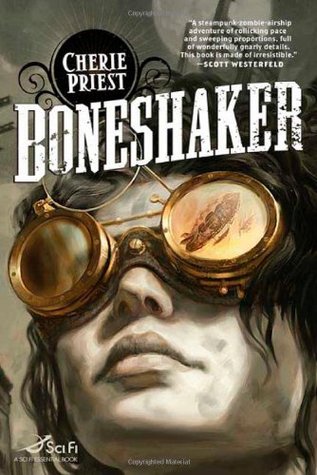
 Boneshaker is a book that I both bought a while ago and never had any real inclination to read. I think I read it after a couple of drinks at the local bookstore/cafe/bar, and then shelved it and only looked at it with mild curiosity from time to time. This is for one big reason. While Boneshaker is, quite obviously from the cover, a steampunk novel, it is also about zombies. And zombies are not really my thing. They don't scare me, they don't thrill me, I don't find them really interesting at all. There's something mildly distasteful about fiction that revels in chopping to pieces and blowing the heads off people who were once, you know, people.
But there as a steampunk category for my 2017 reading challenge, and Boneshaker was already sitting there, so off the shelf it came.
Boneshaker is different from most other zombie novels that are on my radar in that it isn't a modern zombie fiction. Most zombie works are set in our modern world, or possibly in a near-future post-apocalyptic world. The notable exception to this is probably Pride and Prejudice and Zombies, but that's not quite the same as this because P&P&Z is a parody rather than a "serious" work. Boneshaker is set in an alternate-universe 1880 in Seattle, Washington. In this universe, airships and steam engines rule, the American Civil War has been going on for eighteen years, and an early Klondike gold rush spurred a contest to create a mining machine that could bore through ice and rock. The creator of the marvelous machine, Leviticus Blue, built it in his basement...but when he fired it up, chaos reigned. The machine destroyed much of downtown Seattle, including several banks that were subsequently robbed, and broke open a seam of mysterious gas called the Blight, which kills some and does more than kill others, bringing them back to life as "rotters" with an appetite for human flesh. In an attempt to stop the Blight, Seattle was walled off and the survivors began living in an area built up around the wall, struggling to survive in an area which, while separated from the Blight, is still tainted by it.
In the midst of this we find our heroine, thirty-five-year-old Briar Wilkes. The widow of Leviticus Blue and the daughter of Maynard Wilkes, who's either a criminal or a folk hero depending on who you ask, Briar spends most of her time avoiding her past while doing her best to bring up her fifteen-year-old son, Zeke. She's never told Zeke much about his father and grandfather, and so he gets it into his head that his father was innocent in the downfall of Seattle...and so he sets off to go into the walled city and find proof. Briar of course goes after him, and they're separately plunged into a city inhabited by zombies and those too crazy or stubborn to leave, who've started new lives in pockets of clean air cut out underground, and ruled by a mysterious man in a gas mask who bears a striking resemblance in knowledge and mannerisms to Levi Blue, who some suspect may not be as dead as they would hope.
Surprisingly, zombies don't actually play that much of a role in this book, which is something I rather liked. They're more of an atmospheric threat, and aside from a few scenes of the protagonists fleeing from zombie grasps, they're present more through moans and gasps and the sound of running feet than as creatures that actually get a lot of page time. Most of the book is actually spent in the underground spaces of Seattle, showing how the inhabitants there survive and building up a sort of historical post-apocalyptic culture in a time when other parts of the world are just fine. There are apparently some historical inaccuracies that Priest addresses in a brief afterword, regarding the structure of the city itself, but these didn't bother me at all because I really do view this as an alternative universe, in which things can run at a different speed than in our own history--which is basically just as Priest intended. But maybe if I'd lived in Seattle and was more familiar with its landmarks and their histories, these inconsistencies would have bothered me more.
I liked pretty much all of the characters in this book. They all inhabit some morally gray areas, necessitated by the time and place in which they live, but the heroes still have moral compasses and it's easy to see how the "villains" got to where they are, without them becoming caricatures of villains. Zeke is a frustrating teenager without being a total idiot, something that was refreshing to read. And while Briar hasn't always mad the best decisions in raising him, she definitely did the best she could and what she thought was right at the time. She doesn't berate Zeke for his decisions, instead focusing on what needs to be done to get them both out while putting his doubts to rest so that he doesn't make the same mistakes in the future. I had my suspicions about Levi Blue from the beginning, which ended up being spot-on, but Priest had me me second-guessing and doubting myself, which is a real skill. So the ending didn't shock me, but I liked how it came out nonetheless.
What I didn't like was that the end was startling lacking in, well, ending. It's possible it's because this is the first book in a series, but I've looked at the descriptions of the next few, and they feature different main characters and plot lines. Which is fine--I actually prefer series like that--but it means that there's no resolution to the Blight threat, no plan for what to do about Seattle, etc. Maybe it comes back later? I don't know, but even if it does, it seems like a big thing to just apparently drop for several books with no hint of how it's going to be resolved. There's also no hint of how the zombies become zombies in the first place. Yes, it's the Blight, which is caused by a gas that comes up from the ground, and it may or may not be caused by buildup from Mount Rainier... But how does it work?
Still, overall I really liked this. It was different, and while zombies aren't my typical genre, I think they were well-incorporated here...though I'm curious to see what type of logic is going to employed in regards to the actual zombie formation in the first place, if it ever comes back. The next couple of books have different main characters in different locations with apparently unconnected plots in the same universe, but I'm looking forward to them nonetheless.
4 stars out of 5.

