Pages

Showing posts with label an ember in the ashes. Show all posts

Friday, January 13, 2017

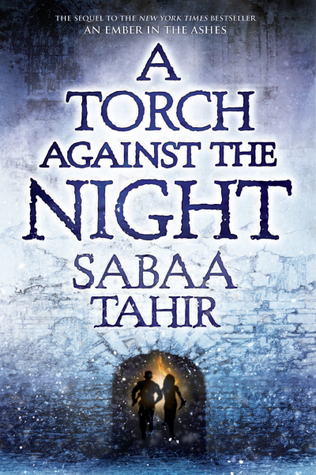
A Torch Against the Night - Sabaa Tahir (An Ember in the Ashes #2)

A Torch Against the Night (An Ember in the Ashes, #2)This was the last book I finished in 2016!  It came in through the library just in time for me to breeze through it.

The book picks up right where An Ember in the Ashes left off, with Elias and Laia fleeing Serra.  They are on a mission to get to the prison of Kauf and free Laia's brother, who knows the mysteries of Serric steel that could held the repressed races and classes of the Martial Empire throw off their oppressors.  Meanwhile, Helen, as the new Emperor's Blood Shrike, is put in charge of the Black Guard and ordered to hunt Elias down for public execution, or her family will pay the price.

I don't think that this book was quite as breathtaking as its predecessor, though it doesn't quite fall prey to Second Book Syndrome.  A lot of this is because Elias and Laia, despite starting the book together, end up separated for a large portion of it, and so the chemistry between them that is so intriguing is, obviously, not there, because they're not together.

What I really did like here was the way that Keenan's reintroduction was handled.  His plot is developed and his role in the Elias-Laia-Keenan love triangle is made so that it's not just a love triangle for a love triangle's sake; there's actually a compelling plot point behind it, which I absolutely adore.  It's so refreshing to see a love triangle that exists for a reason other than "Oh no I don't know which drooling boy to chooooooose!!!!"  This was something that really bothered me for a lot of the book, but how it was tied up really made up for it and showed that Tahir has a firm grasp of what's going on with that particular story thread.  I also liked Helen's plot.  While I hated that her chapters tore me away from Elias and Laia, the way she struggles with her choices and lack thereof is very real, and I appreciate that.  And the way the Soul Catcher plotline is integrated--at first, I had no idea where it was going and couldn't see the point, and was in agony over wanting Tahir to just move on.  But in the end, I did like where it went, though I'm unsure of how it will make the third book in the series really possible.

Still, the strange time jumps continued in this book.  We'd have a few chapters with Laia and Elias, and then there would be a "Two Weeks Earlier" sort of chapter with Helene.  The notations of time changes are helpful, but they still disrupt the flow of the story overall.  I also would have liked to see more of Helene's family.  Ultimately, despite the peril they face, it's a bit hard to feel much for them because we just don't know that much about them.  Even Livvy, her nicer sister, isn't truly seen enough to be a catalyst in our emotions, though she clearly is a focal point for Helen's own feelings.  Finally, while I liked the inclusion of the Soul Catcher's story line because I love that sort of trope (escorts to the other side FTW, people literally tied to their jobs FTW, disgraced spirits trying to make amends FTW) it did feel sort of senseless for much of the book.  The obvious path with Elias' injury was not taken, and while that's nice in one way, it also would have been nice for it to take that route--it would have been neat and tidy and tied Helene even more closely to Elias' cause while forcing her to still be Blood Shrike.  I liked it but I still wonder what on earth Tahir is planning on doing with it, and I'm not totally convinced it will work for future books.

So, yes, I liked it!  But some of the issues from the first book persisted here, some of the magical chemistry between Laia and Elias was lost due to their separation, and while I liked the things Tahir introduced as their own elements, I'm not convinced they fit properly into the story as a whole.  I guess we'll have to see when the other books eventually come out.

3.5 stars out of 5.

Friday, March 18, 2016

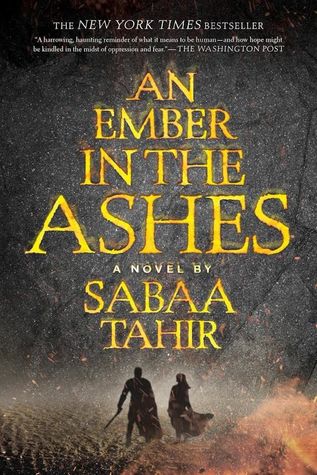
An Ember in the Ashes - Sabaa Tahir (An Ember in the Ashes #1)

An Ember in the Ashes (An Ember in the Ashes, #1)Laia wakes one night to find her brother sneaking in with a sketchbook full of pictures of Martial weapons--which Scholars like them are forbidden to know of.  Minutes later, the Martials show up and kill Laia's grandparents and take her brother prisoner; Laia runs for her life, hoping to find the Scholar Resistance and convince them to free her brother from the Martial prison on the basis that it was resistance members who sold him out, and that they are the children of the Lioness, the resistance's former leader.  Meanwhile Elias, a Martial training to be a Mask, one of the Martial Empire's fiercest warriors, plans to desert his post the day after his graduation from the hellish school known as Blackcliff, where his mother reigns supreme as Commandant and seems to want to kill him, along with pretty much everyone else.  But Elias' plans are shattered when the Augurs, immortal "people" with magic that can read minds and tell the future, proclaim that they are going to select the next Emperor from among four of the newest graduates--and that one of the four is Elias.  Trapped in the Trials, he can't escape if he wants to live, but by staying he risks becoming everything he hates.  And when Laia is sent to Blackcliff to spy on the Commandant for the resistance, their lives start to intersect and intertwine, and they might just be able to bring down the forces aligned against them.

I really liked this book.  I liked both Laia and Elias as main characters and narrators, and I liked the setting that Tahir lay out.  I guess I can see the "ancient Rome" influence that the blurb totes, but it's not really a strong influence.  The fighters in this aren't slaves locked to arena combat, and the arena-style combat that happens isn't really like gladiator combat at all.  This has stronger influences of the Middle East, with creatures like jinn and efrits that lurk in the shadows and come calling at the most inopportune times.  There are a lot of "school" fantasies out there, but this one doesn't follow the normal route of them in that this school is one that the students, and pretty much everyone else, are desperate to escape.  The book also brings up issues like racism, and how Scholars are considered inferior by the Martials, confined to one quarter of the city (like a ghetto), enslaved, and sexually assaulted without most people actually caring about it.  There's also a lot of violence in this book (I'd say it's definitely not for sensitive readers) and considerations of what that violence means, and what it can turn people into, and how good people can also be bad people in different circumstances, and so on.

This isn't high fantasy; the fantasy element does get more pronounced as the story goes on, with the appearance of Augurs, supernatural creatures, and unusual abilities, but the emphasis is on the gritty elements of death and survival rather than on the fantastical ones.  The main characters, for example, don't possess any unusual abilities (at least not yet) and instead have to use their wits, strength, and relationships in order to pull themselves through.  There's a sense that not everyone is who they present themselves as, and the "chosen ones," though that term is never really used, might in fact not be so chosen.  I think there are a lot of interesting dynamics swirling around in the background here, and they come together to make a well-woven story--for the most part.

There are, of course, some flaws.  Tahir seems focused on having not a love triangle, but a love quadrangle, or possibly a love pentagon, which are most definitely even worse than the triangles.  There are some logic flaws, such as why would Blackcliff leave a trail leading directly into the school unguarded, even if it is annoying to use, when they guard every other entrance?  And the trail can't be that annoying to use because two teenage girls use it several times without too much difficultly.  What was up with Laia in that chapter after the third trial?  Why was she even there?  I don't know why the Augers would have done that.  And the timelines can be difficult to follow, too; the chapters jump back and forth between Laia and Elias narrating, but that means that sometimes more time passes in one than in the other, and the narrative has to jump backward in order to catch up instead of just progressing.  I found myself going, "Wait, what's going on with Elias/Laia at this point?" several times because the chapters don't line up as neatly as they should; having a few in a row from one narrator or the other wouldn't have hurt the book at all, and would have made it easier to follow.

Still, the flaws don't detract that much from the overall reading experience, and overall this a great book.  I'm definitely looking forward to reading the sequel.

4 stars out of 5.