Pages

Showing posts with label medieval. Show all posts

Friday, April 27, 2018

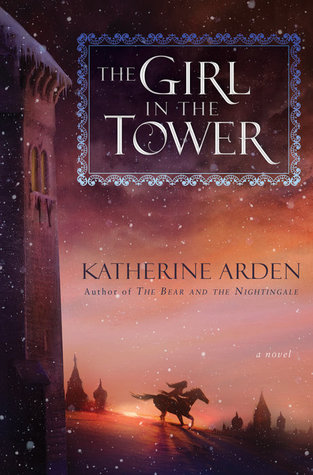
The Girl in the Tower - Katherine Arden (The Winternight Trilogy #2)

The Girl in the Tower (Winternight Trilogy, #2)Oh second books.  They're a bear--and just when you thought that Vasya had defeated the bear.  I was excited about this book, as I adored The Bear and the Nightingale, and this volume promised us adventure for Vasya, moving out into the world beyond her small village and a step into full adulthood, and maybe even more glimpses of the tantalizing frost demon Morozko.

Unfortunately, I didn't feel that this was quite as strong of a book as the first one.  There are some strong elements to it, certainly--we get to see more of the siblings that were rarely glimpsed in the the first book, as Olga and Sasha left fairly early on in the first volume.  Vasya does get to see the world, and learns a little bit in the process, though perhaps after her ordeals in the first book she shouldn't have been quite as naive when she went out into the wide world beyond.  And we get to watch the development of Morozko's feelings towards Vasya, feelings that he is not supposed to have, though this remains a minor element and is not nearly as played up as I would have liked to have seen.  (Please, someone, tell me there is a robust fanfiction community for this series somewhere, because this is a series that could spawn some amazing fanfics.)  However, Vasya's naivete, constant need of rescue, and headstrong ways are getting old, and they're getting old fast.  Despite literally everyone telling her that she is making a mistake kin the way she goes about things in this book, she does whatever she wants anyway, because no one understands her, clearly.  Not even when the answer is staring her right in the face.  Again, one would think she'd learned something from her first paranormal go-round, but no.  Of course not.

Vasya has reason to be frustrated and to strain against confines, of course.  Women don't exactly have the best lot in life in medieval Russia.  If Vasya is discovered to be a girl rather than the boy she travels as, she could be raped and murdered at worst, or confined to a tower for all her days at best, as her sister is.  Vasya does not want to spend her days in a tower; she wants adventure.  However, if she wants adventure, perhaps she should have listened to a number of people who told her that parading about Moscow barely disguised as a boy was not the way to go about it, and was in fact probably the best way to be caught out and open a whole kettle of fish that could mean death for, oh, her entire family.  Additionally, beyond Vasya parading around as a boy, having smug conversations with her horse, and making herself out to be the best thing before sliced bread, nothing really happens here until the last fifteen percent of the book.  The writing is lovely, but without character growth or compelling action to move the story along, it's just not enough to make this a strong book on its own.  The wonderful atmosphere and magic of the first volume were largely gone, both literally and figuratively, and they left a weaker book in their wake.

This was decidedly a second book, and it suffers from Second Book Syndrome.  I still have high hopes for the third volume, The Winter of the Witch, due out later this year--but while The Bear and the Nightingale will be listed in my favorite reads, The Girl in the Tower most certainly will not.

2.5 stars out of 5.

Wednesday, July 26, 2017

Born in Sin - Kinley MacGregor (Brotherhood of the Sword #3/MacAllister #2)

Born in Sin (Brotherhood of the Sword #3/MacAllister, #2)Born in Sin was my pick for the Unapologetic Romance Readers' 2017 Reading Challenge, specifically for the category of "a medieval romance."  I'd originally slated another one for this category, but my library removed it from the digital lending collection before I could get to it.  Luckily, they added Born in Sin instead.

This takes place in the twelfth century, firmly medieval.  Our characters are Sin, a knight serving Henry Plantagenet who was enslaved by the Saracens during Crusades and ended up serving Henry instead of assassinating him, and Callie, a Scottish noblewoman who's being held hostage by the English in hopes that the raids being executed against the English by the Scots will cease.  Callie is also accompanied by her younger half-brother, Jaime.

This was interesting for a Scottish/Highlander romance because it's the heroine who's Scottish; typically in these, it seems to be the English rose falling for the big burly Highlander.  Not so here.  But that doesn't meant that Sin is a wilting English man.  No no no.  In fact, he's a huge knight who has never been defeated in battle, who always goes around dressed in black armor (my, that must be remarkably uncomfortable all the time) and who has tinted his black clothes with red dye so that his opponents won't know when they've injured him in battle.  Because of course that's what one does.  Henry wants to marry Sin to Callie to cement relations between the English and the Scots, which Sin doesn't want because he's no good for her, blah blah blah. But of course they eventually get married and then off to Scotland they go.

This is a pretty simple romance and the medieval setting is more window dressings than anything else.  Callie doesn't act anything like a medieval woman; she's very much of the stereotypical redhead school of foot stamping and hair tossing and going her own way, though she hasn't been characterized with the "fiery redhead" persona, which was a nice change.  In fact, despite her determination, she's very sweet and kind, which was really a revelation.  That's not how most romance heroine are characterized because it's quite easy to go from sweet and kind to downright boring.  Now, was Callie the most intriguing of characters?  No...but then, no one in this book was really super-riveting, so I can't blame her more than I can blame any of the other folk decorating these pages.

My biggest complaint here is that I had a really hard time keeping track of Sin's tangled relations with everyone else in the story.  (Also, his name is Sin?  Really?)  This is probably partially because this is the third book in a series, but I don't really think so; Sin seems to be a new character on the scene, he doesn't have the feel of someone who had been introduced before.  But he seems to be related either literally or figuratively to half the people in the book, and keeping those relations straight was a real doozy.  I think I finally got it figured out towards the end, but it involved a big infodump on MacGregor's part to get me to that point, so that's not exactly excellent.  I like the idea of all the ties--it puts forth the potential for future webs of books, which is something I really like.  But the execution wasn't as well-done as it could have been.

Overall, this was a fine book.  It was kind of cheesy in several ways and the historical setting was more wallpaper than anything else, as all of the characters blatantly flaunted any social conventions that would have accompanied a proper setting of the story.  This happens a lot in medieval-setting books, it seems; while it of course occurs in other time periods as well, it just doesn't seem as egregious in a Regency or Victorian setting as it does here, maybe because those times are just the slightest bit closer to our social norms.  Sin's brothers do intrigue me as characters, so I might investigate their books, but I'm not sure this is a series that I'll really dig into.

3 stars out of 5.