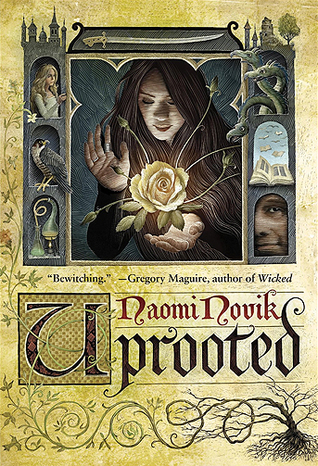
It recently came across my radar that Naomi Novik, of the breaktaking Uprooted, would be putting out a book later this year called Spinning Silver, which would be an expanded take on the 30-page short story of the same title in this collection. That was enough for me to snap it up, and other stories by the likes of Garth Nix and Max Gladstone were extra treats.
A few notes about the collection as a whole. First, these are not "new" fairy tales. They are well-known (and, in one or two cases, less-well-known) fairy tales that have been adapted, as is so de rigueur these days. I don't have any complaints about that, but it's something worth keeping in mind. Second, as with all short story collections, I didn't find all of the inclusions to be of even quality. They can vary wildly in story telling style, themes, deviation from the original story, etc. With that in mind, I've composed this review as a series of short blurbs regarding each story, including its author and origin story, in order to give a better scope of what the book is like as a whole.
-"In the Desert Like a Bone" by Seanan McGuire, based on "Little Red Riding Hood." The book starts off on a strong note with this one, taking Red out of the woods and dumping her instead in the deserts of the American West. There are no werewolves here, though there are dangers and menaces all of their own, and nods to Native American mythology in the form of Coyote. This was a great story of justice and vengeance.
-"Underground" by Karin Tidbeck, based on "East of the Sun and West of the Moon." Tidbeck actually notes using a different story for the basis of this, but it's definitely a variation of EotSaWotM, and is denoted as that in the table of contents. East, an adaptation by Edith Pattou, is one of my favorite fantasy novels. I didn't find "Underground" to be as strong. Tidbeck twists the story in a way that I really didn't like; in the original, the girl goes voluntarily, and Tidbeck has her taken by force (in more ways than one) which lends an extremely icky feel to the whole thing. However, ultimately this story is less about the heroine saving her kidnapper than it is about saving herself. It had a satisfying ending, but made me feel kind of dirty overall.
-"Even the Crumbs Were Delicious" by Daryl Gregory, based on "Hansel and Gretel." I did not like this one. Though there were obvious parallels to the original tale, it did not read as a warping or a retelling, and instead just seemed like a story about a bunch of people getting high and saying weird things while the author went, "See the parallel there? Aren't I so clever?" in the background.
-"The Super Ultra Duchess of Fedora Forest" by Charlie Jane Anders, based on "The Bird, the Mouse, and the Sausage." Having never heard of this story before, I had to look it up. It is weird and bleak. This adaptation is possibly even weirder. Though it lacks the bleakness of the original (probably an improvement) it was another story that really read like the author was going "See how funny I am?" while spouting a bunch of nonsense that was posing as coherent worldbuilding and plot. It felt more like a fever dream than anything else. It has a lot of strong elements to it--women helping women, non-traditional families, despotic governments, etc.--but none of that could really redeem it from the feeling of "WTF is going on right now?" that permeated every sentence.
-"Familiaris" by Genevieve Valentine, based on "The Wolves." "The Wolves" is a rather recently-discovered fairy tale. Knowing that many of her readers won't have the same knowledge of it as they would of, say, something that's been made into an animated musical, Valentine weaves the real original story, though in her own words, throughout her adaptation. It is the first truly depressing story of the book, boiling down to how women are expected to give up their lives and their selves to children, even if we don't particularly want children. While I can appreciate this thematically, the constant switching of perspectives as disorientating and gave me a sense of motion sickness that most prose doesn't inspire.
-"Seasons of Glass and Iron" by Amal El-Mohtar, based on "The Glass Mountain" with minor elements from "The Black Bull of Norroway." While its preceding story was the first truly bleak one, this is the first one that truly felt like a fairy tale, but in a new way. It's another story about women helping each other and, in this case, loving each other, though it's very subtle. Remember the ending of The Legend of Korra? Yeah, it was kind of like that. It's a very sweet story, without a lot of action, but rather about self-forgiveness and helping others not because of a reward, but because you like and care for them, as well as being about women escaping men's expectations, which was a welcome change from "Familiaris." The juxtaposition there was very well done.
-"Badgirl, the Deadman, and The Wheel of Fortune" by Catherynne M. Valente, based on "The Girl with No Hands." If there was an award for "Most Depressing Story in the Book," this one would win it, hands down. Or maybe no hands down. If "Familiaris" was bleak, "Badgirl" was downright depressing. Valente notes that the story upset her so much she had to frequently put it down and walk away while writing, and I can see why. There aren't any real fairy tale elements here, which is part of the reason it's so depressing--there is no veil of fantasy to take away the sorrow here. It is something that would easily happen in real life, and that sense of reality makes it so much worse. It is a story without a lesson or hope for the future, and left me utterly depressed.
-"Penny for a Match, Mister?" by Garth Nix, based on "The Little Match Girl." After "Spinning Silver," this was the story I was most looking forward to in the book, and it did not disappoint. It veers dramatically away from the "Badgirl" story preceding it, thankfully. Instead of a drug-ridden South, we're dumped straight into a weird western set in the same universe as another story Nix has put forth, "Crossing the Line." While this is not the same universe as his Old Kingdom books, there are obvious parallels, like the Line and the Wall and the people who are entrusted with keeping justice and order on both sides. While there is a dark sense of bloodthirsty-ness and vengeance here, it ends on a positive and hopeful note. I would love to see a long-form work set in this universe.
-"Some Wait" by Stephen Graham Jones, based on "The Pied Piper of Hamelin." This would be a story good for fans of Criminal Minds, as long as you're prepared to not have a resolution. There's a technological menace here, but also a human one, and that menace lingers through the end of the story. Questions remain once the tale is done. Where are the children going? How is no one noticing expect the people in this town? How has no one made the connection before? There are a few hints but nothing solid enough to draw an inference or conclusion from, and the hints don't seem to entirely make sense within the context of the story and how the disappearances unfolded.
-"The Thousand Eyes" by Jeffery Ford, based on "The Voice of Death." Atmosphere rules this story. While it's set in New Jersey, what it reminded me of more than anything else was the "Bad Things" opening to True Blood. I think it's the swamp setting; reminds me of the Louisiana bayou. This is the story that asks the question, "What would happen if Bootstrap Bill from Pirates of the Caribbean was actually a singer at a grody cocktail lounge, but with all the death-luring abilities of a siren?" The integration of the painting aspects was interesting, with the interweaving of painting and music and even photography--art as a whole, really--forming the core of the story. It was really well done, though I'm left with a few questions. What was up with the cameras, anyway? And who the heck really is Doris???
-"Giants in the Sky" by Max Gladstone, based on "Jack and the Beanstalk." Definitely the most experimental story of the collection, this takes the form of a series of logs, conversations, and sometimes stream of conscience babblings. It features space elevators and beings who live in a compressed digital format. Orm seems pretty awesome, but in general there was a lot of "What the heck is going on here?" that never fully seemed to go away by the end of the story. It was very different from the novel I read from Gladstone, and I'm not a big form of this format in general, so not my favorite.
-"The Briar and the Rose" by Marjorie Liu, based on "Sleeping Beauty." This is a very menacing version of "Sleeping Beauty," far more so than the original. The witch is also a body snatcher who kills her victims when she's done with them, which doesn't bode well for her current victim. There is no prince here; instead, this is another story of women helping women, and features interesting locales and characters of color. I really appreciated this one; much like "Seasons of Glass and Iron," it felt like a traditional fairy tale, but fresh and new at the same time.
-"The Other Thea" by Theodora Goss, based on "The Shadow." Another story that felt like it could have easily been expanded into a full-length book, this has the feel of a school fantasy with the movement of a personal quest. Both settings, Miss Lavender's school and the Other World, are delightful. So are the characters Thea encounters in both locales. I loved the presentation of magic as a blending of physics and poetry; while this seems the most "sensible" structure of magic in the real world (if there is such a thing as a sensible structure of magic in the real world) it seems to be drastically under-utilized in fiction. Additionally, Thea's eventual recovery of her shadow and the full breadth of her emotions, even grief, looks like a promising start on the rest of her life, so it ended on a great note.
-"When I Lay Frozen" by Margo Lanagan, based on "Thumbelina." This is one hundred percent my least favorite story in the collection because it relies strongly on rape as a titillating factor. Tommelise, as she's known, is endowed with a cloud of pheromones that drives animals and people to have crazy sex, and if none of their own kind are around, they target her instead. Though this only seems to affect male animals, which brings up a problem of its own: If only the males are aroused by Tommelise's presence, then are all of the females in this story being repeatedly raped by their mates? Tommelise herself spends the entire book dodging rape left and right, which was painful to see. What was possibly even more painful was seeing Lanagan say that she gave Tommelise "agency" with this cloud of pheromones, because having pheromones that you can't control and which lead everyone you encounter to trying to rape you doesn't really seem like much agency at all.
-"Pearl" by Aliette de Bodard, based on "Da Trang and the Pearl." A fairy tale written as a space opera, this is one that I think would appeal to fans of Marissa Meyer's Lunar Chronicles. It's not a story that I'm familiar with, but the semi-intelligent swimming-through-air "remoras" were lovely, and I appreciated that de Bodard retained the Vietnamese origins of the story in her space empire. I would love to see something longer in this world. Though it has a melancholy ending, I'm forced to wonder what Pearl will eventually do, coming back from the sun...
-"The Tale of Mahliya and Mauhub and the White-Footed Gazelle" by Sofia Samatar, based on the story of the same name. "The Tale of Mahliya and Mauhub and the White-Footed Gazelle" is another recently-discovered story, coming from a book that was only translated in 2015 (a year before the copyright on Samatar's adaptation) and, as Samatar says, hails from the same origins as One Thousand and One Nights. It's a story-within-a-story, and so is Samatar's adaptation. I'm not familiar with the source material; however, it seemed very much like a lot of time was spent relating the original story (which would need to be done, since most readers wouldn't be familiar with it) and examining parallels and themes from it, and not a lot of time was spent on telling a new story.
-"Reflected" by Kat Howard, based on "The Snow Queen." This is another "science and magic" story, but one that's a good deal wobblier than the others in the collection because there's no system attached to it. It involves reflections and travel between worlds, and trying to reclaim a lost loved one--all great themes, for some reason I read this one with a raised eyebrow and found myself going "Really?" a lot.
-"Spinning Silver" by Naomi Novik, based on "Rumpelstiltskin." This was by far my favorite story in the book. Novik's heroine is prickly and determined, but with hidden vulnerabilities and a good heart even if she has been pushed to drastic measures. Seeing this version of spinning silver into gold (instead of straw into gold; that would have been a stretch even for Novik, I would think) was riveting. Like her long-form work Uprooted, this one features a menacing wood, though it doesn't seem to be the same world as the Wood, similarities in covers notwithstanding. I can't wait to see this one as a full-length book later this year!
Overall, I did like this collection. I think "Spinning Silver," "Penny for a Match, Mister?" and "In the Desert Like a Bone" were the strongest stories featuring new takes, while "Seasons of Glass and Iron" and "The Briar and the Rose" were the most fairy tale-like of the lot. Some of them I did not like, for various reasons, but I think the book as a whole was decent and worth a read.
3.5 stars out of 5.