Pages

Showing posts with label alternate history. Show all posts

Monday, January 23, 2017

The Man in the High Castle - Philip K. Dick

The Man in the High CastleEveryone is talking about the new season of The Man in the High Castle that recently came out on Amazon.  I am not one of those people.  I've seen a handful of episodes from the first season, but the show requires more attention that I typically have to give TV shows and so I haven't made it much farther, despite liking what I did see.  But, of course, there's a book!  How convenient!

Well, for those looking to the book from the show, I think I can safely say this: they're not very similar at all.  So you can just put that aside.  The structure of the world--an alternate reality in which Germany and Japan won World War II and essentially divided up the rest of the world between them, with Africa being destroyed and the free United States relegated to a strip of land called the Rocky Mountain States--is the same between the show and book, but that seems to be about it.  The plot revolves around a few characters.  Nobusuke Tagomi is a Japanese trade minister working in San Francisco (under Japanese control).  Frank Frink is a Jewish American also living in San Fran.  Juliana Frink, his estranged wife, is living in the Rocky Mountain states teaching judo.  Robert Childan is in San Fran, too, and sells American cultural artifacts to the Japanese, who are apparently crazy for them.  The one thread running through all of these is the I Ching, a sort of oracle book, and a book called The Grasshopper Lies Heavy, which depicts another alternative reality in which the US and Great Britain won the war and took over the world.

Over the course of the book, Tagomi tries to attain new technology for Japan but finds himself instead embroiled in a conversation about a plot against the Home Islands by Germany, the leader of which has recently died and the position is which is in a state of flux.  Frink tries to set up his own business.  Childan finds out that some of the artifacts he has are fakes and tries to re-establish his position.  And Juliana, all the way in Canon City, Colorado, finds herself mixed up with an Italian truck driver who introduces her to The Grasshopper Lies Heavy, and eventually sets off with him to meet the mysterious author, Hawthorne Abendsen, also known as the Man in the High Castle due to a fortress he purportedly built to protect himself against his detractors--his book is banned in all German-controlled territories.

While alternative histories typically have fascinating premises, I didn't find myself enjoying this very much.  It was mostly the writing; it's very abrupt and choppy, and I couldn't find myself engrossed in it at all.  It almost reads like a bad translation of a book written in another language.  Granted, some of the main characters are speaking English but it's presumably not their first language--but even the characters whose first language is English speak in such an abrupt and choppy manner, and all of the characters' internal dialogue, which one would assume would be smoother, is the same.  All of the people start to blur together and while some of the events were interesting, I couldn't seem to care about any of the characters as individuals.

The end of the book is thought-worthy.  Juliana's discovery regarding The Grasshopper Lies Heavy is definitely the thing that leaves an impact, rather than any of the other story lines.  It's very meta and did appeal to me, even though the rest of the book did not.  I think this is probably what will ultimately tie into the Amazon series the strongest--this ultimate end concept, even though so much seems to be different.

Overall, an interesting world and end concept, but not a book I enjoyed very much.

2.5 stars out of 5.

Saturday, October 15, 2016

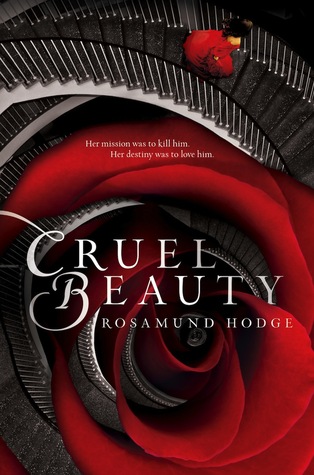
Cruel Beauty - Rosamund Hodge (Cruel Beauty #1)


Cruel Beauty (Cruel Beauty Universe #1)Cruel Beauty is a book that I think had a lot of potential and, for a while, was well-executed, but in the end fell flat.  It was the book club pick for October for the Unapologetic Romance Readers group on Goodreads, and I was pretty excited for it--I had voted for it--because it had been on my to-read list for a while.  It's a Beauty and the Beast-based story in which Nyx, the heroine, has been raised to marry a demon prince as payment for a bargain her father made prior to her birth.  The setting is somewhat strange.  It appears to be the island of Great Britain, but magically cut-off, and on a timeline in which Britain continued to be ruled a sort of Greco-Roman dynasty after the fall of the Roman Empire.  But there's also magic and what seem to be pseudo-Victorian or -Regency trappings.  It's a strange mishmash, and Hodge continues this mash into other areas of the story, which are ultimately what I think led to its downfall.

The story starts with Nyx on the day of her wedding.  She's married by proxy (a statue) to the Gentle Lord, and then promptly deposited on his doorstep with the expectation that she will never return.  But her sacrifice isn't to be for naught.  Once inside the demon's castle, she's supposed to find its four magical centers and destroy the castle, with the demon inside, and free the people of her country from his rule.  But she quickly finds that everything isn't as it seems.  The Gentle Lord, Ignifex (not his real name), lets her know that every night, she'll have the chance to guess his name.  If she gets it right, she goes free.  If she gets it wrong, she dies.  (She also has the option to just not guess.)  And she has a key that unlocks all the doors she's allowed to go through, and told that if she goes through other doors, it's likely she'll die.  Demons lurk in the shadows, ones that don't have the seemingly good intentions of Ignifex, and there seems to be little hope of Nyx ever successfully navigating the constantly-shifting castle and destroying it.  But she does have the help of Shade, Ignifex's shadow who takes on physical, human form at night, and--just maybe--of Ignifex himself, who doesn't actually seem to want to kill her.  Or ravish her.  But of course, as time goes on, feelings grow between them...

Beauty and the Beast is the main basis of the story here, but Hodge also mixes in Greek mythology, mainly the story of Pandora and a weird creation called The Kindly Ones, who seem to be based on the Furies (The Kindly Ones is another word for furies, who have pursuit of oath-breakers as part of their job, and breaking oaths is a big deal in this world) but also have some strange component of making bargains with strings attached, a la Rumplestiltskin. 

Image result for all magic comes with a price

While these strings play together in an interesting fashion throughout the story, at the end they all collide in a sort of series of climaxes, which don't really fit together and seem to go on for far too long--seriously, this book could have ended at least twice before it actually did.  And then there's a weird time paradox involved that I didn't really "buy" the workings of, either.  It's such a shame, because this was a cool world and an interesting premise, but ultimately some of the things that made it so cool made it too complicated to work in a sensible manner, and it kind of fell apart under its own weight.

Nyx was an awesome character, though.  The thing that ultimately her so strong and so different was that she wasn't a nice person, and she wasn't afraid of showing it.  She had a noble goal in mind, but her motive for attaining it had more than a little resentment and guilt attached to it, rather than being selfless.  As Ignifex says, she has "a little malice in her heart," and she never really gets rid of that.  Even at the end, she maintains it, and that's what made her so strong and so different.  Heroines in these sorts of books are always so good and pure, and seeing someone who had a splotch of black on her heart was a very different feelings.  And the same with Ignifex and Shade, both--none of the characters here, not even Nyx's oh-so-sweet twin, are actually good, but they're also not utterly despicable to the point that you don't want to root for them.  It was an interesting balance, and I think that was an aspect that Hodge handled very well.

Ultimately, this is a first book, and I think the construction of it shows in the end.  I'm still interested in reading more of Hodge's work, because I think authors certainly learn a lot from the first book they produce, and come back much stronger in future volumes.  Hodge had strong beginnings here, and with a bit of refinement, I think she could become a real powerhouse in the "fairy tale retelling" genre.

3 stars out of 5.

Wednesday, September 16, 2015

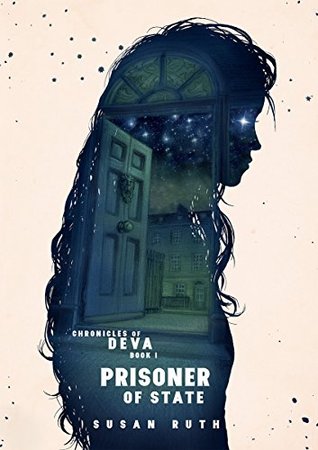
Prisoner of State - Susan Ruth (Chronicles of Deva #1)

Prisoner of State (Chronicles of Deva Book 1)
Susan Ruth is (or was; I can't find her anymore!) a member of the 20,000-member NaNoWriMo group on Facebook, of which I am also a member.  I'm not a very active one, but a good deal of their stuff shows up on my feed, and when Ruth was getting ready to put out Prisoner of State, she posted a few different versions of the cover for the group to see.  That was it: I was hooked.  I have a thing for silhouette covers, especially ones as gorgeous as this, and when Prisoner of State dropped, I scurried off to buy it.  It then sat unread on my Kindle for months because it was buried in the midst of 600 other ebooks.  But I finally dug it up and read it, and let me say this...it was an experience that left me unsure of how I feel about the book as a whole.

This isn't a short book.  It's also not an extraordinarily long one, but it's 400 or so pages of dense content, and a convoluted plot that left me feeling like I needed charts in order to follow it.  Felix Skryker, the main character, makes a variety of notes and charts and family trees in his attempts to unravel the mysteries surrounding Prisoner of State Xanthe Chance, who comes into his care in a whirl of strangeness that permeates the entire novel.  He uses charts to solve the mystery...but I feel like I shouldn't have to use them to just keep track of what's going on.  Part of this is that the threads are all so tangled together, which makes for a realistic mess, but which also makes following the story hard.  It's intensely convoluted, with a ton of names to keep track of.  Some characters (most characters) also go by multiple names and titles, and everyone is also related somehow, which makes it an even bigger mire of trying to figure out who is who and who did what.  But when it came to the characters actually solving the mystery, about 70% of the way through the book, Xanthe decides she's been quite long enough and talks--and then the bulk of the intrigue is done, names and actions and consequences all dumped in your lap over the course of a few pages.

This sudden unraveling has the result of leaving the last 30% of the book feeling rather disconnected.  There's a sudden time-jump of about 5 years, which seems to have been manufactured for the singular purpose of shoving in a pseudo-romance that never really gets off the ground.  One little bit of the mystery is left to be solved here, but it really isn't, with the mystery just vanishing to live (or die?) another day.  This chunk honestly felt like a different book, or like it was fanfiction of the rest of the book.  It seemed to float almost entirely apart from the bulk of the narrative, and that...didn't agree with me.

Now, since I've been negative long enough, let's talk about what I loved about this, because there were definitely aspects I loved.  First, the atmosphere.  Prisoner of State takes place on an alternate Earth which reminded me, more than anything else, of Philip Pullman's The Golden Compass.  There aren't daemons attached to people, but there are flying machines and automata and masters of colleges sneaking around with their own political machinations that muddle everything up for everyone else and religion still factoring heavily in to the point that people can still be accused of heresy even though it seems like the late nineteenth or early twentieth century.  Xanthe also reminded me, in some ways, of The Golden Compass' heroine, Lyra.  Xanthe and Lyra are about the same age and are both thrown into strange situations, though Xanthe has a tragic past and is messed up in ways that Lyra would probably find hard to fathom.  There are also strange occurrences that aren't quite magic going on--the Dislocation Barrier comes to mind.  The barrier cuts Deva and Mercia (part of what we would call the UK) off from the rest of the world, having arrived abruptly at the end of a civil war.  It has turned Deva into a cut-off, dark place, with menaces lurking around every corner.  It's hinted at that the bad actions of Deva's inhabitants even fuel the barrier, in a sort of self-perpetuating cycle because there are a lot of bad actions--it's a very dark book.  It's a tantalizing look at Ruth's world, which is definitely steampunk-inspired but isn't blatantly so, and I wish we'd gotten a few more lush details like that and perhaps a little bit less of the convolutions that made up most of the plot.

I also really did like the writing itself.  Ruth is a very matter-of-fact story teller.  She sometimes falls into the school of telling rather than showing, which we're all warned against these days, but in this particular narrative, I think it works.  It gives it a slightly dated feel, which makes it feel like the book was actually written in the time period in which it takes place.  She also uses this to build up the mystery and then tear it down quickly, which are less skillful, but the style still worked for me as a whole.  It also makes some of the strangeness feel like it belongs, much like Neil Gaiman writes strange things so matter-of-factly that it seems like of course they must be true.

Ruth has some real skill as a writer and storyteller, and I loved her main characters and her world.  I do hope she continues to write these Chronicles of Deva, though I would like to see a little more streamlining as she matures as an author, so that the narrative doesn't leave me with a headache when I step away from trying to keep everything straight.

3.5 stars out 5.