Pages

Showing posts with label buddy read. Show all posts

Friday, January 5, 2018

Ordinary Grace - William Kent Krueger

Ordinary GraceThis was the November book for the Deliberate Reader online book club, but despite putting a hold on it well in advance (in September!) I didn't get it until mid-December, so I kind of missed out on the discussion.  Still, I wanted to read it so I was read up for the year.

This is a sort of mystery, but it's not a pavement-pounding one or one where people are getting shot or anything like that.  Instead, the main character is a twelve-year-old boy whose town is plagued by a series of deaths, some of which may or may not be murder, over the course of one summer.  Starting with the suspicious but possibly accidental death of a boy who was hit by a train, the deaths affect main character Frank and his town in different ways.  Because his father is a local minister and his father's friend works to dig graves in the town, Frank has a front-row seat to the various deaths and becomes ever-more entwined in them, particularly when one hits close to home.

This is a pretty simple mystery, and despite a few red herrings the author placed I had it figured out pretty early on.  There were a few aspects that I hadn't guessed, but none of them actually affected the outcome at all.  However, this only pertains to one death--despite Frank building up the summer of five deaths, only one of them is really relevant to the story, and another is connected but not part of the mystery.  The others were very tangential, one of them being mentioned in about one sentence at the end of the book, as if the author had forgotten he needed to include another death to get his five until that point, and then threw it in just to be done with it.

I did quite like the writing here, however; the atmosphere of a small town in the sixties is really nailed down, and all of the characters felt fleshed-out, developed, and relevant to the plot in their own ways.  Not all of them were likable, but all of them felt as if they belonged and were serving their own purposes, and had lives beyond just serving the plot, which is definitely not always the case in mysteries.  However, because this book was also a "portrait of a town" book in addition to a mystery, having all of the characters fit so well was very important to the book working as a whole.  The one thing I didn't always like was the pacing; while at some times I was intrigued and pulled along by the pace of events, at other times the flow seemed to slow to a crawl, making chunks of the book seem like they were never going to end.  Still, I liked it overall, and as it picked up speed towards the end it made quite a good airplane read.  It finishes up with a sort of "where are they now" epilogue, though, which I really hate as a literary device; the epilogue could have been structured differently or, honestly, left off entirely, and the ending probably would have been more solid.

3.5 stars out of 5.

Tuesday, January 2, 2018

The Gifts of Imperfection - Brene Brown

The Gifts of Imperfection: Let Go of Who You Think You're Supposed to Be and Embrace Who You AreThis is the selection for the Deliberate Reader Book Club on Facebook for 2018, with the focus on an easy-to-discuss nonfiction.  I've actually read one of Brown's books before (Daring Greatly) and so knew what to expect upon opening this one, which predates DG.  I was also pleasantly surprised to find out that it was short, since I was rushing to finish other books before the end of 2017 before I picked this one up.

Brown has spent her career researching shame, and has encountered a phenomenon of people she calls "the Wholehearted" in the process.  Basically, this book is kind of a self-help book on how to let go and relax into living what is, ultimately, a more fulfilling life.  It is not a checklist; anyone looking for one here will be disappointed.  Instead, she goes into the things that she's found common in people who are Wholehearted, and things that get in the way.  She punctuates the book with stories from her life and her research that illustrate her points.

Self-help books are very much not my genre of choice.  However, this wasn't an awful read.  While there are some things that Brown promotes that I don't really buy into (she talks about spirituality and says that it's not about religion, but she certainly deals with it like it is) but there are some good things to keep in mind, such as the importance of taking time to step back, play, rest, and not embracing a culture of scarcity--you know, never having enough time, sleep, beauty, etc.  Instead, try more to embrace what you have, and you'll be happier for it.  Brown herself admits to not liking everything she found in her research; our culture tells us that exhaustion is a sign of hard work and therefore being exhausted is a good thing.  However, it's not good for us as people.  Much of what Brown puts forward here is at odds with American culture and seems like it might be better in line with other places in the world--though of course, nowhere will hit everything she wants.  But beyond all, what's she's emphasizing, sometimes implicitly and sometimes explicitly, is creating and enforcing boundaries.  Letting people push us is how we end up unhappy so much of the time, so being able and willing to put up boundaries, and then stick to them, is vital to overall happiness.

This is a pretty readable book and Brown is an enjoyable author; she writes like it's an easy conversation, which was nice.  However, if you've read any of her other works, you'll probably find this more repetitive.  Daring Greatly focuses on parenting and leading, but she talks about all of the stuff from this book in one way or another, so if you're reading more than one of her books, be aware that you're going to re-tread some ground.  I think this one is probably more outright useful than DG because the things here can be applied to any point of life whereas DG is more focused on parenting and leading, things that I am not particularly interested in; of course, that might be just me.  Still, a good read for this time of year, with things to keep in mind for the year ahead.

3.5 stars out of 5.

Monday, December 25, 2017

A Pirate for Christmas - Anna Campbell

A Pirate for ChristmasA Pirate for Christmas was the holiday romance selection for the Unapologetic Romance Readers' group.  Like most Christmas-themed historical romances, it's a novella rather than a full-length novel.  Also like most Christmas-themed historical romances (and Christmas romances in general, regardless of time period) it relies on love at first sight to get everything going--probably because the short length doesn't leave as much room for relationship and character development.

The two main characters here are Bess, the daughter of the vicar of her rural village, and Rory, who has just taken over the title of Earl after his older brother's death.  There's a rumor rampant in town that Rory is a dastardly pirate, but we know from the book's description that he was actually in the Royal Navy.  When Bess visits the manor to obtain the donkey that always takes part in the Christmas play (Daisy--Daisy was probably the best part of the book) she encounters Rory, the two fall in love at first sight but are of course unable to express their feelings for each other, and go edging around each other as Bess starts reorganizing Rory's house and gets him to give her Daisy and his own participation in the Christmas play...all for the price of a kiss, of course.

As I mentioned before, there's not a lot of room for plot or character development here.  Bess and Rory spend most of the time mooning at each other from afar with all of the village folk trying to push them together, and then there's an extended scene where they conveniently get stuck in a cabin in the woods during a snowstorm together.  Rory wants Bess and Bess wants Rory and and Rory spends a lot of time pursuing Bess but not really wanting to do anything about it because he wants to marry her first (because that's what she deserves) but also not really doing anything to move in a marriage direction.  But of course that's where it all ends up, and then there's a weird time-jump to the honeymoon where the ~sexy times~ start.  Honestly things probably would have been a bit more interesting of Rory really had been a dastardly pirate instead of a misunderstood navy captain, but meh.

Christmas romances in book form are, essentially, the same as those cheesy holiday movies that you see on TV all the time at this time of year.  They  might be cute, for what they are, but they're not particularly good.  This book follows that trope exactly.

2 stars out of 5.

Thursday, December 21, 2017

Savage Ecstasy - Janelle Taylor (Gray Eagle #1)

Savage Ecstasy (Gray Eagle, #1)Slogging through the remainder of my romance reading challenge categories before the end of the year, I came to this: Savage Ecstasy.  This fit into the category of "A Native American romance."  This is a particularly bad category for a couple of reasons.  First, despite asking around in the romance group, I could not find any #OwnVoices Native American romances.  If you know of one, please direct me to it.  But what this ultimately meant was that all of the ones I was finding were written by white women.  Not ideal.  Second, there aren't a lot of ones I could find that were written within the past few decades, which mean that they were pretty much all coming from the era of bodice rippers.  I mean, the title should probably tell you all you need to know about this book, and the rest that I saw were very much like it.  But I already had this one, because it was a bodice ripper buddy read for the Unapologetic Romance Readers last year that I never got around to actually completing.  And so, since I couldn't find anything that looked better, off I went.

This book is just as offensive and downright terrible as the title would suggest.  The story follows Alisha, who has moved to the western territories of the American colonies with her uncle following the death of her parents.  One day some men living in her settlement capture an Oglala warrior, Gray Eagle, and plan to torture and kill him for kicks, but Alisha intervenes and eventually he's just put into isolation instead--from which he escapes and quickly extracts his revenge, returning with his buddies to kill basically everyone at the fort with the exception of Alisha and a few others--one other woman, who's turned into a whore, and a few men that are tortured and killed at the Oglala camp.  He claims Alisha for his own and so begins a brutal tale of repeated rape and abuse on literally every level that's peddled as a romance in which, by the end of the book, the two main characters have never held a conversation.  Seriously.  Gray Eagle speaks English but he doesn't let Alisha know this and so they just snipe at each other in their respective languages with nothing actually being communicated, and Gray Eagle periodically raping Alisha because apparently this will make her love him and be loyal to him.  And Alisha obviously does love him because clearly you fall in love with someone in the thirty seconds it takes you to lay eyes on them, and them killing literally everyone you know, raping you, beating you, torturing you, etc. does nothing to challenge those emotions.

Not only does this book have an awful plot, but it's full of terrible writing and terrible tropes.  Yes, there are some editing issues here, but I think in this case that's actually caused by an older book being converted to a Kindle format.  But the writing itself is still terrible.  It's stilted, jumps between past and present tense, and was so boring that I actually found myself falling asleep while reading it.  Why?  Because there is no depth. It's all surface level, all tell and no show.  And for the terrible tropes?  Well, beyond the love at first sight and the rapey-ness of this, all the men want to bang Alisha because she is beautiful and pure!  And all of the women who are not Alisha hate her because all of the men want to bang her.  Obviously.  Additionally, Alisha is repeatedly described as looking like a little girl, which adds a whole new level of creepiness and ickiness to this which was completely unnecessary.

This was a terrible book.  I will definitely not be reading the others--yes, this is a series, if you can believe it--and cannot fathom reading anything else by this author in general.  There was literally nothing good about this.  I hated it.

1 star out of 5.

The Raven Prince - Elizabeth Hoyt (Princes #1)

The Raven Prince (Princes Trilogy, #1)This was the main buddy read for the Unapologetic Romance Readers group for December 2017.  I'm still waiting on the November title from the library, but the library didn't have this one at all, so I went ahead and bought it and read it during those dark morning hours that you have to suffer through when you travel time zones and consequently wake up two to three hours before everyone else--and the sun.  Good thing for Kindle Paperwhite, eh?

The story here follows Anna, a widow living with her mother-in-law and one servant and whose household is going through some financial difficulties.  She decides to get herself a job to help, and finds a position serving as secretary for the local earl, who has just moved back to the area and who no one has seen yet.  Of course, Anna finds out quickly that she has seen the earl--he nearly ran her over with his horse a few days before, leading to a rather awkward encounter.  And of course the two are attracted to each other, but there are Problems.  Like Anna being barren (which, come on, she clearly isn't) and Edward wanting a family to continue his line, and him being engaged to another woman in order to pursue that.  You know.  Stuff like that.  There's also a very minor blackmail subplot, but most of the book involves Anna trying to seduce Edward, even going so far as to get herself into a brothel so she can have sex with him without him knowing it's here.

This has a good premise and good writing, and I felt the characters had great chemistry, but looking more closely at it, there are definitely some problems.  Edward has a violent temper, doing things like throwing objects at his steward's head, and it seems like maybe that's not a great person to get involved with.  Anna is confident enough to go to London to seduce Edward, but not if he knows it's her--and then gets miffy when he doesn't realize afterward.  Uhm...what?  And when she tells Edward she doesn't want to marry him, he won't take no for an answer.  I know, I know, it's a romance and they need to end up together, so clearly he's going to have to ask her again--but he outright harasses her way past the point that was acceptable.  And he continues to sleep with her before breaking off his engagement to his fiancee, which is pretty slimy in and of itself.  The whole "woman sneaks into a brothel to have sex with the man she desires" trope is also one I've encountered before and not one I'm fond of.

That said...I didn't dislike this.  I think Hoyt's writing is really good, as I mentioned before, and I think it carried the book through its rather questionable character and plot points.  She can write good tension and good banter and a good sex scene, and there is also a minor side romance that was quaint; it's always nice when love isn't exclusively reserved for the main characters.  Also, I liked how the blackmail plot was resolved.  Anna makes a questionable (again) choice regarding it at first, but then realizes what she's doing and works to rectify it.  Of course things still go downhill, but that was more Edward's fault than Anna's.  The main story is also framed by a fairy tale book also called The Raven Prince, which follows the structure of "East of the Sun and West of the Moon" but with a little less work needing to be done on the heroine's end to get her man back.  But while I liked this device, I'm not entirely sure what purpose it served since the two stories don't really parallel each other at all.

This was my first Elizabeth Hoyt book, though I have a bunch of hers on my to-read list.  Based on it, I would read more; some of my other favorite historical romance authors have made some questionable choices in their back catalogues as well, and I've loved other works of theirs.  (Lisa Kleypas comes immediately to mind.)  Hoyt's writing was strong enough for me to not just toss her to the wayside, and I'm interested in seeing what she might have to offer in other plots, preferably ones with less issues involved.

2.5 stars out of 5.

Friday, December 1, 2017

Swear on This Life - Renee Carlino

Swear on This LifeSwear on This Life was the Deliberate Reader book club pick for December 2017, which made Thanksgiving weekend a perfect time to read it.  The book has pretty stellar reviews on Goodreads and a promising premise, so I can see why it was selected.  The story follows Emiline, who discovers that her childhood best friend and first love wrote a book about their experiences, and her supposed life after them, from her perspective, and it is a huge bestseller.  Emiline, who hasn't heard from Jase in more than twelve years, is furious, because he's profiting off her pain and suffering and he's not even getting it right.  But what to do?

So, this had the potential to be good.  But it really wasn't.  The problem is not the plot, or really the characters, but the writing itself.  The entire book, which is composed both of first-person snippets from Emi and of excerpts from the book Jase wrote, All the Roads Between, is flat and lifeless.  It's all telling and no showing.  "I couldn't believe he lied."  "I was so mad."  And so on.  There's a great lack of emotion here, which is somewhat astounding for a story that should have been absolutely bursting with it.  Emi and Jase's story is a hard one to read...except it's not, because there's no feeling embedded in all of the terrible things they went through.  Instead, this book reads like a dry recitation of the facts, instead of a tale that pulls heartstrings and evokes tears and rage and passion.

The nesting of the stories in a sort of Russian doll fashion was interesting, but it wasn't enough to carry a book that lacked any dimension.  I could understand Emi's pain and anger and longing, but it wasn't conveyed very well and I had to do a lot of pulling on my own emotions in order to make it all "click," something that a well-written book should do for me.  And while I think both Emi and Jase were promising characters and could have shone with a little more polish, the supporting characters were all pretty bland and flat, lacking any and all sense of dimension.  I absolutely could not believe that this was a book about a bestselling book because it was so poorly done.  And you know what?  Carlino is aware of this.  You know how we can tell that?  Because at one point Emi points out that Jase's book isn't well written and is just being lauded because it's a story about two kids in bad circumstances.  And that's exactly what the book as a whole is!  Are people really okay with that, or are the majority of readers seriously not catching on?

Overall, bland, not worth the hype, and dear lord I actually spent Thanksgiving weekend reading this.

2 stars out of 5.

Wednesday, October 25, 2017

Scarlet - Marissa Meyer (Lunar Chronicles #2)

Scarlet (The Lunar Chronicles, #2)Scarlet is the second book in the Lunar Chronicles series and is the last book of the series I need to review' life's funny like that, innit?

This book both continues Cinder's story as rogue moon princess and introduces a new character, Scarlet.  The main setting here also shifts to France, where Scarlet lives and is looking for her recently-disappeared grandmother, who was also involved with Cinder's relocation from Luna to Earth, though Scarlet doesn't know it.  The new romantic interest for Scarlet, Wolf, also takes the scene, as does Carson Thorne, an American deserter with a stolen spaceship who falls into Cinder's company.  Kai is also still involved, dealing with the drama of Cinder's escape and rising tensions with Luna from the palace in New Beijing.

Cinder starts coming into her own as a moon-princess-badass here, and Scarlet quickly sets herself up as someone who is not to be messed with.  Scarlet is a typical "fiery redhead" character, which is a bit lacking in originality, but at least her hair is only mentioned twice instead of being harped on for the whole book.  Her "Little Red Riding Hood" story is queued up with her signature red hoodie and, of course, Wolf, as well as a brief encounter between Wolf and a street fighter named Hunter.  There's a bit of a twist in this book, one that I don't think was as evident as the "twist" in Cinder, but reading it through a second time it's pretty obvious where the story was going.  Still, I found the story to be enjoyable.  This is also more of a romance than Cinder was, with a strong bond between Scarlet and Wolf from the beginning, even though both admit that it doesn't make sense.

This isn't a very complex story, and I think that Scarlet's part of it actually moves more slowly than Cinder's story initially did.  Meanwhile, Cinder's story picks up pace as she and Thorne flee New Beijing and try to determine their next steps.  Thorne is a delightful character, someone who thinks that he's much more charming than he actually is and with a checkered past that he tries to spin in the best light possible.  This all sets him up wonderfully as a true hero in the next book, when he see him through a different pair of eyes.  Iko also makes a return to the page here, and she is just as wonderful as ever.  Cinder herself is also a stronger character than she was before, gaining a true determination and sense of self that she lacked in the first book.

Overall, this is a great book, a strong continuation of the series and, I think, better than Cinder itself was.  On the re-read, I'm not quite as dazzled with it as I was the first time I read it.  When I do my re-read of Cress, we'll have to see if Scarlet can retain its place as my favorite book in the series or if it will be overturned.

4.5 stars out of 5.

Sunday, October 1, 2017

Funny in Farsi - Firoozeh Dumas

Funny in Farsi: A Memoir of Growing Up Iranian in AmericaA lighthearted memoir, Funny in Farsi was the Deliberate Reader Book Club title for October's month-long discussion.  The author, Firoozeh Dumas (her father specifically told her not to mention her maiden name in the book, and then wondered why she hadn't used it once it was published) first came to the United States when she was seven, when her father had a two-year work assignment for the Iranian oil industry in California.  After returning to Iran, her family later came back to the United States to liver permanently.

Despite the cover claim that this is "A memoir of growing up Iranian in America," I felt like much of the book wasn't really about Dumas so much as it was about her larger family, with her serving kind of as an observer in the background.  Each "chapter" is really more like a little vignette focusing on a different incident, and there's also a pretty big jump from when Dumas was a child to when she was adult, with only one real chapter on her adolescence--one minute she's trying to get her mother to bake American snacks for her elementary school, and the next she's getting married.  Many of the stories focus explicitly on Dumas' father, something that she admits in the afterword of the book.  Her parents are definitely the center of this narrative; despite having brothers and an extended family, most of the stories involve her parents in the central role, whether it's her mother's accent and learning of English consisting mainly of watching The Price is Right or her father wanting to compete on a bowling game show, "fixing" up the house on his own, or trying on her engagement ring when her boyfriend asked her father's permission to marry her.

Obviously, the humor here is in the clash of cultures that comprises Dumas' life.  While her family is eager to embrace much of American culture, they're still baffled by other parts of it--such as why Americans like turkey.  And then, once Dumas marries a Frenchman, yet another aspect of culture clash enters her life.  To some degree, Dumas presents herself as better than the others around her--better at adjusting, better at understanding, just better, which is a little self-centered, even more so than writing a memoir about your experiences.  (And she is correct that you don't need to have done something amazing to write a memoir about your life.)  Maybe it's that she's more pragmatic than other people in her life, maybe it's a skewed viewpoint; it's hard to say.  However, it's still an amusing read, though one that, like many memoirs, you probably need to take with a grain of salt.

Overall, this was an enjoyable read, but it's one that lacks a lot of depth.  Rather than really digging into any issue, light or heavy, Dumas instead skims over pretty much everything, keeping the focus away from herself.  I would have liked to see a little more depth here in some respect; depth doesn't mean that something has to be depressing, but it would have made the book seem a little more whole-hearted; as it was, it just felt a bit shallow.

3 stars out of 5.

Tuesday, September 26, 2017

My Fair Princess - Vanessa Kelly (Improper Princesses #1)

My Fair Princess (The Improper Princesses #1)This was one of the monthly book selections for the Unapologetic Romance Readers group on Goodreads.  We tend to read a lot of historicals, and this is no exception, which makes me happy because historicals are my favorites!

The plot follows Gillian, the bastard daughter of a royal duke (AKA the Prince Regent's brother) who grew up in Sicily and, when we encounter her, is busy hunting down the bandits who killed her beloved stepfather.  Skip ahead a bit, and Gillian and her surviving family have returned to England, where they have enlisted Charles, Duke of Leverton, to help with civilizing Gillian so she can make a good match.  Why Charles?  Because he's apparently some sort of distant cousin; at least distant enough that I couldn't keep any of the connections straight.  Gillian doesn't want civilizing or a husband, she just wants to go back to Sicily, and so our conflict is born.

As far as plots go, this one revolves around a trope that I quite like: the hero trying to find the heroine a love interest, and then falling for her himself.  Charles as a character actually grew on me quite a bit.  Despite being rather bland and proper at the beginning of the book, he slowly starts to come out of his shell, pulled from his comfort zone by Gillian's behavior and the scandal that she stirs up.  Gillian, on the other hand, made me want to slap her upside the head.  She has her own desires, of course, but she acted like such a child, refusing to even see that maybe the way she was going about things wasn't the way to get what she wanted, or that what she wanted might not even be possible.  She dragged other innocent parties into downright dangerous situations, including a child who wanted to impress her.  When Charles tells her that she can't continue acting like that, she basically blows up and says that well, then they can't be together, to which I say, well then, maybe he would have been better off without her.

As for their relationship, there's a rather abrupt shift in it at one point.  In the beginning of the book, they kind of separately admit to themselves to being mildly attracted to each other, but neither is pursuing the other in any sort of active way.  And then, all of a sudden, they're all over each other.  It's not insta-love or insta-lust, but it's also not a slow development, and the switch felt like it came out of nowhere and made the pacing of the relationship just feel a bit off.  The supporting characters help to bolster the weirdness of the relationship, particularly Charles' sister Elizabeth, who was a wonderful supporting character and just the kind of sweet and steady presence both main characters needed.  Gillian's half-brother, Griffin, is also featured, and appears to be a main character in a book in one of Kelly's other series, the Renegade Royals--one of the books of which I have also read!

Overall, I liked this, but it was nothing extraordinary.  Gillian was an infuriating heroine and her revenge subplots kind of dragged down what could have been something absolutely delightful.  However, I would still be interested in reading more from Kelly in the future.

3 stars out of 5.

Saturday, September 23, 2017

All Night Long - Jayne Ann Krentz

All Night LongAll Night Long was the romantic suspense read for the Unapologetic Romance Readers in August, but it took me a while to get it from the library and then get around to reading it, so I didn't finish it until early September.  The story seems to have a good premise from the summary: having fled her hometown years before after the murder of her parents, Irene is summoned back by the woman who was her best friend the summer of the murders, pulled by a code word that meant something urgent had happened.  But when Irene arrives, she finds that Pamela is dead, too, apparently of an overdose, though Irene suspects more foul play is involved.  And with a sexy ex-Marine innkeeper to help her, she is determined to get to the bottom of things.

There's definitely some suspense here, though the story goes a little sideways and eyebrow-raise-worthy towards the end of the book, complete with a scene of the villain info-dumping all of his motivations and actions to the heroine, which of course gives the hero time to swoop in and save the day.  And the the denouement seems to drag on a bit, as well.  But my main issues with this book were twofold: first, the hero is a total creepy stalker not at all worthy of making this a romance, and second that Irene has absolutely nothing to actually lead her to believe that all of the murders are connected (or are, in fact, murders at all) and instead just forges ahead like a crazy person on nothing more than her gut because--well, there really is no because.

So, first, Luke.  He is not a romantic person.  He is a crazy stalker.  Irene is staying at the hotel that Luke has recently acquired while she's in town, and he immediately begins following her around without her permission, and in fact directly in opposition to all of her wishes, for no reason at all.  Later, after they become involved, he basically shows up and says he's moving in with her.  Their total acquaintance?  A handful of days, at most.  Let me emphasize this for everyone: stalking is not sexy.  It is utterly terrifying, and should not be viewed at all as romantic.  Some books utilize otherwise nonromantic behaviors in a romantic way because the relationships are supposed to be twisted; however, that's not the case here, and Krentz seems to honestly put forth that Luke's behavior towards Irene is attractive and desirable.

And then there's Irene, who's supposed to be an intrepid reporter, but honestly is going on nothing.  The death of her parents was ruled a murder/suicide, which okay, she doesn't have to believe--that's her prerogative.  But there's absolutely no reason for her to believe that Pamela's death is anything but an accident or a suicide, and there's even less for her to go on from there.  Ultimately, of course, Irene is right--because otherwise there wouldn't be a book here--but there's no sense of logical progression in the crimes that form the backbone of this story.

The writing itself is fine, I guess, but Krentz relies on the sensational in order to sell the story and there isn't a lot to propel it along other than that.  The whole book just feels very "thin," from the characterizations of the hero, heroine, and antagonists, to the romance and the very plot itself.  There are some good scenes--a car chase along a winding road comes to mind, as does a confrontation with Luke's family, who were another annoying part of this book--but overall it was nothing to write home about and I don't intend to read any Krentz in the future.

2 stars out of 5.

Sunday, September 17, 2017

Cinder - Marissa Meyer (Lunar Chronicles #1)

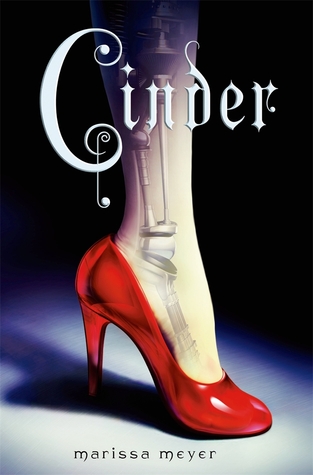
11235712It feels a bit weird reviewing this book so long after I put out my first review on this series, for Cress.  I had read Cinder before, but I wasn't writing reviews at the time, and so this comes to anyone following along a bit out of order.  Cinder was the Unapologetic Romance Readers' theme read of "A sci-fi romance" for September 2017, and I was delighted to have an excuse to re-read it, especially as I'd been in a bit of a reading slump and going back to books I've previously enjoyed always helps with that.

Cinder is, as you can guess from the title and cover, a Cinderella story.  Except this Cinderella is a cyborg.  Injured in an accident she can't remember, Cinder has been left with a mechanical arm and lower leg/foot, with wires in her brain and nervous system and an interface that flashes information over her eyes.  She's also one of the best mechanics in New Beijing, and her business is her step-family's main (only?) source of income.  Oh, and New Beijing, and the rest of the world, are currently being ravaged by a plague with an unknown cause and no cure.  But one day, when Prince Kai stops by Cinder's stall to get an android repaired, Cinder is pulled into a web that she never imagined and that will destroy--or rebuild--her entire life.

I love this story so much.  It follows a very traditional Cinderella structure, but with little flourishes and garnishes that make it seem new.  The pumpkin coach is a decrepit car, the glass slipper is a cyborg foot.  The characters are also wonderful; while Meyer makes Cinder's stepmother absolutely loathsome, the daughters aren't entirely without redemption, particularly Peony, who Cinder actually likes.  And then, of course, there's Iko, Cinder's android sidekick who has a quirky, perky personality all her own.  Adding the plague and the brewing conflict between Earth and Luna adds dramatic tension to a story that traditionally lacks it, and having Prince Kai and Cinder meet and grow closer multiple times before the ball is absolutely necessary--the "love on first site" aspect of Cinderella has never sat well with me, so I appreciate this added relationship building.

That said, this isn't a perfect story.  It has a bit of a cliffhanger ending, which I didn't remember.  Given the narrative arc of the series as a whole, I can see why Meyer had to break it where she did, but it definitely doesn't lead to a satisfying conclusion for this volume.  And while the Cinderella element helps to tie together a story and genre that could otherwise alienate some readers--I probably wouldn't have normally picked up a story about a cyborg--it also means that, despite the flourishes, the plot itself can be quite predictable.  Of course, the story as a whole goes past the Cinderella story, but that doesn't mean that parts of it can't be called from a mile away.

Still, I really enjoyed rereading this.  It's not my favorite book in the series--that goes to Scarlet--nor does it feature my favorite main characters--that would be Cress--but I still think it was a solid intro volume, and would definitely recommend it to others.

4 stars out of 5.

Friday, September 1, 2017

Plainsong - Kent Haruf (Plainsong #1)

Plainsong (Plainsong, #1)Plainsong was the September book for discussion in the Deliberate Reader Book Club.  After the train wreck that August's book, The Diamond Age: or, a Young Lady's Illustrated Primer was, I was glad to see that something was going to be a bit more, ah, tuned down.  The story of a small town in Colorado seemed like that would fit the bill.

This is definitely a character-driven book focusing on a handful of people in the town of Holt, Colorado.  The book also tries to be artsy, by doing one of those things where the author is apparently too good for dialogue punctuation marks.  I find that extremely irritating, and it almost made me put down the book; I only continued reading it because I wanted to be able to take part in the discussion in case anything interesting came up.

The main characters in Holt are Guthrie, his sons Ike and Bobby, and teenager Victoria.  Other characters are the McPheron brothers and Maggie, and occasionally Gutrhie's wife Ella.  Guthrie is a teacher and Ella is depressed and their marriage is falling apart, which clearly impacts their children.  Guthrie is also dealing with a troublesome student in his school.  Victoria, on the other hand, is pregnant from a boy she was seeing over the summer and who has since ditched her, and her mother throws her out of the house and casts her adrift on the town's mercies.

I greatly preferred Victoria's part of the book to any of the other characters.  Watching her adjust to her new life and slowly building a relationship with the McPheron brothers was a real example of character growth, as opposed to Guthrie who seemed to be just running in place.  Ike and Bobby didn't interest me much and their parts mostly seemed like filler, just to show that there were children involved to begin with.  I actually did like Ella; though she's not very present and doesn't seem like a good mother, I could empathize with what was her struggle with depression.  It wasn't that she didn't want to be a good wife or mother or functional human being in her own right, because she clearly did, but she just couldn't.  And she knew that remaining in Holt wasn't going to help her, so she had to leave.  I liked that Haruf didn't seem to shame her for this, but just portrayed it as it was.

One thing to keep in mind is that there's not much of a plot here to follow; this is evidently a series, though it's a strange book to be a series, and there might be some sort of large, overarching plot involved across the multiple books, but there's nothing really driving the story forward as an episodic story in this single volume.  This means that, while some of the people were enjoyable to read about, the book wasn't riveting.  I could put it down easily and sometimes found myself paging ahead to find out when Victoria's next section would begin.  And honestly, the cover here seems perfect for the book: dim and gray, much like Holt and the book itself, with Victoria's red purse and the McPherons' red cow being the only splashes of color in the whole book.

Overall, this was an enjoyable book for what it was, but I didn't find it to be anything extraordinary.  The lack of dialogue punctuation drove me to frustration--there's really no need for that.  I don't think I'll continue with the series, but it was fine for a book club book, and a welcome slowdown from last month's Book of Crazy.

3 stars out of 5.

Tuesday, August 29, 2017

Queen Heir - Jaymin Eve and Leia Stone (NYC Mecca #1)

Queen Heir (NYC Mecca #1)Queen Heir was the monthly book pick for the Unapologetic Romance Readers on Goodreads, though it probably wasn't best-suited for the group because it's not really a romance; the romantic interest doesn't even show up on the page until almost halfway through the book.  It focuses on Arianna, one of the heirs of the wolf-shifter queen in New York, who finds herself fighting for the crown after the queen is murdered.

Arianna is pretty much insufferable.  She is, of course, gorgeous.  She has platinum blond hair and gorgeous eyes but oh, her dad might have been Polynesian so she has dark eyebrows and eyelashes even though otherwise she is pale, pale, pale!  She is the strongest of the heirs, has the best familiar (and the only one that is a wolf), is the best at fighting, the best at magic, the best the best the best.  And the only one who can solve the queen's murder!

The writing here is very clunky and the world building is scattered at best.  For example, the authors once use "ferreted" instead of "ferried," and the magic system was apparently created by the Tuatha De Danann, which makes no sense.  Why not, you ask?  Well, for starters, the Tuatha De Danann are a "race" of Irish/Celtic god-like beings, who the authors here instead label as fae.  But they're specifically linked to Ireland.  Here, the authors decide that New York conveniently has a magic system called "the mecca," which again, good job for either mis-appropriating religious aspects or not understanding what words really mean, which was created by the Tuatha De hundreds of years before humans were there and which conveniently aligns exactly with New York's buroughs.  And can be used for teleportation.  Oh, yes.  They also appear to be lumping together the Tuatha De Danann, who are traditionally considered "good," with the Fomoire, who are generally bad.  Either that or they can't tell the difference between these groups and the Sidhe, which are related to but not the same as the Tuatha De Danann, and are more along the lines of what people sometimes call the "Seelie and Unseelie" faeries.  All of this can be gleaned from a quick perusal of Wikipedia, so I'm not really sure there's an excuse for butchering things this badly.

Now, don't get me wrong, I love adaptations of mythology that are twisted up and made new, but most authors at least try to do it with some respect for and understanding of the sources they're pulling on, rather than just going, "Oh hey, that sounds cool, let's do it!" and diving in without any preliminary research or handling source material without any semblance of tact.  Combined with the annoying main character and the sub-par writing, which was also rife with info-dumping, this book was pretty blah.  The pretty cover lured me in, and I liked Kade quite a bit, but I don't think there were enough redeeming qualities in Kade to keep the rest of the series on the top of my interest list.  I think I'd probably be better of going back to the Kate Daniel books for a paranormal romance featuring a sexy shapeshifter.

2 stars out of 5.

Tuesday, August 1, 2017

The Diamond Age: or, A Young Lady's Illustrated Primer - Neal Stephenson

The Diamond Age: or, A Young Lady's Illustrated PrimerWhat on earth did I just read?  It was a sci-fi book for sure, but beyond that...what?  Okay, okay, I'll give it to you: I'm not the world's biggest sci-fi fan.  I don't typically seek out sci-fi books.  But I've read quite a few from various places along the spectrum that I quite liked.  Unfortunately, I'm not sure I can say that The Diamond Age was one of them.  Because here's the thing: there's not really a plot in this book until the last 20% and by that time I was so uninvested in the characters and world, having been boredly trucking along for the past 400 pages, that I didn't really care about what happened to them when the plot finally emerged.

The book starts with a character called Bud, who isn't at all important, so don't worry about him.  Ultimately the people you have to worry about are Hackworth, a nanotechnology guru, and Nell, a young girl who inadvertently ends up with one of Hackworth's creations, an intelligent "book" called The Young Lady's Illustrated Primer that adjusts to her and teaches her everything from reading to self-defense.  This could be some sort of bildungsroman, featuring Nell as the character coming of age, but it was really too scattered to be that in a convincing way, and then Stephenson tried to shoehorn in a plot about Feeds and Seeds and a revolution in what we know as China that just felt strange.

Ultimately, what this book felt like was that Stephenson wanted to build a cool world, but then he didn't know what to do about it.  Why are white people suddenly grouped together in a "phyle" named for Atlantis when everyone else gets their own group based on their old ethnicity or nationality?  What's up with all the body mods?  Why on earth did those nanites or whatever they're called have to be transmitted through bodily fluids?  Clearly they didn't have to be, we certainly saw enough that weren't, and Stephenson was apparently just figuring out a way to put some orgies and spontaneous combustion into his book.  (No, I am not kidding.)  Miranda was cool, and admirable, but what the heck was up with the Drummers?  That didn't make any sense at all.  This book read like some sort of bizarre fever dream, and one that probably would have been better off left in the world of sleep.  Like a dream, there were so many parts that could have been very intriguing, but it jumped from place to place on the most tenuous connection and just ended up feeling scattered and like Stephenson just made stuff up as he went along instead of thinking how it could all ultimately be connected--and then, when he needed a way to connect it, threw in a revolution, because hey, why not?

This was the August book for The Deliberate Reader's book club, and seems to have baffled many of the readers teeing it up, including the book club founder herself.  Indeed, the book does have remarkably high reviews given how absolutely schizoid it is; apparently a lot of people found the end worth the read, but there was nothing there that surprised me or made me think that the final events redeemed the rest of the book.

1.5 to 2 stars out of 5, for its potential and the actual stories about Princess Nell in the primer.  The main book was junk.

Saturday, July 22, 2017

Master of Crows - Grace Draven

Master of Crows (Master of Crows, #1)The theme read for the Unapologetic Romance Readers for July was a fantasy romance, so I put forward Master of Crows primarily because it was recommended for people who liked Uprooted.  I loved that book, so this was an easy nomination for me.  I didn't actually realize it was by Grace Draven, one of whose books (Radiance) we read before, until someone pointed it out.  But it still got a pretty good number of votes, and so off we went.

The story follows Martise, an apprentice magician who can't actually use magic and who is enslaved to one of the highest magicians in the land.  She's placed with Silhara, a dark magician known as the titular Master of Crows, when he requests help finding a way to kill a god.  Martise is valuable because of her ability to read ancient languages, but she's also supposed to spy on Silhara, who's an enemy of the Conclave, and find proof of heresy so that the Conclave can, uhm, dispose of him.  Silhara, in the meantime, has requested assistance even though he knows said assistant will be a spy because he's plagued by the god Corruption, who wants to possess him and enslave the world.

So.  I wanted to read this book because of how it was recommended for those who liked Uprooted.  How did it stand up?  Hm... Well, I didn't like it quite as much as Uprooted.  That book has an enchanting, fairy tale-like quality to it, despite some of its contents being quite terrible.  Master of Crows didn't have that same vibe, though.  It was darker and not as whimsical-feeling, maybe because the "enemy" was more concrete than the Wood was.  It's also much slower than Uprooted is.  Still, I quite liked the central romance here.  Silhara can be a real jerk at times but I think he did redeem himself, and the Dragon of Uprooted was a real bastard in his own ways, too.  The romance itself is a slow burn, with a bit of instant attraction but a real relationship blooming over the course of time and both parties reluctant to relate their feelings because of their respective positions.  The romance is definitely more prominent here than it was in Uprooted, as well, which is something I liked and really what had me picking this up--you say it's like Uprooted but with more romance?  Yes, please, I say!  I also liked the world that Draven built up; the religious aspect of magic, the idea of killing gods, and the different cultures that she incorporated all struck good notes with  me.

What I didn't like was how this set up some promises that weren't really followed through.  For example, Silhara was supposed to a mysterious, dark magician, one of the most dangerous ever--and while yes, he's very powerful, he's really not dark and spends most of his time tending his orange orchard.  If you're going to have a dark hero, I feel like you need to fully commit to him, rather than just brushing all of it off as just rumors.  Also, I'd hoped to see a bit more emotional turmoil on Martise's part.  She decides in pretty quick order that she can't betray Silhara, because she loves him, and there's really no waffling on this issue.  Considering that the nature of her enslavement is that a member of the Conclave owns a piece of her soul, I think this would have been a bit harder of a decision to make, love or no love.

Still, I did quite like this book.  I didn't like it as much as Uprooted, which was one of the most magical books I've read recently, but I liked it significantly more than Radiance, the other Draven book I'd read.  I was excited to see this had sequels, and disappointed when I figured out they weren't true sequels but instead short stories, which just don't appeal to me in the same way.  Sigh.  Maybe some day.

4 stars out of 5.

Saturday, July 15, 2017

Slightly Married - Mary Balogh (Bedwyn Saga #1)

Slightly Married (Bedwyn Saga, #1)Ah, historical romance!  This was the monthly read for the Unapologetic Romance Readers for July 2017--historical romance is a perpetual favorite in that group since it seems to strike more positive notes for more people, at least if our discussions are any indication.  I was a bit disappointed because this wasn't my nomination and I actually didn't have high hopes for it, but I was pleasantly surprised.

The story is about Eve Morris, whose brother dies in the war against Napoleon.  The brother's commanding officer, Aidan Bedwyn, promised Percy before he died that he would care for Eve and protect her no matter what, though he didn't fully grasp what he was promising when he made said promise.  Eve doesn't want Aidan's protection, though she desperately wants to find a way out of her predicament.  The predicament in question?  Due to a quirk in her father's will, because Eve is unmarried and her brother died less than a year after their father, her estate is set to go to her nasty cousin, leaving Eve and her contingent of "lame ducks," such as former criminals, a fallen woman, and an amputee, completely homeless.  Aidan convinces Eve to marry him as a matter of convenience so she can keep the estate, and away we go.

I didn't feel like Aidan and Eve had a ton of chemistry here, but this was a good story of learning to love the one you're with.  They slowly grow closer to each other over the two months of Aidan's leave, first on a brief trip to London to marry, and then when Eve is dragged back to London by Aidan's overbearing brother.  Like many first books in historical romance series, however, this seems to serve mainly as a launch pad for introducing the other characters in the Bedwyn family, who are obviously the protagonists of their own string of books.  I liked that Balogh didn't start with the most prominent member of the family, which would be the oldest brother, Wulf, who is a duke, and that she instead started with the second brother, Aidan.  And I liked Eve as a character, as well.  The two of the didn't communicate, a constant problem in romances, but I could somewhat understand it given their backgrounds and the nature of how their relationship began.  Neither of them wanted to become emotionally entangled in a relationship that was never meant to last, and which they both believed the other didn't want to last.  Counterproductive?  Yes.  Effective for romantic drama?  Also yes.

Was this the best historical romance I've ever read?  No.  It didn't snap and pop like some others, didn't have me devouring page after page.  The chemistry wasn't super apparent to me, either, and while I don't demand love at first sight (which can be downright sickening) I do like to see some good chemistry.  But I think this was a solid base for a series and am looking forward to reading the others.

3 stars out of 5.

Thursday, July 13, 2017

Act Like It - Lucy Parker (London Celebrities #1)

Act Like It (London Celebrities, #1)Act Like It was one of the book choices for May in the Unapologetic Romance Readers group, but I got stuck at the bottom of a long wait list for it at the library and didn't get my hands on it until now!  I'll pop back into the old discussion, but I'm a bit sad that I missed out on it when it was happening because I really did enjoy this.

The main character is Lainie, a West End actress who's one of four main actors, one of them being her ex-boyfriend, who she has to passionately kiss onstage six nights a week, plus rehearsals.  But Lainie loves acting, loves her theater--just doesn't quite love the awkward social dynamics that can arise.  One of the other main actors, Richard Troy, is known about town as something of a bad boy, yelling at chefs and generally causing scenes--not exactly great for his image.  So his publicist and the theater's publicist, afraid that his bad image is hurting ticket sales, convince Lainie to put out the idea that she and Richard are together to help publicity and give the impression that she's rehabilitating him into a normal human being--in exchange for the profits of two Saturday night shows going to the charity Lainie works with.  She doesn't love the idea, but for the donations, she agrees.

Of course, Lainie and Richard are prickly with each other in all the right ways.  They snipe back and forth, jab at each other, but mostly do it in relatively good humor, and of course they grow on each other, a little bit at a time, and then all at once.  Richard can be a proper jackass, but Lainie gives as good as she gets, doesn't let him really get to her, and doesn't let him walk all over her, so their relationship is actually very equal.  She also starts to put the reins on letting him act like an ass to other people, though of course some things can never entirely change.  The "fake relationship that becomes a real one" is a favorite trope of mine, but just like any trope, it has to be carried off well, and I think that Parker accomplished that.

The characters are both actors by trade, so clearly they at least somewhat live for drama.  So are parts of this book unnecessarily dramatic?  Yes.  But I do think it fits the story and the characters, melodrama included; Lainie muses at one point how when she leaves the stage, she doesn't always feel like herself, but rather like she's playing the role of Lainie in another production; I think that was a particularly good musing to include because it helps to add context to the drama.  They don't necessarily seek it or crave it, but they do at the same time, because that's their natures.  (There's also some melodrama that's situational rather than caused by the characters, which was a bit ridiculous, but ah well.)  Still, in the end they of course come together and manage to communicate and work out their differences--and it doesn't hurt that this isn't a book based on a miscommunication to begin with, and that the characters have been open and honest with each other throughout.

Overall, I really enjoyed this one and look forward to reading more from Parker.

4 stars out of 5.

Saturday, July 8, 2017

Six of Hearts - L. H. Cosway (Hearts #1)

Six of Hearts (Hearts, #1)This was the June read for the Unapologetic Romance Readers' group.  I put off reading it a bit, because I just had so many books I was more interested in reading, but I never skip a read, so I finally got to it in the last week of the month.

The plot revolves around Jason/Jay, whose family dies in a fire when he's a little kid and who ends up being sent away to live with his uncle.  Jay swears revenge on the people who set the fire and killed his family.  After the prologue, the viewpoint switches to Matilda, who was Jay's childhood neighbor but who barely remembers him.  Matilda's mother was killed in a home invasion and she has a bad scar from it on her face/neck.  She still lives with her father and supports him as secretary at his legal practice, and supplements her income by sewing vintage-style dresses that she sells online.  When Jay shows up seeking help from her father in a legal case involving defamation, neither Matilda nor her father recognize him.  Matilda's father refuses to take on his case, but does rent out a room in their house to him...and therefore the scene for romance is set.

I'm gonna be honest: I didn't like this book, and Jay is the reason.  He's a magician by trade, which I find kind of creepy (I was evidently not the only person in the group that felt this way) but if he'd been a decent person, I could have forgiven that.  However, he's really not.  He swears he loves Matilda, but he lied to her for the duration of their relationship.  He's violent, punching out guys who so much as look at Matilda even when he says he doesn't want a relationship with her and scaring off perfectly nice guys she's interested in.  He leaves bruises on her neck after pressuring her into having sex with him when she specifically said no.  Jay just left me feeling slimy, and I can't really excuse his behavior throughout the book.

The "revenge" plot of course circles around the court case, and that's when all of the big "reveals" come out, though they were pretty easy to guess beforehand with one minor exception.  But what I found so unlikely here is that, even with such a clear-cut case, Jay and Matilda's father would have won.  Because they went up against a big newspaper with a ton of money; their opponents would have buried them in paperwork and driven them beyond what they could do.  Of course it's more poetic to have it come out the way it did in the end...but it wouldn't have actually worked and really challenged my suspension of disbelief.

So, no, I did not like this book.  The writing was decent and Matilda was an okay main character--sweet and smart, with the exception of Jay--and the secondary characters were good, too.  But Jay himself was just so awful that I couldn't get over it.

2 stars out of 5.

Saturday, July 1, 2017

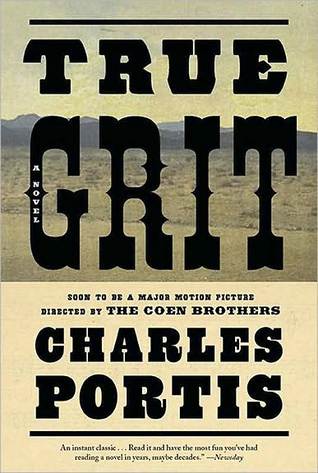
True Grit - Charles Portis

True GritWesterns aren't really my thing.  The exception to this is, possibly, the "weird western" genre I've recently discovered, but I haven't read enough of those to make a solid determination.  However, I can see why westerns do appeal to so many people.  They are, essentially, fantasy without the fantasy.  Instead of wands and shooting spells or slaying dragons or hunting down evil wizards, you've got six guns, pistols fired at ten paces, stopping train robberies, and hunting down the bad guys in the Wild, Wild West.  Maybe with a few saloon girls thrown in for good measure.  True Grit does not contain saloon girls but it does include a quest for revenge, some pistols, outlaws, and even mention of a train robbery, though the robbery itself isn't on the page.

This book, which follows Mattie Ross on a quest to avenge her father by capturing his killer and seeing him hang, was The Deliberate Reader digital book club selection for July, and it certainly did force me to read outside my genre.  That said, the book just didn't agree with me, which is unfortunate, because I can see why so man people like the book, just like I can see why so many people like the genre.  I just didn't.

This has all the makings of a good story, and one that I should like.  A fourteen-year-old's father is killed and she essentially runs away from home to avenge him, recruiting the most hardened federal marshal she can to help her and taking off on a pony called Little Blackie, and then forging ahead on her own when the marshal and a Texas Ranger take off without her, until she can prove that she's going to keep going with them, no matter what.  This is spunk.  This is, I might dare say, "true grit," even though the title itself doesn't refer to Mattie (or does it????) but to the marshal Rooster Cogburn instead.  But there was one thing that really held me back from liking this book, and it held me back in a big way.  What was the thing?  Well...it was the writing.

The story is told as an account given by Mattie long after the events she's chronicling, after most of the cast of characters has passed away.  But having the story told in such a way, so removed from the events it actually relates, has the effect of removing the emotion from the writing.  Scanning the reviews for this book, it looks like I might be in the minority here in a big way, but I found this book extremely flat and emotionless.  The style fit the time period in which the story took place very well, being both succinct and purple in turns, and with a sense that Mattie has a bit of a wry and sometimes black sense of humor looking back at her tale.  But still, it overall came across as flat and unemotional; the few bits of humor couldn't make up for the fact that a scene with a character being trapped in a pit full of rattlesnakes, inches away from plummeting to their death, didn't manage to raise my heart rate even a little bit or make me wonder if said character would survive.  And if the emotion is lacking to the point where caring about the characters is difficult...well, then you've lost me.

Oh well.  Maybe next time.

2 stars out of 5.

Thursday, June 1, 2017

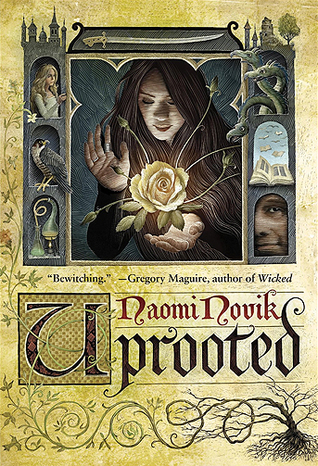
Uprooted - Naomi Novik

UprootedUprooted was the Deliberate Reader book club title for June, and out of all the ones slated for the year, it was the one I was most looking forward to reading.  It had such good reviews and had been on me to-read list for a while, plus I always love a good fantasy.  And let me tell you:

This book was absolutely stunning.

Based in a fantasy that's grounded in Eastern rather than Western Europe, with a heroine named Agnieszka and mentions of Baba Yaga (Baba Jaga), it's a beautiful story about a valley and the girl who saves it.  Agnieszka expects her best friend, Kaisa, to be taken by the Dragon, the magician who is lord over her home valley and who takes a girl every ten years for purposes unknown.  The girls return unharmed but are obviously ruined and end up leaving the valley, always.  But when the time for the choosing comes, the Dragon takes Agnieszka instead, based on what appears to be a budding ability for magic...magic that is desperately needed to keep the Wood, the dark forest that corrupts all it touches and that slowly encroaches on their realm, at bay.

Some reviewers have called Agnieszka a special snowflake.  Well, she kind of is.  She has magic, magic that she has an intuition for as soon as she realizes what it really is that no one seems to have ever seen before.  However, Novik makes it clear through her writing that just because Agnieszka's magic isn't the kind that's in use among the magicians of the realm currently, that doesn't mean it hasn't been seen before, and that it's her connection to the valley that helps to make it so strong.  And Agnieszka is such a likeable character, too.  She's not all sunshine and rainbows; she acknowledges a deep jealousy of Kaisa despite her love of her friend, and she struggles with finding things out even though she sometimes has an intuition for them.  Less imminently likeable is the Dragon.  He's stubborn and mean and seems to be keeping his distance for no apparent reason, except that he is, because if he gets too close to the valley and its inhabitants it's possible the Wood could draw him in, and that would be something terrible indeed.  Woven into both of their characters is, of course, the magic system of the book as well.  In one respect, it revolves around foreign-sounding spellwords, which isn't something terribly innovative, but there are other dimensions, too, which means that it doesn't work the same for every person and each magician featured has their own talents; it seems like any other magician here would have just as easily been deemed a "special snowflake" as Agnieszka, in their own way.

There's a very, very minor romance subplot here that was absolutely delicious, mainly because the sorcerer/apprentice dynamic is one of my favorites (but notably does not extend to other teacher/student relationships, which I find downright creepy).  It's woven so well into the story as a whole, though it did mean that when Agnieszka went away from the valley for a while it read as being a lot slower because there wasn't that developing relationship, even though a lot of interesting and important things actually happened while she was in the city.  And outside the realm of romantic and teaching relationships, Kaisa remains a prominent characters throughout the book, which I didn't expect but really liked.  She becomes such an important person to show the potential and terror of magic and the Wood, and though she and Agnieszka and and Kaisa don't always get along and have their envies of each other, their friendship is deep and true and the book wouldn't have shone nearly as much without it.

The writing is beautiful, the story has good pacing and unfurls in a way that the odds seem insurmountable--I was honestly skeptical that Novik would be able to wrap this up in one book!  The end of the action did seem a bit rushed to me, but there was a wonderful denouement afterwards that wrapped up the characters' paths and left such potential for more.

Someone please point me to the fanfiction archive for this book, because I need more, and I need it now.

5 stars out of 5.