Pages

Showing posts with label psychology. Show all posts

Friday, April 20, 2018

Ghostland - Colin Dickey

Ghostland: An American History in Haunted PlacesThis is not a book of ghost stories.  Let's get that out there right now.  There are some ghost stories in it, yes, of various turns and origins.  However, ghost stories are not the focus of this book.  Instead, what Dickey turns his attention to is the historical and cultural atmospheres that contributed to these stories, as most of them--as Dickey demonstrates--have absolutely zero basis in fact.

The United States has a tumultuous history, and it shows in the ghost stories that populate it.  Dickey digs into a lot of different areas, both geographically and topically, examining such things as: Why aren't there more stories of Native American ghosts, given the violence rained upon them by whites?  Why aren't there more black ghosts in areas that are fraught with dismay and death for Africans or those of African descent, such as former slave markets and places where slaves were tortured?  Why do the details of ghost stories change, sometimes dramatically, over time--things like race, age, and origin all altering on the same ghost?  He answers all of these in turn, and some others to boot.  Though the details vary somewhat, what it all boils down to is that ghost stories reflect cultural hopes and fears at the time they are told, and so the areas that are important at the time of telling are sometimes altered for emphasized in order to emphasize these tensions, whether the alteration is deliberate or not.  For example, a ghost can be a slave in a time when tensions about race and brutality by masters was of cultural importance, but the same ghost can be a white lower-class woman in a time when matters of economic tension are more predominant in the psyche.

Dickey's book works its way from the small to the large, from haunted houses to civic buildings to entire towns and cities and to an idea that our entire country is haunted.  While he touches on some of the places that are particularly renowned for hauntings, such as Eastern State Penitentiary in Pennsylvania, he mostly focuses on places that aren't quite as well known.  He doesn't really explain why he does this, but it seems likely that it's because the less-known places are actually easier to track, as stories might go through fewer permutations if there are fewer people telling the tales.  He also touches on some other areas of ghost stories that might not occur to everyone every day.  For example, by case law in New York State, if a building is said to be haunted it is, by law, haunted--because whether hauntings are a matter of fact or fiction, the belief that a building is haunted affects its value. 

This book had a lot of interesting aspects.  However, because Dickey has a lot of points he wants to make--and many of those points have overlapping and repetitive aspects--none of them are really delved into too deeply, and each point has one or possibly two examples at the most.  I think it would have been interesting to see how some of his theories played out in the context of places said to be more haunted--like the Eastern State Penitentiary, or the White House.  Seeing some of the stories completely debunked was interesting, but then there was no real context for how some of the stories came to be in the first place.  For the Winchester House, there were some rumors started by a paper, but even that can't really indicate the absolute plethora of stories that surround it, and the details are, as Dickey pointed out earlier in the book, what is so very important.  But none of those are touched on.

Overall, a fascinating book, but one that probably could have been a bit stronger in constructing its central argument.  Great for fans of history or fans of ghosts, or skeptics of ghosts!  Or someone who is all of the above.

4 stars out of 5.

Tuesday, January 2, 2018

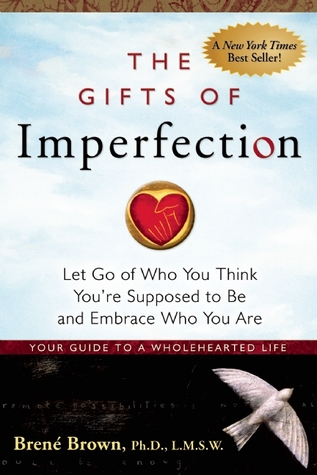
The Gifts of Imperfection - Brene Brown

The Gifts of Imperfection: Let Go of Who You Think You're Supposed to Be and Embrace Who You AreThis is the selection for the Deliberate Reader Book Club on Facebook for 2018, with the focus on an easy-to-discuss nonfiction.  I've actually read one of Brown's books before (Daring Greatly) and so knew what to expect upon opening this one, which predates DG.  I was also pleasantly surprised to find out that it was short, since I was rushing to finish other books before the end of 2017 before I picked this one up.

Brown has spent her career researching shame, and has encountered a phenomenon of people she calls "the Wholehearted" in the process.  Basically, this book is kind of a self-help book on how to let go and relax into living what is, ultimately, a more fulfilling life.  It is not a checklist; anyone looking for one here will be disappointed.  Instead, she goes into the things that she's found common in people who are Wholehearted, and things that get in the way.  She punctuates the book with stories from her life and her research that illustrate her points.

Self-help books are very much not my genre of choice.  However, this wasn't an awful read.  While there are some things that Brown promotes that I don't really buy into (she talks about spirituality and says that it's not about religion, but she certainly deals with it like it is) but there are some good things to keep in mind, such as the importance of taking time to step back, play, rest, and not embracing a culture of scarcity--you know, never having enough time, sleep, beauty, etc.  Instead, try more to embrace what you have, and you'll be happier for it.  Brown herself admits to not liking everything she found in her research; our culture tells us that exhaustion is a sign of hard work and therefore being exhausted is a good thing.  However, it's not good for us as people.  Much of what Brown puts forward here is at odds with American culture and seems like it might be better in line with other places in the world--though of course, nowhere will hit everything she wants.  But beyond all, what's she's emphasizing, sometimes implicitly and sometimes explicitly, is creating and enforcing boundaries.  Letting people push us is how we end up unhappy so much of the time, so being able and willing to put up boundaries, and then stick to them, is vital to overall happiness.

This is a pretty readable book and Brown is an enjoyable author; she writes like it's an easy conversation, which was nice.  However, if you've read any of her other works, you'll probably find this more repetitive.  Daring Greatly focuses on parenting and leading, but she talks about all of the stuff from this book in one way or another, so if you're reading more than one of her books, be aware that you're going to re-tread some ground.  I think this one is probably more outright useful than DG because the things here can be applied to any point of life whereas DG is more focused on parenting and leading, things that I am not particularly interested in; of course, that might be just me.  Still, a good read for this time of year, with things to keep in mind for the year ahead.

3.5 stars out of 5.

Friday, July 7, 2017

Daring Greatly - Brene Brown

Daring Greatly: How the Courage to Be Vulnerable Transforms the Way We Live, Love, Parent, and LeadI read this book for a work event back at the end of May.  Our dean had seen Brene Brown speak at an AACSB conference that my direct supervisor also attended, and suggested that everyone going to this event read portions of the book.  So of course I read the entire thing.

The title comes from a speech by Theodore Roosevelt--the "man in the arena" speech, and the portion reference basically boils down to trying no matter what critics say and being satisfied with yourself.  Brown's research, which centers around shame and vulnerability, basically also boils down to this central premise.  In the book, she goes through the research of people who she considers to be "Wholehearted" and how dealing with shame and vulnerability can shape basically every aspect of your being.  It's not a self-help book; there's no twelve-step plan to fixing anything here.  But there is a lot to keep in mind, and so many things that I could point to, either in myself or others, and go "Yup," in both positive and negative ways.

There are chapters about leading and education, about parenting, about the things we use to shield ourselves from vulnerability and how to overcome them in order to live more fully.  One thing that stuck out to me in that latter chapter?  Disaster planning.  Not "fill up the basement with canned goods" disaster planning, but the sort that you kind of mentally do when you're going down the road with family or friends, having a good time, and then think, seemingly out of the blue, "What do I do if the car crashes and everyone but me dies?  Or if I die?"  And then you start working through it just in case because surely being happy and having a good time has to come with some karmic balance, right?  There's also a lot of good thinking material on how shame and guilt are not the same thing, and how using shame to "motivate" people actually causes them to eventually disengage, whereas guilt and be a real motivator because it speaks to what you did, not who you are, and you can always change what you do.

Is it something I would pick up and read on my own?  No, probably not.  I like things that tend to have a stronger central narrative, even in nonfiction.  But there's a lot of food for thought in here, things to put aside and mull over, to give yourself a mental reminder to consider A when you encounter B, to be a bit more mindful of things that happen in our lives.  I wish there had been a bit more about her actual research in the main body of the book, rather than a few smatterings here and there that she really used to bulk out her philosophy, but I liked it nonetheless.  I did find it a bit hard to finish because the final chapter in the book is about parenting, which doesn't apply to me and I hope never applies to me, but even that gave me something to think about in looking at other people and how they interact with and raise their children.

Overall, I think this was a pretty useful read.  It's not too long, either, so it won't be a huge drain on time if you decide it's not for you.

4 stars out of 5.

Friday, December 2, 2016

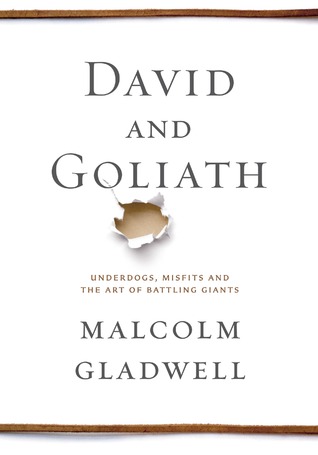
David and Goliath - Malcolm Gladwell

David and Goliath: Underdogs, Misfits, and the Art of Battling GiantsI've read one Malcolm Gladwell book before, What the Dog Saw, which was a collection of articles Gladwell had written over the years that basically examine how people think about different things.  Each article used a couple of different case studies that played into the same theme.  David and Goliath, which was the book for the Deliberate Reader Book Club for November, is basically an expanded version of that.  This book is about how apparent underdogs actually usually have unapparent strengths, and how the "giants" the underdogs face off against typically have weaknesses that can be used against them.  He starts with examining the actual "David and Goliath" story and putting forth a few historical facts and modern theories that make clear that the story isn't what it initially seems to be--and then he expands upon that theme throughout the rest of the book.  It's divided into three sections, which each examines a different aspect of his argument.  Each chapter builds up to the "argument" for that part, and uses several different examples twisted together to do so.

This is a very readable book, but I think its third part was its weakness.  The first two parts are more obviously about "the art of battling giants" than the third, which is more about how apparent power isn't always everything.  Though that argument makes sense in the whole structure of the book, I found myself unconvinced about how Gladwell went about it.  In the "David and Goliath" story, Goliath's weaknesses--enumerated by Gladwell in the foreword--contributed to his downfall.  In the book, however, it seemed like Gladwell's examples were more just about how the "giants" weren't as tough as they thought, not how the "Davids" of the equation actually went about defeating them.  I think, in a way, this might have been because the argument went on for a bit too long.  The point Gladwell was trying to make here was made perfectly well in the earlier parts of the book, though not as explicitly.  When he tried to make it more explicit using more examples that he hadn't brought in before, I think it got a bit lost in the muddle.

The examples themselves are this book's real strength, though.  Especially the people the examples feature.  Each chapter has two or three "main characters," real people who were involved in the events that Gladwell relates.  While some of the background info, which tends to include technical explanations and some data sets and figures, can get a bit dry, the people in the examples really bring the story home and make their experiences shine, and therefore make the point that much clearer.  Gladwell does an excellent job of interweaving the stories and the background to make what could be some very dry and academic info into something that's a pleasure to read, with examples that stick in the mind and stick the point there with them.  It's nonfiction, but it's not heavy, and that was a very good reason for Sheila to pick it as the book club selection for the month.  I'm looking forward to discussing it, and I would definitely be open to reading another Gladwell book in the future, though I don't think they're something I would seek out unless the topic was one that specifically interested me.

3.5 stars out of 5.