Pages

Showing posts with label japan. Show all posts

Friday, August 25, 2017

Unbroken - Laura Hillenbrand

Unbroken: A World War II Story of Survival, Resilience, and RedemptionUnbroken was my latest audiobook, following Missoula as a selection to listen to while walking to and from work some days and while running.  It had been on my to-read list for a while, but wasn't high-priority, so it seemed like a good audiobook choice.  It's the story of Louis Zamperini, an American bombardier in World War II who competed in the 1936 Olympics as a runner, was expected to be the first person to break the four-minute mile, and who ultimately survived the crash of his plane, an extended time in a life raft, sharks, and a series of prison camps in Japan and its territories, including under the reign of a nightmare of a man known to the prisoners as The Bird.  There's also a little nod to Hillenbrand's other book, Seabiscuit--namely that, upon seeing Louis run, someone said that Seabiscuit was the only one that could beat him.

It's an incredible story; Louis had a bit of a misspent youth, and his brother (who was sometimes his co-conspirator, though Louis seemed to be the only one to ever get caught) helped straighten him out by turning him into a runner.  Louis ended up competing in the 5,000 meter event in the 1936 Olympics in Berlin, running in an event that he'd only practiced a few times before his arrival in Germany.  Though he didn't medal, he seemed to be set for the next Olympics as a competitor for the mile--until the US was pulled into World War II and Louis was drafter into the Army Air Force, where he'd briefly enlisted before.  When his plane crashed during a search and rescue mission, Louis and two crewmates survived and found themselves stranded in a life raft that was abysmally poorly provisioned; the three men only had two bars of chocolate and a few cans of fresh water.  Eventually, two of them survived to be picked up...by a Japanese ship, and they promptly became prisoners of war, except without any of the rights accorded to prisoners of war by the Geneva Convention.  Spending time in three different prison camps and never registered with the Red Cross, Louis was lost; his family thought he was dead, and at times, he probably wished he was.

This is a truly amazing story, but I'm ultimately not sure that "Unbroken" is a good title for it.  Louis survived his imprisonment, yes, but he was very, very broken after it.  With a nasty case of PTSD that led him into alcoholism, an obsession with finding and killing The Bird, and nightmares that once had him waking up strangling his wife, Louis certainly didn't walk away from his imprisonment in Japan "unbroken."  Additionally, while it's certainly a story of survival and resilience, I'm not entirely sure where "redemption" plays into it, unless you're counting it as in "The Redeemed Captive" sense, where it means being brought back.  Louis didn't really have anything to be redeemed from; is Hillenbrand trying to get at his religious conversion and eventual comeback from his PTSD, at least to some extent?  Because that's not something that he really needed to be "redeemed" from.  So, yes, probably not the best titling there.

It's an intriguing book and story of survival, but it does drag on a bit.  Every single detail that Hillenbrand seems to have been able to unearth is listed here; every beating, every beating that other prisoners suffered, multiple accounts of how Louis' family was pining away in America for him, though nothing ever changed between these sidebars until it was discovered Louis was, in fact, alive.  Additionally, the final part of the book that detailed Louis' life after the war seemed to drag on.  It really hammers home that PTSD is not a "new" thing, as some people make it out to be, but it also goes into sometimes agonizing detail about what The Bird was up to and how he didn't feel responsible for his actions or that said actions were really bad to begin with.  I understand wanting to have the story be "complete," but it seemed so much slower and dragged on so much more than the earlier parts of the book.  This clearly isn't the "main" story and I feel like it could have been wrapped up in a much shorter section than it was truly given.  It was probably meant to hammer on the "redemption" theme that Hillenbrand was apparently going for, but I really wasn't feeling it.

Overall, this was a good book, but it's nothing I'd be reaching for again.  The pacing was strange and it sometimes seemed over-sensationalized; it was an amazing story on its own, so it didn't really need all of the "look at how amazing this is!" hammering that Hillenbrand laid on it.  It's also not a story of someone remaining unbroken; everyone has a breaking point, everyone, and Louis definitely hit his during his captivity.  His survival was remarkable, but I think Hillenbrand actually blew it up and made it too "larger than life" for it to come off as sincere here.

3 stars out of 5.

Saturday, December 31, 2016

Pull Me Under - Kelly Luce

Pull Me Under: A NovelPull Me Under was my Book of the Month selection for December.  I wasn't really thrilled with any of the selections, but I wanted to get two other books, and you can't skip the month and still do that, so I went with Pull Me Under.  The story here is about Rio, originally Chizuru, who is half American and half Japanese, and spent the first half of her life there--though eight years of that time was spent in a juvenile detention facility after she stabbed and killed a classmate with a letter opener.  After she was released from the center, she moved to the United States, changed her name to Rio, and essentially erased her entire past.  Now married and with an eleven-year-old daughter, Rio Silvestri is completely disconnected from the life she once led...

...until she gets a letter that her father, a Japanese National Treasure and renowned violinist, has died.  Rio decides to return to Japan to attend the funeral despite the fact that she and her father haven't spoken in at least eighteen years.  She leaves her husband and daughter behind in the US, not wanting them to realize who she was in her past life, and jets off for the funeral.  Once in Japan, she runs into Danny, one of her former teachers, and basically invites herself along into Danny's life and onto a pilgrimage to eighty-eight temples that Danny has sent herself to doing.  Meanwhile she continues to avoid telling her husband what's really going on, despite his obvious frustration and knowledge that something is going on.

We know from the beginning that Rio killed someone, and that she doesn't really feel like a murderer.  There's a sense of disconnect from the actual murder and its aftermath and what her life has become.  That said, I still didn't like Rio.  She has this real sense of righteousness about her and is, again, a very selfish character.  I understand her fear that her husband might not want anything to do with her if he knows about her path--that I get.  But when she returns to Japan and forces herself into Danny's life, when Danny clearly does not want her there, and then inviting other people along, too...that was incredibly inconsiderate and very selfish of her.  She holds no consideration for other people and how they might feel regarding her father, and instead seems to feel that she should be the center of this trip even though she and her father have been completely out of touch for more than half her life.

There was some lovely writing here, and I feel like Luce got a real sense of Japan for someone like myself who hasn't ever been there.  I don't think Luce is a bad writer, not at all, and I liked how the story was constructed, all of the supporting characters, and how unique everything was.  I just didn't like Rio as a character or a person, finding her far too selfish for my tastes--refusing to be there for her daughter because her daughter was "testing" her, feeling indignation that her husband is upset that she was hiding her past for their entire marriage, etc.--and that really dragged down the book as a whole for me.

3 stars out of 5.

Wednesday, December 14, 2016

The Samurai's Tale - Erik Christian Haugaard

The Samurai's TaleFor my 2016 reading challenge, there was a category of "A book chosen for you by your spouse, partner, sibling, child, or BFF."  This was the book my boyfriend chose for me to read. He really enjoyed it when he was younger, evidently, and it was a nice short title to help fill out the list, so it worked out pretty well for the category.

The story revolves around Taro, a boy born as nobility in the Warring States period but reduced to the status of a servant when the rest of his family is killed.  But Taro still dreams of being a samurai and gladly accepts his new "captor" as a sort of father figure and works his way up the ladder to gain warrior status, which is actually really weird in retrospect.  There is no revenge factor here, and one would think that there would be.  The early chapters are very episodic and focus on specific events that influence Taro as he grows up; later the chapters gain a more continuous flow and cover the story of Taro's role in an ongoing conflict.

Taro is, of course, good at everything he does and all good and wise people like him.  Only evil people are his enemies.  He is also made out to be morally superior to everyone around him.  While most samurai cut off the heads of their defeated enemies for proof and glory, Taro views the practice as despicable and would never dream of such a thing.  Now, I'm not saying we should encourage teenage boys (who are clearly the audience for this; it was also obviously written in the period before YA became a thing, and so it includes a weird mix of middle-grade and more adult content, but is missing the tropes of modern YA) to chop of people's heads, but this characterization doesn't really fit Taro's time or place, or the position to which he aspired.

Overall, this wasn't really a great book for me.  While I liked some of the episodes, I felt like the whole thing felt kind of off in regards to authenticity of characters and setting.  However, I can definitely see how this acted as a "gateway" book for my boyfriend, who has gone on to have a voracious appetite for James Clavell's Asian Saga books.  It has a flavor to it that I can see being appealing, though the writing itself wasn't my cup of tea.  It has the feel of a written oral history rather than a story written for a novel form with the simple language, limited language, etc. and those have never been my favorite.

2 stars out of 5.

Saturday, October 22, 2016

Shutting Out the Sun - Michael Zielenziger

Shutting Out the Sun: How Japan Created Its Own Lost Generation
Shutting Out the Sun is really about Japan in the first decade of the 2000s, and as such parts of it might be just a tiny bit outdated.  However, there's still some really interesting stuff in here.  The thing is, I think Zielenziger divided the book into two parts.  A very interesting, well-written first part, and a second part that's basically just economic info and isn't as good for reasons I'll discuss more below.

The first part of the book really focuses on the phenomenon of hikikomori, which is a mental health epidemic (Is epidemic too strong a word?  I don't really think so, but maybe.) affecting primarily young men in Japan, where the sufferers shut themselves away, refusing to leave their rooms for months or even years, and refusing to let anyone else see them, as well.  The cause seems to be rooted in what amounts to a form of social anxiety that's brought out because Japan's social constructs are very rigid and community-based, and there's not a lot of ways to exert one's personality.  Zielenziger even points out that things that Westerners would normally count as asserting one's personality, such as unusual clothes, collections, etc., tend to be just another way of fitting in with a certain social group in Japan.  In this part of the book, Zielenziger makes a point to talk to a lot of Japanese citizens who either identify as hikikomori or who study and try to help the hikikomori.  In his introduction, he even made a point to say that he felt a need to include as many Japanese voices as possible because, as an outsider and a Westerner to boot, he couldn't really get a grasp on the hikikomori phenomenon as well as those who are "inside" Japanese society do.  I thought this was a very good point, and was happy to see that Zielenziger did such a good job with this.  I also particularly liked his chapter on women in contemporary Japanese society, and how careers, marriage, and birth control are handled; this was another chapter in which I think there were a good number of Japanese voices to help give us outsiders a look at what's really going on in Japan.

But then we hit the second part of the book.  In the second part, Zielenziger tries to make an argument for the economic and social issues that have formed an atmosphere in which young men can shut themselves away from society and the national birth rate can plummet because women refuse to have children.  In the second part of the book (roughly the second half; there is no real "part" division built in) the Japanese voices nearly vanish.  Zielenziger still has a lot of citations and there's definitely some research here, but it's pretty much all from a Western point of view and, though he does make an attempt to point out American imperialism towards the end, it's somewhat of a weak one and lets the West in general and the United States in general off very lightly for contributing to Japan's current situation.  Granted, many social constructs play into the social problems now facing Japan--but if you're going to make an argument that economics is essentially behind the social problems, then you really need to put a heavier does of the blame on the country that forced the economic situation on Japan in the first place.  That would be us, the good ol' US, and Japan probably doesn't have as much freedom to just "ditch" the US as Zielenziger implies.  Because of the lack of voices in the second half of the book, it does come off as very superior-sounding.  Very much, "Well the west is like this, why can't Japan just change to be like this, too?" with only a passing nod to the conditions that do prevent Japan from just adapting Western attitudes.  And then, of course, there's this kind of expression that the "Western" way is the only way and a presenting things as globalization when they're really imperialism.  Yes, globalization is a real force, but the things that Zielenziger brings up here more often than not fall into imperialism instead.

Overall, some interesting information and interviews to begin with, but the second half is a work I'm very leery of praising.  I liked this book overall, because of that first half, but have some reservations about the second and don't feel confident giving it more than...

3 stars out of 5.

Tuesday, November 5, 2013

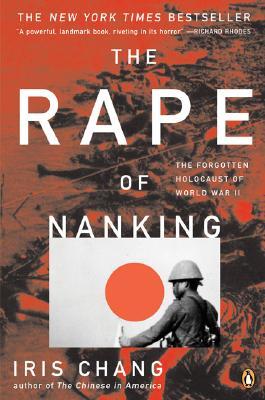
The Rape of Nanking - Iris Chang

The Rape of NankingThere's a saying that those who don't study history are doomed to repeat it.  There's also a saying that those who do study history are doomed to watch others repeat it.  Being a history major at a university that is very politically-focused, this is frequently made blatantly clear to me.  My politically-minded classmates wander about arguing foreign and domestic policy, spatting about how we should deal with Syria, or Egypt, or whatever crisis is in the news that day.  My historically-minded classmates and I wander about going, "But isn't it like when...?"  But it doesn't matter.  No matter how similar a situation is to the past, there will always be differences, and those differences will always stall action.  So, when dive into this book, let's keep a few things in mind, shall we?

-Iris Chang was not, by trade, a historian.  She was a journalist.  This means a few things.  Journalists, by nature of their work, can be very, very skilled at research, finding stories, and putting them together.  They're typically not so great at contextualizing those stories.  I'll talk more about this later.

-Chang was also the Chinese-American daughter of two Chinese immigrants who fled China during WWII with their families.

-Guilt is a slippery animal, and can't always be placed where we would like it.

-History is never one-sided, and in modern times, it is not written exclusively by the victors.

That all said, some people will not like what I have to say here, but I still feel a responsibility to say it in the interests of being as neutral as possible.

Okay, so, this is a good book for people who are not familiar with the Rape of Nanking and its place in WWII, but want to learn about it.  It's a narrative history, but not a terribly scholarly one; while there are notes included at the end of the book, there are no footnotes or endnote numbers directing you to those notes, and there's no way of knowing whether or not you'll be able to track down a reference for the piece of information that interested you.  This probably comes from Chang's journalistic, rather than historic, background.  That's not a bad thing.  "Popular history" books are all the rage these days, and I don't see anything wrong with that; they get people interested in history.  We just have to keep in mind that they're not as scholarly as some other books, and consequently don't usually analyze events as closely as they could.  For those wanting a quick overview of an event, this is fine.  For those hoping for a complete understanding, however, it can be problematic.  Chang's book is immensely readable, and I went through it in about two days.  It gives a quick history of what Chang apparently sees as the Japanese culture that led to the Rape, and then covers the lead-up to the Rape, the Rape itself, and the aftermath, as well as telling what foreign individuals did and what the rest of the world knew about the events as they were happening.  It's a good overview.  In the epilogue, though, it gets a bit preachy.  Chang talks about how Japan needs to sever ties with its past, acknowledge that the Rape was wrong, and embrace a new future.  She talks about that a lot.  And while she's not wrong, necessarily, she leaves out a lot of considerations.

First, as I mentioned above, we need to consider Chang's background.  She's Chinese-American and was raised in the Midwest of the USA, in the midst of an extremely individualistic culture.  Eastern cultures, such as China, Japan, and India, tend to be much more collectivistic than western ones.  That's not bad; it's just different.  It means their values are placed on the good of of the many, instead of the good of the few.  It's apparently worked for them for thousands of years, so I don't see a need to judge that.  What I do think we need to consider, though, is how something like the Rape of Nanking might be viewed in different cultures.  I'm not Japanese; I've never been to Japan.  I certainly can't speak for them.  However, as someone with a background in history, I have to say that when the Japanese say they saw what they did as necessary...well, they might not be lying, like Chang claims they are.  In hindsight, it's easy to see how horribly awry Japan's plans went.  But in the heat of the moment, it's also very easy to see how the Japanese army, massively outnumbered in most cases in Nanking, could have seen the situation as "them or us," and chosen, as most of us would, "us."  Chang mentions on repeated occasions that the Nanking natives, even unarmed, could have easily overwhelmed the Japanese through sheer numbers alone.  As horrible as the Japanese actions in Nanking were, and as reprehensible as they are from an outside perspective over half a century later, it's easy to see where, at the time, those actions might have seemed necessary for self-preservation.  (And let me clarify--I'm talking mostly about the killing, here.  The rampant raping and torture can't really be excused, but Chang does offer a pretty good psychological analysis for why this might have happened in the epilogue, so I'll let that speak for itself.)

Second, lets consider the aspect of guilt.  Who is guilty for the Rape of Nanking?  There are some easy to answers to that, and some not-so-easy ones.  It's hard to tell who knew what, who ordered what, who did what, especially when many documents have been destroyed and many victims refuse to speak.  There is definitely guilt to be laid out, those most of the people deserving of it are probably, by this point in time, dead.  Then there is the idea of collective guilt: that the youth of today's Japan are somehow responsible for the Rape of Nanking because they deny its reality and refuse to make reparations to the victims.  There's a whopping problem with this analysis, and that's that you can't hold Japan's youth responsible for denying the existence of something they don't know about.  I'm not sure how much has changed since Chang's book came out--it was published in 1997--but in the epilogue she talks at length about how the events of the Rape of Nanking have been censored from school curriculum, deleted from books, and shunned in the public sphere.  How are you supposed to correct something you don't know about?  Some people claim to have seen Bigfoot and to have evidence of his existence, but that doesn't mean I believe them.  While the Rape of Nanking isn't Bigfoot, and we know that objectively, it might be hard to comprehend in an environment where it has been treated as Bigfoot for decades.

My other main problem with this is that, well, Chang is American.  We Americans find it very easy to cast judgment against other peoples and refuse to do the same to ourselves.  Chang criticizes Japan for enshrining some of the people who are responsible for the Rape of Nanking and practically worshipping them.  I'm not going to get into the worshipping thing; that's a culture issue.  But the enshrinement of war criminals I'm not afraid to tackle.  Chang criticizes the emperor of Japan for knowing about the Rape and doing nothing about it--perhaps even approving of it.  Fine.  But if we're going to go down that path, we have to keep in mind that that's not just a Japanese trait.  In Washington DC, the Vietnam memorial contains the names of soldiers known to have committed atrocities in Asia, such as cutting off the ears of victims for trophies.  The Enola Gay, the plane that dropped the first atomic bomb, is preserved as a national treasure at the National Air and Space Museum's annex.  We condemn Iranians for flooding to the street chanting against the USA, but when Osama bin Laden was killed, thousands flooded the National Mall, White House, and 9/11 Memorial Site chanting "USA, USA" in a way that is unnervingly similar--we were, after all, celebrating someone's death.  I am not saying that enshrining war criminals is worthy of praise.  But I am saying that those in glass houses shouldn't throw stones, and if you're going to write about history, even an isolated event such as the Rape of Nanking, you still have to consider its place--and your conclusions--in a larger context.

Chang's book is a good introduction to the Rape of Nanking, but it is weak in the historiographical elements and modern context that are vital to actually understanding historical events in their entirety.  I enjoyed reading it, but I am a bit worried about the message that it could leave someone who read only this book and considered it the "all you need to know about the Rape of Nanking" book.  That message seems to be that the Chinese are all that is good, the Japanese are all that is bad, and the current generation needs to pay for the sins of their forefathers in order to move forward to a better world.  But if we're hoping to move forward to a better world, wouldn't holding grudges not be the way to go?  Honestly, the Japanese government as a whole probably should make some sort of apology or reparation to remaining survivors or the families of victims of the Rape of Nanking--but I don't think we should make the leap that this would magically solve the problem, and to some degree that seems to be what Chang implies.

3 stars out of 5.