Pages

Showing posts with label asia. Show all posts

Monday, June 11, 2018

The Unimaginable - Dina Silver

The UnimaginableA beautiful cover and convenient timing left me in the mindset that The Unimaginable was going to be something like Station Eleven--not in topic, because the book summary made it very clear that this was nothing like Station Eleven, but for some reason I had it in my mind that this would have the same beautiful writing, construction, and love of life that Station Eleven contained.  Unfortunately, this was not the case.

The story is about Jessica Gregory, who moves to Thailand in the wake of her mother, who she never really got along with.  She has a job teaching English and gets another job at a bar.  After a few months of this she has three weeks of vacation and decides to look for an adventure by crewing on a boat for a long distance sail, despite having no sailing experience or really any sense in her head at all.  She also falls immediately and conveniently in love with a man almost twice her age who really doesn't want anything to do with her, but of course as soon as she bats her eyelashes at him he falls in love with her, too, despite being in mourning for his deceased wife, and takes her on as crew essentially so he can get around to boning her.  And then, of course, come the pirates.

The writing here is sloppy and the romance is eyeroll- and gag-worthy.  I am an avid reader of romance, but this is not good.  The chemistry is nonexistent, the sex scenes sloppy and deserving of nothing more than cringing.  Despite going into detail, it's ultimate unclear whether Jessica--our narrator--even gets to have a decent orgasm.  Poor thing.  The danger, despite being very real, is completely overblown.  And though the entire book builds up to it from a brief--very brief--prologue, it only lasts about fifteen pages and then is over, and the focus of the book is back to Jessica mooning over Grant, in a relationship that seemed more than a little skeevy to me, mainly because Grant just kept putting Jessica off and wouldn't emotionally commit to her, even for a little bit, but was perfectly willing to fuck her all the way across the Indian Ocean.  Ew.

This is also one of those books where the heroine, despite wanting adventure in the great wide somewhere a la Belle, promptly gives up everything when she meets the hero.  This bothers me in any context, but in contemporary books more than in historical ones, because in times like the Regency era women were taught not to have expectations or dreams and, if they did, to give them up to men.  A modern woman should know better than this.  If what Jessica had wanted was to be a wife and nothing else, then fine--that's a woman's prerogative.  But to claim she wanted adventure and to teach and see the world and not be one of the women from her hometown who just got married and gave up on life, and then to immediately abandon everything in favor of mooning over a guy who has literally said three sentences to her.

The pacing is also awful, and the writing itself is terrible.  It's full of sentences like, "And the, on the Imagine, came...the unimaginable.  You can just tell that Silver wants us to gasp and clutch our pearls and be so dismayed by the drama, but I really didn't care about any of the characters and so this ploy was completely unsuccessful.  There is only one remotely dismaying thing that happens in the book, and it has nothing to do with Jessica or Grant.

There is an author's note at the end of the book about where the story--and all of the character names--came from.  While the origins are remarkable, tragic, and worthy of their own story, this particular story did not do them justice, not in any way.  I would not recommend this, nor will I be picking up anything else by this author in the future.

1.5 stars out of 5, and that's only for the setting.

Saturday, August 5, 2017

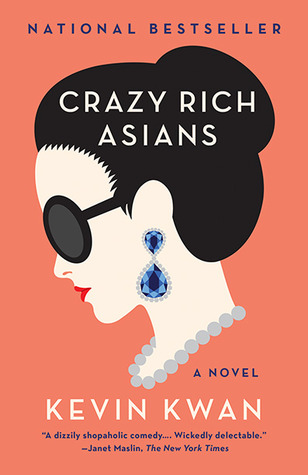
Crazy Rich Asians - Kevin Kwan (Crazy Rich Asians #1)

Crazy Rich AsiansMy first impression after finishing this book is that there should be a comma in the title.  Or maybe not.  Indeed, these Asians are crazy rich, with crazy being used as an adverb modifying "rich" to show the degree of their wealth.  But they're also crazy as in crazy, meddling and pushing and driving people away.  Wow.

This book is the story of several intertwined Singapore Chinese families and one normal Americanized Chinese girl who inadvertently stumbles into the middle of them.  Rachel Chu is thrilled when her boyfriend Nick invites her to go to Asia for the summer--apprehensive, because she's never met his family before, but also excited, because she suspects this might be leading up to a proposal.  But what she didn't expect was that everyone knew who she was before she even arrived, and they're ready to drive her out in order to preserve Nick for someone they consider one of their own.  Rachel has few friends in Singapore, and though she tries to maintain firm, the forces against her sometimes seem insurmountable.

This was a very good book.  It is, at its core, a family drama, but it's funny.  It's kind of like Gossip Girl or something similar, but the characters are adults instead of teenagers.  The drama is over the top, yes, and is in no way supposed to be representative of all Chinese society or Singaporean society or Asian society in general.  But even when the characters are at their most back-stabbing and undermining, the drama still manages to be amusing, mainly because everything is so over the top.  For a while, I was concerned that Kwan was really going to bring down the book with a realistic-but-unhappy ending; fortunately, that wasn't the case.  Everything else was so crazy here, it didn't make sense to have a downer ending that suddenly fit the facts, so I'm glad that Kwan went the way he did.  The writing is extremely readable, and there are lots of terms that are thrown in and foot-noted so that you know what they are.  There's educational aspects about food, drink, and customs among the insanely rich in Singapore.  Rachel, meanwhile, serves as our bridge character--the one who helps bring us into this ridiculous world while maintaining a sense of stability and normalcy.  A character like this was definitely needed, or else all of the crazy might have just been too much.

It does verge on being too much at some points, and I had some doubts about some of the characters, like Araminta, so I'm not sure all of their intentions were clearly marked in the end.  Close to the end, there's also a giant infodump to clear up a little plot involving Rachel's background and Nick's family's attempts to get rid of here.  That really dragged down the pacing at a point that really needed it the least, the climax--the last thing you want to do at the climax of your story is dump in a bunch of background information that disrupts the flow, and that's exactly what happened here.  Still, considering this was a debut novel, it was remarkably good!  Such a funny story and family drama, with good central characters who help anchor all of the crazy ones and lend a sense of "down to earth" that was really needed to balance the plot.  I am definitely looking forward to reading more from Kevin Kwan!

4 stars out of 5.

Wednesday, January 11, 2017

The Windup Girl - Paolo Bacigalupi

The Windup GirlThis is the second Bacigalupi book I've read, the first being The Water Knife.  He seems to delight in writing stories that detail all of the ways that humanity is fucking itself over and what might happen after that.  TWK focused on the water crisis in the American west.  The Windup Girl is about genetically modified organisms.

As with TWK, TWG has several main characters.  Anderson Lake is living in Thailand and working undercover for an American food company called AgriGren.  He's investigating varieties of foods that have started popping up in Thailand (which has restrictions against dealing with the big food companies) because something is not quite right about them, and he suspects a Western geneticist (or generipper) of working with Thailand's seed bank on bringing the foods back into existence.  (Because, of course, no one in Thailand could do this themselves.)  As part of his cover, he runs a factory that makes kink springs--this is a spring-powered world, as apparently most gasoline has been used up, and there are strict carbon emission restrictions in place.

Our other big characters are Emiko, the titular windup girl.  Windups are genetically engineered people created by the Japanese to fulfill different tasks.  Emiko was built as a secretary/assistant/all around pretty girl, and lived a life of luxury until her owner abandoned her in Thailand instead of paying to bring her back to Japan after a business trip.  Now she works at a strip joint/brothel where she is raped onstage nightly by one of her fellow performers.  She's also reviled by the people of Thailand in general because they believe windups have no souls.  Tan Hock Seng is Anderson Lake's factory manager who's using his position to advance himself, and Jaidee, the head of a band of "white shirts" who work as enforcers for the Environment Ministry and are the arch enemies of the Trade Ministry.

This did not appeal to me as much as The Water Knife did.  Something about the passion of the characters that moved TWK was not really present in The Windup Girl.  Emiko yearns to be free, but that's about as passionate it gets.  Even Jaidee, with his hatred for the Trade Ministry and his love for the people of Thailand, doesn't seem to embody the same passions that the characters in TWK did.  The world here is fascinating; the genetically-modified organisms that populate it, from the plants to the megadonts (like elephants, but not) to the windups (who also come in many-armed varieties, for factory for field work, and presumably other types, too) and more.  But what initially seems like a strong central plot revolving around Anderson's search for the new food and the generipper behind it and Emiko's quest for freedom, seems to quickly get derailed into a plot that more revolves around the de-evolution of relations between the different Ministries into a scramble that will determine the country's future.  While this makes sense for the character of Jaidee, it doesn't seem to really "fit" the other characters, who sort of all end up along for the ride.  And while Emiko ultimately is a catalyst, and I thought that part worked well, I feel like this just missed the boat for me overall.  It did win a Hugo and a Nebula, though, so clearly not everyone feels the same way.  The ending is powerful and open enough that it lets the reader imagine the different ways the story might go from there, but again...the body of the book just didn't capture me.

3 stars out of 5 for wonderful world building and a good catalyst and ending, but an unconvincing body.

Wednesday, December 14, 2016

The Samurai's Tale - Erik Christian Haugaard

The Samurai's TaleFor my 2016 reading challenge, there was a category of "A book chosen for you by your spouse, partner, sibling, child, or BFF."  This was the book my boyfriend chose for me to read. He really enjoyed it when he was younger, evidently, and it was a nice short title to help fill out the list, so it worked out pretty well for the category.

The story revolves around Taro, a boy born as nobility in the Warring States period but reduced to the status of a servant when the rest of his family is killed.  But Taro still dreams of being a samurai and gladly accepts his new "captor" as a sort of father figure and works his way up the ladder to gain warrior status, which is actually really weird in retrospect.  There is no revenge factor here, and one would think that there would be.  The early chapters are very episodic and focus on specific events that influence Taro as he grows up; later the chapters gain a more continuous flow and cover the story of Taro's role in an ongoing conflict.

Taro is, of course, good at everything he does and all good and wise people like him.  Only evil people are his enemies.  He is also made out to be morally superior to everyone around him.  While most samurai cut off the heads of their defeated enemies for proof and glory, Taro views the practice as despicable and would never dream of such a thing.  Now, I'm not saying we should encourage teenage boys (who are clearly the audience for this; it was also obviously written in the period before YA became a thing, and so it includes a weird mix of middle-grade and more adult content, but is missing the tropes of modern YA) to chop of people's heads, but this characterization doesn't really fit Taro's time or place, or the position to which he aspired.

Overall, this wasn't really a great book for me.  While I liked some of the episodes, I felt like the whole thing felt kind of off in regards to authenticity of characters and setting.  However, I can definitely see how this acted as a "gateway" book for my boyfriend, who has gone on to have a voracious appetite for James Clavell's Asian Saga books.  It has a flavor to it that I can see being appealing, though the writing itself wasn't my cup of tea.  It has the feel of a written oral history rather than a story written for a novel form with the simple language, limited language, etc. and those have never been my favorite.

2 stars out of 5.

Saturday, October 22, 2016

Shutting Out the Sun - Michael Zielenziger

Shutting Out the Sun: How Japan Created Its Own Lost Generation
Shutting Out the Sun is really about Japan in the first decade of the 2000s, and as such parts of it might be just a tiny bit outdated.  However, there's still some really interesting stuff in here.  The thing is, I think Zielenziger divided the book into two parts.  A very interesting, well-written first part, and a second part that's basically just economic info and isn't as good for reasons I'll discuss more below.

The first part of the book really focuses on the phenomenon of hikikomori, which is a mental health epidemic (Is epidemic too strong a word?  I don't really think so, but maybe.) affecting primarily young men in Japan, where the sufferers shut themselves away, refusing to leave their rooms for months or even years, and refusing to let anyone else see them, as well.  The cause seems to be rooted in what amounts to a form of social anxiety that's brought out because Japan's social constructs are very rigid and community-based, and there's not a lot of ways to exert one's personality.  Zielenziger even points out that things that Westerners would normally count as asserting one's personality, such as unusual clothes, collections, etc., tend to be just another way of fitting in with a certain social group in Japan.  In this part of the book, Zielenziger makes a point to talk to a lot of Japanese citizens who either identify as hikikomori or who study and try to help the hikikomori.  In his introduction, he even made a point to say that he felt a need to include as many Japanese voices as possible because, as an outsider and a Westerner to boot, he couldn't really get a grasp on the hikikomori phenomenon as well as those who are "inside" Japanese society do.  I thought this was a very good point, and was happy to see that Zielenziger did such a good job with this.  I also particularly liked his chapter on women in contemporary Japanese society, and how careers, marriage, and birth control are handled; this was another chapter in which I think there were a good number of Japanese voices to help give us outsiders a look at what's really going on in Japan.

But then we hit the second part of the book.  In the second part, Zielenziger tries to make an argument for the economic and social issues that have formed an atmosphere in which young men can shut themselves away from society and the national birth rate can plummet because women refuse to have children.  In the second part of the book (roughly the second half; there is no real "part" division built in) the Japanese voices nearly vanish.  Zielenziger still has a lot of citations and there's definitely some research here, but it's pretty much all from a Western point of view and, though he does make an attempt to point out American imperialism towards the end, it's somewhat of a weak one and lets the West in general and the United States in general off very lightly for contributing to Japan's current situation.  Granted, many social constructs play into the social problems now facing Japan--but if you're going to make an argument that economics is essentially behind the social problems, then you really need to put a heavier does of the blame on the country that forced the economic situation on Japan in the first place.  That would be us, the good ol' US, and Japan probably doesn't have as much freedom to just "ditch" the US as Zielenziger implies.  Because of the lack of voices in the second half of the book, it does come off as very superior-sounding.  Very much, "Well the west is like this, why can't Japan just change to be like this, too?" with only a passing nod to the conditions that do prevent Japan from just adapting Western attitudes.  And then, of course, there's this kind of expression that the "Western" way is the only way and a presenting things as globalization when they're really imperialism.  Yes, globalization is a real force, but the things that Zielenziger brings up here more often than not fall into imperialism instead.

Overall, some interesting information and interviews to begin with, but the second half is a work I'm very leery of praising.  I liked this book overall, because of that first half, but have some reservations about the second and don't feel confident giving it more than...

3 stars out of 5.

Wednesday, August 24, 2016

Eve of a Hundred Midnights - Bill Lascher

Eve of a Hundred Midnights: The Star-Crossed Love Story of Two WWII Correspondents and their Epic Escape Across the PacificI recently realized I haven't read a lot of nonfiction this year.  This is actually kind of strange for me because I really like nonfiction, and Eve of a Hundred Midnights is a great example of why.

This is the true story of two news correspondents during WWII.  The first, and main one, is Mel Jacoby, who was a relative of the author's.  Mel worked for his college newspaper and went to China on a study abroad during his junior year, at which point he absolutely fell in love with the country.  After his graduation, he found his way back, working as a reporter for a propaganda station in China's wartime capital.  He continued to move around in various reporting capacities, coming and going from different points in Asia for several years.  Eventually, he convinced a girl, Annalee, who had also worked at the college newspaper, and who he had connected with during a stop back in the United States, to also move to China in a news capacity.  But as the war intensified, Mel ended up stationed in the Philippines, and Annalee ended up joining him there and the two got married.  And then the United States suddenly joined the war, and the two found themselves stuck in the islands, with the Japanese army--who were likely to kill Mel if they caught him--growing ever closer.

This book has a lengthy subtitle, "The Star-Crossed Love Story of Two WWII Correspondents and Their Epic Escape Across the Pacific."  Well, that's part of the story.  It's not all of it, and it's really not even most of it.  The actual escape across the Pacific takes up a relatively small part of the book, and it's probably actually one of the most uneventful portions.  It must have been nerve-wracking at the time, I'm sure, but in retrospect, with more than a half a century between us and the story, it wasn't nearly as exciting as reading about dodging falling bombs in China.  The book also isn't really the story of two star-crossed lovers.  First off, star-crossed implies there was something keeping them from each other, and there wasn't.  Second, Annalee is NOT very prominent in this book.  The focus is definitely on Mel, which is understandable, given the author's relation to him, but it's a bit misleading to make it out like Annalee was more of a player than she was.

Most of the book is really about Mel and how he ended up in Manila prior to the US retreat and Japanese army's arrival.  It's a very interesting story, about living in a war capital, navigating the different censors and political bodies, and seeing war grow ever closer, all the while trying to report the news in a way that no one back home was actually doing.  I really enjoyed this, because it was a perspective that we don't usually get.  Lascher includes a hefty reference section in the back, and it's a pretty good bet that Mel and Annalee actually did think and feel as he portrays them, because he quotes their letters and cables extensively.  Lascher is a very engaging writer, and makes Mel and Annalee's story into just that: a story.  I think he does wax poetic a couple of times; the epilogue is a great example of this.  It's very purple and completely unnecessary to the content of the book.  Overall, though, this was a really great book that offered a fairly unique perspective into a part of the war, and the lead-up to it, that we don't typically get to see.  Very interesting.  I just found myself wishing that the part of the story that was actually advertised had been a little more prominent and gripping!

4 stars out of 5.