Pages

Sunday, December 31, 2017

The City of Brass - S. A. Chakraborty (The Daevabad Trilogy #1)

The City of Brass (The Daevabad Trilogy, #1)When City of Brass popped up as a Book of the Month selection for December, I was super excited.  While magical realism books have popped up a few times recently in their selections, it's been a while since I've seen an actual, traditional fantasy novel available.  And The City of Brass is not just a great traditional fantasy novel--it features main characters of whom none are white.

The story follows two main characters: Nahri, a young woman with mysterious healing powers who makes a living as a thief and con artist in Cairo, during the time that the city was besieged by Napoleon and who accidentally summons a djinn; and Ali, a djinn prince who is training to be the Qaid (essentially the head of the guards) for the djinn city of Daevabad and who is secretly funding a rebellion by the shafit, or those of mixed djinn and human blood.  When Dara, the djinn Nahri summoned, whisks her off to Daevabad in pursuit of her mysterious heritage, she and Ali are set on a collision course.

I was excited to see a fantasy set in Egypt in this era, but unfortunately it moved away from Cairo pretty quickly.  However, the city of Daevabad was wonderful.  The book is full of lush imagery, from the brass walls surrounding the city to the different djinn districts, garb, and rituals.  The divisions, racism, and bigotry between and amongst the groups felt very real.  Chakraborty has managed to create a world that feels real, incorporating just enough "human" elements to not completely alienate readers--many of the djinn practice a form of Islam, though she doesn't really dig into it--but still having it feel foreign and disorientating and magical.  The conflict between Nahri's ancestors and Ali provides the crux of the book, as does the djinn king's machinations for what's happening in his city regarding both Nahri and the shafit.  There is a minor element of romance between Dara and Nahri, which I liked, but I suspect it won't last--and probably shouldn't; I wouldn't blame Nahri for not forgiving Dara for some of his actions--and I hope the love interest doesn't swivel to Ali instead, though I suspect it would.  I liked the friendship that Nahri and Ali had, sincere despite both of them knowing that each had ulterior motives.  There are also layers of history here, though I felt like I didn't understand all of them; I would have liked some more information about the peri and the marid, for example.

This is a very promising first book for a fantasy series; the world, the characters, the magic all seem to have a lot of possibilities set up for future books.  I'm just disappointed that I'll have to wait for the next one!

4.5 stars out of 5.

Friday, December 29, 2017

The Shivering Sands - Victoria Holt

The Shivering SandsA Gothic romance was my last category to read for my 2017 romance challenge with the Unapologetic Romance Readers group.  I'd had The Shivering Sands picked out for quite a while, and saved it for the end of the challenge so I'd at least have one good category to look forward to after drudging through a bunch that I really didn't like.  Someone once told me that Victoria Holt was the queen of Gothic romances, and so it seemed like a good choice--especially because I've already read the most iconic of Gothic romances, Daphne DeMaurier's Rebecca, Emily Bronte's Wuthering Heights, and Charlotte Bronte's Jane Eyre.

In the wake of the disappearance of her archaeologist sister Roma, Caroline takes on the position of music teacher for the manor in the town in which Roma disappeared.  Going incognito, she hopes to make a living, distance herself from the death of her famous pianist husband, and possibly solve her sister's disappearance, as well.  At Lovat Stacy, she becomes entwined with the three young women who live there, the returned prodigal son Napier who was responsible for his older brother's death, and the other strange and curious residents of both the manor and the surrounding area.  When a second disappearance occurs and Caroline continues to investigate, she finds that she might be the next on the list of those to disappear.  The title refers to the quicksands that lurk off the coast of Lovat Stacy, which have devoured ships whole, leaving only their masts to haunt the inhabits of the manor and town on the shore.

This was definitely a Gothic.  It has a mystery, it has a gloomy atmosphere--the manor by the cold and stormy sea, the burned-out chapel in the copse.  It has the characters who may or may not be guilty of terrible things on pretty much every front.  It has a mad relative lurking in the wings to shake things up and make strangely insightful statements.  It has a heroine with a boring and yet tragic past who pokes her nose into something larger than she, and who ends up deeper than she ever intended to be.  Gothics are not fast-paced action novels and they don't tend to be steamy romances, either.  Consequently, the pacing can be a bit slow, the heroines more introspective than in some other genres.  That was certainly the case here.  The romance is mild, with two love interests representing polar opposite futures vying for Caroline's hand--but it's clear that her mind is made up from the start, even as she fights against it in the name of logic.  There's not a lot of wooing, or embraces, or anything like that.  Instead, the romance is more the "drawn to you and I don't know why" type, but I think it works because it suits the atmosphere of the book.  Caroline is, after all, drawn to Lovat Stacy and its inhabitants and she doesn't quite know why, being as she has already accepted that her sister is dead before she arrives.

Overall, I really enjoyed this book.  It's slower, quieter, but the atmosphere was spot-on, the air of menace lurked over the whole thing, and I didn't manage to figure out who the individual behind the disappearances was.  Of course I knew that quicksand was going to have to be involved in at least one case--the title of the book points that out on its own--but I didn't guess in what way, and the way Holt wrapped it all up was beautifully done as well.  I would definitely read more by this author.

5 stars out of 5.

Cocoa Beach - Beatriz Williams

Cocoa BeachDon't be fooled by the pretty colors and frothy cover--Cocoa Beach is not a book about a vacation on a tropical beach.  Rather, it's a historical novel set during World War I and during the interwar years, with a quiet menace lurking in the background and a whole posse of unreliable characters.  This book could have easily been titled Liars and the Lies They Tell but it probably wouldn't have given off the same vibe.

The book is entirely from the perspective of Virginia Fortescue, a young mother whose family has a dark secret that's just come to light and who spent World War I driving ambulances in Europe, where she met her husband, British doctor Simon.  The time period alternates between Virginia's time meeting and falling in love with Simon during the war and several years later, when they've been separated, Simon is dead, and Virginia has gone to Florida with their daughter to handle the estate of the man she hasn't seen in three years.  But Virginia doesn't quite believe that Simon is actually dead, and a whole heap of things suggest she might be right--and even if she's not, there was definitely more going on with his death than just an accidental house fire.

I really enjoyed this book.  Trying to figure out which characters were telling the truth and which ones were lying was an interesting endeavor.  I guessed some of the plot points here ahead of time, but not all of them, and there was one doozy near the end that really came out of nowhere to smack me upside the head--but still made sense in the context of the book.  The writing was very good--not excellent, but very good.  The atmosphere that Williams creates in war-torn France, in dreary Cornwall, and of course in Cocoa Beach is wonderful.  There are even some Gothic tones, particularly in the long segment at Maitland, the citrus plantation that features.  She also does a good job of making you doubt pretty much everyone; in the afterword, she mentioned that for much of the book she herself hadn't been sure of whether Simon was a good guy or a bad guy, and I could really feel that come through in Virginia's search for what happened.  That said, there were a few issues.  The "dark family secret" turns out to be nothing such; that should have been left alone, there was no need for it to be undone like that.  And then there are some weird turns of phrase here and there--the phrase "omnivorous eyes" comes instantly to mind.

Still, I really liked this.  It's a good historical mystery, but one that's not about a detective or officer, just a normal woman trying to find out what has happened to her life.  The settings and atmosphere suited it perfectly, and the juxtaposition between Virginia's near-bliss in war-torn Europe and her misery in the paradise of Cocoa Beach was very well done.  I would definitely recommend it and would even consider reading it again!

4 stars out of 5.

Wednesday, December 27, 2017

Deep Down Dark - Hector Tobar

Deep Down Dark: The Untold Stories of 33 Men Buried in a Chilean Mine, and the Miracle That Set Them FreeA recommendation from the DC library, I picked up the audiobook of Deep Down Dark to listen to while processing spreadsheets at work.  This is the book about the Chilean mine disaster that trapped thirty-three miners underground in 2010; during their ordeal, the miners made a bargain to sell their story collectively, something they mostly held to, and Hector Tobar ended up being the one to write it.  As the only person who had the full, authorized version, much of the book comes from exclusive interviews conducted with the men involved.

The book starts the morning of the disaster with the men going to work, and goes all the way up until Tobar is actually writing the book.  While thirty-three men were trapped, Tobar focuses on a few "main characters" in order to tell the story, the ones who were the most prominent in one way or another.  Additionally, he pulls in people from the surface who weren't as focused on, such as the sister of one of the miners who was known as the "mayor" of the camp town that sprang up outside the mine during the men's imprisonment and rescue efforts.  He goes over the different plans to reach and rescue the men, which involved personnel and equipment from an unbelievable number of countries.  This was kind of like a real-life The Martian but set underground instead of on Mars--and with more people.  But the basics are the same; there's a disaster, someone (or many someones) are trapped seemingly beyond reach and hope, and the world comes together to get them back.  Tobar also goes into the politics of the rescue and its aftermath; how different parties used it as leverage in campaigns, the backlash against the men when they didn't react like the media wanted them to, etc.  They've never been compensated by the company or the government for their ordeal, which is truly criminal; Oakley sunglasses and trips to countries provided by those countries don't exactly make up for the trauma of being trapped in a mine for months.

That said, sometimes the narrative seemed to stall, and not because forward movement in the search and rescue had stalled.  More, it would be because Tobar started repeating things or repeating the same thing but in the words of different people.  While I can see the value of multiple perspectives, at some point it really seemed to not be necessary and to just be taking up space.  Additionally, though Tobar focuses on a smaller cast of characters than was actually involved, the cast is still large enough that it's hard to keep track of who is who at times--particularly for someone unfamiliar with Latin American names like myself; had I seen them on a page I think I would have pinned them by sight, but listening they sometimes blended together especially as they were frequently known by nickname and relationships in addition to given names.  He does reveal a lot of the bickering and conflict that took place surrounding the rescue, which I liked--because not everyone gets to be a sparkling white hero.  In fact, no one does; everyone has flaws, and he shows them, which I think was necessary in order for this book to be sincere.

Overall, a very good listen.  It's long, but worth it if you have the time and the interest.

4 stars out of 5.

Tuesday, December 26, 2017

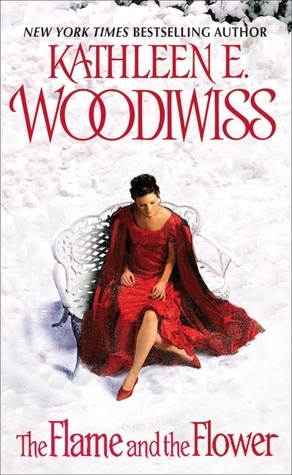
The Flame and the Flower - Kathleen E. Woodiwiss (Birmingham #1)

The Flame and the Flower (Birmingham)The second-to-last category of my 2017 romance reading challenge is done, and it was the last category I was dreading, since I saved one I was looking forward to for my final book.  What was the category, you ask?  The bodice ripper.  And when you look up bodice rippers, the name of Woodiwiss abounds, so one of hers seemed like the logical choice to fill this category.  Of course, bodice rippers are known for an abundance of rape and creepy men and unlikable heroines, so I pretty much knew what I was in for going into it.

The story is about Heather, living a life of drudgery with her aunt and uncle until her aunt's brother offers to bring her to London to get her a position teaching at a school--though when they arrive, he promptly attempts to rape her, ending in a struggle in which he's stabbed and Heather flees.  Her flight ends rather abruptly when two sailors get hold of her and take her onto a ship where she meets Brandon Birmingham, the captain, who thinks she's a prostitute and does proceed to rape her, several times, despite her repeatedly telling him no and declaring she's not a prostitute.  So, nice guy.  Heather manages to flee again, back to her aunt and uncle, until it's discovered she's pregnant and they all return to London to force Brandon to marry her, with the help of a family friend.  And then Heather is whisked away to America, where Brandon lives and plans to stay after retiring from his life at sea.

So, this is basically the story of an eighteen-year-old girl falling in love with her rapist, who is nearly twice her age.  Brandon declares that he hates Heather for trapping him into marriage, and that she'll be nothing but a servant to him, but he never treats her as such.  Though he does eventually threaten to rape her again if she doesn't come to him willingly.  So there's that.  Overall, he's not as rapey and creepy as most bodice ripper heroes, but I definitely still would not put in him the categories of "good guy" or "desirable romantic interest" because of the way he basically disregards Heather's feelings while simultaneously panting after her for the entire book.  And, you know, how he says that he raped her eight months ago and she should be over it by now.  Of course, to balance out Brandon's rather mild status are a bunch of other bodice ripper tropes--all other women hating Heather because she has Brandon and they don't and is prettier than them, all the other men wanting to rape Heather because she's pretty and innocent and naive, and a few murders thrown in for good measure.

The writing here is measurably better than the last bodice ripper I read, Savage Ecstasy, which was quite a relief.  I wouldn't go so far as to say I enjoyed this book, but reading it wasn't the form of torture that SE was.  It's all rather purple and melodramatic but again, that's something that I expected of a book in this genre in general.  Heather's feelings for Brandon were completely unrealistic--she's afraid of him for a bit and then gaga over him in quick succession and laughs off her extremely traumatic rape within less than a year.  But that's probably to be expected because Heather doesn't really seem to have much agency at all.  Every now and then she gets mad and stamps her foot or breaks something, but these rages never lead to actual action and she just goes back to doing whatever Brandon wants--or whatever she thinks he wants--the next time he appears on the page.  And then there's the portrayal of people of color--Brandon's housekeeper is black woman who is basically the embodiment of the Mammy stereotype (a la Gone with the Wind; it's a thing in books that take place during the era preceding the Civil War that black women are either portrayed as "the Mammy" or "the Jezebel" with little else to distinguish them) and it's questionable whether or not the "servants" were actually slaves.  They're called servants, but everyone else in the Charleston area has slaves, sooooo...

Obviously, this is a very problematic book.  The portrayal of "romantic rape," the women who are clearly sluts because they want sex but are not Heather, the "all ugly people are bad," the stereotyping of people of color, and all the other things I mentioned above all add up to it.  However, as it wasn't as terrible--in writing, in brutality, in pretty much anything, as the last one I read, sooo...

1.5 stars out of 5.

Monday, December 25, 2017

A Pirate for Christmas - Anna Campbell

A Pirate for ChristmasA Pirate for Christmas was the holiday romance selection for the Unapologetic Romance Readers' group.  Like most Christmas-themed historical romances, it's a novella rather than a full-length novel.  Also like most Christmas-themed historical romances (and Christmas romances in general, regardless of time period) it relies on love at first sight to get everything going--probably because the short length doesn't leave as much room for relationship and character development.

The two main characters here are Bess, the daughter of the vicar of her rural village, and Rory, who has just taken over the title of Earl after his older brother's death.  There's a rumor rampant in town that Rory is a dastardly pirate, but we know from the book's description that he was actually in the Royal Navy.  When Bess visits the manor to obtain the donkey that always takes part in the Christmas play (Daisy--Daisy was probably the best part of the book) she encounters Rory, the two fall in love at first sight but are of course unable to express their feelings for each other, and go edging around each other as Bess starts reorganizing Rory's house and gets him to give her Daisy and his own participation in the Christmas play...all for the price of a kiss, of course.

As I mentioned before, there's not a lot of room for plot or character development here.  Bess and Rory spend most of the time mooning at each other from afar with all of the village folk trying to push them together, and then there's an extended scene where they conveniently get stuck in a cabin in the woods during a snowstorm together.  Rory wants Bess and Bess wants Rory and and Rory spends a lot of time pursuing Bess but not really wanting to do anything about it because he wants to marry her first (because that's what she deserves) but also not really doing anything to move in a marriage direction.  But of course that's where it all ends up, and then there's a weird time-jump to the honeymoon where the ~sexy times~ start.  Honestly things probably would have been a bit more interesting of Rory really had been a dastardly pirate instead of a misunderstood navy captain, but meh.

Christmas romances in book form are, essentially, the same as those cheesy holiday movies that you see on TV all the time at this time of year.  They  might be cute, for what they are, but they're not particularly good.  This book follows that trope exactly.

2 stars out of 5.

The Death and Life of the Great Lakes - Dan Egan

The Death and Life of the Great LakesRecently my boyfriend decided that we should read more books together so that we can discuss them, and since more books is always okay with me, off we went.  He picked the first book, The Death and Life of the Great Lakes, which was also hugely interesting to me because I grew up on the Great Lakes, specifically Lake Erie but with visits to Lake Michigan and also the Niagara River in the Niagara Falls area.  I'm familiar with zebra mussels and sea weed and algae slicks and dead fish on the beach.  I knew that the Cuyahoga River used to catch fire with some regularity, and that Erie, PA was the largest freshwater fishing port in the world, and that the lake just didn't freeze over like it used to, and that Lake Erie was, quite frankly, pretty polluted and gross.  But I didn't know how bad things actually were.

Egan divides his book into three parts: the front door, the back door, and the future.  The "front door" to the Great Lakes is the Saint Lawrence Seaway, over which foreign ships bring cargo and also ballast water laden with invasive species, which they then proceed to dump in the Great Lakes.  Enter the zebra mussel and the quagga mussel, plagues upon fresh water systems everywhere.  This part also deals with the sea lamprey (mostly dealt with now due to a massive ongoing poisoning campaign--pleasant, right?), the alewife, and the chinook and coho salmon, planted in the lakes by a misguided campaign by one person to make the lakes into some sort of sport fishing paradise.  All of this, of course, ravaged the lakes' natural ecosystem, to the point that they will never truly recover.  The "back door" is the Chicago Sanitary and Ship Canal, which connects the Great Lakes to the Mississippi River Basin.  Not only has it provided a route for the quagga and zebra mussels to spread to much of the country beyond the lakes, but it's providing a route for extremely invasive species of Asian Carp to get into the lakes, which would make all the devastation the mussels have wreaked look like nothing.  This part also talks about runoff that has led to toxic algae blooms on Lake Erie that threaten clean water supplies.  And finally, the third part talks about threats to the lakes from climate change, cities wanting to funnel away the water for various reasons, and finally a drop of hope in the bucket of despair in regards to how the lakes are, in some small way, adapting and people are working to "fix" them.

This is a bleak book.  Despite Egan's attempts to show that, if we really try, we can stop the damage and start to repair it, it's pretty clear that the lakes will never be what they once were again.  The invasive species can't be gotten rid of.  There's some hope with genetic manipulation of them, but that can be a Pandora's box all on its own.  And then there's an absolute reluctance for people to actually do anything to begin with.  Farmers don't want to change their fertilizing practices, saying that the agricultural runoff isn't really due to them, even though there's overwhelming evidence to show that it is.  Agreements to funnel water away from the lakes keep going through.  There's no real teeth in an order that ships coming from overseas implement better methods of cleansing their ballast tanks of invasive species before dumping in the lakes.  And everyone fights tooth and nail against suggestions to cut the Chicago canal off from the lakes to stop the march of Asian carp.  All of this despite the fact that all of this going on is costing money and stopping it would not really affect trade or the economy at all.  It's infuriating.  Rage-inducing.  And pretty darn hopeless.

This is an excellent read, though.  Egan's writing is engaging and informative at the same time, and he writes in a narrative style while still conveying so much about the state and future of the lakes.  Sprinkled with interviews and anecdotes, I could definitely see the years of reporting that went into what ultimately became this book.  It's also an important read, and I think that it should be pushed on pretty much everyone possible.  The Great Lakes aren't just the problem of the people who live on them; they are twenty percent of the world's available surface freshwater.  That said, there is something that I think was missing here, and that is that the book is written almost entirely from an American perspective.  Egan's an American who did this research for American papers, so that's understandable.  However, Canada also touches the Great Lakes and has a ton of influence on what happens to them!  I would have loved to see something from the other side of the border--a part, a chapter, something other than a few lines about Canadian initiatives that match American ones.

Overall, an excellent read albeit a depressing one.  Read it anyway.  Educate yourself.  Water is everyone's problem.

4 stars out of 5.