Pages

Showing posts with label world war i. Show all posts

Friday, December 29, 2017

Cocoa Beach - Beatriz Williams

Cocoa BeachDon't be fooled by the pretty colors and frothy cover--Cocoa Beach is not a book about a vacation on a tropical beach.  Rather, it's a historical novel set during World War I and during the interwar years, with a quiet menace lurking in the background and a whole posse of unreliable characters.  This book could have easily been titled Liars and the Lies They Tell but it probably wouldn't have given off the same vibe.

The book is entirely from the perspective of Virginia Fortescue, a young mother whose family has a dark secret that's just come to light and who spent World War I driving ambulances in Europe, where she met her husband, British doctor Simon.  The time period alternates between Virginia's time meeting and falling in love with Simon during the war and several years later, when they've been separated, Simon is dead, and Virginia has gone to Florida with their daughter to handle the estate of the man she hasn't seen in three years.  But Virginia doesn't quite believe that Simon is actually dead, and a whole heap of things suggest she might be right--and even if she's not, there was definitely more going on with his death than just an accidental house fire.

I really enjoyed this book.  Trying to figure out which characters were telling the truth and which ones were lying was an interesting endeavor.  I guessed some of the plot points here ahead of time, but not all of them, and there was one doozy near the end that really came out of nowhere to smack me upside the head--but still made sense in the context of the book.  The writing was very good--not excellent, but very good.  The atmosphere that Williams creates in war-torn France, in dreary Cornwall, and of course in Cocoa Beach is wonderful.  There are even some Gothic tones, particularly in the long segment at Maitland, the citrus plantation that features.  She also does a good job of making you doubt pretty much everyone; in the afterword, she mentioned that for much of the book she herself hadn't been sure of whether Simon was a good guy or a bad guy, and I could really feel that come through in Virginia's search for what happened.  That said, there were a few issues.  The "dark family secret" turns out to be nothing such; that should have been left alone, there was no need for it to be undone like that.  And then there are some weird turns of phrase here and there--the phrase "omnivorous eyes" comes instantly to mind.

Still, I really liked this.  It's a good historical mystery, but one that's not about a detective or officer, just a normal woman trying to find out what has happened to her life.  The settings and atmosphere suited it perfectly, and the juxtaposition between Virginia's near-bliss in war-torn Europe and her misery in the paradise of Cocoa Beach was very well done.  I would definitely recommend it and would even consider reading it again!

4 stars out of 5.

Thursday, January 14, 2016

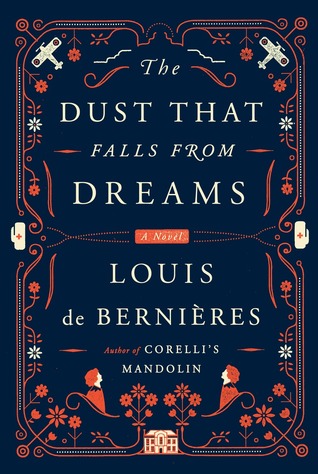
The Dust That Falls From Dreams - Louis de Bernieres

The Dust That Falls from DreamsI picked this book up at the library because, quite frankly, that is one of the loveliest titles I've seen in a while.  The Dust That Falls From Dreams...  There's just something incredibly romantic about it, don't you think?  That, and because when I read the flap, I saw that the story takes place in the years of and surrounding World War I, which I think is an underrepresented conflict in historical fiction given its impact on the world.  World War II has tons of historical fiction surrounding it, but I see much less taking place during WWI.

The story here is definitely character-driven, following the McCosh family, particularly the eldest daughter Rosie, through the years before, during, and after the war.  Before the war, Rosie and her sisters are friends with the boys who live on either side of them, forming a large group called "the Pals."  Rosie and Ashbridge, the eldest Pendennis boy, are very close and become engage (formally; they were informally engaged since Rosie was twelve) right before Ash goes off to fight in France with his brothers.  From a very early time, we know that Ash is doomed, and can see the consequences of this looming up for Rosie.  Rosie and her sisters eventually take up wartime occupations, their mother witnesses a tragedy, and their father opens a number of new ventures.  Meanwhile, Daniel Pitt, one of the boys from the other side of the fence, becomes an ace pilot.

Because this is a character-driven story, there's not really a plot.  It's more about watching as Rosie, because she is definitely the main character, develops.  Rosie can be extremely frustrating at times, especially to a reader who (like me) isn't particularly religious.  Rosie is very religious, and while I could see why she was so, the degree to which she clung to her beliefs could be absolutely infuriating.  She has a tendency to ruin her own happiness, as well as that of others, because she clings to her faith so strongly, even when other parts of her religion--and religious figures such as Fairhead the chaplain--tell her that it's okay to move on.  Daniel was an utter saint for putting up with her, and if I had been his mother, I probably would have smacked Rosie upside the head for the way she behaved toward him.  That said, I still liked Rosie, quite a bit.  Her frustrating qualities were greatly balanced by her overwhelming goodness.  She's just so nice that you can't help but like her.  And it's not an infuriating or fake niceness, because she has her angry moments--she throws a Wedgewood vase at someone at one point--but because she's genuinely a good soul.

Daniel was, by far, my favorite character; his charm, his quirks, everything about him was good.  His doubts, both in himself and in his country, are genuine, but he still does his duty because he feels it's the right thing to do, and perseveres in his relationship with Rosie because he does love her, even when it doesn't seem like she cares about him in return.  He's really better than she deserves at many points, but holds out.

The supporting characters were also, for the most part, delightful.  I would have liked to see a few more of their plots tied up, though--at the end, several people are just left hanging.  Rosie and Daniel's plot wound up fairly nicely.  Everything was pretty much resolved in regards to them, or at least it was suggested that everything was.  But for Ottilie, Mr. McCosh, and Archie (who I would have liked to see more of in general) things were left somewhat hanging.  It felt like de Bernieres almost created too many characters, and then decided he couldn't have plots for all of them, and so focused in on a few, ignored a few, killed a few, and sent a few off to distant locales so he wouldn't have to deal with them.

This book also got off to what I felt was a very slow start--but once the war started, I liked it more.  The pace picked up, the characters became more interesting, and the story itself became more complex.  I have mixed feelings about how the non-narrative chapters were written; journal entries and letters have never been my favorite ways of portraying or reading action in books.  However, they do fit the time period and theme of how war affects people, so I suppose they were all right.  They got fewer and farther between later in the book, which I appreciated; the plain narrative chapters definitely suited me more.

Overall, though, I quite liked this book; I feel like it's a solid 3.5 to 4 stars for its overall art and portrayal of a somewhat underrepresented turbulent time on the global stage, while focusing in on that times' effects on a small group of people who are still somewhat representative of the whole.

Monday, September 21, 2015

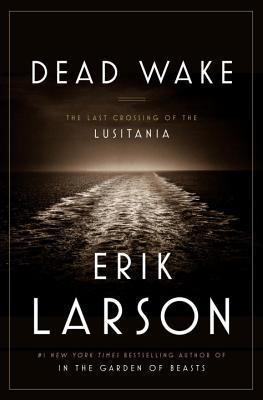
Dead Wake: The Last Crossing of the Lusitania - Erika Larson

Dead Wake: The Last Crossing of the LusitaniaErik Larson's books apparently have appeal to me, since all but one of them are on my "to read" shelf.  I think he just covers historical moments that I find particularly interesting.  From the look of his books (and my experience with this one) he doesn't feel the need to write broad, sweeping historical narratives, but rather focuses on smaller moments and events in the context of the larger ones everyone studies so intently.  I knew about the Lusitania, a large passenger liner that sailed in the early twentieth century, and had a conception about it that a lot of people probably shared: that when Germany sank it, it was the even that catapulted the United States into World War I.  This was, as Larson points out at the end of the book, not the case; the US didn't enter the war for more than two years after the Lusitania sank, though the sinking was certainly the cause of a huge amount of outrage in the neutral US.

In Dead Wake, Larson examines day-to-day life on the Lusitania amidst the building tension of the war, particularly a warning from Germany that any UK-bound ships were considered valid for sinking and which mentioned the Lusitania specifically.  He also includes the operations of U-20, the German submarine which sank the Lusitania, and the operations of Woodrow Wilson, Winston Churchill, and a few other areas/departments, such as the secret British intelligence group in the so-called Room 40.  He relied on a wide variety of resources to create this narrative, including letters, memoirs, and logs--pretty much everything except interviews.  The Lusitania sank in 1915, after all, which means that none of the survivors are still around.  He did an extraordinarily good job of it, making the people who sailed on the ship and submarine, and who watched and manipulated events from afar, seem real and relatable even though he only had limited resources on which to rely.  He builds tension throughout the entire book until the ultimate sinking, and then winds everything up quite neatly without too much hemming and hawing about consequences.

At the end of the book, he does bring up one thing that I think is ultimately a flaw: he doesn't answer any real questions about what happened.  No one really seems to know why the Lusitania didn't receive a naval escort, why the instructions (or lack thereof) were so ambiguous, why it wasn't diverted to a safer route given the intelligence available.  While it's interesting that no real answers have come out regarding this, I would have liked to have seen Larson take a stab at answering them given the information he dug up.  Ultimately, this was an informative book but nothing that was really groundbreaking, because it doesn't include any sort of argument or thesis, only facts.

4 stars out 5.