Pages

Showing posts with label humor. Show all posts

Friday, April 22, 2016

Modern Romance - Aziz Ansari

Modern RomanceI'm not entirely sure why I read this book, other than a coworker said it was good.  I'm not really in the "romance" market right now, having been in a relationship for four years and not planning to end it any time soon, and the world of "modern romance," involving sexting, Tinder, online dating, and so on, which is what a lot of this book covers, has never really been something that intrigued me.  But the concept in general as interesting enough, I guess, because I saw it at the library and picked it up...though this probably isn't something I would have gone out and purchased.

In Modern Romance, Aziz Ansari, or someone ghostwriting much of it for him (I'm always so skeptical about books written by celebrities; not that they actually could write a book, because why wouldn't they be able to, but that they actually had the time to write a full book instead of just signing off on it and maybe putting a few touches here and there.  Maybe this is unfair of me, but I can't seem to shake it.) examines how romance has changed in "modern" times, basically since the rise of the internet and the smartphone.  It's a surprisingly academic work, undertaken with the help of some big focus groups and some scientists of various disciplines (who, interestingly, do not have their names on the cover).  They look at what romance was like for the generations who grew up and married before the internet and smart phones and online dating and the phenomenon known as "emerging adulthood" and how that has changed since all of those things came about, and to some degree how romance works in other places around the world, too.  They look at how we find partners, how we get in touch with partners, and so on, all the way to the "settling down" portion.  Along the way, they go to Tokyo and Buenos Aires and Paris, and even briefly Doha, to look at dating in those places, too.  But much of the focus is on how our phones have become so entangled in our love lives.  There were some interesting points here but nothing that I thought was really, really groundbreaking; I think if you thought through most of these things on your own, you'd come to the same conclusions, and the conclusions are basically what you'd expect.

Ultimately, the conclusion seems to be that finding your "soulmate" is now the desirable thing, rather than someone you can just be happy with, which was a thing in many of our parents' generations, and that there are a lot more choices now because the digital world has opened up and allowed us to connect with so many more people in so many new ways, and that can make the search for a "soulmate" even harder than it would initially seem.  There are some funny quips throughout this, but it is definitely not a humor book on the whole, so if you're looking for a comedy book here, you'll be disappointed.  Also, there were a few bits that I could have done without, like Ansari recounting the experience of using a Japanese masturbation toy.  I get it, people masturbate, it's healthy, blah blah blah.  That doesn't mean I want to read about someone I don't know doing it in more detail than I really felt comfortable with.  I'm never going to be able to watch Parks and Rec without thinking about that now.  It's ruined it for me.

Overall, I'd shelve this book as "mildly interesting but not compelling."

2.5 stars out of 3 for sheet interest level.

Wednesday, February 17, 2016

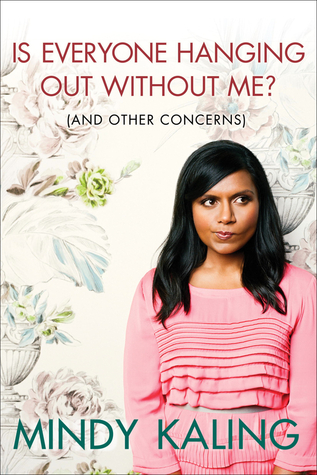
Is Everyone Hanging Out Without Me? (And Other Concerns) - Mindy Kaling

Is Everyone Hanging Out Without Me? (And Other Concerns)Mindy Kaling is one of those people that, in an abstract way, I kind of think I would want to be best friends with...but then I kind of second-guess that, because it's the reaction pretty much everyone has had to this book, and that makes me really think that that's the reaction everyone is supposed to have to this book, and maybe she's not as adorable as she seems?  Am I reading too much into this?  Maybe, maybe not.  Anyway, I'll probably never meet Mindy Kaling, let alone have the opportunity to become best friends with her, so this is a dilemma I will never have to face--along with the dilemma of having my clothes stolen out of my closet, because that is part of Mindy's Best Friend Code of Conduct: "All of your clothes also belong to me."

I've seen very, very few episodes of The Office, the show that made Mindy famous, and the few that I've seen I didn't really find funny.  This might be because they were all first-season episodes, and Mindy makes pretty clear in the book that a lot of people didn't like the first season.  That said, I do think she's a funny person overall.  This book had a lot of quirky, funny parts, and a lot of good points, and a few eye-roll-worthy ones.  One of the latter was when she wonders why people always ask her what the other actors on The Office are like in real life, but they never ask her what she's like, which she just presumes to mean that everyone thinks she's exactly like her character, Kelly Kapoor.  Or maybe--just maybe, stay with me here--they don't ask her what she's like because a) that's kind of a loaded question; I mean, how can she really answer that, and b) maybe they feel they don't need to ask because they already talking to her and forming that opinion themselves, which they haven't had the opportunity to do with the other actors, hence the questions.  But she also includes a lot of funny anecdotes, like the stories behind the stream of narcissistic pictures in her Blackberry (yes, celebrities also pop pimples and try to cover it up before important occasions) and the story of her rise to The Office through a production of a play she did about Matt Damon and Ben Affleck (which I had never heard of before) and some heartfelt stories, like how unfair it was that People magazine invited her for a photo shoot and only showed up with one thing in her size, which was obviously way less fun and pretty than all of the other things they showed up with in a size 0.

Overall, Mindy is a really funny person, even if sometimes her humor can be a bit, uhm, off?  There are some racist remarks in here, that she seems perfectly cognizant of and seems to have left in despite some advice about not appearing racist in your books.  But her totally dorky moments, like how much she loves Conan O'Brien (a lot) and dieting (possibly even more) and how she can only work out when she's concocting elaborate revenge fantasies in her head (she saves The Voice from terrorists in one) are quirky and snarky and made for a fast, light read.  This fulfilled my "A book written by a comedian" category for Popsugar's 2016 Reading Challenge, and I am glad I picked this one for it.  I want to read Tina Fey's Bossypants at some point, but Mindy was so cute and likable in this book, despite talking about how vain and shallow she is, that you really can't help but like her, even when she does really shitty things like leave her coat behind at parties so people think she's coming back when she really intends to ditch them.  I mean, I understand the urge to want to a leave a party, pronto, but it is polite to at least let people know you're leaving--and if you don't do that, to at least not lie about it when they call you out on your just slipping away.  These are some of the moments that make me suspect that Mindy isn't really as likable as she makes herself out to be...but I liked the book anyway, since our paths will never cross, it's not a concern.

3.5 stars out of 5.

Sunday, January 17, 2016

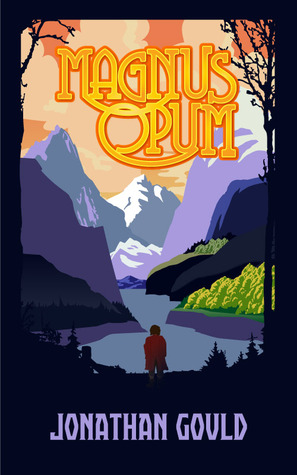
Magnus Opum - Jonathan Gould

13570616It's very rare that I don't know what to make of a book, but Magnus Opum was one of those instances.  Let me give a brief outline of the plot to start to explain why this is.  Magnus is a Kertoobi, who are kind of like hobbits except that they don't live in houses build into hills and they have some other weird customs instead, but they do frown upon people having adventures.  One day, Magnus' brother gets wanderlust and goes off, writes for a bit, and is then never heard from again--until some Doosies, all of whom love gossip, come bearing news of his death.  Magnus sets out to find out the truth about his brother's death, see the sights his brother saw, and perhaps even seek revenge.  On the way, he gets swept up with a Cherine named Shaindor; Cherines are all obsessed with goodness and beauty, and also happen to be in a perpetual war with Glurgs, the awful, hideous race who killed Magnus' brother.  Of course, nothing is what it seems, and as the story goes on Magnus has to adjust his vision of the world and come to terms with his new discoveries.

In theory, this all sounds fine, but something about Magnus Opum just rubbed me the wrong way.  Partly it's because it's so silly that it's hard to tell if it's meant to be a satire of these sorts of fantasies--where a person goes off and has adventures and comes back changed and everything--or if it's meant to be serious in its own regard.  The abundance of made-up words, analogies, and metaphors all contributes to the general silliness, as does the fact that all members of each race are the same as each other--all Doosies love gossip, all Cherines love beauty and music and goodness, all Glurgs are ugly and horrible (or are they?) and to be feared, and so on.  This is one of my pet peeves in fantasy.  Not all humans are the same; all humans have different wants and dreams and personalities, and these races being painted with such broad strokes is one of the things that made me lean toward it being a satire--because I wanted to like it, but... I don't know.  Thank heavens that the story became more complex than it originally seemed, because I was on the verge of not finishing it from sheer exasperation.  I was hoping that things would turn out to be not quite what they seemed, and they did--but there the twists ended, and everything went back to being predictable once again.

That was my other issue with this story.  It was predictable.  There were no big twists, no big reveals, no "hooks" that pulled me along and kept me reading.  Magnus was an interesting character, going against the grain of his race as he does, but is also stereotypical in that regard.  The epic "quest" here didn't seem to be one as such, and the ultimate conflict...isn't.  Everything is resolved so nicely and neatly, and there ultimately didn't seem to be anything propelling the plot forward other than random coincidences.  This is a silly story more than a compelling one, and I'm sure some people value it for that; personally, I found myself wanting something more, something more complex, something with a little more body and a little more plot.  Would I read other books by this author?  Maybe.  I think I'd probably want to sample them first, to see if they're more up my alley than this one is.  It wasn't bad, it was just...meh.  I think there was a lot of potential here, but it wasn't fleshed out or utilized as fully as I think it could have been, and came off as more juvenile than anything else.  To others, this might not be the case, but to me...this one wasn't a hit.

2.5 stars out 5.

I received this book free from Awesome Indies Books in return for an honest review.

Monday, June 10, 2013

Dead Funny: Humor in Hitler's Germany - Rudolph Herzog

Dead Funny: Humor in Hitler's Germany Dead Funny: Humor in Hitler's Germany purports to be about the history of jokes about Hitler, the Third Reich, and the Holocaust within the bounds of Germany before and during WWII.  And indeed, it does start off this way, expounding on the history of political jokes and how they're used to relieve stress, and were actually good for Hitler's government.  However, after that, it rapidly falls apart into a disorganized jumble that can't even decide which continent it wants to focus on.  While subjects like the treatment of the Holocaust through humor by the Jews, the treatment of jokers, and the changing attitudes of the Nazis toward political jokes are broached, they're tossed in with confusing accounts of Hollywood comedies and BBC radio skits.  While those certainly pertain to Nazi humor, they don't exactly pertain to humor in Hitler's Germany, and they don't pertain to telling jokes in Hitler's Germany, either.  The German title of the book is Heil Hitler, Das Schwein Ist Tot!  Lachen unter Hitler--Komik und Humor im Dritten Reich, which seems to translate to Heil Hitler, the Swine is Dead!  Laughter Under Hitler--Comedy and Humor in the Third Reich, which retains the focus on Germany, so there's no clarity there, either.

Additionally, I think there's a problem with the translation.  Or, not so much a problem with the translation--it's a very comprehensible translation--but a problem with the concept of this particular book being translated.  Herzog repeatedly says that certain jokes are completely untranslatable, which makes their inclusion seem pointless when there are so many others which, when translated to English, retain their point if not their clever wordplay.  Paired with the disorganization and seeming inability to focus on one topic, jumping from jokes in Germany to cabarets in Switzerland to a long-winded explanation of the plot of an American movie, it's not exactly a riveting read.  It does have its moments, of course, but overall it reminded me more of a poorly-conceived thesis paper than a professional, structured book.

2 stars out of 5.