Pages

Showing posts with label middle grade. Show all posts

Friday, June 9, 2017

The Thief - Megan Whalen Turner (The Queen's Thief #1)

The Thief (The Queen's Thief, #1)I think I originally read The Thief way back when I was in fifth grade, so...in like 2003?  One of my teachers had it in her classroom library and I absolutely devoured it.  At the time, I don't believe it had any sequels, and I just learned that it had gained some in the past year--so of course I had to go back and read it first, being as it had been a decade and a half since I'd read it the first time! The thief in question in the book is Gen, who starts the story in prison for stealing the seal of the king and bragging about it in a wineshop.  He's taken out of prison by the king's magus, a sort of scholar, who believes he knows where a great treasure is--and needs Gen to steal it.

The world here is mostly based on ancient Greece, though for some reason there are also guns?  Kind of weird.  But for the most part, yes, Greece-based.  There are gods and goddesses lurking in the stories in the background, and two side characters that serve as the magus's apprentices and also as vessels for transmitting a lot of the background information that needs to be absorbed without it being downright info-dumping.  I thought this was very well-done.  What I actually didn't like here was Gen himself.

Here's the thing.  Gen is a brat.  He spends so much of his time acting downright obnoxious.  And yes, there's a reason for this, and it gets better, but for about two thirds of the book he's just as annoying as can be, and not only to the magus and his other travelling companions, but to me as the reader as well.  It was absolutely infuriating and I really sympathized with the other characters who wanted to strangle Gen...probably not an ideal situation for feelings towards a main character.  Despite having read this book before, I actually didn't remember much past the 70% mark, which is when Gen starts getting better, so I also had no memory of it improving, and found myself dreading dealing with him for the duration of the book.

While I liked the world-building, I also feel like it might have been a bit confusing for someone who didn't already have an understanding of ancient Greece.  There are a lot of things that are drawn from history here and not really explained in the book, so someone who hasn't actually taken a college-level course in ancient Greek history like I have might have been a little lost; I know I definitely understood more this time through, having taken such a course during my time as a history student in college, than I did when I read it in fifth grade.  Being as this is categorized as a children's book, I think a little more fleshing-out of the setting could have probably been useful.  I'm not sure how many fifth graders understand what an agora is or the various invading forces that went against Greece and how that played out, influences of which are floating about and are important in understanding the political climate on which the story spins.

Still, though, this was a fast and very enjoyable read.  The design of the temple in which the treasure is hidden was so cool--kind of Water-Temple-from-Ocarina-of-Time-esque.

Image result for water temple

Overall, I really liked this, and am looking forward to reading the sequels!

4 stars out of 5.

Wednesday, May 10, 2017

The Tale of Despereaux - Kate DiCamillo

The Tale of DespereauxThe Tale of Despereaux was my pick for a category for my 2017 reading challenge for "A book from a non-human perspective."  This was a really hard category to find a book for; the obvious books, like Black Beauty, I had already read or, like The Art of Racing in the Rain, refused to read because I don't like to read books where the dog dies.  A list of books with non-human main characters suggested The Tale of Despereaux.  It's kind of a loose fit for the category, but half of our point-of-view characters are non-human, so I'm going to go with it since I'm having such hard time finding a title for this category.

The tale is a whimsical, middle-grade level story about a very small mouse who falls in love with a princess and is condemned to death for treading into the human world, but escapes his fate and embarks on a quest to save said princess from a rat named Chiaroscuro.  Also involved is a simple serving girl named Mig.  There's an omniscient narrator who tells the story, but each character has a background portion of the book and then they all come together later on.

The writing here is very fairy tale-like, which was probably the point.  There's some very poignant prose as well, which surprised me for a middle-grade book, but then I guess that's why this won a Newbery Medal.  Take this line from near the end of the book, for example: "But, alas, he never really belonged in either place, the sad fate, I am afraid, of those whose hearts break and then mend in crooked ways."  This is such a simple yet powerful statement that I kind of had to take a step back and examine how it fits not just this story, but so many other ones, and so many people in the real world.  Even when it's not explicitly stated about a character, it's easy to see in hindsight how this suits so many people both real and fictional, and it's a very insightful line and good lesson for a book of this level.

The characters here are all sympathetic, even the "bad" ones.  You can see how they came to where they are and how they've grown, and continue to grow as the story progresses.  The simple narrative style actually lends itself to this because the circumstances are laid out in such a matter of fact manner that everything is very clear, without DiCamillo trying to twist things around and add so many layers that you can't really see to the truth of the thing.  It's also a quick read, which makes it even more impressive that it packs so much emotion and dimension into a relatively small page count, and an even smaller one once you factor in the illustrations that take up a significant portion of space.  The illustrations were actually the one thing I didn't really like about the book; I don't feel like they added to the story, and illustrations actually take away some of the ability of the reader to visualize things as they wish, so I'm pretty much always against them for all but the most junior-reading-level books.

Overall, though, a wonderful, simple story with a good heart that I think even older readers such as myself can enjoy.

4 stars out of 5.

Friday, March 24, 2017

Dealing with Dragons - Patricia C. Wrede (The Enchanted Forest Chronicles #1)

Dealing with Dragons (Enchanted Forest Chronicles, #1)Dealing with Dragons is an absolutely charming book. (By the way, if anyone knows where I can get a copy of this cover edition, let me know!  I lost mine a while back and they're now on a new edition, so the first book doesn't match the rest of the set.)  I read it for one of my reading challenge categories, "A book you've read before that never fails to make you smile."  This is a middle-grade book that I originally read when I was its intended target, but even as an adult I liked going back to it for a fast, light read that might not be "laugh out loud" funny but is definitely "crack a smile to yourself" charming.

The story is about Princess Cimorene, who is a most improper princess.  She wants to learn how to fence and cast magic and is absolutely bored by embroidery and etiquette.  Of course, this is a very typical character type for books, but it's not a typical princess type for Cimorene's kingdom.  When Cimorene finds out her parents are planning to marry her off to a most boring prince in an attempt to settle her down, she runs away and becomes the servant of a dragon--which is considered a very proper thing for a princess to do, though it's usually because said princess has been kidnapped, not because she's done it by choice.  Cimorene's governing dragon is Kazul, who takes Cimorene on (instead of eating her) to categorize her library (which is largely in Latin) and cook her cherries jubilee.  Cimorene settles into her new position right away, facing even the most boggling of dilemmas with a calm, cool, practical attitude that is absolutely refreshing.  She's not one to make stupid or emotional decisions, as so many teenaged protagonists are likely to do, and seems to have a steadying effect on all those around her.  And when a problem with wizards pops up, Cimorene is eager to help.

The world of the Enchanted Forest Chronicles is one that could be traversed easily with assistance from Diana Wynne Jones' Tough Guide to Fantasyland.  It's a land of self-aware cliches and tropes, which makes fun of both them and itself in equal measure.  And though Cimorene's character archetype is a trope in and of itself, it's so different from the world around her that it absolutely works.  Bits of different stories can be seen here and there, inhabiting the world around her; another princess has been almost forced into every fairy tale trope in the book, to no avail, until her family finally managed to get her kidnapped by a dragon.  None of the characters are necessarily deep, but they're all quaint and charming and serve their purposes just fine.  It also offers a few startling inversions of tropes, one of which is tied directly to the climax of the book.

This is the first in a series, but it can very easily be read by itself.  It's a fast read, about two hundred pages of large print, and the writing style (because it's really a middle-grade book) is of course easy to get through as well.  Wrede has a matter-of-fact writing style that manages to be engaging and to the point without sacrificing the immersive reading experience or challenging suspension of disbelief.  Could things be a little more developed?  Of course.  But there's three more books for that.

Overall, this is such a fun read, and I had a great time re-reading it as an adult even though I'm no longer its target audience.  If you have younger readers, this is a great book for them that I think is enjoyable for anyone reading along.

4 stars out of 5.

Sunday, March 5, 2017

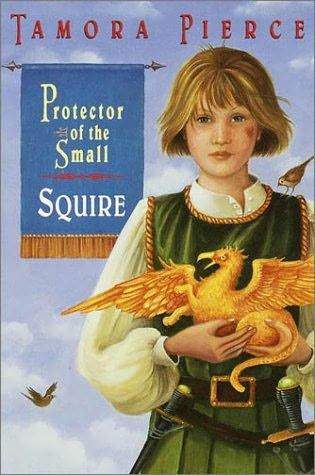
Squire - Tamora Pierce (Protector of the Small #3)

Squire (Protector of the Small, #3)Tamora Pierce was one of my favorite authors growing up.  The first book of hers was actually the second one of this particular series, Page, which I got in a stack of books one of my mother's coworkers gave to me, because someone had given them to her niece, who wasn't a reader.  I didn't even realize it was a series until a couple of years later, when I found this one at a book store!  Pierce has written a lot of books, most of them middle-grade but some of them trending into the young adult category, and all of them about awesome girls and women doing awesome things.  She has a few male main characters, but overall she is very much a girl power author.  This particular book is one of my favorites of hers, and I'd decided to read it for the "A book you loved as a child" category of my 2017 reading challenge.  And since I've been horribly sick the past few days, and being sick always makes me nostalgic for things from when I was sick when I was little (Campbell's chicken noodle soup and grilled cheese sandwiches, anyone?) this seemed like a great time to read it.

The main character in the Protector of the Small series is Keladry of Mindelan, a young woman training to be the second female knight in over a century, and the first to actually train openly as female.  In this third book, Kel has passed out of her time as a page and into the status of a squire, needing to train directly under a knight, though she suspects that no one will choose her because she's "The Girl."  Luckily for her, someone does pick her--Raoul of Goldenlake and Malorie's Peak, the commander of the King's Own (kind of like a mini-army/National Guard sort of thing) and a legend in his own right.  Though Kel dreamed of being the squire of Alanna the Lioness, she knows it's not possible and is thrilled to be Raoul's squire, travelling with the Own and helping those across Tortall.  Along the way, she fights a centaur, rescues a baby griffin that she ends up stuck with, and encounters many characters that appeared in the series preceding this one, such as Alanna herself, Raoul himself, Daine the Wildmage, Numair Salmalin, and so on.  Those slightly-more-than-cameos are one of the reasons I find this particular book to be so enjoyable.  Raoul is an amazing character, a knight who respects Kel for her own worth but doesn't force it upon others and instead helps her to earn respect, though it's often hard-won.

In this series, Kel faces the many challenges of being a girl in what is essentially a man's world.  When Alanna won her shield, she did it disguised as a boy.  Kel, being openly female, faces harassment, gossip, destruction of her property, even the kidnapping of one of her servants in an attempt to make her quit her training.  Kel faces all of this with a cool exterior, even when it enrages her on the inside.  She fights for respect both for herself and for those who are unable to fight for it themselves--hence the "Protector of the Small" name of the series.  Kel is such a great character, being an outsider in so many ways but being unwilling to give up on her dreams or her duties.  When I was little, I wanted to be Kel.  She fights with a glaive, which inspired me to give one of my own main characters a glaive as a weapon.  She knows how to fight with a normal staff as well; I distinctly remember swinging around a broom handle in the front yard, many times, practicing what I imagined to be Kel's staff fighting.  I desperately wanted to be as awesome as Kel is.  I still do, and the very battered, much-read condition of the book shows it.

That said, I haven't read this is in years, and it's definitely a little rougher than I remember.  It was Pierce's third series, and one thing that's cool about her writing is that you can see how she grows as a writer over the course of them.  This book is a little less than four hundred pages long, and it covers four years of Kel's life and her entire time as a squire--that's a lot of ground to cover in a small amount of pages.  As such, she has to do a good amount of exposition and skipping over things, and that isn't always done in the smoothest manner.  She also does a lot of re-hashing of things that happened in the previous books, which I don't really think is necessary in a series.  Additionally, this isn't a book that has a strong central plot.  It's about Kel's time as a squire, but there's not really a single compelling motive here beyond that.  That's something that's pretty prevalent throughout this particular series, thought the fourth book does have a central plot revolving around more than just Kel's general struggles.  This one does set up well for the fourth book, though, with the escalation of hostilities with Scanra and the introduction of the enchanted metal killing machines.

This was such a fast, nostalgic read, and I really enjoyed it once again.  As much as when I was younger?  Maybe not quite that much, but I still think it's an excellent book and compensates well for its weaknesses, and is such a great book for girls in need of a role model who does something other than think about boys.  (Kel does think about boys, but her life far from revolves around them.  Pierce's attitudes towards her heroines and sex, that they engage in it but do so of their own free will and while taking proper precautions, is something that I think is very important to include in books for this age group.)

4 stars out of 5.

Friday, June 3, 2016

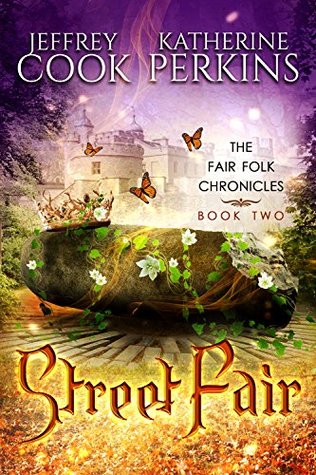
Street Fair - Jeffrey Cook and Katherine Perkins (Fair Folk Chronicles #2)

Street Fair (Fair Folk Chronicles, #2)Street Fair is the second book in Jeffrey Cook and Katherine Perkins' Fair Folk Chronicles.  It follows Megan, a teenager who has recently discovered that she's a half-faerie princess, and her friends as the Goblin Market comes to town, and brings with it a host of unforeseen trouble that deals with Gaelic mythology, particularly that of Balor and the Fomoiri.

I had some difficulty with the first of the Fair Folk Chronicles because it really made faeries much more sugary-sweet than they are traditionally said to be.  That's still the case here; despite a bit of a bloodthirsty toast at one point, even the Unseelie court is kind of like a bunch of teenagers who just like to hang around and play pranks on each other rather than be menacing in any meaninful way.  The Seelie court is basically all sweetness and light.  Ashling the pixie continues to annoy me beyond all reason.  However, the story as a whole appealed to me and agreed with me much more, and that's because of the topic.  The integration of the Fomoiri and Balor really hit a sweet spot for me, and I can tell you exactly why: because I associate it with Diane Duane's Young Wizards series, and specifically the fourth book, A Wizard Abroad, which deals with the same subject though in a different way.  That actually really helped re-orient myself regarding how to look at this book.  Until that topic started to come in, I was looking at the Fair Folk books as young adult books, but they're really not.  I can't remember exactly how old the main characters are (though Lani can drive, so they must be about sixteen), but in writing and subject, these books are much more middle-grade than young adult.  There is very light kissing, but also a lot of parental supervision and the whole thing is very clean, which is really more characteristic of the middle-grade than the young-adult age group these days.  The same goes for the Young Wizards books.

As for the book itself... This is obviously much more of a "series" book than the first one is.  It has a plot of its own, albeit one that involves a lot of running around and not actually doing a much, The integration of these parts of Gaelic mythology are pretty cool, and I think it would be a good way to get younger readers interested in such topics.  But it also sets up for a continuance, which the first book in the series didn't.  Book 3 (A Fair Fight) will clearly deal with the set-up from here, and I'm curious to see if the fourth book (All's Fair) will continue on from Book 3 or if it will be more of a standalone story like the the first volume was.  Seeing Megan gain some more control of her abilities, and realize some of the repercussions of dealing with faeries, was pretty neat.  At the same time, though, much of the book did end up reading like set-up for the next one.  Some of the elements also didn't seem to fit for me.  For example, the main villain is known as the Butterfly Collector to the main characters, and apparently is the person who was behind the ruination of Ashling's wings.  But he doesn't seem to have done this more than once; now, I'm not saying that it's not bad to have only done it once, because clearly it was, but why Collector?  That indicates multiple times.  Was this something that was brought up in Book 1 but that I forgot?  If so, disregard, but it was a bit discordant to me.  Also, as I mentioned before, the plot seems to involve a lot of running around and fight scenes, but very little of that actually advanced the plot.  It was more filler until the higher-ups decided to do something--and most of it was incredibly stupid of the characters to do in the first place, something that they acknowledged but then proceeded on with anyway because "there weren't other options" even though there really were.

I'm interested to see where the next book here goes; there are definitely indications that all chaos is about to break loose.  Now that I've been able to re-orient my view of these books, they do agree with me more, and I think these would be good options for middle-grade students interested in mythology-based fantasy--but I would not go so far as to put them as young adult, given that the heavier themes characteristic of young adult books are pretty much entirely absent in this series.

3.5 stars out of 5.