Pages

Showing posts with label mythology. Show all posts

Monday, April 30, 2018

Circe - Madeline Miller

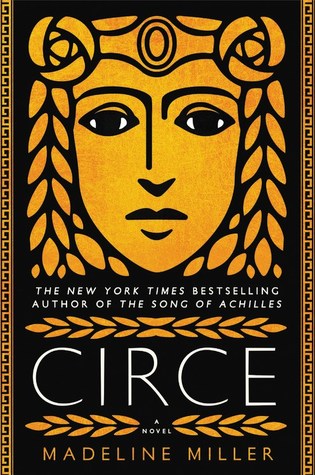
CirceAfter an off-month for Book of the Month in March, where they only had one title in which I was interested, they came back strong in April with a variety of books with piqued my interest.  The first and foremost of them, however, was Circe.  I haven't read Miller's other Greek mythology-inspired book, The Song of Achilles, but Circe's story interest me anyway, and much more than Achilles' did.  A goddess in her own right and the daughter of Titans, Circe is best known for her appearance in The Odyssey, where she tries to delay Odysseus on his way home from the Trojan War.  She is not Calypso, another nymph/witch who succeeds in delaying Odysseus for something like seven years.

One problem with writing a book based on mythology is that there are so many versions of different mythos that, no matter how you write it, you're bound to piss someone off because you left out their favorite part or adapted it in a way they don't like.  The only thing to do is to pick a string, stick to it, and don't waste time trying to justify every detail you changed or neglected because it doesn't fit with the thread of story that you chose to follow.  Miller does this admirably.  She leaves out pieces of Circe's mythology that aren't well known or that conflict with her strong center story line--that of a woman who defies the gods and seeks love even in her isolation--and builds connections to other, more tangential parts that work with that story.  For example, Circe only has one child with Odysseus in this telling, when she's sometimes said to have three; in contrast, Miller builds up Circe's connections with her siblings, particularly Pashiphae, mother of the Minotaur, in order to insert Circe into that story and emphasize her breaking with her Titan kin to seek her own fulfillment instead.  She overcomes so much--her vicious family, an Olympian pantheon who'd be happier with her dead, her own mistakes, rape--and while she doesn't always do it with grace, she does it with her own sort of strength.

That said, despite so many fascinating mythological elements tying in, this is not a fast-paced book.  Circe's story is, ultimately, one of exile to an island with nothing but her magic and her animals to keep her company.  While at first I found even these portions of the book fascinating--watching Circe grow into her arts, tame her animals, etc. was appealing in its own way--it became tedious after a while.  Of course, it also grows tedious for Circe herself, so maybe that was suiting, but I did find myself skimming more on these quiet portions as the book went on.  Even some of the parts of the book that should have been riveting--such as the entire story surrounding Scylla--were sometimes more slow than not, because of how much pondering Circe does as opposed to actually acting.  Ultimately, however, the book has an extremely satisfying ending--just firm enough and yet vague enough to leave possibilities and closure at the same time.

I really, really enjoyed this book.  I had completely discounted The Song of Achilles when I saw it before because I didn't think it would be something that interested me, but this book has completely changed my mind.  This is an extremely underutilized vein of fantasy--all of the Greek myth retellings or adaptations that are popular tend to be modern rather than set in their historic period, which is honestly their strength--and I would love to see more like this take the stage in popular fantasy.

4 stars out of 5.

Wednesday, November 22, 2017

Elsker - S. T. Bende (Elsker Saga #1)

Elsker (The Elsker Saga, #1)Did you like Twilight, but maybe wish that Edward wasn't quite so psycho?  Or did you want writing of an ever-so-slightly higher caliber?  Or a college setting rather than a high school one?  But still with "powerful immortal spends all of his time going to school over and over again and then falls in love with teenage girl"?  Well then do I have the book for you.

I read this for a category in the Unapologetic Romance Readers group, that of a virgin hero, because I already had it on my Kindle and it appeared on a list that fit that category--unfortunately, the matter of either character's virginity never really comes up, though it's kind of implied the heroine is (go figure).  So I'm going to have to ditch it for that and pick another one.  But at least I can take it off my Kindle now!

The plot follows Kristia, an eighteen-year-old college student from Oregon who gets visions, though normally boring ones, and nightmares of Ragnarok that she blames on her grandmother telling her too many stories of Norse mythology when she was younger.  Wanting a change of pace, she applies for a study abroad at Cardiff University in Wales, where she meets Ull, the hottest guy on campus who also happens to be a Norse god in disguise.  Of course it's love at first sight, and Kristia figures out who Ull really is in pretty quick succession because of two conversational slip-ups he makes and her mythology class.  Because, you know, a centuries-old god would totally just let it slip in casual conversation that his stepfather is Thor and he's known his best friend for eight hundred years.  And when hearing that his stepfather's name is Thor, Kristia would totally automatically assume that his family is comprised of gods instead of thinking, you know, maybe they're just really into mythology, hence the reason Ull is studying it.

The romance here is kind of flat, because the two are in love and all gushy over each other pretty much right away.  And because they're in love right away, there's need for another conflict--aka the "We can't be together because of Ragnarok!!!" plotline.  The problem with all of this is that the entire story is full of holes that you could sail the Titanic through.  Let's examine a few, shall we?

For example, why is Ull so concerned about Kristia not getting wrapped up in Ragnarok?  It shouldn't matter; the story of Ragnarok involves the destruction of the human world, as well, with only two people surviving to restart the human race...and if one of those was Kristia, she'd be hooking up with another guy, so I'm not sure that's something he'd be psyched about either.  Ull says that Kristia is in control of her own fate--but also has a Norn that has decided the two of them are supposed to be together, which doesn't seem like Kristia has a lot of say in the matter.  And they're fated to be together, but apparently no one knows if that will actually happen.  And apparently being a seer will allow Kristia to travel through the various worlds without being detected?  What kind of logic is that?

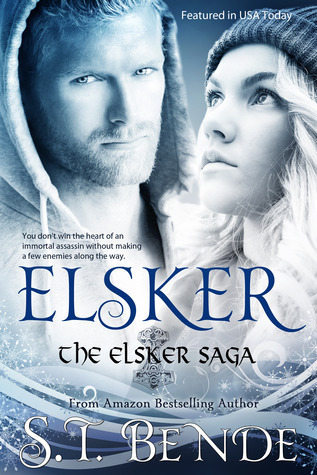
The actual writing here is okay.  It was nice to see some female friendships, and the girls do discuss things other than guys, though Ull is still a central topic of conversation.  Bende seems to have a shaky grasp on how grammar with dialogue works, and she also has a few words that are misused in the place of homophones.  Additionally, the cover is a little weird because it says "You don't win the heart of an immortal assassin without making a few enemies along the way," which has nothing to do with the story, because Ull is not an assassin (he mentions he was a warrior in the past, but not really an assassin) and Kristia doesn't make any enemies except one person in her dreams, who I am betting is Loki because Loki is suspiciously absent here, but that doesn't even really affect the story at all.

Overall, this was kind of meh, and I don't really see myself reading the future books.  But it wasn't terrible, so I'll give it...

2 stars out of 5.

Saturday, November 11, 2017

Norse Mythology - Neil Gaiman

Norse MythologyNorse Mythology is what I ended up reading for my reading challenge category of "A book based on mythology," after switching out Olympos.  Olympos is the sequel to Illium, and while I still want to read it, I read Illium so long ago that I think I need to re-read it before taking on Olympos.

I think it's important to note that this is not, actually, a book of Norse mythology.  Rather, it is a book of Gaiman's own retellings of various Norse myths, blending parts of other versions together and only really including his favorite stories.  It's not comprehensive, and it's not a textbook.  It also forms somewhat of an overall story arc, which actual "nonfiction" mythology books typically don't.  While Gaiman uses a writing style that is austere and fits with a classical myth-telling style, you can see his touches in different parts of characterization--Thor is basically a dumb jock, and Loki is one of those people who is both clever but also pitiful, the geeky kid who's picked on by the others and uses his intelligence to get back at them.  Did they deserve it?  Yes.  But did he also deserve their retaliation most of the time?  Yes.  Also, the dialogue shows Gaiman's wry style at different points--for example, I can't imagine an "original" telling of a myth blatantly featuring the words, "Thor, shut up."

The book is overall a story of Odin, Thor, and Loki, though plenty of other characters also feature.  The arc that Gaiman has embedded--possibly unintentionally, given his remarks in the foreword--features the back-and-forth between Loki and the other gods, leading up to Loki's imprisonment, freedom, and ultimately Ragnarok and what comes beyond.  Ragnarok and the death of the gods is a fascinating concept, and I think Gaiman does it justice.  The stories are in turns funny, gross, and eye-roll-worthy, and also have the features of classic myths such as explanations for natural phenomena, such as Thor causing tides by drinking from a horn connected to the deepest part of the ocean.

This is a quick read, and also one that is easy to pick up and put down; even though the book forms an overall narrative, each chapter or story also stands on its own.  You can read this in one sitting, or you can read a story at a time before putting it aside and coming back to it later.  Doing the latter might mean that the arc is less apparent, because I think some of the connections between the stories are more evident if you read them in quick succession, but it's still completely doable.

So, how does it compare to Gaiman's other works?  Well... I haven't read everything he's written, but I don't like this as much as I like his traditional novels.  Neverwhere, The Ocean at the End of the Lane, American Gods, and so on are works of art.  His original short stories are also excellent.  I would rank Norse Mythology somewhere between his short stories and his poetry, which I'm really not much of a fan of.  I hope we see Gaiman make a return to traditional novels soon, because he's been working on other projects for a while, and I miss those beautiful jewels of books showing up on the shelves.  This is good, but it's just not as enveloping, breathtaking, or wonderful as those others are.

3 stars out of 5.

Sunday, December 4, 2016

Marked - Elisabeth Naughton (Eternal Guardians #1)

Marked (Eternal Guardians, #1)Marked was the Unapologetic Romance Readers book for November.  No, we are not good at reading things in a timely manner.  Thank you for noticing.  It's a paranormal romance with a focus on Greek-based mythology, but set in a modern world.  The main characters are Theron, head of the Argonauts from the mystical realm of Argolea, who work to protect humanity (Or Argolea.  Or something.  There seems to be some disagreement over what they actually do.) and Casey (short for Acacia, of course) a young woman who works the used bookstore her grandmother formerly owned and waitresses at a strip club to help ends meet.  The book starts with Theron barging into the club, sweeping another woman out of it, and then promptly being almost killed by demons, who scatter when Casey shows up despite her being someone they are supposed to kill. (?)  Casey rescues Theron, helps nurse him back to health (which happens very quickly because he is not human) and they almost have steamy sex before he notices a mark on her and jets off to figure out what's going on.

This book didn't have many highlights for me.  What I did like about it were the almost-sex scenes, which were very, very steamy.  The actual sex scenes suddenly went from steamy to "I'm going to die in three days so we must gently make love now!" very quickly and sort of made me want to gag.  But what really drove me up the wall here was the lack of internal logic in this book.  "But it's a paranormal book!" you might say.  And to that I still say, as I always do, "Yes, but it must play by its own rules."  I don't think Naughton did a very good job of that here.  At the climax of the book, she ultimately seems to go, "Screw the rules, I'm the author!" and the very thing that was supposed to have massive consequences for the entire length of the book didn't have any.  Also on this point, she uses the style of speech for all the characters, who all sound like foul-mouthed teenagers (I have nothing against foul language but really, I found myself rolling my eyes at it here), even the princess who has supposedly been sequestered away from the rest of society, which makes the whole "Oh, the Argoleans learned it from humans!!!" argument a bit weak.  The big romantic conflict is also ultimately resolved with no effort at all other than one character being stubborn, and really wasn't a conflict to begin with since none of the characters actually intended to go through with any of the things that would have made it a conflict to begin with.  Sigh.

She also cherry-picked mythological elements, which drove me crazy, because if you're going to do mythology, at least try to make it all work together or put some story behind it rather than just taking what you like and throwing out the rest with no explanation.  And what exactly was the point of this prophecy/separation of powers deal, anyway?  It didn't actually seem to serve a purpose?

Overall, I was not a big fan of this.  Naughton has a way of writing some steamy scenes but I don't think they could carry the book through all of its other weak moments.  I liked some of the other Argonauts and wouldn't mind seeing more about them...but I'm not quite sure I'm ready to go through another book of this to do so.

2 stars out of 5.

Saturday, October 15, 2016

Cruel Beauty - Rosamund Hodge (Cruel Beauty #1)


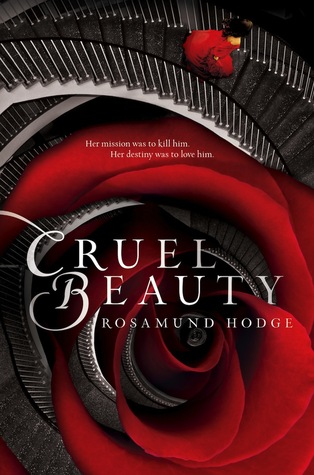
Cruel Beauty (Cruel Beauty Universe #1)Cruel Beauty is a book that I think had a lot of potential and, for a while, was well-executed, but in the end fell flat.  It was the book club pick for October for the Unapologetic Romance Readers group on Goodreads, and I was pretty excited for it--I had voted for it--because it had been on my to-read list for a while.  It's a Beauty and the Beast-based story in which Nyx, the heroine, has been raised to marry a demon prince as payment for a bargain her father made prior to her birth.  The setting is somewhat strange.  It appears to be the island of Great Britain, but magically cut-off, and on a timeline in which Britain continued to be ruled a sort of Greco-Roman dynasty after the fall of the Roman Empire.  But there's also magic and what seem to be pseudo-Victorian or -Regency trappings.  It's a strange mishmash, and Hodge continues this mash into other areas of the story, which are ultimately what I think led to its downfall.

The story starts with Nyx on the day of her wedding.  She's married by proxy (a statue) to the Gentle Lord, and then promptly deposited on his doorstep with the expectation that she will never return.  But her sacrifice isn't to be for naught.  Once inside the demon's castle, she's supposed to find its four magical centers and destroy the castle, with the demon inside, and free the people of her country from his rule.  But she quickly finds that everything isn't as it seems.  The Gentle Lord, Ignifex (not his real name), lets her know that every night, she'll have the chance to guess his name.  If she gets it right, she goes free.  If she gets it wrong, she dies.  (She also has the option to just not guess.)  And she has a key that unlocks all the doors she's allowed to go through, and told that if she goes through other doors, it's likely she'll die.  Demons lurk in the shadows, ones that don't have the seemingly good intentions of Ignifex, and there seems to be little hope of Nyx ever successfully navigating the constantly-shifting castle and destroying it.  But she does have the help of Shade, Ignifex's shadow who takes on physical, human form at night, and--just maybe--of Ignifex himself, who doesn't actually seem to want to kill her.  Or ravish her.  But of course, as time goes on, feelings grow between them...

Beauty and the Beast is the main basis of the story here, but Hodge also mixes in Greek mythology, mainly the story of Pandora and a weird creation called The Kindly Ones, who seem to be based on the Furies (The Kindly Ones is another word for furies, who have pursuit of oath-breakers as part of their job, and breaking oaths is a big deal in this world) but also have some strange component of making bargains with strings attached, a la Rumplestiltskin. 

Image result for all magic comes with a price

While these strings play together in an interesting fashion throughout the story, at the end they all collide in a sort of series of climaxes, which don't really fit together and seem to go on for far too long--seriously, this book could have ended at least twice before it actually did.  And then there's a weird time paradox involved that I didn't really "buy" the workings of, either.  It's such a shame, because this was a cool world and an interesting premise, but ultimately some of the things that made it so cool made it too complicated to work in a sensible manner, and it kind of fell apart under its own weight.

Nyx was an awesome character, though.  The thing that ultimately her so strong and so different was that she wasn't a nice person, and she wasn't afraid of showing it.  She had a noble goal in mind, but her motive for attaining it had more than a little resentment and guilt attached to it, rather than being selfless.  As Ignifex says, she has "a little malice in her heart," and she never really gets rid of that.  Even at the end, she maintains it, and that's what made her so strong and so different.  Heroines in these sorts of books are always so good and pure, and seeing someone who had a splotch of black on her heart was a very different feelings.  And the same with Ignifex and Shade, both--none of the characters here, not even Nyx's oh-so-sweet twin, are actually good, but they're also not utterly despicable to the point that you don't want to root for them.  It was an interesting balance, and I think that was an aspect that Hodge handled very well.

Ultimately, this is a first book, and I think the construction of it shows in the end.  I'm still interested in reading more of Hodge's work, because I think authors certainly learn a lot from the first book they produce, and come back much stronger in future volumes.  Hodge had strong beginnings here, and with a bit of refinement, I think she could become a real powerhouse in the "fairy tale retelling" genre.

3 stars out of 5.

Friday, June 3, 2016

Street Fair - Jeffrey Cook and Katherine Perkins (Fair Folk Chronicles #2)

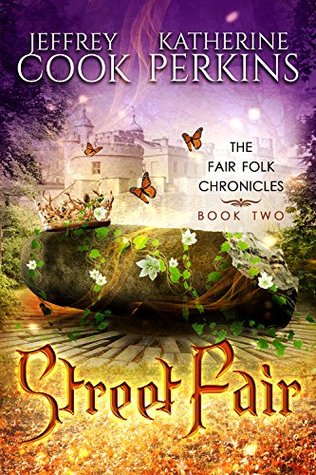
Street Fair (Fair Folk Chronicles, #2)Street Fair is the second book in Jeffrey Cook and Katherine Perkins' Fair Folk Chronicles.  It follows Megan, a teenager who has recently discovered that she's a half-faerie princess, and her friends as the Goblin Market comes to town, and brings with it a host of unforeseen trouble that deals with Gaelic mythology, particularly that of Balor and the Fomoiri.

I had some difficulty with the first of the Fair Folk Chronicles because it really made faeries much more sugary-sweet than they are traditionally said to be.  That's still the case here; despite a bit of a bloodthirsty toast at one point, even the Unseelie court is kind of like a bunch of teenagers who just like to hang around and play pranks on each other rather than be menacing in any meaninful way.  The Seelie court is basically all sweetness and light.  Ashling the pixie continues to annoy me beyond all reason.  However, the story as a whole appealed to me and agreed with me much more, and that's because of the topic.  The integration of the Fomoiri and Balor really hit a sweet spot for me, and I can tell you exactly why: because I associate it with Diane Duane's Young Wizards series, and specifically the fourth book, A Wizard Abroad, which deals with the same subject though in a different way.  That actually really helped re-orient myself regarding how to look at this book.  Until that topic started to come in, I was looking at the Fair Folk books as young adult books, but they're really not.  I can't remember exactly how old the main characters are (though Lani can drive, so they must be about sixteen), but in writing and subject, these books are much more middle-grade than young adult.  There is very light kissing, but also a lot of parental supervision and the whole thing is very clean, which is really more characteristic of the middle-grade than the young-adult age group these days.  The same goes for the Young Wizards books.

As for the book itself... This is obviously much more of a "series" book than the first one is.  It has a plot of its own, albeit one that involves a lot of running around and not actually doing a much, The integration of these parts of Gaelic mythology are pretty cool, and I think it would be a good way to get younger readers interested in such topics.  But it also sets up for a continuance, which the first book in the series didn't.  Book 3 (A Fair Fight) will clearly deal with the set-up from here, and I'm curious to see if the fourth book (All's Fair) will continue on from Book 3 or if it will be more of a standalone story like the the first volume was.  Seeing Megan gain some more control of her abilities, and realize some of the repercussions of dealing with faeries, was pretty neat.  At the same time, though, much of the book did end up reading like set-up for the next one.  Some of the elements also didn't seem to fit for me.  For example, the main villain is known as the Butterfly Collector to the main characters, and apparently is the person who was behind the ruination of Ashling's wings.  But he doesn't seem to have done this more than once; now, I'm not saying that it's not bad to have only done it once, because clearly it was, but why Collector?  That indicates multiple times.  Was this something that was brought up in Book 1 but that I forgot?  If so, disregard, but it was a bit discordant to me.  Also, as I mentioned before, the plot seems to involve a lot of running around and fight scenes, but very little of that actually advanced the plot.  It was more filler until the higher-ups decided to do something--and most of it was incredibly stupid of the characters to do in the first place, something that they acknowledged but then proceeded on with anyway because "there weren't other options" even though there really were.

I'm interested to see where the next book here goes; there are definitely indications that all chaos is about to break loose.  Now that I've been able to re-orient my view of these books, they do agree with me more, and I think these would be good options for middle-grade students interested in mythology-based fantasy--but I would not go so far as to put them as young adult, given that the heavier themes characteristic of young adult books are pretty much entirely absent in this series.

3.5 stars out of 5.

Saturday, February 6, 2016

Persephone - Kaitlin Bevis (Daughters of Zeus #1)

Persephone (Daughters of Zeus #1)Let's start with this: I did not enjoy this book.  It intrigued me, because I love stories based off myths and fairytales, and the story of Persephone and Hades is one my favorites.  I read and devoured Meg Cabot's Abandon series a year or two back, which was based on the Persephone story and was absolutely delicious.  I was hoping that Kaitlin Bevis' adaption would be more along those lines.  It wasn't.

The story is about Persephone, who is in high school when she abruptly finds out that she's a goddess, that the god of winter is after her, and that the guy who rescued her from her is now her husband.  Suddenly living in the underworld, does Persephone fret her pretty little head off about her mother and friends on earth?  No.  What does she do instead?  She shops.  She drinks coffee.  She designs dresses and re-decorates her room.  Apparently the underworld is like suburbia.  Eventually, of course, she gets her butt in motion and actually does something, but only after pages and pages and pages of her fretting about like a regular sixteen-year-old, not one who should have larger concerns than the view outside her bedroom windows.  Other annoying things about her: men fall in love with her at first sight (multiple times, and not just Hades; Hades gets a pass because that's how the myth goes).

The supporting characters annoyed me just as much.  The gods are supposed to thousands of years old, and yet they all act like a bunch of teenagers.  Hades, Thanatos, Demeter...all of them seem to not possess an ounce of sense in their god-like heads, as did their lackeys the Reapers, Charon, and even Persephone's friend Melissa (who was, to be fair, an actual teenager).  Boreas, as a villain, was completely lacking from the picture.  Cassandra, who should have been awesome, was merely annoying instead.  Bevis decided to do away with the part of Cassandra's curse that dictated that no one would believe her visions, instead deciding to go with the curse ended when she died, which basically means Cassandra knows everything that's coming and tells Hades about it in advance so he can deal with it, and Persephone never needs to.  Cassandra could have been an incredibly compelling character, but was instead relegated to cheesy, annoying sidekick.

The settings were also cringe-worthy; the underworld is apparently just like suburbia, very Stepford Wives-ish but without the menace lurking underneath.  Tartarus could have provided an interesting component but was, again, pushed off to the side so that Bevis could talk more about Persephone's flowershop in the suburbs of the underworld.

And the romance?  Pretty much non-existent.  Hades falls in love with Persephone at first sight, as per the myth, and that's about it.  There's no real development of their relationship on either side.  Oh, and the winter that descends upon the world is from Boreas, not from Demeter missing and searching for her daughter.  No, Demeter is totally okay with her daughter going off to the underworld and marrying a guy thousands of years older than her.  What?  What what what?

And the writing!  Bevis skips from one incident to another with no smooth transitions, to the point that at the beginning of the book I found myself wondering what the heck was going on at some points.  "Where did this come from?" I wondered, for a long time before realizing it was a completely different scene and time, there just hadn't been any transition to it.  Unnecessary adverbs abound, Hades sighs about every two seconds... I could go on, but I won't.

If you're looking for a young adult adaptation of the Persephone story, try Meg Cabot's Abandon instead; I reviewed the trilogy here, and while I certainly had some issues with it, it left a much better impression overall than Bevis' adaptation did.  If you want a young adult story of a girl coming into crazy nature powers and falling in love with a death god, try Kresley Cole's Aracana series.  Both, I think, would be far better options than this book.

1.5 stars out of 5.

Saturday, July 26, 2014

Chasing the Star Garden - Melanie Karsak (Airship Racing Chronicles #1)

Chasing the Star Garden (The Airship Racing Chronicles, #1)First off, can I just say look at that cover art?  Gorgeous.  Absolutely gorgeous.  I am jealous of Karsak for having such beautiful cover art.

Now, on to the substance.  Chasing the Star Garden follows our narrator, Lily Stargazer, as she tries to unravel the mystery of a kaleidoscope given to her under strange circumstances.  Lily is mainly an air jockey, and the book falls into a series called "The Airship Racing Chronicles," but really, there is very little to do with airship racing here; only two chapters (the first and the last) feature any real racing.  The bulk of the story follows the kaleidoscope mystery.  Lily is also somewhat of an alcoholic (her drink of choice is absinthe) and a user of both laudanum and opium, has two lovers that feature in the story (one of which is a fictionalized version of Lord Byron) and is a little bit into BDSM.  Some of these qualities, mainly the addictions and her behavior regarding them, are rather less than endearing.  For example, Lily has taken so much laudanum at one point that the airship she's supposed to be piloting ends up in trouble because she's high.  However, Lily is well aware that she might be on a bad path, wondering, "If I continued like I did, what would be my end destination?  The answer to that question was not pretty.  I'd stopped asking it long ago."  This self-awareness is rather more endearing, and allows one to root for Lily getting over her issues and finding some meaning in her life.

Character-wise, I rather liked most of them.  Lily and her crew, Jessup and August, as well as Lord Byron and Lily's other lover, Sal, are all great.  Celeste, a courtesan who shows up partway through, was less great.  She was okay, I guess, but overall I found her bland, when her origins and plotline should have lent her an air of mystique.  I liked how Lily's back story unraveled, and maybe Celeste would have been more interesting if she'd had a little more back story or we could see inside her head more--impossible, given the first-person perspective, but still.  I would have also liked to see a bit more integration of the airship racing story, and the characters that went with it, like Cutter the American pilot and Etienne the French pilot.

I did find some plotholes in the main storyline, which revolves around using the mysterious kaleidoscope to search for a statue which was lost during ancient times.  One part of the story involves using another statue to find it, which didn't make sense to me because the guy who carved and placed the statues had nothing to do with the guy who moved one of them, so why would one point to another?  I also didn't really get how the kaleidoscope worked.  There was something about it being "altered," but the random nature of kaleidoscope patterns kind of goes against the idea of them being able to reveal things when pointed in certain directions and at certain objects.  As the book advanced, it took on more of a fantasy/supernatural/mythology air and kind of lost some of its early steampunk flair, with airships being used but not being the focus of the story.  While this didn't really bother me, I can see where it would bother some people who were in it for a thoroughly steampunk tale, so keep that in mind; as the book goes on, the steampunk element is more for atmosphere than it is for actual substance.  Oh, and as far as the "star garden" goes, it just refers to the sky, which is a bit...purple for my tastes.

Lastly, I found the entire final chapter rather abrupt.  The reunion, the abbreviated race, the heroics--it all kind of seemed to jar with the speed of the rest of the story, and felt like Karsak just got tired of writing and wanted to wrap it all up.  While I have no objections to the ending logically or emotionally, the pacing just seemed to be....off.  I would have preferred to see this slowed down and fleshed out a bit more than it actually was.

Overall, however, I thoroughly enjoyed this, and will be picking up the next book of Lily's adventures, Chasing the Green Fairy--though I'd also be interested in seeing books following other main characters in this world!

3.5 stars out of 5.