Pages

Showing posts with label science. Show all posts

Monday, December 25, 2017

The Death and Life of the Great Lakes - Dan Egan

The Death and Life of the Great LakesRecently my boyfriend decided that we should read more books together so that we can discuss them, and since more books is always okay with me, off we went.  He picked the first book, The Death and Life of the Great Lakes, which was also hugely interesting to me because I grew up on the Great Lakes, specifically Lake Erie but with visits to Lake Michigan and also the Niagara River in the Niagara Falls area.  I'm familiar with zebra mussels and sea weed and algae slicks and dead fish on the beach.  I knew that the Cuyahoga River used to catch fire with some regularity, and that Erie, PA was the largest freshwater fishing port in the world, and that the lake just didn't freeze over like it used to, and that Lake Erie was, quite frankly, pretty polluted and gross.  But I didn't know how bad things actually were.

Egan divides his book into three parts: the front door, the back door, and the future.  The "front door" to the Great Lakes is the Saint Lawrence Seaway, over which foreign ships bring cargo and also ballast water laden with invasive species, which they then proceed to dump in the Great Lakes.  Enter the zebra mussel and the quagga mussel, plagues upon fresh water systems everywhere.  This part also deals with the sea lamprey (mostly dealt with now due to a massive ongoing poisoning campaign--pleasant, right?), the alewife, and the chinook and coho salmon, planted in the lakes by a misguided campaign by one person to make the lakes into some sort of sport fishing paradise.  All of this, of course, ravaged the lakes' natural ecosystem, to the point that they will never truly recover.  The "back door" is the Chicago Sanitary and Ship Canal, which connects the Great Lakes to the Mississippi River Basin.  Not only has it provided a route for the quagga and zebra mussels to spread to much of the country beyond the lakes, but it's providing a route for extremely invasive species of Asian Carp to get into the lakes, which would make all the devastation the mussels have wreaked look like nothing.  This part also talks about runoff that has led to toxic algae blooms on Lake Erie that threaten clean water supplies.  And finally, the third part talks about threats to the lakes from climate change, cities wanting to funnel away the water for various reasons, and finally a drop of hope in the bucket of despair in regards to how the lakes are, in some small way, adapting and people are working to "fix" them.

This is a bleak book.  Despite Egan's attempts to show that, if we really try, we can stop the damage and start to repair it, it's pretty clear that the lakes will never be what they once were again.  The invasive species can't be gotten rid of.  There's some hope with genetic manipulation of them, but that can be a Pandora's box all on its own.  And then there's an absolute reluctance for people to actually do anything to begin with.  Farmers don't want to change their fertilizing practices, saying that the agricultural runoff isn't really due to them, even though there's overwhelming evidence to show that it is.  Agreements to funnel water away from the lakes keep going through.  There's no real teeth in an order that ships coming from overseas implement better methods of cleansing their ballast tanks of invasive species before dumping in the lakes.  And everyone fights tooth and nail against suggestions to cut the Chicago canal off from the lakes to stop the march of Asian carp.  All of this despite the fact that all of this going on is costing money and stopping it would not really affect trade or the economy at all.  It's infuriating.  Rage-inducing.  And pretty darn hopeless.

This is an excellent read, though.  Egan's writing is engaging and informative at the same time, and he writes in a narrative style while still conveying so much about the state and future of the lakes.  Sprinkled with interviews and anecdotes, I could definitely see the years of reporting that went into what ultimately became this book.  It's also an important read, and I think that it should be pushed on pretty much everyone possible.  The Great Lakes aren't just the problem of the people who live on them; they are twenty percent of the world's available surface freshwater.  That said, there is something that I think was missing here, and that is that the book is written almost entirely from an American perspective.  Egan's an American who did this research for American papers, so that's understandable.  However, Canada also touches the Great Lakes and has a ton of influence on what happens to them!  I would have loved to see something from the other side of the border--a part, a chapter, something other than a few lines about Canadian initiatives that match American ones.

Overall, an excellent read albeit a depressing one.  Read it anyway.  Educate yourself.  Water is everyone's problem.

4 stars out of 5.

Friday, September 22, 2017

The Wave - Susan Casey

9674788There is something utterly fascinating about the ocean and how little we know about it.  Fascinating, and completely terrifying, because have you ever witnessed an 1,800 foot high wave?  No?  Neither have I, and after this, I plan on avoiding the ocean for like, ever, because I don't want to! 

In this, Casey splits her attention in a few different directions to examine big waves in various contexts.  First, in a narrative she goes back to again and again, she follows surfers, particularly Laird Hamilton, as they attempt to surf bigger and bigger waves across the globe, with a lot of focus on Hawaii's "Jaws" surf spot.  Interwoven with the surfing, which is probably the easiest for the layperson to understand, she talks to scientists who study waves, salvagers who recover ships wrecked by huge waves, historians who look at
the big waves of the past--like the 1958 mega-tsunami in Alaska that I referenced in the first paragraph of this review--and other assorted "wave" personalities. 

What all of this underscores is that the ocean is really freaking scary, and it's likely to get even more so.  We actually know very, very little about how waves, particularly big waves, work--one of Casey's interview subjects points out that, after a certain size, waves kind of stop acting like water waves and start acting kind of like waves of light, which is totally weird.  We can't study them in their natural environment to any great degree because, as another interviewee pointed out, if you encounter a hundred-foot wave, you're probably trying to survive it, not measure it.  But we know that they occur much more often than we used to think they did, and that they're doing a lot of damage--like apparently sinking two shipping ships or tankers per week, and why is no one pointing that out???  I think Casey did a good job of pulling in all kinds of information that people don't really encounter about waves and the ocean, and by using the surfing as the core of the narrative, she focused a lot of the science into through a lens that a lot of us laypeople can understand.

I listened to this an audiobook, and the narrator, Kirsten Potter, was excellent.  She has a very conversational way of reading the book and, while some of her "surfer guy" impressions came off as very stereotypical and maybe even mildly offensive, she really made the book engaging.  I think this is one that would have been good in actual book form as well, but it was a good choice for audiobook!

Overall, I really enjoyed this.  It's a great science book about a topic that I don't think is really frequently covered in the "popular science" category.  Apparently Casey has written some other books that have serious ethical questions involved regarding her behavior in researching and writing them, but I really liked this one, didn't see any issues like that, and would recommend it to others.

4 stars out of 5.

Monday, September 26, 2016

What If? Serious Scientific Answers to Absurd Hypothetical Questions - Randall Munroe

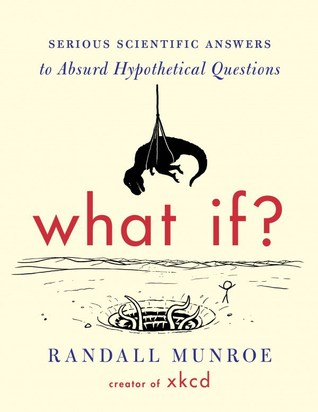
What If?: Serious Scientific Answers to Absurd Hypothetical QuestionsSo, What If? was my choice for a satire book for my 2016 reading challenge.  In it, Randall Munroe, the author of the webcomic xkcd answers email questions he's received that are absolutely ridiculous, but he answers them in a serious manner.  I think the best, easy example of this is the often-asked question, "What would happen if the sun turned off?"  In answer, Munroe lists a lot of "pros" to the sun going out, such a reduced risk of solar flares, improved satellite service, being able to drive across asphalt laid directly on ice instead of needing to build bridges, and safer parsnip consumption.  And then he follows it up with the downside to the scenario: we would all freeze and die.  Other types of crazy questions include...

-What would happen if all the rain in a rainstorm fell as one massive droplet?
-How many Lego bricks would it take to build a bridge capable of carrying traffic London to New York?
-How quickly would the oceans drain if a circular portal 10  meters in radius leading into space were created at the bottom of the Marianas Trench, and how would the world change as the water was being drained?

These are accompanied by the actual science--though sometimes stretched in crazy ways--which is really well explained for those of us who are not physicists, and also by the stick figure comics that Munroe has become internet-famous for.  His type of humor really agrees with me (when I understand it; the webcomic's page contains a warning that states "This comic occasionally contains strong language (which may be unsuitable for children), unusual humor (which may be unsuitable for adults), and advanced mathematics (which may be unsuitable for liberal-arts majors)," and I am a liberal-arts major) so I thought I would like the book quite a bit.  And I did...

...but.  Here's the thing.  Munroe also runs a What If? blog, and most of the content of the book comes from there.  There are a few new things in the book version, but just a few, and most of the "new things" are questions that came in that Munroe finds especially weird and worrying but doesn't answer in full as he does the other ones.  If you've read the What If? blog, then there's not a ton of new stuff here to enjoy.  The blog is also set up better for Munroe's style than the book is.  xkcd and consequently What If? are known for the alt-text that Munroe uses, which is the text that appears when you hover your mouse over an image, and serves as a sort of caption.  Pretty much all of the comics that Munroe inserts into the What If? answers online include an alt-text, but only a few of them are included as captions in the book.  He also uses footnotes in a funny way on the blog, but when you read the book, either in hard copy or on Kindle, they're not as accessible; on the blog, you click the footnote and the note actually just pops up where you are, without directing you to the end of the article.  In the book, you have to go to the end of the article to read the notes, which are typically funny and not actually citations, and are things you want to read as you along rather than at the end, and that makes for a lot of flipping back and forth.

Munroe's typical wit and style are evident here, and I wasn't disappointed by that at all.  Still, I think this book is best suited for people who aren't familiar with xkcd and What If? in their internet forms; if you're already a fan, I think you're better off just sticking to the website.

3 stars out of 5.