Pages

Saturday, July 13, 2013

The Perfume Collector - Kathleen Tessaro

The Perfume Collector
The Perfume Collector is perfume in the form of written word.  That sounds cheesy, but it's true.  It's a novel of discovery, starting out misleadingly simple and gaining more complexity and subtly as it goes on. It's like perfume; the longer you wear it, the more complex it becomes as it mingles with your skin, taking on you in addition to its own ingredients.

This is a novel written around two different women, Eva and Grace, in two different times.  Eva's timeline is earlier, ranging from 1927 to 1954, while Grace's timeline is steady in 1955.  Eva's first appearance is as a jaded woman who is dying and trying to straighten out the remainder of her affairs, and from then on we get to see her in her younger days, as a teenager and then a young woman.  Grace is a woman living in London with a marriage that is, if not failing, then certainly not as happy as it can be.  She receives word that Eva left her an inheritance, even though they've never met, and sets out to discover more about the mysterious woman who left her a fortune.  The characters definitely mature throughout the story, and it's just as obvious with Grace as it is with Eva.

There are some awkward point of view shifts in this book, not between Eva and Grace, but between them and other, supporting characters.  There are no page or chapter breaks for these shifts, and the narrative, which is mostly written with a single-person perspective, seems to lurch uncomfortably as we switch to the mind of another character.  The narrative itself is, as I said before, deceptively simple.  I felt that I knew the "big reveal" for most of the book, because it wasn't really that much of a secret or a surprise.  The hints were abundant.  But when the "reveal" came, there was so much more to it that hadn't been hinted at.  It added a delightful dimension to the story, and I found myself enjoying the latter bit of it quite a bit more than the beginning.  I was also extremely pleased with the end, because if it had ended any differently, the whole point of Eva's will would have been...well, not in vain, but I don't think it would have had such a beautiful conclusion.

Overall, and excellent read.

4 stars out of 5.

Thursday, July 11, 2013

The School of Essential Ingredients - Erica Bauermeister

The School of Essential IngredientsIt's not a secret, to anyone who knows me, that I love food and cooking.  Indeed, I stated in my review of Consider the Fork that I would be perfectly content to be a housewife if it meant that I could stay at home and cook (and, consequently, eat) all day long.  This will, however, probably seem less appealing as my metabolism slows down.  It keeps the pounds off now, but in the future... Oh, boy, I'm going to be fat.

When I started reading this book, I expected a book about cooking and learning to cook.  Not a cookbook; I knew it was a novel, about an ensemble cast with their own backgrounds and wants and needs, but I expected there to be more focus on the actual "learning to cook" process than there actually was.  Bauermeister's cooking pro, Lillian, doesn't believe in recipes due to an aversion to the written word (HOW COULD ANYONE HAVE AN AVERSION TO THE WRITTEN WORD?!?!) so there aren't any recipes included.  Mildly disappointing, but I guess  beyond the point of the book itself.

What the book actually is, is a collection of back stories for people who happen to meet in a cooking class and may or may not become involved in each other's lives.  They were good stories--engaging, well-written, and often poetic; Bauermeister is a very good writer in that respect--but there wasn't a lot of forward motion.  Of course, there didn't really need to be, since it wasn't a plot-centered novel, but...  But, well, of the nine stories (eight students and one teacher), six of them take place entirely in the past.  Lillian, Helen, Carl, Isabelle, Tom, and Claire all have stories that abruptly cease when we reach the present day.  We never learn what Claire does that makes her happy, or why Carl and Helen are taking a cooking class and what they gain from it.  They're just there.  Lillian and Tom have a bit of interaction at the very end, but it's still not really integrated in the sense that the class isn't woven into their lives; it's just the place they met.  As for Isabelle...it seemed that her story was centered around the idea of being "edgy," and just came across as kind of random.

On the flip side, Antonia, Ian, and Chloe all have stories with forward motion in them, and those were really more enjoyable to me.  Antonia is from Italy and is adjusting to life in the US while trying to convince a couple that they don't really need an industrial kitchen in their Victorian-era home.  Ian is trying to woo Antonia.  And Chloe is struggling with life after high school and living with a boyfriend who isn't exactly the cream of the crop.  Throughout the story, all of these characters actually grew as people and left the class much more "full" than when they started.

When the writing did focus on the class, however, I loved Lillian's voice in how she treats food.  I'm not sure I actually agree with everything Bauermeister put in her mouth, but I want to agree with it.  On some level, it probably is true that people are shaped by the way they eat, but I'm not sure it's to quite the degree that it's made out to be in the book.  And I'm also not sure that, even though I love cooking, cooking is as magical as it's made out to be in the book.  Restaurants, and more specifically restaurant kitchens, are not places where people have cozy chats.  They are hot, sweaty places of work, and while there is certainly something magical about raw ingredients turning into fully-prepared dishes, there is rarely something magical about the attitude that goes into them.

Still, this was a highly enjoyable read with some really great writing and very human characters, all of them with their own quirks and flaws.  While there wasn't as much "motion" as I would have liked, this was a great book to curl up with on a rainy evening and thoroughly devour.  (Devour.  Get it?  Because food.)

3.5 out of 5 stars.

Tuesday, July 9, 2013

The Winter Palace - Eva Stachniak (Catherine #1)

The Winter Palace: A Novel of Catherine the GreatHaving taken a course on Russian history last fall, I spent most of this book trying to match up historical fact to the happenings in the book.  That said, it was a futile effort because my course focused on Russian history, not Russian intrigue.  The plot follows a Polish woman who moved to Russia when she was young in the company of her parents.  When she is orphaned at the age of fifteen, almost sixteen, she finds a place serving in the palace Empress Elizabeth.  She becomes a "tongue," a palace spy for the Empress, and befriends Princess Sophie when the German girl arrives to marry the Grand Duke.  Intrique follows.

This was a book full of much drama, and it was a good read.  There isn't a ton of history in it; large historic events are only mentioned in the background, and the story mostly takes place within the walls of various Russian palaces.  The Winter Palace, while giving its name to the book, is only one of the locations, and spends a large portion of the book uninhabited as it is renovated.  There are plenty of descriptions of sumptuous dresses to please those enamored with royal life.  There are lovers and affairs and forced marriages and plenty of backstabbing among the palace inhabitants.  It has all the elements of a good historical fiction, with plenty of description of Russian foods to add a little cultural flavor (ha ha, flavor, get it?).

The main complaint I have about this book is that none of the characters ever seem to grow up.  Varvara acts like she's sixteen and Catherine acts like she's fourteen throughout the entire book, which spans several decades.  Varvara's daughter acts at age eight exactly the way she acted at age three.  When Catherine and Varvara have a falling out, it's over something that a pair of high school students would quarrel over, not an issue that would sever a long bond of friendship between two mature women.  Presumably these characters, who are playing at revolution and ruling an empire, should have a bit more maturity than that, especially after everything they've gone through.  The characters are completely stagnant.  Maybe there's supposed to be a message in that, something about history repeating itself to those who have not learned from it, but it comes across more as poor character management.  Perhaps it would have been better if the scope had been limited to a smaller period of time, when less character change would be expected, but as it was, it just seemed strange to find adults running around pretending to be children while planning a revolution in their free time.

I also found Varvara's relationship with Egor unrealistic.  I didn't know if she was supposed to hate him or love him or tolerate him, and I really hoped that there would be some other love interest somewhere along the way.  There seemed to be a lot of potential people to fill that role, but nothing ever came of it. Kind of disappointing.  It didn't entirely kill the story; far from it, but it would have been a good side-plot.

2 stars out of 5.

Sunday, July 7, 2013

The Book of Lost Fragrances - M. J. Rose (Reincarnationist #4)

Meet Jac.  She sees dead people.  Well, actually only one dead person, and that's her mother.  But she DOES have vivid hallucinations, an ex-flame from a younger time, and a little brother who's obsessed with finding a perfume that can help people remember their past lives.  The brother, Robbie, wants Jac to help him, because apparently she has the finest nose there is and will be able to identify the perfume's elusive ingredients better than anyone else.  Robbie wants to find the perfume in order to give it to the Dalai Lama, to help his cause by proving reincarnation.  How this will help is never actually explained.

So, there is a lot going on in this book.  There is the story with Robbie, Jac, and Griffin trying to find the perfume.  There is a story line about the Dalai Lama and the Panchen Lama and the constant struggle in Tibet.  There is a story line about members of the Chinese Triad in Paris.  There is a story set during the French Revolution, and one set during Cleopatra's time in Egypt.  The two "old" storylines, of the Revolution and Egypt, are kind of necessary to a book about reincarnation, but they probably didn't have to be as explicit.  I think more "hinting" would have been better, letting me make up my own mind about whether all of the reincarnation stuff was bullshit or not.  As it was, I felt like it was being shoved down my throat.  The story line with the Dalai and Panchen Lamas probably could have been eliminated entirely; the "purpose" for the perfume could have, instead, been shifted to restoring the memories of Jac and Robbie's father, who has Alzheimer's.  That would have freed up the Tibet storyline for another book.

Also, the blatant political message for a free Tibet was kind of annoying.  I am aware of the terrible situation Tibet is in, but I didn't want it shoved down my throat in a book that was focused more on Paris and Egypt.  Like I said before, I think it would have been best to separate that story and put it in a separate book of its own, where it could have more attention and be more fully explored.

That said, this was an enjoyable, fast read.  It's one of those books that has many short chapters instead of a few long ones, which makes it easy to pick up and put down without losing the thread of the story entirely.  It also has a glossary of Rose's research in the back, in case you feel like learning a little more about some of the topics (i.e. making perfume) that are featured in the book.  I liked the characters, for the most part, though they were all kind of obnoxious in that there wasn't any real character growth until the very end.  I'm also not sure what was up with Jac's mother's ghost, because if the pretense of the book revolves around reincarnation, shouldn't she have been reincarnated rather than just floating around and talking to Jac...?  I also did not like the ending.  It seemed like a cop-out instead of dealing with more complicated issues the characters had.  But still, a light, fast read.  Also, though this is the fourth book in a series, you do not have to read the others to understand this.  I picked it up without knowing it was part of a series, and it all made sense to me, though now I can see where it might have been referencing some of the earlier books.  But still, it stands alone as a narrative and won't leave you hopelessly confused.

2 stars out of 5.

Friday, July 5, 2013

Assassins of the Turquoise Palace - Roya Hakakian

Assassins of the Turquoise PalaceThe biggest problem with Assassins of the Turquoise Palace is that I had no idea what it was about.  Having been raised in the good ol' US of A, I have been pretty much perpetually inundated with messages of "Iran is bad.  Bad bad bad."  While I doubt that's true in its entirety--few things ever are--there are a myriad of areas in which it does seem to have merit.  For example, the Iranian government's ordering of the killings in this book.  That wasn't exactly cool.  But what I was left wondering, for the entire book, was why it was ordered in the first place.  I think it had something to do with Kurds.  I don't know much about Kurds, pretty much just that they're a group of people in the Middle East who don't have a country of their own, much like the Roma, or the Jews before Israel was created, or the Palestinians today.  I don't know why the Iranian government wanted these particular Kurds dead.  Or were they Kurds?  Was that ever said?  I think it was mentioned that they supported an independent country for Kurdistan, but just because they supported it doesn't meant they were Kurds themselves.

You might see why this book left me a little confused.  Parts of the book also rambled or jumped around a bit too much; I have never seen more pagebreaks in my life, I swear!  It made following the multiple characters a little more difficult than I would have liked.

Also, despite the book being entitled Assassins of the Turquoise Palace, very little time is spent talking about the Turquoise Palace, the assassins, or even the assassination.  The focus is on the 90's-era trial of the men accused of killing several Iranian activists in Berlin.  Now, don't get me wrong, I love me a good trial.  I am an avid watcher of Law & Order (but only the episodes with McCoy, because he is a badass in the courtroom) and I take law classes for fun at my university.  And I do think that the trial and everything surrounding it was written very well, and was very easy to read; no slogging through legal mumbo-jumbo required.  But, if I'm picking up a book called Assassins of the Turquoise Palace, I really do expect the focus to be somewhat on the assassins.  I would have liked that story.  How did these people get to be killers, anyway?  It's entirely possible that book can't be written, because of a dearth of sources or something like that, but I think it would have been a more compelling read.  Not that a quest for justice is un-compelling, but... I don't know.  It just wasn't what I thought it was going to be, and what it was wasn't enough to make up for that.

One more thing.  While the writing is very detailed, which is what makes it so readable, I'm skeptical of how accurate it is.  Including dreams and feelings can be done in a nonfiction book through detailed interviews, but that would be very detailed indeed.  I'm skeptical if, at times, Hakakian isn't speculating and putting her own words or feelings into the mouths and hearts of the people of the book.

And can we talk about that cover for a second?  It  doesn't influence my opinion of the book, but man, that is some of the worst photo-editing I've ever seen.

So, lacking some information that made it a bit hard to understand, with a bit of a jumpy structure, it was a hard book to really get into.  While its actual topic was well-written, for the most part, it isn't a book I would pick up again.

2 stars out of 5.

Wednesday, July 3, 2013

Two-Way Street - Lauren Barnholdt

Two-Way StreetWarning: This review contains profanity.

What.  The.  Fuck.  I'm not sure I've ever read a bigger piece of trash in my life.  How anyone could get away with writing this is utterly beyond me.  I actually had to take notes on everything that was wrong with this book, just so I didn't lose track.  Let's start at the beginning, shall we?

First, everyone, and I mean everyone, in this book is fucking psychotic.  All of them.  It's a completely unrealistic portrayal of high school/college students.  High school and college students do not spend all of their time fucking and drinking.  They don't.  I don't know how long ago Barnholdt was in high school and college, or what her social life was like when she was there, but for some reason I have a feeling she wishes this was what college and high school were like, not what they were actually like.  Is there sex and partying in high school and college?  Yeah, sure.  But people do not spend every night of the week attending multiple parties.  Especially when they're stellar students, like Courtney and Jordan supposedly are, because you actually can't be a stellar student and still have time to spend every night hooking up and drinking.  Trust me, I know.  And they all, even the adults, run around sharing secrets and blackmailing people.  What?  And let's not forget that not a single parent cares that their children, who are underage (Courtney is 17) are running around at all hours of the night with people they have never met before, and they encourage this behavior.

Then there are Courtney and Jordan themselves.  We are supposed to believe that they had a wonderful, beautiful relationship, that they never fought, and it's wonderful that they got back together.  Uhm, no.  Not at all.  Courtney, for starters, is psycho.  She believes her ex-boyfriend is a liar and a cheat, even when she knew he wasn't lying to her or cheating on her.  Her relationship with him revolves heavily around the use of Myspace, which is definitely not the way to have a successful, healthy relationship.  She also automatically assumes that every girl who isn't a virgin is a slut.  Myspace Girl is a slut because Jordan likes her.  Any girl who ever bats an eyelash at Jordan, even before Courtney liked him, is a slut.  But this logic does not apply to Jordan, even though he apparently hooks up with girls left and right.  Barnholdt apparently still lives in an age where only women can be sluts, and men who sleep around are to be congratulated for their actions because it makes them even more desirable.  And can I mention how Courtney thinks that girls who are desirable, but are honest and never cheat on their boyfriends are "the worst kind of girls"?  What the fuck is that about?  Apparently Courtney thinks that lying and cheating are desirable qualities in a girlfriend?!

Now let's talk about Jordan.  Jordan, as mentioned before, is the type of guy who hooks up with a different girl every night of the week.  He also deeply regrets not having the appropriate amount of time to gel his hair in the morning.  He likes his rap "hard and dirty" and thinks Courtney, who he is in love with, is dressed like a slut because she's wearing shorts and a tank top in Florida in the middle of the fucking summer.  Let me repeat that.  She's a slut because she's wearing shorts and a tank top in Florida, one of the hottest, most humid places in the country.  God forgive her for not wearing a full-length skirt and a bonnet to cover her hair!  He also thinks that, if a girl shows any interest in him at all after they hook up, she is automatically psychotic; heaven forbid that a woman expects a guy she's been intimate with to treat her like an actual human being and not like a disposable fuck toy!  We're apparently also supposed to think Jordan is edgy or something because he bought pot for a party once.  No.  That is not edgy, that's just stupid and a waste of money.  We're supposed to like him because he cries over his breakup with Courtney, but that was all because he was a complete idiot in the first place, so I don't pity him at all.  He broke up with her, after all, and for what was literally no reason.

Oh, and the "big secret" of the breakup is hardly a secret at all, and not nearly juicy enough to justify all of the sheer stupidity, slut-shaming, and overall misogyny of this book.  And the writing sucks.  How many times can you use "totally" in one sentence?  And at least learn to keep your character details straight, because Courtney is some kind of stellar student one moment, is in all AP classes, and the next she can't solve a single math problem on her own.

1 out of 5 stars, because at least it was short.

Monday, July 1, 2013

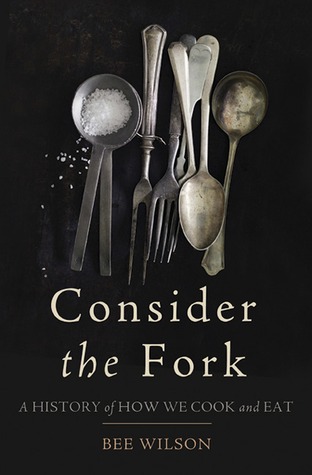
Consider the Fork - Bee Wilson

Consider the Fork: How Technology Transforms the Way We Cook and EatConfession: I would be perfectly content to be housewife for the rest of my life.  I'm a traitor to my gender, I know.  I should be trying to make myself respected as a working woman in a corporate world dominated by men and all that jazz, but really, I would be perfectly content to stay at home and cook all day long.  Okay, so I'm not such a huge fan of doing dishes or laundry, but I could get past that.  Being left alone all day to do some quick cleaning, read a good book, and whip up a cappuccino fudge cheesecake (recipe from Smitten Kitchen) sounds like absolute heaven.  I would probably become morbidly obese in short order, because even a fast metabolism can't cope with delicacies like that every day, but hey, my apartment building has a gym in it.  I could totally start running on the treadmill with all the time I'd have on my hands!

How does all of this connect with Consider the Fork?  Well, Consider the Fork is "A History of How We Cook and Eat," and that cooking part has largely been the work of women for centuries.  Millenia, even.  Which didn't work so well when women wore long skirts and sleeves that easily caught on fire, but hey, we're past that now in my part of the world, and I can feel safe whipping up some deep-fried ravioli on a gas stove while wearing a T-shirt.  Anyway, the book is broken up into different topics such as "Knife," "Fire," Ice," "Grind," and "Eat," with each focusing on a different area of the kitchen and how it has evolved.  For example, "Fire" is not only about how people have cooked over fires in different parts of the world, but also how the stove evolved and how cultural wants and needs changed that, and how the stove itself changed how we cook and eat.  "Eat" is about silverware, chopsticks, and other eating utensils, and how they fit into our culture of food.  Each chapter is also followed by a one or two-page snippet about something more specific, like the Italian mezzaluna knife or the nutmeg grinder.

The book is full of little anecdotes to focus different parts, and it is immensely readable, especially for a foodie like myself.  Wilson's writing portrays vivid images of meals from all periods of cooking, and makes every single one of them sound appetizing, even when they really weren't.  But what's so different about the book isn't about how humans shaped cooking; it's more about how cooking shaped humanity.  For example, that ever-so-slight overbite that I spent three years in braces to obtain?  That overbite that's supposedly the "perfect" smile for those of my generation?  Yeah, that wouldn't exist without the adaptation of using knives and forks to eat, rather than just ripping stuff up with our teeth.  And the invention of pots and pans completely changed how we eat!  Isn't that awesome?  I think so.  The book also appears to be pretty well-researched in the areas it covers, though there aren't footnotes so I can't confirm that entirely.  There is a "Notes" section, but honestly, I didn't read it, and it's not very long.

My only complaint--and it is a fairly large one--is that Wilson focuses on the USA and UK for her history of food and eating.  Coming in third place would probably be China.  I would have liked to learn more about how people ate all over the world.  What about in Polynesia?  What about in India, or Iran?  What about the Eskimos?  What kind of stuff did they eat, invent, or adopt, and how did it change their cultural evolution?  There's probably, to some degree, a problem with sources in these areas (and language barriers are a bitch) but I would have been very interested to see a more globally-comprehensive history.  Oh, and another, smaller one--the "ye olden days" portions focus mainly on the upper classes.  More "recent" accounts focus more on the middle class.  I would have liked to see more class, as well as geological, diversity.  Still a good, easy read, though, and it might just change the way you look at what goes into your mouth, and how that stuff gets there!

3 stars out of 5.