Pages

Showing posts with label fiction. Show all posts

Friday, June 22, 2018

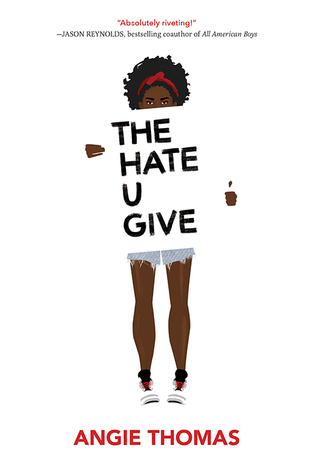
The Hate U Give - Angie Thomas

The Hate U GiveSometimes a book comes out that everyone is talking about.  Sometimes it's in a good way, sometimes it's in a bad way, sometimes it's in a mix of the two.  The Hate U Give seems to fall into the third category; from what I've seen, it's mostly good chatter, but then a handful of people who seem to feel that Thomas is just "stirring the pot."  Which...let's not get into it.  Anyway, this is a book that had people talking, and made the long list for the National Book Award.  So when Emma Watson put it up as the May/June read for her Our Shared Shelf book club, of course it was an easy one to pick up.

The story follows Starr, a high school student who sees her best friend shot by a police officer after they're pulled over for having a tail light out.  Starr is the only witness, but she doesn't want anyone to know who doesn't absolutely have to, because she knows it could tear her life apart.  But the trauma itself has a lasting impact, and the events shake her city to its core, dividing communities, families, and friends.

Is the writing in this book the most amazing ever in style?  No.  However, it's very, very good.  Thomas uses slang and dialect without making it seem obnoxious--like the dreaded phonetically-written Scottish accent I seem to encounter so much--and instead it reads as natural.  She shows the division that inherently exists in Starr's life, between her home life and her school, where she carefully monitors her clothing and behavior so she doesn't come across as "ghetto" or "an angry black woman" and can fit in better with her peers.  She has a masterfully-crafted narrative of empathy, and that is really what this book knocked out of the park.  It truly does allow the reader to step into Starr's shoes and see things from her perspective--how there are conflicting narratives and how those narratives came to be from one set of facts, and how they affect her and those around her.  Starr is not a person of conflict by nature, but finds herself surrounded by it, from protests that turn to riots in her neighborhood to a friend who doesn't outright mean harm but is unwilling to recognize or work to correct her prejudices and racist tendencies.

This book does not have a specific location, as far as I can tell.  It has generic place names and a generic place feel.  It is not a retelling or a spin of any one incident, but instead a look at a mentality and the events that lead up to it, and provides a lens for which those of us who have not and never will experience things like this because of our privilege and background and can really see where these characters are coming from.  There is some info-dumping; there is some awkward time-skipping.  There is some "It's two months later"-ing, which is never really a good narrative device.  But the emotion and purpose in this book ring true, and once I figured out the out-of-order pages at the beginning of my library copy (a printing error and not something inherent in the book, I'd guess) I was truly engrossed.

4.5 stars out of 5.

Monday, April 23, 2018

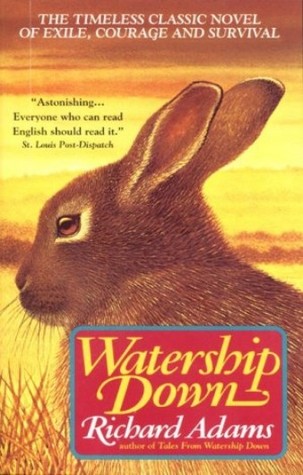
Watership Down - Richard Adams

Watership Down (Watership Down, #1)Watership Down is one of those children's books that I never read.  It's not that I disliked books about animals--in fact, I loved the Redwall books when I was younger, and the Narnia books have a good number of talking animals as well.  But for some reason, I thought this was a book about rabbits going to war.  And like in rabbit-y ways--like, basically World War II with rabbits.  I'm not entirely sure where I got this idea, but I think it might have been the title; it just sounds like some sort of distress call from a boat that's been struck by a torpedo: "SOS!  Watership down, I repeat, Watership down!  SOS!"

I finally got around to reading it because it was the Deliberate Reader book club selection for April in the Facebook group.  It also slotted nicely into my reading challenge category for a book that is a parable; while Adams did not intend the book to be a parable, saying that it was just a book about rabbits, it seems it's frequently read as a parable, and that's good enough for me.

The plot here is fairly basic.  Adams builds a society of rabbits, but keeps them in their natural habits and forms; they talk and act and think, but they're not necessarily anthropomorphized in the way that, say, Mickey Mouse is.  Within this society, some rabbits are gifted with seeing; in the warren of rabbits that starts the book, one of these seers if Fiver, the best friend of the main rabbit, Hazel.  Fiver predicts some unknown devastation for the warren, and on his warning, Hazel convinces some other rabbits to leave the warren with them.  They strike out into the countryside, seeking a place to build a new warren.  Along the way they encounter other rabbits who fled their warren, and encounter other rabbits not of their group.  And even when they establish a new home, they can't live in contentment, because without any females, they can't sustain a new colony.  And it's this struggle for survival, both immediately and in the long term, that drives the book.

Throughout the story, Hazel grows from an undersized, un-listened-to rabbit to the leader of the group, using logic instead of emotion and pushing on in the face of fear in order to take the new warren to safety.  We also get to see several different modes of warren society; the home warren, the one they encounter on the way, the one they establish on Watership Down, and Efrafa.  We also encounter other colorful characters, such as General Woundwort and the best character in the entire book, the bird Kehaar.  Human society is glimpsed through the rabbits' eyes and the story is bulked up by tales of the mythical rabbit who was the original rabbit leader, in the style of Br'er Rabbit and other trickster stories.

The writing was surprisingly engaging.  While it got off to a slow start, I soon found myself wrapped up in the story.  I didn't expect to enjoy it nearly as much as I did, but the different types of rabbit societies offered a wonderful study of contrasts, and seeing our core group of rabbits come together and learn to triumph as a cohesive group rather than a bunch of misfits was a great central propulsion.  Hazel was also definitely the proper choice for a central character.  The other two obvious choices would be Bigwig or Fiver, either of whom would have quickly become annoying as a main character--Bigwig because of his impulsivity, and Fiver because of his Timidity.  The other types of animals also held enough difference and interest to not make the book bland, which it could have easily become.

Overall, I was pleasantly surprised by my reading experience.  This is another one I can cross of my classics list, and I even recommended it to a few people who'd had similar misconceptions about the book.  A worthy read.

4 stars out of 5.

Wednesday, July 12, 2017

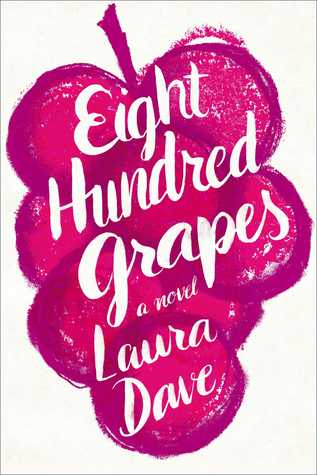
Eight Hundred Grapes - Laura Dave

Eight Hundred GrapesAh, another foray into the world of audiobooks.  My audiobook selections tend to revolve mainly around what the library has available for download at the exact moment I'm looking; Eight Hundred Grapes fit that description when I finished Dark Places and was looking for something else to listen to while walking to/from work and doing my running.  The book had caught my eye before, from Book of the Month and then on a few lists of good books from 2016, so I decided it was worth a shot.  The results?

Pretty good!  The narrator here is good for the book's main character, Georgia, who narrates the story in first-person.  Georgia flees to her family's vineyard in Sonoma County, California, seeking refuge after seeing her fiance out on the street with another woman and a child she never knew about while she was at the final fitting for her wedding dress.  Upon her arrival, she discovers her mother has another man in the house, her father is sleeping in the winemaker's cottage, the family vineyard has been sold to a Big Bad Corporation, and one of her brothers might just be in love with the other's wife.  Yikes.  So the story is Georgia attempting to navigate all of this family drama, all the while trying to decide whether or not she should forgive her fiance for keeping his daughter a secret and marry him anyway.

This is a story of family drama, clearly, which I really enjoy.  I liked how Georgia's first-person chapters were interspersed with other chapters set in the past that focused more on her parents.  Those third-person chapters helped to flesh out how they ended up where they were in a good, characterizing fashion, rather than her mother and father just info-dumping everything on Georgia in her chapters.  Though, now that I think of it, I wonder if there was a bit of omniscience from Georgia here, her picking up on things from those third-person chapters that she's never actually told in the first-person ones... Hm. 

Georgia is a likeable character, and the supporting characters were likable, too--even the transgressing Ben.  The narrator's voice sounds a little silly when she tries to do the dialogue for the men in the book, but until my dream of having every audiobook read by a full cast is realized, I guess that's something I'm just stuck with.  But story-wise, the things that I didn't like here were two-fold.  First, not enough Jacob.  For how the book ends, I think there needed to be more Jacob.  Second, that epilogue!  This, even though it's still about Georgia, abruptly switches from first-person to third-person, and it comes across as really cheesy and just...ugh.  Did not like.  I think that the book easily could have ended with the last chapter from Georgia's perspective and been just fine.  Maybe even better.  Just like how the movie Lincoln would have been better if it had ended with that shot of him going down the stairs to leave for Ford's Theater instead of going through the entire assassination sequence, because hey, we all know how it ends, right?

This was a shorter book, but it had a great sense of atmosphere, good pacing, and good characters. The narrator mostly suited it, and overall I found it a very enjoyable reading/listening experience.

4 stars out of 5.

Friday, March 10, 2017

Mr. Penumbra's 24-Hour Bookstore - Robin Sloan

Mr. Penumbra's 24-Hour Bookstore (Mr. Penumbra's 24-Hour Bookstore, #1)There was something charming about this title that made buy it.  It also might have had something to do with the fact that there's this tumblr post that makes the rounds of the Nano Participants (formerly known as NaNoWriMo) group on Facebook that complains that such a thing as a 24-hour bookstore doesn't exist.  (To which my response is, it does.  It's called the Kindle store/iBooks/etc.)  But it sat on my shelf for a while, quietly glowing (yes, glowing; those books on the cover glow in the dark) until I found myself in need a book to fit my reading challenge category of "A book with an eccentric character."  It worked out perfectly, because pretty much all of the characters in this book are eccentric!

The main character is Clay, who ends up working at the eponymous bookstore after stumbling across it during a walk.  Clay doesn't actually aspire to work at a bookstore, but he's been unemployed for a while after the bagel shop for which he was a graphic designer/web designer/social media marketer/etc. shut down.  In the bookstore, he finds himself selling a few books every now and then to random incomers, but more often loaning out books to strange repeat customers who have membership cards, and the books that go out on loan seem to be full of gibberish or code.  With a few strange friends, like Neel the guy who sells software to animate boobs better, or Matt the prop designer who's building a city in their living room, or Kat the Google employee who dreams of finding a way to live forever, Clay sets out to figure out what's going on, leading to a bigger mystery than he intended to find.

This book is a love letter to both books and technology.  This was so refreshing.  Another meme that goes around the Facebook group periodically is how people who read on Kindles or other e-readers aren't "real" readers.  (Also popular is one about how people who dogear book pages to mark their place are monsters.  I dogear each page with relish now.)  But the characters in this book don't see it that way.  They have a bookstore, but they have e-readers.  They have books of code and are reverent toward "old knowledge" but savor the computing possibilities of Google, Hadoop, and so on.  I loved this.  Believe it or not, books and technology can live in harmony!  Gasp!  They're not actually hunting each other to extinction!  Amazing!  Even the book-worshipping members of the Unbroken Spine realize this with relatively little influencing.

The mystery is also a great sort of mystery.  The hunt proclaims to be around the search for the secret to immortality, but there's little belief on Clay's behalf that immortality is something that can be attained in the literal sense.  I liked this, because it means that the story didn't go off the rails.  There was a mystery, but the sleuthing involved a middle-grade trilogy about singing dragons and an examination of technologies that most of us wouldn't have dreamed of, and a mysterious internet pirate who inserted himself into pirated copies of the Harry Potter books.  It's all very charming and, yes, very eccentric, but it works.  There are discussions of museum archives and of typefaces and it's so much quirkiness that it all just works together.  I think if Sloan had gone just a little bit farther in any direction, it would have been too much, but he held back to just the right degree to make this an enjoyable read.

Is it a bit farfetched at times?  Yes.  It is.  And I found myself a little bit unsure of how seriously to take some of it.  Does Google actually run this way?  I don't know, it just seems so weird, and yet, it is Google... But I still enjoyed it, and I think Sloan held the back from going too far in the immortality direction, instead choosing to make things figurative.  A very enjoyable read, and I'm glad I finally got to it.

4 stars out of 5.

Wednesday, April 27, 2016

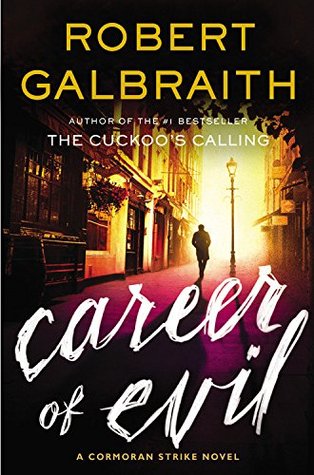
Career of Evil - Robert Galbraith (Cormoran Strike #3)

Career of Evil (Cormoran Strike, #3)I am so bad at figuring out mysteries.  I swear, I'm the absolute worst.  I had a theory all throughout this one, but it is a good thing I am not a detective, because it was dead wrong.  As always, I fell for the red herring.  To be fair, though, Galbraith/Rowling can do a really subtle red herring; at points I felt like some bits were heavy-handed, but I'm starting to think that this is just a technique used in the mystery genre to keep you looking away from the real decoy, so that the truth jumps out at you from around the corner when it comes.

Let me back up.

So, Career of Evil is the third book in "Robert Galbraith," aka J. K. Rowling's, Cormoran Strike mystery series, about an ex-military private detective who has solved a few noteworthy cases in the relatively recent past, but is still struggling to keep his business above water.  Joining him is Robin, his assistant who really wants to be more of a partner due to a long-buried love of mystery solving.  The first two Strike novels involved murders, as does this one, but this one goes in two directions that the previous ones didn't: the pasts of the two main characters, and serial killers.  In this book, Robin herself becomes a target, stalked by a serial killer who we get perspective chapters from now and then.  Additionally, Galbraith starts to really lay out the pasts of the characters that brought them to where they are, in what I think is more detail than in the previous two novels.  The Cuckoo's Calling and The Silkworm both had some of Strike's background in them, but very little of Robin's; that comes out more here, along with increased detail about Strike, amidst a slew of relationship problems for Robin and an increasing tension between her and Strike on several different levels.

Honestly, the characters are what fascinate me about these books more than the plots.  The murder mysteries are fun to try to solve, even if I never get them right, and are always just chilling enough without straying into territory that could be considered cheesy and overblown.  But Rowling has always had a knack for developing really believable characters, and she's carried that skill over into her Galbraith persona, making Strike and Robin three-dimensional characters who are more than just the sum of their parts.  Even the secondary and tertiary characters that appear here are nuanced to a degree that I think is rarely seen in fiction, which is nice.  It makes the story as a whole very complex and helps to create a full-bodied world that supports the story rather than just acting as backdrop.

But I still hate Matthew.  I know that is the point, but I hate him and I hated the chapters where I had to read about him for more than a minute or two because he was so terrible.  Also, this book relied very heavily on Blue Oyster lyrics, and it kind of made it feel like a fanfic.  Not that fanfics are bad (I've read some really excellent ones) but it seemed off from the tone of the first two books.

Overall, this series has maintained solid 4-star ratings from me, and that's true for this one as well.

4 stars out of 5.

Friday, April 1, 2016

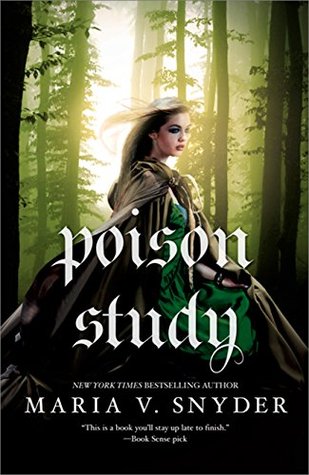
Poison Study - Maria V. Snyder (Study #1)

Poison Study (Study, #1)So, in the wake of the Maria V. Snyder books I've read recently being, well, disappointments compared to what I remembered Poison Study, Snyder's first book, being, I decided to re-read Poison Study and then the rest of Snyder's books and do an examination of what, writing-wise, happened in them to lead to what I personally feel is a decrease in quality.  Obviously, the best place to star this was the beginning, so I grabbed Poison Study from the library (my own copy is a couple of hundred miles away) and got reading.

Poison Study is Snyder's first book, and I can completely see why it landed her the opportunity to write more.  It begins with Yelena, a young woman awaiting her execution in the dungeons of Ixia's Commander.  Ixia has an absolute zero-tolerance policy for murderers, and so Yelena's bound for the noose...except she isn't.  Luckily for her, there is a loophole in the zero-tolerance policy.  The Commander's food taster recently died, and Ixia's militaristic Code of Behavior dictates that the position of food taster be offered to the next prisoner on death row.  Enter Yelena.  When Valek, the Commander's right-hand man and expert in the arts of assassination, poisons, and general sneakery, offers Yelena the job, she takes it, even though it doesn't pay anything--as Valek says, "The food taster is paid in advance.  How much is your life worth?"

But just because Yelena isn't going to be hung doesn't mean she can't die in any manner of other nasty ways--like poisoning purposeful or accidental, having her throat slit by goons of her victim's father, being assassinated by a magician from the neighboring realm of Sitia, etc.  And while she deals with these continued threats on her life, she also has to deal with burgeoning magical powers that are illegal in Ixia, evil chocolate, and of course Valek himself.  Throughout the book, Valek serves varied roles, such as mentor, protector, love interest, and even potential murderer.  He's definitely one of the coolest characters in the book, and I wish his relationship with Yelena had been a bit more pronounced.  It's not really a slow burn, because it's so subtle for most of the book, until BAM! it isn't anymore.  But Valek was awesome no matter what, having an immense repertoire of skills and knowledge while still managing to be human.

Poison Study is also much tighter than the other Snyder books I've read recently.  All of the plot threads weave together into a coherent whole without any of the dropped plots I've seen from her lately.  Only one character (the briefly-seen Mia) seemed to be superfluous; everyone else was worked in very carefully to suit Snyder's purposes.  This was such a relief, you can't even imagine!  I was so, so, so happy to realize that yes indeed, Poison Study did live up to my memories of it.  The writing's a bit rougher than I remember (I find first-person writing to be rougher in general, no matter who is holding the pen), and Snyder has a thing for info-dumping from time to time, but the book as a whole was great.  She doesn't shy away from Yelena's traumatic past at all; the book actually starts with Yelena's memories of being tortured so really, you know what you're getting into here.  She's a murderer who doesn't regret her actions at all, but is still a good person with a steady moral compass.  Basically she's great.  I never felt that Yelena was being blatantly stupid.  I never wanted to smack her for a dumb decision.  Sometimes she delayed a good decision for a while, but she didn't let it get to the point that it was a danger to herself and others, and she always went into situations as prepared as she could be, even if it didn't necessarily end up in her favor.

Ixia is an interesting setting, too--a country under a militaristic government but not at war, settling into the new way of life after generations of living in the shadow of what seems to have been a tyrannical monarchy.  Actually, a book set during that era could be really interesting.  The magic system isn't really developed fully because magic is forbidden in Ixia (though it does exist and does occur) but that didn't bother me because it's clearly going to be developed more in Poison Study's sequel, Magic Study, and a robust magical system wasn't important to the overall plot of the book.

So, to conclude, yes: Poison Study was all that I remembered it being.  It's a great story with a strong heroine who, despite having a tragic past, isn't cliched in the slightest.  Yelena and Valek are compelling main characters and are fully capable of carrying this story to its conclusion.  Poison Study is a great, unusual fantasy book, and I think it's worth a read for most fantasy lovers out there.

4.5 stars out of 5.

Sunday, March 27, 2016

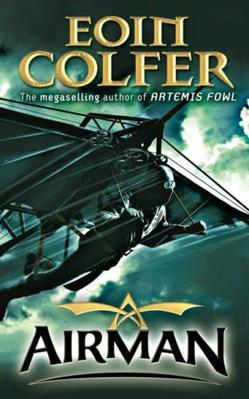
Airman - Eoin Colfer

File:Airman.jpgAirman by Eoin Colfer tells the story of Conor Broekhart, a young man living in the fictional mini-nation of the Saltee Islands.  (The Saltee Islands are a real place, but they are unihabited and everything about the Saltees in the book is fictional.)  All his life, Conor has been best friends with the Saltee princess, Isabella, and he has been tutored by a Frenchman obsessed with things such as fencing, karate, and above all aeronautics.  Conor is perfectly okay with this, because he was born in a balloon basket and flying is apparently his destiny.  Hm...

Okay.  I like Colfer.  At least, I remember liking Colfer; I read the Artemis Fowl books when I was younger and enjoyed them quite a bit, though I believe a few more have come out since then.  Those have a very different feel to them than Airman, but that isn't necessarily a bad thing.  Airman is...well, I guess it's kind of historical fiction, but it's also kind of steampunk.  All of the apparatuses Colfer includes are real, or closely based on real machines/inventions, but the setting of the Saltees, the prison, the diamond mind, etc. definitely gives a steampunk flavor.

Story-wise, I enjoyed this but it did not shine.  The plot revolves around Conor being thrown into prison for his supposed involvement in the death of King Nicholas, though really it's because he knows the truth behind the King's death and the Lord Marshall of the Islands, Bonvilain, wants to shut him up while maintaining control over Conor's family, who are very prominent in the Islands and could mess things up for him.  So, at the age of fourteen, Conor ends up in prison, befriends an inmate or two, and begins plotting his escape--which only takes up about half the book, because of course after he's free he has to make things right in the Islands.

Conor himself was an excellent character, as was Linus Wynter, the blind musician who becomes Conor's close friend.  Both seemed well-rounded with specific motives for everything they did, and Conor in particular changed in accordance with his experiences in prison.  That was good; he didn't exhibit any naivete that I might have expected from the hero of a YA novel.  The rest of the cast, though... Bonvilain was weak as a villain, really, because he wasn't any different from any other fictional villain.  He had no original twists, nothing, though I think Colfer TRIED to spice him up by making him part of the Knights of the Holy Cross (Knights Templar).  Isabella was supposed to be an excellent queen, but she kind of fell flat, literally needing to hold someone's hand in order to address her people or her employees.  And then suddenly at the end she's threatening to slice someone in three with a samurai sword.  Uhm, what?  Where did that come from?  And while we were meant to fell sympathy for Conor's parents, they really didn't get enough page time to build up their pain, and all we really saw was Conor's father magically recovering from his grief to aid Isabella.  There were an excess of comically inept side characters, ranging from Otto, the inmate whose greatest pride is his hair; to Pikes, Bonvilain's essentially useless sidekick; to Uncle, a boy who won't take a bath.  The side character with the most potential was probably Sultan, Bonvilain's poisons expert, but he was sadly underutilized and underdeveloped.  I also didn't feel like Isabella and Conor's relationship was believable; it was just kind of stated that it was there, and then Conor came back a completely different person and Isabella didn't have anything to say about that?

And what HAPPENED to Otto and all those diamonds, anyway?!

Overall, enjoyable but lacking some characterization.

3 stars out of 5.

Monday, February 29, 2016

Little Beach Street Bakery - Jenny Colgan (Little Beach Street Bakery #1)

Little Beach Street Bakery (Little Beach Street Bakery, #1)This is a book that undeniably falls into the category of "chick lit."  That is, a category of light, fluffy reads that might have like, two serious moments in them, but feature heroines that charm everybody who meets them and are unfairly trodden upon, but win upon the masses with their spunk and good looks, get the guy, and turn their lives (which typically start in some sort of dead end) into ones that anyone would be jealous of living.  In this case, that heroine is Polly.  She and her boyfriend Chris ran a graphic design company that failed, leaving them bankrupt.  When the bank seizes their assets, including their flat, Polly is left looking for somewhere else to live.  The only place that she can find that's in her price range and isn't absolutely terrible (only a little bit terrible) is in the town of Polbearne, which sits on a quasi-island that's connected to the shore by a causeway at some times and is cut off by the tides at others.  Due to this quirky feature, Polbearne is pretty much deserted.  Polly moves there anyway, hoping for inspiration to make a change in her life, and begins spending all of her time baking breads, which turn out to be illicit because the proprietor of Polbearne's only bakery is also Polly's landlady and isn't very nice about Polly threatening her business.

There are romance plots here, two of them, which Colgan handles by just writing one of them out of the story altogether in what seemed like something a little too convenient and a little too overwrought, something clearly designed to yank at a reader's heartstrings.  The other one isn't really every developed; it's just suddenly there, and then gone, and then there again, and then gone again, and then there again.  All the see-sawing got a little annoying after a while; I didn't see any real point to Polly's stint in America and think the plot would have been better served by eliminating that entirely.  As it was, I was left wishing the characters would just make up their minds already so we could get on with everything else.  The supporting characters in this were charming, though Polly was, in the manner of chick lit heroines, a bit too annoyingly perfect.  All of the problems that came her way were someone else's fault; her bankruptcy was the fault of her boyfriend, her persecution the fault of a bitter old woman (Colgan pretends that other people on in Polbearne treat Polly like an outsider, but they really don't), her second failed relationship the fault of the other party, and so on.  Polly never actually has to take responsibility for her own decisions--but then again, she never makes a bad one!  This is the kind of fluffiness I'm talking about when it comes to chick lit; the few darker moments are just thrown in by outside forces and have minimal lasting effect on the heroine.

As an American, I also can't help but be a little affronted at how Colgan portrayed the American characters in the novel.  Is that what she thinks Americans actually act like?  Is that what she thinks we talk like?  Polly makes light of this at a few moments, but the joke is ultimately beaten to the point of a dead horse, and while the other supporting characters at least have a couple of dimensions to them, the American ones are pretty much cardboard cutouts of stereotypes, which seems a bit unfair to me.

Honestly, the most interesting part of this book was Polly's struggle to do her own thing regarding her bread and then, ultimately, the bakery itself.  This part came across as more realistic than the relationship aspects, and it was absolutely mouth-watering at times, making me want to go off in search of some focaccia myself.  I ultimately had to settle for a rosemary boule and some whipped garlic butter from Whole Foods, but still--I love books with a food aspect, and Polly's breads, while simple, sounded utterly delightful.  Added into the quaint atmosphere of Polbearne, I think this could have been a really strong book without the love triangle pieces--in fact, probably stronger than it was with them.  This book had its charming points, but ultimately I don't think it had a compelling enough story or characters to make me really want to seek out the sequel.

3 stars out of 5.

Saturday, December 5, 2015

Mishap Mansion - Allison Beckert and Jennifer Bigelow

Mishap MansionSo, I read this book for two reasons: I needed a book to read that was written by someone under 30, and I really didn't want to read Divergent.  So I went to the NaNoWriMo Facebook group and asked if anyone there had written anything that would qualify, and this one got tossed out as a possibility--I honestly don't remember which of the listed authors mentioned it, and I'm not going to go back and look.  I was really hoping for good things from this.  The premise, that a group of friends moves into a mansion in Hawaii and has romantically-inclined adventures, sounded cute.  But in execution, I was severely disappointed, and I don't really think that I could recommend it.

I took a ton of notes while I was reading this because so many things bugged me, something that I rarely do when reading because I don't have that many issues with a book.  But here, they just kept piling up until I had to take notes or risk losing the whole train of thought.  Let me touch on the most minor one first: editing.  I normally have a lot of issues with indie books and line edits, use of grammar, etc, and I have to say that wasn't the case here, except for a few minor cases.  The dialogue isn't written correctly when the characters cut each other off, with the dashes left outside the quotation marks instead of inside of them, and there are several instances of the authors using a homophone for the word they meant--the one I noted down was using "feinting," as in faking, instead of "fainting," as in passing out, but I remember seeing a few more before that.  For the most part, however, there's a solid grasp of spelling and grammar here, which is often missing in independently-published works.  They could, however, use a proper book formatter.  This book is written like a blog, with line breaks between all of the paragraphs instead of tabbing, and no working table of contents, things that don't take that much effort to include but can make a big difference in streamlining the reading experience.

No, what bothered me here was the structure and plot of the book itself...by which I mean that there wasn't any.  The plot is supposed to be that the main character, Whisper, finds out that she inherits her aunt's mansion and fortune in Hawaii, on the condition that she and the guest list from her last birthday party move in immediately, leaving behind their jobs and lives in the process, of course.  Because all of these people would totally be willing to jump at the strings of a dead lady they've never met...  For what purpose?  No one knows.  I certainly never found out, like I never found out why the party guests, despite having attended said party together, had never met when they moved in.  This read as a meandering "slice of life" role play rather than as a book with a plot (even a character-driven one) and solid structure.  Whenever anything starts to lag, which things do quite often, the authors just toss in another character for no apparent reason than to get things going again.  Nothing ties in to a larger plot.  And can we talk about names?  What kind of names are "Whisper" and "QT" (As in Cutie?  Really?) when the rest of the people have normal names?  Whisper's appears to have no purpose other than to designate her as a "special snowflake."  QT's bothered me, too, but luckily she wasn't mentioned that much, despite being mentioned in the first few pages.  She hardly showed up at all after that, until the authors apparently decided they needed a wedding to liven things up--again, for no apparent reason other than things had stopped moving.

I hated Sasha, and found no redeeming qualities in her.  Sasha is a supreme bitch and doesn't really get over it--until she does for (again) no apparent reason.  All the characters here run around protesting that they don't like each other until, suddenly, they confess their love for each other.  They have no depth, flip-flopping between nice to mean and happy to angry with no in-betweens.  Sasha and Daniel are the worst examples of this (David aside, who was clearly meant to be a bastard, and was overwrought in being one...) and I absolutely could not designate them as likable or believable love interests for other characters after the way they behaved.  Sasha is the sort of girl who hates on other girls because they're pretty, and yells at another character for having "vain little habits" when the character in question (Molly, another character apparently without any purpose...) wants to get her brush out of the bathroom while Sasha is brushing her teeth.  Apparently wanting to brush your hair before breakfast is the height of vanity.  One could attempt to argue that Sasha is so insufferable at the beginning in order to show her growth as the story goes on--but there's not growth so much as there is a sudden change without any real motivation behind it other than falling in love.  Because love clearly actually changes people.  (It doesn't.)  The characters don't have believable motivations on any front, and act like cardboard cutouts rather than real people.  I couldn't really believe or like any of them because they were written without any dimension and were apparently supposed to be adults but ran around acting like hormonal middle school students instead.  And let's not even talk about the supposed historical society sub-plot, if you can call it that, which has SO many things wrong with it...

Actually, let's talk about it.  Let's talk about how the historical society apparently expects a crumbling mansion to be renovated at any moment, or they won't give it their endorsement as a historical landmark, how they can apparently evict the inhabitants from the premises even though the property is privately owned, how the head of the historical society can apparently be outranked by some random kid who just moves in but is a Secret Agent of the society the entire time, how they hate the mansion but want it as their headquarters the entire time...

What?

In addition to all of that, the writing managed to be too simplistic and too overwrought at the same time.  The characters emotions and motivations were told, rather than shown, but the authors must have felt the need to describe the characters and Hawaii in such great detail that adjectives end up appended to every other word, and you end up like sentences like this: "Through the window was a long swatch of green, interrupted with palms and various island jewels that swept from the house to the beach, which was dimly glimpsed in its liquid beauty," and "She had lustrous, innocent eyes, and an endearing smile.  Sasha didn't have to guess that everyone loved her the moment they met her; it was written all over the young lady."  Ugh.

Finally, let's touch on how this book as categorized.  All of the categories on Amazon trickle down to "inspirational," "Christian," and "romance."  I guess there's a minor romantic aspect to this book, but again, it seems like kids in middle school rather than functioning adults.  I'm guessing that's what contributes to the "Christian," aspect, because there's nothing religious about this at all.  So it has to be that the characters aren't running around having raunchy sex.  Which is fine, but...the romance was still really wimpy.  You can write a good romance without including raunchy sex, and there are tons of them out there that are far more engrossing and enjoyable than this one.  As for the "inspirational" aspect... I'm not sure where that comes in at all.

I don't recommend this book.  I think the authors have a knack for cute ideas, but as of this point they don't seem to have the finesse to execute those ideas well, and this needs a lot more polishing before it becomes good.

1.5 to 2 stars out of 5.

Saturday, November 28, 2015

Second Position - Katherine Locke (District Ballet Company #1)

Second Position (District Ballet Company #1)Whew!  It's been a while.  Sorry about that, but things have been busy at work, and then I traveled with the boyfriend to visit his family for Thanksgiving, and the internet in northern New Jersey is about as fast as 1990's dial-up.  On top of that, I started reading a few slow-going books at the same time.  I finally needed something a little faster, so I picked up Second Position.  (I was originally tempted to write "something a little lighter, but this book was anything but, so that didn't really fit.)  I needed to read a book that took place in Washington, DC for the Popsugar Reading Challenge's category, "A book that takes place in your hometown."  Really, this seemed to me like a poor choice of category because many, many people live in towns that do not feature as the settings in books.  My hometowm of Erie, Pennsylvania happens to be one of them.  I did some Googling, but nothing came up and no one I talked to had any ideas, either.  So I switched tactics and began looking at my second hometown, Washington.  The Seamstress hadn't worked out for this, but one of my friends had added Second Position to her list, and an author I quite like (Sherwood Smith) gave it a favorable review, so I figured it was time to get reading.

Second Position is a beautiful book that tackles an extraordinarily complicated relationship.  Aly and Zed danced ballet in Philadelphia, and their close friendship morphed into something more--until they got in a car accident and everything changed.  Zed lost his leg.  Aly lost their baby.  In the wake of the accident, the pair were separated and didn't see each other for years, until Aly walks into Zed's favorite cafe in Washington.  She's on leave from the Philadelphia Ballet Company after having a mental breakdown, hitting another dancer, and seeking treatment for an eating disorder.  Zed now lives in DC, where he teaches theater.  The chance encounter in the cafe sets them on another collision course, this time with each other and a discussion of all the things they could gain or lose.

Because of the characters' backstories, the book takes on a lot of big, complicated issues that most romance authors don't choose to include in their stories.  Depression, anxiety, amputations, eating disorders, miscarriages--it's a lot of issues to cram into one book.  But Locke handles them well, with finesse and respect.  Aly's eating disorder is not disparaged or glorified, but treated with a gentle respect and consideration for how it affects all areas of her life, and how she works to overcome it.  Oh, and did I mention that Zed is a recovering alcoholic?  His issues aren't touched on as deeply as Aly's, an interesting decision but one I suppose makes sense.  Having both parties as messed up as Aly, at the same time, would have been a disaster waiting to happen, and probably an not a salvageable one.

This is not, in any way, a happy book.  There is not witty banter, no tete a tetes, no side characters lending a little levity to the situation.  There are supporting characters, but they're very minor.  It's all Aly and Zed, all the time, and they're so incredible intense that I sometimes needed a break.  They were, at times, overwhelming.  This definitely isn't a book to read for a light afternoon, but the writing and tragic reality of it, and how healthy Zed and Aly's relationship ultimately is, made it a beautiful story nonetheless.  I would have liked to see more of Zed's struggle, at least in hindsight, because how he was so together in comparison to Aly almost made his problems seem less than hers, though they definitely were equal.  Hopefully this will be touched on more in the second book, Finding Center, which I will definitely be picking up.

4 stars out of 5.

Sunday, October 25, 2015

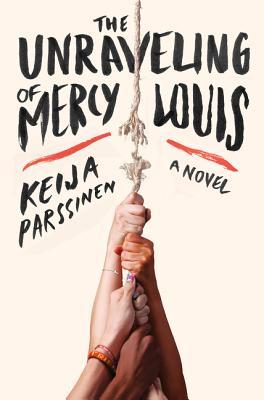
The Unraveling of Mercy Louis - Keija Parssinen

The Unraveling of Mercy Louis: A NovelIn my quest to finish the Popsugar Reading Challenge, I needed to fulfill the category "A book set in high school."  Or something along those lines.  I'd planned to read Perks of Being a Wallflower to finish the category, but for some reason none of the libraries in my university's circle would give it to me.  One of them had it on hold because, apparently, it's used in a class.  At another, the book had been lost and they never replaced it.  As for the rest...well, who knows?  At any rate, I couldn't get it from the university library, didn't feel like going to get a public library card, and didn't want to buy it, so I started looking for alternatives.  In the meantime, I found The Unraveling of Mercy Louis on the popular reading shelf at the library and picked it up because I'd read a good review of it...somewhere.  I thought it was over at The Armchair Librarian, but if that was it, now I can't find it.  So maybe it was somewhere else.  Anyway, as I flipped through my Kindle a day later, I found that I already had the book, because apparently I'd purchased it at some point.  I must have really wanted to read it!  I returned the library copy so someone else could get it and started reading the Kindle one.

The story is told in a first-person narrative by the titular character, Mercy, and in third-person from the perspective of one of Mercy's classmates, Illa.  The setting is Port Sabine, Texas--a small town that is still recovering from an explosion at the local oil refinery three years earlier.  The year is 1999, and between the explosion a few years before, a dead baby found in a dumpster, and her prophetic visions, Mercy's grandmother thinks that the Rapture is coming.  Mercy, raised by her grandmother, follows closely in her beliefs, and wants to live out the remainder of the days before the end of the world enjoying her final summer vacation, playing at least part of the basketball season of her senior year--the world's supposed to end partway through it--and staying out of trouble so she can go to Heaven.  Over the summer, though, things start to fall apart.  Mercy and her best friend Annie have a disagreement, and Annie refuses to speak to Mercy.  Mercy speaks in tongues and delivers orders to find the baby's killer at church.  And then, as she tries to find her basketball groove again in the wake of a terrible game during States in the schoolyear, she runs into Travis and gets herself a boyfriend, something her grandmother has strictly forbidden.

Illa, meanwhile, is an anorexic who wants to shrink herself down to nothing, and to be friends with Mercy above anything else.  Illa spends most of her time in the summer taking care of her mother, who was seriously injured in the refinery fire and is now confined to a wheelchair.  Illa resents her mother for not trying hard enough and tries to escape through photography and managing the Lady Rays, the varsity basketball team that Mercy and Annie play on.  Through her outsider's eyes, Illa sees things and asks questions that Mercy isn't able to, being so wrapped up in her own life.  And so Illa is the one who manages to piece some things together and help when Mercy begins to unravel in earnest.

The book goes through the summer and into the school year, when Mercy, Annie, and other girls in the school are suddenly struck by a mysterious illness that leaves them trembling and making strange sounds.  No one knows how or why it's happening.  Meanwhile, the quest to find who killed the baby continues.  It's a mess, a big mysterious mess, and no one is entirely sure of anything.

I loved the language of this book.  It was beautifully written, and I think it managed to really encapsulate the feeling of being young and having everything suddenly fall apart, and not understanding why.  Illa is a young woman struggling with her bisexuality, which I thought was also a lovely touch; she's bisexual and figuring it out, not knowing if she wants to kiss Lennox or Mercy, but Parssinen doesn't make that the entire focus of her character like so many authors might be tempted to do.  Instead, it's just something that adds dimension and focus to her character, something that makes her more real, just like her anorexia.  Mercy and Illa are both extraordinarily flawed, but you still can't help but like them and want things to work out for them in some way.

On that note... Do things work out?  It's hard to say for Mercy, easier to do so for Illa.  This book has an extraordinarily ambiguous ending.  There's hope in it, on some fronts, but a complete lack of resolution on others.  I appreciate that Parssinen apparently trusts us to figure out what's important, but at the same time, I still want to know more about the not-so important stuff.  I guess it's supposed to be a lesson, that in life we don't always get all the answers--but I already knew that.  I didn't need to read a book to learn it, and I think that if the author trusts us to know what's important, she should also trust us to know that life is unfair without her having to tell us.  It was a beautiful book, but it lacked a bit of cohesion at the end, leaving too many loose threads to even having a pleasantly ambiguous ending.

3 stars out of 5.

Sunday, June 21, 2015

Mambo In Chinatown - Jean Kwok

18693922Oooooh, this was a complicated book for me.  On one hand, I loved it.  On the other, it frustrated me immensely.

I loved it for a few reasons.  First, it's pretty much like a Chinatown version of Take the Lead or Step Up or one of those other dance movies, which I love, but with an adult as the main character instead of a teenager.  I liked Charlie.  I thought she was a relatable main character, with a realistic backstory who struggles with a lot of things and is happy to finally find a place where she fits in and succeeds, without it seeming like she's been constantly victimized.  She takes care of her father and her younger sister and sees her family as a priority, but she's still a young American woman (technically, American-Born Chinese) who wants some measure of independence.  That longing for independence doesn't fit in with her father's views on the world; he thinks Charlie should be the obedient daughter, like she would be if she'd grown up in China.  Charlie's struggles to balance the two different worlds she enters were a great way of showing the cultural push and pull that can act on immigrant families and second-generation Americans.  I also really liked the cast of supporting characters, in particular Ryan (obviously) and Nina (also obviously).  They seemed very real, like they were real people in and of themselves and not put on the page just to support Charlie.  And the dancing aspect!  I loved it.  I wish I could ballroom dance, and while for some reason I thought this was a historical novel, something along the lines of Lisa See's China Dolls, I was very happy with the modern setting because of the whole competitive ballroom dance aspect it brought to the table.

The main thing I didn't like about this book is that it made me dislike myself.  There are a few reasons for this, and all of them have to do with aspects of the book I didn't like, but knew I was viewing unfairly, or did like and knew I shouldn't.

First, I pretty much wanted to punch Charlie's dad in the face for most of the book.  He was so set in his ways that he was completely unwilling to consider anything else: wanting Charlie to marry someone he's always known, preferably via matchmaker; using eastern medicine and witchcraft to treat Lisa's condition even when it obviously wasn't doing anything, and was convinced that Charlie couldn't make a single decision, from what to wear to where to work to who to visit, without his approval.  I knew this was a cultural thing, because Charlie's dad immigrated to the US from China, which is much more conservative with how children act in regards to their parents' wishes, and therefore I knew I shouldn't be upset, just understanding that there was a cultural divide.  But I still wanted to punch him, and that made me frustrated with myself.  Also, he really did an about-face at the end of the book that I think could have been handled differently.  In order for the ending to work, he needed to become more flexible, but I think it could have been made into a more gradual process.

Second, Lisa.  I wanted to slap Lisa just as much as Charlie did at times, and I knew that was wrong.  (Well, for most the book I didn't feel so bad about it, but then came the Big Reveal, and then I felt awful about it.)  I get why Lisa was so uncommunicative, in hindsight, because that's very typical for what she was going through, but at the same time I wanted to smack her upside the head and tell her she was being an idiot.  Which is stupid, because she's twelve, and was dealing with some horrible stuff in addition to feeling like her sister had suddenly abandoned her, and that made me frustrated with myself, too.

Third, Ryan.  I looooved Ryan.  I thought he was awesome.  I know not everyone did, and there are definitely reasons for that, and that brings me to the thing that I liked that I shouldn't have which makes me angry: Ryan and his girlfriend, Fiona.  See, for pretty much the entire book, Ryan is in a long-distance relationship with a girl named Fiona.  And yet he starts to get involved with Charlie.  I loved the dynamic between Ryan and Charlie, the sort of "it's forbidden but we really like each other and connect" sort of thing (I'm a sucker for that, I freely admit it) but it really bothered me that they were going along with it when they were both aware that Ryan was technically already in a relationship.  Infidelity is something I am not okay with as a plot device, and the fact that I liked Ryan and Charlie together even though Ryan had a girlfriend (even a conspicuously absent girlfriend) really bothered me.  I think the plot could have worked just as well without the girlfriend aspect, because Charlie wasn't really allowed to date Ryan anyway because he was a student, and I would have been much more open to that relationship if Fiona hadn't been an issue.

So, I was pretty conflicted about a lot of parts of this book, but at the same time I couldn't stop reading and I really loved the narrative as a whole.  Because of that, I can't wholeheartedly give it a glowing review, but this is definitely something I would read again--albeit maybe as a guilty pleasure.

Also, I kind of wish Todd got his own book.

3.5 to 4 stars out of 5.

Tuesday, June 9, 2015

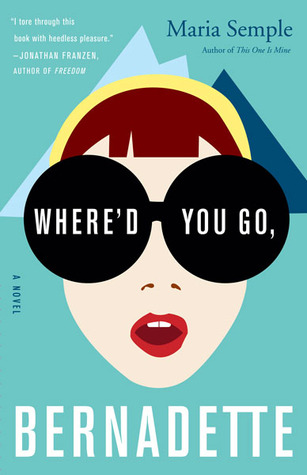
Where'd You Go, Bernadette - Maria Semple

Where'd You Go, BernadetteWhere'd You Go Bernadette[?] is a novel about disappearing.  Everyone in this book is disappearing, and they're all absolutely crazy.  The titular Bernadette Fox, once a famous architect, has vanished from the architectural scene and is slowly being subsumed into soccer mom life (except her daughter, Bee, doesn't play soccer, but it amounts to the same thing, really).  But she's also disappearing from that, having a virtual assistant in India run all of her errands for her so she doesn't have to interact with other people, and then she up and disappears entirely, with no one knowing where she went or what happened to her.  Meanwhile, her husband disappears from their family and into his work, and the supporting characters (known almost entirely through documents they produce) are losing themselves in various ways, too.  Everyone in the book is falling to pieces in pretty much every way imaginable, and Semple does a beautiful job of showing how they're all collapsing on the inside but showing completely different faces to the world around them, making them seem far more composed and in control than they actually are.  Even teenaged Bee, who seems the most together of all of them, is slowly dissolving and un-becoming, disappearing into a completely different Bee as she starts the search for her lost mother.

This is, also, a supremely funny book.  There were multiple occasions when I found myself gasping or giggling out loud at some antic.  Who'd have thought that blackberry brambles could be so funny?  I didn't, and yet they were.  (The blackberry brambles, such an innocuous object, are still one of the cornerstones of this story; hardly any of it would have happened without--or, perhaps more accurately, with--them.)  A lot of this is due to how the book is set up.  The majority of it is a series of documents produced by the characters: emails to and about each other, newsletters sent out to the parents of Bee's school, stuff like that.  Normally I'm not a fan of document-based books, because they tend to be exhausting to read, but this one was extremely engaging.  Despite the characters not being "present" on the page, they were all easily distinguishable and knowable.  The documents trace Bernadette's difficulties coping with life in Seattle, which she tries to avoid by throwing herself into preparations for a cruise to Antarctica--which she simultaneously tries to avoid.  While Bernadette isn't actually "losing it," it looks to many people like she is, and things draw to a head and culminate in her vanishing.  After this point, there are some more documents regarding Bernadette's husband and the other people mixed up in the mess.  Then the book switches, and Bee begins narrating, telling about her search for Bernadette when everyone else has given up.

I also liked how mental health was treated in this narrative.  Bernadette has anxiety regarding some things, but she's not "crazy."  She's not even really agoraphobic, though the back of the book says she is; she does leave the house, routinely, for various things without any crippling anxiety.  She can cope with things and do them herself; she just prefers not to.  However, as she trusts more and more of her life to other people, particularly the Indian virtual assistant mentioned before, people begin to think she's mentally unwell, particularly the mothers of Bee's classmates, who frown upon Bernadette's decisions and lifestyle in general.  This was a wonderful example of how someone who's different--not bad, just different--can be completely stigmatized in an area beyond high school.  Mothers and other parents can be just as vicious as kids in this regard, and the book shows it well--as well as showing Bernadette being vicious right back.  Bernadette doesn't vanish because she's driven to the edge; she vanishes because other people think she has been, and she wants to show that they're wrong.  It's a great example of how people's preconceptions can cause utter chaos when really nothing is the way it was thought to be.

There were a few things that had me raising an eyebrow throughout this (particularly how easy it apparently is to escape from an Antarctic cruise ship, for multiple people) but in general I thought Semple did an extremely good job with how she structured the book; like all books, it requires suspension of disbelief, but once it gets going, everything fits so logically together that it's not a challenge to buy the narrative as a whole.  I pretty much read this in one sitting, and enjoyed every minute of it.

4.5 stars out of 5.

Thursday, March 6, 2014

The Salzburg Connection - Helen MacInnes

The Salzburg ConnectionHelen MacInnes has been labeled "the queen of suspense" by some, and I think I would probably agree with that based on my impressions of The Salzburg Connection.  The plot revolves around a box hidden in an Austrian lake, and all of the people who are trying to find it or prevent it from being found.  This results in there being a lot of moving parts, but MacInnes handles it well.  She's also rather unique in the world of cold war spy novelists in that she actually has strong female characters.  Lynn adapts remarkably well to the adverse conditions she finds in Zurich and proves to be a good person to have on hand.  And Elissa... Oh, what to say about Elissa without ruining anything?  Well, she's definitely a clever character, and she does not in any way fall into the trope of the "Bond girl" that is so common throughout spy novels.

This is a somewhat dated book, having been published in 1968, but that doesn't diminish its reading quality.  It is devoid of the slick gadgets found in so many spy novels, probably because the primary characters are not spies themselves, and this makes it a much more believable narrative.  Mathison, a lawyer who is also the main character of the novel--he is the main character, despite his relatively late appearance--is just trying to figure out what he's gotten himself into and help someone out.  He doesn't want to be a spy, and he doesn't really engage in that much spy-like activity.  That's all left to other characters, making Mathison extremely engaging.  Because we experience the story mostly through his perspective, we get the real experience of what he's going through, rather than jumping right into the shocking doings of the underworld.

MacInnes also has a wonderful layering effect going on throughout the novel.  As said before, there are a lot of moving parts, and just when you think you have all of their paths figured out, she adds another dimension--some of which aren't revealed until the very end.  They aren't huge twists that will completely change the plot for you, but they do add a lot of "oomph" to the experience and make it seem a much more "full" narrative.  I didn't really buy into the romance subplot, because I felt it wasn't worked enough to be really engaging, but that wasn't the main point of the book so I can let it go.  Overall, I would definitely recommend this to anyone who likes spy stories, mysteries, Nazis, or novels about the complicated relations of the cold war.

4 out of 5 stars.

Thursday, July 11, 2013

The School of Essential Ingredients - Erica Bauermeister

The School of Essential IngredientsIt's not a secret, to anyone who knows me, that I love food and cooking.  Indeed, I stated in my review of Consider the Fork that I would be perfectly content to be a housewife if it meant that I could stay at home and cook (and, consequently, eat) all day long.  This will, however, probably seem less appealing as my metabolism slows down.  It keeps the pounds off now, but in the future... Oh, boy, I'm going to be fat.

When I started reading this book, I expected a book about cooking and learning to cook.  Not a cookbook; I knew it was a novel, about an ensemble cast with their own backgrounds and wants and needs, but I expected there to be more focus on the actual "learning to cook" process than there actually was.  Bauermeister's cooking pro, Lillian, doesn't believe in recipes due to an aversion to the written word (HOW COULD ANYONE HAVE AN AVERSION TO THE WRITTEN WORD?!?!) so there aren't any recipes included.  Mildly disappointing, but I guess  beyond the point of the book itself.

What the book actually is, is a collection of back stories for people who happen to meet in a cooking class and may or may not become involved in each other's lives.  They were good stories--engaging, well-written, and often poetic; Bauermeister is a very good writer in that respect--but there wasn't a lot of forward motion.  Of course, there didn't really need to be, since it wasn't a plot-centered novel, but...  But, well, of the nine stories (eight students and one teacher), six of them take place entirely in the past.  Lillian, Helen, Carl, Isabelle, Tom, and Claire all have stories that abruptly cease when we reach the present day.  We never learn what Claire does that makes her happy, or why Carl and Helen are taking a cooking class and what they gain from it.  They're just there.  Lillian and Tom have a bit of interaction at the very end, but it's still not really integrated in the sense that the class isn't woven into their lives; it's just the place they met.  As for Isabelle...it seemed that her story was centered around the idea of being "edgy," and just came across as kind of random.

On the flip side, Antonia, Ian, and Chloe all have stories with forward motion in them, and those were really more enjoyable to me.  Antonia is from Italy and is adjusting to life in the US while trying to convince a couple that they don't really need an industrial kitchen in their Victorian-era home.  Ian is trying to woo Antonia.  And Chloe is struggling with life after high school and living with a boyfriend who isn't exactly the cream of the crop.  Throughout the story, all of these characters actually grew as people and left the class much more "full" than when they started.

When the writing did focus on the class, however, I loved Lillian's voice in how she treats food.  I'm not sure I actually agree with everything Bauermeister put in her mouth, but I want to agree with it.  On some level, it probably is true that people are shaped by the way they eat, but I'm not sure it's to quite the degree that it's made out to be in the book.  And I'm also not sure that, even though I love cooking, cooking is as magical as it's made out to be in the book.  Restaurants, and more specifically restaurant kitchens, are not places where people have cozy chats.  They are hot, sweaty places of work, and while there is certainly something magical about raw ingredients turning into fully-prepared dishes, there is rarely something magical about the attitude that goes into them.

Still, this was a highly enjoyable read with some really great writing and very human characters, all of them with their own quirks and flaws.  While there wasn't as much "motion" as I would have liked, this was a great book to curl up with on a rainy evening and thoroughly devour.  (Devour.  Get it?  Because food.)

3.5 out of 5 stars.

Tuesday, July 9, 2013

The Winter Palace - Eva Stachniak (Catherine #1)

The Winter Palace: A Novel of Catherine the GreatHaving taken a course on Russian history last fall, I spent most of this book trying to match up historical fact to the happenings in the book.  That said, it was a futile effort because my course focused on Russian history, not Russian intrigue.  The plot follows a Polish woman who moved to Russia when she was young in the company of her parents.  When she is orphaned at the age of fifteen, almost sixteen, she finds a place serving in the palace Empress Elizabeth.  She becomes a "tongue," a palace spy for the Empress, and befriends Princess Sophie when the German girl arrives to marry the Grand Duke.  Intrique follows.

This was a book full of much drama, and it was a good read.  There isn't a ton of history in it; large historic events are only mentioned in the background, and the story mostly takes place within the walls of various Russian palaces.  The Winter Palace, while giving its name to the book, is only one of the locations, and spends a large portion of the book uninhabited as it is renovated.  There are plenty of descriptions of sumptuous dresses to please those enamored with royal life.  There are lovers and affairs and forced marriages and plenty of backstabbing among the palace inhabitants.  It has all the elements of a good historical fiction, with plenty of description of Russian foods to add a little cultural flavor (ha ha, flavor, get it?).

The main complaint I have about this book is that none of the characters ever seem to grow up.  Varvara acts like she's sixteen and Catherine acts like she's fourteen throughout the entire book, which spans several decades.  Varvara's daughter acts at age eight exactly the way she acted at age three.  When Catherine and Varvara have a falling out, it's over something that a pair of high school students would quarrel over, not an issue that would sever a long bond of friendship between two mature women.  Presumably these characters, who are playing at revolution and ruling an empire, should have a bit more maturity than that, especially after everything they've gone through.  The characters are completely stagnant.  Maybe there's supposed to be a message in that, something about history repeating itself to those who have not learned from it, but it comes across more as poor character management.  Perhaps it would have been better if the scope had been limited to a smaller period of time, when less character change would be expected, but as it was, it just seemed strange to find adults running around pretending to be children while planning a revolution in their free time.

I also found Varvara's relationship with Egor unrealistic.  I didn't know if she was supposed to hate him or love him or tolerate him, and I really hoped that there would be some other love interest somewhere along the way.  There seemed to be a lot of potential people to fill that role, but nothing ever came of it. Kind of disappointing.  It didn't entirely kill the story; far from it, but it would have been a good side-plot.

2 stars out of 5.

Sunday, July 7, 2013

The Book of Lost Fragrances - M. J. Rose (Reincarnationist #4)

Meet Jac.  She sees dead people.  Well, actually only one dead person, and that's her mother.  But she DOES have vivid hallucinations, an ex-flame from a younger time, and a little brother who's obsessed with finding a perfume that can help people remember their past lives.  The brother, Robbie, wants Jac to help him, because apparently she has the finest nose there is and will be able to identify the perfume's elusive ingredients better than anyone else.  Robbie wants to find the perfume in order to give it to the Dalai Lama, to help his cause by proving reincarnation.  How this will help is never actually explained.

So, there is a lot going on in this book.  There is the story with Robbie, Jac, and Griffin trying to find the perfume.  There is a story line about the Dalai Lama and the Panchen Lama and the constant struggle in Tibet.  There is a story line about members of the Chinese Triad in Paris.  There is a story set during the French Revolution, and one set during Cleopatra's time in Egypt.  The two "old" storylines, of the Revolution and Egypt, are kind of necessary to a book about reincarnation, but they probably didn't have to be as explicit.  I think more "hinting" would have been better, letting me make up my own mind about whether all of the reincarnation stuff was bullshit or not.  As it was, I felt like it was being shoved down my throat.  The story line with the Dalai and Panchen Lamas probably could have been eliminated entirely; the "purpose" for the perfume could have, instead, been shifted to restoring the memories of Jac and Robbie's father, who has Alzheimer's.  That would have freed up the Tibet storyline for another book.

Also, the blatant political message for a free Tibet was kind of annoying.  I am aware of the terrible situation Tibet is in, but I didn't want it shoved down my throat in a book that was focused more on Paris and Egypt.  Like I said before, I think it would have been best to separate that story and put it in a separate book of its own, where it could have more attention and be more fully explored.

That said, this was an enjoyable, fast read.  It's one of those books that has many short chapters instead of a few long ones, which makes it easy to pick up and put down without losing the thread of the story entirely.  It also has a glossary of Rose's research in the back, in case you feel like learning a little more about some of the topics (i.e. making perfume) that are featured in the book.  I liked the characters, for the most part, though they were all kind of obnoxious in that there wasn't any real character growth until the very end.  I'm also not sure what was up with Jac's mother's ghost, because if the pretense of the book revolves around reincarnation, shouldn't she have been reincarnated rather than just floating around and talking to Jac...?  I also did not like the ending.  It seemed like a cop-out instead of dealing with more complicated issues the characters had.  But still, a light, fast read.  Also, though this is the fourth book in a series, you do not have to read the others to understand this.  I picked it up without knowing it was part of a series, and it all made sense to me, though now I can see where it might have been referencing some of the earlier books.  But still, it stands alone as a narrative and won't leave you hopelessly confused.

2 stars out of 5.

Wednesday, July 3, 2013

Two-Way Street - Lauren Barnholdt

Two-Way StreetWarning: This review contains profanity.

What.  The.  Fuck.  I'm not sure I've ever read a bigger piece of trash in my life.  How anyone could get away with writing this is utterly beyond me.  I actually had to take notes on everything that was wrong with this book, just so I didn't lose track.  Let's start at the beginning, shall we?

First, everyone, and I mean everyone, in this book is fucking psychotic.  All of them.  It's a completely unrealistic portrayal of high school/college students.  High school and college students do not spend all of their time fucking and drinking.  They don't.  I don't know how long ago Barnholdt was in high school and college, or what her social life was like when she was there, but for some reason I have a feeling she wishes this was what college and high school were like, not what they were actually like.  Is there sex and partying in high school and college?  Yeah, sure.  But people do not spend every night of the week attending multiple parties.  Especially when they're stellar students, like Courtney and Jordan supposedly are, because you actually can't be a stellar student and still have time to spend every night hooking up and drinking.  Trust me, I know.  And they all, even the adults, run around sharing secrets and blackmailing people.  What?  And let's not forget that not a single parent cares that their children, who are underage (Courtney is 17) are running around at all hours of the night with people they have never met before, and they encourage this behavior.

Then there are Courtney and Jordan themselves.  We are supposed to believe that they had a wonderful, beautiful relationship, that they never fought, and it's wonderful that they got back together.  Uhm, no.  Not at all.  Courtney, for starters, is psycho.  She believes her ex-boyfriend is a liar and a cheat, even when she knew he wasn't lying to her or cheating on her.  Her relationship with him revolves heavily around the use of Myspace, which is definitely not the way to have a successful, healthy relationship.  She also automatically assumes that every girl who isn't a virgin is a slut.  Myspace Girl is a slut because Jordan likes her.  Any girl who ever bats an eyelash at Jordan, even before Courtney liked him, is a slut.  But this logic does not apply to Jordan, even though he apparently hooks up with girls left and right.  Barnholdt apparently still lives in an age where only women can be sluts, and men who sleep around are to be congratulated for their actions because it makes them even more desirable.  And can I mention how Courtney thinks that girls who are desirable, but are honest and never cheat on their boyfriends are "the worst kind of girls"?  What the fuck is that about?  Apparently Courtney thinks that lying and cheating are desirable qualities in a girlfriend?!

Now let's talk about Jordan.  Jordan, as mentioned before, is the type of guy who hooks up with a different girl every night of the week.  He also deeply regrets not having the appropriate amount of time to gel his hair in the morning.  He likes his rap "hard and dirty" and thinks Courtney, who he is in love with, is dressed like a slut because she's wearing shorts and a tank top in Florida in the middle of the fucking summer.  Let me repeat that.  She's a slut because she's wearing shorts and a tank top in Florida, one of the hottest, most humid places in the country.  God forgive her for not wearing a full-length skirt and a bonnet to cover her hair!  He also thinks that, if a girl shows any interest in him at all after they hook up, she is automatically psychotic; heaven forbid that a woman expects a guy she's been intimate with to treat her like an actual human being and not like a disposable fuck toy!  We're apparently also supposed to think Jordan is edgy or something because he bought pot for a party once.  No.  That is not edgy, that's just stupid and a waste of money.  We're supposed to like him because he cries over his breakup with Courtney, but that was all because he was a complete idiot in the first place, so I don't pity him at all.  He broke up with her, after all, and for what was literally no reason.

Oh, and the "big secret" of the breakup is hardly a secret at all, and not nearly juicy enough to justify all of the sheer stupidity, slut-shaming, and overall misogyny of this book.  And the writing sucks.  How many times can you use "totally" in one sentence?  And at least learn to keep your character details straight, because Courtney is some kind of stellar student one moment, is in all AP classes, and the next she can't solve a single math problem on her own.

1 out of 5 stars, because at least it was short.

Saturday, June 29, 2013

A Kiss at Midnight - Eloisa James (Fairy Tales #1)

A Kiss at Midnight (Fairy Tales, #1)
Every now and then, a girl likes to read a trashy romance novel.  It's one of those simple truths, a little guilty pleasure I think we all like to indulge in every now and then.  And in my opinion, if the novel is based off a fairy tale, even better, because then I get to scrutinize it for interesting twists.

This didn't have many of them.

As the title and cover would suggest, A Kiss at Midnight is based off the story of Cinderella, though it takes place in Regency-period England rather than in some place where magic trees or fairy godmothers are prevalent.  There are some changes from the original story--the stepsister isn't evil, the prince is exiled and will never be king, the heroine is posing as someone else for much of the story--but it's nothing that made my jaw drop.  Really, I feel like it didn't need to be a Cinderella story at all, and that it would have served its purpose, romance-novel-wise, if it had just revolved around Kate pretending to be Victoria.  I think a more interesting story would probably have been that of Tatiana: the Russian princess uprooted from her home to marry an impoverished prince she's never met, only to find him in love with another woman.  That could be interesting.  This?  This was...entertaining, in a typical romance novel sort of way, but I wouldn't go so far as to say it's actually interesting.

So, the plot wasn't terribly interesting.  The characters weren't that interesting, either.  Really, my favorites were Effie and Henry.  Kate and Gabriel themselves were just...blah.  Kate is a Nice Girl who slaves away for her family, servants, and tenants while her stepmother and stepsister spend all of her dead father's fortune.  After her stepsister Victoria, who is genuinely a nice person, has a little mishap with a dog bite, Kate agrees to pose as Victoria in order to secure the approval of one of Victoria's fiance's relatives; this approval is apparently vital, even though the fiance and the relative (the prince) have never met before.  Kate spends the entire story talking about duty, how she just couldn't leave her stepfamily, and whining that she will never marry Gabriel because she believes that he'll have affairs, even if she blatantly states that she doesn't think he's the type to leave.  Gabriel spends his time whining that Kate isn't rich enough for him to marry if he's going to pay for the upkeep of an entire castle and its staff because that is his responsibility.

Suck it up and find solutions.  The two of you are supposed to be adults, aren't you?

Effie and Henry, though, were delightful.  And Tatiana seems like she had potential, too, though we didn't really see that much of her.  Oh well.  That's the way the cookie crumbles.

2 stars out of 5.

Thursday, June 27, 2013

Touch Of Power - Maria V. Snyder (Healer #1)

Touch of Power (Healer, #1)I actually had to double check that this book was by Maria V. Snyder because, uhm, what happened to her writing?  I adore her first novel, Poison Study, though I adored its sequels slightly less, and while I haven't read the Glass series or the Insider duo, I was looking forward to this one.  I just don't understand what happened!  The book was a sloppy mess, and Snyder's writing seems to have de-matured between Poison Study and Touch of Power.  Touch of Power just seemed like a slapdash collection of plot elements, including:

-flower that may or may not be able to kill you
-eleven types of magic, many of which seem to contradict   each other and none of which are properly explained
-multiple princes
-a religious cult
-fifteen realms, one of which randomly has a president that is very out of place
-way too many caves
-a plague that kills anyone who tries to cure it
-a missing sibling
-zombies
-a romance that doesn't really ring true

So.  While I liked how healing magic works in Touch of Power, with a healer assuming an injured/sick person's maladies and then healing herself by just getting better ten times faster than a normal person would, that was pretty much the only good part of this book.  Everything else just feels like Snyder cobbled together a bunch of different story lines, any one of which would have made a respectable novel of its own.  It just felt like this wasn't actually the novel Snyder wanted to write.  I couldn't decide if she wanted to write a zombie novel, a school story about the children of powerful/royal families, a book about a plague-ravaged land, a tale of rescuing a lost sibling, a narrative of struggle about coming to terms with a hated power, or a chronicle of trying to bring down an evil king. All of those were present here, and it was just too much.  Not a single aspect was explored fully, leaving the book a hurried rush from one plot element to the next without anything actually being settled.

Additionally, every single one of the characters in this book lacks dimension.  They are all single-faceted, which makes their "growth" come across as false, especially Kerrick.  What was up with that sudden romance?  While it's not insta-romance in the sense that they fall in love right away, when it does happen, it's pretty instantaneous, with no build or maturation of the relationship at all.  And while Avry is a perfectly nice protagonist, she isn't someone you can really root for, because she's not really struggling.  She's just kind of there.  We're just supposed to accept that Avry is Special, and that is why everything goes right for her.

Speaking of that, what was with that ending?  I have NEVER seen a more blatant cop out on explanation.  NEV.  ER.

Overall, while I'm kind of curious as to what Avry &. Co. will get up to next, I'm not curious enough to slog through another of these when there's much better stuff out there.

1.5 stars out of 5.