Pages

Showing posts with label united states. Show all posts

Friday, May 4, 2018

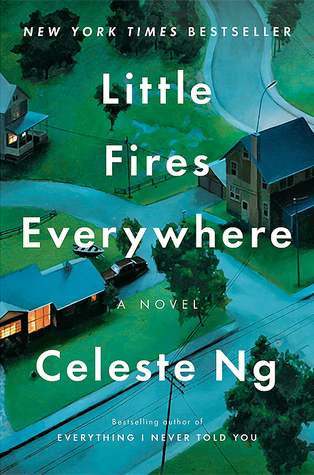
Little Fires Everywhere - Celeste Ng

Little Fires EverywhereLittle boxes on the hillside, little boxes made of ticky tacky; little boxes on the hillside and they all look just the same.

Shaker Heights is a seemingly perfect community.  The Richardsons are a seemingly perfect family; sure, the youngest daughter, Izzy, is completely odd, but--oh, wait, Izzy burned the house down?  Okay, maybe something is up here after all.

This story focuses around two families: the Richardsons and the Warrens.  The Richardsons, including Mr., Mrs., and children Lexie, Trip, Moody, and Izzy (in descending order for age) have lived in Shaker Heights for Mrs. Richardson's entire life, and those of her children.  Izzy is odd, yes, but the family is basically a perfect picture of upper-middle class America in the late 90s.  The Warrens are a much smaller family, just mother Mia and daughter Pearl.  They've lived a nomadic life driven by Mia's artistic tendencies, but have finally settled in the Richardsons' rental property so that Pearl can have some stability in high school.  Soon Pearl, Lexie, Moody, and Trip are hanging out regularly, and Izzy seeks out Mia, who she feels understands her better than her own family does.  The two families are intertwined, and then abruptly split apart by a custody battle in which neither family is directly involved.

This seems like something of a strange premise for a book, and I was skeptical; how would Ng make this work?  I  liked Everything I Never Told You, but I wasn't amazed by it.  Still, she has a way of writing family life and making it compelling, and that comes through in this book as well.  And while EINTY dealt with suicide (or did it?) this book revolves, deeply and intimately, around issues of motherhood.  What makes a mother?  What makes a good mother?  Is being a blood relative enough?  Or does love matter more?  Or connection to culture?  What matters most here?  And it can't all matter most, and there can't be a balance of it, because that's not a possibility in this particular custody battle, and there are no easy answers surrounding it.  Ng has crafted the ideal scenario for this battle to play out, because everyone is right to some degree, and no one has the right answer--for May Ling/Mirabelle, or for anyone else in the book.

The crafting of the central scenario was well done, though it didn't come into play until fairly late in the book.  Much of the page time is spent building up the characters and the relationships between them so that Ng can later tear them apart, though this is not a tapestry that unravels from all angles; no, there is a central person behind that, and despite having good intentions, she is not very likable.  However, several parts of this book didn't quite work as well as they could have.  First, Izzy was an underutilized character, getting far less page time than the other members of the cast.  I suppose this is because she is supposed to be the person who is sitting back and watching everything, and then acts when no one else is looking.  However, this isn't apparent until much later, and if it had been woven more throughout the book that Izzy knew things that people weren't giving her credit for, there could have been a much better sense of foreboding built up.  Second, the mothers' time lines weren't well woven throughout the rest of the story; they were just dropped in big chunks, and if they'd been broken up a bit and better interspersed with the main timeline, then it would have come across as more even character development instead of info-dumping.

Still, I quite enjoyed this.  I'm not raging that I didn't pick it up from Book of the Month back in 2017, but it was a good book nonetheless and I'm glad I got to it now.

4 stars out of 5.

Wednesday, April 25, 2018

The Bollywood Bride - Sonali Dev (Bollywood #2)

The Bollywood Bride (Bollywood)This is another one of those books that I've had for ages but, despite being intrigued by it, just never got it.  When you own a book, sometimes reading it doesn't seem as pressing as reading all of your library books that have due dates attached to them!  But the Popsugar Reading Challenge for 2018 has a category for "A book by an author of a different ethnicity than you," and since this was hovering so close to the top of my to-read list anyway, it was an easy one to slot in for that category.

Given the title of the book, with the emphasis on the word "Bride," I thought that this was going to be a romance.  While there is a romantic plot, perhaps one that is really the central driving force of the book, what this really felt like was a book about family, particularly family you choose over family you're born to.  Heroine Ria was mostly raised by her aunt and uncle following a terrible encounter with her mentally-ill mother, and while she and her father loved each other, their relationship was strained by that encounter and everything that followed it.  But Ria is now somewhat estranged from her aunt and uncle, who she kind of sees as her real parents, stemming from a secret relationship with her not-cousin (seriously, not her cousin, but around a lot, and the cousin of her cousin) that ended poorly on several fronts.  Ria has spent the last decade in India as a Bollywood star, and returns to Chicago and her family in order to attend the wedding of her actual, blood cousin who is more like a brother to her than anything.

Ria is perhaps not the ideal heroine.  She's kind of mean, and deliberately does things that hurt people.  Ostensibly she does these things to protect them, but it seems like what would really be better would be letting people make informed decisions for themselves.  Vikram is also kind of terrible.  He holds grudges and does spiteful things, and while he might be entitled to do so, he doesn't just hurt Ria, he hurts everyone else around him in the process.  However, they are surrounded by absolutely wonderful people who love and support each other and welcome misfits into their fold and make everyone around them feel wanted.  They keep each others' secrets, but to actually protect each other, rather than out of some misguided sense of righteousness.  Ria's aunt and uncle are both wonderful, her cousin is wonderful, his fiancee is wonderful, the aunties are wonderful, everyone is wonderful except our main characters.  Luckily this isn't a book that depended totally on romance between the heroine and hero to propel it; the supporting characters were so important in building the feeling in the story.

The writing itself is decent; Dev an write a good romantic scene, but I think her true strength was in those wonderful family scenes, and even more so in descriptions of food!  Oh geeze, I got so hungry reading this book.  I wanted to eat so much Indian food, it wasn't even funny.  Except Indian food is like a million dollars in the United States, and so I didn't.

Overall, a good book, and I might be interested in readings others by Dev--but not the sequel to this one, because it sounds depressing af.

3.5 stars out of 5.

Friday, April 20, 2018

Ghostland - Colin Dickey

Ghostland: An American History in Haunted PlacesThis is not a book of ghost stories.  Let's get that out there right now.  There are some ghost stories in it, yes, of various turns and origins.  However, ghost stories are not the focus of this book.  Instead, what Dickey turns his attention to is the historical and cultural atmospheres that contributed to these stories, as most of them--as Dickey demonstrates--have absolutely zero basis in fact.

The United States has a tumultuous history, and it shows in the ghost stories that populate it.  Dickey digs into a lot of different areas, both geographically and topically, examining such things as: Why aren't there more stories of Native American ghosts, given the violence rained upon them by whites?  Why aren't there more black ghosts in areas that are fraught with dismay and death for Africans or those of African descent, such as former slave markets and places where slaves were tortured?  Why do the details of ghost stories change, sometimes dramatically, over time--things like race, age, and origin all altering on the same ghost?  He answers all of these in turn, and some others to boot.  Though the details vary somewhat, what it all boils down to is that ghost stories reflect cultural hopes and fears at the time they are told, and so the areas that are important at the time of telling are sometimes altered for emphasized in order to emphasize these tensions, whether the alteration is deliberate or not.  For example, a ghost can be a slave in a time when tensions about race and brutality by masters was of cultural importance, but the same ghost can be a white lower-class woman in a time when matters of economic tension are more predominant in the psyche.

Dickey's book works its way from the small to the large, from haunted houses to civic buildings to entire towns and cities and to an idea that our entire country is haunted.  While he touches on some of the places that are particularly renowned for hauntings, such as Eastern State Penitentiary in Pennsylvania, he mostly focuses on places that aren't quite as well known.  He doesn't really explain why he does this, but it seems likely that it's because the less-known places are actually easier to track, as stories might go through fewer permutations if there are fewer people telling the tales.  He also touches on some other areas of ghost stories that might not occur to everyone every day.  For example, by case law in New York State, if a building is said to be haunted it is, by law, haunted--because whether hauntings are a matter of fact or fiction, the belief that a building is haunted affects its value. 

This book had a lot of interesting aspects.  However, because Dickey has a lot of points he wants to make--and many of those points have overlapping and repetitive aspects--none of them are really delved into too deeply, and each point has one or possibly two examples at the most.  I think it would have been interesting to see how some of his theories played out in the context of places said to be more haunted--like the Eastern State Penitentiary, or the White House.  Seeing some of the stories completely debunked was interesting, but then there was no real context for how some of the stories came to be in the first place.  For the Winchester House, there were some rumors started by a paper, but even that can't really indicate the absolute plethora of stories that surround it, and the details are, as Dickey pointed out earlier in the book, what is so very important.  But none of those are touched on.

Overall, a fascinating book, but one that probably could have been a bit stronger in constructing its central argument.  Great for fans of history or fans of ghosts, or skeptics of ghosts!  Or someone who is all of the above.

4 stars out of 5.

Monday, January 8, 2018

The Wilderness of Ruin - Roseanne Montillo

The Wilderness of Ruin: A Tale of Madness, Fire, and the Hunt for America's Youngest Serial KillerI adore true crime books.  I adore things about serial killers, who are obviously terrible but are also fascinating.  I've watched Criminal Minds through like six times.  So when The Wilderness of Ruin popped up in the libraray's true crime category, I was intrigued.  Why?  Because, according to the cover, this book is supposed to be "A tale of madness, Boston's greatest fire, and the hunt for America's youngest serial killer."  In reality, it is none of those things.  In fact, it is three separate things: an account of the evolution and of the so-called "youngest serial killer," Jesse Pomeroy (who wasn't really a serial killer, though he undoubtedly would have become one--he killed two people, and technically you need to kill three people over a span of more than a month to be considered a serial killer), a short telling of a huge fire that swept through Boston, and a mini-biography of Herman Melville. 

This book was pretty awful.  Why?  There is absolutely nothing in these three narratives to tie them together.  Montillo tries for a "well, the fire happened while Jesse lived in Boston, and Melville probably read articles about Jesse and was interested in mental illness!" as an explanation for why these three things comprise the book, but it's a very weak explanation and doesn't work at all in context.  The fire takes about two chapters and is never mentioned again.  There is no "hunt" for Jesse Pomeroy; because he'd assaulted younger children before, the police knew exactly where to look when they found a body that matched his MO and had him arrested in pretty short order.  I kept expecting a jail break or something that would lead to an actual hunt, but that never happened.  And the Herman Melville thing was just...weird.  I have no idea why a biography of Herman Melville occupied approximately a third of this book.  In addition to these three main threads, other random topics are delved into with an amount of detail that wasn't appropriate for what was going on in the larger narrative, such as the production of dime novels or penny dreadfuls.  Montillo seems to want to tackle the ethics of Jesse's sentencing--both the death sentence and his commuted life in solitary confinement sentence--but doesn't really do so well; perhaps she was afraid of getting too political?

The writing itself wasn't bad, but the content was scattered and the structure did not hold together.  This seemed like it was going to be fascinating, but really was just disappointing.  Talk about a premise that did not deliver.

1.5 stars out of 5.

Monday, December 4, 2017

Tatiana and Alexander - Paullina Simons (The Bronze Horseman #2)

Tatiana and Alexander (The Bronze Horseman, #2)Guys, we have a problem.  My library had The Bronze Horseman, the first book in this trilogy, and it had this one, the second.  You know what it doesn't have in any format?  The third book.  What am I supposed to do?  Honestly, I could probably stop reading here since this book has a pretty firm ending, but it would feel weird to just leave out the third book, you know what I mean?  But though I'm eager to read the third book, that doesn't meant that this book isn't without its flaws.

The book doesn't pick up where the first one left off so much as jump backwards--the parts with both Tatiana and Alexander overlap with the happenings at the very end of the first book, with Tatiana fleeing to America and Alexander being arrested by the NKVD.  The chapters early in the book are also interspersed with short bits about Alexander in his life prior to his first appearance in The Bronze Horseman.  For much of the book, Tatiana and Alexander are separated, neither truly knowing whether or not the other is alive.  Because two characters who don't even know the "living or dead" status of their significant others don't really bode well for romance, the first half to two-thirds of the book heavily involves a lot of re-treading of the ground covered in the first book, particularly the time that the two spent in Lazarevo--which was, unfortunately, the weakest part of the first book.  And while the "present" parts of the book--aka, the parts that are actually happening on this book's timeline, after Tatiana and Alexander's separation, rather than during the "past" part before it--have some interesting happenings, they're pretty much all on Alexander's part.  See, Alexander is busy being arrested and interrogated by the NKVD and then going through other sorts of hell in Russia afterwards, while Tatiana spends her time bopping around New York with their child Anthony.  While she's not disrespectful toward Alexander or anything, and in fact does what she came to find him from thousands of hours away, her parts just aren't as interesting.

Where this book regained its strength was in the final part, when Tatiana returns to Europe in search of Alexander, once again in her disguise as a Red Cross nurse, though I guess it's not exactly a ruse anymore.  This returns her to action, and shows the strength and goodness of her character that just wasn't present while she was drifting around New York and protesting that she could never love again.  Tatiana does have a good character, but Simons didn't display it to its fullest here, though Alexander was done wonderfully.  In fact, he was probably better in this book than in the first one, precisely because he and Tatiana were separated for most of the book.  Once they're reunited, Alexander actually gets worse again.  Why?  Because their separation allowed his controlling tendencies to fade to the wayside, and when they're reunited, all of those terrible character traits come surging to the surface again.

Overall, I don't think this was as strong of a book as the first one.  The setting of wartime Leningrad really carried the first book, and without that here, the characters separately weren't enough to make up for it.  Alexander's parts were good until Tatiana showed up, whereas Tatiana was better once she returned to Europe, which basically sums up the unevenness of the book.  I'm still interested in seeing the end of these characters' story as the timeline moves away from World War II and into the Cold War, but I'm a little leery of how Simons will pull it off after this offering.

3 stars out of 5, and most of that is from the end of the book which at least had good pacing even if Alexander became a bastard again.

Monday, November 27, 2017

Under the Banner of Heaven - Jon Krakauer

Under the Banner of Heaven: A Story of Violent FaithOkay, so, I'm gonna confess that I thought this book was about climbing a mountain, primarily because the edition I read had a mountain, or very large mountain-like rock, on the cover, and I interpreted the "heaven" in the title as "the sky."  You know, like the heavens?  No, I was not confusing it with Krakauer's Into Thin Air, which actually is about climbing a mountain, namely Mount Everest.  I've read Into Thin Air, and my enjoyment of it (as well as of Missoula) was why I picked this up in the audiobook format.  Imagine my surprise when it started out by talking about a murder!  Well, that was okay, too, because I love true crime; it's awful, but fascinating at the same time.

Krakauer starts the book by discussing a gristly double murder committed by two brothers, Ron and Dan Lafferty, with the victims being their sister-in-law Brenda and her daughter Erica.  Though Ron committed suicide in prison after being convicted, Dan maintained that, while he committed the murders, he shouldn't be considered "guilty" of them because he killed his sister-in-law and her daughter under orders from God.  Hm...  Then Krakauer goes into the body of the book, which alternates chunks about the events leading up to the murder, the murder, and what followed it, with historical pieces about the founding of the Church of Jesus Christ of Latter-day Saints, aka the Mormon church.  Why is the Mormon piece so important?  Because the Lafferty brothers belonged to a fundamentalist splinter group of it which subscribed to tenants that the main Mormon church has pushed to the wayside, such as plural marriage, and one of the reasons they wanted to kill Brenda was because they thought she convinced Ron's wife to leave him after he wanted to take a second wife.  Ah, yes, polygamy--this book has it.

Krakauer blantantly says towards the beginning of the book that the main, modern Mormon church is not a problem, but that the problems he examines stem from fundamentalist groups that stem from it--just as all religions have problematic fundamentalists.  (Yes, all.)  The only times he talks about the main church is in a historical context, when he goes into its foundation, which seems pretty kooky but problems seems so because, as Krakauer points out, it was just founded much more recently than most religions.  And then he goes into the integration of polygamy into the church's practices, which really seems like it happened because the founder, Joseph Smith, wanted to bang a lot of women who weren't his wife and wanted his wife to just shut up and accept it, and a bunch of other guys high up in the church decided they wanted to do that, too.  This was a problem.  Is polyamory a problem?  No, as long as all members are consenting.  But Krakauer digs into how a solid policy of it led to rampant sexual abuse, rape, and incest, which women literally couldn't say no to because the men in charge told them all it was God's will, and they could be excommunicated, losing their families and entire lives, if they refused to go along.  It's this policy and these awful practices which still abound in the splinter fundamentalist groups that Krakauer discusses in the contemporary part of the book.

This is a riveting story on all fronts, and Krakauer is an excellent nonfiction writer to record it.  There is a bit of a structure issue with it, however, because he goes and tells a lot about the murders of Brenda and Erica right in the prologue, which means that for much of the contemporary chunks of the book, I was just waiting for something to happen that I already knew was going to happen.  I think this might have been a bit better if Krakauer had let us know that something had happened, but left the "reveal" for where it fit in the body of the main book, rather than in the prologue.  That would have let us know that it was building up for a purpose, not just rambling, but still had something to "surprise" us with.  He also tries to go into all sorts of terrorism comparisons in the end, which seemed like reaching far.  Does it tie into the topic?  Yes.  However, I don't think it was the right place in this particular story, especially because there's no good answer for the question that Krakauer wants to examine by bringing a terrorism component into play--namely, if someone has religious convictions, can we count them as delusional, and in any case, if they commit a crime based on those convictions, can we hold them guilty?

Still, the body of the book, before it dives into trial transcripts and metaphysical ponderings at the end, was excellent.  I really like Krakauer and hope to read his other books as well.

4 stars out of 5.

Monday, August 21, 2017

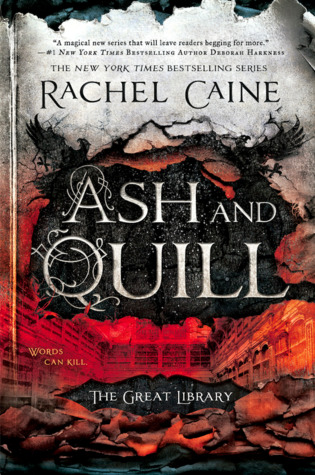
Ash and Quill - Rachel Caine (The Great Library #3)

Ash and Quill (The Great Library #3)
No one with a book is ever alone, even in the darkest moments.

Oh dear.  Oh dear oh dear oh dear.  You know that point where a series starts to go downhill?  A series that you absolutely love?  That you want to succeed more than anything in the world?  I think this might be that point in this series.  Here's the thing.  Ink and Bone was amazing.  Paper and Fire was great.  But Ash and Quill?  It was...good.  And that's all.

This picks up right where the second book left off, with Jess and his band of misfits appearing in Philadelphia, the main Burner stronghold in the American Colonies, after fleeing the Library in Europe.  This change of setting had great promise, but unfortunately the book didn't really deliver.  Jess and his friends spend probably half the book imprisoned in Philadelphia, plotting their escape, and the other half of the book fleeing Philadelphia and trapped in a second location, which they also must plot to escape.  Their plan to fight against the Great Library does not really go anywhere.  Thomas and Jess build not one, but two printing presses.  They build a weapon.  They survive Greek fire attacks on Philadelphia by the High Garda.  There's a sense of pieces moving in the larger world beyond the characters, such as the revolt of several countries, but the main characters don't actually accomplish much, and that leaves this book feeling very much like filler--a third book suffering from second book syndrome, if you will.

The sense of world here is still wonderful, but our characters, with one exception, seem to have stagnated.  Jess and most of his band have failed to evolve in the face of their new circumstances.  They are not allied with the Library or the Burners, but want a middle path, and so find themselves surrounded by enemies.  But Morgan, Jess' love interest and the one possessing magical powers in the group, is the only one who seems ready to rise and twist and change to suit the things that arise in their paths.  Additionally, while the world itself is still interesting Philadelphia is not as riveting a location as Alexandria, Rome, London, etc. have been in the series.  It's pretty much stuck in colonial times, with a few exceptions, and without many of the library technologies seen throughout the rest of the world.  It's a city under siege, but this is never really examined and the city seems to lack the depth of the other locales.  And I'm a bit concerned about the end; it seems very likely the group is going to split up and the next book will need to include multiple perspectives rather than sticking with just Jess, and that seems like it could get messy quickly.

I liked this book, but I didn't love it.  It didn't keep me turning pages or gasping for the next one at the end--a good thing, I guess, since the next one probably won't be out until around this time next year, but a bit disappointing at the same time because it just didn't have the same sparkle as the other volumes did.  The diverse cast remains a draw, but I wish they'd grow a bit more as characters instead of remaining essentially the same people we met in the first book.  Some changes came about in the second book, but in this one... None.  This one wasn't bad, but I do still hope that the next one will be better.

3 stars out of 5.

Sunday, August 20, 2017

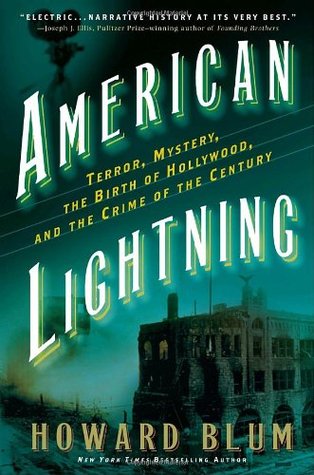
American Lightning - Howard Blum

American Lightning: Terror, Mystery, the Birth of Hollywood & the Crime of the CenturyOkay, I'm going to come out and say it: this book was kind of a drag.  Especially for a book that promises to be about "Terror, Mystery, the Birth of Hollywood, and the Crime of the Century."  Ostensibly, it's about the bombing of the Los Angeles Times building, the bombings that came before and after it, the hunt for the criminals, the trial...and a guy who makes movies?  What?  Where the connection?  Well, here's the answer: there isn't one.

Now, that's not 100% true.  The private detective who worked on the bombings knew the guy who made the movies.  But still.  The movies weren't actually about the bombings, they were just about social events that occurred around the same time, and in a very vague sort of way--putting the two directly together is a very tenuous connection at best, and trying to tie it together with "But they saw each other in a hotel at the end of it!!!" doesn't really lend the connection any credence.  And with the book relying on such a tenuous connection, it was on shaky ground to start with.

Blum focuses on three main figures in this book: Billy Burns, a private inspector; Clarence Darrow, a lawyer; and D. W. Griffith, the filmmaker.  But for most of the book, only Burns is actually relevant, as he and other inspectors from his company attempt to find out who are behind the bombings that are sweeping the nation.  A startling string of domestic terrorist attacks, the bombings sprung from the ongoing battle of union workers vs. businesses, but initially no one was sure which side was actually doing the bombing.  Was it the unions, trying to get back at businesses who were against unions?  Or was it the businesses themselves, trying to frame the unions?  Meanwhile, Blum intersperses chapters about Darrow and Griffith just...being themselves.  Lawyering.  Having affairs.  Making movies.  It's incredibly boring and served no purpose.  Griffith's line isn't necessary at all and certainly doesn't play into "the birth of Hollywood" as his movies were made in New York and he wasn't even the first person to film a big movie.  Darrow becomes necessary to the story, but not until the very end, and even then it seems like Blum greatly inflated his role in the story, especially given the way the investigation and trial ended.

The writing is bland and it's hard to determine what's actually pulled from research and what's conjecture, especially in the realm of conversations that occurred.  There always seemed like suddenly there was going to be a turning point, a new sight of depths...but then that point never actually developed.  There were some interesting parts, mainly when Blum actually focused on the investigations, but for the most part this was a very "meh" book.  For a good read about an investigation surrounding a crime closely linked to social issues, I would recommend American Fire or Killers of the Flower Moon--the first is set in the 2010s, the second in the 1920s.  They are both excellent and far outshone this one.

2 stars out of 5.

Sunday, April 30, 2017

Killers of the Flower Moon - David Grann

Killers of the Flower MoonThis was my choice for my April Book of the Month.  As soon as I read the description--about how, in the 1920s, the Osage Native American tribe was the richest per capital group in the world, and its members suddenly began dying under mysterious circumstances, and how the FBI became involved, trying to make a name for itself after a restructure--I knew it had to be my selection.  Nonfiction of this variety is fairly rare in Book of the Month; most of the nonfiction they feature is contemporary memoirs and collections rather than actual investigations like this, so I snatched it up while I could.  It sounded fascinating.  Terrible, but fascinating.

And that's exactly what it was.  A string of mysterious murders plagued the Osage, particularly the family of Mollie Burkhart, who lost essentially her entire family in a short span of time.  Eventually, with more than twenty-four murders looming over the Osage, with the tribe members afraid to go out at night, the FBI under the newly-appointed J. Edgar Hoover was told to do something about it.  The FBI had existed before this, so in that sense it's really not a story about the birth of the FBI.  But it is a story about the rebirth of the FBI, which prior to its restructure had been plagued with corruption and inefficiency.  Granted, most people know that the FBI under Hoover wasn't exactly squeaky clean, but he certainly wanted his new bureau to look good when it came under his control, and that led to a lot of pressure for Agent White, the man put in charge of the case, to solve the murders.

This is a complicated story involving a ton of twists and turns and strings of murders that point to multiple serial killers involved in the Osage murders.  While the case was eventually "solved" and closed, Grann found while writing the book that there were holes in the case and that, while the person who was convicted was definitely involved, there was more going on.  He conducted interviews, combed through archives, and eventually managed to piece together more of the story, uncovering a whole string of serial killers targeting the Osage in an attempt to gain control of the headrights that granted them money from the oil companies drilling on land the Osage owned the mineral rights for.  That this happened with one serial killer is imaginable, though of course terrible; that multiple people thought that this was acceptable, and either got away with it or got off lightly, is a travesty of justice.  That people beyond the Osage have completely forgotten about this or never known about it shows how little the Osage's lives were valued by those outside their community, and that is a tragedy.

This is a well-researched book; you can definitely see the legwork that Grann put into writing it.  He has extensive end notes including interviews and archival sources that aren't in publication, and read the case files from the FBI regarding the case.  That he not only reported on the original case but went beyond it and seems to have solved several more and established that the Osage's "Reign of Terror" actually extended much further and longer than most people had previously thought is remarkable and admirable.  The writing was also eminently readable.  It really reads like a narrative about Mollie and her family, and then about Agent White when he comes in to solve the case with his band of miscreants.  It was a real page-turner that had me trying to carve more time out of my day to finish reading.  And when I found myself wondering how Grann could possibly fill up another third of the book when I neared the end of part two, that's when he dropped the revelation that there was so much more than White and his fellows had ever thought.

This is an Old West story with cowboys and "Indians" and oilmen and people being thrown off trains to hide the dirty deeds of other.  It has cattle rustlers and undercover agents and all of the elements of a good Western story, except it is tragically and almost unbelievably true.  Grann has done a marvelous job with this, creating a book that had me raring to talk about it with others the moment I finished it.  I definitely recommend!

5 stars out of 5.

Friday, April 28, 2017

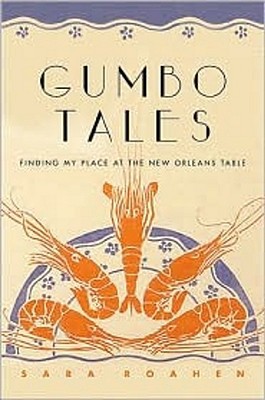
Gumbo Tales - Sara Roahen

Gumbo Tales: Finding My Place at the New Orleans TableI have never been to New Orleans.  The boyfriend has, and he dubbed it the worst place he's ever been.  That said, it's hard to believe after reading Sara Roahen's delightful Gumbo Tales.  Focused on New Orleans food and the struggle to fit in as a transplant to the city, Roahen divides her book into chapters that each focus on a dish or beverage and a theme that goes along with it.  For example, the chapter about Sazeracs focuses on parallels between New Orleans and Roahen's native Wisconsin as well as the evolution of the cocktail.  The history of all the dishes are dug into, though for most of them there's a lot of ambiguity about how the food really came to be, such New Orleans hosts such a mish-mash of peoples and always has.

Roahen clearly started writing this book pre-Katrina, which leads to an odd and heartbreaking duality.  She has a lot of nostalgia for the city "before the storm" and a lot of heartbreak for how it's suffered "after the storm," as the history of New Orleans has become divided, but there's also a lot of hope there, too.  She notes which restaurants and stands have closed their doors, seemingly never to return, but also the ones that have opened again stronger than ever, or the ones that aren't open yet but show signs of life, slowly stirring.  Even the rebuilding of the city's Vietnamese community is touched upon, with the revival of the street market and the Tet festival.  Carnival is described, both pre- and post-Katrina, in a way that most who are not native to New Orleans could possibly imagine.

But of course, this is primarily a book about food, and Roahen's descriptions are tantalizing.  She manages to make foods that I would likely never try, like tripe and turkey necks, sound delicious.  The only dish that even she couldn't make me crave was fertilized eggs--yes, eggs that actually have chicks in them.  That one brought up a shudder, but aside from that, I think every single thing she mentioned sounded delicious.  And it was educational, too!  She clearly did a lot of research here, citing various books from various time periods as part of her research into the evolution of New Orleans cuisines (including Cajun, Creole, Vietnamese, and all sort of hybrids and others that pop up here and there) and some of them seem like they could be great reading on their own.  Additionally, she provides a lot of insight into how some of the dishes are actually prepared, in their many preparations--something that she learned as someone trying to cook New Orleans style.  For example, I'd never known that the color of a roux affected a gumbo so much!  Or that so many different types of meat were supposed to go into red beans and rice!  This book has definitely inspired me to try some more New Orleans-style recipes, though I can't by any stretch call myself a New Orleansian.

Overall, this is another great addition to my trove of food books.  I don't think it's something I'd go back and read again and again, but I definitely made some mental notes about things to look into further, and it was certainly an enjoyable read.

4 stars out of 5.

Monday, September 12, 2016

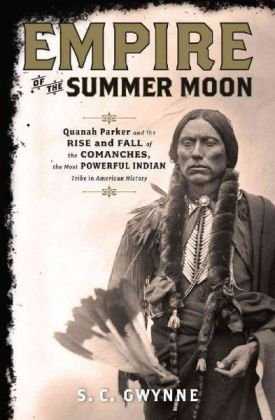
Empire of the Summer Moon - S. C. Gwynne

Empire of the Summer Moon: Quanah Parker and the Rise and Fall of the Comanches, the Most Powerful Indian Tribe in American HistoryEmpire of the Summer Moon is another title that came to me through the Deliberate Reader book club.  I was pretty pleased when I picked it up, because as I noted recently I haven't read a lot of nonfiction this year, and this was a nice change.  According to the subtitle, it's about "Quanah Parker and the Rise and Fall of the Comanches, the Most Powerful Indian tribe in American History," which is some interesting capitalization, but that's besides the point.  Let me just put this out there from the beginning: other than a couple of chapters at the end, this book is not really about Quanah Parker.  Parker's relevance is basically that he managed to wrangle the title of "Principle Chief of the Comanches" out of the US Government when the majority of the Comanches had been, finally, confined to a reservation, and he became a leader later in his life and caused a lot of trouble for the government earlier in it.  But beyond that, this book is largely not about Parker, but is more about the Comanches in general, without specifics for any part of it.

It must have been hard to write a book about the Comanches, because really people didn't, and don't, know that much about them.  They weren't a literate tribe and kept themselves fairly isolated, far more so than most of the First Nations we hear about.  The exact degree of isolation depended on the band (there were five within the Comanches) but overall it means that there isn't a lot of documentation from the Comanche side of things.  This means that what Gwynne is forced to rely on is documentation from the American (and Spanish, and Mexican, and Texan) side of things.  The result is that most of the information comes from records of Comanche raids on settlements and the various attempts to hunt down groups of Comanches, either preemptively or for revenge.  The notable exception to this is the few times that people who were taken captive by the Comanches and were either released or adopted into the tribe documented their experiences to some degree, which was a fascinating change.  As for documents from the Comanches themselves?  There are a few letters "written" by Quanah Parker at the end, but that's pretty much it.  Maybe something that a chief said here or there that was recorded by a white guy, but there's not much in that category.

I think this was a fairly good general history; it's hard to be more specific and detailed without that (non-existent) documentation from the Comanche side.  But even the generalities of Comanche life were fascinating.  What did bother me was some of the language that Gwynne uses.  He constantly refers to the Comanches and other First Nations peoples as savages, uncivilized, and lacking in culture.  Well that might all be true...but only if you're looking at it from a standard "white conqueror" viewpoint.  It's such a weird thing because this isn't an old book; it was published in 2010, a year when one would think that the author of a book such as this would know better.  The writing itself is very engaging, and it kept me reading until the end, but I had this constant little squirming sensation in the back of my mind because, uhm, that's not how you talk about people?  Or have I been mis-informed all this time?  Anyway, while the narrative part is good, there is a lot of underlying racism here, and sometimes it's not lying that far under; it's very clearly an instance of "history is written by the victors," in which case victors is, of course, white guys.  Not cool at all.  I think if that had been handled in a proper way, this book would merit a better rating than I'm ultimately going to give it, which has to be...

2.5 stars out of 5.  There was some interesting information here and it really got me interested in a period and area of history in which I hadn't formerly had much interest, but the way it was handled was not the best and it gets a serious knock for that.

Monday, April 25, 2016

The Midnight Assassin - Skip Hollandsworth

The Midnight Assassin: Panic, Scandal, and the Hunt for America's First Serial KillerI adore crime shows.  Law and Order (the original one, with McCoy!) is amazing, and is Bones, and then, of course, there is the best of them all: Criminal Minds.  (NCIS and all of its spin-offs are terrible.  Do not talk to me about them.)  Criminal Minds focuses specifically on serial killers, a group of murderers which is both terrifying and fascinating.  Of course, in Criminal Minds they always get their man in the end, but in real life things aren't always so neat and tidy, especially in periods which pre-dated modern forensics.  The most famous historical serial killer is probably Jack the Ripper, but he wasn't the first person who sort of (and this is totally creepy to say but is true) revolutionized mass murder.  That honor appears to have gone to the Midnight Assassin, a serial killer who terrorized Austin, Texas starting in 1884 before up and vanishing.  This was four years before Jack the Ripper made his kills in London and about a decade before H. H. Holmes built his murder hotel to capitalize on the World's Fair in Chicago.  Unlike Holmes and like Jack the Ripper, the Midnight Assassin was never caught, despite killing at least seven people, and maybe a couple of more outside of Austin.

Skip Hollandsworth uses The Midnight Assassin to lay out the events of 1884 and 1885 that terrorized Austin.  Someone started breaking into the quarters of servant women and killing them with an axe, and then moved on to several more prominent members of the community.  Of course, it wasn't until well-to-do white women, instead of black servant women, started dying that anyone really took notice.  Racism was rampant in the day and Austin presumed that it had to be a black man, or maybe even a roving band of black men, who were behind the killings, even though at least one person said they thought the killer was white.  Two people were tried for two separate murders, despite there being little to no evidence that they were actually involved.  The whole thing was basically a debacle, with no one really having any idea of what was actually going on.  In fact, no one was ever actually caught, and when Jack the Ripper began killing women in London people thought that it might be the Austin killer, relocated to England.  This theory doesn't hold much water in modern times because the Austin killer and Jack the Ripper had very different styles, which is (and I can tell you this as a super-experienced watcher of Criminal Minds) pretty indicative that they weren't the same person.  Serial killers, we all know, tend to use the same method over and over again.

What's sort of weird with that book is that Hollandsworth lays out a bunch of false trails that I kept thinking were going to evolve into a theory about who the killer actually was, but they never did.  For example, the bits about the insane asylum seemed like they were going to result in one of the patients there at least being accused of the murders, even if they turned out to be innocent, but that never actually happened.  Consequently, I was left perplexed as to why such emphasis was placed on the asylum and its staff and inhabitants in the first place.  It seemed liked Hollandsworth wanted to tell this story, but there really wasn't enough source material to bulk out a cohesive theory, so he settled for just including random other happenings around Austin, like the asylum and the recounting of lots of parties.  The elections, at least, tied in to the story, because the scandal of the murders impacted them in a huge way.

Ultimately, though, this is an unsatisfying book because there's no theory.  Hollandsworth mentions at the end that he's still hoping more evidence will arise that might point to who the killer was, but I would have liked to see him take a stab at "solving" the case anyway and at least trying to support any idea he might have had.  As it was, the book ended on a "Yeah, we just can't know" note, which was kind of annoying because it meant the book was basically an expanded version of the Wikipedia page on the killings, without any substantive thought added into it.  Compared to the last book I read about a serial killer, Eric Larson's Devil the White City, The Midnight Assassin just ended up falling flat.

3 stars out of 5; a fascinating series of events, but nothing to elevate the book as a whole to another level.

Sunday, April 3, 2016

Welcome to Nightvale - Joseph Fink and Jeffrey Cranor

Welcome to Night ValeAs many people know, Welcome to Nightvale is a popular podcast about a town, called Nightvale, that is weird, and where weird things happen.  Unlike many people, I have not ever listened to this podcast.  I struggle with podcasts in general because I start thinking about something else and then realize I've missed everything that's going on and have no idea what's happening.  But the idea of Nightvale appealed to me, so when I saw this book at the library, I snapped it up!

This Welcome to Nightvale focuses on two main characters: Jackie, the nineteen-year-old owner of a pawnshop that sells back everything for eleven dollars, but offers payments like a good night's sleep, and Diane, a mother working at a marketing firm and who moonlights as a PTA member even though her son finished elementary school years ago.  Diane's son, Josh, is a typical teenager who doesn't know who his dad is, except that he's also a shapeshifter.

Trouble stars for Jackie when a guy shows up at her shop, gives her a piece of paper that says "King City" on it, and then vanishes.  Jackie would have forgotten him right away, except that she literally cannot get rid of the piece of paper.  No matter what she does to it, it reappears in her hand moments later.  Her obsession with the paper and how to get rid of it begins to devour her life.  Meanwhile, two of Diane's coworkers go missing, and only one comes back--and no one remembers the other at all.  And then, of course, Diane's ex and Josh's father, Troy, has begun appearing around town in a variety of occupations.  Diane, knowing that Josh wants to meet his father, is determined to do something about this, but she doesn't quite know what and so resorts to stalking Troy for lack of any better plan of attack.  Diane and Jackie's paths begin to criss-cross and they eventually decide to work together to decipher the mystery devouring their lives.

The plot of this book isn't really anything to write home about, getting dragged to and fro by random occurrences that have no real explanation as to why and how they happen.  It's Nightvale itself that holds the real appeal here.  It's a place where the diner serves invisible pie, where writing utensils have been outlawed and you need a permit to turn on a computer at home, and where the City Council and librarians are the two most terrifying forces around.  Meanwhile, King City lingers at the edge of some people's awareness, but all they really know about it is that it's bad news for whoever goes looking for it.  These things were all, on their own, quite cool, especially the library sequences.  That said, I think this book relies a little bit too much on Nightvale's weirdness to carry the plot, such as it is.  Too many plot points existed as "Oh, that's just the way it is."  I do not favor this sort of explanation in storytelling.  Building a compelling world is difficult, but it has to be done and done well.  Worlds don't have to adhere to our own world's logic, but they should contain a logic of their own.  I didn't feel that Nightvale had any internal logic at all.  All of its aspects, from City Hall to the diner to the library to the taco stand to, well, everything, worked alone, but very few of them worked in conjunction with each other.  It means that Nightvale is a cool veneer to look at but there's nothing really driving it underneath.  This might, of course, be the point, but it's hard to say for sure, and I really didn't like it that much at all.

2 stars out of 5.

Friday, March 11, 2016

The Water Knife - Paolo Bacigalupi

The Water KnifeThe Water Knife is basically a story of the people of the American southwest and what happens to them when water starts drying up, droughts begin taking over, and the scramble liquid becomes all-encompassing.  The "water knife" of the title is not an actual knife, but the main character, Angel.  He is a water knife in the sense that he "cuts" water; that is, he works for a woman named Catherine Case, known as the Queen of the Colorado River, who enforces the water rights of Las Vegas vehemently.  Angel is one of her posse who goes out and takes down anyone who's trying to siphon Case's water away, cutting off the flow by any means necessary and leaving people and places to die in his wake.  He is very, very good at what he does, which makes him the perfect candidate for a mission Case wants completed: find out what's happening with a rumored score in Arizona, and if there are water rights up for grabs, grab them.

Our other two main characters are Lucy and Maria, who live in Phoenix--Angel's destination.  Phoenix is slowly being devoured by the desert, dust storms coming more frequently and lasting longer, the water only for the very wealthy; those who aren't wealthy are basically living off the mercy of the Red Cross.  Everyone with sense and ability is getting out, but getting out is hard because the other states have closed their borders to refugees from the waterless states.  Maria is originally from Texas, which has been completely destroyed by natural disasters, and she wants to leave Arizona, too, but can't afford a "coyote" to smuggle her across the border into another state.  She and her friend Sarah are basically doing all they can just to stay afloat--Sarah by working as a prostitute, Maria by selling water from Red Cross pumps at hiked-up prices at a construction site.  Lucy, on the other hand, can leave whenever she wants; she's not from Arizon, but has moved there to further her career as a journalist and document Phoenix's descent, which she does quite faithfully via the hashtag #PhoneixDownTheTubes.  But Lucy gets more than she bargained for when one of her friends, who'd spent recent days talking about a big score and a way to California, turns up dead.  Furious, Lucy aims her pen at everyone she's resisted targeting for so long, completely disregarding her own safety in a city that has basically become a dog-eat-dog world.

As Angel searches for water rights and Lucy searches for the truth, their paths and that of Maria begin to weave in and out of each other.  It's an extremely dangerous place, Bacigalupi's Phoenix, People get shown, blown up, fed to hyenas, and all sorts of other unpleasant things.  This is a very violent book; I'd really say it's not for the faint-of-heart.  There is also an "attraction" plotline, which I hesitate to call a real romance because the characters like each other, are intrigued by each other, and are definitely attracted to each other, but they're still also perfectly willing to stab each other in the back if necessary, and neither of them is really sure what their involvement is.  "Romance" typically implies some sort of resolution, which this didn't have and I don't think will have, given that, to my knowledge, there's not going to a Water Knife #2.

The path of this book is twisty and turning, with things spiraling in around each other but everything still interlocking quite well.  I didn't see any gaping plotholes; Bacigalupi's world seems very tight.  This is, however, a book that lacks a lot of resolution.  There's no world-saving going on here, so if you're the type of person who likes to leave a book with everything wrapped up in a neat little package, this is not for you.  It's definitely a "it's the journey, not the destination" that counts type of book.  In the end, the world (or at least the American southwest) is still pretty much screwed, but I'd come to care about the characters and have hope for their individual futures more than I did for the world at large.  It was a type of ending that, yes, would suck if it were reality (which it very well could become; that is the scary part about books like this) but I think fit the narrative perfectly.  It also read, to me, as basically a prequel to Dust by Hugh Howey.  Put together, I think the two are a really good sci-fi story about what might happen when we start running out of water.  It is not, however, a book that goes along with the misleadingly-titled (but lovely) What the World Will Look Like When All the Water Leaves Us.

An excellent book, but a violent one and one that is scary in its foreboding of a likely reality.  Sensitive readers be warned!

4.5 stars out of 5.

Wednesday, December 9, 2015

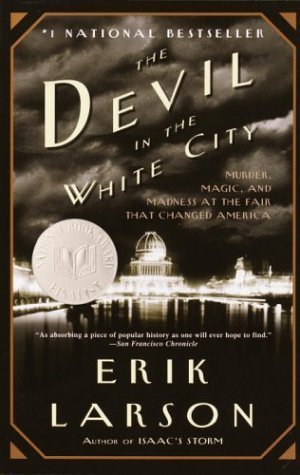
The Devil in the White City - Erik Larson

The Devil in the White City: Murder, Magic, and Madness at the Fair That Changed AmericaNot too long ago I read Erik Larson's Dead Wake: The Last Crossing of the Lusitania, and I really loved it.  It's a great example of a narrative history and how history can be absolutely enthralling.  I'd had Devil in the White City on my list for a while, even before reading Dead Wake, and while out to dinner with a friend it was brought up--so I bumped it up on my list.  The book chronicles the building and running of the 1893 World's Fair in Chicago, which became known as the White City due to the color of the huge, majestic buildings built for the fair.

I almost started by saying that they just don't do World's Fairs anymore...which would have been very stupid of me because another friend actually just spent the entire summer in Milan for Expo Milano, this year's World's Fair/Universal Exposition in Milan.  Maybe the thought I'm trying to grasp is that they just don't do World's Fairs like they used to anymore--there are no more Eiffel Towers and giant Ferris wheels to dazzle us.  While I'm sure the Expo was awesome, there's just something magical about reading descriptions of what the architects of the White City achieved.  And there's something very creepy about the other story that's twined through the story of the White City--the story of the devil, H. H. Holmes.

Now, did these stories go together?  Yeah, I guess.  I mean, Holmes built his murder hotel specially to lure women arriving in Chicago to see the White City--but he'd begun his killings before that, and other than taking a love interest and her sister to the White City, he didn't have much to do about it.  I think Larson mainly put these two narratives together to play off the whole darkness/light duality, which he does quite well.  Sometimes, however, I felt like he was just using Holmes to add menace to the story he really wanted to tell, which was about the fair.  I thought this because the bulk of the book is about the fair--those chapters are much longer than the Holmes chapters in general, with the exception of the chapters regarding the eventual investigation into Holmes' devious doings.  For the most part, Larson's attention is on the building and running of the fair--which makes the title a little disingenuous, though titles are generally the publisher's decision and not the author's.

I knew about the Lusitania before I read Dead Wake; I didn't know about the White City and H. H. Holmes before I read this book, so it was educational.  This is a great book for people who like history but don't live heavily-academic works; I would totally ask for this, or give it, as a Christmas present for someone like that.  It's a great, fast read (despite being almost 400 pages; they go quickly) and I thoroughly enjoyed it.

4 stars out of 5.

Friday, October 30, 2015

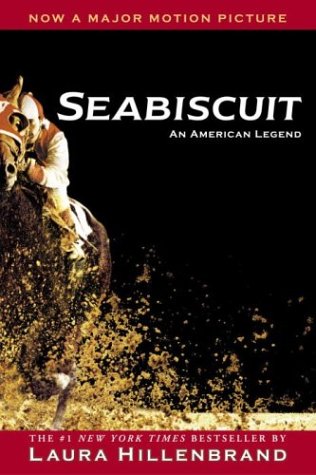
Seabiscuit - Laura Hillenbrand

Seabiscuit: An American LegendSeabiscuit had been on my to-read list for a while, and relatively toward the top of it because my university's library system had a copy.  I requested it, along with a bunch of other books, and took it home.  Where it sat.  And sat.  And sat.  At one point, it even ended up in the laundry basket, because I had to move it and that's just where it ended up.  And then, of course, it got buried by clothes.  It came overdue; I renewed it, but still didn't touch the book to actually read it.  And then I came to a realization: I didn't really want to read it at all.  This meant, of course, that even though it was numerically high on my to-read list (the books the library has are always numerically high; I sort through them pretty often) it was actually very low on the want-to-read list.  Hm.  A book at the bottom of your to-read list... Popsugar, is that you?  Why yes, it is!  When I realized this, I immediately fished the book out and began to read it.

Most of the delay is my own fault.  After checking Seabiscuit out, I realized I'd been mixing up horse movies the entire time.  See, I have a few movie weaknesses: sport movies (Friday Night Lights, Miracle) figure skating movies (Ice Castles, The Cutting Edge, Ice Princess) and horse movies.  And I'd been mixing two up!  In my head, Seabiscuit had gotten all muddled up with Hidalgo, and after checking the book out I realized that Hidalgo was the movie I'd actually wanted to read.  However, Hidalgo isn't a book, and so I was left with Seabiscuit.  I started it anyway, because now the book would count for a category of the Popsugar challenge that I hadn't locked down yet.  And... I was pleasantly surprised!

Laura Hillenbrand is an excellent writer.  That's probably why her two books, Seabiscuit and Unbroken, were both made into movies.  She has a way of writing that really makes historical scenes come alive.  In Seabiscuit, she follows the horse himself, as well as owner Charles Howard, jockeys Red Pollard and George Woolf, trainer Tom Smith, and some of Seabiscuit's rivals.  She follows the threads through all their lives as they come together and move apart, building up the tension of Seabiscuit's wins, losses, injuries, and comebacks.  I like horse movies, but I don't actually care one whit about horse racing, and Hillenbrand still managed to keep me riveted even though I knew how the story ended.  It's a really good author who can do that, and Hillenbrand definitely managed it.  The edition I read was even illustrated, which Hillenbrand apparently really pushed for, so that you could follow the whole saga in pictures.  While this made it a rather unwieldy book, one that was definitely suited for the coffee table rather than the bus, I think it was a nice touch overall.

Was this one of my favorite books of nonfiction?  No.  It wasn't.  Nonfiction books that fall onto my favorites list make me think, give me revelations, or bring out something that I never knew before.  This didn't do any of those, but that's just the nature of this book.  It's not really Hillenbrand's fault, and I think that, if I were really into horse racing or had known even less about the sport, it would have resonated much more with me.  I just happened to fall into the part of the spectrum where it didn't have that sort of impact.  Still, a very enjoyable book, and I read it over the course of a few lazy evenings.  I'd recommend it to someone who's interested in what's probably one of the greatest stories of horse racing, but doesn't feel like slogging through pages and pages of backstory and information in order to do it.

3.5 stars out of 5.

Thursday, October 29, 2015

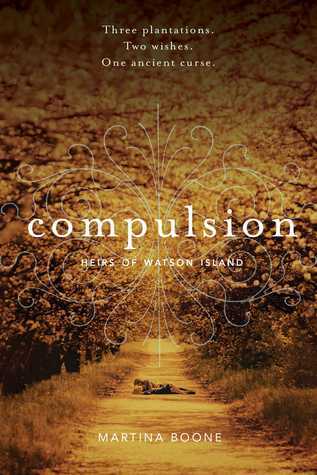
Compulsion - Martina Boone (Heirs of Watson Island #1)

Compulsion (The Heirs of Watson Island, #1)If you're a fan of young adult fiction, I heartily recommend signing up for PulseIt, a website that weekly posts free books and extended excerpts of books that you can read online.  The site is run by Simon & Schuster, which means all of the books posted are published by that house, but they still cover a wide variety of genres within the young adult sub-set.  They've recently lengthened the postings from one week to two, doubling the amount of time you have to read a title, but still post weekly so that, at any time, you have two books and two (or sometimes more!) extended excerpts to look at.  I found Poison Princess and the rest of the Arcana Chronicles, which I've really enjoyed, through this site, along with some frustrating titles, but I still think it's worth looking at.

Compulsion was a book that middle in quality.  It had great potential out of the gate, but I think it fizzled later on and never really lived up to it.  I expected it to be a sort of teen southern Gothic, maybe something like Servants of the Storm, which I thought was wonderfully written but fell agonizingly flat at the end.  I thought that Barrie, moving to Watson Island, South Carolina from her mother's home in San Francisco, would face some sort of lurking menace in her new abode, something that would utterly change her life, but she really didn't.

So, as I said, Barrie moves to Watson Island.  This comes in the wake of her mother's death.  Her mother, Lula, was seriously disfigured in a fire while pregnant with Barrie, and remained a shut-in for the rest of her life, often applying the same rules to Barrie, who's rather sheltered as a result.  Barrie's caretaker, Mark, was diagnosed with cancer and was going into hospice care, so Barrie couldn't stay with him anymore.  Instead, she moves to Watson's Landing on Watson Island to live with the aunt she never knew she had.  At the beginning of the book, she's not look forward to it, which is fair because I imagine few people savor moving for their final year of high school.  On top of that, the move doesn't exactly go well.  Her aunt doesn't pick her up from the airport, and when Barrie takes a cab to the family plantation, she finds that Aunt Pru might be a little bit crazy.  And on top of that, the house is apparently trying to kill Barrie, and her special ability--that to find lost things, which she's always had--starts going haywire.  On the bright side, there's a really cute guy she's attracted to and who's attracted to her, and now Barrie has a family that she never even knew existed.

Not too far into the book, Barrie meets her cousin, Cassie.  There's a lot family intrigue going on between the families of Barrie, Cassie, and Eight, who is Barrie's love interest.  Basically, it all boils down to their ancestors being a group of pirates, and while Barrie and Eight's families got gifts (the Watsons can find what is lost, the Beauchamps or Beauregards or whatever the heck they're called know what people want) Cassie's got a curse.  Cassie wants Barrie's help to break the curse by finding a family treasure that was buried during the Civil War, though how that's supposed to help I'm not quite sure.  The gifts and curses supposedly stem from the Fire Carrier, a Cherokee witch who trapped evil spirits on Watson Island, which is also interesting because the Cherokees didn't have territory along the Carolina coast.  Meddling with Native American customs, including "magic," is a tricky business, and while I can't really say if Boone did her research on it or not because I don't know enough on the subject to call her out on any errors, I hope she tread carefully regarding that aspect of the story.  But, historical accuracy aside, let me talk about Fire Carrier for a moment.  At the beginning of the book, he's made out to be very menacing.  As the book goes on, he gets more benevolent.  That's fine; character development and all, though he's not really a main actor.  At least, he's not a main actor until the very end, when he neatly wraps up the book's main conflict on his own in a very deus-ex-machina moment.

My main complaint with the book was Barrie.  I liked her as a character in general.  I thought her gift was unusual enough to be interesting and that her adaptation to the new situation was realistic.  What I didn't like about Barrie was that she's completely incapable of doing anything for herself.  Whenever she gets into any sort of situation, whether it's finding a secret room, going into town, or escaping the boat of her wicked drug-dealing uncle, she can't get out of it on her own.  She always has to be rescued, usually by Eight but once by Fire Carrier.  It's hard to view her as a capable person when she can get into trouble, but she can't get out of it, not even the most mediocre sort.  And she does this even after Eight points out that she's doing it.

The southern Gothic air I expected in this book was also lacking.  It was there at the beginning--spooky plantation, weird powers, family secrets and intrigue, etc.  But then the menacing shadows became cute little sidekicks, the family intrigue turned out to be not-so-intriguing, and the weird powers didn't end up packing that much punch.  The spooky plantation underwent a makeover to become just another charming southern locale.  It seemed like Boone lost a lot of her atmosphere and momentum in having Barrie try to improve her surroundings, and the entire book suffered for it.  The writing was beautiful, and I can only imagine what Boone could have done with a properly creepy atmosphere, but she gave up that opportunity way too early on for it to add to the book as a whole.

Finally, the title.  The title and the book's description both describe the abilities of the families as "compulsions."  Except a compulsion means that you have to do something.  Barrie likes finding things that are lost, because she gets a headache if she doesn't, but she certainly doesn't have to.  It doesn't eat away at her sanity if she doesn't.  She just gets a headache.  Compulsive disorders are a serious mental condition, and I can't help but feel that Boone trivialized that in how she worded and structured her novel.

I'm mildly interested in the sequel to this, Persuasion, but I'm not sure I'll be picking it up.  Barrie didn't really grow much as a character, other than deciding that she liked Watson Island.  Which is good, considering that she's stuck there in more ways than one.  It would have been interesting to see her struggle more, and with things just working out for her so easily, I'm not sure how compelling of a read the sequel will be.

2.5 stars out of 5.

Monday, September 21, 2015

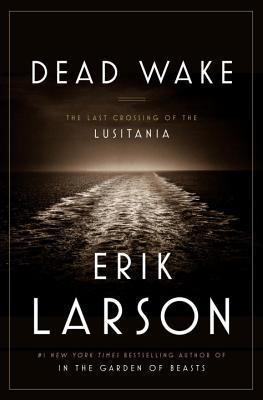
Dead Wake: The Last Crossing of the Lusitania - Erika Larson

Dead Wake: The Last Crossing of the LusitaniaErik Larson's books apparently have appeal to me, since all but one of them are on my "to read" shelf.  I think he just covers historical moments that I find particularly interesting.  From the look of his books (and my experience with this one) he doesn't feel the need to write broad, sweeping historical narratives, but rather focuses on smaller moments and events in the context of the larger ones everyone studies so intently.  I knew about the Lusitania, a large passenger liner that sailed in the early twentieth century, and had a conception about it that a lot of people probably shared: that when Germany sank it, it was the even that catapulted the United States into World War I.  This was, as Larson points out at the end of the book, not the case; the US didn't enter the war for more than two years after the Lusitania sank, though the sinking was certainly the cause of a huge amount of outrage in the neutral US.

In Dead Wake, Larson examines day-to-day life on the Lusitania amidst the building tension of the war, particularly a warning from Germany that any UK-bound ships were considered valid for sinking and which mentioned the Lusitania specifically.  He also includes the operations of U-20, the German submarine which sank the Lusitania, and the operations of Woodrow Wilson, Winston Churchill, and a few other areas/departments, such as the secret British intelligence group in the so-called Room 40.  He relied on a wide variety of resources to create this narrative, including letters, memoirs, and logs--pretty much everything except interviews.  The Lusitania sank in 1915, after all, which means that none of the survivors are still around.  He did an extraordinarily good job of it, making the people who sailed on the ship and submarine, and who watched and manipulated events from afar, seem real and relatable even though he only had limited resources on which to rely.  He builds tension throughout the entire book until the ultimate sinking, and then winds everything up quite neatly without too much hemming and hawing about consequences.

At the end of the book, he does bring up one thing that I think is ultimately a flaw: he doesn't answer any real questions about what happened.  No one really seems to know why the Lusitania didn't receive a naval escort, why the instructions (or lack thereof) were so ambiguous, why it wasn't diverted to a safer route given the intelligence available.  While it's interesting that no real answers have come out regarding this, I would have liked to have seen Larson take a stab at answering them given the information he dug up.  Ultimately, this was an informative book but nothing that was really groundbreaking, because it doesn't include any sort of argument or thesis, only facts.

4 stars out 5.

Sunday, August 23, 2015

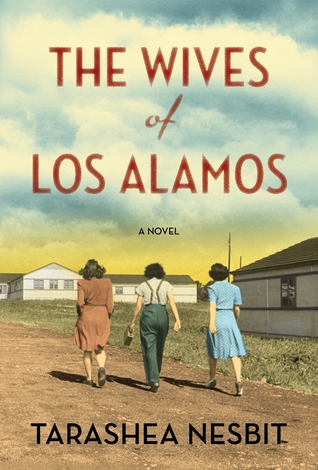
The Wives of Los Alamos - Tarashea Nesbit

The Wives of Los AlamosThis seems to be a contentious book for one reason and one reason only: it's written in first-person plural.  Pretty much every review about it begins that way, and if I had read them before I requested the book from the library, I probably wouldn't have picked it up.  It doesn't have a solid core narrative.  It doesn't have real, distinct characters; different women are mentioned by name at several points, but no one is ever really given the chance to develop because of the amorphous "we" talking about "our" sometimes contradictory experiences.  I understand why this device was used; it's supposed to give you a feel for the lives of the women of Los Alamos as a whole, instead of just picking or making up one or two to flesh out more fully and stand in for the rest.  It's meant to capture a wider range of experiences.  Is it successful?  I didn't really think so.  Some of the women are so obviously outsiders that they're clearly not contained within the "we," and that means that their experiences are completely left out of the book. 

Each chapter has a theme, such as "Children" or "Foreigners," and the snippets that compose each chapter--because each chapter is composed of a series of one-paragraph snippets, instead of a more traditional narrative--adhere to that theme.  It's a sort of experimental style, and while some people loved it, I didn't.  I didn't hate it.  I did hate it to begin with, but as with most writing, I got used to it after a while, and it didn't grate on my nerves so much.  But I never really liked it, and was left feeling like Nesbit could have offered a much richer picture of Los Alamos if she had just been fuller in her telling.  I guess that's just my preference; I like books with real characters and central narratives, even if those narratives don't move quickly and are more character-driven than anything else.  An amorphous, ever-changing central figure who isn't even one figure but a conglomerate of many left me feeling like I was reading about a hive mind, which is kind of demeaning to a group of women who no doubt went through a lot of hardships to support their husbands.

By choosing the narrative style she did, Nesbit avoided a great deal of detail.  This probably saves her from being savaged by people who are sticklers for historical accuracy, but I felt it distanced me more than intrigued me, and I felt left out more than anything else.  A novel needs to draw readers in and connect them with the characters, and I felt that wasn't accomplished here; looking at other reviews, some people clearly disagree, but hey, that's the nature of personal preferences, and I guess we'll have to agree to disagree on this one.  To me, this was an okay book, with a really good premise--I feel like these women haven't had a lot of historical fiction written about them, and they are truly fascinating subjects--but it just fell flat because of its strange delivery.  Experimental styles, I feel, are sometimes better left to subjects that have already been widely explored in more traditional mediums, as then the new style brings a new light to the subject.  I'm not sure this particular subject, these women and this place and time, were quite ready for being experimented with before we were better acquainted.

2 stars out of 5.

Monday, July 20, 2015

American Catch - Paul Greenberg

American Catch: The Fight for Our Local SeafoodI've said it before, and I'll say it again: I love food.  And of all the foods I love, seafood is at the very top of that list.  When I was in high school, if I got straight As, my dad would take me out for all-you-can-eat snow crab legs at one of our favorite restaurants.  In more recent times, I've dragged my boyfriend out on a quest for fried clams because I decided I had to have them right now, and then spent a week in Maine eating sea food at literally every meal.  Fish and chips (cod), fish tacos with a cilantro-lime crema (tilapia), lobster pots, crab cakes, steamed mussels, grilled trout, spicy crunchy yellowtail rolls, broiled scallops, blackened catfish...the list goes on and on.  If it dwells in water, I'll eat it.  I trace much of this back to growing up in Erie, Pennsylvania, which was once the largest fresh-water fishing port in the world, mainly for one item: Lake Erie perch.  When I visit home these days, I make a point of ordering up some fried perch, one of the most delectable fried fish you can ever consume and one that came right out of the waters I grew up by.  Until now, it never occurred to me that eating Lake Erie perch--a fish that was caught within miles of where I ate it--was unusual.  But guess what?  It is.  It's very unusual.  And that's a very, very bad thing.

Greenberg uses American Catch to dig into all the problems with how Americans use and view seafood.  The US controls more fishing grounds than any other country, and we have an extremely long coast line, and yet the vast majority of our seafood is shipped off to countries like China--and most of the seafood we eat is imported from those same countries, which doesn't seem to make a lot of sense.  Using three examples--New York oysters, Gulf shrimp, and Alaskan sockeye salmon--Greenberg illustrates how this came about and what the implications for it are.  We constantly decimate our coastlines and the salt marshes that comprise them in order to create more land for agriculture and more desirable places for the rich to vacation, all the while destroying the habitats and breeding grounds of local sea food; we did this to such a degree in New York City that it's actually illegal to eat the New York oysters that survive there, because the water is so polluted that eating said oysters can make people sick.  And we do this even though creating an environment that can sustain oysters is good for the city: oysters filter water and create reefs that can help lessen the effects of of storm surges, like the one that decimated so much of the city in Hurricane Sandy.  On the shrimp front, we allow industry, such as big oil, to pollute the Gulf of Mexico and destroy our coast and the shrimp that live and breed there, and mess with the Mississippi River until it's basically just shooting washed-off fertilizers from big agriculture into the Gulf and creating a deoxygenated dead zone where nothing can live.  And in Alaska, on Bristol Bay, the largest salmon run in the world with some of the best salmon there is, we ponder letting a huge mine destroy the area because it offers a faster payout than fishing does.  And for some reason, we don't see most of this as a problem.

Greenberg really digs into why this is; why we're blind to the problem of seafood because it doesn't present itself as a problem.  After all, I can still grab as many pounds of shrimp as I want from the grocery store, so why should the problem of the Gulf come to my mind?  Does it really matter that the shrimp I'm buying come from farms that are wreaking similar havoc in Asia, and that the shrimp are likely heavily dosed with antibiotics to avoid the diseases that can decimate harvests?  Well...it probably does.  And if it doesn't, it should.  I can very easily see this book being painted as a tool of the "liberal media" by conservatives, who, as Greenberg points out, tend to see any attempt at regulation as an interference with their god-given rights to do whatever the hell they want, and screw anyone who disagrees.  But the fact of the matter is, the way that we treat seafood isn't sustainable, and if I want to be able to enjoy a big piece of salmon years down the road, our attitudes toward it have to change.  This isn't really a new idea, but it is an important one that nonetheless seems to get lost in the shuffle, and the more it's brought up, the more potential there is for people to listen and enact change.

This is a great book, one that uses a few solid examples in conjunction to make a much larger and powerful point, and one that brings in a lot of the people who are actually, personally affected in order to illustrate how the issues in the industry can drag us down.  It doesn't focus on just one geographic area, instead showing that our abuse of seafood truly is a national problem, from New York to Louisiana to Alaska, and that we need to consider the bigger picture of how we view seafood if we're going to fix it.  Because of the subject matter, it's a book that can come across a little preachy at times, which is typical for books like this and somewhat unavoidable, and Greenberg gets all cheery at the end in what I think was an attempt to avoid blatant fearmongering.  Still, after reading this one, I know one thing: I'll probably be looking into where my seafood comes from a little more closely from now on.

4 stars out of 5.