Pages

Showing posts with label russia. Show all posts

Friday, April 27, 2018

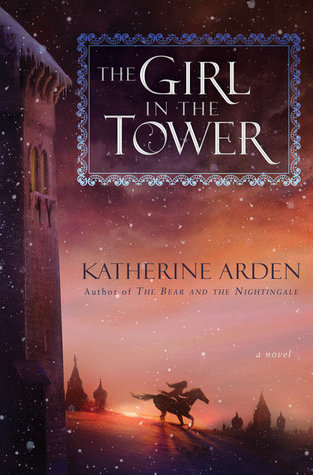
The Girl in the Tower - Katherine Arden (The Winternight Trilogy #2)

The Girl in the Tower (Winternight Trilogy, #2)Oh second books.  They're a bear--and just when you thought that Vasya had defeated the bear.  I was excited about this book, as I adored The Bear and the Nightingale, and this volume promised us adventure for Vasya, moving out into the world beyond her small village and a step into full adulthood, and maybe even more glimpses of the tantalizing frost demon Morozko.

Unfortunately, I didn't feel that this was quite as strong of a book as the first one.  There are some strong elements to it, certainly--we get to see more of the siblings that were rarely glimpsed in the the first book, as Olga and Sasha left fairly early on in the first volume.  Vasya does get to see the world, and learns a little bit in the process, though perhaps after her ordeals in the first book she shouldn't have been quite as naive when she went out into the wide world beyond.  And we get to watch the development of Morozko's feelings towards Vasya, feelings that he is not supposed to have, though this remains a minor element and is not nearly as played up as I would have liked to have seen.  (Please, someone, tell me there is a robust fanfiction community for this series somewhere, because this is a series that could spawn some amazing fanfics.)  However, Vasya's naivete, constant need of rescue, and headstrong ways are getting old, and they're getting old fast.  Despite literally everyone telling her that she is making a mistake kin the way she goes about things in this book, she does whatever she wants anyway, because no one understands her, clearly.  Not even when the answer is staring her right in the face.  Again, one would think she'd learned something from her first paranormal go-round, but no.  Of course not.

Vasya has reason to be frustrated and to strain against confines, of course.  Women don't exactly have the best lot in life in medieval Russia.  If Vasya is discovered to be a girl rather than the boy she travels as, she could be raped and murdered at worst, or confined to a tower for all her days at best, as her sister is.  Vasya does not want to spend her days in a tower; she wants adventure.  However, if she wants adventure, perhaps she should have listened to a number of people who told her that parading about Moscow barely disguised as a boy was not the way to go about it, and was in fact probably the best way to be caught out and open a whole kettle of fish that could mean death for, oh, her entire family.  Additionally, beyond Vasya parading around as a boy, having smug conversations with her horse, and making herself out to be the best thing before sliced bread, nothing really happens here until the last fifteen percent of the book.  The writing is lovely, but without character growth or compelling action to move the story along, it's just not enough to make this a strong book on its own.  The wonderful atmosphere and magic of the first volume were largely gone, both literally and figuratively, and they left a weaker book in their wake.

This was decidedly a second book, and it suffers from Second Book Syndrome.  I still have high hopes for the third volume, The Winter of the Witch, due out later this year--but while The Bear and the Nightingale will be listed in my favorite reads, The Girl in the Tower most certainly will not.

2.5 stars out of 5.

Friday, April 6, 2018

Pairing Off - Elizabeth Harmon (Red Hot Russians #1)

Pairing Off (Red Hot Russians, #1)Once again, can I just state that figure skating romances are da bomb?  Okay, now that that's out of the way, let me get to the actual book...

This came to me as I was perusing lists of figure skating books in the wake of absolutely loving From Lukov with Love.  I picked up Pairing Off and a couple of other titles off the list hoping for good things, and overall I feel that Pairing Off delivered.

Our main characters are Anton and Carrie, Russian and American pairs figure skaters, respectively.  The two met and had a, erm, romantic encounter when they were teenagers competing in junior games, and then completely lost touch.  Years later, Carrie has been banned from US figure skating after her partner initiates a sex scandal by sleeping with a judge in exchange for high scores.  Hoping for a new start in Russia--not in high competition, but at least in something that can keep skating in her life--she finds herself paired up with Anton, who doesn't recognize her from their encounter years before, and whose partner ditched him for another skater, though the two of them remain romantically involved.  But while Anton doesn't remember Carrie, Carrie certainly remembers Anton, and the two find themselves drawing closer both to each other and to Olympic dreams.

This was a solid sports romance novel.  The setting--modern Moscow--is unusual for an American romance novel, and I quite liked it.  The figure skating aspect is wonderful.  Carrie and Anton are a pair that don't immediately click, and they have to work to get to know each other.  It's not a hate-to-love relationship, but it's certainly one that has a rocky start, partially due to their past and partially because of Anton's more reserved character.  There are some good side characters here, too.  Initially Carrie seems to be hated by the entire figure skating community, American, Russian, and otherwise, but she slowly finds friends in Russia, though not everyone falls over themselves to get to know her--which is good, because I didn't want this to turn into Everyone Loves Carrie.  Olga, of course, is a Class A bitch and you have to wonder about why Anton stays with her for so much of the book despite their long connection, but she's not the only one who doesn't fawn over Carrie (though no one else is perhaps quite so venomous).

What I didn't like was Carrie's Tortured Past and her dynamics with her father.  I think one or the other would have been more than adequate here.  But Carrie blames herself for the suicide of her mother, and takes responsibility for her father's political career almost entirely on her own shoulders, which was ridiculous.  I know that people get survivor's guilt, or blame themselves for things they can't control, but the length of time that this was drawn out for and the melodrama that surrounded it was completely out of proportion and took away from some of the better aspects of the book.  And what was up with the sudden paparazzi storm?  That seemed larger than life, as well...

Overall, I liked this one.  It was a solid start to a series.  The second book (Turning It On) involves reality TV and I'm not sure that's really up my alley, so I might skip to the third book (Getting It Back) since there's not an overarching plot, but I'm definitely interested in more books in this vein!

4 stars out of 5.

Wednesday, April 4, 2018

The Winter Station - Jody Shields

The Winter StationThis was another book that struck my eye while at the bookstore, but it wasn't one that intrigued me quite enough to shell out the jacket price for it.  Luckily, that is what the public library is for.

This is a book about a plague--pneumonic plague, particularly, one that ravaged the city of Harbin (known as Kharbin the book, due to its Russian perspective) in the early twentieth century.  It's a city in China but one that is essentially ruled by Russia, but I have some reservations about this...more on that later.  The main character is "the Baron," the medical examiner for the city, who I personally could not stand.  Though he's supposed to be working with a team of doctors, all of them trying to prevent the plague from spreading, he has a much "holier than thou" perspective, pretending he knows better than everyone else involved even though no one seems to know what they're doing, himself included.

This was not a book I ended up liking very much.  The Baron was a huge turn-off to me.  While Shields presents him as having more respect for the Chinese residents of the city than anyone else, his bend towards Chinese medicine doesn't actually benefit anyone and might actually make things worse.  He's just as closed off to new opinions as his peers, though he's fine with his close-mindedness because of course he is right.  (He's not.)  And then, when things get mad, instead of buckling down and forging onward, he essentially throws a fit, leaves the main the hospital, and starts wandering the streets looking for random people to help.  He becomes increasingly paranoid about being infected with the plague himself, which, while understandable, didn't really make him any more likable because reading about his obsession over and over again didn't contribute at all to the story.

This is also a book that doesn't have a climax or conclusion, but rather instead just peters out as the Baron runs around with ever decreasing agency and purpose.  It has no sense of closure.  It's very strange.  There's a quote on the cover that this a book about Russia (IT'S NOT RUSSIA IT'S CHINA, STOP COLONIALISM) that reads as if it were written by a Russian; I don't have a huge base in Russian literature, but I would agree with that assessment...however, in this particular case, I don't think this is a huge boon to the story.  Instead, it reads as cold, something that suits the setting and story, but which doesn't really make for an emotional or riveting read.  There's a lot of drinking vodka and practicing calligraphy and mourning the fate of society, or whatever, and not a lot of stuff actually taking place, not even on a character-development front.  It is a book that is not driven by plot nor character, and instead drifts along without purpose.

And finally, let's address historical accuracy.  Shields based her narrative off a real person who wrote a memoir, which was published in German.  I don't have access to this memoir.  However, wanting to know more about this plague, I started Googling, and...well, it seems like the Baron is an awful choice for hero because he was pretty much, uhm, wrong, and all of the people made out to be villain in this were actually more heroes in the actual course of events.  Even if their initiatives weren't always successful, they were at least trying, unlike the Baron, who sneers at everyone else but doesn't ultimately do anything of his own to end the plague.

Ultimately, this was a disappointing book, one that had a vastly colonialist bend, and was not an interesting read at all.  I'm kind of sorry I sunk so much time into this, hoping it would get better when it never did.

2 stars out of 5--mostly for an interesting setting and time period and not for the characters or the story itself.

Saturday, March 24, 2018

The Death of Ivan Ilych - Leo Tolstoy

The Death of Ivan IlychThe Death of Ivan Ilych isn't my first Tolstoy.  That would be War and Peace (the foreword to Ivan Ilych talks about how Tolstoy used W&P as a vehicle to discuss theories of history!!!) and I followed it up a year or two later with Anna Karenina.  But Ivan Ilych wouldn't have made it onto my reading list if not for it being a book club selection at The Deliberate Reader, because it is a novella, clocking in at around 75 pages depending on your edition and format.  Starting with the funeral of the eponymous Ivan Ilych, the story then jumps back to the beginning of his fall, first slow and then fast, in a series of short chapters.

I don't really like short stories because I typically don't find them to have enough substance for me.  There are some exceptions, of course; Neil Gaiman can write an amazing fantasy short story when the mood strikes him, and I've read some absolutely wonderful literary ones, as well.  Unfortunately for me, Ivan Ilych didn't fall into this wonderful character.  It is exactly what it purports to be: an account of Ilych's death.  Always wanting more and better, his greed drives him to spend beyond his means to no success, and it's in the process of this spending and remodeling of a new home that he quite literally falls, injuring himself in the process.  The injury initially seems minor, but drags him down towards a slow and painful death that's not only torturous to him, but to everyone around him, none of whom seem to particularly like him to begin with.  In the process of dying, Ilych reflects on his life--he feels that he has been wronged by dying, because he lived as he should have, though questions of things like love and meaning come to him as he lies in excruciating pain for weeks before passing away.

This is a contemplative story, and one that's probably not suited for everyone at every point in life.  Several of Ilych's acquaintances reflect on how he might die, but they couldn't possibly, and that's something that I think a lot of readers can empathize with.  After all, most of us don't spend a lot of time dwelling on our own mortality, and I suppose getting us to do so was part of Tolstoy's goal in writing this tale.  Ilych is not an interesting person; he's a mid-level bureaucrat in the justice system and his life is not exactly filled with adventure.  He wants to better himself and sees money as a way to do that.  He has family issues.  Most of us share these qualities, to some degree, as well as some rather unlikable ones that those close to us come to know.  In this way, though we might not like Ilych, I think we can probably understand where he's coming from, why he finds his demise so unfair, etc.  In this, I think Tolstoy did a very good job.

The problem?  This story isn't very interesting.  It's not really supposed to be, I guess--contemplative if definitely more its vein.  While this has its purpose, it doesn't make for a very riveting read.  This was a story I found myself wandering away from again and again, and it took me a surprising amount of time to get through less than a hundred pages.  It has its time and place, and I think it's actually quite good in that regard; it just didn't strike me at this time.

Based on the story's clear merit, I'm going to write it higher than I would on pure enjoyment.  I can see myself "enjoying" this more in a more melancholy or contemplative mood, and it's one I could potentially return to at some point, which isn't something I'd say about most tales of this length.

4 stars out of 5.

Wednesday, January 17, 2018

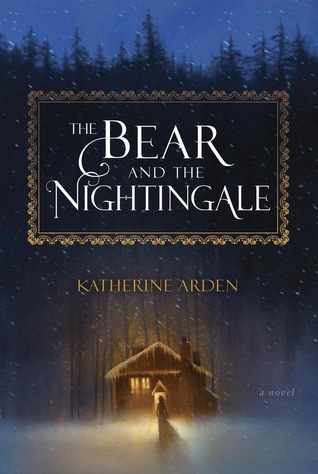
The Bear and the Nightingale - Katherine Arden (The Winternight Trilogy #1)

The Bear and the Nightingale (Winternight Trilogy, #1)The Bear and the Nightingale is what I wanted from a Russian-themed fantasy and what I didn't really get from the Grisha trilogy.  Yes, Grisha was meant to be bigger and flier, and it was that--but it lacked warmth and depth and heart, and TBATN has that in spades.

The main character here is Vasilisa, though she doesn't really come into her own until the second half of the book, being too young to do much for the first half.  The first half instead follows her family and other characters as they come together in Vasilisa's small town on her father's lands.  Among these are Konstantin, a priest who paints icons and wants to save souls at any cost, and Anna, the daughter of the Grand Prince who becomes Vasilisa's stepmother following the death of Vasilisa's birth mother.  Also coming the village is a strange pendant given to Vasilisa's father by a man no one else remembers, who seems almost inhuman--the pendant being meant for Vasilisa herself, though her nanny keeps it from her for years.

Vasilisa is the daughter of a witch, or so it's said, and she can see the household and forest spirit s that populate her father's lands.  But with the arrival of the priest and the fear he puts into the villagers, the spirits begin to weaken and a menace in the forest becomes stronger and stronger.  Fear, fire, and famine threaten the village, and while Vasilisa does what she can to keep the friendly spirits strong and the evil at bay.  But she is just one person, and the duel between the menace in the woods and the strange blue-eyed man who wants Vasilisa becomes ever more fraught with peril.

This starts out as a very low fantasy and slowly escalates into the higher realms as it progresses--more magic, more spirits, more supernatural conflict.  Vasilisa does not go along slinging spells or enchantments; the magic she possesses is more of a "seeing and understanding" type aided by the stories that her nanny told her when she was younger.  Consequently, the magic is very atmospheric and has a mystical and yet cozy feel to it, with the dark lurking beyond at the same time.  The setting is a period when Russia was ruled by the Tartars (aka the group composed of Mongul and Turkish elements that came together under Genghis Khan) and kind of lends itself to a fairy tale setting.  The writing itself is very good; I think Arden balanced the characters and plot elements well.  That said, the first half of the book is very slow.  It takes a long time for things to get set up and going, and I kept telling myself it would but at times I felt like despairing that anything would ever happen.  This book also isn't a romance, and I felt like that was an element I was looking for to some degree in the later parts of the book, as it would not have been appropriate in the earlier parts; there wasn't much room left for it, but man, Morozoko is awesome.  Maybe something for future books???

Overall, this was a fabulous read to start the new year with.  I'm greatly looking forward to reading the second volume, which was released in December, but I think I'll hold off on it so that I can space it between this one and the third book's release, which is dated for August.

4 stars out of 5.

Monday, December 4, 2017

Tatiana and Alexander - Paullina Simons (The Bronze Horseman #2)

Tatiana and Alexander (The Bronze Horseman, #2)Guys, we have a problem.  My library had The Bronze Horseman, the first book in this trilogy, and it had this one, the second.  You know what it doesn't have in any format?  The third book.  What am I supposed to do?  Honestly, I could probably stop reading here since this book has a pretty firm ending, but it would feel weird to just leave out the third book, you know what I mean?  But though I'm eager to read the third book, that doesn't meant that this book isn't without its flaws.

The book doesn't pick up where the first one left off so much as jump backwards--the parts with both Tatiana and Alexander overlap with the happenings at the very end of the first book, with Tatiana fleeing to America and Alexander being arrested by the NKVD.  The chapters early in the book are also interspersed with short bits about Alexander in his life prior to his first appearance in The Bronze Horseman.  For much of the book, Tatiana and Alexander are separated, neither truly knowing whether or not the other is alive.  Because two characters who don't even know the "living or dead" status of their significant others don't really bode well for romance, the first half to two-thirds of the book heavily involves a lot of re-treading of the ground covered in the first book, particularly the time that the two spent in Lazarevo--which was, unfortunately, the weakest part of the first book.  And while the "present" parts of the book--aka, the parts that are actually happening on this book's timeline, after Tatiana and Alexander's separation, rather than during the "past" part before it--have some interesting happenings, they're pretty much all on Alexander's part.  See, Alexander is busy being arrested and interrogated by the NKVD and then going through other sorts of hell in Russia afterwards, while Tatiana spends her time bopping around New York with their child Anthony.  While she's not disrespectful toward Alexander or anything, and in fact does what she came to find him from thousands of hours away, her parts just aren't as interesting.

Where this book regained its strength was in the final part, when Tatiana returns to Europe in search of Alexander, once again in her disguise as a Red Cross nurse, though I guess it's not exactly a ruse anymore.  This returns her to action, and shows the strength and goodness of her character that just wasn't present while she was drifting around New York and protesting that she could never love again.  Tatiana does have a good character, but Simons didn't display it to its fullest here, though Alexander was done wonderfully.  In fact, he was probably better in this book than in the first one, precisely because he and Tatiana were separated for most of the book.  Once they're reunited, Alexander actually gets worse again.  Why?  Because their separation allowed his controlling tendencies to fade to the wayside, and when they're reunited, all of those terrible character traits come surging to the surface again.

Overall, I don't think this was as strong of a book as the first one.  The setting of wartime Leningrad really carried the first book, and without that here, the characters separately weren't enough to make up for it.  Alexander's parts were good until Tatiana showed up, whereas Tatiana was better once she returned to Europe, which basically sums up the unevenness of the book.  I'm still interested in seeing the end of these characters' story as the timeline moves away from World War II and into the Cold War, but I'm a little leery of how Simons will pull it off after this offering.

3 stars out of 5, and most of that is from the end of the book which at least had good pacing even if Alexander became a bastard again.

Saturday, October 21, 2017

The Bronze Horseman - Paullina Simons (The Bronze Simons #1)

The Bronze Horseman (The Bronze Horseman, #1)The Bronze Horseman was a group read for the Unapologetic Romance Readers group in September, but I just got around to it this month.  I'm also slotting it in for the "military romance" category in the group's 2017 reading challenge.  Let me tell you, this book is a whopper of a romance--over 800 pages, and it looks like the two sequels are even longer!

What I have to give Simons credit for in this is her sense of time and place.  Set during the time leading up to and during the siege of Leningrad in World War II, the main characters are swept up in all of the hardship that the siege entails.  Starvation, freezing, bombings, deaths en masse--they suffer through it all.

But then, they're also infuriating people.  So not so much credit there.

The main characters are Tatiana Metanova and Alexander Belov.  They spy each other across the street one day during the white nights in a Leningrad summer, just as the war really moves into Russia, and fall in love immediately.  Problem: Alexander is dating Tatiana's older sister, Dasha.  This is the conflict that will fuel the first half of the book, as Tatiana is so scared to lose her sister's love and affection that she insists that Alexander keep dating her despite all of the trouble it causes everyone involved.  Tatiana's love for Dasha also apparently doesn't seem to go both ways, as Dasha uses Tatiana mercilessly and is fine with writing her off at the first available opportunity.  Of course, there's only one way a conflict like this can end, and the book then moves onto what's an incredibly slow start to a second half, where Tatiana and Alexander are reunited and proceed to have sex for about a hundred straight pages before diving back into the war and the siege.

The story is definitely much weaker in the time that Simons moved it away from Leningrad.  The siege provided such structure to the story, a time and place that people might not act as they otherwise would.  In Leningrad, Alexander's controlling behavior comes across as protective, especially because Tatiana is not only naive but possesses feathers for brains for much of the book--yes, she's seventeen, but in a time when "adolescence" wasn't really a thing (I mean, this is Soviet Russia, for crying out loud) she doesn't really have an excuse to continue being as dumb as she is for as long as she is, and miraculously still alive.  In other circumstances, though, Alexander's behavior strikes me as downright abusive, and doesn't bode well for the future.  He's also ruthless with using Tatiana for his own gains, especially because he knows what's likely to happen to her down the road because of his own background.  And then there's Alexander's "best friend" Dimitri, who is vile in his own special way.  Tatiana doesn't mean to be vile--in fact, I firmly believe she has a good heart, and that's the only thing that saves her character from being absolutely death-worthy--but ultimately, this is a book about terrible people doing terrible things to each other, and basically getting away with it because of the war pressing in on them from literally all sides.

There are two more books to this series, and geeze, I have no idea how much more wringing Simons can put these people through, especially given how the book ended.  It's like a train wreck--absolutely terrible, not in writing but in happenings, and yet it's so impossible to look away.  I do intend to continue reading this series, but oh man, I just don't know where it's gonna go.

3.5 stars out of 5.

Wednesday, June 21, 2017

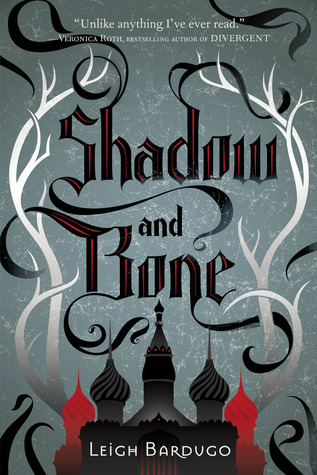
Shadow and Bone - Leigh Bardugo (Grisha #1)

Shadow and Bone (The Grisha, #1)Set in a Russian-inspired fantasy world, Shadow and Bone is the story of Alina, a young woman working as a cartographer in the army until, on a journey through the magically-dark-and-dangerous Fold (aka the Unsea) she shows off previously-unknown light powers and is swept off to be trained as a Sun Summoner and a savior of the people...falling into the grasp of the intriguing Darkling and leaving behind her best friend from childhood, Mal, in the process.  One of my friends loves this series, and Bardugo's associated duet that happens after these books (Six of Crows and its sequel) so I had this slated for one of my reading challenge categories for the year in order to finally get around to it.  Aaaaaand...?

Rage.  Ugh.  This started off with such promise.  "Who is the love interest here?" I demanded of said friend.  "I don't want to get my hopes up over nothing."  She refused to tell me.  "This book is going to crush me, isn't it?" I asked.  She liked my comment.  Because here's the thing...the Darkling is freakin' awesome and Mal is totally lame.

Yes.  I said it.  And coming off the high that was Uprooted just a little while ago, I was so looking forward to another magical-tutor-romance thing.  And for a while, it looked like I was going to get it!  I was intrigued.  The Darkling has, guess what, dark powers that compliment Alina's sun-summoning ones.  A light-mage/dark-mage pairing?  Okay, not the most original, but I thought there was promise there.  But as I read on, I started to get suspicious.  Mal wasn't responded to Alina's letters, for no apparent reason.  This clearly meant he wasn't getting them--they were being intercepted somewhere along the way.  And honestly, it just couldn't be that easy.  After all, there are three books in this series, and this is just the first.  I started to have a sneaking feeling that the Darkling was going to turn out to be a Big Bad and Mal was going to sweep back in and become the childhood-friend-turned-love-interest, which is a dynamic that I actually don't really like.  And if the Darkling became the Big Bad, it would mean that Bardugo was seemingly falling back on the tired, tired, tired trope of "light=good, dark=bad."  Which I really, really hoped wasn't going to happen, because I had such hopes here.

Overall, this was a book with a lot of potential.  It's a story with a lot of potential.  I have a bit of hope for it becoming fuller and more fleshed out in the next two books, which I definitely will read, but coming to the end of this one I find myself a tiny bit disappointed.  The writing is pretty clearly on the wall here, and I was feeling so miserable about it that I even went and read the jacket blurb of the third book.  I can already tell that I don't like where it's headed.  Sigh.  So much sadness here.

Another reviewer suggested that, if you liked where you thought this book was going but were disappointed in where it actually went, you should read Sarah J. Maas' A Court of Thorns and Roses and its sequels.  I'm inclined to agree; while maybe not having the awesome Russian-fantasy-dynamic that the Grisha has (which is very cool and I'm so happy to see that authors are branching out into areas other than generic-medieval-England fantasy settings) it has the feel that I was actually looking for here.  I'd also recommend Uprooted.

So, yes, I will keep reading these books...but I'm going in steeled for the worst.

3 stars out of 5.

Friday, February 17, 2017

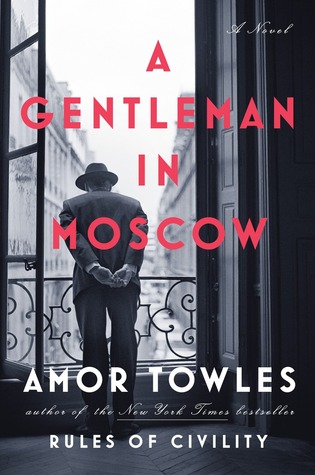
A Gentleman in Moscow - Amor Towles

A Gentleman in MoscowA Gentleman in Moscow was one of my Book of the Month selections back in September 2016, but I hadn't gotten around to reading it yet.  This made it the perfect choice for my 2017 reading challenge category, "A book that takes place in a hotel."  This is because almost the entirety of the book takes place in the Hotel Metropol in Russia.  The main character, Count Alexander Rostov, lives in the hotel when he is arrested by Stalin's administration because of his background.  But instead of being executed, he's sentenced to house arrest in the hotel because of a poem he wrote years ago.  His rooms are downgraded--from a luxurious suite to a tiny attic garret--but he got off easy, and the story follows his life in the hotel as he bonds with staff and visitors, develops a long-lasting rivalry, and makes his life into something of meaning despite the narrow confines of its physical space.

This was an absolutely lovely book.  When Rostov begins to waste away in the hotel, settling into listlessness in the time after his initial sentencing, a nine-year-old girl with a penchant for yellow named Nina pulls him out of his funk and shows him all that the hotel really has to offer.  And as the years go on he transitions from a guest--even under house arrest, he has quite a bit of money stashed away that he can draw on--to a staff member, helping the Boyarsky dining room work as he has always imagined it should.  And he ultimately ends up caring for a young girl left in his hands when her mother goes off to Siberia in search of her husband.  All the while, he tracks the changes in the world through the guests who come and go and the things that happen around him, only venturing outside the hotel's confines once in the several decades he spends there.

The characters here were wonderful.  I could perfectly picture the chef Emile, ruling the kitchens with his giant chopping knife, and Nina in her yellow dress and her passkey on a ribbon around her neck, and little Sofia with her big eyes and solemn face, and Marina the seamstress with her wandering eye and talented hands, and even the characters who come and go, like Mishka and Osip.  And then, of course, there's the Bishop, coming up from being a lowly waiter to the manager of the hotel and wreaking havoc on the hotel and its inhabitants in the process.  The antics that Rostov and his compatriots get up to, from exploring dusty basements for treasure to making illicit French fish stews, are a sort of grown-up, Soviet-era version of that Disney Channel show The Suite Life of Zach and Cody.  But because this is the Soviet era, there's also an underlying sense of danger.  The hostesses are reporting on guests to the Secret Police.  Characters receive the Minus Six, an exile from the six largest cities in Russia.  And there's always the sense that, if Rostov does something wrong, his house arrest might end and he might end up against a wall with a firing squad pointed at him--a fate he just avoided to begin with.

One thing I was disappointed with was the ending.  I do suppose that it fits, in a way, but I was definitely hoping for something else.  I love that Rostov did what he thought was best for everyone else, and then took care of himself, but I was hoping he would take a slightly different path.  And Anna, too.  And that maybe everything could have worked out for Sofia...

Anyway, despite the ending, this was a lovely book, and I tore through it.  It's not packed with action and it's not heavy on plot; it's definitely driven by character and place more than anything else.  If you're looking for a lot of drama and a lot of action, this isn't the book for you.  But for something that has just a touch of grit and a touch of whimsy, all at the same time, I think this is a great choice.

4.5 stars out of 5.

Tuesday, December 1, 2015

Anna Karenina - Leo Tolstoy

Anna Karenina I read War and Peace in school a few years ago, in a great course called "Napoleon vs. Tolstoy," and really enjoyed most of it.  I felt like Tolstoy's characters were great, and that he had a very interesting way of taking on the Napoleonic Wars from Russia's perspective.  Of course, Tolstoy only focuses on upper-class characters, the aristocracy of Moscow and St. Petersburg, and so I was interested in reading more of his works.  Of course, the fact that Anna Karenina was in the process of being adapted into a movie staring Kiera Knightly, who is absolutely lovely, didn't hurt either.  A few years later, I still haven't seen the movie, but I now have read the book, with the intent of using it for the Popsugar Reading Challenge category of "A classic romance."  Now, when I read "A class romance," my mind immediately goes where most people's probably does: Pride and Prejudice.  But I wanted to read something else (though I do love P&P, I didn't want any Jane Austen this time around) and so I picked Anna Karenina, which is really two classic romances in one, and which is different than Austen in a very real way.

See, Anna Karenina doesn't end happily for everyone.  If that's a spoiler... Well, it's not, because the book's been out for ages and at this point I don't think anything can really be a spoiler for it.  But there are two romances involved: Anna's with Count Vronsky, and Levin's with Kitty.  These two couples are intrinsically opposed, and most of the book that focuses on them is composed of parallel scenes: similar setups that show exactly how different the same situations can end up, based on the people who are interacting.  Of course, Tolstoy's female characters tend toward the wildly dramatic and his men towards either extremely glib or extremely grim.  Tolstoy doesn't really seem to do "middle ground" that much; this was the case in War and Peace, too, as I remember.  And Tolstoy is also not only an author, but a philosopher, which means that the book isn't just a story, it's a philosophical treatise.  Now, in War and Peace the philosophy was about Tolstoy's theory of history.  In Anna Karenina, it seems to be something about people's connection to the land, something about the will of the people, and something about the meaning of life, or maybe all three just mixed together.  Philosophy isn't exactly my strong suit, and Levin bonking me over the head with it over and over again didn't sit well with me.

There's not much really to be said about Anna Karenina beyond that, to me.  After all, it's a classic, and most things that are to be said about classics have already been said.  Overall, though, I did enjoy the book, especially the climactic scene at the train station.  The 50 pages of philosophy that followed?  Not so much.

3.5 stars out of 5.

Tuesday, July 9, 2013

The Winter Palace - Eva Stachniak (Catherine #1)

The Winter Palace: A Novel of Catherine the GreatHaving taken a course on Russian history last fall, I spent most of this book trying to match up historical fact to the happenings in the book.  That said, it was a futile effort because my course focused on Russian history, not Russian intrigue.  The plot follows a Polish woman who moved to Russia when she was young in the company of her parents.  When she is orphaned at the age of fifteen, almost sixteen, she finds a place serving in the palace Empress Elizabeth.  She becomes a "tongue," a palace spy for the Empress, and befriends Princess Sophie when the German girl arrives to marry the Grand Duke.  Intrique follows.

This was a book full of much drama, and it was a good read.  There isn't a ton of history in it; large historic events are only mentioned in the background, and the story mostly takes place within the walls of various Russian palaces.  The Winter Palace, while giving its name to the book, is only one of the locations, and spends a large portion of the book uninhabited as it is renovated.  There are plenty of descriptions of sumptuous dresses to please those enamored with royal life.  There are lovers and affairs and forced marriages and plenty of backstabbing among the palace inhabitants.  It has all the elements of a good historical fiction, with plenty of description of Russian foods to add a little cultural flavor (ha ha, flavor, get it?).

The main complaint I have about this book is that none of the characters ever seem to grow up.  Varvara acts like she's sixteen and Catherine acts like she's fourteen throughout the entire book, which spans several decades.  Varvara's daughter acts at age eight exactly the way she acted at age three.  When Catherine and Varvara have a falling out, it's over something that a pair of high school students would quarrel over, not an issue that would sever a long bond of friendship between two mature women.  Presumably these characters, who are playing at revolution and ruling an empire, should have a bit more maturity than that, especially after everything they've gone through.  The characters are completely stagnant.  Maybe there's supposed to be a message in that, something about history repeating itself to those who have not learned from it, but it comes across more as poor character management.  Perhaps it would have been better if the scope had been limited to a smaller period of time, when less character change would be expected, but as it was, it just seemed strange to find adults running around pretending to be children while planning a revolution in their free time.

I also found Varvara's relationship with Egor unrealistic.  I didn't know if she was supposed to hate him or love him or tolerate him, and I really hoped that there would be some other love interest somewhere along the way.  There seemed to be a lot of potential people to fill that role, but nothing ever came of it. Kind of disappointing.  It didn't entirely kill the story; far from it, but it would have been a good side-plot.

2 stars out of 5.