Pages

Showing posts with label europe. Show all posts

Monday, June 18, 2018

In the Garden of Beasts - Erik Larson

In the Garden of Beasts: Love, Terror, and an American Family in Hitler's BerlinErik Larson is an awesome history author.  I've read both Dead Wake (about the sinking of the Lusitania) and Devil In the White City (about a serial killer and the Chicago World's Fair) by him, and found both of them to be excellent in quality.  When I was looking for a book linked to my family history for my reading challenge, I decided to just pick something set in Germany, because I didn't know what else to focus on.  (Despite this book focusing on the family of an ambassador in WWII Germany, I am neither related to the Dodds, nor am I aware that any of my direct family were Nazis, though I suppose anything is possible; wouldn't that be a nasty surprise?)

In this book, Larson focuses on Ambassador William Dodd, the first US ambassador to Hitler's Germany, and Dodd's daughter Margaret.  His wife and son were also present in Germany, but are not looked as much in the course of the book.  And what the book is, is a startling examination of the old adage "Hindsight is 20/20."  Now, we have such clear hindsight, being able to see that Hitler was bad news, and that something should have been done sooner--but through the Dodds, we can see how that wasn't the case at the time.  They initially were kind of friendly toward Nazism in general, being somewhat anti-Semitic themselves, though Hitler himself was seen as kind of a kooky guy who Hindenburg had well in hand and who probably wouldn't remain in power very long.  But the Dodds slowly become more and more aware of what a terrible situation is brewing in Germany--and are stonewalled by everyone else, who either outright don't believe them or don't want to believe them, or do believe them but don't want to get involved with European affairs and instead only want to focus on Germany paying its reparations from World War I.  It's an incredibly frustrating story to read, because you can see the trouble building in the background, and the Dodds growing increasingly concerned and Ambassador Dodd's attempts in particular to do something without causing an international incident--and without getting himself fired in the process, as he isn't well-liked in the State Department to begin with--and knowing that it's all futile.

Larson builds the tension here wonderfully.  This is a true work of nonfiction, as well--everything he implements is taken from letters, cables, diaries, etc.  He does step back to speculate once or twice, but always notes that he's doing so, saying something such as, "Perhaps, but they didn't write about it they did, so we can't really know."  The Dodds aren't really the most interesting people on their own; the details of their day-to-day lives can be boring, mostly consisting of Dodd's colleagues at the State Department planning to oust him and working to undermine him at pretty much every turn and Margaret having a bunch of affairs, but I think that provided exactly what it was supposed to: an idea of how life went on for most people in Germany, and it was not a sudden event that Hitler rose to power, made being Jewish illegal, and started killing people and planning to take over Europe.  Rather, it was a slippery slope that rose against a background of existing tensions, and no one action took place until the preceding ones seemed normal.  Hm...does that sound familiar to anyone alive today...?

This is not a "fast" read, nor is it a thrilling one.  But it is one that is chilling in the way that it, in many ways, mirrors the world we live in now.  They say that those who don't study history are doomed to repeat it--so study up, folks.

4 stars out of 5.

Monday, December 4, 2017

Tatiana and Alexander - Paullina Simons (The Bronze Horseman #2)

Tatiana and Alexander (The Bronze Horseman, #2)Guys, we have a problem.  My library had The Bronze Horseman, the first book in this trilogy, and it had this one, the second.  You know what it doesn't have in any format?  The third book.  What am I supposed to do?  Honestly, I could probably stop reading here since this book has a pretty firm ending, but it would feel weird to just leave out the third book, you know what I mean?  But though I'm eager to read the third book, that doesn't meant that this book isn't without its flaws.

The book doesn't pick up where the first one left off so much as jump backwards--the parts with both Tatiana and Alexander overlap with the happenings at the very end of the first book, with Tatiana fleeing to America and Alexander being arrested by the NKVD.  The chapters early in the book are also interspersed with short bits about Alexander in his life prior to his first appearance in The Bronze Horseman.  For much of the book, Tatiana and Alexander are separated, neither truly knowing whether or not the other is alive.  Because two characters who don't even know the "living or dead" status of their significant others don't really bode well for romance, the first half to two-thirds of the book heavily involves a lot of re-treading of the ground covered in the first book, particularly the time that the two spent in Lazarevo--which was, unfortunately, the weakest part of the first book.  And while the "present" parts of the book--aka, the parts that are actually happening on this book's timeline, after Tatiana and Alexander's separation, rather than during the "past" part before it--have some interesting happenings, they're pretty much all on Alexander's part.  See, Alexander is busy being arrested and interrogated by the NKVD and then going through other sorts of hell in Russia afterwards, while Tatiana spends her time bopping around New York with their child Anthony.  While she's not disrespectful toward Alexander or anything, and in fact does what she came to find him from thousands of hours away, her parts just aren't as interesting.

Where this book regained its strength was in the final part, when Tatiana returns to Europe in search of Alexander, once again in her disguise as a Red Cross nurse, though I guess it's not exactly a ruse anymore.  This returns her to action, and shows the strength and goodness of her character that just wasn't present while she was drifting around New York and protesting that she could never love again.  Tatiana does have a good character, but Simons didn't display it to its fullest here, though Alexander was done wonderfully.  In fact, he was probably better in this book than in the first one, precisely because he and Tatiana were separated for most of the book.  Once they're reunited, Alexander actually gets worse again.  Why?  Because their separation allowed his controlling tendencies to fade to the wayside, and when they're reunited, all of those terrible character traits come surging to the surface again.

Overall, I don't think this was as strong of a book as the first one.  The setting of wartime Leningrad really carried the first book, and without that here, the characters separately weren't enough to make up for it.  Alexander's parts were good until Tatiana showed up, whereas Tatiana was better once she returned to Europe, which basically sums up the unevenness of the book.  I'm still interested in seeing the end of these characters' story as the timeline moves away from World War II and into the Cold War, but I'm a little leery of how Simons will pull it off after this offering.

3 stars out of 5, and most of that is from the end of the book which at least had good pacing even if Alexander became a bastard again.

Wednesday, December 28, 2016

Sarah's Key - Tatiana De Rosnay

Sarah's KeySarah's Key was a book lent to me by a coworker who thought I would like it.  Well, I'm not sure that I liked it overall--but when we discussed, we liked the same parts of it, and it's those parts that really resonate, so I think that was more the point overall.  The story is in two timelines.  One takes place in France in 1942, when the French police round up thousands of men, women, and children and lock them in the Velodrome d'Hiver before sending them on to camps near Paris, and then on to Auschwitz to be gassed.  The orders for this were issued by the Nazi German occupiers, but the operation itself was entirely carried out by the French.  The main character on this timeline is Sarah (who is referred to, for the longest time, as "the girl," which is annoying, because we know her name is ultimately Sarah, it's right in the title) who is caught in the round-ups with her family.  Before they're dragged from their home, Sarah locks her little brother in a hidden cupboard in an attempt to keep him safe, thinking that she'll be coming back within a few hours.  This goes about as well as you can expect.

The second timeline takes place in 2002.  Julia Jarmond is an American living in Paris, with a French husband, who works for an American magazine aimed at expats in Paris.  She's assigned  a story about the Vel d'Hive round-ups as part of the memorial taking place for the 60th anniversary.  While investigating the story, she finds out that the apartment that her husband's family owns, and which they are currently renovating, belonged to a family caught in the round-up in the 40's.  The husband's family moved into it in a hurry soon after it was vacated.  Julia becomes absolutely obsessed with finding out about the family who lived in the apartment, tracking them down, and letting them know that they haven't been forgotten.

Sarah's part of the story, no matter which timeline it's being told in, is ultimately the more powerful.  I had no idea that the Vel d'Hive round-ups happened.  It seems most people don't.  While I knew that the Vichy government in France was complicit with the Nazis, I was clueless that they had collaborated to such a high degree.  This is the important part of the book.  Knowing that these things happened and not forgetting them, even though many seem eager to do so, or at least to gloss over French participation in these terrible events.  In this respect, I can totally sympathize with Julia's actions, because not forgetting is paramount.

...but at the same time, Julia was an incredibly selfish character, and I didn't much like her.  (I don't actually really care about her pregnancy.  This seems to have been handled relatively well, in my opinion, having her go through her options without being preachy.  She didn't make the decision that best benefited her husband, but that relationship was on the rocks, anyway, so I think it was probably best for everyone involved that it went the way it did.)  She allows her obsession with Sarah to take over her life and proceeds to drop a bomb on someone else regarding it, someone who didn't ask for it, and then she continues to basically cyber-stalk the guy when he asks her to stay away.  And naming the baby Sarah?  I think that's incredibly creepy and very poor taste.  Ultimately, Julia does well to remember, but she goes beyond remembering and into appropriating Sarah's story as her own, which is not appropriate, at all.  And when William expresses a feeling that Julia failed him, she is upset, which struck me as highly hypocritical.  She made it out like she was doing him a favor, but ultimately all of her actions were for her own peace of mind, not for anyone else, and consequently I don't think she really had the right to get to offended when William opened up to her--which was what she wanted all along.

The writing here is a bit lopsided, too.  The chapters in the first half are very short, and alternate between Julia and Sarah, which meant that as soon as I got into one part of the story, I was jerked back out of it in favor of the other part.  I would have liked if the chapters had been just a bit longer to help smooth that jerky feeling.  And the writing itself is a bit uneven; there are some wonderful, evoking images, but there also short, choppy patches, and the two don't always seem to fit together.

Overall, I think Sarah's story was the powerful, important part of the book here, and Julia was a terrible character.  Skimming some other reviews, I don't seem to be alone in these sentiments.  Sarah's narrative chapters vanish halfway through the book, but her story doesn't, which is good because that's the compelling part.  Remembering the history is vital...but Julia went about it in a terrible way, and I absolutely could not like her for it.

3 stars out of 5.

Thursday, January 14, 2016

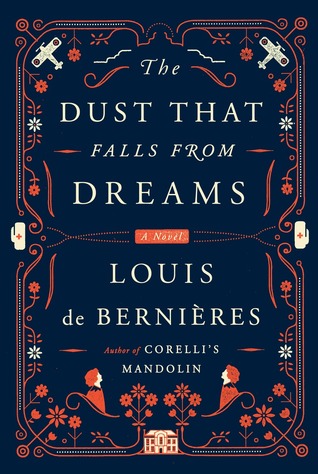
The Dust That Falls From Dreams - Louis de Bernieres

The Dust That Falls from DreamsI picked this book up at the library because, quite frankly, that is one of the loveliest titles I've seen in a while.  The Dust That Falls From Dreams...  There's just something incredibly romantic about it, don't you think?  That, and because when I read the flap, I saw that the story takes place in the years of and surrounding World War I, which I think is an underrepresented conflict in historical fiction given its impact on the world.  World War II has tons of historical fiction surrounding it, but I see much less taking place during WWI.

The story here is definitely character-driven, following the McCosh family, particularly the eldest daughter Rosie, through the years before, during, and after the war.  Before the war, Rosie and her sisters are friends with the boys who live on either side of them, forming a large group called "the Pals."  Rosie and Ashbridge, the eldest Pendennis boy, are very close and become engage (formally; they were informally engaged since Rosie was twelve) right before Ash goes off to fight in France with his brothers.  From a very early time, we know that Ash is doomed, and can see the consequences of this looming up for Rosie.  Rosie and her sisters eventually take up wartime occupations, their mother witnesses a tragedy, and their father opens a number of new ventures.  Meanwhile, Daniel Pitt, one of the boys from the other side of the fence, becomes an ace pilot.

Because this is a character-driven story, there's not really a plot.  It's more about watching as Rosie, because she is definitely the main character, develops.  Rosie can be extremely frustrating at times, especially to a reader who (like me) isn't particularly religious.  Rosie is very religious, and while I could see why she was so, the degree to which she clung to her beliefs could be absolutely infuriating.  She has a tendency to ruin her own happiness, as well as that of others, because she clings to her faith so strongly, even when other parts of her religion--and religious figures such as Fairhead the chaplain--tell her that it's okay to move on.  Daniel was an utter saint for putting up with her, and if I had been his mother, I probably would have smacked Rosie upside the head for the way she behaved toward him.  That said, I still liked Rosie, quite a bit.  Her frustrating qualities were greatly balanced by her overwhelming goodness.  She's just so nice that you can't help but like her.  And it's not an infuriating or fake niceness, because she has her angry moments--she throws a Wedgewood vase at someone at one point--but because she's genuinely a good soul.

Daniel was, by far, my favorite character; his charm, his quirks, everything about him was good.  His doubts, both in himself and in his country, are genuine, but he still does his duty because he feels it's the right thing to do, and perseveres in his relationship with Rosie because he does love her, even when it doesn't seem like she cares about him in return.  He's really better than she deserves at many points, but holds out.

The supporting characters were also, for the most part, delightful.  I would have liked to see a few more of their plots tied up, though--at the end, several people are just left hanging.  Rosie and Daniel's plot wound up fairly nicely.  Everything was pretty much resolved in regards to them, or at least it was suggested that everything was.  But for Ottilie, Mr. McCosh, and Archie (who I would have liked to see more of in general) things were left somewhat hanging.  It felt like de Bernieres almost created too many characters, and then decided he couldn't have plots for all of them, and so focused in on a few, ignored a few, killed a few, and sent a few off to distant locales so he wouldn't have to deal with them.

This book also got off to what I felt was a very slow start--but once the war started, I liked it more.  The pace picked up, the characters became more interesting, and the story itself became more complex.  I have mixed feelings about how the non-narrative chapters were written; journal entries and letters have never been my favorite ways of portraying or reading action in books.  However, they do fit the time period and theme of how war affects people, so I suppose they were all right.  They got fewer and farther between later in the book, which I appreciated; the plain narrative chapters definitely suited me more.

Overall, though, I quite liked this book; I feel like it's a solid 3.5 to 4 stars for its overall art and portrayal of a somewhat underrepresented turbulent time on the global stage, while focusing in on that times' effects on a small group of people who are still somewhat representative of the whole.

Friday, December 11, 2015

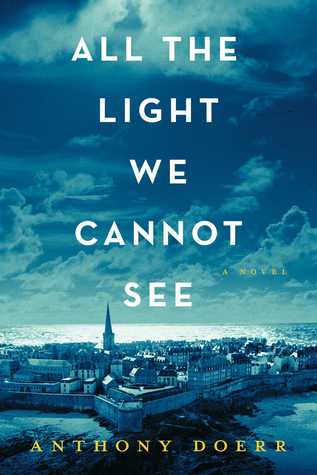
All the Light We Cannot See - Anthony Doerr

All the Light We Cannot SeeOne of the categories for Popsugar's Reading Challenge for 2015 was "A Pulitzer Prize-winning book," which of course led me to All the LIght We Cannot See.  I did scroll through the list of Prize winners for other options, but out of all of them, this one seemed the most interesting to me, and it got great reviews from regular readers in addition to the Prize-givers, so it seemed like a solid option.

And it was beautiful.  The book takes place during World War II, with short periods and a slightly longer denouement taking place before and after the war, respectively.  There are two main characters.  Werner is a German boy/teenager who gets into a prestigious school for his engineering abilities.  He can fix pretty much any radio, and is soon designing his own, which the Germans use to hunt down resistance fighters in eastern Europe and in France.  The other main character is Marie-Laure, a French girl/teenager who lost her eyesight at a young age and whose father is trusted with taking a copy (or potentially the original) of an infamous diamond with him when he and Marie-Laure flee Paris.  Marie-Laure's father is eventually arrested as a spy, and Marie-Laure unwittingly becomes the guardian of the diamond in his absence.

The diamond itself is the axis on which the story spins.  It lends a fantasy, or maybe a magical-realism, element to the story--is the diamond magic, or not?  Is it a curse, or luck?  Doerr never comes out on one side or the other, making it a real either-or that tantalizes at various parts of the story, sometimes seeming one way, sometimes seeming the other, and we're ultimately left having to make our own decisions on the matter.  The war-time setting lends atmosphere more than anything else, and is cause for some poignant moments that would not have otherwise happened, but most of the plot could easily take place in another point in time, when a group of people is hiding a diamond from someone else who wants it.  That, to me, was good, because it made the story easier to slip into, and while there are some heavy events in this book, Doerr doesn't focus on the aspects of the war that many do: concentration camps, shootings, fighting a resistance.  His focus on a teenager who is in the German army, but tries to distance himself from its doings, and on a French civilian--who ends up helping the resistance, but only in the barest of possible ways--makes the story seem more every-day, makes the characters more real.  Most of us probably can't imagine what it would be like to find a downed pilot, rescue him from a tree, nurse him back to health, and then smuggle him across the border to safety.  However, most of us probably can imagine asking for a loaf of bread and passing off a piece of paper.  Small, simple things, but they make such a difference in this story.

The writing here is absolutely beautiful.  Doerr's descriptions of Marie-Laure's world are wonderful, and Saint-Malo was clear to me even though Marie-Laure couldn't see it to actually describe it.  Werner's parts were lovely, too, though in a more painful way.  His attempts to distance himself from his own actions, a blatant dissociation in order to preserve his sense of righteousness as much as possible when he knows that what he is doing hurts people, was painful at times, especially in regards to his friend Frederick and in his estrangement from his sister Jutta.  At the same time, though, it's easy to see how boys like Werner would have ended up rabid Nazis.  Werner was picked up from an orphanage in a nothing town, saved from a life of mining coal and probably dying young, and instead put into a school where he was treated like he was special, like his knowledge and skills were valued.  That's quite a lure, and it's easy to see how he wanted to vanish into that world--though the niggling conscience instilled by his own morals and his sister never quite left him.

 The only real complaint I have about this book is that the denouement was too long.  This is one of the instances in which I felt there was too much resolution; I would have liked a little more to be left up to our imaginations, instead of multiple time-jumps taking us decades into the future to see where various characters ended up.  A little more mystique in regards to the characters would have matched the mystery tied to the diamond, and tied in a little more meaningfully to me.  Still, though, a beautiful book, and one I would heartily recommend to pretty much anyone.

4 stars out of 5.

Monday, December 7, 2015

Lovers at the Chameleon Club, Paris 1932 - Francine Prose

Lovers at the Chameleon Club, Paris 1932This book has been on my to-read list for quite a while, but the university library system in DC didn't have it.  However, when I was scanning the popular reads section a few weeks ago, it was there!  So of course I picked it up.

The book is historical fiction written in the style of a collection of memoirs, letters, biographies, and even some chapters that are written in a typical third-person narrative style.  Each character has his or her own style that's maintained throughout the book; Lionel writes books that aren't specifically memoirs, but are definitely first-person, while Lily and Suzanne write memoirs, Gabor writes letters to his parents, and Lou's story is told through a biography written in 2010.  The mix of styles means that each character has a distinctive voice, and their overlapping opinions and version of events give a nuanced feeling to the story.  What's most interesting about this book, though, is that it's a fictionalized version of historical events--obviously, because it's historical fiction, but even more closely than most historical fiction is.  All of the characters are re-named real people, so that Prose could draw heavily on their real lives and doings but still have some creative license.  The title is taken from the title of Gabor's book-within-a-book, which is in turn named for a photo he took.  While the photo described in the book is its own, it's easy to see that it's drawn heavily from this photo:

"Lesbian Couple at Le Monocle, 1932" by Brassai, Cleveland Museum of Art 

This makes Gabor, Brassai, a real-life Hungarian photographer, and Lou Villars is really Violette Morris, a female athlete turned Nazi sympathizer.  The book is clearly built off Prose's fascination with Morris/Villars, and how such a young woman could slide into what could, arguably, be called evil amongt the larger narrative of Europe's slide into World War II.  The other characters' stories all really revolve around Lou's, even though they have their own events happening beyond her scope.  Possibly this was meant to be a real biography that Prose reworked into a fictionalized version, possibly not; but it was a delightful read nonetheless.  I didn't know anything about Morris, Brassai, or the other real-life people who inspired the characters before I read this, but the book made me want to read and learn more about them, and that's a good book indeed.  It does have the result, however, of having to keep in mind that the book is fiction, and carefully balancing out the real-life aspects with the fictionalized aspects in one's head.

Out of all the sections, Gabor's were my least favorite.  I dislike narratives written in letter form, and I was glad that Gabor's letters shortened and became more scarce as the book went on, to be replaced by chapters of the memoirs and the pseduo-biography instead.  And then, from nowhere--gasp!--we get an unreliable narrator!  Ugh, that bothers me so much, but at the same time it gives a ton more dimension to what could have been a good, but somewhat flat, book, because it raises the question...who is telling the truth?  And for the unreliable narrator, what was that person's motive in telling the story as he or she did?  These are questions that are never actually resolved in the book, though another character speculates on them in the end, and it left me with some food for thought, something to chew over while starting on my next book.  I started reading All the Light We Cannot See while I was reading Lovers, which is another World War II historical-fiction book, and the two paired together have made an excellent read so far.

Overall, I really liked this is a historical fiction, but some of the characters--like Lionel, and Arlette--annoyed me enough that I'm not quite willing to give it a full 4 stars.  There's no preface or prologue explaining the pseudo-historical aspects of it, either, which I don't like; when something treads this close to the truth/fiction boundary, I feel like the author should at least have the decency to own up to it and put the facts straight in an afterword.  I'm not sure if I'd read this again, but I liked it this time around.

3.5 stars.

Sunday, October 4, 2015

The Monuments Men - Robert M. Edsel

The Monuments Men: Allied Heroes, Nazi Thieves, and the Greatest Treasure Hunt in HistoryThe Monuments Men came to my attention during one of the most awesome courses I took in college, "Indiana Jones in History," which wasn't about Indiana Jones so much as it was about historiography--that is, who gets to tell history and how they form those narratives.  As part of the course, we read The Rape of Europa, which is about the looting of art, sculptures, etc. from locations all across Europe during World War II, as well as the efforts to protect and preserve those same cultural items and to retrieve the ones that were stolen.  It was interesting, and the Monuments Men factored into it, and I consequently didn't really have any interest in reading The Monuments Men because I figured The Rape of Europa had already covered it all.  And then, of course, The Monuments Men became a movie.  I still didn't really have any interest in reading it...until the Popsugar Reading Challenge threw out "A book that was made into a movie."  While I had other books that had become movies, I'd also picked up The Monuments Men when it was on sale on Kindle, so I figured this was as good a time as ever to read it.  And?  Well, it was much, much better than The Rape of Europa.

Don't get me wrong.  Europa was good.  But it was a very academic work, one that was written for more of an art history audience.  It seemed to rely heavily on the reader knowing the names of tons of artists and tons of pieces of art, and its scope meant that it went from place to place very quickly.  The Monuments Men also jumped from place to place, but Edsel did this very purposefully to build tension and cover a select handful of people rather than to just cover as much territory as humanly possible.  Edsel also focuses exclusively on the work of the Monuments Men in the areas of France, Germany, and Austria, mostly from D-Day onward, and the recovery efforts of the few who made it into the Monuments Men's ranks.  By restraining his scope, Edsel manages to make this a narrative history that, while it's well-noted and researched, still manages to be engaging and readable to someone who isn't totally versed in either WWII history or art.  Instead of producing laundry lists of art and artists, Edsel uses a few well-known artists (Vermeer, Michelangelo) and a few iconic pieces of art (The Astronomer) to illustrate his points and keep a continuous narrative.  Consequently, the book is informative while also reading like a gripping war story.

I had two main complaints about this book.  The first was the chapter length.  Edsel's chapters vary wildly in length; some are only a handful of pages long, taking less than five minutes to read.  Others are more than four times that long.  While none of the chapters were bad, the differences in length could be frustrating.  There were many times that I wouldn't start a new chapter because I just didn't have time for it--though if it had been the length of the other chapters, I could have read two or three more.  The other complaint was that, at the end, Edsel suddenly seems to switch from telling a story to solving a mystery.  I didn't necessarily mind the mystery-solving aspect, because most history books do revolve around an argument that tries to "solve" some aspect of history.  However, in most cases, the entire book revolves around building and supporting an argument; any narratives are secondary to the argument.  In this case, it was the other way around.  Most of the book was a narrative, and the argument came out of nowhere at the end, which just seemed...odd.

Okay, there was a third thing, and that was that Edsel suddenly took a moralistic approach at the end.  World War II was horrible on so many fronts.  We know that.  (Well, most of us do.  There are certainly Holocaust deniers out there, but I doubt they'd be reading this to begin with.)  Edsel's random preachy moment at the end, about one of the Monuments Men recovering a painting that he, as a German Jew, had never been allowed to see when it was on display, came across as rather abrupt, and it would have been best if it had been either left out or worked in a bit more subtly...which would have been hard, because the Monuments Man in question really wasn't even involved for most of the story, and instead seemed to have been incorporated only for this purpose.  It was weird.

Despite the rather jarring bits at the end which didn't seem to properly incorporated, I did enjoy this.  The narrative style worked well, and the book as a whole was engaging.  I definitely read on later than I should have on several occasions, because it was just so good.  I might even read this one again.  Maybe.  We'll see.

4 stars out of 5.

Thursday, July 24, 2014

The Swan King - Christopher McIntosh

The Swan King: Ludwig II of BavariaThe Swan King is a biography of Ludwig II of Bavaria, the king responsible for the building of fabulous castles such as Neuschwanstein, which supposedly served as the inspiration for the Sleeping Beauty castle at Disneyland in California.  Ludwig was a fascinating character, living more in his mind than in the real world, with an obsession for mythology and the music of Wagner.  He didn't spend much time in his capital of Munich, instead spending most of his time on the throne traveling between the various castles and palaces of Bavaria and sponsoring Wagner in the arts.  He went mad towards the end of his life and eventually died under what seem to be mysterious circumstances, leading to the question of whether he committed suicide or whether he was murdered.

Overall, I really liked this book.  I felt the pacing was pretty good, although it did get bogged down in the politics of Germany and Europe in general at a few times.  This is hard to avoid in biographies of rulers, though, because so much of their lives does depend on what's happening on the larger world stage.  Unfortunately, one of the most interesting documents that MacInstosh could have used, Ludwig's "secret diary," was destroyed during World War II, but he still has lots of letters and such to draw on as documentary evidence.

That said...this book was somewhat lacking in citations, which makes me a little uneasy.  Some things, like how Ludwig ordered a bunch of servants to go rob the Rothschild bank in order to finance his castles, seem like they really should have had a citation, ,and yet they don't.  The book has 204 pages of biographical content, and about 12 pages of citations at the back, most of which are "Ibid."  There's also a lot of "projecting," where McIntosh kind of puts words into Ludwig's mouth via the phrase "must have," which really put me off.  As in, "Ludwig must have felt..." "Ludwig must have thought..." and so on.  How can you make those claims?  There are very rarely quotes or citations surrounding them, and it puts me off somewhat as someone who spent the past four years of her life getting a history degree and citing everything.  Also, note that this book is published by a company called "I. B. Taurus and Comopany," not by one of the notable academic presses such as Harvard, Oxford, Princeton, etc. which makes it a bit less reputable in my eyes.  Granted, some very academic books can come out of less-known presses, but I'm not entirely sure this was one of them.

Overall, I found this an enjoyable read, but I also would have found it a more trustworthy read if it had been better sourced and cited.

2.5 to 3 stars out of 5.