Pages

Friday, August 8, 2014

The Officer and the Bostoner - Rose Gordon (Fort Gibson Officers #1)

18104279Oh, historic romances.  How you pull my heartstrings--and not always in the ways the authors intended.  I was hoping when I dove into Gordon's book that I'd be finding a new Julia Quinn or Lisa Kleypas to devour, albeit one whose book was set in the early American West instead of in London society.  Unfortunately, that wasn't the case.  The book wasn't bad, but it just wasn't what I look for in a historical romance novel.
So, The Officer and the Bostoner (the use of Bostoner rather than Bostonian is completely deliberate, by the way) follows Allison Piers, who gets off a stagecoach to get a bite to eat and ends up left behind in a military fort on the edge of Indian lands.  She was on her way to meet her fiance--now she's stranded with no way of getting out for at least a few weeks.  In swoops Captain Wes Tucker, who offers to marry her, keep his hands to himself, and annul the marriage when Allison's fiance arrives to rescue her so that she won't be harassed by the fort's other soldiers in the meantime.  Allison doesn't see any other real options for herself, and so she agrees, and the prim Bostoner/Bostonian has to get used to rough living on the frontier.
While the story isn't the most original, I can't really fault that, because most historical romances revolve around tropes to fuel them.  That didn't bother me.  What bothered me was that Gordon apparently couldn't decide whether this was going to be a sweet or sultry romance, and so almost three-quarters of the way through it flops from one to the other.  The first, larger part of the book has glances and blushes and occasional, mostly accidental touches and all kinds of modesty and so on, and while Allison and Wes had their moments, they definitely weren't getting steamy and ripping each others' clothes off, or even sticking their tongues in each others' mouths.  And then, in the span of about two pages, it suddenly turns into all kinds of trailing tongues and vanishing clothes and...well, you get the picture.  I really wish that either Wes and Allison had...not necessarily become physically involved earlier, but maybe had a stronger attraction to each other earlier.  Maybe more steamy kissing or something?  Nothing too much, just enough so that I'd know which way the book was going to go!  The sudden emergence of steam in the last part combined with the outpouring of sudden drama (FAR more drama than in the rest of the book, really just dumped in at once) made the whole thing seem a bit unbalanced, and it flopped from sweet-but-slightly-boring into too-much-at-once territory very quickly.

So, I guess The Officer and the Bostoner wasn't quite my cup of tea.  Or coffee, right, Wes?  That said, Gordon seems like a pretty prolific writer in the historical romance genre, so maybe I just need to find a setting/characters that suit my fancy a bit more and we'll be a better match.  But as for this one...?

2.5 stars out of 5.

Thursday, August 7, 2014

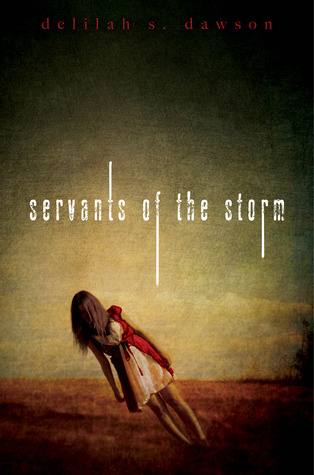
Servants of the Storm - Delilah S. Dawson

Servants of the StormI wish I hadn't read this book.  I really do.  Because dear lord, I loved it so, so much, and then I got to the end and was consumed by a fiery rage.  For the vast majority of the book, I was enthralled.  I loved Dovey, and Isaac, and kind of hated Baker because he was annoying, but overall the story reminded me of nothing more than Holly Black's Tithe and Valiant and Melissa Marr's Wicked Lovely, except it doesn't deal with faeries and it was set in the south, specifically Savannah.  It has the same deal of someone seeing what other people can't and getting pulled into a mess bigger than themselves and oh dear lord, I was loving it so, so much.It had a sort of post-apocalyptic feel to it, too, though it was actually a post-natural disaster setting, and that mixed with the supernatural aspect also had me thinking of Kresley Cole's Poison Princess, which I found annoying to begin with but was completely enthralled by when I got to the end.  It was set up to be a five-star book, to be read again and again, all the way.  This was going to be a book I was talking about for days, recommending to everyone I came across.  It was on its way to being a star.

And then the end.  This is a book that, if I had not been reading it on my laptop (it was Simon and Schuster's book of the week on their PulseIt website), I would have thrown it across the room in a fit of rage.  Is Dovey an unreliable narrator?  Is she not?  I don't know.  I HATE IT SO MUCH.  Is there a sequel?  Don't know.  It's set up like there should be, but since this book technically hasn't even been released for about a half hour after I'm writing this (11:30PM on August 4th, though this will likely be posted later) it's hard to say.  It's not listed as being in a series on either Goodreads or Amazon, though.  But then, I don't think Tithe was supposed to have sequel/companion books when it was first published, either, though I could be wrong about that.  But STILL.  I am so angry at Dawson right now that I can barely type.  I want some type of closure in my books, you know?  It doesn't even have to be closure that I like, though I obviously prefer closure that I like!  BUT THIS.  NO.  NOT EVEN A LITTLE.  In fact, this book has led me to create a new "rage-inducing" shelf on Goodreads, of which it is currently the only occupant.

I adored SO SO MUCH OF THIS BOOK and then absolutely HATED the ending, and not in the same way I hated the endings to other books, like Gods in Alabama.  With that, I felt disappointed that so much excellent storytelling had come to such a lackluster conclusion.  With this, I just feel cheated.  Cheated isn't a good way to leave your readers--or at least it's not a good way to leave me.  It makes me hold a grudge against you, dear Delilah S. Dawson.  How I wish you had chosen to do something else.  If a sequel to Servants of the Storm appears, I'll probably pick it up seeking the closure that I didn't get here--but I won't be reading any of Dawson's other books, because I'm not going to set myself up for that sort of disappointment again.

Seriously, guys.  Just go read Tithe instead.  It'll give you the same feeling of beauty and decay and creepiness and fantasy and romance--all of the good parts of this book--and in the end, you'll still have closure.

2.5 out of 5 stars, right in the middle, for both the beauty and rage.

Wednesday, August 6, 2014

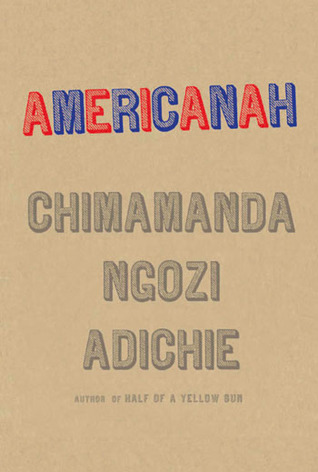
Americanah - Chimamanda Ngozi Adichie

AmericanahFirst off, can I say that Adichie is actually featured on a BeyoncĂ© track?  How cool is that?  I mean, Adichie is a fantastic writer on her own merits and definitely didn't need BeyoncĂ© to be taken seriously as a writer, but still.  Pretty cool.  (The feature, if anyone is interested, is an excerpt of a speech Adichie gave about why everyone should be feminists.)

I've read all of Adichie's other works and really loved them, and was thrilled to finally get my hands on Americanah, which was checked out at the library pretty much since it came out.  Let me tell you, it didn't disappoint.  It spans oceans and years, following the lives of Ifemelu and Obinze, two Nigerians who fell in love in secondary school, and where their lives take them.  When the book opens, Ifemelu is living in Princeton, and is preparing to move back to Lagos in Nigeria.  Obinze is married and living in Lagos.  The bulk of the book is the story of how these two got to where they are, being a series of flashbacks that aren't necessarily in sequential order.  The book was ever so slightly out of balance in that the beginning and middle kind of outweighed the end, length-wise, but of course that's not a deal breaker.  Adichie can write an absolutely stunning drama, and Americanah was no exception.  Her characters are terribly, tragically real.  They do things that they regret and they have very real, very human flaws that make them unlikeable at points, but you can never really stop rooting for them because you know them so well and want them to succeed.  Their transformations across the years as they age and mature are also startling, something which becomes very apparent when Ifemelu eventually returns to Nigeria as an "Americanah," someone who's spent time in America an has been changed by it.  Also, her handling of setting is phenomenal.  I've never been most of the places Adichie writes about (the only one I've seen myself is Baltimore) and yet I can really picture them through her magnificent prose.

One feature I found very interesting was Ifemelu's profession as a blogger--though I did find it a bit unrealistic how quickly she gained followers.  While she has several other jobs throughout the book, her ultimate calling is apparently blogging, and she runs a blog full of her own observation on black Americans through the eyes of a non-American black.  Let me tell you, there are some real stingers about how Americans view race and how deeply ingrained it is in our society, but they were well-thought out and succinct rather than offensive--though I find it easy to believe that some people would find them offensive.  She's blunt, but honest, and that's marvelously refreshing.  I do know that novels are hardly ever biographical, but at the same time I'm forced to wonder how much came from Adichie's own experiences, just because of how poignant some of the happenings here are.  Overall, it's a truly stunning book, and I would recommend it to anyone who loves good literature and good drama.

Also, kudos to her publisher for having such a lovely cover and not just plastering on a picture of a sunset and an acacia tree.

5 stars out of 5.

Tuesday, August 5, 2014

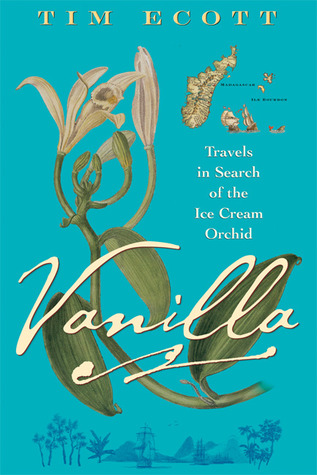
Vanilla: Travels in Search of the Ice Cream Orchid - Tim Ecott

Vanilla: Travels in Search of the Ice Cream OrchidSo, I have a thing about food.  It's no secret.  I have a fabulous metabolism now, but let me tell you, when I get older, I am going to be so fat because I love to eat.  A lot.  Vanilla was just my latest foray into the world of books about food.  And let me tell you, if you're looking for a book about food to read on vacation, this is a great one.  I took it with me to Maine, which was lovely but was nonetheless a far cry from the tropical areas where vanilla is grown, and I spent the entire time pining after after the perfect scoop of vanilla ice cream.

That said...this isn't much of a history of vanilla.  I mean, there's a history of vanilla there, but it's interspersed with all kinds of other stuff.  There's an entire chapter about life on the island of Bourbon/Reunion that doesn't touch on vanilla at all.  Really, it does come across as Ecott traveling a lot and writing a book about vanilla to justify it.  Not that it's a bad thing--I loved reading his descriptions of Mexico, Tahiti, Madagascar, and all the other stops along the way, and his interactions with the people who make up the vanilla industry.  My biggest complaint was that the narrative had a weird sort of organization.  While I would have liked to see vanilla go from the vine to the processing and then onwards, in order, it bounced around a lot, going from vine to processing back to vine to the food it goes into and all around in a manner that wasn't confusing, per se, but certainly seemed a bit discordant.

This book wasn't a really "dense" history, if that makes sense; the history is really just glazed over, for the most part, with a few more in-depth pieces about individuals who made a real impact.  But, like I said before, that made it a great, easy vacation read.  and it made me want to travel, too, and eat vanilla ice cream all the while.  The book barely went into the modern industry at all--apparently the modern vanilla industry is full of deep, dark secrets that no one is willing to disclose--but I still found it thoroughly enjoyable.  Overall, it reminded me a great deal of Rachel Louise Snyder's Fugitive Denim, which deals with the modern denim industry and travels about in a manner similar to Ecott's.  I really enjoyed Fugitive Denim, so it's not really a surprise that I liked Vanilla, too.  This isn't a book for someone looking for a detailed, scientific look at vanilla, but it is a book for someone like me who likes food and travel and good writing, and I would definitely recommend it on those aspects.

4 stars out 5.

Monday, August 4, 2014

Tea Cups & Tiger Claws - Timothy Patrick

Tea Cups & Tiger ClawsI am probably one of very few people in my demographic in the US who has not watched Breaking Bad or Game of Thrones and has not read the Song of Ice and Fire books.  Still, much of it has somehow been absorbed into my pop culture subconscious, such as the fact that George R. R. Martin called Walter White a monster worse than anyone in Westeros.  And while I know that there are some real doozies of monsters out there in fiction-land, I think Timothy Patrick's character Dorthea Railer could play ball with the worst of them.

Tea Cups & Tiger Claws follows three generations of women, starting with Elma Railer during World War I.  Elma gives birth to identical triplets and allows two of them, Abigail and Judith, to be adopted by a duchess, but she keeps the third baby, Dorthea, for herself--presumably out of spite for the people trying to manipulate her into giving up all three of her children.  The Railer family is, put simply, white trash, and everyone figures that Dorthea will end up just as bad as the rest of them.  She doesn't.  She ends up much, much worse.  As Dorthea tries to claw her way to the top of Prospect Park society and find her place in the mansion on the hill, she creates her own little underworld, complete with drugs, secret dungeons, kidnapping, and a hefty dose of murder.  Sucked into this mess are Abigail and Judith's daughters, good girl Sarah and party girl Veronic, and when Dorthea finally makes her grab for the high life, it's Sarah and Veronica who get caught in the flames.

This is very much a character-driven story, and really all of the characters are reflections of each other, showing what each could have become if things were just a little different.  It's written in a mostly-linear fashion, broken up by great chunks of background info on places and people.  Still, this exposition is written in such a flowing, fluid style that I didn't feel it bogged down the narrative at all, but instead made it even fuller and richer.  The level of detail could have easily strayed into the territory of dull and lifeless, but instead left just enough to the imagination to keep me interested.

There were a few issues--some misplaced or misused words, some typos and rough grammar in a few areas, though not enough to be ruinous to the whole.  The thing that bothered me most was part of the mystery I never felt was truly resolved.  One of the characters leaves clues tot eh others that are meant to help stop Dorthea.  While I am pretty sure I know who the helper is, it was never said outright, and the "how"s and "why"s of the aid are left somewhat in the dark.  I really would have liked to see that fleshed out a bit more to add some more completeness to the story.  Still, I could gather enough on my own, I guess, and the engaging characters and prose kept me going long after I should have been asleep on more than one night.

4.5 stars out of 5.

Saturday, July 26, 2014

Chasing the Star Garden - Melanie Karsak (Airship Racing Chronicles #1)

Chasing the Star Garden (The Airship Racing Chronicles, #1)First off, can I just say look at that cover art?  Gorgeous.  Absolutely gorgeous.  I am jealous of Karsak for having such beautiful cover art.

Now, on to the substance.  Chasing the Star Garden follows our narrator, Lily Stargazer, as she tries to unravel the mystery of a kaleidoscope given to her under strange circumstances.  Lily is mainly an air jockey, and the book falls into a series called "The Airship Racing Chronicles," but really, there is very little to do with airship racing here; only two chapters (the first and the last) feature any real racing.  The bulk of the story follows the kaleidoscope mystery.  Lily is also somewhat of an alcoholic (her drink of choice is absinthe) and a user of both laudanum and opium, has two lovers that feature in the story (one of which is a fictionalized version of Lord Byron) and is a little bit into BDSM.  Some of these qualities, mainly the addictions and her behavior regarding them, are rather less than endearing.  For example, Lily has taken so much laudanum at one point that the airship she's supposed to be piloting ends up in trouble because she's high.  However, Lily is well aware that she might be on a bad path, wondering, "If I continued like I did, what would be my end destination?  The answer to that question was not pretty.  I'd stopped asking it long ago."  This self-awareness is rather more endearing, and allows one to root for Lily getting over her issues and finding some meaning in her life.

Character-wise, I rather liked most of them.  Lily and her crew, Jessup and August, as well as Lord Byron and Lily's other lover, Sal, are all great.  Celeste, a courtesan who shows up partway through, was less great.  She was okay, I guess, but overall I found her bland, when her origins and plotline should have lent her an air of mystique.  I liked how Lily's back story unraveled, and maybe Celeste would have been more interesting if she'd had a little more back story or we could see inside her head more--impossible, given the first-person perspective, but still.  I would have also liked to see a bit more integration of the airship racing story, and the characters that went with it, like Cutter the American pilot and Etienne the French pilot.

I did find some plotholes in the main storyline, which revolves around using the mysterious kaleidoscope to search for a statue which was lost during ancient times.  One part of the story involves using another statue to find it, which didn't make sense to me because the guy who carved and placed the statues had nothing to do with the guy who moved one of them, so why would one point to another?  I also didn't really get how the kaleidoscope worked.  There was something about it being "altered," but the random nature of kaleidoscope patterns kind of goes against the idea of them being able to reveal things when pointed in certain directions and at certain objects.  As the book advanced, it took on more of a fantasy/supernatural/mythology air and kind of lost some of its early steampunk flair, with airships being used but not being the focus of the story.  While this didn't really bother me, I can see where it would bother some people who were in it for a thoroughly steampunk tale, so keep that in mind; as the book goes on, the steampunk element is more for atmosphere than it is for actual substance.  Oh, and as far as the "star garden" goes, it just refers to the sky, which is a bit...purple for my tastes.

Lastly, I found the entire final chapter rather abrupt.  The reunion, the abbreviated race, the heroics--it all kind of seemed to jar with the speed of the rest of the story, and felt like Karsak just got tired of writing and wanted to wrap it all up.  While I have no objections to the ending logically or emotionally, the pacing just seemed to be....off.  I would have preferred to see this slowed down and fleshed out a bit more than it actually was.

Overall, however, I thoroughly enjoyed this, and will be picking up the next book of Lily's adventures, Chasing the Green Fairy--though I'd also be interested in seeing books following other main characters in this world!

3.5 stars out of 5.

Thursday, July 24, 2014

The Swan King - Christopher McIntosh

The Swan King: Ludwig II of BavariaThe Swan King is a biography of Ludwig II of Bavaria, the king responsible for the building of fabulous castles such as Neuschwanstein, which supposedly served as the inspiration for the Sleeping Beauty castle at Disneyland in California.  Ludwig was a fascinating character, living more in his mind than in the real world, with an obsession for mythology and the music of Wagner.  He didn't spend much time in his capital of Munich, instead spending most of his time on the throne traveling between the various castles and palaces of Bavaria and sponsoring Wagner in the arts.  He went mad towards the end of his life and eventually died under what seem to be mysterious circumstances, leading to the question of whether he committed suicide or whether he was murdered.

Overall, I really liked this book.  I felt the pacing was pretty good, although it did get bogged down in the politics of Germany and Europe in general at a few times.  This is hard to avoid in biographies of rulers, though, because so much of their lives does depend on what's happening on the larger world stage.  Unfortunately, one of the most interesting documents that MacInstosh could have used, Ludwig's "secret diary," was destroyed during World War II, but he still has lots of letters and such to draw on as documentary evidence.

That said...this book was somewhat lacking in citations, which makes me a little uneasy.  Some things, like how Ludwig ordered a bunch of servants to go rob the Rothschild bank in order to finance his castles, seem like they really should have had a citation, ,and yet they don't.  The book has 204 pages of biographical content, and about 12 pages of citations at the back, most of which are "Ibid."  There's also a lot of "projecting," where McIntosh kind of puts words into Ludwig's mouth via the phrase "must have," which really put me off.  As in, "Ludwig must have felt..." "Ludwig must have thought..." and so on.  How can you make those claims?  There are very rarely quotes or citations surrounding them, and it puts me off somewhat as someone who spent the past four years of her life getting a history degree and citing everything.  Also, note that this book is published by a company called "I. B. Taurus and Comopany," not by one of the notable academic presses such as Harvard, Oxford, Princeton, etc. which makes it a bit less reputable in my eyes.  Granted, some very academic books can come out of less-known presses, but I'm not entirely sure this was one of them.

Overall, I found this an enjoyable read, but I also would have found it a more trustworthy read if it had been better sourced and cited.

2.5 to 3 stars out of 5.