Pages

Showing posts with label germany. Show all posts

Monday, June 18, 2018

In the Garden of Beasts - Erik Larson

In the Garden of Beasts: Love, Terror, and an American Family in Hitler's BerlinErik Larson is an awesome history author.  I've read both Dead Wake (about the sinking of the Lusitania) and Devil In the White City (about a serial killer and the Chicago World's Fair) by him, and found both of them to be excellent in quality.  When I was looking for a book linked to my family history for my reading challenge, I decided to just pick something set in Germany, because I didn't know what else to focus on.  (Despite this book focusing on the family of an ambassador in WWII Germany, I am neither related to the Dodds, nor am I aware that any of my direct family were Nazis, though I suppose anything is possible; wouldn't that be a nasty surprise?)

In this book, Larson focuses on Ambassador William Dodd, the first US ambassador to Hitler's Germany, and Dodd's daughter Margaret.  His wife and son were also present in Germany, but are not looked as much in the course of the book.  And what the book is, is a startling examination of the old adage "Hindsight is 20/20."  Now, we have such clear hindsight, being able to see that Hitler was bad news, and that something should have been done sooner--but through the Dodds, we can see how that wasn't the case at the time.  They initially were kind of friendly toward Nazism in general, being somewhat anti-Semitic themselves, though Hitler himself was seen as kind of a kooky guy who Hindenburg had well in hand and who probably wouldn't remain in power very long.  But the Dodds slowly become more and more aware of what a terrible situation is brewing in Germany--and are stonewalled by everyone else, who either outright don't believe them or don't want to believe them, or do believe them but don't want to get involved with European affairs and instead only want to focus on Germany paying its reparations from World War I.  It's an incredibly frustrating story to read, because you can see the trouble building in the background, and the Dodds growing increasingly concerned and Ambassador Dodd's attempts in particular to do something without causing an international incident--and without getting himself fired in the process, as he isn't well-liked in the State Department to begin with--and knowing that it's all futile.

Larson builds the tension here wonderfully.  This is a true work of nonfiction, as well--everything he implements is taken from letters, cables, diaries, etc.  He does step back to speculate once or twice, but always notes that he's doing so, saying something such as, "Perhaps, but they didn't write about it they did, so we can't really know."  The Dodds aren't really the most interesting people on their own; the details of their day-to-day lives can be boring, mostly consisting of Dodd's colleagues at the State Department planning to oust him and working to undermine him at pretty much every turn and Margaret having a bunch of affairs, but I think that provided exactly what it was supposed to: an idea of how life went on for most people in Germany, and it was not a sudden event that Hitler rose to power, made being Jewish illegal, and started killing people and planning to take over Europe.  Rather, it was a slippery slope that rose against a background of existing tensions, and no one action took place until the preceding ones seemed normal.  Hm...does that sound familiar to anyone alive today...?

This is not a "fast" read, nor is it a thrilling one.  But it is one that is chilling in the way that it, in many ways, mirrors the world we live in now.  They say that those who don't study history are doomed to repeat it--so study up, folks.

4 stars out of 5.

Friday, December 11, 2015

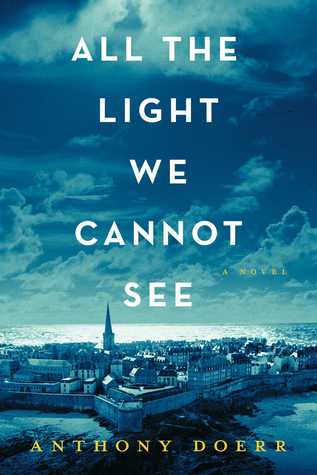
All the Light We Cannot See - Anthony Doerr

All the Light We Cannot SeeOne of the categories for Popsugar's Reading Challenge for 2015 was "A Pulitzer Prize-winning book," which of course led me to All the LIght We Cannot See.  I did scroll through the list of Prize winners for other options, but out of all of them, this one seemed the most interesting to me, and it got great reviews from regular readers in addition to the Prize-givers, so it seemed like a solid option.

And it was beautiful.  The book takes place during World War II, with short periods and a slightly longer denouement taking place before and after the war, respectively.  There are two main characters.  Werner is a German boy/teenager who gets into a prestigious school for his engineering abilities.  He can fix pretty much any radio, and is soon designing his own, which the Germans use to hunt down resistance fighters in eastern Europe and in France.  The other main character is Marie-Laure, a French girl/teenager who lost her eyesight at a young age and whose father is trusted with taking a copy (or potentially the original) of an infamous diamond with him when he and Marie-Laure flee Paris.  Marie-Laure's father is eventually arrested as a spy, and Marie-Laure unwittingly becomes the guardian of the diamond in his absence.

The diamond itself is the axis on which the story spins.  It lends a fantasy, or maybe a magical-realism, element to the story--is the diamond magic, or not?  Is it a curse, or luck?  Doerr never comes out on one side or the other, making it a real either-or that tantalizes at various parts of the story, sometimes seeming one way, sometimes seeming the other, and we're ultimately left having to make our own decisions on the matter.  The war-time setting lends atmosphere more than anything else, and is cause for some poignant moments that would not have otherwise happened, but most of the plot could easily take place in another point in time, when a group of people is hiding a diamond from someone else who wants it.  That, to me, was good, because it made the story easier to slip into, and while there are some heavy events in this book, Doerr doesn't focus on the aspects of the war that many do: concentration camps, shootings, fighting a resistance.  His focus on a teenager who is in the German army, but tries to distance himself from its doings, and on a French civilian--who ends up helping the resistance, but only in the barest of possible ways--makes the story seem more every-day, makes the characters more real.  Most of us probably can't imagine what it would be like to find a downed pilot, rescue him from a tree, nurse him back to health, and then smuggle him across the border to safety.  However, most of us probably can imagine asking for a loaf of bread and passing off a piece of paper.  Small, simple things, but they make such a difference in this story.

The writing here is absolutely beautiful.  Doerr's descriptions of Marie-Laure's world are wonderful, and Saint-Malo was clear to me even though Marie-Laure couldn't see it to actually describe it.  Werner's parts were lovely, too, though in a more painful way.  His attempts to distance himself from his own actions, a blatant dissociation in order to preserve his sense of righteousness as much as possible when he knows that what he is doing hurts people, was painful at times, especially in regards to his friend Frederick and in his estrangement from his sister Jutta.  At the same time, though, it's easy to see how boys like Werner would have ended up rabid Nazis.  Werner was picked up from an orphanage in a nothing town, saved from a life of mining coal and probably dying young, and instead put into a school where he was treated like he was special, like his knowledge and skills were valued.  That's quite a lure, and it's easy to see how he wanted to vanish into that world--though the niggling conscience instilled by his own morals and his sister never quite left him.

 The only real complaint I have about this book is that the denouement was too long.  This is one of the instances in which I felt there was too much resolution; I would have liked a little more to be left up to our imaginations, instead of multiple time-jumps taking us decades into the future to see where various characters ended up.  A little more mystique in regards to the characters would have matched the mystery tied to the diamond, and tied in a little more meaningfully to me.  Still, though, a beautiful book, and one I would heartily recommend to pretty much anyone.

4 stars out of 5.

Monday, December 7, 2015

Lovers at the Chameleon Club, Paris 1932 - Francine Prose

Lovers at the Chameleon Club, Paris 1932This book has been on my to-read list for quite a while, but the university library system in DC didn't have it.  However, when I was scanning the popular reads section a few weeks ago, it was there!  So of course I picked it up.

The book is historical fiction written in the style of a collection of memoirs, letters, biographies, and even some chapters that are written in a typical third-person narrative style.  Each character has his or her own style that's maintained throughout the book; Lionel writes books that aren't specifically memoirs, but are definitely first-person, while Lily and Suzanne write memoirs, Gabor writes letters to his parents, and Lou's story is told through a biography written in 2010.  The mix of styles means that each character has a distinctive voice, and their overlapping opinions and version of events give a nuanced feeling to the story.  What's most interesting about this book, though, is that it's a fictionalized version of historical events--obviously, because it's historical fiction, but even more closely than most historical fiction is.  All of the characters are re-named real people, so that Prose could draw heavily on their real lives and doings but still have some creative license.  The title is taken from the title of Gabor's book-within-a-book, which is in turn named for a photo he took.  While the photo described in the book is its own, it's easy to see that it's drawn heavily from this photo:

"Lesbian Couple at Le Monocle, 1932" by Brassai, Cleveland Museum of Art 

This makes Gabor, Brassai, a real-life Hungarian photographer, and Lou Villars is really Violette Morris, a female athlete turned Nazi sympathizer.  The book is clearly built off Prose's fascination with Morris/Villars, and how such a young woman could slide into what could, arguably, be called evil amongt the larger narrative of Europe's slide into World War II.  The other characters' stories all really revolve around Lou's, even though they have their own events happening beyond her scope.  Possibly this was meant to be a real biography that Prose reworked into a fictionalized version, possibly not; but it was a delightful read nonetheless.  I didn't know anything about Morris, Brassai, or the other real-life people who inspired the characters before I read this, but the book made me want to read and learn more about them, and that's a good book indeed.  It does have the result, however, of having to keep in mind that the book is fiction, and carefully balancing out the real-life aspects with the fictionalized aspects in one's head.

Out of all the sections, Gabor's were my least favorite.  I dislike narratives written in letter form, and I was glad that Gabor's letters shortened and became more scarce as the book went on, to be replaced by chapters of the memoirs and the pseduo-biography instead.  And then, from nowhere--gasp!--we get an unreliable narrator!  Ugh, that bothers me so much, but at the same time it gives a ton more dimension to what could have been a good, but somewhat flat, book, because it raises the question...who is telling the truth?  And for the unreliable narrator, what was that person's motive in telling the story as he or she did?  These are questions that are never actually resolved in the book, though another character speculates on them in the end, and it left me with some food for thought, something to chew over while starting on my next book.  I started reading All the Light We Cannot See while I was reading Lovers, which is another World War II historical-fiction book, and the two paired together have made an excellent read so far.

Overall, I really liked this is a historical fiction, but some of the characters--like Lionel, and Arlette--annoyed me enough that I'm not quite willing to give it a full 4 stars.  There's no preface or prologue explaining the pseudo-historical aspects of it, either, which I don't like; when something treads this close to the truth/fiction boundary, I feel like the author should at least have the decency to own up to it and put the facts straight in an afterword.  I'm not sure if I'd read this again, but I liked it this time around.

3.5 stars.

Monday, September 21, 2015

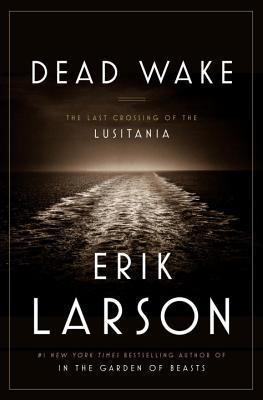
Dead Wake: The Last Crossing of the Lusitania - Erika Larson

Dead Wake: The Last Crossing of the LusitaniaErik Larson's books apparently have appeal to me, since all but one of them are on my "to read" shelf.  I think he just covers historical moments that I find particularly interesting.  From the look of his books (and my experience with this one) he doesn't feel the need to write broad, sweeping historical narratives, but rather focuses on smaller moments and events in the context of the larger ones everyone studies so intently.  I knew about the Lusitania, a large passenger liner that sailed in the early twentieth century, and had a conception about it that a lot of people probably shared: that when Germany sank it, it was the even that catapulted the United States into World War I.  This was, as Larson points out at the end of the book, not the case; the US didn't enter the war for more than two years after the Lusitania sank, though the sinking was certainly the cause of a huge amount of outrage in the neutral US.

In Dead Wake, Larson examines day-to-day life on the Lusitania amidst the building tension of the war, particularly a warning from Germany that any UK-bound ships were considered valid for sinking and which mentioned the Lusitania specifically.  He also includes the operations of U-20, the German submarine which sank the Lusitania, and the operations of Woodrow Wilson, Winston Churchill, and a few other areas/departments, such as the secret British intelligence group in the so-called Room 40.  He relied on a wide variety of resources to create this narrative, including letters, memoirs, and logs--pretty much everything except interviews.  The Lusitania sank in 1915, after all, which means that none of the survivors are still around.  He did an extraordinarily good job of it, making the people who sailed on the ship and submarine, and who watched and manipulated events from afar, seem real and relatable even though he only had limited resources on which to rely.  He builds tension throughout the entire book until the ultimate sinking, and then winds everything up quite neatly without too much hemming and hawing about consequences.

At the end of the book, he does bring up one thing that I think is ultimately a flaw: he doesn't answer any real questions about what happened.  No one really seems to know why the Lusitania didn't receive a naval escort, why the instructions (or lack thereof) were so ambiguous, why it wasn't diverted to a safer route given the intelligence available.  While it's interesting that no real answers have come out regarding this, I would have liked to have seen Larson take a stab at answering them given the information he dug up.  Ultimately, this was an informative book but nothing that was really groundbreaking, because it doesn't include any sort of argument or thesis, only facts.

4 stars out 5.

Thursday, July 24, 2014

The Swan King - Christopher McIntosh

The Swan King: Ludwig II of BavariaThe Swan King is a biography of Ludwig II of Bavaria, the king responsible for the building of fabulous castles such as Neuschwanstein, which supposedly served as the inspiration for the Sleeping Beauty castle at Disneyland in California.  Ludwig was a fascinating character, living more in his mind than in the real world, with an obsession for mythology and the music of Wagner.  He didn't spend much time in his capital of Munich, instead spending most of his time on the throne traveling between the various castles and palaces of Bavaria and sponsoring Wagner in the arts.  He went mad towards the end of his life and eventually died under what seem to be mysterious circumstances, leading to the question of whether he committed suicide or whether he was murdered.

Overall, I really liked this book.  I felt the pacing was pretty good, although it did get bogged down in the politics of Germany and Europe in general at a few times.  This is hard to avoid in biographies of rulers, though, because so much of their lives does depend on what's happening on the larger world stage.  Unfortunately, one of the most interesting documents that MacInstosh could have used, Ludwig's "secret diary," was destroyed during World War II, but he still has lots of letters and such to draw on as documentary evidence.

That said...this book was somewhat lacking in citations, which makes me a little uneasy.  Some things, like how Ludwig ordered a bunch of servants to go rob the Rothschild bank in order to finance his castles, seem like they really should have had a citation, ,and yet they don't.  The book has 204 pages of biographical content, and about 12 pages of citations at the back, most of which are "Ibid."  There's also a lot of "projecting," where McIntosh kind of puts words into Ludwig's mouth via the phrase "must have," which really put me off.  As in, "Ludwig must have felt..." "Ludwig must have thought..." and so on.  How can you make those claims?  There are very rarely quotes or citations surrounding them, and it puts me off somewhat as someone who spent the past four years of her life getting a history degree and citing everything.  Also, note that this book is published by a company called "I. B. Taurus and Comopany," not by one of the notable academic presses such as Harvard, Oxford, Princeton, etc. which makes it a bit less reputable in my eyes.  Granted, some very academic books can come out of less-known presses, but I'm not entirely sure this was one of them.

Overall, I found this an enjoyable read, but I also would have found it a more trustworthy read if it had been better sourced and cited.

2.5 to 3 stars out of 5.

Friday, July 5, 2013

Assassins of the Turquoise Palace - Roya Hakakian

Assassins of the Turquoise PalaceThe biggest problem with Assassins of the Turquoise Palace is that I had no idea what it was about.  Having been raised in the good ol' US of A, I have been pretty much perpetually inundated with messages of "Iran is bad.  Bad bad bad."  While I doubt that's true in its entirety--few things ever are--there are a myriad of areas in which it does seem to have merit.  For example, the Iranian government's ordering of the killings in this book.  That wasn't exactly cool.  But what I was left wondering, for the entire book, was why it was ordered in the first place.  I think it had something to do with Kurds.  I don't know much about Kurds, pretty much just that they're a group of people in the Middle East who don't have a country of their own, much like the Roma, or the Jews before Israel was created, or the Palestinians today.  I don't know why the Iranian government wanted these particular Kurds dead.  Or were they Kurds?  Was that ever said?  I think it was mentioned that they supported an independent country for Kurdistan, but just because they supported it doesn't meant they were Kurds themselves.

You might see why this book left me a little confused.  Parts of the book also rambled or jumped around a bit too much; I have never seen more pagebreaks in my life, I swear!  It made following the multiple characters a little more difficult than I would have liked.

Also, despite the book being entitled Assassins of the Turquoise Palace, very little time is spent talking about the Turquoise Palace, the assassins, or even the assassination.  The focus is on the 90's-era trial of the men accused of killing several Iranian activists in Berlin.  Now, don't get me wrong, I love me a good trial.  I am an avid watcher of Law & Order (but only the episodes with McCoy, because he is a badass in the courtroom) and I take law classes for fun at my university.  And I do think that the trial and everything surrounding it was written very well, and was very easy to read; no slogging through legal mumbo-jumbo required.  But, if I'm picking up a book called Assassins of the Turquoise Palace, I really do expect the focus to be somewhat on the assassins.  I would have liked that story.  How did these people get to be killers, anyway?  It's entirely possible that book can't be written, because of a dearth of sources or something like that, but I think it would have been a more compelling read.  Not that a quest for justice is un-compelling, but... I don't know.  It just wasn't what I thought it was going to be, and what it was wasn't enough to make up for that.

One more thing.  While the writing is very detailed, which is what makes it so readable, I'm skeptical of how accurate it is.  Including dreams and feelings can be done in a nonfiction book through detailed interviews, but that would be very detailed indeed.  I'm skeptical if, at times, Hakakian isn't speculating and putting her own words or feelings into the mouths and hearts of the people of the book.

And can we talk about that cover for a second?  It  doesn't influence my opinion of the book, but man, that is some of the worst photo-editing I've ever seen.

So, lacking some information that made it a bit hard to understand, with a bit of a jumpy structure, it was a hard book to really get into.  While its actual topic was well-written, for the most part, it isn't a book I would pick up again.

2 stars out of 5.

Monday, June 10, 2013

Dead Funny: Humor in Hitler's Germany - Rudolph Herzog

Dead Funny: Humor in Hitler's Germany Dead Funny: Humor in Hitler's Germany purports to be about the history of jokes about Hitler, the Third Reich, and the Holocaust within the bounds of Germany before and during WWII.  And indeed, it does start off this way, expounding on the history of political jokes and how they're used to relieve stress, and were actually good for Hitler's government.  However, after that, it rapidly falls apart into a disorganized jumble that can't even decide which continent it wants to focus on.  While subjects like the treatment of the Holocaust through humor by the Jews, the treatment of jokers, and the changing attitudes of the Nazis toward political jokes are broached, they're tossed in with confusing accounts of Hollywood comedies and BBC radio skits.  While those certainly pertain to Nazi humor, they don't exactly pertain to humor in Hitler's Germany, and they don't pertain to telling jokes in Hitler's Germany, either.  The German title of the book is Heil Hitler, Das Schwein Ist Tot!  Lachen unter Hitler--Komik und Humor im Dritten Reich, which seems to translate to Heil Hitler, the Swine is Dead!  Laughter Under Hitler--Comedy and Humor in the Third Reich, which retains the focus on Germany, so there's no clarity there, either.

Additionally, I think there's a problem with the translation.  Or, not so much a problem with the translation--it's a very comprehensible translation--but a problem with the concept of this particular book being translated.  Herzog repeatedly says that certain jokes are completely untranslatable, which makes their inclusion seem pointless when there are so many others which, when translated to English, retain their point if not their clever wordplay.  Paired with the disorganization and seeming inability to focus on one topic, jumping from jokes in Germany to cabarets in Switzerland to a long-winded explanation of the plot of an American movie, it's not exactly a riveting read.  It does have its moments, of course, but overall it reminded me more of a poorly-conceived thesis paper than a professional, structured book.

2 stars out of 5.