Pages

Saturday, July 26, 2014

Chasing the Star Garden - Melanie Karsak (Airship Racing Chronicles #1)

Chasing the Star Garden (The Airship Racing Chronicles, #1)First off, can I just say look at that cover art?  Gorgeous.  Absolutely gorgeous.  I am jealous of Karsak for having such beautiful cover art.

Now, on to the substance.  Chasing the Star Garden follows our narrator, Lily Stargazer, as she tries to unravel the mystery of a kaleidoscope given to her under strange circumstances.  Lily is mainly an air jockey, and the book falls into a series called "The Airship Racing Chronicles," but really, there is very little to do with airship racing here; only two chapters (the first and the last) feature any real racing.  The bulk of the story follows the kaleidoscope mystery.  Lily is also somewhat of an alcoholic (her drink of choice is absinthe) and a user of both laudanum and opium, has two lovers that feature in the story (one of which is a fictionalized version of Lord Byron) and is a little bit into BDSM.  Some of these qualities, mainly the addictions and her behavior regarding them, are rather less than endearing.  For example, Lily has taken so much laudanum at one point that the airship she's supposed to be piloting ends up in trouble because she's high.  However, Lily is well aware that she might be on a bad path, wondering, "If I continued like I did, what would be my end destination?  The answer to that question was not pretty.  I'd stopped asking it long ago."  This self-awareness is rather more endearing, and allows one to root for Lily getting over her issues and finding some meaning in her life.

Character-wise, I rather liked most of them.  Lily and her crew, Jessup and August, as well as Lord Byron and Lily's other lover, Sal, are all great.  Celeste, a courtesan who shows up partway through, was less great.  She was okay, I guess, but overall I found her bland, when her origins and plotline should have lent her an air of mystique.  I liked how Lily's back story unraveled, and maybe Celeste would have been more interesting if she'd had a little more back story or we could see inside her head more--impossible, given the first-person perspective, but still.  I would have also liked to see a bit more integration of the airship racing story, and the characters that went with it, like Cutter the American pilot and Etienne the French pilot.

I did find some plotholes in the main storyline, which revolves around using the mysterious kaleidoscope to search for a statue which was lost during ancient times.  One part of the story involves using another statue to find it, which didn't make sense to me because the guy who carved and placed the statues had nothing to do with the guy who moved one of them, so why would one point to another?  I also didn't really get how the kaleidoscope worked.  There was something about it being "altered," but the random nature of kaleidoscope patterns kind of goes against the idea of them being able to reveal things when pointed in certain directions and at certain objects.  As the book advanced, it took on more of a fantasy/supernatural/mythology air and kind of lost some of its early steampunk flair, with airships being used but not being the focus of the story.  While this didn't really bother me, I can see where it would bother some people who were in it for a thoroughly steampunk tale, so keep that in mind; as the book goes on, the steampunk element is more for atmosphere than it is for actual substance.  Oh, and as far as the "star garden" goes, it just refers to the sky, which is a bit...purple for my tastes.

Lastly, I found the entire final chapter rather abrupt.  The reunion, the abbreviated race, the heroics--it all kind of seemed to jar with the speed of the rest of the story, and felt like Karsak just got tired of writing and wanted to wrap it all up.  While I have no objections to the ending logically or emotionally, the pacing just seemed to be....off.  I would have preferred to see this slowed down and fleshed out a bit more than it actually was.

Overall, however, I thoroughly enjoyed this, and will be picking up the next book of Lily's adventures, Chasing the Green Fairy--though I'd also be interested in seeing books following other main characters in this world!

3.5 stars out of 5.

Thursday, July 24, 2014

The Swan King - Christopher McIntosh

The Swan King: Ludwig II of BavariaThe Swan King is a biography of Ludwig II of Bavaria, the king responsible for the building of fabulous castles such as Neuschwanstein, which supposedly served as the inspiration for the Sleeping Beauty castle at Disneyland in California.  Ludwig was a fascinating character, living more in his mind than in the real world, with an obsession for mythology and the music of Wagner.  He didn't spend much time in his capital of Munich, instead spending most of his time on the throne traveling between the various castles and palaces of Bavaria and sponsoring Wagner in the arts.  He went mad towards the end of his life and eventually died under what seem to be mysterious circumstances, leading to the question of whether he committed suicide or whether he was murdered.

Overall, I really liked this book.  I felt the pacing was pretty good, although it did get bogged down in the politics of Germany and Europe in general at a few times.  This is hard to avoid in biographies of rulers, though, because so much of their lives does depend on what's happening on the larger world stage.  Unfortunately, one of the most interesting documents that MacInstosh could have used, Ludwig's "secret diary," was destroyed during World War II, but he still has lots of letters and such to draw on as documentary evidence.

That said...this book was somewhat lacking in citations, which makes me a little uneasy.  Some things, like how Ludwig ordered a bunch of servants to go rob the Rothschild bank in order to finance his castles, seem like they really should have had a citation, ,and yet they don't.  The book has 204 pages of biographical content, and about 12 pages of citations at the back, most of which are "Ibid."  There's also a lot of "projecting," where McIntosh kind of puts words into Ludwig's mouth via the phrase "must have," which really put me off.  As in, "Ludwig must have felt..." "Ludwig must have thought..." and so on.  How can you make those claims?  There are very rarely quotes or citations surrounding them, and it puts me off somewhat as someone who spent the past four years of her life getting a history degree and citing everything.  Also, note that this book is published by a company called "I. B. Taurus and Comopany," not by one of the notable academic presses such as Harvard, Oxford, Princeton, etc. which makes it a bit less reputable in my eyes.  Granted, some very academic books can come out of less-known presses, but I'm not entirely sure this was one of them.

Overall, I found this an enjoyable read, but I also would have found it a more trustworthy read if it had been better sourced and cited.

2.5 to 3 stars out of 5.

Tuesday, July 22, 2014

The Marriage List - Dorothy McFalls

The Marriage ListAs far as regency romances go, I would say The Marriage List was just okay.  The two main characters are May, who is described as "squat" with "amber" hair, and Radford, who was injured on the Peninsula and has struggled with his crushed leg and foot ever since.  Both Radford and May do everything because of a sense of duty.  Radford feels like it's his duty to marry a suitable girl and carry on the family name so that his mother doesn't end up distressed.  May does everything in the name of family duty to care for her ailing Aunt Winnie.  The two of them are convinced that even though they are attracted to each other, they can never be together because being together would get in the way of their duties.  Overall, they were just too similar in personality to make their interactions terribly interesting, and the witty banter for which regency romances are generally known was pretty much entirely lacking.  The entire book was pretty much one character going, "I can't be with him/her," and then the other character doing the same.  There was a slight secondary conflict built in involving May's uncle, and if that had been played up a bit more, the narrative might have been more interesting.  As it was, I just found it bland.  Honestly, the most interesting characters in the whole thing were the side characters, Wynters (I don't remember his first name), who was Radford's best friend, and May's best friend Iona--oh, and Princess the horse!

This is also a "sweet" romance, rather than a "sultry" one, which means that the steamiest it gets is some kissing.  Now, there's nothing intrinsically wrong with that, but combined with the bland plot and bland characters, I found myself struggling to continue on.  I did finish the book, but it didn't really capture my interest like regency romances by some of the greats like Julia Quinn and Lisa Kleypas.  This edition also had some typos, missing words, and so on, and could have used a final editing.

2 out of 5 stars.

Sunday, July 20, 2014

Beyond the Cliffs of Kerry - Amanda Hughes (Bold Women of the 18th Century #1)

13549660Beyond the Cliffs of Kerry follows Darcy McBride, a young Irishwoman, from her home in the seaside town of Kilkerry to the American Colonies, where she is sold as an indentured servant following her arrest as a smuggler.  Of course, Darcy is drop dead gorgeous (apparently the only gorgeous woman in the entire world) despite spending many of her developmental years in the midst of a famine, and everyone wants to have sex with her.  While I liked the overall story of this book, it was incredibly slow getting off the ground; Darcy doesn't even get caught until a third of the way in, and then there's a ship voyage before she gets to the colonies, too, all of it in incredible detail.  Except that detail isn't really a good thing in this particular book, because Hughes just dumps it all in your lap and tells you what's going on; there is absolutely no emotion in this book, and there should have been emotion.  Tons of it.  There are several instances of rape or attempted rape, betrayal, heartbreak--and through it all, Darcy and everyone around her appear to remain mostly flat and emotionless, making what could have been a riveting tale somewhat difficult to read.  You can't just tell me "She was in love with him," because what does that even mean?  I want to know how he made her heart beat faster in her chest, how she found it hard to breathe around him, like someone was squeezing her lungs--things that I can empathize with.  But no, there's none of that.  And even in the wake of two rapes, Darcy doesn't really seem to care.  Hughes says later that "Darcy was terrified of rape" but she does absolutely nothing to show us that Darcy was terrified of rape.  Nothing.  Nothing at all.  It was just...flat.
There are also significant grammar problems in this book, mainly in the "unnecessary comma" department, which makes the sentences seem choppy and stilted, and the "missing and extra quotation marks" department, which makes it a bit unclear where dialogue begins and ends.  This could definitely do with another good editing.
I did, however, like that Hughes set the book during what we here in the US call the French and Indian War (I believe it's the Seven Years' War in other places?) because it is a rather underutilized time period in historical fiction.
2 stars out of 5.

Friday, July 18, 2014

Flame Moon - K. J. Jackson (Flame Moon #1)

15848266I'll admit it--I had lower expectations for Flame Moon.  But when I finally read it, I was very pleased.  The story follows Skye, a girl who goes on a kayaking trip in Colorado, falls in the river, and wakes up with no memory.  Without a memory, or really anything else, she is forced to depend on a group of people who are willing to help her until she can figure out where she came from, where she was going, and what she was doing.  A group that includes, I might point out, her super hawtt kayaking guide, Aiden.  Who's engaged to another woman.  Oops.  But the longer Skye stays, the more complicated things get, and they quickly trend into the realm of the supernatural, with the group Skye has fallen in with and Skye herself possessing various powers. There's action, there's romance, there's some cool training scenes, there's sex.  Skye is a strong character who has made mistakes but is willing to struggle on, and while Aiden can be a bit possessive, and definitely wouldn't be a good romantic match for a lot of people, for them it works.
That said...there were still some issues.  There were some run-on sentences, missing punctuation and typos every now and then, but they weren't rampant.  There were a couple of big plotholes, which I would love to discuss but feel like I really can't without spoilers.  Basically, though, someone wants Skye dead or turned evil, and sets up an elaborate plan to do it when in reality they could have just grabbed her from the get-go, and this someone also thinks that doing some things are definitely not in Skye's best interests are to protect her, explanations which I found lacking.  The amnesia plotline and the matter of revealing a supernatural world to Skye results in a lot of info-dumping at the beginning of the book, which is never really a good thing.  While I liked how Skye's returning memories were handled at first, that quickly ended, and suddenly Skye just remembered everything, which was very abrupt, and then suddenly we're expected to make connections with people and events in Skye's memories that were never explained, leaving me a bit baffled as to how Skye knew some of the things she did.  I also thought the "climax" of the book came a bit early, which left a lot of story afterwards that didn't have as much propelling it.  Oh, and the sex was good, but I did get kind of tired of Skye screaming during it all the time.
Still, I found all of those issues relatively minor, and overall I really enjoyed Flame Moon.  I would definitely recommend this to someone looking for a good paranormal romance, I look forward to reading the other two books in this trilogy.
3.5 stars out of 5.

Wednesday, July 16, 2014

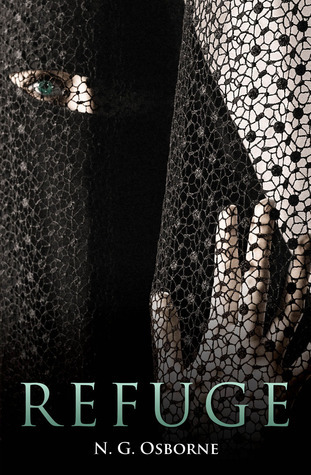
Refuge - N. G. Osborne (Refuge #1)

RefugeThis book was a complicated one for me, because I really liked the overall story, but I still had some issues with it that definitely got in the way of the reading experience.  The plot follows three main characters: Charlie, an American who has moved to Peshawar, Pakistan to work for a company called Mine Aware that hopes to demine villages and fields in Afghanistan; Noor, an Afghan refugee who teaches at a girl's school and hopes to get a scholarship to study abroad; and Tariq, Noor's older brother and a member of the mujadhideen, who were people fighting to free Afghanistan from Soviet/Russian control during the Cold War and its aftermath.  These three are supported by characters such as Noor's father, Charlie's assistant, an American CIA operative, and a Dutch administrator hoping to climb the "aid" career ladder.  There are two major plots at play: one revolves around Charlie and Noor and their relationship (or lack thereof) and the other revolves around Tariq, who promises a Saudi prince that he can marry Noor, only to find that she had fled his grasp, at which point he begins to hunt her down to fulfill his promise and advance his own interests.  I thought the plots worked together wonderfully, and I really loved Noor's reluctance to be interested in Charlie, because she wants a life of her own, not to be rescued by someone.  She seeks shelter with him reluctantly, and their relationship has what seems like a natural growth from conflict to affection, and Noor shelters some very real doubts about it the whole time, which I can't imagine any woman in her position wouldn't shelter.  As for Charlie, he grows immensely during his time in Peshawar and Afghanistan, both professionally and personally, and I thought it was handled very well--though I did have to wonder where he was getting all the money (stacks of hundred dollar bills) that he was throwing around!

Also, I loved how this book treated the use of the burqa.  While burqas are commonly seen as a sign of repression here in the US, Osborne used them fabulously in his story telling.  While, for some women in his narrative, burqas are a symbol of oppression and the control of women by men, for others they represent safety.  When Noor is hiding from her brother, she adopts wearing a burqa in the streets and is amazed at how invisible it makes her and how it enables her to go about her life without harassment, and consequently she doesn't revile it--and Noor is a huge believer of equality between men and women.  I think allowing such a strong, feminist character to find safety in the use of a burqa (that she adopted via her own choice, not someone else's, albeit not for religious reasons) was a great choice on Osborne's part.

But, like I said, I still had some issues with the book.

First, it needs a good line editor.  There are tons of places with misplaced (or, more frequently, missing) commas.  Now, I am a huge fan of the comma, and am probably prone to overusing them, but there were definitely places were a comma was grammatically necessary and was missing.  Also prevalent were a slew of instances in which a question mark should have been replaced with a period and vice versa, because the punctuation used did not actually match the sentence it was attached to.  Also, there were several long stretches of dialogue with no tags such as "said" used, which normally wouldn't be an issue...except Osborne starts new paragraphs rather arbitrarily, so sometimes keeping track of who was talking was difficult because I wasn't sure if the speaker had actually changed or if it was just a new paragraph with the same speaker.

Second, I had an issue with the characterization of Elma.  I can't say too much about this without spoilers, but while Elma is originally made out to be a career woman who will sleep her way to the top if necessary, the majority of the narrative built up her softer side.  She was definitely determined to advance herself, but she was still a real thinking, feeling person.  I felt like this all changed at the end of the book, and was truly appalled at how easily she lost that humanity.

And, third and last, I don't think this needed to be a series.  I think some of the subplots could probably have been cut out, and the narrative streamlined a bit more in order to allow it to become one book instead of multiples.  I might pick up the next one (I'm not entirely sure how many there are, honestly) but I'm not sure at this point.  If I do, I hope that it's better structured and edited than this first volume.  However, overall I think the story was a solid one, and I would recommend this to anyone with the patience to wade through its flaws for the gem at their center.

3 out of 5 stars.

Saturday, July 12, 2014

The Ghost Pirate's Treasure - Barbara Ivie Green (Paranormally Yours #1)

The Ghost Pirate's Treasure: Mystery of the Jaguar Warrior (Paranormally Yours, #1)Part of the blurb for The Ghost Pirate's Treasure claims that the book "explores the mystery of the Mayan Sun calendar, with enough nonsense thrown in to make it all deliriously whacky." Well, "nonsense" and "deliriously whacky" are right, but not in a good way.  I think most of the "nonsense" mentioned in the blurb comes from two things: the fact that Green is obviously desperately in need of a good editor, and her complete inability to keep various Mesoamerican cultures straight.  The book claims to explore the mystery of the Mayan sun calendar, by which it mainly means "the supposed end of the world on 12/21/12."  Except it also deals with El Dorado, Quetzacoatl, and Peru, none of which have anything do with each other.  El Dorado, as in the city of gold, was supposedly located in the Amazon River basin.  Quetzacoatl was the serpent god made famous by the myth of the Aztecs and Hernando Cortes, and the Aztecs and their famous city of Tenochtitlan were located where Mexico City is today.  (Side note: there is historical reason to believe the Aztecs didn't actually think Cortes was Quetzacoatl, and that the "myth" of Quetzacoatl's return was made up after the Spanish conquest of the Aztecs in order to justify their loss.)  Peru was in the area of the Incas, the Andes Mountains.  And the Mayans were prominent around the area of the Yucatan Peninsula.  What does all of this mean?  While most of these civilizations shared some commonalities, as they were not completely cut off from each other, they were not the same and their mythologies, cultures, and ways of life differed immensely.  Seriously, if you're going to write a book about the end of the world based on the Mayan calendar, at least actually use Mayan history and culture, rather than mishmash of whatever you think is cool.  A little consistency is great, and considering that all of the things I mentioned above can be discovered on Wikipedia in a matter of minutes, you would think that it would be easy to realize that they're not of the same origins and consequently shouldn't be thrown into the same plot without something larger to bind them together--and if you don't try to unite them in some logical way, eventually someone who actually paid attention in history class (like me) is going to pick up your book and go, "What the heck is this person talking about?"  Oh, and also, the Maya were not completely wiped out by the Spanish, and many people of Mayan descent still live in Mexico today, and a variety of Mayan languages are still thriving.

Now let's get on to the editing.  It's awful.  Atrocious.  Misuses of "your" and "you're," misplaced and missing quotation marks, random italics that don't make any sense, awkward changes of viewpoint, clunky sentences, and strange formatting abound.  While the spelling is pretty good, the grammar isn't, and the formatting is pretty bad.  Green apparently doesn't know where to properly place quotation marks, insert line breaks in dialogue, or even properly use dialogue tags.  Let me give you an example.  Things such as: "Blah blah blah," Jessie said.  "Blabby blabby blab," Jessie whined, abound in this book, and anyone who reads or writes much can probably tell you right off the bat that the second dialogue tag isn't necessary.  I find it highly unlikely that Green utilized an editor for this book, and she should have.  Everyone needs an editor.  No author is good enough to just self-edit, and I'm not entirely sure Green even did that, given the nightmarish quotation mark situation.

Finally, let me address issues of the plot other than historical accuracy.  The plot is...flimsy, at best.  There's very little explanation, and we jump from, "There is a ghost with a hidden treasure," to "It's the end of the world!" with very little in-between.  Annoying characters abound and the "villain" of the piece appears to have been thrown in at the last minute because there's really no build-up to his villainy.  At the beginning, Jacques the ghost pirate suggests that he's some dark and menacing demon, and this is never delivered upon.  The romance, for what it is, is pretty much instant; within the space of four days Jessie goes from divorcing her husband to falling in love with a dead guy who she thought was a figment of her imagination for two days.  In the world of books, there is a difference between face-past and rushed, and this definitely falls into the category of rushed.  Also, Green had the extremely annoying habit of using words like "potty" and "pee-peed," as if her audience isn't mature enough to read the word "toilet" without snickering like a bunch of two year olds.  And there's also something near the end about one of the characters gaining supernatural abilities out of nowhere.  Uhm...where did that come from?  I'm so confused.  Overall, it felt like Green had a bunch of different plots and just decided to mash them all together with no feel for consistency between one and the other, and came out with a great big mess as a result.

1.5 out of 5 stars.