Pages

Showing posts with label murder. Show all posts

Monday, April 25, 2016

The Midnight Assassin - Skip Hollandsworth

The Midnight Assassin: Panic, Scandal, and the Hunt for America's First Serial KillerI adore crime shows.  Law and Order (the original one, with McCoy!) is amazing, and is Bones, and then, of course, there is the best of them all: Criminal Minds.  (NCIS and all of its spin-offs are terrible.  Do not talk to me about them.)  Criminal Minds focuses specifically on serial killers, a group of murderers which is both terrifying and fascinating.  Of course, in Criminal Minds they always get their man in the end, but in real life things aren't always so neat and tidy, especially in periods which pre-dated modern forensics.  The most famous historical serial killer is probably Jack the Ripper, but he wasn't the first person who sort of (and this is totally creepy to say but is true) revolutionized mass murder.  That honor appears to have gone to the Midnight Assassin, a serial killer who terrorized Austin, Texas starting in 1884 before up and vanishing.  This was four years before Jack the Ripper made his kills in London and about a decade before H. H. Holmes built his murder hotel to capitalize on the World's Fair in Chicago.  Unlike Holmes and like Jack the Ripper, the Midnight Assassin was never caught, despite killing at least seven people, and maybe a couple of more outside of Austin.

Skip Hollandsworth uses The Midnight Assassin to lay out the events of 1884 and 1885 that terrorized Austin.  Someone started breaking into the quarters of servant women and killing them with an axe, and then moved on to several more prominent members of the community.  Of course, it wasn't until well-to-do white women, instead of black servant women, started dying that anyone really took notice.  Racism was rampant in the day and Austin presumed that it had to be a black man, or maybe even a roving band of black men, who were behind the killings, even though at least one person said they thought the killer was white.  Two people were tried for two separate murders, despite there being little to no evidence that they were actually involved.  The whole thing was basically a debacle, with no one really having any idea of what was actually going on.  In fact, no one was ever actually caught, and when Jack the Ripper began killing women in London people thought that it might be the Austin killer, relocated to England.  This theory doesn't hold much water in modern times because the Austin killer and Jack the Ripper had very different styles, which is (and I can tell you this as a super-experienced watcher of Criminal Minds) pretty indicative that they weren't the same person.  Serial killers, we all know, tend to use the same method over and over again.

What's sort of weird with that book is that Hollandsworth lays out a bunch of false trails that I kept thinking were going to evolve into a theory about who the killer actually was, but they never did.  For example, the bits about the insane asylum seemed like they were going to result in one of the patients there at least being accused of the murders, even if they turned out to be innocent, but that never actually happened.  Consequently, I was left perplexed as to why such emphasis was placed on the asylum and its staff and inhabitants in the first place.  It seemed liked Hollandsworth wanted to tell this story, but there really wasn't enough source material to bulk out a cohesive theory, so he settled for just including random other happenings around Austin, like the asylum and the recounting of lots of parties.  The elections, at least, tied in to the story, because the scandal of the murders impacted them in a huge way.

Ultimately, though, this is an unsatisfying book because there's no theory.  Hollandsworth mentions at the end that he's still hoping more evidence will arise that might point to who the killer was, but I would have liked to see him take a stab at "solving" the case anyway and at least trying to support any idea he might have had.  As it was, the book ended on a "Yeah, we just can't know" note, which was kind of annoying because it meant the book was basically an expanded version of the Wikipedia page on the killings, without any substantive thought added into it.  Compared to the last book I read about a serial killer, Eric Larson's Devil the White City, The Midnight Assassin just ended up falling flat.

3 stars out of 5; a fascinating series of events, but nothing to elevate the book as a whole to another level.

Wednesday, April 2, 2014

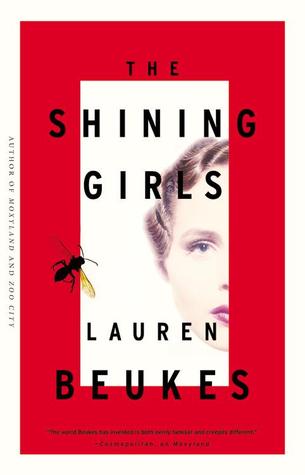
The Shining Girls - Lauren Beukes

The Shining GirlsSometimes my university's popular fiction section has really good books showcased in it.  Sometimes it doesn't.  This is one of the "doesn't" times.

The plot revolves around a time-traveling serial killer whose mission is to kill a bunch of "shining girls."  Why these girls are shining, we don't know.  Why they need to die, we don't know.  Why the killer can travel through time, we don't know.  Why the the house is magical and allows this weirdness, we don't know.  How any of this works, we don't know.  It's never explained.  Any of it.

The chapters rotate between a wide variety of characters.  There are three main ones: Harper, our serial killer; Kirby, one of his victims who actually lived through his attack and now wants to find him; and Dan, a reporter who covered Kirby's case and is now acting as her mentor at a newspaper while helping her unravel the strands of the mystery.  Dan was utterly lovable, with Kirby's own good in mind.  Kirby was self-destructive.  I can understand wanting the person who attacked and nearly killed you to pay for it, but chasing him into an abandoned house by yourself and with no weapons?  Not good.  Harper is just...meh.  There's absolutely no empathy between Harper and the reader, which makes him an extremely off-putting main character.  It made his chapters a chore to read, which shouldn't have been the case.  Harper's killer psychology should have been fascinating, but it wasn't.  he just killed people for apparently no reason, even when we could see inside his head.  Considering his chapters carry about half the book, that wasn't a highlight.  The other characters are Harper's other various victims, who each have one or two chapters a piece, and those chapters vary greatly in quality.

There's one chapter with Kirby in the time-traveling house that occurs in the narrative way earlier than it probably should have, ruining some of the suspense.  The time travel premise seems to rely on the idea that time is a series of loops, but Harper doesn't ever face any consequences for messing with time, and surely he has to be messing up something with all that back-and-forthing and killing people.  I really, really loved some of the victims and would have liked to see them for more than just a few pages.  Some of the writing was quite good, particularly later in the book with the Kirby and Dan chapters, but early on Beuke's conveyance of negative emotions (anger, fear, sadness, frustration, etc.) relied heavily on the use of profanity.  Don't get me wrong, I don't mind profanity.  But I don't think that it should be the basis for conveying your characters' emotions.

Overall, this book did not shine, unlike the girls it was supposedly about.

2 stars out of 5.

Wednesday, December 4, 2013

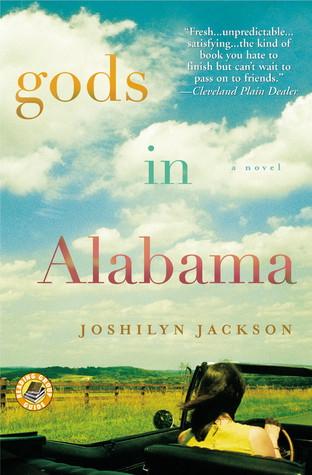
Gods in Alabama - Joshilyn Jackson

Gods in Alabama
Arlene Fleet is a graduate student in Chicago, Illinois, who suspects that her boyfriend is about to propose to her...until he overhears a phone conversation with her aunt and suspects that she might be ashamed of him, as she's never taken him home to meet her family.  He demands that she attend the party her aunt is trying to harangue her into going home for, and that she take him with her.  A fight ensues.  In the midst of it, a girl from Arlene's Alabama hometown shows up on Arlene's doorstep asking questions about a guy named Jim Beverly, and suddenly the book isn't a romantic comedy anymore, because Arlene knows exactly where--or, more accurately, what--Jim Beverly is, and that's dead.  The rest of the book follows Arlene and Burr as they head down to Alabama to throw Rose Mae off Jim's trail, though Burr doesn't know that's the real purpose of the trip.  Arlene is trying to work up the guts to tell him, but faced with everything against her, it's not exactly easy.

I thought I was absolutely going to love this book up until the last chapter.  Five stars, all the way.  The writing is phenomenal, and I can completely imagine Arlene, her crazy family, Rose Mae Lolley, Burr, and the small town of Possett, Alabama.  I loved the multi-faceted way in which she portrayed not only Arlene, the grad student, good Southern Baptist girl, slut, and murderer, but also Jim Beverly, who could protect his girlfriend from her abusive father and usher a girl to the nurse's office so she doesn't have to be embarrassed by having blood all over her pants, but also turn into a violent drunk.  Arlene and Burr's relationship was very real, with conflicts and bumps and moments when you think it might be over, but always lasting because they really and truly do know each other.  I loved the way Burr dealt with Arlene's crazy, mostly-racist family, and I was really loving the book in general.

And then there was that last chapter.  See, in the last chapter, Jackson pretty much unravels the gorgeous narrative she had built up until that point.  I was expecting a House of Sand and Fog-type ending, and I would have been okay with that.  That's not the way this goes, though.  In the end, everyone gets away with what they've done, Jim is a monster after all, Arlene and her family are reconciled, and she and Burr presumably live happily ever after.  It's just too perfect.  Murder doesn't end that way.  Or, it does, sometimes, but very, very rarely.  Arlene & Co. are just primed to be starring on an episode of Cold Case 25 years from now.  That last chapter knocked a couple of stars off my rating of this one.  A more "flawed" ending for Arlene & Co. would have been more satisfying, I think; heart-wrenching, yes, but I think Jackson could have pulled it off if she tried.  She just didn't try.

2.5 stars.