Pages

Wednesday, June 17, 2015

The Assassination of Margaret Thatcher - Hilary Mantel

20563988The fact that the title of this book references a fictionalized event (Margaret Thatcher's assassination--also not a reference to October 12th, 1984 assassination attempt) should be a pretty good indicator of the book's contents.  It's short stories, and all of them have this sense of being completely plausible while also being completely fantastic and utterly creepy.

I feel like I'm not a good judge of short stories.  I know I could never write one; they take a tremendous amount of restraint to do properly, and that's something I seem to lack when it comes to writing.  Mantel, however, has this quality in spades.  She knows exactly how much to reveal in each tale and how much to leave lurking in the shadows, where you can almost but not quite get a glimpse of it.  The topics covered in this collection are broad, from matters of extramarital affairs to dealings with the supernatural to just plain tragedies that are left so that they'll almost give you nightmares.  The endings are, in more than one case, menacing, and the writing style is so matter-of-fact that it's hard to believe that the world could be any other way.

I really enjoyed this, particularly the "Winter Break" story (so creepy) and the titular "The Assassination of Margaret Thatcher," because even though I knew the attempted assassination was fictional, Mantel presented it so elegantly that I felt an urge to look up Thatcher and make sure I hadn't missed something (I don't think I did).  However, one thing I feel is that short stories are often rife with dimensions and symbolism that require deep study, and on a few of these ("Commas") I definitely felt like there was something I missed in reading.  I think several of these stories could bear with a deeper examination, but quite frankly I'm not the right person to do that.  I think this could make a wonderful book for a literature class, though--one that could provide excellent curriculum while also being an entertaining read for the students.  The slight touches of supernatural are enough to make one think, "But what if...?" while not straying into outright realms of fantasy, and the more menacing aspects of the stories (cloven hoofs and grubby hands come to mind immediately) send shivers down the spine.  Overall, I really enjoyed this, and I might look into picking up one of Mantel's novels (which are, I'm told, quite different) once I work through some of the other volumes currently in my possession.

4 out of 5 stars.

Monday, June 15, 2015

An Appetite for Violets - Martine Bailey

An Appetite for VioletsIn 1773, Kit Tyrone arrives at an Italian villa, looking for his missing sister.  He knows she should be at the villa, but all he finds is a decaying feast, the sister's pet pug, and a mannequin dressed in her clothes holding one of his letters and a beautiful ruby.  The story then jumps back six months and switches to the real main character, Biddy Leigh, as she describes the events leading up to the strange scene at the villa.  Biddy is an under-cook at an English estate, and Kit's sister Carinna is her new mistress, who orders Biddy and a few others to accompany her to France and then to Italy "for her health."  Along the way, Biddy records her travels in a book given to her by her ailing mentor and collects recipes.  There's obviously an air of menace about the trip, which Biddy realizes all along but can't fully grasp until it's in hindsight.  She matures greatly during her journey, from a young woman who only wants to marry her sweetheart into someone with larger views and ambitions.  It's a slow and subtle growth, as Biddy takes on more and more responsibilities regarding the traveling party, and was well-done.  I liked the love story (not the love story that the summary makes it out to be, however, which is a good thing; the real one is much better than the summary-hinted one could have been) and the slow buildup of tension, but there were still parts I didn't really like.

One of those parts was Mr. Loveday's chapters.  Loveday is Carinna's slave, and while he's a friend and accomplice to Biddy, his chapters are mostly reminiscences about his home island somewhere in Indonesia, along with the events that led up to his capture and sale as a slave.  While this was good background on the character, I felt like it could have been worked in better than Loveday just daydreaming all the time and not really doing anything else in his chapters; all of his action seems to be in Biddy's chapters, which makes his seem somewhat pointless.  The other aspect I wasn't fond of is that, even though this is a sort of mystery (What happened at the villa?) it's not really a mystery you can solve.  This is because of the way it's written--past tense, versus present tense--which I can appreciate, but if there's going to be a mystery, I like there to be at the least the possibility of solving it, even if I'm not usually successful in that pursuit.  In this, there's no real clues along the way, just the build-up and climax put forward very matter-of-factly.  There's also no real concern for Biddy, because even though some bad stuff happens to her, you know she's writing the story down after the fact, so she has to make it through.

Finally, the characterization of one of the supporting characters (the eventual love interest) bothered me.  Originally, he's fascinated by Biddy and sees to view her as an equal, despite a perceived difference in their classes and an obvious difference in their abilities.  But then, during the novel's denouement, that attitude completely vanishes and he turns into someone who expects Biddy to obey his every wish and not really do anything for herself.  It seemed like a very abrupt about-face without any real cause, especially because he knew what had happened.  If he had been like that the whole time, it would have been more bothersome as a love story but likely more historically accurate; instead, it just came off as awkward, and the man at the end seemed like a completely different person without any real cause, unlike Biddy's transformation (which definitely had cause).

I liked the inclusion of food as a marker for different events on the story, but at the end, I thought Biddy's musings on food and recipes turned a little too philosophical to read true, and the story probably could have ended just a couple of pages sooner without anything really being lost.  Everything is neatly tied up in the end, without any loose ends dangling, which was nice; everything finally comes full-circle, and everything ultimately gets explained.  Overall, I think this was a great book, and a very easy read despite its length.  I'd definitely read others by this author, though they might be some time in coming since it seems like this is her first novel.

4 stars out of 5.

Saturday, June 13, 2015

The Last Good Paradise - Tatjana Soli

21853659This has a fairly low rating on Goodreads, considering that I pulled it from the "Popular Reads" section of the library, and for the longest time I couldn't figure out why.  It seemed like it was going to be a really good study of character.  The story starts with Anne, a lawyer who aspires to be a "shark," and her chef husband Richard, who flee the country after Richard's business partner (and Anne's former lover) Javi embezzles money from their restaurant and lands all of them in a pot of trouble.  They grab the money they have left and head for a tiny resort in the South Pacific, somewhere near Tahiti.  Anne picks the place because it's completely unplugged--no phones, no internet, nothing.  While one of Anne's lawyer friends tries to straighten things out back in the US, Anne and Richard dissolve into island life along with the island's other occupants--guests Dex Cooper (occupation: rockstar) and Wende (occupation: muse) along with the staff (owner Loren, and multifuctional staffers/lovers Titi and Cooked).
For a while, this seemed like it was going to be an exploration of character and relationships, a novel that didn't really have a strong central "plot" so much as strong central "people," and that was fine with me.  The setting was wonderful, and I thought Soli did an excellent job of building the relationships and lack thereof among the characters, orchestrating a well-wrought drama that didn't need a lot of external plot influences in order to propel it forward and keep my interest.  And then...that all changed.  It's like Soli wrote half the book, and then saw a documentary about the affects of nuclear testing on the South Pacific and was so compelled by it that she felt a need to make it an intrinsic part of her narrative.  The book suddenly winged from slowly-built drama and character to talk of terrorists and staged kidnappings.  It just doesn't seem to fit.  The characters all abruptly find a sense of a purpose in a way that is completely disconnected from how the book seemed to be going before.  And then, after a bunch of what can be considered melodrama, it goes back to the way it was before--all serene and subtle and wonderfully written.  The switch of direction was jarring, and didn't seem to be particularly well done.  It had me gaping at the page in complete disbelief, because it felt like a different book entirely.
For the most part, I liked this.  The writing was very matter-of-fact, a style that I think lends itself well to character-driven works and works written with an omniscent point of view.  But, as mentioned before, the sudden switch in narrative left me jarred out of the story and altogether discontented with it until it resumed its original tone toward the end.  I was satisfied with the ending, other than one character's end scene which tended toward the purple end of the writing spectrum.  Because of that weird middle bit (I feel like it probably should have been worked into a different book entirely, instead of smashed into this one; the premise wasn't bad, but the execution and placement really was) I can't really endorse this whole-heartedly, and I can see why it has such a low Goodreads rating.  It was bound for 4 to 4.5 stars, but as it is, I feel like I can't give it that high of a rating.  I'd probably read something else from Soli, but I feel like I'd have to scrutinize the reviews on it first, to make sure that this disconnection in the middle isn't a recurring theme.

Oh, and there's a reference to Portal.
3 to 3.5 stars out of 5.

Tuesday, June 9, 2015

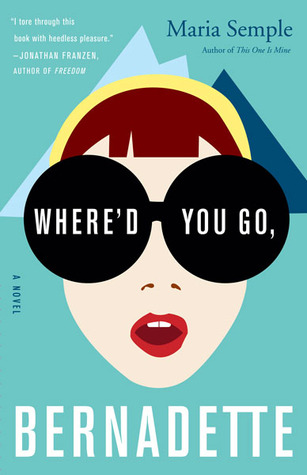
Where'd You Go, Bernadette - Maria Semple

Where'd You Go, BernadetteWhere'd You Go Bernadette[?] is a novel about disappearing.  Everyone in this book is disappearing, and they're all absolutely crazy.  The titular Bernadette Fox, once a famous architect, has vanished from the architectural scene and is slowly being subsumed into soccer mom life (except her daughter, Bee, doesn't play soccer, but it amounts to the same thing, really).  But she's also disappearing from that, having a virtual assistant in India run all of her errands for her so she doesn't have to interact with other people, and then she up and disappears entirely, with no one knowing where she went or what happened to her.  Meanwhile, her husband disappears from their family and into his work, and the supporting characters (known almost entirely through documents they produce) are losing themselves in various ways, too.  Everyone in the book is falling to pieces in pretty much every way imaginable, and Semple does a beautiful job of showing how they're all collapsing on the inside but showing completely different faces to the world around them, making them seem far more composed and in control than they actually are.  Even teenaged Bee, who seems the most together of all of them, is slowly dissolving and un-becoming, disappearing into a completely different Bee as she starts the search for her lost mother.

This is, also, a supremely funny book.  There were multiple occasions when I found myself gasping or giggling out loud at some antic.  Who'd have thought that blackberry brambles could be so funny?  I didn't, and yet they were.  (The blackberry brambles, such an innocuous object, are still one of the cornerstones of this story; hardly any of it would have happened without--or, perhaps more accurately, with--them.)  A lot of this is due to how the book is set up.  The majority of it is a series of documents produced by the characters: emails to and about each other, newsletters sent out to the parents of Bee's school, stuff like that.  Normally I'm not a fan of document-based books, because they tend to be exhausting to read, but this one was extremely engaging.  Despite the characters not being "present" on the page, they were all easily distinguishable and knowable.  The documents trace Bernadette's difficulties coping with life in Seattle, which she tries to avoid by throwing herself into preparations for a cruise to Antarctica--which she simultaneously tries to avoid.  While Bernadette isn't actually "losing it," it looks to many people like she is, and things draw to a head and culminate in her vanishing.  After this point, there are some more documents regarding Bernadette's husband and the other people mixed up in the mess.  Then the book switches, and Bee begins narrating, telling about her search for Bernadette when everyone else has given up.

I also liked how mental health was treated in this narrative.  Bernadette has anxiety regarding some things, but she's not "crazy."  She's not even really agoraphobic, though the back of the book says she is; she does leave the house, routinely, for various things without any crippling anxiety.  She can cope with things and do them herself; she just prefers not to.  However, as she trusts more and more of her life to other people, particularly the Indian virtual assistant mentioned before, people begin to think she's mentally unwell, particularly the mothers of Bee's classmates, who frown upon Bernadette's decisions and lifestyle in general.  This was a wonderful example of how someone who's different--not bad, just different--can be completely stigmatized in an area beyond high school.  Mothers and other parents can be just as vicious as kids in this regard, and the book shows it well--as well as showing Bernadette being vicious right back.  Bernadette doesn't vanish because she's driven to the edge; she vanishes because other people think she has been, and she wants to show that they're wrong.  It's a great example of how people's preconceptions can cause utter chaos when really nothing is the way it was thought to be.

There were a few things that had me raising an eyebrow throughout this (particularly how easy it apparently is to escape from an Antarctic cruise ship, for multiple people) but in general I thought Semple did an extremely good job with how she structured the book; like all books, it requires suspension of disbelief, but once it gets going, everything fits so logically together that it's not a challenge to buy the narrative as a whole.  I pretty much read this in one sitting, and enjoyed every minute of it.

4.5 stars out of 5.

Monday, March 23, 2015

The Last Original Wife - Dorothea Benton Frank

The Last Original WifeThe cover of this book had me dreaming of tropical locations and days on the beach.  I'd hoped it would read something like Barbara Delinsky's Sweet Salt Air, which was a drama I rather liked.  But it didn't.  And I didn't like it.  We're presented with two narrators, Les and Wes.  Les is unhappy in her marriage, for a lot of reasons, most of them having to do with Wes.  Wes' friends have all recently gotten divorced and remarried (or, in one case, widowed and remarried) and Les hates their new wives.  She calls them Barbies and thinks that they're stupid and sluts.  She thinks Harold is an asshole for cheating on his (now ex) wife and is pissed when it's hinted at that Wes might have cheated on her during a trip to Atlantic City.

So what does Les do?  She goes and does the exact same thing and cheats on Wes.  But apparently we're supposed to think that it's okay for her to cheat on him, because she was unhappy.  It's never okay to cheat on someone, unhappy or not.  If you're unhappy, you either need to work it out or break it off.  Not be a vapid, hypocritical bitch who thinks more about what her brother's dog is wearing than the effect that a divorce might have on her family.  And then it's all tied up in a neat little package, happily ever after, la di da.  What?  No.

I hated everyone in this book except Danette, who was the best person of the bunch.  Everyone else was a bunch of hypocritical, stereotypical bastards.

Oh, and the amount of dialogue drove me crazy.  All Les ever does is complain and shop.  That's it.  There is more to life than that!  Uuuuuuugh!  And there were some great settings that were completely underutilized, too.  Atlanta and Charleston (particularly Charleston) have so much character, and our author just ignored that completely and moved Les around like she she didn't have a single brain cell to her name.  If you want me to root for the main character, there has to be some redeeming quality.  Les had none, and Wes had even fewer.

Completely frustrating.  One star.  This is why "chick lit" has a bad name.

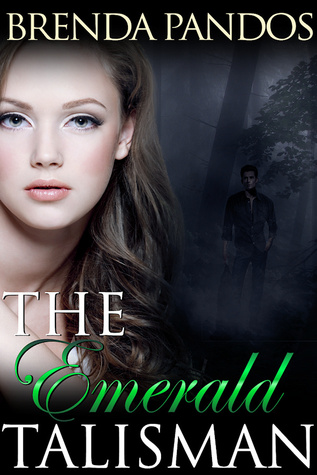
The Emerald Talisman - Brenda Pandos (Talisman #1)

7940997
I have some serious issues with young adult paranormal romances these days, mostly because most of them are terrible.  This one is no different.  Let's dive right in, shall we?

Julia, our heroine, is an idiot.  She thinks words like "obscure" (a word of a whopping two syllables) are "big" and that people should be teased for using them, is taking alegbra at age sixteen (around here, it's taken when you're thirteen or fourteen, in eighth grade, if not earlier).  I work with stupid people all day long (NOT my coworkers, it should be noted--but definitely our customers/clients) and don't particularly want to read about them in my free time.  Doing so just extends the period of time in which I feel the need to punch someone.

It reads like the author just made a character sheet (Q: What type of car does your character drive?  A: A 1984 Volkswagen Quantum) and then dumped every single detail off it into the first chapter.  So basically, you get this: "My name is Julia.  These are my friends.  I can read minds and none of them know.  I drive a 1984 Volkswagen Quantum and work at the best sandwich shop in town.  My mother disappeared when I was five, but my aunt acts as a surrogate mother figure even though I hate her new husband.  I live in the cutest house on the block."  And so on and so forth.  Everything in italics, by the way, is verbatim from the book.

And then there's the biggest problem: the love interest.  Nicholas.  Oh, Nicolas.  Julia, what were you thinking, girl?  He stalks you, doesn't want anyone to know you're together, he may or may not eventually want to rip your throat out and drink your blood.  If that doesn't say "deal-breaker," then I don't know what does.  But no.  Julia meets Nicholas and five minutes later (literally, five minutes later) is head over heels in love with him, obsessing over him, and doing all kinds of stupid, dangerous stuff in the process.

I dream of a young adult paranormal romance in which the heroine actually possesses a brain.  This isn't it.  1.5 stars.

Thursday, October 30, 2014

Enchantress - James Maxwell (Evermen Saga #1)

Enchantress (Evermen Saga, #1)
Enchantress is one of those books that I feel had awesome potential but didn't quite live up to it.  It took a long time for me to get into the story; I found the writing fairly juvenile, the characters flat, and the comma use fairly abysmal, considering that this is supposed to be a professionally-published book.  (Though 47North is an Amazon imprint, so I'm skeptical of how much work they actually put into the books they publish.)  I'm glad I soldiered through, because there was a great story lurking in the background involving a pair of siblings, one who wants to be an enchantress and one who wants to be a bladesinger, and the conflict in which they find themselves embroiled, but ultimately Maxwell just kept doing things that would jar me out of the tale and leave me going, "Wait, what?"  Here are some examples:

-Ella makes a terrible, foolish decision that has terrible results, and yet she is only nominally punished for it; she isn't expelled from the enchanters' school, all of classmates and teachers continue to adore her, and she gets the school's most prestigious award despite her actions.

-Maxwell alternates between info-dumping on things that aren't really interesting, like politics, and not fleshing out aspects of the story which would be interesting, like the Dunfolk, the different types of magic, etc.

-Characters appear out of nowhere, and we are expected to develop emotional connections to them on the basis of two or three pages, before they vanish, are killed off, or otherwise exit stage right and are never seen again.  Other characters' loyalties and motivations seem to switch between different factions and emotions with little rhyme or reason behind the changes.

-There seems to be some discrepancy with the internal "rating" of this book.  For example, Maxwell includes a fairly detailed sexual encounter early in the book, as well as a near-rape scene and some gruesome battles, but the "wrack" (which should probably be "rack") punishment/torture session is self-censored, which seemed odd when it could have greatly helped the development of Ella's character.  As it was, she came off seeming completely unaffected by that incident, and it did nothing to mature her as a person.

-Maxwell dabbled with elements of a lot of books I liked; a city of bridges, like in Bitterblue, a magical academy much like in Harry Potter, A College of Magics, or The Name of the Wind, an imposing empire poised to take away the freedom of other territories similar to The Ropemaker, and fantasy desert tribes like The Woman Who Rides Like a Man, but never really tied these together into what felt like a rich, cohesive whole, and instead spent too much time jumping between elements, trying to cram in too many plotlines that were never fully developed or explored.

-Armor and swords that requires constant singing to make them useful doesn't actually seem very useful at all, especially when this "needs to be sung about to work" quality isn't used consistently.

-The story strongly relies on the concept of different "houses" that practice different types of magic, but all of the types actually feel the same, with no clear distinctions made between them.  Essence, the source of magic, can't be used on living things, only inanimate objects, so there doesn't seem to be a reason that one group of people can enchant a wall and another group can enchant a shield, but they can't switch objects.  Additionally, despite it being repeatedly hammered on that essence can't be used on (most) living things without horrible consequences, one house can apparently make trees come to life, move around, and even fight battles without said consequences making an appearance.

-A better place to break the book would have been when Ella joined up with the desert clans and Miro fought his big battle; after these points, the book had a much different feel to it that would have suited the beginning of a second book more than the ending of a first one.

I might pick up The Hidden Relic, the second book in this series, but I'm not sure quite yet.  If I do, I hope to find that Maxwell's writing has matured some and the flaws that were so jarring in Enchantress are lessened or eliminated in The Hidden Relic.