Pages

Showing posts with label rape. Show all posts

Monday, February 19, 2018

Not Quite a Husband - Sherry Thomas (Marsdens #2)

Not Quite a HusbandHaving read Sherry Thomas' YA fantasy trilogy, the logical next step was to try one of her historical romances.  I picked Not Quite a Husband because I'd seen it on a few friends' reading lists, and it was also available from the library.  It was a quick read, only about two and a half hours, which made it a perfect book for a Saturday afternoon.

Heroine Bryony fell immediately and madly in love with Leo Marsden when he appeared in London one Season, reappearing from a past in which she knew him as a child.  Despite being focused on her career and having no plans to marry, she proposes to him in quick order, he accepts, they marry--and the marriage falls apart almost before it has even begun.  Time jump after the prologue to Bryony living in a remote area of India, serving as a doctor to a missionary community and hiding from the scandal that the annulment of her marriage caused.  Until Leo shows up, having been sent by Bryony's sister to find her based on a claim that her father--from whom Bryony is estranged--is dying.  And so begins a trip back across India while a rebellion brews in the background.

This struck me because I was simultaneously finishing up The Far Pavilions, which also takes place (mostly) in India, though in both books it's an India pre-partition, which means that the geography also includes modern-day Pakistan, so keep that in mind while you're trying to keep things straight in your head.

Watching the initial relationship here was, to me, more interesting than watching Bryony and Leo come back together.  Seeing those little snippets of them growing up, encountering each other again in London, and then the dissolution of that relationship...that was the fascinating part.  I do think their reunion could have been fascinating, however, I wasn't entirely convinced by it.  The sex was definitely of the "dubious consent" variety, which kind of squicked me out (and so was a lot of the sex during their marriage, which, what?  THAT IS SO CREEPY, LEO), and rapey heroes are so not my thing.  Just because someone gets physical pleasure from sex doesn't mean they want it, let's remember.  Then, the entire impetus of the relationship is basically adrenaline in the face of near-death experiences, which is fun, except that's basically the entire thing, no other supporting emotional incidents.

Overall, I was disappointed by this.  The initial premise and the setting had such promise, but the relationship really soured to me because of Leo's actions.  If he wasn't so rapey I think I would have liked him--I think I even could have forgiven him the discretion, maybe--but the combination was just too much to me.  I didn't hate Leo with a fiery passion (a la Greg from Happily Ever Ninja) but he creeped me out and I found myself wondering why it too Bryony so long to get away from him in the first place.  (Yes, yes, Victorian norms.  I know.  But that can totally be skirted in a modern book.)

Additionally, this is marked as the second book in a series, so I've denoted that, but looking at the so-called first book, I'm not sure what the connection actually is.

2 stars out of 5--for the setting and premise, and also for Bryony, because female doctors in historical fictions are awesome.

Wednesday, January 10, 2018

Perennials - Mandy Berman

PerennialsI never went to sleepaway camp as a kid or teen.  I went to week-long day camp a few summers as a Girl Scout, and I think there were a few weekend-long overnight excursions, but nothing long-term.  It was just something that never came up and something, reflecting back, that my family probably couldn't have afforded even if it had come up.  So to me, summer camp has all the sheen of media, and typically in the horror movie sense.  You know, campers missing in the woods, something in the lake that's killing people...that kind of stuff.

Perennials both is and isn't like that.  Ostensibly about two young women, Fiona and Rachel, who attended a camp as children, as they return for one final summer as camp counselors and learn about growing up in the face of a tragedy.  Well, there is a tragedy indeed--more than one.  And while there are no serial killers lurking in the woods and no monsters cruising the lake, this book sometimes struck me as a horror story of another kind entirely, because what is up at this camp is very, very wrong.  Counselors are sleeping together--as teenagers do--and the camp director even gets involved.  Someone witnesses a rape--a very obvious one, in which the victim is seen saying she wants to go to bed, and is blatantly pulled into the woods and raped despite her protests--and the victim is punished for it along with the perpetrator.  Ill fates await not one but two campers over the course of the same summer. 

The lens Berman chose for this was interesting.  The story is told in third-person through a variety of perspectives; Rachel and Fiona each have a couple of chapters, but most of the book has the viewpoints of a variety of other characters.  The camp director, the two girls' mothers, Fiona's little sister, other counselors, campers, etc. all get to chime in with things happening over the course of the summer.  My favorite was probably Sheera, and I would have liked to see more of her; she was so different from the other characters, which was no doubt the point, and I felt a little robbed when she exited the stage relatively early in the book.  Seeing things through both Rachel and Fiona's perspectives was interesting, though--from Fiona's perspective we can see that she thinks Rachel doesn't really care about her except to serve as the "responsible" one, but from Rachel's we get another view: that she really does love Fiona, she just wishes she would come out of her shell and not need constant reassurance that she's liked.

The title here was especially poignant; while marigolds, the plant the camp is named after, are annual flowers, Fiona and Rachel themselves are perennials, coming back year after year and seeming to pick up right where they left off.  The difference is this final summer, when things seem to change so drastically in such a short period of time.  Both of their lives are ultimately turned upside down and the two are pushed apart by the events of the summer--however, the book ends on a positive note, with the potential for them to recover and grow closer together as a result, if they want to.

On the downside, the multiplicity of viewpoints leads to a lot of info-dumping.  Because there are so many characters and Berman wants to give you the full story about what brought each of them to Camp Marigold, there's a lot of "This happened to this person, which made them feel this way, which led to this."  There are a few great flashback scenes that did far more to contribute to character building than the straight-up info dumping, which showed some of what Berman could do, but the book's short length limited them by necessity and so we were left with long periods of info separating out bits of character interaction and forward movement.

Ultimately, I liked this.  However, I think it's much darker than Berman intended it to be.  Obviously there are some tragic events here, but there's another layer of darkness underlying it all that I'm not sure was deliberate.  And if it was--well, this was marketed in entirely the wrong way.  But for a character-driven book, I thought this was very good.

4 stars out of 5.

I received a free copy of this book from the publisher for winning a Goodreads giveaway.

Saturday, October 28, 2017

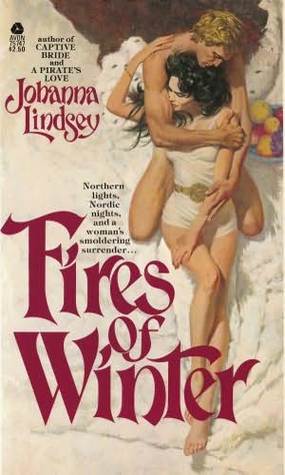
The Fires of Winter - Johanna Lindsey (Haadrad Viking Family #1)

Fires of Winter (Haardrad Viking Family, #1)I recently looked at my 2017 reading challenge in the Unapologetic Romance Readers group on Goodreads and realized that if I didn't get moving, I was going to be in very, very big trouble.  Here's the thing: I was tearing through that challenge at the beginning of the year.  But in doing so, I kind of...read all of the categories I was looking forward to.   Which left me with the "dregs" of categories I don't have much interest in or have downright been dreading reading for the end of the year.  Sigh.  Nevertheless, I had to get to it, so I decided to go for the "Viking romance" category I still had pending.

Much like sheikh romance books, Viking romance books seem to have a theme of being very rapey.  This is somewhat because this is what Vikings did.  They pillaged and plundered and raped and ravaged.  Not amongst their own people, where rape was a very, very serious crime, but Viking romances typically involve a young woman from the British Isles being swept away by a marauder and then falling desperately in love with him after her "traitorous body" responds to his ravishments.

Ich.

But there didn't appear to be any escaping it, and so I took on Fires of Winter.  The heroine here is a Celtic woman named Brenna, who was basically allowed to act like a boy for much of her young life and goes around in boys' clothes and carrying a sword.  You would think Brenna would be all about the #gurlpower, but the book starts with her discovering a man raping a woman and deciding it's okay as long as the rapist marries his victim.  This pretty astutely sums up Brenna's outlook for the book.  She's supposed to be married to a Viking in order to cement some sort of peace treaty, but the Viking's father, Anselem--with whom the deal was struck--reneges and raids her home as a form of vengeance; the prospective groom, unaware that he even was a prospective groom, doesn't show up until later, when Brenna is already ensconced in his house as a slave gift from the aforementioned raiding father.  Brenna, unlike all of the other women in her town, manages to escaped being raped in the journey to Norway, because of course her virginity must be preserved so "hero" Garrick can divest her of it.

Garrick is awful.  He's known as the "Hardhearted" because he doesn't like women after a former lover scorned him, but we're supposed to see through his tough exterior to a warm and cushy center.  Not so much.  Repeatedly raping the heroine doesn't really get very far, and Lindsey doesn't even attempt to mitigate the act with any "traitorous body" nonsense (which is the traditional out in this type of book, the 1980s bodice-ripper--"she liked it and so it's okay in the end") until pretty far into the book.  And even then, Brenna returns to her philosophy of that it's not wrong that Garrick is raping her, it's wrong that he's raping her and refusing to marry her after.  Why does he refuse to marry her?  Because she's a slave, but he can't free her, because then he wouldn't be able to rape her!  Obviously.

BUT!  Here is the thing.  Horrible people doing horrible things does not necessarily a bad book make, as my recent reading experience of The Bronze Horseman goes to show.  What actually made this a bad book was the writing.  Brenna was not a heroine I could root for; her actions in the beginning of the book, excusing a rapist even though she protests to hate rape, set me against her from the start, and it wasn't an upward path from there.  Despite saying she will never be dominated by a Viking, she finds herself basting the hindquarters of animals pretty quickly and cleaning up a room she trashes because Garrick says he won't feed her until she does.  She is of the foot-stamping, hair-tossing variety of woman who everyone happens to love, or at least want, at first sight and who, despite being "the best" warrior, manages to get her ass handed to her at every turning point.  She screeches and flails and is just generally so annoying that I wouldn't have minded if she fell into a fjord and drowned.  Garrick, though a terrible person, actually fit the book better, because his actions were essentially what I expected of this variety of character in this time and place.  I actually kind of appreciated that Lindsey didn't make him the raider who had stolen Brenna away, because that was actually something a little different.  But despite having an intellectual acknowledgement of Garrick and his motivations, I still couldn't feel strongly for him in any direction because Lindsey's writing is just flat.  No emotion, no spark, no fury, no passion.  Nada.

Looking at other reviews of the book now, I see I probably could have spared myself the time if I had realized Nenia from Readasaurus Reviews (and also admin of the Unapologetic Romance Readers group) had already read and reviewed this.  But still, the library didn't have anything available on Kindle and this was relatively inexpensive, and I don't think most other Viking romances would have any better, so I'm just going to move on.

1.5 stars out of 5.

Saturday, July 8, 2017

Missoula - Jon Krakauer

Missoula: Rape and the Justice System in a College TownOh, boy.  What a hard book this was to listen to.  It was available through the DC library, so I grabbed it because the topic was riveting, but I knew it would be hard from the get-go, and it was.

Somewhere between twenty and twenty-five percent of women in college will be sexually assaulted.  Jon Krakauer examines this situation specifically in Missoula, Montana, which was the scene of a rape scandal in 2012 when it came to light that a slew of sexual assaults and rapes had occurred at the University of Montana.  Krakauer focuses his narrative around a few of the cases that came to light, and focuses mainly on a young woman named Allison.  Allison's case is central to the book because she's connected to so many other people who played parts in the other cases that Krakauer brings up.

He addresses false rape allegations, which are exceptionally rare, and how people still believe that "crying rape" is something that women do because they regret decisions or want attention--because clearly every woman wants to be dragged in front of a court and denigrated as a slut in front of everyone she's ever known, right?  Turns out that the false statistic that 50% of rape allegations are false comes from two small studies, both of which have been thoroughly debunked but people still cling to, much like people still cling to that one thoroughly debunked study that claimed vaccines cause autism.  And with that put aside, he dives into how cases are prosecuted (or not prosecuted) and how they're dealt with at the university level.

The results of all this are devastating.  They reinforce that men feel entitled to women's bodies, to drugging them or plying them with alcohol and then ignoring the word "no."  That those who are responsible for prosecuting rape cases frequently choose not to do so because it would be too hard, and that women are discouraged from pressing the matter or reporting their rapes because if they do, they will be paraded as sluts in front of a course of family, friends, acquaintances, officials, media, etc.  That "no" means "yes" and moaning can only be done in pleasure, not pain or fear, and clearly means that you liked it, so obviously it was consensual.  That, even if a man is convicted of rape, people are so often concerned about the impact of prison time on his life rather than the impact the rape has had on his victim.  That people can be elected to high positions in the legal system after slandering rape victims in court.  That if you play football, you really can get away with anything.

Men are, of course, raped as well--but this is a crime that is perpetrated largely against women by men, and so that's what Krakauer focuses on.  His narrative includes interviews, transcripts trials, and reviews of documents, and it's overall a very thoroughly researched book.  It's devastating, of course, and rage-inducing, but overall an excellent example of literary journalism.  And he nails it home with one poignant fact: that, despite the fact that he's focused on this string of rapes in Missoula, Missoula actually had a rape average below the national one, and that is the real scandal.

Highly recommended.

5 stars out of 5.

Saturday, July 27, 2013

Royal Seduction - Jennifer Blake (Royal Seduction #1)

Royal Seduction (Royal, #1)Royal Seduction begins when a prince comes to town looking for the lover of his murdered brother.  He wants to ask her some questions.  Unfortunately, he thinks that Angeline is the girl he's looking for, when in fact her cousin Claire is the former prince's lover.  When Angeline insists that she's not the right person, Rolfe refuses to believe her, or even ask anyone else at the party where they meet if she is who she says she is.  Rather than try to verify her story, he kidnaps her and rapes her.  Then, having realized that Angeline is the wrong girl on the basis that she was still a virgin, he refuses to apologize or release her, and continues raping her periodically as he drags her about the countryside in search of Claire.  Along the way, Angeline is kidnapped by other people several more times, and is nearly raped by other men on at least three occasions, while falling in love with Rolfe in a dazzling display of Stockholm Syndrome.  Apparently we're supposed to think that Rolfe's rapes are romantic, while the other near-rapes are horrendous.

Rolfe never apologizes, merely displays a tremendous sense of entitlement that makes him think he's entitled to take whatever and whoever whenever he wants.  He drinks copiously and displays extremely violent tendencies.  This might not be historically inaccurate; of course, horrible things like rape did occur in "courting" and in some places probably still do.  But that doesn't make it right, and it doesn't make it romantic.  Portraying it as so only presents a twisted vision of a severely traumatizing experience and lends itself to the culture of blaming the victim.  It's because of shit like this that people say women are responsible for rape, because hey, they never explicitly said no.  And it's romantic.  Stop crying, bitches.

Hey, Blake, I have news for you.  Rape is rape is rape, and it's not sexy.

1 star out of 5.