Pages

Showing posts with label character driven. Show all posts

Wednesday, January 31, 2018

The Music Shop - Rachel Joyce

The Music ShopOne day this past fall, I got stuck in a Youtube spiral.  You know, you start watching one video--in my case, one of Lea Salonga performing "Own my Own" from Les Miserables--and soon you're going through one related video after another.  I ended up, somehow, in chain of flash mob videos, including one of a performance of the "Hallelujah Chorus" in a food court.  I'm not sure what kind of Youtube spirtal Rachel Joyce got stuck in, but it must have been a similar one, because I feel pretty confident that this book is one of those "What led to this moment?" ponderings.

Set mostly in the late 1980s, the main character in this story is Frank, the owner of a music shop in England that only sells vinyl in a time when CDs are becoming all the rage.  When a young woman faints outside his shop one night, Frank finds himself seemingly tied to her as she comes back again and again, and finally asks him to teach her about music the way he sees it--in a way that was influenced by his eccentric and neglectful mother--though Frank knows there can't be any romance, because Ilse has a fiance.  Filled with quirky characters such as Kit the accident-prone assistant manager, the man who only likes Chopin, the ex-priest Father Anthony who owns a religious souvenir shop, and Maud the grumpy tattoo artist who is secretly in love with Frank, this is also the story of a crumbling but loving community that makes up the nook of Unity Street.  The chapters each focus around a song or cluster of songs, with Frank giving new insight into people on how to live and feel through the music that he finds for them.  But for Ilse, even with her lessons, he hears only silence.

This is a cute story.  Frank's devotion to vinyl isn't blind, he has reasons for it, and hey, vinyl is even making a comeback in our current days, when most of our music is purchased and consumed through our computers and phones!  (This is touched on later in the book, as well.)  I did feel like the "Hidden Track" segment at the end was unnecessary, but maybe that's why it's labeled as a hidden track instead of an epilogue--it's not necessary to listen to it/read it, but you can if you want to.  Though the "sides" of the story, which make up the parts, gave me a very strange mental picture.  Rather than having just two "sides," like a record, there are three or four--which would make a very oddly-shaped record indeed.

The discussions of music that both Frank and his mother, Peg, lead throughout the book are by far some of its strongest points.  They make you think of music in new ways--about the sounds that underlay the main melody, about the way the instruments are used, about the silence that precedes and follows and sometimes pauses a song.  The atmosphere of Unity Street is intriguing--the struggling community being menaced by Big Development, and not really being able to keep going despite their willpower to do so.  The close-knit connections of the people here provide the heart for the story, even when things seem to be going badly.  But some of it is definitely overblown.  Kit's clumsiness, for example, is never ending and completely exasperating, and while it leads to a catalyst for the story, I found myself rolling my eyes in exasperation at him rather than laughing for his antics after just a few chapters.  And the climax of the book, while lovely, definitely stretched the bounds of suspension of disbelief.  Additionally, Frank and Ilse's love (because yes, of course there is love even though Frank is convinced it can't be) is of the instant variety, which means that the back-and-forth between them for most of the book feels excessively dramatic.

Overall, a cute book, but one I'm not sure I would reach for again.  After all, if I want to get the feeling of that climactic scene, I can just head over to Youtube.

3 stars out of 5.

Friday, January 19, 2018

Baking Cakes in Kigali - Gaile Parkin

Baking Cakes in KigaliBaking Cakes in Kigali has been on my to-read list for a while, and as I have a friend who recently traveled to Rwanda and was in Kigali for New Years', the book popped back to the front of my mind and it seemed like a good time to read it!

Set in Kigali in 2000, the story is a slow, character-driven one about a neighborhood that centers around a single apartment complex and particularly one woman who lives there, Angel.  Angel is a native Tanzanian who lives in Kigali with her husband, who is doing consulting work for a technical institute, and their five grandchildren, who they care for in the wake of the deaths of both of their children.  Angel interacts with other people who live in the complex as well as others they are connected to, and others still who come to order cakes from her.  Her cake making business is the heart of the book, bringing her into the lives of many other people and revealing their secrets to her, as she promises confidentiality as part of being a "professional somebody."  There characters include Odile, a nurse who survived the Rwandan genocide; Jenna, the wife of a CIA agent who she doesn't know is a CIA agent, and who is also cheating on her; Sophie and Catherine, a pair of American volunteers helping with the reconstruction of Rwanda in the wake of the genocide; Vincenzo, Amina, and Safiya, a Muslim family Angel is close to; and Leocadie, a young woman who runs a small shop down the street.

This is a book that touches on a multitude of tough subjects while still remaining a wholesome story.  There are so many tough subjects--AIDS, genocide, suicide, rape, genital mutilation, kidnap and child soldiers, to name just a few--that I kept expecting disaster to pop up around every corner, but it (thankfully) never did.  Really, the story touches on those things, but it's about Angel acting as a sort of mother to the entire neighborhood, handing out wisdom over cake and milky cardamom tea.  Love, loss, and schemes are all poured out and over, and Angel, despite having had difficult times of her own, remains a calm force throughout, and even leverages her insight for others to help herself come to terms with the death of her daughter.

I liked the writing here.  At some times I did find it a bit stiff and formal--however, I had to keep in mind that, while this book was written in English, most of the dialogue is actually delivered in Swahili that Parkin represents as English on the page.  Some other reviews indicate that Angel's version of Kigali seems a bit too bright and sunny for taking place after the genocide--however, the genocide occurred in 1994, and the book takes place in 2000.  There are ongoing trials and attempts at reconciliation--two of the characters that Angel meets have come from South Africa, where they worked on the truth and reconciliation process following the breakdown of apartheid, in order to assist--but six years can change a heck of a lot.  And I think Parkin did a good job showing that, while some people seem happy and functional, they can still be deeply scarred and haunted below the surface.  And it's also important to remember that, while the genocide was clearly a huge part of recent Rwandan history, it's not all that Rwanda is--and that, I think, is what Parkin was really aiming for, and I think she accomplished it.

The structure of the book revolves a series of events, all things which people would order a cake for, which allows Angel to really become involved.  Again, this is a character driven book, which means that there's not a strong central plot and the story instead revolves slowly around the people on the page rather than a driving event or crisis.  The structure works well for this type of narrative, but it's definitely not something that everyone enjoys.  Considering this was a first novel, I think it was done extremely well; characters can be hard to balance without plot points driving them along, but Parkin did so with aplomb, and this was overall a joy to read.

4 stars out of 5.

Wednesday, January 10, 2018

Perennials - Mandy Berman

PerennialsI never went to sleepaway camp as a kid or teen.  I went to week-long day camp a few summers as a Girl Scout, and I think there were a few weekend-long overnight excursions, but nothing long-term.  It was just something that never came up and something, reflecting back, that my family probably couldn't have afforded even if it had come up.  So to me, summer camp has all the sheen of media, and typically in the horror movie sense.  You know, campers missing in the woods, something in the lake that's killing people...that kind of stuff.

Perennials both is and isn't like that.  Ostensibly about two young women, Fiona and Rachel, who attended a camp as children, as they return for one final summer as camp counselors and learn about growing up in the face of a tragedy.  Well, there is a tragedy indeed--more than one.  And while there are no serial killers lurking in the woods and no monsters cruising the lake, this book sometimes struck me as a horror story of another kind entirely, because what is up at this camp is very, very wrong.  Counselors are sleeping together--as teenagers do--and the camp director even gets involved.  Someone witnesses a rape--a very obvious one, in which the victim is seen saying she wants to go to bed, and is blatantly pulled into the woods and raped despite her protests--and the victim is punished for it along with the perpetrator.  Ill fates await not one but two campers over the course of the same summer. 

The lens Berman chose for this was interesting.  The story is told in third-person through a variety of perspectives; Rachel and Fiona each have a couple of chapters, but most of the book has the viewpoints of a variety of other characters.  The camp director, the two girls' mothers, Fiona's little sister, other counselors, campers, etc. all get to chime in with things happening over the course of the summer.  My favorite was probably Sheera, and I would have liked to see more of her; she was so different from the other characters, which was no doubt the point, and I felt a little robbed when she exited the stage relatively early in the book.  Seeing things through both Rachel and Fiona's perspectives was interesting, though--from Fiona's perspective we can see that she thinks Rachel doesn't really care about her except to serve as the "responsible" one, but from Rachel's we get another view: that she really does love Fiona, she just wishes she would come out of her shell and not need constant reassurance that she's liked.

The title here was especially poignant; while marigolds, the plant the camp is named after, are annual flowers, Fiona and Rachel themselves are perennials, coming back year after year and seeming to pick up right where they left off.  The difference is this final summer, when things seem to change so drastically in such a short period of time.  Both of their lives are ultimately turned upside down and the two are pushed apart by the events of the summer--however, the book ends on a positive note, with the potential for them to recover and grow closer together as a result, if they want to.

On the downside, the multiplicity of viewpoints leads to a lot of info-dumping.  Because there are so many characters and Berman wants to give you the full story about what brought each of them to Camp Marigold, there's a lot of "This happened to this person, which made them feel this way, which led to this."  There are a few great flashback scenes that did far more to contribute to character building than the straight-up info dumping, which showed some of what Berman could do, but the book's short length limited them by necessity and so we were left with long periods of info separating out bits of character interaction and forward movement.

Ultimately, I liked this.  However, I think it's much darker than Berman intended it to be.  Obviously there are some tragic events here, but there's another layer of darkness underlying it all that I'm not sure was deliberate.  And if it was--well, this was marketed in entirely the wrong way.  But for a character-driven book, I thought this was very good.

4 stars out of 5.

I received a free copy of this book from the publisher for winning a Goodreads giveaway.

Friday, November 24, 2017

The Japanese Lover - Isabelle Allende

The Japanese Lover
The Japanese Lover has been on my radar for some time because it was a past Book of the Month option, but it was sold out by the time I joined BotM, so I didn't get a chance to read it.  When it was added to my library's digital book collection, I added myself to the waitlist--only to have about a billion holds all come through at the same time and lead to me scrambling to finish them all!

The story here is on two timelines.  We're first introduced to a contemporary timeline, though it still takes place over the span of a few years.  The main character in this timeline is Irina, a young woman originally from Moldova who begins working at Lark House, an elder care facility in San Francisco.  Through her work, she also ends up being the assistant to Alma Belasco, a still-independent woman who lives at the facility much to the bafflement of her family.  Alma's grandson, Seth, also becomes involved as he falls in love with Irina.  The second timeline involves Alma's past, from her immigration to the United States from Poland in the days leading up to World War II through her later life, and heavily involves both her cousin/eventual husband Nathaniel and Ichimei, the son of the Belasco family gardener to whom Alma becomes close...and who is, it doesn't take a genius to guess, the eponymous "Japanese lover."

Looking at this book now, I realize that it's been translated, and I bet that explains the problems I had with the book.  They are basically the same complaints that I have about every book in translation, which is what leads me to think it's actually the nature of translation rather than some problem intrinsic with the book itself.  The problems are twofold: the prose is very tell-y without a lot of emotional depth, and the conversation is very stilted.  Honestly, considering that I have these issues so often with translated books, I'm not going to dig into them too much and just kind of accept that it's the way they are.  However, I do think that there are a couple of things that are unique to this book that I can go into in a bit more depth. 

The two timelines is an interesting and important component of this book, but they're definitely not equal in quality.  The contemporary timeline is much stronger than the historical one.  Why?  Because it covers less time.  The book is pretty evenly divided between the two timelines, but with the contemporary one covering fewer years, it means that Allende can examine the characters and events with more depth.  In the historical timeline, she tends to glaze over lot of the characters' deeper emotions and motivations, and the writing doesn't end up being as engaging.  Additionally, Irina is given a Tragic Past.  It is tragic indeed, but it is hard to see what purpose it actually gave to the plot other than making her shy away from Seth (who, by the way, will not take "no" for an answer, very creepy and pushy) and honestly, a girl doesn't need a Tragic Past in order to not want to be with a guy, or to be with anyone.  It seemed like Allende was just trying to justify the delay in their relationship, but honestly, you don't need to justify not wanting to be in a relationship with someone.  That grated on my nerves a bit; even if Allende wanted the two of them to end up together, there was no reason that Irina couldn't just decide that her life was in a better place for a relationship later in the book than it was earlier.

Overall, I enjoyed this, but the translation meant that it had rough spots, and some of it wasn't engaging.  This definitely isn't a "rave" review, but I wouldn't discourage you from reading this, either, if the story seems like it would pique your interest.

3 stars out of 5.

Friday, September 1, 2017

Plainsong - Kent Haruf (Plainsong #1)

Plainsong (Plainsong, #1)Plainsong was the September book for discussion in the Deliberate Reader Book Club.  After the train wreck that August's book, The Diamond Age: or, a Young Lady's Illustrated Primer was, I was glad to see that something was going to be a bit more, ah, tuned down.  The story of a small town in Colorado seemed like that would fit the bill.

This is definitely a character-driven book focusing on a handful of people in the town of Holt, Colorado.  The book also tries to be artsy, by doing one of those things where the author is apparently too good for dialogue punctuation marks.  I find that extremely irritating, and it almost made me put down the book; I only continued reading it because I wanted to be able to take part in the discussion in case anything interesting came up.

The main characters in Holt are Guthrie, his sons Ike and Bobby, and teenager Victoria.  Other characters are the McPheron brothers and Maggie, and occasionally Gutrhie's wife Ella.  Guthrie is a teacher and Ella is depressed and their marriage is falling apart, which clearly impacts their children.  Guthrie is also dealing with a troublesome student in his school.  Victoria, on the other hand, is pregnant from a boy she was seeing over the summer and who has since ditched her, and her mother throws her out of the house and casts her adrift on the town's mercies.

I greatly preferred Victoria's part of the book to any of the other characters.  Watching her adjust to her new life and slowly building a relationship with the McPheron brothers was a real example of character growth, as opposed to Guthrie who seemed to be just running in place.  Ike and Bobby didn't interest me much and their parts mostly seemed like filler, just to show that there were children involved to begin with.  I actually did like Ella; though she's not very present and doesn't seem like a good mother, I could empathize with what was her struggle with depression.  It wasn't that she didn't want to be a good wife or mother or functional human being in her own right, because she clearly did, but she just couldn't.  And she knew that remaining in Holt wasn't going to help her, so she had to leave.  I liked that Haruf didn't seem to shame her for this, but just portrayed it as it was.

One thing to keep in mind is that there's not much of a plot here to follow; this is evidently a series, though it's a strange book to be a series, and there might be some sort of large, overarching plot involved across the multiple books, but there's nothing really driving the story forward as an episodic story in this single volume.  This means that, while some of the people were enjoyable to read about, the book wasn't riveting.  I could put it down easily and sometimes found myself paging ahead to find out when Victoria's next section would begin.  And honestly, the cover here seems perfect for the book: dim and gray, much like Holt and the book itself, with Victoria's red purse and the McPherons' red cow being the only splashes of color in the whole book.

Overall, this was an enjoyable book for what it was, but I didn't find it to be anything extraordinary.  The lack of dialogue punctuation drove me to frustration--there's really no need for that.  I don't think I'll continue with the series, but it was fine for a book club book, and a welcome slowdown from last month's Book of Crazy.

3 stars out of 5.

Saturday, August 5, 2017

Crazy Rich Asians - Kevin Kwan (Crazy Rich Asians #1)

Crazy Rich AsiansMy first impression after finishing this book is that there should be a comma in the title.  Or maybe not.  Indeed, these Asians are crazy rich, with crazy being used as an adverb modifying "rich" to show the degree of their wealth.  But they're also crazy as in crazy, meddling and pushing and driving people away.  Wow.

This book is the story of several intertwined Singapore Chinese families and one normal Americanized Chinese girl who inadvertently stumbles into the middle of them.  Rachel Chu is thrilled when her boyfriend Nick invites her to go to Asia for the summer--apprehensive, because she's never met his family before, but also excited, because she suspects this might be leading up to a proposal.  But what she didn't expect was that everyone knew who she was before she even arrived, and they're ready to drive her out in order to preserve Nick for someone they consider one of their own.  Rachel has few friends in Singapore, and though she tries to maintain firm, the forces against her sometimes seem insurmountable.

This was a very good book.  It is, at its core, a family drama, but it's funny.  It's kind of like Gossip Girl or something similar, but the characters are adults instead of teenagers.  The drama is over the top, yes, and is in no way supposed to be representative of all Chinese society or Singaporean society or Asian society in general.  But even when the characters are at their most back-stabbing and undermining, the drama still manages to be amusing, mainly because everything is so over the top.  For a while, I was concerned that Kwan was really going to bring down the book with a realistic-but-unhappy ending; fortunately, that wasn't the case.  Everything else was so crazy here, it didn't make sense to have a downer ending that suddenly fit the facts, so I'm glad that Kwan went the way he did.  The writing is extremely readable, and there are lots of terms that are thrown in and foot-noted so that you know what they are.  There's educational aspects about food, drink, and customs among the insanely rich in Singapore.  Rachel, meanwhile, serves as our bridge character--the one who helps bring us into this ridiculous world while maintaining a sense of stability and normalcy.  A character like this was definitely needed, or else all of the crazy might have just been too much.

It does verge on being too much at some points, and I had some doubts about some of the characters, like Araminta, so I'm not sure all of their intentions were clearly marked in the end.  Close to the end, there's also a giant infodump to clear up a little plot involving Rachel's background and Nick's family's attempts to get rid of here.  That really dragged down the pacing at a point that really needed it the least, the climax--the last thing you want to do at the climax of your story is dump in a bunch of background information that disrupts the flow, and that's exactly what happened here.  Still, considering this was a debut novel, it was remarkably good!  Such a funny story and family drama, with good central characters who help anchor all of the crazy ones and lend a sense of "down to earth" that was really needed to balance the plot.  I am definitely looking forward to reading more from Kevin Kwan!

4 stars out of 5.

Wednesday, July 12, 2017

Eight Hundred Grapes - Laura Dave

Eight Hundred GrapesAh, another foray into the world of audiobooks.  My audiobook selections tend to revolve mainly around what the library has available for download at the exact moment I'm looking; Eight Hundred Grapes fit that description when I finished Dark Places and was looking for something else to listen to while walking to/from work and doing my running.  The book had caught my eye before, from Book of the Month and then on a few lists of good books from 2016, so I decided it was worth a shot.  The results?

Pretty good!  The narrator here is good for the book's main character, Georgia, who narrates the story in first-person.  Georgia flees to her family's vineyard in Sonoma County, California, seeking refuge after seeing her fiance out on the street with another woman and a child she never knew about while she was at the final fitting for her wedding dress.  Upon her arrival, she discovers her mother has another man in the house, her father is sleeping in the winemaker's cottage, the family vineyard has been sold to a Big Bad Corporation, and one of her brothers might just be in love with the other's wife.  Yikes.  So the story is Georgia attempting to navigate all of this family drama, all the while trying to decide whether or not she should forgive her fiance for keeping his daughter a secret and marry him anyway.

This is a story of family drama, clearly, which I really enjoy.  I liked how Georgia's first-person chapters were interspersed with other chapters set in the past that focused more on her parents.  Those third-person chapters helped to flesh out how they ended up where they were in a good, characterizing fashion, rather than her mother and father just info-dumping everything on Georgia in her chapters.  Though, now that I think of it, I wonder if there was a bit of omniscience from Georgia here, her picking up on things from those third-person chapters that she's never actually told in the first-person ones... Hm. 

Georgia is a likeable character, and the supporting characters were likable, too--even the transgressing Ben.  The narrator's voice sounds a little silly when she tries to do the dialogue for the men in the book, but until my dream of having every audiobook read by a full cast is realized, I guess that's something I'm just stuck with.  But story-wise, the things that I didn't like here were two-fold.  First, not enough Jacob.  For how the book ends, I think there needed to be more Jacob.  Second, that epilogue!  This, even though it's still about Georgia, abruptly switches from first-person to third-person, and it comes across as really cheesy and just...ugh.  Did not like.  I think that the book easily could have ended with the last chapter from Georgia's perspective and been just fine.  Maybe even better.  Just like how the movie Lincoln would have been better if it had ended with that shot of him going down the stairs to leave for Ford's Theater instead of going through the entire assassination sequence, because hey, we all know how it ends, right?

This was a shorter book, but it had a great sense of atmosphere, good pacing, and good characters. The narrator mostly suited it, and overall I found it a very enjoyable reading/listening experience.

4 stars out of 5.

Monday, July 10, 2017

Rich and Pretty - Rumaan Alam

Rich and PrettyRich and Pretty is one of the backlog of Book of the Month books that I had on my back list and finally got around to reading.  It has a pretty dismal rating, a 2.77 on Goodreads as of the time of this writing, and honestly, I think it's pretty well deserved.  Goodreads considers 2 stars an "okay" book and 3 stars a book you "liked," so the majority of people who've read and rated this on Goodreads didn't really enjoy it that much.  And it's a pretty bland book, so that sounds about right.

The story is about two women, Sarah and Lauren, as they move into new phases of their lives.  They've been friends since age eleven, and now in their early thirties Sarah works at a charity shop and is getting married, and Lauren is trying to get a promotion from her job as assistant editor.  They don't see each other much anymore, but when they do they easily fall back into the patterns of their earlier friendship.  But at various points, the differences between them are painfully obvious, such as how Sarah is ready to marry after only having like four boyfriends; Lauren isn't looking for anything serious, and it grates on her nerves when Sarah frowns upon her casual sex.  The title refers explicitly to Sarah and Lauren; Sarah has always been the rich one, while Lauren has always been the pretty one.

The writing is just okay.  While it's a male author writing female main characters, it's not terrible, and terrible is something that I've gotten used to when reading books such as this.  However, Sarah and Lauren are apparently always focusing on their "tits," which is not something I've ever encountered in an actual, living, breathing woman--a fascination with breasts is something I've also come to expect of male authors writing female characters, and that's not any different here.  Sigh.  Sarah, Lauren, and their supporting characters are also just bland.  They're not interesting in any way.  While each of them could have been fascinating, they're all flat and one-dimensional.  Additionally, there's something about the way that Alam writes that just makes me a little nauseous, almost like being seasick; this is something that I also encountered while reading The God of Small Things, and it's not a very pleasant experience.  The sentences can be rambling and hard to follow and sometimes have strange constructions, and just have this "wavy" feeling that was...ugh.  It makes me feel sick just thinking about it.

So, was it a good book?  Not really.  With flat characters and no real plot to speak of, it just didn't intrigue.  I do like character-driven books, and the characters don't even have to be nice or good--but they do have to be interesting.  None of the people here were that, which is unfortunate, and makes it a flop as a character-driven book.

1.5 stars out of 5.

Wednesday, July 6, 2016

The Sound of Glass - Karen White

The Sound of GlassSo, a while ago I had a ton of Karen White books on my to-read list.  A ton of them.  There's just something about her covers that appeals to me.  They're so beachy and summery and they just look inviting.  But then, I went through and cleared them all out after I read a non-Karen-White book, The Last Original Wife.  The cover had some of the same feel as the Karen White books, and I hated the book.  It made me feel like the Karen White books were going to be the same.  And then, just within the past week or so, the Bookalicious Babe blog had a review of Karen White's Flight Patterns up.  It was a really good review, starting off by stating that "Karen White is one of my go to Southern writers."  Well, that's pretty high praise.  So when I wandered into the library and saw The Sound of Glass on the Popular Reads shelf, I decided to give it a go.

I like the writing style here, I really do.  The plot follows Merritt moving to a South Carolina town after she inherits a house from her deceased husband's family, and finds herself entangled with her stepmother and ten-year-old half-brother who show up unexpectedly on her porch, and with her brother-in-law who's trying to figure out what drew his brother to Merritt.  Meanwhile, there are chapters that go back in time to Merritt's great-grandmother-in-law, who knows something about an airplane crash that happened in the 1950s and who has left a rather creepy mark on Merritt's inherited house.  All of this takes place along the South Carolina coast, with some boat trips along rivers and marshes, talk of crocodiles, plenty of sweet tea, and a kitchen that comes straight out of the mid-1900s.  All of this lent such a sense of atmosphere to this story that I couldn't get enough of it.

What I could get enough of was the mystery in the background here, and the spousal and child abuse that was rampant throughout this book.  None of the main characters are abusers--but the number of people who are, floating about in the backstory, is truly astounding.  It's mainly the members of Merritt's husband's family, with the exception of her brother-in-law.  And the whole plot about the airplane crash and what actually caused it, and how Merritt ended up tied into the very family that holds the secret to the cause, even if they don't know it... It really did stretch my incredulity.  I like when things are tightly knit, with all the ends tied together, but in this case the whole situation just seemed a little more far-fetched than my suspension of disbelief was willing to allow.  The idea that someone would track down Merritt and get involved with her because her grandmother, who was already dead, Knew Something that Merritt clearly didn't know was just...crazy.

The building of relationships, though, is the true driving point of this novel, and I thought that was well-done.  Merritt has problems connecting with people and a lingering resentment of her father and stepmother, so when her stepmother and half-brother show up it's a struggle for her to let them in--an ditto for her brother-in-law who seems to both dislike her, and who reminds her so much of her husband even though she quickly finds they're really not that alike.  Merritt moving on from her past, in multiple ways, and learning to reconnect with people is the core of this, and I thought it was well done.  Loralee, the stepmother, seemed like a character who would drive me crazy at first, but she really did grow on me, coming across with a hefty dose of Southern charm and some good--though often trite--advice.  Owen was that rare creature in novels: a kid who isn't annoying beyond all belief.  And Gibbes, the brother-in-law... Mmmm.  What a nice addition.

So, despite the overly-contrived mystery here, I did really like this book as a whole, and I can definitely see myself reading more Karen White novels, especially in this summer season!

4 stars out of 5.

This book also (inadvertently) ended up fulfilling my reading challenge category of "A book that takes place during summer."

Wednesday, June 24, 2015

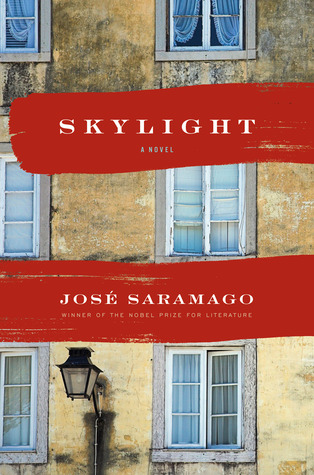
Skylight - Jose Saramago

20256571Character-driven novels are intrinsically hard to review.  There's no strong central plot drawing them forward, and without a strong central plot it's a little hard to convey what a book is actually about.  In this case, it's particularly hard for me, because I haven't read any of Saramago's other work.  The guy won a Nobel Prize for literature; there's obviously something big and compelling his writing, but I just didn't see that, and I feel like that means I missed something.
 
Now, part of that could easily be because Skylight is some of Saramago's early work, and consequently his writing isn't fully polished and hasn't completely developed into what it would presumably become later.  In the introduction, it's noted that many of the threads of story found in Skylight can be found in more fully-developed forms in works composed later in Saramago's career.  Maybe I should have read some of those first, so that I could make an apt comparison.  However, I didn't, and so here we are.
 
Skylight's main characters all inhabit the same apartment building in Lisbon, Portugal, in 1952.  The building is divided into six different apartments, and each apartment contains its own inhabitants with their own problems, though they are all intricately woven through each other.  Cobbler-philosopher Silvestre and his wife take in a boarder named Abel who is hoarding experience in life, but without a real purpose.  Across the hallway live Emilio and Carmen, Emilio's Spanish wife who raises hell because she feels trapped in her marriage.  On the second floor, a former prostitute named Lidia is now the mistress of a businessman, and across the way Justina deals with her womanizing husband.  On the third floor, a young woman gets a new job for Lidia's paramour, but the position only causes tension in the building, and a pair of sisters keep secrets from their mother and their aunt.
 
The book flap calls Saramago "the master of the quotidian," and indeed he does seem to have a wonderful way of capturing the everyday lives of his characters.  Without having a strong central plot, Saramago still manages to have a steady building of tension that leads up to a climax.  However, the novel seems to end abruptly, without several of the plot lines fully resolved.  While some of them are left open-ended but with a satisfying drop-off point, others are just...left.  Justina and Claudhina's plots are the most obvious examples of this.  I didn't feel like there was any indication of how those plots were supposed to go beyond the pages of the book.  I also didn't really feel drawn to Silvestre; his plots and character started off well, but as soon as he became a philosopher in addition to a cobbler, he lost a lot of my interest.  His ramblings to and with Abel about purpose and love and blah blah blah bored me, and it felt very much like Saramago was just preaching his own philosophy.  I don't mind when books have a message woven in, but I prefer it when it's done subtly, rather than it being repeatedly shoved in my face.

Still, overall, this was a lovely work of character and I enjoyed it.

3.5 stars out of 5.  (I feel terrible saying that.  This guy won a Nobel Prize and here I am giving it 3.5 stars.  Oh dear god, what have I done...not that it really does anything, but still.)

Saturday, August 9, 2014

The Septembers of Shiraz - Dalia Sofer

The Septembers of ShirazThe Septembers of Shiraz actually has nothing to do with Septembers in Shiraz, so don't pick it up if you're hoping Shiraz will be a prominent feature.  It's not.  In fact, the book is split pretty much entirely between Tehran in the early 1980s and New York City at the same time.  The title comes from one little passage of reflection at the very end, and while it does have a ring to it and some lovely alliteration, it's not exactly relevant to the plot.  The plot revolves around Isaac Amin, a gem dealer who is arrested for mysterious reasons, and his family as they go through the ordeal of his imprisonment while trying to keep up appearances.  While Isaac struggles with life in prison, never knowing if each night will be his last, his wife and daughter face harassment from the Iranian Revolutionary Guard at their home.  Farnaz, Isaac's wife, tries to keep life moving on, and his daughter Shirin steals files from the house of one of her friends in the hope that the files' subjects will escape her father's fate.  Meanwhile, Isaac's son Parviz attends university in New York City and only has spotty communication with his family, and lives an impoverished life when they are not able to send money, at the same time becoming involved in the lives of the Mendelsons, a family of Hasidic Jews from whom he rents his living space.

It took me a while to get into this book, mainly because not much was happening.  Sofer's writing style just didn't grab me and pull me in, and after Isaac's arrest--which happens almost immediately--there's a lot of day-to-day stuff going on before the next "big thing" come along.  It ended at a sort of strange place, and overall felt rather anti-climatic.  That said, I did get into the book about halfway through and enjoyed it, though it's probably not one that I'll grab for the next time I want to read something about the Middle East.  It was good, but not really remarkable; that's pretty much all there is to it.  It did, however, leave me wanting a Turkish-style tea set, for some strange reason.

3 stars out of 5.

Monday, August 4, 2014

Tea Cups & Tiger Claws - Timothy Patrick

Tea Cups & Tiger ClawsI am probably one of very few people in my demographic in the US who has not watched Breaking Bad or Game of Thrones and has not read the Song of Ice and Fire books.  Still, much of it has somehow been absorbed into my pop culture subconscious, such as the fact that George R. R. Martin called Walter White a monster worse than anyone in Westeros.  And while I know that there are some real doozies of monsters out there in fiction-land, I think Timothy Patrick's character Dorthea Railer could play ball with the worst of them.

Tea Cups & Tiger Claws follows three generations of women, starting with Elma Railer during World War I.  Elma gives birth to identical triplets and allows two of them, Abigail and Judith, to be adopted by a duchess, but she keeps the third baby, Dorthea, for herself--presumably out of spite for the people trying to manipulate her into giving up all three of her children.  The Railer family is, put simply, white trash, and everyone figures that Dorthea will end up just as bad as the rest of them.  She doesn't.  She ends up much, much worse.  As Dorthea tries to claw her way to the top of Prospect Park society and find her place in the mansion on the hill, she creates her own little underworld, complete with drugs, secret dungeons, kidnapping, and a hefty dose of murder.  Sucked into this mess are Abigail and Judith's daughters, good girl Sarah and party girl Veronic, and when Dorthea finally makes her grab for the high life, it's Sarah and Veronica who get caught in the flames.

This is very much a character-driven story, and really all of the characters are reflections of each other, showing what each could have become if things were just a little different.  It's written in a mostly-linear fashion, broken up by great chunks of background info on places and people.  Still, this exposition is written in such a flowing, fluid style that I didn't feel it bogged down the narrative at all, but instead made it even fuller and richer.  The level of detail could have easily strayed into the territory of dull and lifeless, but instead left just enough to the imagination to keep me interested.

There were a few issues--some misplaced or misused words, some typos and rough grammar in a few areas, though not enough to be ruinous to the whole.  The thing that bothered me most was part of the mystery I never felt was truly resolved.  One of the characters leaves clues tot eh others that are meant to help stop Dorthea.  While I am pretty sure I know who the helper is, it was never said outright, and the "how"s and "why"s of the aid are left somewhat in the dark.  I really would have liked to see that fleshed out a bit more to add some more completeness to the story.  Still, I could gather enough on my own, I guess, and the engaging characters and prose kept me going long after I should have been asleep on more than one night.

4.5 stars out of 5.