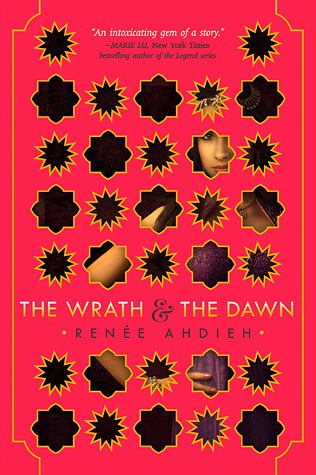
Here is the thing: I absolutely love the story of Scheherazade. It's not a very known tale, so for those of you not following along, I'll summarize. Once upon a time there was a caliph who found his wife had been unfaithful to him. As punishment, he beheaded her, and every day after that he took a new bride and beheaded her the following morning. Eventually, the daughter of one of his viziers, Scheherazade, volunteered to become his next bride. The night before her planned death, she begged the caliph for a chance to say goodbye to her sister. He granted her request, and as he waited in the next room, Scheherazade began telling her sister a story. By the time the dawn came, she'd reached a cliffhanger. The caliph, entranced by the tale, demanded that she finish the story, but she refused, saying it could only be told by night. Begrudgingly, he allowed her to live until the next night so she could finish the story and he could know the ending. The next night, she finished the story...and began a new one, also ending in a cliffhanger at dawn. The cycle repeated itself for a thousand and one nights, at the end of which the caliph had fallen in love with Scheherazade and did not kill her, instead letting her live on as his queen.
I've been longing for a good Sheherazade story for a
long time, but there have always seemed to be a few problems in the way. First off, it's pretty hard to make a guy who wants to kill the heroine for something someone else did a viable love interest. That's really,
really difficult. He has to have damn good reasons for that, and maybe not even then will that be okay. Second, Scheherazade's whole story is stories
within the story, which means the bulk of her story isn't even actually about her. While this can give an author a lot of room to create, it also means there isn't much of a framework to use as a guide. I think Ahdieh managed to conquer these roadblocks
very well and create what is, for the most part, a very intriguing story.
Ahdieh's Shahrzad, aka Shazi, volunteers to become the next doomed bride of the caliph (constantly and annoyingly referred to as the boy-king) in order to avenge her best friend, one of Khalid's former victims. She plans to make him put off her execution for long enough to find a way to kill
him instead. Shahrzad is, of course, good at pretty much everything. Wall-climbing, witty banter, archery, ect...it all falls within her grasp (except swordplay, though she picks that up within the course of a few paragraphs, too). These skills are all put to use in keeping herself alive--until she doesn't really need them to keep herself alive anymore because Khalid falls in love with her pretty early in the story and then she's not really in danger anymore. There's still danger
around, and intrigue, because she still doesn't know
why he killed all those girls, but her own life isn't directly on the line which does tend to lower the tension a bit. The story is bulked up by the introduction of Shahrzad's former love interest, Tariq, who vows to rescue her from Khalid's evil clutches, and the integration of magic into what was initially portrayed as a Ruritanian-type setting; you know, a fake kingdom, but this time in the Middle East instead of in Europe.
I think this book had a lot going for it. There are some great kissing scenes, some scenes that blatantly allude to other stories (particularly Aladdin, which we are all, of course, more familiar with from the Disney adaptation than from the original Arabian Nights story, which is actually set in China), and the elements of Scheherazade that prove so problematic are adapted to make the whole story much more palatable, though it takes a while for them all to come out--for much of the book, I was going, "Okay, I get
that part, but this whole thing is
still not okay." In the end, it's kind of a moral quandary, which I'm sure Ahdieh's going to tie up in a bow in the second book,
The Rose and the Dagger (due out in May). That said, I still had a few issues with this.
First, Shahrzad's clothes are a topic of
constant discussion. Now, I love pretty clothes as much as anyone and probably more than some, and I think discussions of pretty clothes have their place in books like this. Clothes are used to shock and awe, and to bulk up a character's appearance to others or make a character appear like something they are not. However, there are times in this book when Shahrzad's clothes have
no bearing on what is happening and still are described at length; for example, there's a part where she's basically pacing in her room and Ahdieh spends several paragraphs describing her clothes and jewelry. I thought, at first, that this was going to tie into the Bluebeard story integrated into the narrative, because Bluebeard's last wife (in some versions) wears a diamond necklace that falls into a pool of blood and therefore betrays her for doing something she was told not to do. That didn't happen, and it left the whole outfit description thing pretty pointless. I don't think these descriptions should have been cut entirely, but I think they could definitely have been narrowed down; we didn't need a day-by-day account of what she was wearing. "She dressed and went to do blah-blah" could have easily fit in for "She dressed in this and that and the other, with a necklace made of and a belt of and bangles of..." Do you get my point?
Second, I hated Shahrzad's handmaiden, the Greek girl who I despised so much that I have entirely blocked her name out of my mind. (It's Despina, I think? Maybe?) She was supposed to be this complex side character with a personality and story of her own, which she was, but she was also this really terrible example of how stereotypes can come alive in books. Despina is in Khalid's service as a slave, even though there's absolutely nothing slave-like about her, and she comes from Enlightened Greece which is apparently completely different from places like Khorasan where they still have things like slavery anyway! Gasp! And she's always saying things like "Hera help me" or whatever, which were annoying...her whole "Greek" thing was really stupid and made me really, really hate her. I don't know why Greece even had to come into it other than as a way to introduce a "civilized" country where rulers don't chop off the heads of their wives every morning.
Third, there is a lot of waffling here. I hate waffling unless it's done really, really well. And there's a lot of refusing to tell people about important things for really stupid reasons, too. "Tell her!" "I don't want to!" is about the gist of it. Which, of course, leads to a lot of misunderstandings. This is very much a book where communication is the key to all of the problems; the problems could have been worked out a
lot sooner if the characters had just talked to each other. Hell, the story could have been avoided entirely if Khalid had just talked to
his people. Granted, he probably would have been offed, but hey, you gotta do what you gotta do in order to preserve your kingdom, right? And it ended with a lot of waffling in a
really weird place.
There was some really lush storytelling here, in places, and some good handling of the original story's central problems for being a viable retelling/romance, but I think Ahdieh added in her own problems that kind of even the scales for it. I'm still eager to read the second book, but I hope some of these problems are resolved in it.
3.5 stars out of 5.
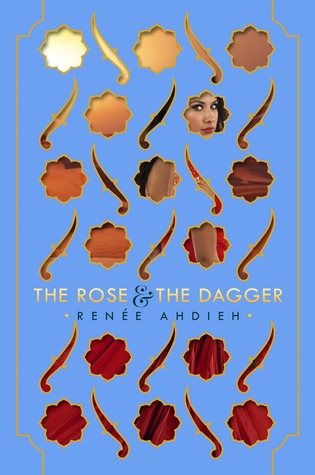 The Rose and the Dagger continues the story of The Wrath and the Dawn, finishing it up. In the wake of the storm and fire that have mostly destroyed the city of Rey, Shahrzad finds herself in the desert with her father, her sister, Tariq, and gathering forces that are preparing to move against her husband and her city. Ultimately, that's most of what this book is: Shazi city around doing not much at all. She flies around on a magic carpet a bit, tries to learn some magic of her own--mostly unsuccessfully, except when it most matters, of course--and pines for Khalid, who is still referred to as "the boy-king" in every other sentence, even though he most certainly is not a child. Oh, and she tries to figure out how to break the curse, except the curse no longer seems to figure that strongly into the plot. In fact, nothing really seems to figure strongly into the plot.