Pages

Showing posts with label fairy tale. Show all posts

Wednesday, June 20, 2018

Firelight - Kristen Callihan (Darkest London #1)

Firelight (Darkest London, #1)Firelight is a book that kept catching my eye as it popped up on various to-read lists.  I like Kristen Callihan's contemporary romance books in her VIP series--both Idol and Managed were very good.  If that caliber of writing with a Victorian-era fantasy setting, I thought we'd be good to go.  And the library even had a copy!

The story here follows Miranda, a young woman who has the ability to start fires, and Benjamin Archer, a lord who has fallen under a curse and never shows his face or other parts of his body, instead going about in a mask and dark clothing.  Several years after an initial encounter in an alley, Archer gets Miranda to marry him through coercion.  Despite this, Miranda decides he's hot and that she loves him immediately, no matter why he's so weird--and despite the fact that he might be, you know, a murderer.

And herein lies the root of our problem.  Callihan's contemporary novels have great chemistry and build in the romance department, and that is entirely absent here.  There is no spark between these characters, despite Miranda being literally able to create fire.  There is no sense of fairy tale whimsy or destined or doomed romance, despite the story drawing heavily on East of the Sun and West of the Moon, my favorite of all fairy tales.  And there is no decent-strength fantasy to propel the story in lieu of these other elements.  There is no apparent reason that Miranda has these abilities.  Archer's curse is a mishmash of religions that don't really seem to click together, and seem to have been compiled merely to seem mystical without any thought as to what might actually be behind them.  And his curse doesn't really make much sense, either...  What information we are provided is dumped into our laps in a monologue by one character literally as Miranda gets ready to walk into the final conflict.

I'm not entirely turned off this series.  I do have faith in Callihan's writing skills, and Miranda's sisters have promise as main characters in other books.  Hopefully this was just a bad start to a series, in which Callihan hadn't really fully thought through what she wanted to put forth, and the other ones will be better.  I'll give it another try, but this one in particular was not a home run for me.

2 stars out of 5.

Wednesday, January 17, 2018

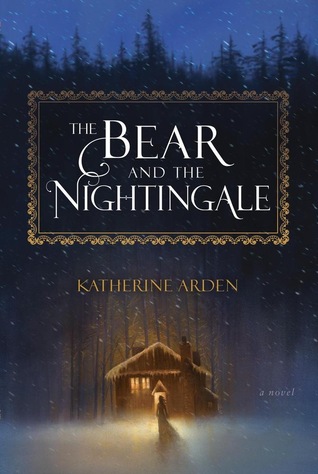
The Bear and the Nightingale - Katherine Arden (The Winternight Trilogy #1)

The Bear and the Nightingale (Winternight Trilogy, #1)The Bear and the Nightingale is what I wanted from a Russian-themed fantasy and what I didn't really get from the Grisha trilogy.  Yes, Grisha was meant to be bigger and flier, and it was that--but it lacked warmth and depth and heart, and TBATN has that in spades.

The main character here is Vasilisa, though she doesn't really come into her own until the second half of the book, being too young to do much for the first half.  The first half instead follows her family and other characters as they come together in Vasilisa's small town on her father's lands.  Among these are Konstantin, a priest who paints icons and wants to save souls at any cost, and Anna, the daughter of the Grand Prince who becomes Vasilisa's stepmother following the death of Vasilisa's birth mother.  Also coming the village is a strange pendant given to Vasilisa's father by a man no one else remembers, who seems almost inhuman--the pendant being meant for Vasilisa herself, though her nanny keeps it from her for years.

Vasilisa is the daughter of a witch, or so it's said, and she can see the household and forest spirit s that populate her father's lands.  But with the arrival of the priest and the fear he puts into the villagers, the spirits begin to weaken and a menace in the forest becomes stronger and stronger.  Fear, fire, and famine threaten the village, and while Vasilisa does what she can to keep the friendly spirits strong and the evil at bay.  But she is just one person, and the duel between the menace in the woods and the strange blue-eyed man who wants Vasilisa becomes ever more fraught with peril.

This starts out as a very low fantasy and slowly escalates into the higher realms as it progresses--more magic, more spirits, more supernatural conflict.  Vasilisa does not go along slinging spells or enchantments; the magic she possesses is more of a "seeing and understanding" type aided by the stories that her nanny told her when she was younger.  Consequently, the magic is very atmospheric and has a mystical and yet cozy feel to it, with the dark lurking beyond at the same time.  The setting is a period when Russia was ruled by the Tartars (aka the group composed of Mongul and Turkish elements that came together under Genghis Khan) and kind of lends itself to a fairy tale setting.  The writing itself is very good; I think Arden balanced the characters and plot elements well.  That said, the first half of the book is very slow.  It takes a long time for things to get set up and going, and I kept telling myself it would but at times I felt like despairing that anything would ever happen.  This book also isn't a romance, and I felt like that was an element I was looking for to some degree in the later parts of the book, as it would not have been appropriate in the earlier parts; there wasn't much room left for it, but man, Morozoko is awesome.  Maybe something for future books???

Overall, this was a fabulous read to start the new year with.  I'm greatly looking forward to reading the second volume, which was released in December, but I think I'll hold off on it so that I can space it between this one and the third book's release, which is dated for August.

4 stars out of 5.

Saturday, November 11, 2017

Norse Mythology - Neil Gaiman

Norse MythologyNorse Mythology is what I ended up reading for my reading challenge category of "A book based on mythology," after switching out Olympos.  Olympos is the sequel to Illium, and while I still want to read it, I read Illium so long ago that I think I need to re-read it before taking on Olympos.

I think it's important to note that this is not, actually, a book of Norse mythology.  Rather, it is a book of Gaiman's own retellings of various Norse myths, blending parts of other versions together and only really including his favorite stories.  It's not comprehensive, and it's not a textbook.  It also forms somewhat of an overall story arc, which actual "nonfiction" mythology books typically don't.  While Gaiman uses a writing style that is austere and fits with a classical myth-telling style, you can see his touches in different parts of characterization--Thor is basically a dumb jock, and Loki is one of those people who is both clever but also pitiful, the geeky kid who's picked on by the others and uses his intelligence to get back at them.  Did they deserve it?  Yes.  But did he also deserve their retaliation most of the time?  Yes.  Also, the dialogue shows Gaiman's wry style at different points--for example, I can't imagine an "original" telling of a myth blatantly featuring the words, "Thor, shut up."

The book is overall a story of Odin, Thor, and Loki, though plenty of other characters also feature.  The arc that Gaiman has embedded--possibly unintentionally, given his remarks in the foreword--features the back-and-forth between Loki and the other gods, leading up to Loki's imprisonment, freedom, and ultimately Ragnarok and what comes beyond.  Ragnarok and the death of the gods is a fascinating concept, and I think Gaiman does it justice.  The stories are in turns funny, gross, and eye-roll-worthy, and also have the features of classic myths such as explanations for natural phenomena, such as Thor causing tides by drinking from a horn connected to the deepest part of the ocean.

This is a quick read, and also one that is easy to pick up and put down; even though the book forms an overall narrative, each chapter or story also stands on its own.  You can read this in one sitting, or you can read a story at a time before putting it aside and coming back to it later.  Doing the latter might mean that the arc is less apparent, because I think some of the connections between the stories are more evident if you read them in quick succession, but it's still completely doable.

So, how does it compare to Gaiman's other works?  Well... I haven't read everything he's written, but I don't like this as much as I like his traditional novels.  Neverwhere, The Ocean at the End of the Lane, American Gods, and so on are works of art.  His original short stories are also excellent.  I would rank Norse Mythology somewhere between his short stories and his poetry, which I'm really not much of a fan of.  I hope we see Gaiman make a return to traditional novels soon, because he's been working on other projects for a while, and I miss those beautiful jewels of books showing up on the shelves.  This is good, but it's just not as enveloping, breathtaking, or wonderful as those others are.

3 stars out of 5.

Sunday, September 17, 2017

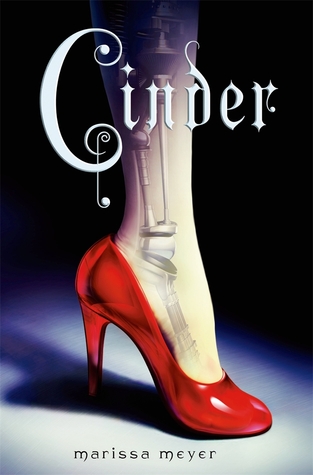
Cinder - Marissa Meyer (Lunar Chronicles #1)

11235712It feels a bit weird reviewing this book so long after I put out my first review on this series, for Cress.  I had read Cinder before, but I wasn't writing reviews at the time, and so this comes to anyone following along a bit out of order.  Cinder was the Unapologetic Romance Readers' theme read of "A sci-fi romance" for September 2017, and I was delighted to have an excuse to re-read it, especially as I'd been in a bit of a reading slump and going back to books I've previously enjoyed always helps with that.

Cinder is, as you can guess from the title and cover, a Cinderella story.  Except this Cinderella is a cyborg.  Injured in an accident she can't remember, Cinder has been left with a mechanical arm and lower leg/foot, with wires in her brain and nervous system and an interface that flashes information over her eyes.  She's also one of the best mechanics in New Beijing, and her business is her step-family's main (only?) source of income.  Oh, and New Beijing, and the rest of the world, are currently being ravaged by a plague with an unknown cause and no cure.  But one day, when Prince Kai stops by Cinder's stall to get an android repaired, Cinder is pulled into a web that she never imagined and that will destroy--or rebuild--her entire life.

I love this story so much.  It follows a very traditional Cinderella structure, but with little flourishes and garnishes that make it seem new.  The pumpkin coach is a decrepit car, the glass slipper is a cyborg foot.  The characters are also wonderful; while Meyer makes Cinder's stepmother absolutely loathsome, the daughters aren't entirely without redemption, particularly Peony, who Cinder actually likes.  And then, of course, there's Iko, Cinder's android sidekick who has a quirky, perky personality all her own.  Adding the plague and the brewing conflict between Earth and Luna adds dramatic tension to a story that traditionally lacks it, and having Prince Kai and Cinder meet and grow closer multiple times before the ball is absolutely necessary--the "love on first site" aspect of Cinderella has never sat well with me, so I appreciate this added relationship building.

That said, this isn't a perfect story.  It has a bit of a cliffhanger ending, which I didn't remember.  Given the narrative arc of the series as a whole, I can see why Meyer had to break it where she did, but it definitely doesn't lead to a satisfying conclusion for this volume.  And while the Cinderella element helps to tie together a story and genre that could otherwise alienate some readers--I probably wouldn't have normally picked up a story about a cyborg--it also means that, despite the flourishes, the plot itself can be quite predictable.  Of course, the story as a whole goes past the Cinderella story, but that doesn't mean that parts of it can't be called from a mile away.

Still, I really enjoyed rereading this.  It's not my favorite book in the series--that goes to Scarlet--nor does it feature my favorite main characters--that would be Cress--but I still think it was a solid intro volume, and would definitely recommend it to others.

4 stars out of 5.

Sunday, July 23, 2017

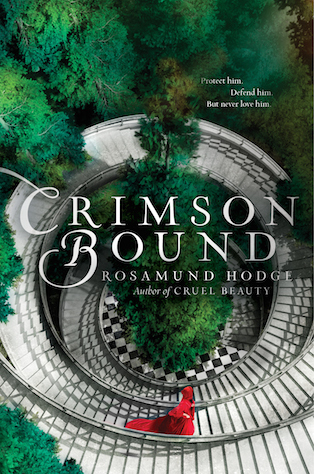
Crimson Bound - Rosamund Hodge

Crimson BoundRed like roses fills my dreams and brings me to the place you rest...

If there's one thing that sums up the tone of this book, it's the original "Red" trailer for Rooster Teeth's webseries RWBY.  There is, in fact, very little in common between the plot of RWBY and that of Crimson Bound; the similarities can basically be boiled down to "young woman in red coat kills monsters," though Ruby uses a scythe/shotgun and Rachelle uses a sword.  But there's such atmosphere in that trailer, and it is that which is evoked in the pages of Crimson Bound.

 I read Rosamund Hodge's other fairy tale book, Cruel Beauty, earlier this year and while it felt magical, I didn't really like the ending, feeling it was messy.  Crimson Bound does not have that issue, and was beautiful all throughout.  The story is a retelling of Little Red Riding Hood, a rarely-used retelling unless someone's going with the "Red and the werewolf fall in love" angle, which has its perks, but this didn't go that way and it was refreshing.  The main character in this France-inspired fantasy realm is Rachelle, who was supposed to serve as a woodwife following in her aunt's footsteps, guarding her village against misfortune and the evils of the Great Forest, a mystical wood on a separate plane that overlies Rachelle's world and encroaches upon it.  However, Rachelle is claimed by a forestborn, marked with a black star that means she must kill within three days or die herself.  She kills her aunt and flees her village, ending up as a bloodbound in the service the king, hunting down the creatures that appear from the Great Forest to hunt humans.  All the while, she dreads the return of the Devourer, a being that kept the world in darkness until a human woman stole the sun and moon from his belly and bound him with a mysterious sword that has since been lost.  Wanting to save the world as a sort of redemption, Rachelle dreams of finding one of the two swords that could defeat the Devourer again.

I think fans of Uprooted or Hunted would really like this; they all have a similar feel to them, especially with the whole "magical and menacing forest" dynamic.  The love interest here was unusual, and not who I thought it would end up being; I originally thought Hodge would try to pair Rachelle off with Erec, the captain of the king's bloodbound who Rachelle calls her best friend.  Ultimately, this did not happen, and that's a good thing.  Rachelle is a fascinating character.  She has both an urge to die and a will to live; she plans on going to Hell even as she dreams of saving the world; she wants to be beautiful and in love despite being afraid of what lurks inside her and the monster she might become.  There's a definite religious aspect here, but it wasn't preachy; it was more in the search of redemption and balance, though there was definitely an aspect of denial of reality here as well.  It played wonderfully with the rest of the book.  The supporting characters were wonderful, the playing out of the plot in parallel with the Red Riding Hood story and the myth of the Devourer was spot-on, and the slow building of dark menace overlaying the decadent setting of a Versailles-inspired court was beautiful.

Ultimately, the climax was here was wonderful, with all of the right elements being pulled together and unspooling in just the right way.  Rachelle chooses the path of needles, not the path of pins, and it shows--she struggles, and she fails, and she backslides, and she does petty things, but she perseveres and ultimately comes out better for it in the end, as does the world.  It's a striking story, in characters, world, and plot, and I am so glad to have read it.

5 stars out of 5.

Monday, July 3, 2017

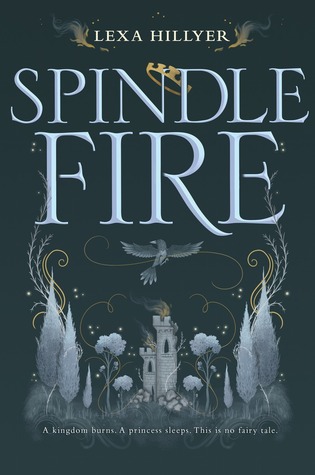
Spindle Fire - Lexa Hillyer (Spindle Fire #1)

Spindle Fire (Spindle Fire #1)Fairy tale retellings always intrigue me, and when I was looking for another book to add to an Amazon order so I could get free same-day shipping, I settled on Spindle Fire because it promised to be an intriguing retelling of the Sleeping Beauty story.  Featuring not one princess but two, and one of them a bastard trying to save her enchanted sister, with a wicked faerie lurking the background... Well, it had potential.

The story follows Isabelle, the bastard princess, and her younger, legitimate sister Aurora.  Isabelle is blind and Aurora is mute and has no sense of touch, those senses being taken from the girls by faeries when they were small.  When Aurora's fiance, the prince of the neighboring kingdom, is killed on his way to marry her, the kingdom is threatened with chaos and Isabelle is to be sent away.  So she runs away instead, and Aurora follows her, and in the process stumbles across a golden spinning wheel, where she pricks her finger and ends up in a dream world called Sommeil and apparently haunted by the long-thought-dead faerie Belcoeur.  Meanwhile, the faerie Malfleur, said to have killed her sister Belcoeur, raises troops to march against the kingdom.

The most intriguing thing here was that Isabelle is a blind heroine.  Aurora's muteness and lack of touch are interesting, but ultimately not used much because in Sommeil her tithes seem to be waived and her voice and sense of touch come back to her.  Since she spends most of the book in Sommeil, she doesn't really come across as "challenged" as she actually is in the real world.  Isabelle, on the other hand, spends the entire time in the real world, where her lack of sight is a huge disability.  She manages, but once she leaves the places that she already knows, it becomes infinitely harder.  And yet Hillyer manages to have a great sense of imagery, showing how Isabelle pictures the world through touch and smell and sound even without her sight.

Other than that, the book wasn't as intriguing as I thought it would be.  Some of the plotting and world-building definitely seems confused; like, is this supposed to be our world, or not?  There were indications in both directions.  And what's up with Malfleur and Belcoeur?  Because some people say that Mafleur is evil but she says that she saved everyone from Belcoeur who didn't really seem to be doing anything...?  There's a big info-dump chapter near the end of the book that I thought would straighten this out, but ultimately it didn't.  And as for breaking the curse...what a cop-out that actually was, and I feel like it actually removes a lot of the promise of the second book because now all that's left is dealing with Malfleur, and military conflicts are typically less interesting than twisty curses.

Overall, this was an okay book.  It's marketed as young adult but I feel like it's more middle-grade in reading level; there are a few parts that trend more YA, but as a whole it doesn't have a YA feel to it.  With that and the other confused aspects of it, I'm not really sure I'm intrigued to read the second book when it comes out.

2 stars out of 5.

Wednesday, March 22, 2017

Wintersong - S. Jae-Jones

WintersongThis book enchanted me from the moment I read the description, about how a girl has heard stories of the Goblin King her entire life, and has savored them, but only half-believed until her sister is stolen away to be his bride.  Elisabeth, who has always dreamed of being a composer while her younger brother shines as a gifted violinist, is ready to sacrifice everything to save her sister: her music, her life, her freedom.  But maybe it's not such a sacrifice after all, because for once in her life, she feels wanted, desired, something that hasn't happened before.

Obviously, there are some parallels here to the cult film Labyrinth, starring the one, the only David Bowie as Jareth the Goblin King.  The stealing of the sibling, the promise that the heroine and the sibling can be free if they can escape, the goblin ball, the peach.  There's clearly a lot of inspiration from the film here.  That said, this doesn't attempt to be a novelization of the film--though there is one of those, if you're interested.  Rather, Jae-Jones takes some of the most hypnotic elements from the movie and twists them and builds them into something completely different that is definitely an "inspired by" rather than an "adapted from."  And people draw inspiration from everywhere, so I have absolutely no problems with that.  There's also a pseudo-Persephone story here that was an element I really liked.  And the sacrificing of the Goblin King's name...that's a very nice trope, one I definitely favor, that made me want to love this book so badly.

Unfortunately, the romance here just didn't click for me.  One of the reasons that Elisabeth agrees to become the Goblin King's bride, in addition to saving her sister and presumably the world, is that he wants her.  And while that might have been true--the way he wants her but still tries to protect her seems to indicate that, certainly--I never really felt that Elisabeth truly wanted him.  She was attracted to him, yes, but I'm not sure she wanted him "entire," as they said so frequently.  What Elisabeth really wanted was to be wanted, and that was the main draw.  She wanted to be wanted in a distinctly sexual manner, because Elisabeth isn't pretty.  She's downright plain, something that's emphasized again and again, along with that her real beauty is on the inside.  But still, being physically desired is something new for her, and I think that was what she wanted, more than anything else.  And once she got it, once it was hers...she wanted to leave.  Which doesn't exactly ring as a fairy tale love for all time to me.

The end here was also a disappointment to me.  While some might feel that it suited the book, which was dark and dreary and I don't think really a "young adult" book at all, despite the heroine's age, I felt like there was a way to make this a true romance with a traditional "happily ever after" ending, but without going beyond the bounds of being realistic for the established universe.  There was a pattern of Goblin Kings being replaced, and a precedent of at least one leaving with his bride--so why couldn't it have come full circle?  It didn't have to perpetually solve the problem of the sacrifice to end winter, but for this particular pair it could have worked.  It sort of makes me wonder if Jae-Jones is planning a second book to possibly resolve some of this, though it doesn't look as if this has been announced as part of a duology or longer series.  Of course, it just came out a few weeks ago, so there's still time.

So, yes, there were enchanting elements to this book.  The premise, the music, the promise of romance, the looming threat of eternal winter...they all had so potential.  Unfortunately, I feel like the romance didn't fully develop on both sides and that the ending didn't suit the established book.  I'm all for bittersweet endings, as long as they fit--but this one didn't, and it marred the experience for me.

3 stars out of 5.

Sunday, March 19, 2017

Hunted - Meagan Spooner

HuntedI read the books Meagan Spooner wrote with Amie Kaufman, the These Broken Stars books, which I loved, and when I saw that she had a Beauty and the Beast retelling coming out, I was super excited.  I couldn't wait to see what Spooner would do on her own, and her Beauty sounded awesome: she's a huntress!  How cool.  So I snatched this up the day it came out.  Luckily I had the day off work, because I absolutely devoured this book.

The story follows Yeva, the youngest daughter of a wealthy merchant in medieval Russia.  When Yeva's father loses everything in a caravan that's attacked by the Mongols, he moves the family to his old hunting cabin.  Once a great hunter, he takes to the woods once again...but something is hunting him in return, and it begins to drive him crazy.  When he vanishes, Yeva, who used to hunt with her father, sets out in pursuit of him.

The family dynamics here are so wonderful.  Yeva has such a loving, supportive family.  They all care for each other and lift each other up, even when one person's interests might go directly against another's.  Positive relationships are so rare in fairy tales and young adult books, so seeing one here was a real treat.  But what was an even bigger treat is the main story itself.

It does take a while to get going; this isn't a fast book.  But the writing was beautiful, slowly drawing us into the Russian fantasy world that Yeva inhabits.  Yeva is called Beauty, just as her sisters were named for Grace and Light (though they all have given names as well) but she doesn't get everything she wants just because she's beautiful.  She wants more than her life in their town, desperately, and is actually relieved when they move to her father's hunting cabin, because she thinks she'll be happy if she can just return to hunting in the forest with him like she did when she was younger.  What she really wants is to find the mythic Firebird that her father told her stories of, but she'll settle for hunting.  But as she begins to hunt, working hard to regain skills she's lost, she stumbles into the problem of her father's vanishing--and then his evident death.  Catching and killing the Beast responsible for his death becomes the next thing Yeva wants, and the driving force in the story.  Even when she's the Beast's captive, her motivation is to stay long enough to find his weak spot and kill him, no matter what kindnesses are shown to her.

Minor spoilers here regarding the nature of the curse and the flaw at the center of the story.  There is one big central flaw in this story that I could find, and it has to do with the nature of the Beast's curse.  The Beast has been cursed by the Firebird and the curse can only be broken if the Firebird returns to him on its own.  There's a little twist here, of course, which I won't reveal, but if it's believed that the way to break the curse is to get the Firebird to come back voluntarily...then why would the Beast be trying to kill it?  *scratches head*  I don't think killing it really counts as it coming back voluntarily.

So, yes, there's a central flaw in the logic of the story.  Spooner kind of accommodates for this at the end of the book, where of course breaking the curse isn't what they thought it would be, but it definitely did mar the reading experience for me.  However, I still loved this book.  The slow build (though not a slow burn) and the way that Spooner parallels Yeva's and the Beast's stories was wonderful.  There's a very, very slight love triangle but it's not used in a typical sense, and there is no Disney Gaston here to serve as a central villain.  Really, there is no villain in this book, which I think actually is one of its strengths, because it means the characters are pitted against nature and against their own inner selves, which is a strong conflict to go with.  The overlaying of the fantasy world with the normal world also really worked here, as did Yeva's growing awareness of it.

So, this is not a perfect book.  But I loved it nonetheless, and I can definitely see myself reading it again in the future.  If you like fairy tale retellings, I would definitely recommend this one.

4 stars out of 5.

Wednesday, February 15, 2017

Enchanted - Alethea Kontis (Woodcutter Sisters #1)

Enchanted (Woodcutter Sisters #1; Books of Arilland #1)Enchanted was one of the first books that I added to my to-read list on Goodreads, all the way back in 2011.  And guess what?  I apparently owned it for a significant amount of time but never realized it.  I must have bought it when it was on sale for Kindle one day and then promptly forgotten.  But it works out, because it means I had it on hand to finally read for my 2017 reading challenge, for the category of "A book that's been on your to-read list way too long."

Honestly, this had been on my list for so long, but I never really made any serious moves towards reading it.  It was something about the cover.  While the premise sounded interesting--it's a fairy tale adaptation, which is basically my favorite trope--something about it just seemed like it was going to come across as very juvenile.  So I braced myself for that when I finally started reading.  And guess what?

I loved it.

This starts off like it's going to be an adaptation of "The Frog Prince."  But it's really pretty much every fairy tale rolled into one.  "The Frog Prince" is the beginning and base, but much of it is quickly resolved.  Elements of "Cinderella," "Jack and the Beanstalk," "Sleeping Beauty," "Rapunzel," and others are all woven into the central story.  The main character is Sunday Woodcutter, the seventh daughter of a seventh daughter, who befriends a talking frog in the magical Wood one day when she's writing in her journal.  Sunday only ever writes about her family and things that have already happened, because if she writes about things that haven't yet happened, they have an uncanny way of coming true, but not in the way she wanted.  She starts sharing her stories with the frog, who introduces himself as Grumble, and every day she leaves him with a kiss in hopes that it will break the curse that binds him to frog form--Grumble can't remember who he was as a man.

And one day, the kiss works.  But Sunday doesn't know it, because she's already gone, and when Grumble wakes up as Prince Rumbold, he comes to the realization that Sunday will probably want nothing to do with him, because her family blames him for the breath of Sunday's oldest brother, who was turned into a dog after he accidentally killed Rumbold's puppy years ago, and then vanished and presumably died.  So he sets up an elaborate scheme to win her back, involving a series of balls to which every eligible maiden in the kingdom is invited.  Meanwhile, he's plagued by voices and the ghost of his mother, and something sinister is going on with his father, and it seems to involve Sorrow, his fairy godmother...

...who is the sister of Sunday's fairy godmother, Joy.  And also her aunt.  It's all wonderfully woven together, why Sunday's family is the way it is, what has been going on in the castle, the menace that's lurking over the entire kingdom.  I loved pretty much all of it.  The world is exquisite, with so many background strands going throughout it.  I want to know everything--what happened to Monday, about Thursday's adventures as a captain and the wife of the Pirate King, what happened to Jack Jr. All of it.  But I did have a few reservations.

For example, after Rumbold's curse is broken, what's up with all of the people suddenly trying to kill Sunday?  And why do they just up and give up after a few attempts?  People with fey-purple eyes offering her combs, apples, ribbons--these are all classic fairy tale death traps, as Joy neatly illustrates.  But exactly why it's happening is never made clear.  And I also found myself disappointed in how little impact Sunday had on the climax and end of the story.  Despite her seemingly amazing power, despite the fact that she's the main character, despite that she's the seventh daughter of a seventh daughter and so supposedly has a great destiny...she doesn't do anything at the climax.  Instead, she stands by and watches as others take care of the mess.  Rumbold, Joy, Friday, Saturday, her father--all of them play bigger roles in the end than Sunday does, which was strange and a bit sad to me.

However, I still really enjoyed this book.  There's so much promise in this world and in the characters therein.  The way that Kontis wove together so many different story tropes into a coherent whole was every bit as magical as I had hoped it would be, and so much more than I thought it would be.  I definitely look forward to reading the others in this series.

4 stars out of 5.

Monday, January 30, 2017

Mechanica - Betsy Cornwell (Mechanica #1)

Mechanica (Mechanica, #1)Mechanica has been on my to-read list for a while, and I finally got to it as part of my 2017 reading challenge, for the category of "A book with a title that's a character's name."  Now, to be fair, Mechanica isn't the given name of the main character of the story--no more so than Cinderella is the given name of that character.  Rather, it's a nickname given to the character by her evil stepfamily.

As with the traditional Cinderella story, Nicolette is rather abused by her stepmother and two stepsisters in the years following the death of her father.  But unlike the traditional Cinderella, Nicolette--also known as Nick--is a mechanic and inventor, following in the footsteps of her mother, who mixed magic and mechanics to create fabulous miniature creatures which can create tasks assigned to them in addition to simpler inventions that make life easier.  Nicolette's world is also one that's torn by an ongoing conflict with the Fey, who hail from a continent across the sea and have been suppressed by her country, Esting, for years.

This was a delightfully refreshing fairy tale adaptation.  I don't mind adaptations that stick fairly faithfully to the originals, and I was initially a little disappointed when I found that Nicolette wasn't adhering as closely to the "poor girl treated as a maid finds a prince and falls in love" trope as I'd anticipated, no matter how much mechanical and innovative padding was added to the story.  (I also, from the cover, kind of thought that Nicolette herself was going to be some sort of automaton, but that's mostly because I clearly did not read the description.)  But in the very beginning of the book, Nicolette finds herself fascinated by how the Fey build families and friendships, and that becomes a compelling motivation for her.  She doesn't just want to fall in love.  She wants to be loved, in more ways than romantically, and that is what propels her throughout the story.  Yes, she wants to be free of her stepfamily, but it's more than just that.  That is such a lovely and unusual motivation for this type of story that it was, in the end, very refreshing, as are Nicolette's choices when she is ultimately faced with them.

That said, I still didn't love the story.  I wish that the stepfamily had been given a bit more dimension.  Cornwell tries to give the stepmother a bit of humanity toward the end of the book, but backpedals from it pretty quickly--Nicolette doesn't want to see her stepmother as human.  I found that rather disappointing; I'd hoped for better from her.  There's been a recent trend of giving the stepfamily a bit more humanity and I would have liked to see that continue here, but that wasn't really the case.  Additionally, I would have liked to see more interactions between Nicolette and Fin.  Considering her emotions towards him, I think it would have been good if they'd had more interactions than Nicolette could count on one hand.  There are also a few worldbuilding things I would have liked to have seen fleshed out more--like the Ashes.  Someone mentions they're cursed, and yet that doesn't seem to go anywhere, nor does Nicolette seem to be that concerned about that possibility.  But perhaps those will be ironed out in a future book?

Overall, a refreshing fairy tale adaptation, with some lovely, innovative elements, but I think it could have done with a bit more depth.

3.5 stars out of 5.

Monday, October 17, 2016

Confessions of an Ugly Stepsister - Gregory Maguire

Confessions of an Ugly StepsisterConfessions of an Ugly  Stepsister was my pick for a fairytale retelling for my 2016 reading challenge.  I read Wicked back when I was in high school, and wasn't a huge fan.  There were some interesting aspects to it but I found it overall very strange and it didn't really agree with me.  I liked Confessions much better!

The story takes place in seventeenth-century Holland, where the Fisher family has just fled after the death of the father.  Our main character is Iris, the younger of the two "ugly stepsisters" from the traditional Cinderella story.  When the family finds refuge with a painter, Iris finds a love for drawing and a growing attraction to the master painter's assistant, but is too busy helping her family to survive to act on her desires.  Eventually, the family finds themselves moved into the house of a prosperous trader dealing in tulips, and this is where the Cinderella tale really begins to take shape.  Iris is a much more sympathetic character than the stepsister in the story, but she still has her "ugly" moments on the inside--her looks are nothing to write home about, but her actions are, for the most part, well-intended.

But honestly, the most fascinating character here is Clara.  She is such a weird Cinderella-character, and seeing her essentially relegate herself to her reduced status was something very different, as was her agoraphobia and her, honestly, bitchiness.  For much of the book, Clara acts more like the stereotypical ugly stepsister than Iris and the older sister, Ruth.  Clara's firm belief that she is a changeling is strange, but evidently a mechanism for coping with something that happened to her when she was younger.  While some of the details come out eventually, not all of them do, but based on Clara's actions, I think we can probably make some educated guesses.  It's definitely a darker take on the story than one typically reads, all of the grit of harsh reality without any of the light touches of magic to lighten things up.  Some of the feel of it was, honestly, very similar to The Miniaturist, and I think readers of one would like the other.  The Cinderella story is an overall minor aspect here, and this is more of a historical fiction with a bit of a fairytale-inspired treatment than a true fairytale retelling, because the retelling doesn't truly come into play until so late in the game.

SPOILERS IN THIS PARAGRAPH: The thing I didn't like here was Ruth.  I thought the treatment of her character was an interesting one, and she has her own sort of growth throughout the story.  When the revelations came out in the end, I at first thought that it was a fascinating way to go about it--but then there was an assertion by Ruth that I really didn't agree with.  It just didn't seem to fit.  While I think some of her actions, and that everyone underestimated her, suited the story overall, the suggestion that she had basically faked her mental/developmental disorder for her entire life in order to pull one over on her mother was...mildly offensive.  I did not think that aspect worked, at all, and it really turned me off to the ending in general, which is a shame.

Overall, this was good.  I liked it, and it's made me more inclined to read more of Maguire's work than Wicked did.  I think the historical fiction-style retelling worked better than his treatment of Oz, though maybe if I went back to that book now I would feel differently.  The revelation at the end here was a bit of a turn-off, but I think the bones of this story were good and the writing was elegant, I enjoyed it as a whole.

The Kindle edition, though, does need some serious work--there are a huge number of missing quotation marks, the paragraph/page breaks are strange, and the formatting is overall not good; very disappointing for a release from a major house.

3.5 stars out of 5.

Saturday, October 15, 2016

Cruel Beauty - Rosamund Hodge (Cruel Beauty #1)


Cruel Beauty (Cruel Beauty Universe #1)Cruel Beauty is a book that I think had a lot of potential and, for a while, was well-executed, but in the end fell flat.  It was the book club pick for October for the Unapologetic Romance Readers group on Goodreads, and I was pretty excited for it--I had voted for it--because it had been on my to-read list for a while.  It's a Beauty and the Beast-based story in which Nyx, the heroine, has been raised to marry a demon prince as payment for a bargain her father made prior to her birth.  The setting is somewhat strange.  It appears to be the island of Great Britain, but magically cut-off, and on a timeline in which Britain continued to be ruled a sort of Greco-Roman dynasty after the fall of the Roman Empire.  But there's also magic and what seem to be pseudo-Victorian or -Regency trappings.  It's a strange mishmash, and Hodge continues this mash into other areas of the story, which are ultimately what I think led to its downfall.

The story starts with Nyx on the day of her wedding.  She's married by proxy (a statue) to the Gentle Lord, and then promptly deposited on his doorstep with the expectation that she will never return.  But her sacrifice isn't to be for naught.  Once inside the demon's castle, she's supposed to find its four magical centers and destroy the castle, with the demon inside, and free the people of her country from his rule.  But she quickly finds that everything isn't as it seems.  The Gentle Lord, Ignifex (not his real name), lets her know that every night, she'll have the chance to guess his name.  If she gets it right, she goes free.  If she gets it wrong, she dies.  (She also has the option to just not guess.)  And she has a key that unlocks all the doors she's allowed to go through, and told that if she goes through other doors, it's likely she'll die.  Demons lurk in the shadows, ones that don't have the seemingly good intentions of Ignifex, and there seems to be little hope of Nyx ever successfully navigating the constantly-shifting castle and destroying it.  But she does have the help of Shade, Ignifex's shadow who takes on physical, human form at night, and--just maybe--of Ignifex himself, who doesn't actually seem to want to kill her.  Or ravish her.  But of course, as time goes on, feelings grow between them...

Beauty and the Beast is the main basis of the story here, but Hodge also mixes in Greek mythology, mainly the story of Pandora and a weird creation called The Kindly Ones, who seem to be based on the Furies (The Kindly Ones is another word for furies, who have pursuit of oath-breakers as part of their job, and breaking oaths is a big deal in this world) but also have some strange component of making bargains with strings attached, a la Rumplestiltskin. 

Image result for all magic comes with a price

While these strings play together in an interesting fashion throughout the story, at the end they all collide in a sort of series of climaxes, which don't really fit together and seem to go on for far too long--seriously, this book could have ended at least twice before it actually did.  And then there's a weird time paradox involved that I didn't really "buy" the workings of, either.  It's such a shame, because this was a cool world and an interesting premise, but ultimately some of the things that made it so cool made it too complicated to work in a sensible manner, and it kind of fell apart under its own weight.

Nyx was an awesome character, though.  The thing that ultimately her so strong and so different was that she wasn't a nice person, and she wasn't afraid of showing it.  She had a noble goal in mind, but her motive for attaining it had more than a little resentment and guilt attached to it, rather than being selfless.  As Ignifex says, she has "a little malice in her heart," and she never really gets rid of that.  Even at the end, she maintains it, and that's what made her so strong and so different.  Heroines in these sorts of books are always so good and pure, and seeing someone who had a splotch of black on her heart was a very different feelings.  And the same with Ignifex and Shade, both--none of the characters here, not even Nyx's oh-so-sweet twin, are actually good, but they're also not utterly despicable to the point that you don't want to root for them.  It was an interesting balance, and I think that was an aspect that Hodge handled very well.

Ultimately, this is a first book, and I think the construction of it shows in the end.  I'm still interested in reading more of Hodge's work, because I think authors certainly learn a lot from the first book they produce, and come back much stronger in future volumes.  Hodge had strong beginnings here, and with a bit of refinement, I think she could become a real powerhouse in the "fairy tale retelling" genre.

3 stars out of 5.

Saturday, August 13, 2016

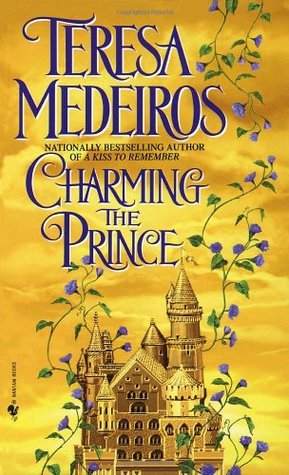
Charming the Prince - Teresa Medeiros (Fairy Tales #1)

450924Charming the Prince was the main buddy read for August in the Unapologetic Romance Readers group on Goodreads.  (We also have a bodice ripper for this month, which I'm planning on reading as well.)  It's supposed to be a historical romance Cinderella retelling, though honestly the "historical" and "Cinderella retelling" parts are painted in with only the broadest strokes.  The main plot follows Branson, the bastard-born lord of some lands in the fourteenth century and Willow, the daughter of another lord who lost all his money and married a rich widow, bringing her and her posse of children into his home.  Now, years later, Willow has basically been relegated to a servant, taking care of her step- and half-siblings, until Branson's men show up at her father's holdings looking for a wife for Branson.  He has specifically requested someone who is "maternal" and "bovine" who can act as a mother to his posse of children, numbering around a dozen, while not awakening his lusts at all, because he doesn't want more children; the ones he have terrify him enough.  Due to a bonnet and an apron full of apples, Willow is mistaken for being both maternal and bovine and has been married off before Branson's representative really realizes his mistake.  The rest of the book consists of Branson coming to terms with his children and Willow and Willow trying to get Branson to appreciate her for herself, which no one has done in a long time.

The writing here is decent, and some of the incidents involving Willow and the kids were amusing, but overall I don't think this was anything remarkable to write home about.  The whole "Branson is so fertile he can get you pregnant just by looking at you" thing was way overdone, especially considering some of the information that comes out later in the book.  There's also a subplot involving one of Willow's stepsisters, who stows away in her luggage and ends up being present throughout the book, and who wants to marry Branson herself.  That felt overly contrived and, honestly, didn't add anything to the book--nor did the whole creepy stepbrother thing.  The "historical" setting lends nothing because it's sketched in very lightly.  The main thing the setting does that I can think of is help distinguish this book from the more plentiful Regency romances we normally see, which are set several centuries later.  That did make for a nice change, but I don't think it was so terribly important to the plot or characters.  Honestly, I feel like this could have been placed in almost any historical era and would have varied very little because of it.

The romance was nice, but again, nothing stellar.  Branson and Willow were immediately attracted to each other and wanted to like each other but also didn't at the same time, which was weird.  I think the ongoing "conflict" between them, which mainly consisted of "warfare" between Willow and her forces (the kids and her stepsister and some of the servants) and Branson and his forces (his men) was honestly the most amusing part of the book.  Once it ended, the whole thing got rather bland rather quickly.  There was some nice kissing, but honestly this is something I think the setting worked against--drafty castles with straw strewn everywhere, no matter how clean, don't really strike me as romantic.

Overall, I don't think this was anything special.  It was an okay romance, but just okay; the "Cinderella" plot it purported to have was barely present, most of the characters were just meh, and despite the title, there wasn't a prince anywhere in sight.  I wouldn't be totally opposed to reading something else by this author, but she's not someone I'll be purposefully seeking out anytime soon based on this book.

2 stars out of 5.

Wednesday, May 25, 2016

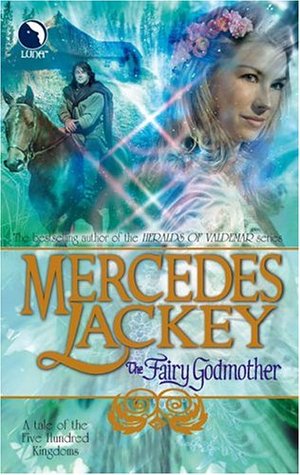
The Fairy Godmother - Mercedes Lackey (Five Hundred Kingdoms #1)

13982Mercedes Lackey is a pretty prolific author of romantic fantasies.  I've read her Element Masters series (most of them, at least; I believe a few more have been published since I read them initially) and found that they were good in the fantasy element, but very light in the romance; I thought the Five Hundred Kingdoms series, the first book of which is The Fairy Godmother, would be a little heavier on the romance because it's published by Luna, which specializes in romantic fantasy and sci-fi.  Well...it kind of was, once the romance actually appeared, but that didn't happen until a good way through the book.

So, The Fairy Godmother is a deviation from a fairy tale.  Elena Klovis is supposed to be Cinderella, but her prince is only eleven years old, so clearly that's not going to work; instead, when her evil stepmother and stepsisters leave town to escape their debts, she takes the first job offer that comes along...which just happens to be with a woman who turns out to be the Fairy Godmother for Elena's kingdom and some others, and who is looking for an apprentice.  The first fifty to sixty percent of the book deal with Elena learning to become a Fairy Godmother and make the Tradition, a magical force which tries to push people down paths following different fairy tale archetypes.  The job of a Fairy Godmother is to help along the good paths and try to diver the bad ones, working within the constraints of the Tradition to ensure that no backlash comes about.  When Bella, Elena's mentor, decides that Elena is ready, she promptly ditches Elena and is never seen again, not even to offer some friendly advice on some of Elena's harder cases.  In her absence, Elena steps up her Fairy Godmother game.

The romance comes into play when Elena sets out to question a trio of brother Questers headed down a Glass Mountain path, and ends up turning the middle brother into a donkey for his terrible behavior.  Since she feels bad leaving him to wander the woods and probably die, she takes him back to her home (also inhabited by a quartet of Brownies, though they don't seem to care about being thanked, which I could have sworn was a Brownie thing) so that he can work and learn humility and eventually regain his humanity--permanently, as she has to give him one human day per week or risk him forgetting his humanity.  The prince, Alexander, spends his time scheming to get away, and then eventually begins to learn his lesson.  And there are some romantic dreams, though there's not much real-life romance between them.  In fact, any time some real-life romance begins to emerge, Elena pushes back against it because she's afraid the Tradition is going to push her onto a path that will ultimately be detrimental to...well, everything.

The Fairy Godmother aspect of this was really creative; I liked how Lackey subverted so many fairy tales and turned so many into other ones, even inventing a few new ones.  While I expected a typical Cinderella story, I wasn't heartbroken when that wasn't what I got.  Elena's magic manages to be stereotypical and creative at the same time, following old paths while also forging new ones.  But I didn't believe the romance here at all.  It felt very, very fake, unlike the romances which slowly built up in the Element Masters series.  Honestly, it did seem that magic forced the romance in this, rather than the romance growing on its own...even though Lackey was trying to make it seem like Elena and Alexander found their way on their own.  Additionally, the "big baddie" forced in at the end was just that: forced.  It felt like a different story entirely.

I got this book as part of a set from the library, so I'll read the second one to see if The Fairy Godmother was more just world setup for the series as a whole, but I do hope the romance will be more pronounced in the other books, or else I won't continue with the series a whole.

3 stars out of 5.

Wednesday, March 16, 2016

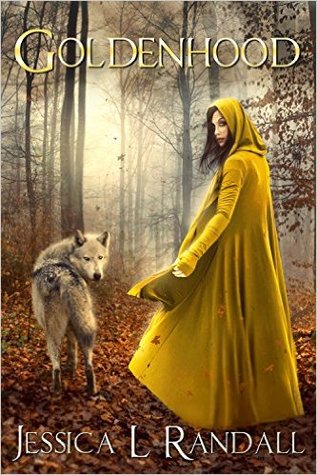
Goldenhood - Jessica L. Randall

GoldenhoodWhen I saw that Jessica L. Randall had a fairytale adaptation to her name, I was super excited.  I liked the charm of her Obituary Society book (I have the second one and just need to get around to using it) and was thrilled to see her turn her pen to a fairytale.  Granted, it was Red Riding Hood, which isn't the most exciting to me, but still.  So, how did it hold up?

It was okay.  The story is about Elise, who comes from a family where the women are said to be witches.  Her grandmother supposedly set wolves on her grandfather, killing him; her mother walked off into the woods and was never seen again; and her aunt serves as the village wisewoman, trying to put aside any witchy tendencies, but the townspeople won't really let her.  Elise herself is inexplicably drawn to the woods, and only the golden cloak she wears--a cloak that was once her mother's--keeps her tethered enough to resist the forest's call.  But as she begins having dreams that hint that something is hiding in the woods, waiting for her, farm animals begin showing up dead and a massive wolf is spotted around the town, Elise might not be able to resist the woods after all--not if she wants to survive with her family intact.

This wasn't a terribly twisty book; everything is laid out all nice and neat and there aren't any big surprises.  There were a few times when I went, "Really?  Oh, okay," but nothing that had my jaw dropping in shock or awe.  Elise is a nice girl but not, I think, a particularly intriguing one; her little sister, Rosie, might have actually been more interesting had she been a bit older.  (Rosie is Red Riding Hood, paired with Elise's Goldenhood.)  Most Riding Hood adaptations tend to have one thing in common, which is werewolves, because that's the obvious place to go with it, and this isn't really any different in that respect.  There's a light romance story line, but nothing too series; one sweet kiss is really as far as it goes.  I thought the end would tie up a bit more neatly with Elise wanting to embrace magic and the title of witch or showing the villagers how things could be, with care, but it didn't go that way; instead, everyone tells a bunch of conflicting stories that everyone believes anyway, and no one questions any of the weird stuff that happened, which was kind of strange.  Okay, really strange.  That was a bit of a plot hole, really.

This is a short book, at 129 pages, which was another reason I picked it up; it helped fill in my "A book under 150 pages" category for a reading challenge.  But I think Randall could have taken the time to add some more pages and flesh things out a little more, and the story would have benefited from it.  It also would have benefited from another round of line edits; there are multiple instances of quotation marks in random places and typos such as "ee'll" instead of "we'll".  It's nothing major, but enough to show that the book isn't really as polished as it could have been.  Overall, it's not my favorite short fairy tale adaptation.  That title still goes to Jill Myles' The Scarecrow King.  But this was good, and I'd be interested in seeing other adaptations from Randall now that she has a bit more experience under her belt to work with.

3 stars out of 5.

Wednesday, March 9, 2016

The Wrath & The Dawn - Renee Ahdieh (The Wrath & The Dawn #1)

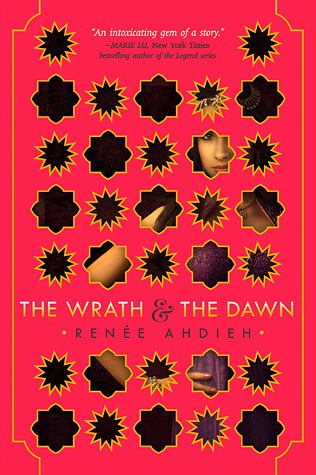
The Wrath and the Dawn (The Wrath and the Dawn, #1)Here is the thing: I absolutely love the story of Scheherazade.  It's not a very known tale, so for those of you not following along, I'll summarize.  Once upon a time there was a caliph who found his wife had been unfaithful to him.  As punishment, he beheaded her, and every day after that he took a new bride and beheaded her the following morning.  Eventually, the daughter of one of his viziers, Scheherazade, volunteered to become his next bride.  The night before her planned death, she begged the caliph for a chance to say goodbye to her sister.  He granted her request, and as he waited in the next room, Scheherazade began telling her sister a story.  By the time the dawn came, she'd reached a cliffhanger.  The caliph, entranced by the tale, demanded that she finish the story, but she refused, saying it could only be told by night.  Begrudgingly, he allowed her to live until the next night so she could finish the story and he could know the ending.  The next night, she finished the story...and began a new one, also ending in a cliffhanger at dawn.  The cycle repeated itself for a thousand and one nights, at the end of which the caliph had fallen in love with Scheherazade and did not kill her, instead letting her live on as his queen.

I've been longing for a good Sheherazade story for a long time, but there have always seemed to be a few problems in the way.  First off, it's pretty hard to make a guy who wants to kill the heroine for something someone else did a viable love interest.  That's really, really difficult.  He has to have damn good reasons for that, and maybe not even then will that be okay.  Second, Scheherazade's whole story is stories within the story, which means the bulk of her story isn't even actually about her.  While this can give an author a lot of room to create, it also means there isn't much of a framework to use as a guide.  I think Ahdieh managed to conquer these roadblocks very well and create what is, for the most part, a very intriguing story.

Ahdieh's Shahrzad, aka Shazi, volunteers to become the next doomed bride of the caliph (constantly and annoyingly referred to as the boy-king) in order to avenge her best friend, one of Khalid's former victims.  She plans to make him put off her execution for long enough to find a way to kill him instead.  Shahrzad is, of course, good at pretty much everything.  Wall-climbing, witty banter, archery, ect...it all falls within her grasp (except swordplay, though she picks that up within the course of a few paragraphs, too).  These skills are all put to use in keeping herself alive--until she doesn't really need them to keep herself alive anymore because Khalid falls in love with her pretty early in the story and then she's not really in danger anymore.  There's still danger around, and intrigue, because she still doesn't know why he killed all those girls, but her own life isn't directly on the line which does tend to lower the tension a bit.  The story is bulked up by the introduction of Shahrzad's former love interest, Tariq, who vows to rescue her from Khalid's evil clutches, and the integration of magic into what was initially portrayed as a Ruritanian-type setting; you know, a fake kingdom, but this time in the Middle East instead of in Europe.

I think this book had a lot going for it.  There are some great kissing scenes, some scenes that blatantly allude to other stories (particularly Aladdin, which we are all, of course, more familiar with from the Disney adaptation than from the original Arabian Nights story, which is actually set in China), and the elements of Scheherazade that prove so problematic are adapted to make the whole story much more palatable, though it takes a while for them all to come out--for much of the book, I was going, "Okay, I get that part, but this whole thing is still not okay."  In the end, it's kind of a moral quandary, which I'm sure Ahdieh's going to tie up in a bow in the second book, The Rose and the Dagger (due out in May).  That said, I still had a few issues with this.

First, Shahrzad's clothes are a topic of constant discussion.  Now, I love pretty clothes as much as anyone and probably more than some, and I think discussions of pretty clothes have their place in books like this.  Clothes are used to shock and awe, and to bulk up a character's appearance to others or make a character appear like something they are not.  However, there are times in this book when Shahrzad's clothes have no bearing on what is happening and still are described at length; for example, there's a part where she's basically pacing in her room and Ahdieh spends several paragraphs describing her clothes and jewelry.  I thought, at first, that this was going to tie into the Bluebeard story integrated into the narrative, because Bluebeard's last wife (in some versions) wears a diamond necklace that falls into a pool of blood and therefore betrays her for doing something she was told not to do.  That didn't happen, and it left the whole outfit description thing pretty pointless.  I don't think these descriptions should have been cut entirely, but I think they could definitely have been narrowed down; we didn't need a day-by-day account of what she was wearing.  "She dressed and went to do blah-blah" could have easily fit in for "She dressed in this and that and the other, with a necklace made of and a belt of and bangles of..."  Do you get my point?

Second, I hated Shahrzad's handmaiden, the Greek girl who I despised so much that I have entirely blocked her name out of my mind.  (It's Despina, I think?  Maybe?)  She was supposed to be this complex side character with a personality and story of her own, which she was, but she was also this really terrible example of how stereotypes can come alive in books.  Despina is in Khalid's service as a slave, even though there's absolutely nothing slave-like about her, and she comes from Enlightened Greece which is apparently completely different from places like Khorasan where they still have things like slavery anyway!  Gasp!  And she's always saying things like "Hera help me" or whatever, which were annoying...her whole "Greek" thing was really stupid and made me really, really hate her.  I don't know why Greece even had to come into it other than as a way to introduce a "civilized" country where rulers don't chop off the heads of their wives every morning.

Third, there is a lot of waffling here.  I hate waffling unless it's done really, really well.  And there's a lot of refusing to tell people about important things for really stupid reasons, too.  "Tell her!" "I don't want to!" is about the gist of it.  Which, of course, leads to a lot of misunderstandings.  This is very much a book where communication is the key to all of the problems; the problems could have been worked out a lot sooner if the characters had just talked to each other.  Hell, the story could have been avoided entirely if Khalid had just talked to his people.  Granted, he probably would have been offed, but hey, you gotta do what you gotta do in order to preserve your kingdom, right?  And it ended with a lot of waffling in a really weird place.

There was some really lush storytelling here, in places, and some good handling of the original story's central problems for being a viable retelling/romance, but I think Ahdieh added in her own problems that kind of even the scales for it.  I'm still eager to read the second book, but I hope some of these problems are resolved in it.

3.5 stars out of 5.

Sunday, March 6, 2016

Fire and Hemlock - Diana Wynne Jones

Fire and HemlockDiana Wynne Jones used to be one of my favorite authors when I was younger, but for some reason I never actually read Fire and Hemlock or the Howl's Moving Castle books, which might arguably be her most famous due to the Miyazaki move that drew inspiration from, but was not a direct adaptation of, the first of the series.  Fire and Hemlock popped up on my radar fairly recently when I read a rather scathing review of Sarah J. Maas' A Court of Thorns and Roses, which is part Beauty and the Beast and part Tam Lin.  That reviewer (Nenia Campbell, the review is here) rather thought ACOTAR sucked, and recommended Fire and Hemlock as a Tam Lin retelling in its place.  I rather liked ACOTAR, but I've generally found books that Nenia recommends to be excellent, so when I saw this was available as an e-book from the library I was pretty excited.

While I think that this was a well-written book, with everything woven together very well, I would not recommend it for people looking for something similar to ACOTAR.  Fire and Hemlock is much more middle-grade than ACOTAR, which is very definitely young adult verging on adult.  Fire and Hemlock is set up differently, with Polly trying to figure out why she's suddenly realized she has two sets of memories and what she can do to fix it; much of the book is told in a sort of series of prolonged flashbacks, detailing Polly's "hidden" set of memories.  These heavily feature Mr. Lynn, who Polly ran into when she was ten and accidentally crashed a funeral.  Their lives got tied together then, and they kept associating with each other.  Polly developed feelings for Mr. Lynn which was a weird sort of dynamic because she was fifteen at the oldest when she saw him last, and he was an adult from the very beginning.  When she eventually figures out what happens, she goes off to fix it, of course, just as any proper young spunky heroine would.  This has a lot of cool fantasy elements to it, but it lacked the one thing I was really hoping to find (and, given Polly's age in the book, this is a good thing): romance.

Here's the thing: ACOTAR is sexy.  Fire and Hemlock is not.  This is, in reflection, a good thing, because a sexy element in Fire and Hemlock would be very Lolita-esque, which is super super weird and not okay.  That said, when the book opened with Polly being nineteen, I thought I was going to be in for a good romance, though not necessarily a steamy one like Maas'.  After all, Fire and Hemlock dates to 1985, and Wynne Jones never struck me as a particularly steamy writer to begin with.  But I thought there'd be something sweet here, and really, I was a bit befuddled by how the whole thing came together.  Because Polly's crush is apparently actually true love, and its reciprocated?  Again, the whole age thing just made this super weird for me, and I couldn't really enjoy it as much as I wanted to.  I think that, had Polly been older for the duration of the book, this would have worked much better for me even without a strongly-pronounced romantic element.  As it was, it just kind of creeped me out a bit.  Age-gap romances can have a lot going for them, but not really when one of the participants is ten.  Granted, the "romantic" element grows as Polly gets older (she doesn't fall head-over-heels for Lynn from the beginning) but she's still young enough that it's disconcerting.

Diana Wynne Jones is a fantastic author, and I definitely still intend to read the Howl's Moving Castle books, but Fire and Hemlock was not for me.  It had some really intriguing elements, like the dual sets of memories, but some of the things (like how Polly always knew what to do "by instinct") didn't convince me and the relationship aspect weirded me out far too much for me to really enjoy the book.  The last bit, when Polly was older, was much more comfortable than the majority of it when they were in the flashback phase.  It was just kind of icky, even though nothing icky actually happened.  I don't know.  It just didn't sit well with me.  I won't be reaching for this one again.

2 stars out of 5.

Monday, December 21, 2015

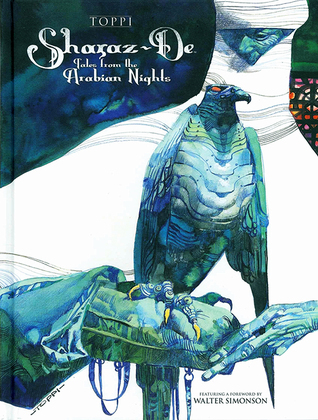
Sharaz-De: Tales from the Arabian Nights - Sergio Toppi

Sharaz-De: Tales from the Arabian NightsLet me start by saying this: Scheherazade is one of my favorite fairytales.  For those of you who don't know (and many don't; this one isn't as popular as the likes of Cinderella and Sleeping Beauty) Scheherazade is the teller of the 1,001 Arabian Nights.  The term "1,001 Arabian Nights" itself comes from her story.  Here is (briefly) how it goes: One upon a time, the king of a middle-eastern kingdom found out his wife had been unfaithful to him.  He had her killed, and then decided to marry a new virgin every day and have her beheaded the next morning.  He did this to 1,000 women before Scheherazade, his vizier's daughter, volunteers to be the next bride.  Now, Scheherazade was a bit of a bookworm and an excellent storyteller.  The night of her marriage, she asked the king to let her say goodbye to her sister.  He agreed, and Scheherazade went into the next room to say her farewells.  But instead of saying goodbye, she began to tell her sister a story.  She didn't finish the story, but instead stopped partway through as dawn approached, leaving a cliffhanger.  The king, who'd been listening in on this conversation, decided to let Scheherazade live another day so that she could finish the story the next night, and he could know the ending.  The next night, she finished the first story and began a second, which she also left unfinished, and the king repeated his delaying of Scheherazade's execution.  This went on for a total of 1,0001 nights and 1,001 stories, at the end of which the king had fallen so madly in love with Scheherazade that he decided not to have her beheaded at all, and she gets to live on as his queen.

Sharaz-de doesn't follow this story.  The title obviously refers to Scheherazade, but she's only a minor character in this and the other stories don't even bolster her own.  The backstory is the same: king finds out wife is cheating, kills her, decides to do the same to a bunch of other women.  But in this version, Sharaz-de is from another country entirely.  She tells a story at night, finishes it, and then tells a second one--and finishes that one, too.  The king lets her live because he wants to hear more stories, so she goes on.  And the book just ends this way.  She tells a bunch of stories, but the resolution of him falling in love with her and letting her live is never actually reached.  It just, apparently, goes on forever.  The stories themselves are beautifully depicted, and full of people who do bad things getting what's coming to them from supernatural sources, but ultimately I felt jipped out of the story I thought I was getting.  The Scheherazade structure doesn't work in this book because the story isn't actually there; I feel like Toppi would have done better to nix that storyline all together and just depict the stories themselves, without revealing Scheherazade/Sharaz-de as the narrator, and simply titling it "Tales from the Arabian Nights."  It is tales, but the larger narrative structure is missing, which leaves the book somewhat lacking.

The art is beautiful and complex, whether it's in black-and-white or in color, but I'm not a huge fan of graphic novels in general, so finding that the story I'd hoped for and been led to expect by the title and initial set-up was just abandoned was highly disappointing.  At least I got my Popsugar Reading Challenge category of "A graphic novel" out of the way.

2.5 stars out of 5.

Saturday, July 25, 2015

Entwined - Heather Dixon

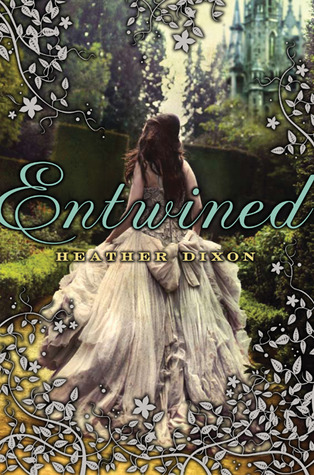
EntwinedAzalea is oldest of elven princesses, and she feels the weight.  She is Princess Royale, which means her future husband is picked out by Parliament because he will one day be king.  Her mother is ailing, and has been for a long time, so Azalea acts as a mother figure to her ten younger sisters.  And her father...well, he's not really interested in them.  And then, on the night of the Yuletide Ball, Azalea's mother dies while giving birth to a twelfth and final princess, and the girls are left basically alone as their father first retreats into himself, and then leaves for war with a neighboring kingdom.  The girls are left alone, with instructions to follow the strict rules of morning: all black clothing, they can't be seen in public except on Royal Business, the windows must remain covered at all times, and--worst of all--absolutely no dancing.  But Azalea and her sister's can't resist dancing, an activity their mother loved, and after the ballroom is locked against them, they're left looking for somewhere else to go.  They find a sanctuary at the bottom of a hidden passage in their bedroom--a garden of silver, with a pavilion at its center that is watched over by a man named Keeper, who conjures magical dances night after night for the princesses...and eventually asks them to free him.

This was an interesting take on The Twelve Dancing Princesses.  While it takes a while for the main plot to get going, it's ultimately much darker than the original, which is a good thing; there's an air of menace about the dances that only strengthens with time, until Azalea is desperate to make it all stop but isn't sure how to do so without bringing down serious consequences on all of them.  And while the original fairytale is very much a man's story--a king who wants control over his daughters and their actions so badly that he offers to give one of them, any of them, away to the first man who can help him--this one is much more a story of family.  Azalea is both sister and mother to many of her sisters, and tries to do what is best for all of them while balancing their father's complicated role in their lives.  In this way, Entwined is very much a Frozen-esque story: family takes precedence over romance, though there is a light dusting of romance here and there.  To me, the romantic story lines weren't really strong enough to be entirely believable, and I kept hoping they would become more prominent, but if they had, the family story might have fallen by the wayside, and I do think that, ultimately, the family story was the one that had to remain central.

There is a danger in writing a story about twelve princesses, of course, and that is that it can be very easy to simply have too many main characters running about.  I think Dixon handled this nicely.  Azalea is very obviously the main character--she is the only main character, really, as the book is written entirely in third-person limited, from Azalea's view.  And by making Azalea young (sixteen or seventeen-ish), Dixon manages to make the youngest of the princesses so young that they're not really characters at all; they're bodies with names and sometimes actions, like chewing on someone, who are mostly toted around by the older girls.  While most of the girls have personalities and dialogue and purpose, the only one who comes close to being a main character like Azalea is Bramble, the second-eldest, and I think that was as it should be; it gave a good supporting cast without cluttering the pages, and overall made Azalea a stronger character because the sheer youth of some of the girls emphasized how much Azalea had to do to keep them all together.

As for the writing itself--it's charming, utterly charming.  It definitely has a fairytale feel to it, while still being just a little bit more grown up.  This is distinctly a young adult piece, not an adult one, but it's also not all sugar-coated with sunshine and rainbows like some adaptations can be.  Things go very, very wrong, and Azalea is left struggling to fix them with the little knowledge she has, and there's no absolute certainty that she'll manage to do so.  The Twelve Dancing Princesses is a story that, in the original, lacks in many things, like character development, a strong central villain, and even a strong plot, and I thought Dixon managed to immensely improve upon all of these aspects.  This is the second adaptation of TDP that I've read this year, the first being Girls at the Kingfisher Club, and while I really liked Girls, in my opinion, Entwined is how the story is meant to be.

4 stars out of 5.

Monday, July 13, 2015

Gretel and the Dark - Eliza Granville

Gretel and the DarkThis book had a lot of things that I absolutely love: fairy tales, historical fiction, a psychological element.  At times, it was absolutely enchanting.  But despite the book's very good reviews, I didn't really like it overall.  There were a few reasons for this.  First, until the very end of the book, you're left wondering what the heck is going on.  The two alternating storylines are obviously connected, but I was left wondering if one of the stories was a dream, a delusion, or if Granville was actually going with the idea of someone time-traveling in order to try to kill Hitler.  Second, I'm not sure how, but Granville actually managed to make a main character who is a Holocaust survivor utterly unlikeable.

Okay, that was kind of a lie.  I know exactly how Granville managed to make her Holocaust-survivor main character unlikeable.  Mainly, she made Krysta a complete brat, so much that I wanted to slap her and lock her in a cupboard just as much as most of the characters that surrounded her did.  We weren't supposed to like Johanna, but man, I sympathized with Johanna and her desire to put Krysta in her place way more than I sympathized with Krysta herself.  Her constant streams of "Won't," "Want," "Don't want to," and so on were absolutely unbearable at more than one point.  Granville tried to turn her obstinacy into a positive trait later in the narrative, successfully, but even that wasn't enough to wash away the dislike of Krysta that had built up over the first three-quarters of the book.

The other characters I liked.  Lilie's character was weird but cool, Josef's character was creepy but realistic and added an interesting psychological element to the story, Benjamin was easily the most empathy-worthy character of the lot, and Gudrun and Greet both had the "gruff housekeeper who means well" dynamic to them.  I found that I enjoyed the Vienna storyline much more than the Ravensbruck storyline, which is kind of problematic given the structure of the two and how they fit together.  Whenever Krysta appeared on the page, I wanted her off it as soon as possible, and considering she was our main point-of-view character...that's an issue.  I know Krysta was young--exactly how young I don't remember, if it was ever mentioned, though it is mentioned that she's older than one would think--and had somewhat-recently lost her mother, but let me tell you: in all my years of dealing with precocious children and entitled students, I have never met a child as insufferable as Krysta is.

The inclusion of all the different fairy tales and how they fit together and morphed from telling to telling was interesting, but trying to figure out how they fit into the different timelines and storylines was disorientating and didn't allow me to get a good feel for the story as a whole.  It was just a weird feeling, and in the end I wasn't sure where I was left standing with this one.  Normally I would read a fairy tale-inspired book more than once, but this one?  Not so much.

2.5 stars out of 5.