Pages

Sunday, June 21, 2015

Mambo In Chinatown - Jean Kwok

18693922Oooooh, this was a complicated book for me.  On one hand, I loved it.  On the other, it frustrated me immensely.

I loved it for a few reasons.  First, it's pretty much like a Chinatown version of Take the Lead or Step Up or one of those other dance movies, which I love, but with an adult as the main character instead of a teenager.  I liked Charlie.  I thought she was a relatable main character, with a realistic backstory who struggles with a lot of things and is happy to finally find a place where she fits in and succeeds, without it seeming like she's been constantly victimized.  She takes care of her father and her younger sister and sees her family as a priority, but she's still a young American woman (technically, American-Born Chinese) who wants some measure of independence.  That longing for independence doesn't fit in with her father's views on the world; he thinks Charlie should be the obedient daughter, like she would be if she'd grown up in China.  Charlie's struggles to balance the two different worlds she enters were a great way of showing the cultural push and pull that can act on immigrant families and second-generation Americans.  I also really liked the cast of supporting characters, in particular Ryan (obviously) and Nina (also obviously).  They seemed very real, like they were real people in and of themselves and not put on the page just to support Charlie.  And the dancing aspect!  I loved it.  I wish I could ballroom dance, and while for some reason I thought this was a historical novel, something along the lines of Lisa See's China Dolls, I was very happy with the modern setting because of the whole competitive ballroom dance aspect it brought to the table.

The main thing I didn't like about this book is that it made me dislike myself.  There are a few reasons for this, and all of them have to do with aspects of the book I didn't like, but knew I was viewing unfairly, or did like and knew I shouldn't.

First, I pretty much wanted to punch Charlie's dad in the face for most of the book.  He was so set in his ways that he was completely unwilling to consider anything else: wanting Charlie to marry someone he's always known, preferably via matchmaker; using eastern medicine and witchcraft to treat Lisa's condition even when it obviously wasn't doing anything, and was convinced that Charlie couldn't make a single decision, from what to wear to where to work to who to visit, without his approval.  I knew this was a cultural thing, because Charlie's dad immigrated to the US from China, which is much more conservative with how children act in regards to their parents' wishes, and therefore I knew I shouldn't be upset, just understanding that there was a cultural divide.  But I still wanted to punch him, and that made me frustrated with myself.  Also, he really did an about-face at the end of the book that I think could have been handled differently.  In order for the ending to work, he needed to become more flexible, but I think it could have been made into a more gradual process.

Second, Lisa.  I wanted to slap Lisa just as much as Charlie did at times, and I knew that was wrong.  (Well, for most the book I didn't feel so bad about it, but then came the Big Reveal, and then I felt awful about it.)  I get why Lisa was so uncommunicative, in hindsight, because that's very typical for what she was going through, but at the same time I wanted to smack her upside the head and tell her she was being an idiot.  Which is stupid, because she's twelve, and was dealing with some horrible stuff in addition to feeling like her sister had suddenly abandoned her, and that made me frustrated with myself, too.

Third, Ryan.  I looooved Ryan.  I thought he was awesome.  I know not everyone did, and there are definitely reasons for that, and that brings me to the thing that I liked that I shouldn't have which makes me angry: Ryan and his girlfriend, Fiona.  See, for pretty much the entire book, Ryan is in a long-distance relationship with a girl named Fiona.  And yet he starts to get involved with Charlie.  I loved the dynamic between Ryan and Charlie, the sort of "it's forbidden but we really like each other and connect" sort of thing (I'm a sucker for that, I freely admit it) but it really bothered me that they were going along with it when they were both aware that Ryan was technically already in a relationship.  Infidelity is something I am not okay with as a plot device, and the fact that I liked Ryan and Charlie together even though Ryan had a girlfriend (even a conspicuously absent girlfriend) really bothered me.  I think the plot could have worked just as well without the girlfriend aspect, because Charlie wasn't really allowed to date Ryan anyway because he was a student, and I would have been much more open to that relationship if Fiona hadn't been an issue.

So, I was pretty conflicted about a lot of parts of this book, but at the same time I couldn't stop reading and I really loved the narrative as a whole.  Because of that, I can't wholeheartedly give it a glowing review, but this is definitely something I would read again--albeit maybe as a guilty pleasure.

Also, I kind of wish Todd got his own book.

3.5 to 4 stars out of 5.

Saturday, June 20, 2015

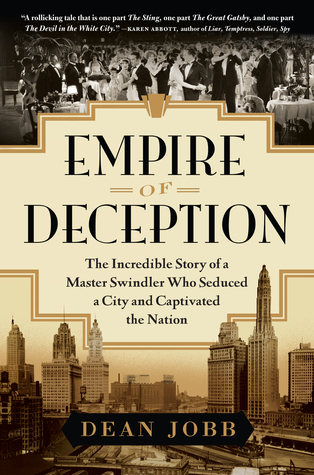
Empire of Deception - Dean Jobb

22859560There's nothing better to kick off a weekend than a story about a swindler, amiright?  Okay...maybe there are a few better ways, but this book is pretty much like a true financial-crime version of Law & Order, which we all know is one of the best shows ever, so I can't think of many better ways.  In Empire, Jobb tells the story of Leo Koretz, who built a veritable financial empire (haha, I'm so funny) based on fake mortgages and stocks.  The mortgages were supposedly based on property in Arkansas that was used to grow rice--and indeed, the property existed, it just wasn't really worth anything, let alone what Koretz was getting for it.  The stocks, on the other hand, were a complete fabrication, based on a fictitious timber and oil company based in Panama.  Between the two scams, Koretz made off with several million dollars, much of it taken from his friends and family, who had become desperate to invest in Koretz's fake company after he repeatedly told them "no."  You know how it goes--the more someone tells you "no," the more you want what they're denying you.  And so it went here, until Koretz absconded and the truth came out.

Koretz did most of his swindling in the 1910's and 1920's, which leads Jobb to include more than a few allusions to The Great Gatsby, which doesn't really seem fair because other than liking parties and spending money, Koretz was nothing like the fictitious Gatsby.  However, the drama mostly takes place in Chicago and, to a lesser extent, Nova Scotia, which are two areas that are seldom examined in histories of the era, so getting a peek at them was awesome.  Koretz was busy swindling long before and long after Ponzi's fraud scheme began and ended, while Al Capone was clawing his way up the gang ladder, and while the entire nation was plunging head-first into the Jazz Age, which leads to a ton of colorful background for Jobb's tale.  Also getting some page-time is Robert Crowe, an attorney who once worked with Koretz and takes up the task of finding and prosecuting him after he escapes.  At times, the writing can get a bit dry, especially when Jobb dives off into using too many quotes.  Don't get me wrong, quotes are good, and can lend a lot of flavor to a book, but too many of them can be distracting and can let the mind wander while the action isn't advancing.  Overall, however, I found the writing engaging and the book a pretty easy read.  It's also much shorter than it initially appears, because a good chunk of the pages are devoted to notes on sources, which is a solid use of page space for any history book worth its salt.  But don't worry; footnotes and annotations don't weigh this one down, and the citations are tucked neatly away in the back where they won't distract you during your read.  Though if you do want to find the citation for something, that might make it a bit difficult...

Overall, though, a fun read. Not one of my favorite history books and not one I'm likely to read again, but good nonetheless.

3.5 stars out of 5.

Friday, June 19, 2015

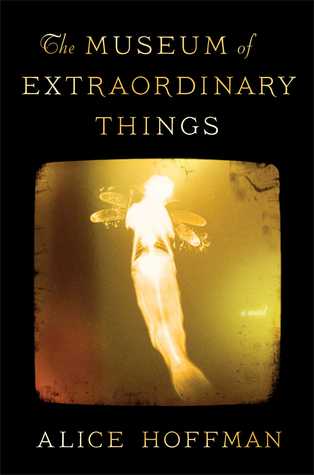
The Museum of Extraordinary Things - Alice Hoffman

The Museum of Extraordinary ThingsFor Coralie, the extraordinary is everyday.  Her father owns and runs the Museum of Extraordinary Things, a small exhibit on Coney Island that some would term a "freak show," featuring people with various kinds of abnormalities, including Coralie herself.  Born with webbed fingers, she performs as a mermaid in her father's exhibit, along with a "wolf man," a "butterfly girl," and various other oddities.  Coralie is kept on a tight leash, and she dreams of knowing more about the world, a desire that is only further fueled when she glimpses a young man in the woods one night while she's pretending to be a river monster on her father's orders.

Eddie (born Ezekiel) Cohen is a photographer scraping by in New York City with his trusty pit bull Mitts.  As a child, he worked first in garment factories with his father, and then as a sort of child investigator, which played on a knack he has for finding things.  Following the terrible Triangle Shirtwaist Factory Fire, which Eddie photographed, a man approaches him asking Eddie to help find his daughter, who has been missing since the day of the inferno but who doesn't appear to have been a victim of  the flames.  This request sets Eddie and Coralie on a collision course, built on the strings of wonder and obsession as Coralie tests the boundaries her father has set and Eddie tries to solve the mystery of Hannah Weiss.

The writing in this varies between tell-y and absolutely beautiful, and part of that is due to the way the narrative is set up.  The chapters alternate between Coralie and Eddie.  Each chapter begins with a long section of italicized, first-person narration before switching to another section of third-person narration.  Switching the perspectives has the dual effect of being cool (it allows us to see into the main characters' minds more easily, while still moving the plot along at a pace that can be hard to accomplish in first-person) and jarring, because the transitions are so abrupt and obvious.  But Coralie's sections in particular can be lovely, because she has this strange flipped sense of the extraordinary; to her, the strange is commonplace and everyday things, like the other parks of Coney Island (especially Dreamland) are reasons for wonder, which makes common settings and events seem wondrous to the reader, as well.  Additionally, one of the climactic scenes (there are two: one regarding the Hannah Weiss plot and one regarding Coralie) seemed to fall flat, like Hoffman was in such a hurry to get on to the bigger scene that followed that she just glossed over what could have easily been an utterly spine-chilling event.  Another minor plot, dealing with Eddie and his father, didn't seem fully wrapped-up to me, but possibly others were satisfied with how that went.

There are also other parts of this book I would have been happier without knowing about, and I don't see that they were intrinsic to the plot.  The one that comes most to mind is the Dreamland fire.  I can see where Hoffman was going, framing the main narrative with two huge fires in New York, but at the same time, the Dreamland fire bothered me so much (spoiler: animals die, guys) that I really wished it hadn't been included, especially as it didn't seem terribly important to the plot.  It made everything very dramatic, I suppose, and I can see where the fire might also have been used as some sort of symbolism for the destruction of Coralie's former life or something like that, but I also felt like the same affect could have been achieved without a slaughterfest of innocent, loyal animals.  That one was a major downer for me and definitely tainted the rest of the ending.

Overall, though, I think this was a wonderful book.  It's a very different aspect of historical fiction, one that we don't see very often (though it does bear similarities to Palisades Park in some ways), and I enjoyed that.  The character of the time and place really come through in addition to the actual, living characters on the page.  The supporting cast was well fleshed out, instead of seeming like paper cutouts of people there only to support Coralie and Eddie.  I'd probably read this one again, despite the aspects of it I disliked; the pros outweighed the cons by a good deal here.

4 out of 5 stars.

Wednesday, June 17, 2015

The Assassination of Margaret Thatcher - Hilary Mantel

20563988The fact that the title of this book references a fictionalized event (Margaret Thatcher's assassination--also not a reference to October 12th, 1984 assassination attempt) should be a pretty good indicator of the book's contents.  It's short stories, and all of them have this sense of being completely plausible while also being completely fantastic and utterly creepy.

I feel like I'm not a good judge of short stories.  I know I could never write one; they take a tremendous amount of restraint to do properly, and that's something I seem to lack when it comes to writing.  Mantel, however, has this quality in spades.  She knows exactly how much to reveal in each tale and how much to leave lurking in the shadows, where you can almost but not quite get a glimpse of it.  The topics covered in this collection are broad, from matters of extramarital affairs to dealings with the supernatural to just plain tragedies that are left so that they'll almost give you nightmares.  The endings are, in more than one case, menacing, and the writing style is so matter-of-fact that it's hard to believe that the world could be any other way.

I really enjoyed this, particularly the "Winter Break" story (so creepy) and the titular "The Assassination of Margaret Thatcher," because even though I knew the attempted assassination was fictional, Mantel presented it so elegantly that I felt an urge to look up Thatcher and make sure I hadn't missed something (I don't think I did).  However, one thing I feel is that short stories are often rife with dimensions and symbolism that require deep study, and on a few of these ("Commas") I definitely felt like there was something I missed in reading.  I think several of these stories could bear with a deeper examination, but quite frankly I'm not the right person to do that.  I think this could make a wonderful book for a literature class, though--one that could provide excellent curriculum while also being an entertaining read for the students.  The slight touches of supernatural are enough to make one think, "But what if...?" while not straying into outright realms of fantasy, and the more menacing aspects of the stories (cloven hoofs and grubby hands come to mind immediately) send shivers down the spine.  Overall, I really enjoyed this, and I might look into picking up one of Mantel's novels (which are, I'm told, quite different) once I work through some of the other volumes currently in my possession.

4 out of 5 stars.

Monday, June 15, 2015

An Appetite for Violets - Martine Bailey

An Appetite for VioletsIn 1773, Kit Tyrone arrives at an Italian villa, looking for his missing sister.  He knows she should be at the villa, but all he finds is a decaying feast, the sister's pet pug, and a mannequin dressed in her clothes holding one of his letters and a beautiful ruby.  The story then jumps back six months and switches to the real main character, Biddy Leigh, as she describes the events leading up to the strange scene at the villa.  Biddy is an under-cook at an English estate, and Kit's sister Carinna is her new mistress, who orders Biddy and a few others to accompany her to France and then to Italy "for her health."  Along the way, Biddy records her travels in a book given to her by her ailing mentor and collects recipes.  There's obviously an air of menace about the trip, which Biddy realizes all along but can't fully grasp until it's in hindsight.  She matures greatly during her journey, from a young woman who only wants to marry her sweetheart into someone with larger views and ambitions.  It's a slow and subtle growth, as Biddy takes on more and more responsibilities regarding the traveling party, and was well-done.  I liked the love story (not the love story that the summary makes it out to be, however, which is a good thing; the real one is much better than the summary-hinted one could have been) and the slow buildup of tension, but there were still parts I didn't really like.

One of those parts was Mr. Loveday's chapters.  Loveday is Carinna's slave, and while he's a friend and accomplice to Biddy, his chapters are mostly reminiscences about his home island somewhere in Indonesia, along with the events that led up to his capture and sale as a slave.  While this was good background on the character, I felt like it could have been worked in better than Loveday just daydreaming all the time and not really doing anything else in his chapters; all of his action seems to be in Biddy's chapters, which makes his seem somewhat pointless.  The other aspect I wasn't fond of is that, even though this is a sort of mystery (What happened at the villa?) it's not really a mystery you can solve.  This is because of the way it's written--past tense, versus present tense--which I can appreciate, but if there's going to be a mystery, I like there to be at the least the possibility of solving it, even if I'm not usually successful in that pursuit.  In this, there's no real clues along the way, just the build-up and climax put forward very matter-of-factly.  There's also no real concern for Biddy, because even though some bad stuff happens to her, you know she's writing the story down after the fact, so she has to make it through.

Finally, the characterization of one of the supporting characters (the eventual love interest) bothered me.  Originally, he's fascinated by Biddy and sees to view her as an equal, despite a perceived difference in their classes and an obvious difference in their abilities.  But then, during the novel's denouement, that attitude completely vanishes and he turns into someone who expects Biddy to obey his every wish and not really do anything for herself.  It seemed like a very abrupt about-face without any real cause, especially because he knew what had happened.  If he had been like that the whole time, it would have been more bothersome as a love story but likely more historically accurate; instead, it just came off as awkward, and the man at the end seemed like a completely different person without any real cause, unlike Biddy's transformation (which definitely had cause).

I liked the inclusion of food as a marker for different events on the story, but at the end, I thought Biddy's musings on food and recipes turned a little too philosophical to read true, and the story probably could have ended just a couple of pages sooner without anything really being lost.  Everything is neatly tied up in the end, without any loose ends dangling, which was nice; everything finally comes full-circle, and everything ultimately gets explained.  Overall, I think this was a great book, and a very easy read despite its length.  I'd definitely read others by this author, though they might be some time in coming since it seems like this is her first novel.

4 stars out of 5.

Saturday, June 13, 2015

The Last Good Paradise - Tatjana Soli

21853659This has a fairly low rating on Goodreads, considering that I pulled it from the "Popular Reads" section of the library, and for the longest time I couldn't figure out why.  It seemed like it was going to be a really good study of character.  The story starts with Anne, a lawyer who aspires to be a "shark," and her chef husband Richard, who flee the country after Richard's business partner (and Anne's former lover) Javi embezzles money from their restaurant and lands all of them in a pot of trouble.  They grab the money they have left and head for a tiny resort in the South Pacific, somewhere near Tahiti.  Anne picks the place because it's completely unplugged--no phones, no internet, nothing.  While one of Anne's lawyer friends tries to straighten things out back in the US, Anne and Richard dissolve into island life along with the island's other occupants--guests Dex Cooper (occupation: rockstar) and Wende (occupation: muse) along with the staff (owner Loren, and multifuctional staffers/lovers Titi and Cooked).
For a while, this seemed like it was going to be an exploration of character and relationships, a novel that didn't really have a strong central "plot" so much as strong central "people," and that was fine with me.  The setting was wonderful, and I thought Soli did an excellent job of building the relationships and lack thereof among the characters, orchestrating a well-wrought drama that didn't need a lot of external plot influences in order to propel it forward and keep my interest.  And then...that all changed.  It's like Soli wrote half the book, and then saw a documentary about the affects of nuclear testing on the South Pacific and was so compelled by it that she felt a need to make it an intrinsic part of her narrative.  The book suddenly winged from slowly-built drama and character to talk of terrorists and staged kidnappings.  It just doesn't seem to fit.  The characters all abruptly find a sense of a purpose in a way that is completely disconnected from how the book seemed to be going before.  And then, after a bunch of what can be considered melodrama, it goes back to the way it was before--all serene and subtle and wonderfully written.  The switch of direction was jarring, and didn't seem to be particularly well done.  It had me gaping at the page in complete disbelief, because it felt like a different book entirely.
For the most part, I liked this.  The writing was very matter-of-fact, a style that I think lends itself well to character-driven works and works written with an omniscent point of view.  But, as mentioned before, the sudden switch in narrative left me jarred out of the story and altogether discontented with it until it resumed its original tone toward the end.  I was satisfied with the ending, other than one character's end scene which tended toward the purple end of the writing spectrum.  Because of that weird middle bit (I feel like it probably should have been worked into a different book entirely, instead of smashed into this one; the premise wasn't bad, but the execution and placement really was) I can't really endorse this whole-heartedly, and I can see why it has such a low Goodreads rating.  It was bound for 4 to 4.5 stars, but as it is, I feel like I can't give it that high of a rating.  I'd probably read something else from Soli, but I feel like I'd have to scrutinize the reviews on it first, to make sure that this disconnection in the middle isn't a recurring theme.

Oh, and there's a reference to Portal.
3 to 3.5 stars out of 5.

Tuesday, June 9, 2015

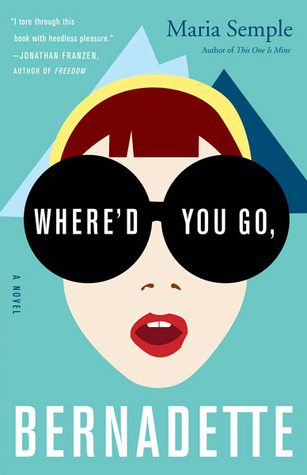
Where'd You Go, Bernadette - Maria Semple

Where'd You Go, BernadetteWhere'd You Go Bernadette[?] is a novel about disappearing.  Everyone in this book is disappearing, and they're all absolutely crazy.  The titular Bernadette Fox, once a famous architect, has vanished from the architectural scene and is slowly being subsumed into soccer mom life (except her daughter, Bee, doesn't play soccer, but it amounts to the same thing, really).  But she's also disappearing from that, having a virtual assistant in India run all of her errands for her so she doesn't have to interact with other people, and then she up and disappears entirely, with no one knowing where she went or what happened to her.  Meanwhile, her husband disappears from their family and into his work, and the supporting characters (known almost entirely through documents they produce) are losing themselves in various ways, too.  Everyone in the book is falling to pieces in pretty much every way imaginable, and Semple does a beautiful job of showing how they're all collapsing on the inside but showing completely different faces to the world around them, making them seem far more composed and in control than they actually are.  Even teenaged Bee, who seems the most together of all of them, is slowly dissolving and un-becoming, disappearing into a completely different Bee as she starts the search for her lost mother.

This is, also, a supremely funny book.  There were multiple occasions when I found myself gasping or giggling out loud at some antic.  Who'd have thought that blackberry brambles could be so funny?  I didn't, and yet they were.  (The blackberry brambles, such an innocuous object, are still one of the cornerstones of this story; hardly any of it would have happened without--or, perhaps more accurately, with--them.)  A lot of this is due to how the book is set up.  The majority of it is a series of documents produced by the characters: emails to and about each other, newsletters sent out to the parents of Bee's school, stuff like that.  Normally I'm not a fan of document-based books, because they tend to be exhausting to read, but this one was extremely engaging.  Despite the characters not being "present" on the page, they were all easily distinguishable and knowable.  The documents trace Bernadette's difficulties coping with life in Seattle, which she tries to avoid by throwing herself into preparations for a cruise to Antarctica--which she simultaneously tries to avoid.  While Bernadette isn't actually "losing it," it looks to many people like she is, and things draw to a head and culminate in her vanishing.  After this point, there are some more documents regarding Bernadette's husband and the other people mixed up in the mess.  Then the book switches, and Bee begins narrating, telling about her search for Bernadette when everyone else has given up.

I also liked how mental health was treated in this narrative.  Bernadette has anxiety regarding some things, but she's not "crazy."  She's not even really agoraphobic, though the back of the book says she is; she does leave the house, routinely, for various things without any crippling anxiety.  She can cope with things and do them herself; she just prefers not to.  However, as she trusts more and more of her life to other people, particularly the Indian virtual assistant mentioned before, people begin to think she's mentally unwell, particularly the mothers of Bee's classmates, who frown upon Bernadette's decisions and lifestyle in general.  This was a wonderful example of how someone who's different--not bad, just different--can be completely stigmatized in an area beyond high school.  Mothers and other parents can be just as vicious as kids in this regard, and the book shows it well--as well as showing Bernadette being vicious right back.  Bernadette doesn't vanish because she's driven to the edge; she vanishes because other people think she has been, and she wants to show that they're wrong.  It's a great example of how people's preconceptions can cause utter chaos when really nothing is the way it was thought to be.

There were a few things that had me raising an eyebrow throughout this (particularly how easy it apparently is to escape from an Antarctic cruise ship, for multiple people) but in general I thought Semple did an extremely good job with how she structured the book; like all books, it requires suspension of disbelief, but once it gets going, everything fits so logically together that it's not a challenge to buy the narrative as a whole.  I pretty much read this in one sitting, and enjoyed every minute of it.

4.5 stars out of 5.