Pages

Showing posts with label non white mcs. Show all posts

Saturday, September 9, 2017

Mornings in Jenin - Susan Abulhawa

Mornings in JeninHm...  After finishing Mornings in Jenin, I'm not entirely sure what to think.  I'm conflicted about it, which seems suitable, because it is a book of conflict.  Centering largely around Amal, a Palestinian refugee, over the course of her life between the refugee camp of Jenin, an orphanage in Jerusalem, Philadelphia, Lebanon, and then some more of the same.  Amal always seems to find herself in the center of whatever conflict is brewing between Israelis and Palestinians, and I keep coming back to this in reflecting on the book, because I ultimately had one big problem with it: it's very heavy handed.

The Israel/Palestine conflict is one that I don't want to get into, because quite frankly I don't want to start a fire.  However, Abulhawa mentions in her afterword that someone said to her once that Palestinian literature is greatly lacking in presence in the Western world, which is one of the reasons she wrote Mornings in Jenin.  I certainly agree with that, but in trying to right that, I think Abulhawa might have tried a bit too hard and shoved too much into one book.  I felt for Amal, but towards the end of the book I found a thought crossing my mind: What a lovely piece of propaganda. It's not actually propaganda, of course, but Abulhawa spends much of the book beating readers over the head with one message: Israel and Israelis are evil.  There are only two exceptions to this, but they're also not really exceptions.  Ismael/David isn't evil, but he's really Palestinian.  And Ari isn't evil, but he is what Abulhawa describes as a "self-hating Jew," and so is on the outside of Israeli civilization anyway.  Meanwhile, the Palestinian characters are all, all, pretty much flawless.  Even the characters who initially seem flawed, such as being cold or distant, are later excused as just loving too much.

The book also has a weird quirk where it lurches between tenses and perspectives; Amal is followed in both first and third person, as is her brother Yousef, and the transitions between the sections aren't always or even often smooth.  Meanwhile, parts of the narrative jump between present and past tense, which helps to compound the confusion, as does the jumping between past and present in the narrative itself.

That's not to say that I didn't enjoy the book.  As I said before, I felt for Amal, for her constant adrift-ness in the world and for the tragedies she kept facing.  I cried at the end of the book--I am a sucker for a good death scene, though in this case it was more the funeral that got to me.  But I admit I was still a little judgey towards Amal at this point, thinking, You knew what it was like, what could happen--how could you in good conscience take your daughter there?  I liked the eventual re-entry of David/Ismael into the picture, but found how easy it was somewhat questionable.  And the final bit of the book...hmmmm.  It kind of seemed like acrobatics to make the narrative fit the facts of history.

Overall, this was a book that I think has an important place in its genre and in literature in general.  However, it was heavy-handed and had problems with the narrative structure.  The emotion is there and there's a sincerity to the whole story that resonates throughout the entire book, but I'm not sure that it overcame the other problems and I just couldn't bring myself to enjoy this as a story, even as a tragic one (which is, of course, its own sort of melancholy enjoyment).

2 stars out of 5.

Saturday, February 18, 2017

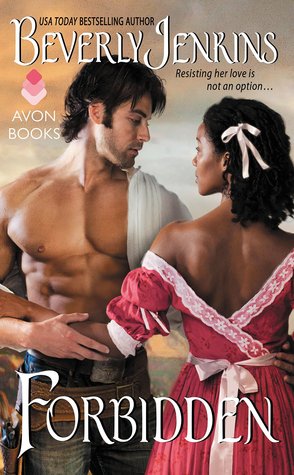
Forbidden - Beverly Jenkins (Old West #1)

Forbidden (Old West, #1)In the Unapologetic Romance Readers' group, we're doing a reading challenge where one of the categories is "An African American romance."  And since February is Black History Month, we decided that it would be a great time to tackle the category as a group!  One member put forth Temptation as the nomination for the category, and it was pretty unanimously agreed upon, and so on we went.

In the years after the Civil War, former slave Rhine moves west to Virginia City, Nevada, where he starts up a new life passing for white.  Meanwhile, Eddy Carmichael dreams of leaving Denver, Colorado for California, where she wants to set up her own restaurant.  Unfortunately, Eddy's plans fall apart when she's robbed and left for dead in the desert in the midst of her journey.  Rhine finds her and rescues her, taking her back to Virginia City and helping get her healthy again.  After a few days, Eddy is transplanted to a boarding house owned by Sylvia Stewart, another woman of color, where she signs on as a cook to rebuild the money she needs to go to California and start her restaurant.  But there lingers an attraction between Rhine and Eddy, one that's problematic for two reasons.  One, Rhine is passing for white, while Eddy is very obviously a woman of color, and while some people in Virginia City are accepting, others remain entrenched in the racism of the antebellum era.  And two, Rhine is already engaged.  To a white woman.  Whoops.

There are a few strengths to this book.  The time, place, and premise are all strong--the tug of attraction across (presumed) racial lines, Rhine's desire to both be with Eddy and help "his" people in ways he couldn't if he wasn't passing as white, and the setting of the antebellum period in the West, rather than in the South (where even this premise probably would have resulted in someone being killed) all lend this a great degree of depth.  The side characters are also well-done, with all of them having backgrounds and places in the story that serve as more than just window dressings for the main characters to flit between.

The book's great weakness, though, is the writing.  It is very "tell" and hardly any "show," and consequently I didn't find it engaging at all.  I understand that Jenkins is trying to convey an immense amount of information about time, place, and background, but the result is that it doesn't come across as an immersive experience.  The writing was just too jerky to keep me fully engaged in the story and what was happening between the characters.  The other, great elements of the book were enough to persuade me to keep reading and finish the book, but the overall flow just wasn't there.  There was inconsistency on some details, too--for example, Eddy's last name appears to change from Carmichael to Cunningham and back again.  It's not enough to turn me off Jenkins entirely--I have another of her books, Through the Storm, that I was supposed to read in 2016 but never got around to--but I wasn't terribly impressed with this as a first offering in the writing department, especially not for a book that was named the American Library Association's Romance of the Year.

3 stars out of 5.

Sunday, June 21, 2015

Mambo In Chinatown - Jean Kwok

18693922Oooooh, this was a complicated book for me.  On one hand, I loved it.  On the other, it frustrated me immensely.

I loved it for a few reasons.  First, it's pretty much like a Chinatown version of Take the Lead or Step Up or one of those other dance movies, which I love, but with an adult as the main character instead of a teenager.  I liked Charlie.  I thought she was a relatable main character, with a realistic backstory who struggles with a lot of things and is happy to finally find a place where she fits in and succeeds, without it seeming like she's been constantly victimized.  She takes care of her father and her younger sister and sees her family as a priority, but she's still a young American woman (technically, American-Born Chinese) who wants some measure of independence.  That longing for independence doesn't fit in with her father's views on the world; he thinks Charlie should be the obedient daughter, like she would be if she'd grown up in China.  Charlie's struggles to balance the two different worlds she enters were a great way of showing the cultural push and pull that can act on immigrant families and second-generation Americans.  I also really liked the cast of supporting characters, in particular Ryan (obviously) and Nina (also obviously).  They seemed very real, like they were real people in and of themselves and not put on the page just to support Charlie.  And the dancing aspect!  I loved it.  I wish I could ballroom dance, and while for some reason I thought this was a historical novel, something along the lines of Lisa See's China Dolls, I was very happy with the modern setting because of the whole competitive ballroom dance aspect it brought to the table.

The main thing I didn't like about this book is that it made me dislike myself.  There are a few reasons for this, and all of them have to do with aspects of the book I didn't like, but knew I was viewing unfairly, or did like and knew I shouldn't.

First, I pretty much wanted to punch Charlie's dad in the face for most of the book.  He was so set in his ways that he was completely unwilling to consider anything else: wanting Charlie to marry someone he's always known, preferably via matchmaker; using eastern medicine and witchcraft to treat Lisa's condition even when it obviously wasn't doing anything, and was convinced that Charlie couldn't make a single decision, from what to wear to where to work to who to visit, without his approval.  I knew this was a cultural thing, because Charlie's dad immigrated to the US from China, which is much more conservative with how children act in regards to their parents' wishes, and therefore I knew I shouldn't be upset, just understanding that there was a cultural divide.  But I still wanted to punch him, and that made me frustrated with myself.  Also, he really did an about-face at the end of the book that I think could have been handled differently.  In order for the ending to work, he needed to become more flexible, but I think it could have been made into a more gradual process.

Second, Lisa.  I wanted to slap Lisa just as much as Charlie did at times, and I knew that was wrong.  (Well, for most the book I didn't feel so bad about it, but then came the Big Reveal, and then I felt awful about it.)  I get why Lisa was so uncommunicative, in hindsight, because that's very typical for what she was going through, but at the same time I wanted to smack her upside the head and tell her she was being an idiot.  Which is stupid, because she's twelve, and was dealing with some horrible stuff in addition to feeling like her sister had suddenly abandoned her, and that made me frustrated with myself, too.

Third, Ryan.  I looooved Ryan.  I thought he was awesome.  I know not everyone did, and there are definitely reasons for that, and that brings me to the thing that I liked that I shouldn't have which makes me angry: Ryan and his girlfriend, Fiona.  See, for pretty much the entire book, Ryan is in a long-distance relationship with a girl named Fiona.  And yet he starts to get involved with Charlie.  I loved the dynamic between Ryan and Charlie, the sort of "it's forbidden but we really like each other and connect" sort of thing (I'm a sucker for that, I freely admit it) but it really bothered me that they were going along with it when they were both aware that Ryan was technically already in a relationship.  Infidelity is something I am not okay with as a plot device, and the fact that I liked Ryan and Charlie together even though Ryan had a girlfriend (even a conspicuously absent girlfriend) really bothered me.  I think the plot could have worked just as well without the girlfriend aspect, because Charlie wasn't really allowed to date Ryan anyway because he was a student, and I would have been much more open to that relationship if Fiona hadn't been an issue.

So, I was pretty conflicted about a lot of parts of this book, but at the same time I couldn't stop reading and I really loved the narrative as a whole.  Because of that, I can't wholeheartedly give it a glowing review, but this is definitely something I would read again--albeit maybe as a guilty pleasure.

Also, I kind of wish Todd got his own book.

3.5 to 4 stars out of 5.

Thursday, August 7, 2014

Servants of the Storm - Delilah S. Dawson

Servants of the StormI wish I hadn't read this book.  I really do.  Because dear lord, I loved it so, so much, and then I got to the end and was consumed by a fiery rage.  For the vast majority of the book, I was enthralled.  I loved Dovey, and Isaac, and kind of hated Baker because he was annoying, but overall the story reminded me of nothing more than Holly Black's Tithe and Valiant and Melissa Marr's Wicked Lovely, except it doesn't deal with faeries and it was set in the south, specifically Savannah.  It has the same deal of someone seeing what other people can't and getting pulled into a mess bigger than themselves and oh dear lord, I was loving it so, so much.It had a sort of post-apocalyptic feel to it, too, though it was actually a post-natural disaster setting, and that mixed with the supernatural aspect also had me thinking of Kresley Cole's Poison Princess, which I found annoying to begin with but was completely enthralled by when I got to the end.  It was set up to be a five-star book, to be read again and again, all the way.  This was going to be a book I was talking about for days, recommending to everyone I came across.  It was on its way to being a star.

And then the end.  This is a book that, if I had not been reading it on my laptop (it was Simon and Schuster's book of the week on their PulseIt website), I would have thrown it across the room in a fit of rage.  Is Dovey an unreliable narrator?  Is she not?  I don't know.  I HATE IT SO MUCH.  Is there a sequel?  Don't know.  It's set up like there should be, but since this book technically hasn't even been released for about a half hour after I'm writing this (11:30PM on August 4th, though this will likely be posted later) it's hard to say.  It's not listed as being in a series on either Goodreads or Amazon, though.  But then, I don't think Tithe was supposed to have sequel/companion books when it was first published, either, though I could be wrong about that.  But STILL.  I am so angry at Dawson right now that I can barely type.  I want some type of closure in my books, you know?  It doesn't even have to be closure that I like, though I obviously prefer closure that I like!  BUT THIS.  NO.  NOT EVEN A LITTLE.  In fact, this book has led me to create a new "rage-inducing" shelf on Goodreads, of which it is currently the only occupant.

I adored SO SO MUCH OF THIS BOOK and then absolutely HATED the ending, and not in the same way I hated the endings to other books, like Gods in Alabama.  With that, I felt disappointed that so much excellent storytelling had come to such a lackluster conclusion.  With this, I just feel cheated.  Cheated isn't a good way to leave your readers--or at least it's not a good way to leave me.  It makes me hold a grudge against you, dear Delilah S. Dawson.  How I wish you had chosen to do something else.  If a sequel to Servants of the Storm appears, I'll probably pick it up seeking the closure that I didn't get here--but I won't be reading any of Dawson's other books, because I'm not going to set myself up for that sort of disappointment again.

Seriously, guys.  Just go read Tithe instead.  It'll give you the same feeling of beauty and decay and creepiness and fantasy and romance--all of the good parts of this book--and in the end, you'll still have closure.

2.5 out of 5 stars, right in the middle, for both the beauty and rage.