Pages

Showing posts with label current events. Show all posts

Friday, June 22, 2018

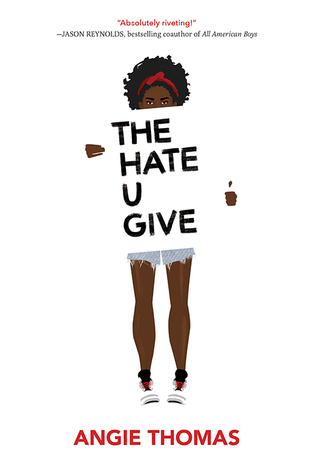
The Hate U Give - Angie Thomas

The Hate U GiveSometimes a book comes out that everyone is talking about.  Sometimes it's in a good way, sometimes it's in a bad way, sometimes it's in a mix of the two.  The Hate U Give seems to fall into the third category; from what I've seen, it's mostly good chatter, but then a handful of people who seem to feel that Thomas is just "stirring the pot."  Which...let's not get into it.  Anyway, this is a book that had people talking, and made the long list for the National Book Award.  So when Emma Watson put it up as the May/June read for her Our Shared Shelf book club, of course it was an easy one to pick up.

The story follows Starr, a high school student who sees her best friend shot by a police officer after they're pulled over for having a tail light out.  Starr is the only witness, but she doesn't want anyone to know who doesn't absolutely have to, because she knows it could tear her life apart.  But the trauma itself has a lasting impact, and the events shake her city to its core, dividing communities, families, and friends.

Is the writing in this book the most amazing ever in style?  No.  However, it's very, very good.  Thomas uses slang and dialect without making it seem obnoxious--like the dreaded phonetically-written Scottish accent I seem to encounter so much--and instead it reads as natural.  She shows the division that inherently exists in Starr's life, between her home life and her school, where she carefully monitors her clothing and behavior so she doesn't come across as "ghetto" or "an angry black woman" and can fit in better with her peers.  She has a masterfully-crafted narrative of empathy, and that is really what this book knocked out of the park.  It truly does allow the reader to step into Starr's shoes and see things from her perspective--how there are conflicting narratives and how those narratives came to be from one set of facts, and how they affect her and those around her.  Starr is not a person of conflict by nature, but finds herself surrounded by it, from protests that turn to riots in her neighborhood to a friend who doesn't outright mean harm but is unwilling to recognize or work to correct her prejudices and racist tendencies.

This book does not have a specific location, as far as I can tell.  It has generic place names and a generic place feel.  It is not a retelling or a spin of any one incident, but instead a look at a mentality and the events that lead up to it, and provides a lens for which those of us who have not and never will experience things like this because of our privilege and background and can really see where these characters are coming from.  There is some info-dumping; there is some awkward time-skipping.  There is some "It's two months later"-ing, which is never really a good narrative device.  But the emotion and purpose in this book ring true, and once I figured out the out-of-order pages at the beginning of my library copy (a printing error and not something inherent in the book, I'd guess) I was truly engrossed.

4.5 stars out of 5.

Saturday, September 9, 2017

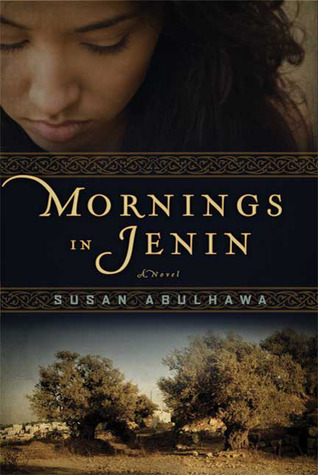
Mornings in Jenin - Susan Abulhawa

Mornings in JeninHm...  After finishing Mornings in Jenin, I'm not entirely sure what to think.  I'm conflicted about it, which seems suitable, because it is a book of conflict.  Centering largely around Amal, a Palestinian refugee, over the course of her life between the refugee camp of Jenin, an orphanage in Jerusalem, Philadelphia, Lebanon, and then some more of the same.  Amal always seems to find herself in the center of whatever conflict is brewing between Israelis and Palestinians, and I keep coming back to this in reflecting on the book, because I ultimately had one big problem with it: it's very heavy handed.

The Israel/Palestine conflict is one that I don't want to get into, because quite frankly I don't want to start a fire.  However, Abulhawa mentions in her afterword that someone said to her once that Palestinian literature is greatly lacking in presence in the Western world, which is one of the reasons she wrote Mornings in Jenin.  I certainly agree with that, but in trying to right that, I think Abulhawa might have tried a bit too hard and shoved too much into one book.  I felt for Amal, but towards the end of the book I found a thought crossing my mind: What a lovely piece of propaganda. It's not actually propaganda, of course, but Abulhawa spends much of the book beating readers over the head with one message: Israel and Israelis are evil.  There are only two exceptions to this, but they're also not really exceptions.  Ismael/David isn't evil, but he's really Palestinian.  And Ari isn't evil, but he is what Abulhawa describes as a "self-hating Jew," and so is on the outside of Israeli civilization anyway.  Meanwhile, the Palestinian characters are all, all, pretty much flawless.  Even the characters who initially seem flawed, such as being cold or distant, are later excused as just loving too much.

The book also has a weird quirk where it lurches between tenses and perspectives; Amal is followed in both first and third person, as is her brother Yousef, and the transitions between the sections aren't always or even often smooth.  Meanwhile, parts of the narrative jump between present and past tense, which helps to compound the confusion, as does the jumping between past and present in the narrative itself.

That's not to say that I didn't enjoy the book.  As I said before, I felt for Amal, for her constant adrift-ness in the world and for the tragedies she kept facing.  I cried at the end of the book--I am a sucker for a good death scene, though in this case it was more the funeral that got to me.  But I admit I was still a little judgey towards Amal at this point, thinking, You knew what it was like, what could happen--how could you in good conscience take your daughter there?  I liked the eventual re-entry of David/Ismael into the picture, but found how easy it was somewhat questionable.  And the final bit of the book...hmmmm.  It kind of seemed like acrobatics to make the narrative fit the facts of history.

Overall, this was a book that I think has an important place in its genre and in literature in general.  However, it was heavy-handed and had problems with the narrative structure.  The emotion is there and there's a sincerity to the whole story that resonates throughout the entire book, but I'm not sure that it overcame the other problems and I just couldn't bring myself to enjoy this as a story, even as a tragic one (which is, of course, its own sort of melancholy enjoyment).

2 stars out of 5.

Monday, July 20, 2015

American Catch - Paul Greenberg

American Catch: The Fight for Our Local SeafoodI've said it before, and I'll say it again: I love food.  And of all the foods I love, seafood is at the very top of that list.  When I was in high school, if I got straight As, my dad would take me out for all-you-can-eat snow crab legs at one of our favorite restaurants.  In more recent times, I've dragged my boyfriend out on a quest for fried clams because I decided I had to have them right now, and then spent a week in Maine eating sea food at literally every meal.  Fish and chips (cod), fish tacos with a cilantro-lime crema (tilapia), lobster pots, crab cakes, steamed mussels, grilled trout, spicy crunchy yellowtail rolls, broiled scallops, blackened catfish...the list goes on and on.  If it dwells in water, I'll eat it.  I trace much of this back to growing up in Erie, Pennsylvania, which was once the largest fresh-water fishing port in the world, mainly for one item: Lake Erie perch.  When I visit home these days, I make a point of ordering up some fried perch, one of the most delectable fried fish you can ever consume and one that came right out of the waters I grew up by.  Until now, it never occurred to me that eating Lake Erie perch--a fish that was caught within miles of where I ate it--was unusual.  But guess what?  It is.  It's very unusual.  And that's a very, very bad thing.

Greenberg uses American Catch to dig into all the problems with how Americans use and view seafood.  The US controls more fishing grounds than any other country, and we have an extremely long coast line, and yet the vast majority of our seafood is shipped off to countries like China--and most of the seafood we eat is imported from those same countries, which doesn't seem to make a lot of sense.  Using three examples--New York oysters, Gulf shrimp, and Alaskan sockeye salmon--Greenberg illustrates how this came about and what the implications for it are.  We constantly decimate our coastlines and the salt marshes that comprise them in order to create more land for agriculture and more desirable places for the rich to vacation, all the while destroying the habitats and breeding grounds of local sea food; we did this to such a degree in New York City that it's actually illegal to eat the New York oysters that survive there, because the water is so polluted that eating said oysters can make people sick.  And we do this even though creating an environment that can sustain oysters is good for the city: oysters filter water and create reefs that can help lessen the effects of of storm surges, like the one that decimated so much of the city in Hurricane Sandy.  On the shrimp front, we allow industry, such as big oil, to pollute the Gulf of Mexico and destroy our coast and the shrimp that live and breed there, and mess with the Mississippi River until it's basically just shooting washed-off fertilizers from big agriculture into the Gulf and creating a deoxygenated dead zone where nothing can live.  And in Alaska, on Bristol Bay, the largest salmon run in the world with some of the best salmon there is, we ponder letting a huge mine destroy the area because it offers a faster payout than fishing does.  And for some reason, we don't see most of this as a problem.

Greenberg really digs into why this is; why we're blind to the problem of seafood because it doesn't present itself as a problem.  After all, I can still grab as many pounds of shrimp as I want from the grocery store, so why should the problem of the Gulf come to my mind?  Does it really matter that the shrimp I'm buying come from farms that are wreaking similar havoc in Asia, and that the shrimp are likely heavily dosed with antibiotics to avoid the diseases that can decimate harvests?  Well...it probably does.  And if it doesn't, it should.  I can very easily see this book being painted as a tool of the "liberal media" by conservatives, who, as Greenberg points out, tend to see any attempt at regulation as an interference with their god-given rights to do whatever the hell they want, and screw anyone who disagrees.  But the fact of the matter is, the way that we treat seafood isn't sustainable, and if I want to be able to enjoy a big piece of salmon years down the road, our attitudes toward it have to change.  This isn't really a new idea, but it is an important one that nonetheless seems to get lost in the shuffle, and the more it's brought up, the more potential there is for people to listen and enact change.

This is a great book, one that uses a few solid examples in conjunction to make a much larger and powerful point, and one that brings in a lot of the people who are actually, personally affected in order to illustrate how the issues in the industry can drag us down.  It doesn't focus on just one geographic area, instead showing that our abuse of seafood truly is a national problem, from New York to Louisiana to Alaska, and that we need to consider the bigger picture of how we view seafood if we're going to fix it.  Because of the subject matter, it's a book that can come across a little preachy at times, which is typical for books like this and somewhat unavoidable, and Greenberg gets all cheery at the end in what I think was an attempt to avoid blatant fearmongering.  Still, after reading this one, I know one thing: I'll probably be looking into where my seafood comes from a little more closely from now on.

4 stars out of 5.