Pages

Showing posts with label middle east. Show all posts

Wednesday, December 6, 2017

A Teaspoon of Earth and Sea - Dina Nayeri

A Teaspoon of Earth and SeaThis book has been on my to-read list for ages, and I'm not entirely sure why I added it.  It probably had something to do with the cover; I love a good silhouette cover and a lyrical title.  It might have also had something to do with the description--Iranian girl (and eventually young woman) uses her love for America to escape.  But honestly, I can't remember on that part now.

The story follows Saba, who loses her mother and her sister on the same day in the years following the Iranian revolution.  She's convinced they flew off to America, leaving Saba and her father behind.  Others insist that her mother is gone and her sister is dead, but Saba's belief that they are alive is so all-encompassing that she had me half-convinced that she was right--and there really was no telling what happened to her mother... Wrapped up in her beliefs, Saba embraces forbidden American culture through books, movies, and TV shows, and tells stories of her sister Mahtab's new life in America.  As Saba grows up and goes through love and marriage and abuse and heartbreak on many fronts, she dreams of making it to America herself, even refusing to go to college in Iran because she is saving herself for an American education.

This was somewhat of a slow book, and it took me a while to get through it even though it wasn't that long in pages.  The plot is entirely Saba's longing to escape and everything that gets in her way.  While there are definitely bad parts of her story--something that her husband does to preserve his honor and her inheritance, the laws that mean she won't get the inheritance anyway even though she has a marriage contract to preserve it, the way her friend is beaten for being "immodest" but really for being beautiful and saying "no," and various other cultural aspects that come in the wake of the revolution--are certainly reprehensible.  But there's a certain idolization of American culture that didn't seem healthy, either.  And when Saba finally does escape, we're led to believe that her life, with few exceptions, really is as hunky-dory as she had imagined it to be.  The book finishes up just after 9/11, and while Saba admits that it will make it harder for her to visit her family still in Iran or for them to visit her in America, that's really the only consequence of her life, as she's spent so long making herself American from afar that she's not really Iranian anymore.  This was a weird dynamic to me, and one that I don't feel great about looking back; it just rubs me the wrong way for some reason.  It felt like Saba was willing to just write off all of the good things--and there certainly were good things, she listed them numerous times--in exchange for books and TV and music, which seemed very shallow of her, just like one of the old woman of her town was always accusing her of being.

I wanted to like Saba as a character, but I just couldn't quite bring myself to do it.  Really, none of the characters here were very likable--I felt like they were all very self-absorbed and greedy.  The exception was probably Ponneh, but then she jumped too far into a resistance and dragged her friends into danger with her when they didn't want anything to do with it, so I kind of lost my sympathy there as well.  I think Nayeri did a wonderful job with the setting of the book, but the actual characters left a lot to be desired for me, and the slow pacing didn't help either.

2 stars out of 5.

Saturday, September 9, 2017

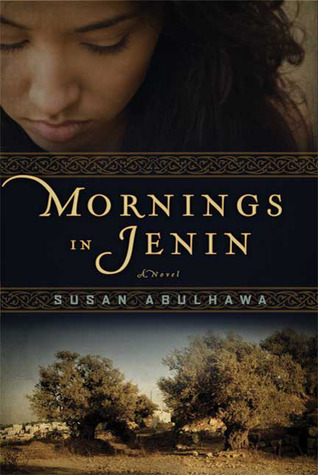
Mornings in Jenin - Susan Abulhawa

Mornings in JeninHm...  After finishing Mornings in Jenin, I'm not entirely sure what to think.  I'm conflicted about it, which seems suitable, because it is a book of conflict.  Centering largely around Amal, a Palestinian refugee, over the course of her life between the refugee camp of Jenin, an orphanage in Jerusalem, Philadelphia, Lebanon, and then some more of the same.  Amal always seems to find herself in the center of whatever conflict is brewing between Israelis and Palestinians, and I keep coming back to this in reflecting on the book, because I ultimately had one big problem with it: it's very heavy handed.

The Israel/Palestine conflict is one that I don't want to get into, because quite frankly I don't want to start a fire.  However, Abulhawa mentions in her afterword that someone said to her once that Palestinian literature is greatly lacking in presence in the Western world, which is one of the reasons she wrote Mornings in Jenin.  I certainly agree with that, but in trying to right that, I think Abulhawa might have tried a bit too hard and shoved too much into one book.  I felt for Amal, but towards the end of the book I found a thought crossing my mind: What a lovely piece of propaganda. It's not actually propaganda, of course, but Abulhawa spends much of the book beating readers over the head with one message: Israel and Israelis are evil.  There are only two exceptions to this, but they're also not really exceptions.  Ismael/David isn't evil, but he's really Palestinian.  And Ari isn't evil, but he is what Abulhawa describes as a "self-hating Jew," and so is on the outside of Israeli civilization anyway.  Meanwhile, the Palestinian characters are all, all, pretty much flawless.  Even the characters who initially seem flawed, such as being cold or distant, are later excused as just loving too much.

The book also has a weird quirk where it lurches between tenses and perspectives; Amal is followed in both first and third person, as is her brother Yousef, and the transitions between the sections aren't always or even often smooth.  Meanwhile, parts of the narrative jump between present and past tense, which helps to compound the confusion, as does the jumping between past and present in the narrative itself.

That's not to say that I didn't enjoy the book.  As I said before, I felt for Amal, for her constant adrift-ness in the world and for the tragedies she kept facing.  I cried at the end of the book--I am a sucker for a good death scene, though in this case it was more the funeral that got to me.  But I admit I was still a little judgey towards Amal at this point, thinking, You knew what it was like, what could happen--how could you in good conscience take your daughter there?  I liked the eventual re-entry of David/Ismael into the picture, but found how easy it was somewhat questionable.  And the final bit of the book...hmmmm.  It kind of seemed like acrobatics to make the narrative fit the facts of history.

Overall, this was a book that I think has an important place in its genre and in literature in general.  However, it was heavy-handed and had problems with the narrative structure.  The emotion is there and there's a sincerity to the whole story that resonates throughout the entire book, but I'm not sure that it overcame the other problems and I just couldn't bring myself to enjoy this as a story, even as a tragic one (which is, of course, its own sort of melancholy enjoyment).

2 stars out of 5.

Monday, September 5, 2016

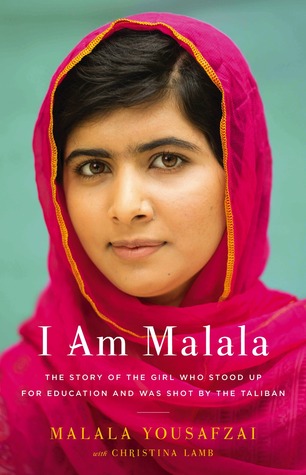
I Am Malala - Malala Yousafzai

I Am Malala: The Story of the Girl Who Stood Up for Education and Was Shot by the TalibanSo, let me show my uneducated American-ness for a second here.  I confess that, prior to Malala Yousafzai being shot, I had no idea who she was.  Even after she was shot I had no idea who she was, and I honestly had no idea why it was such a big deal.  Because, in my ignorance, I was under the impression that the Taliban was off shooting schoolgirls all the time.  This, apparently, was not the case.  Malala is a bit of a special instance, due to her advocacy for girls' education--though the Taliban insists that she was shot because she was going against Islam, not because of her stances on education.  Either way, her experiences were the reason I turned to this as my pick for a political memoir for my reading challenge this year.  I didn't really want to read about a run-of-the-mill politician, so Malala's memoir seemed like a good alternative.

Now, this didn't end up being as political as I had anticipated, as Malala basically recounts her entire life story up until the time she was shot, and a period of time afterwards when she was recovering.  It was written before she won the Nobel Peace Prize and before she became such a huge force in advocacy for education around the world.  Still, you can see the seeds of that in this, and definitely see her political origins in Swat, Pakistan, the valley where she grew up.  Her father was definitely a big influence on her, and she emphasizes again and again that no matter how much she admired her father and no matter how much he worked with her on her advocacy, it was still her decision to make her speeches and put herself out there.  She's definitely a strong young woman, and someone to be admired for her firm stance even in the face of being assaulted by the Taliban.

My issue with this was pretty much exactly the opposite of the issue I had with the last memoir I read, Climbing the Mango Trees.  In CtMT, I found that the writing was good, sometimes even beautiful, but the content just didn't interest me.  In I Am Malala, the content is amazing and inspiring, but the writing...well, it reads like a teenage girl wrote it.  Malala has a co-writer listed (Christina Lamb; the listing is unusual, but I like it) but I would definitely say that she was heavily involved in this book because of the way it reads.  It really does sound like a high school essay at many points.  Now, I completely understand that yes, Malala was still in school when she wrote it, but the downside of this authenticity of voice means that the writing oftentimes isn't very engaging.  The life she describes and her growth to an active advocate for education is fascinating, but the writing lends a certain distance to this that, at times, almost makes it read more like a Wikipedia article than a memoir.

Malala is an amazing young woman with an important cause, and I really admire her for that.  I'm glad that I read this, because it gave me a deeper understanding of where she came from and exactly why she's advocating for education--even before the Taliban became involved, she wanted everyone to be able to go to school.  The writing wasn't the most riveting I've ever seen, but I'm still very happy with this as a selection for my reading challenge.

3.5 stars out of 5.

Wednesday, October 28, 2015

The Kite Runner - Khaled Hosseini

The Kite RunnerI feel like I'm one of a rare group of readers who didn't jump on The Kite Runner back when it came out.  I remember people reading it when I was in high school, but it didn't really intrigue me.  I did read A Thousand Splendid Suns, which focuses on a mainly female cast in Afghanistan, a premise I found much more interesting because of how women's situation in Afghanistan has changed so much over such a relatively short period.  However, the Popsugar Reading Challenge has a category for "A banned book," and I thought this would fit nicely.  We don't actually have banned books in the US, so I think this is a silly category to include at all, but some institutions (especially schools, and especially religious private schools) often take issue with books and ban them from the curriculum and libraries.  The Kite Runner often falls into the "banned" category in institutions for a few reasons, including swearing, but let's be honest: it's the parents who don't want their kids reading about Muslim and homosexual characters who push for the ban.  I'm a huge proponent of letting kids read what they want, because widening your worldviews is good and reading a book can't hurt you, but some people apparently feel differently and that leads to books like The Kite Runner being banned.

So, the plot.  The book is narrated in first-person by Amir, the son of a wealthy businessman who spends his days with a servant his age, Hassan.  Hassan is the son of a man who Amir's father considers to be family, and so Hassan is also considered family.  He was born with a harelip, and for his birthday one year, Amir's father pays to have it fixed.  Amir's father includes Hassan in everything, which leads Amir to be jealous of Hassan, who he considers more than a servant but not quite a friend or brother.  Amir craves his father's love and approval, which often seem to be lacking, for himself, and sometimes wants to exclude Hassan so he can have his father's attention.  It's a complicated relationship, with a lot of complicated feelings behind it.  The reasons for these come out later in the book (which I did not see coming; clearly I am out of the loop) and make a lot of sense, and I think Hosseini did a really good job building up to it and tying it all together, making it logical and not just a "Hah!  Gotcha!" moment.

Every winter in Amir's neighborhood, there is a kite fighting competition.  The kids try to battle each other's kites out of the sky, and other kids chase down the falling kites, which are viewed as trophies--especially the last kite to fall.  One winter, Amir and Hassan win the competition and are the last kite flying; while Amir celebrates, Hassan takes off to "run" and retrieve the second-place kite, which they knocked out.  When he doesn't return quickly, Amir goes looking for him.  He finds him cornered by a bunch of bullies who have harassed Amir and Hassan for years.  Amir wants to help Hassan, but he also doesn't; he doesn't want to get in the middle, and he has always been a self-admitted coward.  Torn, he ends up standing by as Hassan is raped by the bullies.  Ashamed of his actions, he avoids Hassan from then on, and eventually drives Hassan and his father Ali away.  Some time after, Amir and his father flee war-torn Afghanistan for San Francisco, where they start up a new life, one that Amir welcomes because it's free of the taint of shame that followed him in Afghanistan.  However, decades later the shame comes back when a friend from Afghanistan requests that Amir return to see him before he dies, and tells Amir that there is a way to make things right.

The book is both Amir's fall from grace and his path to redemption, and all of the threads tie together in a way that makes a wonderfully-woven whole.  It's a depressing book, at times, the very picture of "bad things happen to good people," but it also includes villains getting what's coming from them.  There's no "happily ever after" here, and Amir admits he doesn't know if there will be one at all, but the book ends on an overall hopeful note, with the suggestion that, even though Amir cannot fix the past, he might be able to atone for some of his sins and help pave the way toward a brighter future.  I didn't find this a riveting book, one I couldn't put down, but it has lovely language and development, and I can certainly see why it's so popular.  I think that some of the people who insist this book be banned could actually benefit greatly from reading and understanding it, but that's probably too much to hope for.

4 stars out of 5.

Saturday, August 9, 2014

The Septembers of Shiraz - Dalia Sofer

The Septembers of ShirazThe Septembers of Shiraz actually has nothing to do with Septembers in Shiraz, so don't pick it up if you're hoping Shiraz will be a prominent feature.  It's not.  In fact, the book is split pretty much entirely between Tehran in the early 1980s and New York City at the same time.  The title comes from one little passage of reflection at the very end, and while it does have a ring to it and some lovely alliteration, it's not exactly relevant to the plot.  The plot revolves around Isaac Amin, a gem dealer who is arrested for mysterious reasons, and his family as they go through the ordeal of his imprisonment while trying to keep up appearances.  While Isaac struggles with life in prison, never knowing if each night will be his last, his wife and daughter face harassment from the Iranian Revolutionary Guard at their home.  Farnaz, Isaac's wife, tries to keep life moving on, and his daughter Shirin steals files from the house of one of her friends in the hope that the files' subjects will escape her father's fate.  Meanwhile, Isaac's son Parviz attends university in New York City and only has spotty communication with his family, and lives an impoverished life when they are not able to send money, at the same time becoming involved in the lives of the Mendelsons, a family of Hasidic Jews from whom he rents his living space.

It took me a while to get into this book, mainly because not much was happening.  Sofer's writing style just didn't grab me and pull me in, and after Isaac's arrest--which happens almost immediately--there's a lot of day-to-day stuff going on before the next "big thing" come along.  It ended at a sort of strange place, and overall felt rather anti-climatic.  That said, I did get into the book about halfway through and enjoyed it, though it's probably not one that I'll grab for the next time I want to read something about the Middle East.  It was good, but not really remarkable; that's pretty much all there is to it.  It did, however, leave me wanting a Turkish-style tea set, for some strange reason.

3 stars out of 5.

Wednesday, July 16, 2014

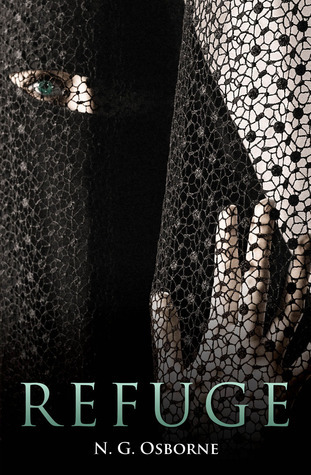
Refuge - N. G. Osborne (Refuge #1)

RefugeThis book was a complicated one for me, because I really liked the overall story, but I still had some issues with it that definitely got in the way of the reading experience.  The plot follows three main characters: Charlie, an American who has moved to Peshawar, Pakistan to work for a company called Mine Aware that hopes to demine villages and fields in Afghanistan; Noor, an Afghan refugee who teaches at a girl's school and hopes to get a scholarship to study abroad; and Tariq, Noor's older brother and a member of the mujadhideen, who were people fighting to free Afghanistan from Soviet/Russian control during the Cold War and its aftermath.  These three are supported by characters such as Noor's father, Charlie's assistant, an American CIA operative, and a Dutch administrator hoping to climb the "aid" career ladder.  There are two major plots at play: one revolves around Charlie and Noor and their relationship (or lack thereof) and the other revolves around Tariq, who promises a Saudi prince that he can marry Noor, only to find that she had fled his grasp, at which point he begins to hunt her down to fulfill his promise and advance his own interests.  I thought the plots worked together wonderfully, and I really loved Noor's reluctance to be interested in Charlie, because she wants a life of her own, not to be rescued by someone.  She seeks shelter with him reluctantly, and their relationship has what seems like a natural growth from conflict to affection, and Noor shelters some very real doubts about it the whole time, which I can't imagine any woman in her position wouldn't shelter.  As for Charlie, he grows immensely during his time in Peshawar and Afghanistan, both professionally and personally, and I thought it was handled very well--though I did have to wonder where he was getting all the money (stacks of hundred dollar bills) that he was throwing around!

Also, I loved how this book treated the use of the burqa.  While burqas are commonly seen as a sign of repression here in the US, Osborne used them fabulously in his story telling.  While, for some women in his narrative, burqas are a symbol of oppression and the control of women by men, for others they represent safety.  When Noor is hiding from her brother, she adopts wearing a burqa in the streets and is amazed at how invisible it makes her and how it enables her to go about her life without harassment, and consequently she doesn't revile it--and Noor is a huge believer of equality between men and women.  I think allowing such a strong, feminist character to find safety in the use of a burqa (that she adopted via her own choice, not someone else's, albeit not for religious reasons) was a great choice on Osborne's part.

But, like I said, I still had some issues with the book.

First, it needs a good line editor.  There are tons of places with misplaced (or, more frequently, missing) commas.  Now, I am a huge fan of the comma, and am probably prone to overusing them, but there were definitely places were a comma was grammatically necessary and was missing.  Also prevalent were a slew of instances in which a question mark should have been replaced with a period and vice versa, because the punctuation used did not actually match the sentence it was attached to.  Also, there were several long stretches of dialogue with no tags such as "said" used, which normally wouldn't be an issue...except Osborne starts new paragraphs rather arbitrarily, so sometimes keeping track of who was talking was difficult because I wasn't sure if the speaker had actually changed or if it was just a new paragraph with the same speaker.

Second, I had an issue with the characterization of Elma.  I can't say too much about this without spoilers, but while Elma is originally made out to be a career woman who will sleep her way to the top if necessary, the majority of the narrative built up her softer side.  She was definitely determined to advance herself, but she was still a real thinking, feeling person.  I felt like this all changed at the end of the book, and was truly appalled at how easily she lost that humanity.

And, third and last, I don't think this needed to be a series.  I think some of the subplots could probably have been cut out, and the narrative streamlined a bit more in order to allow it to become one book instead of multiples.  I might pick up the next one (I'm not entirely sure how many there are, honestly) but I'm not sure at this point.  If I do, I hope that it's better structured and edited than this first volume.  However, overall I think the story was a solid one, and I would recommend this to anyone with the patience to wade through its flaws for the gem at their center.

3 out of 5 stars.