Pages

Showing posts with label world war ii. Show all posts

Monday, December 4, 2017

Tatiana and Alexander - Paullina Simons (The Bronze Horseman #2)

Tatiana and Alexander (The Bronze Horseman, #2)Guys, we have a problem.  My library had The Bronze Horseman, the first book in this trilogy, and it had this one, the second.  You know what it doesn't have in any format?  The third book.  What am I supposed to do?  Honestly, I could probably stop reading here since this book has a pretty firm ending, but it would feel weird to just leave out the third book, you know what I mean?  But though I'm eager to read the third book, that doesn't meant that this book isn't without its flaws.

The book doesn't pick up where the first one left off so much as jump backwards--the parts with both Tatiana and Alexander overlap with the happenings at the very end of the first book, with Tatiana fleeing to America and Alexander being arrested by the NKVD.  The chapters early in the book are also interspersed with short bits about Alexander in his life prior to his first appearance in The Bronze Horseman.  For much of the book, Tatiana and Alexander are separated, neither truly knowing whether or not the other is alive.  Because two characters who don't even know the "living or dead" status of their significant others don't really bode well for romance, the first half to two-thirds of the book heavily involves a lot of re-treading of the ground covered in the first book, particularly the time that the two spent in Lazarevo--which was, unfortunately, the weakest part of the first book.  And while the "present" parts of the book--aka, the parts that are actually happening on this book's timeline, after Tatiana and Alexander's separation, rather than during the "past" part before it--have some interesting happenings, they're pretty much all on Alexander's part.  See, Alexander is busy being arrested and interrogated by the NKVD and then going through other sorts of hell in Russia afterwards, while Tatiana spends her time bopping around New York with their child Anthony.  While she's not disrespectful toward Alexander or anything, and in fact does what she came to find him from thousands of hours away, her parts just aren't as interesting.

Where this book regained its strength was in the final part, when Tatiana returns to Europe in search of Alexander, once again in her disguise as a Red Cross nurse, though I guess it's not exactly a ruse anymore.  This returns her to action, and shows the strength and goodness of her character that just wasn't present while she was drifting around New York and protesting that she could never love again.  Tatiana does have a good character, but Simons didn't display it to its fullest here, though Alexander was done wonderfully.  In fact, he was probably better in this book than in the first one, precisely because he and Tatiana were separated for most of the book.  Once they're reunited, Alexander actually gets worse again.  Why?  Because their separation allowed his controlling tendencies to fade to the wayside, and when they're reunited, all of those terrible character traits come surging to the surface again.

Overall, I don't think this was as strong of a book as the first one.  The setting of wartime Leningrad really carried the first book, and without that here, the characters separately weren't enough to make up for it.  Alexander's parts were good until Tatiana showed up, whereas Tatiana was better once she returned to Europe, which basically sums up the unevenness of the book.  I'm still interested in seeing the end of these characters' story as the timeline moves away from World War II and into the Cold War, but I'm a little leery of how Simons will pull it off after this offering.

3 stars out of 5, and most of that is from the end of the book which at least had good pacing even if Alexander became a bastard again.

Friday, November 24, 2017

The Japanese Lover - Isabelle Allende

The Japanese Lover
The Japanese Lover has been on my radar for some time because it was a past Book of the Month option, but it was sold out by the time I joined BotM, so I didn't get a chance to read it.  When it was added to my library's digital book collection, I added myself to the waitlist--only to have about a billion holds all come through at the same time and lead to me scrambling to finish them all!

The story here is on two timelines.  We're first introduced to a contemporary timeline, though it still takes place over the span of a few years.  The main character in this timeline is Irina, a young woman originally from Moldova who begins working at Lark House, an elder care facility in San Francisco.  Through her work, she also ends up being the assistant to Alma Belasco, a still-independent woman who lives at the facility much to the bafflement of her family.  Alma's grandson, Seth, also becomes involved as he falls in love with Irina.  The second timeline involves Alma's past, from her immigration to the United States from Poland in the days leading up to World War II through her later life, and heavily involves both her cousin/eventual husband Nathaniel and Ichimei, the son of the Belasco family gardener to whom Alma becomes close...and who is, it doesn't take a genius to guess, the eponymous "Japanese lover."

Looking at this book now, I realize that it's been translated, and I bet that explains the problems I had with the book.  They are basically the same complaints that I have about every book in translation, which is what leads me to think it's actually the nature of translation rather than some problem intrinsic with the book itself.  The problems are twofold: the prose is very tell-y without a lot of emotional depth, and the conversation is very stilted.  Honestly, considering that I have these issues so often with translated books, I'm not going to dig into them too much and just kind of accept that it's the way they are.  However, I do think that there are a couple of things that are unique to this book that I can go into in a bit more depth. 

The two timelines is an interesting and important component of this book, but they're definitely not equal in quality.  The contemporary timeline is much stronger than the historical one.  Why?  Because it covers less time.  The book is pretty evenly divided between the two timelines, but with the contemporary one covering fewer years, it means that Allende can examine the characters and events with more depth.  In the historical timeline, she tends to glaze over lot of the characters' deeper emotions and motivations, and the writing doesn't end up being as engaging.  Additionally, Irina is given a Tragic Past.  It is tragic indeed, but it is hard to see what purpose it actually gave to the plot other than making her shy away from Seth (who, by the way, will not take "no" for an answer, very creepy and pushy) and honestly, a girl doesn't need a Tragic Past in order to not want to be with a guy, or to be with anyone.  It seemed like Allende was just trying to justify the delay in their relationship, but honestly, you don't need to justify not wanting to be in a relationship with someone.  That grated on my nerves a bit; even if Allende wanted the two of them to end up together, there was no reason that Irina couldn't just decide that her life was in a better place for a relationship later in the book than it was earlier.

Overall, I enjoyed this, but the translation meant that it had rough spots, and some of it wasn't engaging.  This definitely isn't a "rave" review, but I wouldn't discourage you from reading this, either, if the story seems like it would pique your interest.

3 stars out of 5.

Saturday, October 21, 2017

The Bronze Horseman - Paullina Simons (The Bronze Simons #1)

The Bronze Horseman (The Bronze Horseman, #1)The Bronze Horseman was a group read for the Unapologetic Romance Readers group in September, but I just got around to it this month.  I'm also slotting it in for the "military romance" category in the group's 2017 reading challenge.  Let me tell you, this book is a whopper of a romance--over 800 pages, and it looks like the two sequels are even longer!

What I have to give Simons credit for in this is her sense of time and place.  Set during the time leading up to and during the siege of Leningrad in World War II, the main characters are swept up in all of the hardship that the siege entails.  Starvation, freezing, bombings, deaths en masse--they suffer through it all.

But then, they're also infuriating people.  So not so much credit there.

The main characters are Tatiana Metanova and Alexander Belov.  They spy each other across the street one day during the white nights in a Leningrad summer, just as the war really moves into Russia, and fall in love immediately.  Problem: Alexander is dating Tatiana's older sister, Dasha.  This is the conflict that will fuel the first half of the book, as Tatiana is so scared to lose her sister's love and affection that she insists that Alexander keep dating her despite all of the trouble it causes everyone involved.  Tatiana's love for Dasha also apparently doesn't seem to go both ways, as Dasha uses Tatiana mercilessly and is fine with writing her off at the first available opportunity.  Of course, there's only one way a conflict like this can end, and the book then moves onto what's an incredibly slow start to a second half, where Tatiana and Alexander are reunited and proceed to have sex for about a hundred straight pages before diving back into the war and the siege.

The story is definitely much weaker in the time that Simons moved it away from Leningrad.  The siege provided such structure to the story, a time and place that people might not act as they otherwise would.  In Leningrad, Alexander's controlling behavior comes across as protective, especially because Tatiana is not only naive but possesses feathers for brains for much of the book--yes, she's seventeen, but in a time when "adolescence" wasn't really a thing (I mean, this is Soviet Russia, for crying out loud) she doesn't really have an excuse to continue being as dumb as she is for as long as she is, and miraculously still alive.  In other circumstances, though, Alexander's behavior strikes me as downright abusive, and doesn't bode well for the future.  He's also ruthless with using Tatiana for his own gains, especially because he knows what's likely to happen to her down the road because of his own background.  And then there's Alexander's "best friend" Dimitri, who is vile in his own special way.  Tatiana doesn't mean to be vile--in fact, I firmly believe she has a good heart, and that's the only thing that saves her character from being absolutely death-worthy--but ultimately, this is a book about terrible people doing terrible things to each other, and basically getting away with it because of the war pressing in on them from literally all sides.

There are two more books to this series, and geeze, I have no idea how much more wringing Simons can put these people through, especially given how the book ended.  It's like a train wreck--absolutely terrible, not in writing but in happenings, and yet it's so impossible to look away.  I do intend to continue reading this series, but oh man, I just don't know where it's gonna go.

3.5 stars out of 5.

Friday, August 25, 2017

Unbroken - Laura Hillenbrand

Unbroken: A World War II Story of Survival, Resilience, and RedemptionUnbroken was my latest audiobook, following Missoula as a selection to listen to while walking to and from work some days and while running.  It had been on my to-read list for a while, but wasn't high-priority, so it seemed like a good audiobook choice.  It's the story of Louis Zamperini, an American bombardier in World War II who competed in the 1936 Olympics as a runner, was expected to be the first person to break the four-minute mile, and who ultimately survived the crash of his plane, an extended time in a life raft, sharks, and a series of prison camps in Japan and its territories, including under the reign of a nightmare of a man known to the prisoners as The Bird.  There's also a little nod to Hillenbrand's other book, Seabiscuit--namely that, upon seeing Louis run, someone said that Seabiscuit was the only one that could beat him.

It's an incredible story; Louis had a bit of a misspent youth, and his brother (who was sometimes his co-conspirator, though Louis seemed to be the only one to ever get caught) helped straighten him out by turning him into a runner.  Louis ended up competing in the 5,000 meter event in the 1936 Olympics in Berlin, running in an event that he'd only practiced a few times before his arrival in Germany.  Though he didn't medal, he seemed to be set for the next Olympics as a competitor for the mile--until the US was pulled into World War II and Louis was drafter into the Army Air Force, where he'd briefly enlisted before.  When his plane crashed during a search and rescue mission, Louis and two crewmates survived and found themselves stranded in a life raft that was abysmally poorly provisioned; the three men only had two bars of chocolate and a few cans of fresh water.  Eventually, two of them survived to be picked up...by a Japanese ship, and they promptly became prisoners of war, except without any of the rights accorded to prisoners of war by the Geneva Convention.  Spending time in three different prison camps and never registered with the Red Cross, Louis was lost; his family thought he was dead, and at times, he probably wished he was.

This is a truly amazing story, but I'm ultimately not sure that "Unbroken" is a good title for it.  Louis survived his imprisonment, yes, but he was very, very broken after it.  With a nasty case of PTSD that led him into alcoholism, an obsession with finding and killing The Bird, and nightmares that once had him waking up strangling his wife, Louis certainly didn't walk away from his imprisonment in Japan "unbroken."  Additionally, while it's certainly a story of survival and resilience, I'm not entirely sure where "redemption" plays into it, unless you're counting it as in "The Redeemed Captive" sense, where it means being brought back.  Louis didn't really have anything to be redeemed from; is Hillenbrand trying to get at his religious conversion and eventual comeback from his PTSD, at least to some extent?  Because that's not something that he really needed to be "redeemed" from.  So, yes, probably not the best titling there.

It's an intriguing book and story of survival, but it does drag on a bit.  Every single detail that Hillenbrand seems to have been able to unearth is listed here; every beating, every beating that other prisoners suffered, multiple accounts of how Louis' family was pining away in America for him, though nothing ever changed between these sidebars until it was discovered Louis was, in fact, alive.  Additionally, the final part of the book that detailed Louis' life after the war seemed to drag on.  It really hammers home that PTSD is not a "new" thing, as some people make it out to be, but it also goes into sometimes agonizing detail about what The Bird was up to and how he didn't feel responsible for his actions or that said actions were really bad to begin with.  I understand wanting to have the story be "complete," but it seemed so much slower and dragged on so much more than the earlier parts of the book.  This clearly isn't the "main" story and I feel like it could have been wrapped up in a much shorter section than it was truly given.  It was probably meant to hammer on the "redemption" theme that Hillenbrand was apparently going for, but I really wasn't feeling it.

Overall, this was a good book, but it's nothing I'd be reaching for again.  The pacing was strange and it sometimes seemed over-sensationalized; it was an amazing story on its own, so it didn't really need all of the "look at how amazing this is!" hammering that Hillenbrand laid on it.  It's also not a story of someone remaining unbroken; everyone has a breaking point, everyone, and Louis definitely hit his during his captivity.  His survival was remarkable, but I think Hillenbrand actually blew it up and made it too "larger than life" for it to come off as sincere here.

3 stars out of 5.

Monday, May 1, 2017

Hannah Coulter - Wendell Berry

Hannah CoulterHannah Coulter is possibly one of the most boring books I've read in a while, which is unfortunate because it doesn't bode well for the discussion on Facebook for the Deliberate Reader digital book club, which is what I read this for.

The premise is simple.  Hannah Coulter is an old woman looking back over her life in Port William, Kentucky, including her time as a girl during the Great Depression and her young womanhood during World War II, as well as her later married life.  But here's the thing: Hannah Coulter's life is boring.  She farms.  She has children.  She talks about the characters of these children, and of some of the people connected to her and her family in various ways.  But that's pretty much it.  There's not a plot, just a lot of "late in life" musing about what being a farmer and a mother has meant to her.  But honestly, I didn't feel like there was anything here that I haven't gotten out of countless other books, and those books had more to offer than this one did.

I guess it's well-written enough for literary fiction, but there's nothing intriguing that really kept me wanting to read.  I only finished it because it was a book club book and some perverse desire I have to finish every book I start even when I don't really like it.  It's just a "meh" book and doesn't drive me to pick up anything else of Berry's...like, ever.  There's not a conflict, not even a character-driven one, and while many reviewers seem to be praising how introspective it was, and how it highlights small-town life, but quite frankly I think that idolizing the small-town farming life has just as many dangers in it as idolizing big-city life.  I've lived both, and Berry makes small towns seem far more idyllic than it really is, even if he and I grew up in different times.  As the "story," such as it is, goes on, Hannah turns her attention more to other people than herself, which eliminates some of the promise the book held early on, when she talked about her own thoughts and her own struggles.  Instead, she spends much of the later part of the book just talking about others and what they did and how they did it and so on.

Apparently, this is actually part of a series of interconnected books about this fictitious town and the same people...but I struggle to see how reading them all could have appeal when so much of it seems to have been just laid out here.

Ah, well.  At least it was short.

2 stars out of 5.

Wednesday, March 8, 2017

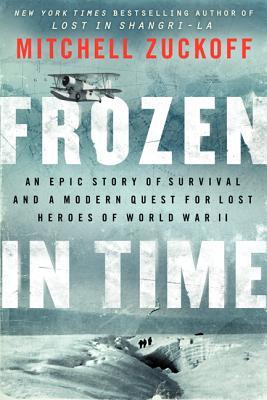
Frozen in Time - Mitchell Zuckoff

Frozen in Time: An Epic Story of Survival and a Modern Quest for Lost Heroes of World War III've read another of Zuckoff's books, Lost in Shangri-La, which is about a rescue of a group of Americans who were in a plane crash in a remote area of New Guinea during World War II and ended up in a village that had very little outside contact prior to the crash and the Americans' arrival.  With Frozen in Time, Zuckoff moved on to another island rescue mission, but instead of the tropics, this one goes to the Arctic, to the glaciers of Greenland.

There are two stories here: the historical, World War II crash-and-rescue story, and the modern story about the attempts to get a recovery mission up and running.  In 1942, a plane crash in New Zealand leaves five men stranded, and the rescue attempts strand nine more in a different location.  And the rescue attempts for the combined crews start stranding and claiming the lives of even more men.  On top of everything, it's not expected that men can live more than a month on the glaciers of Greenland, and winter is bearing down.

I did find this book a little misleading.  I knew several crashes were going to happen in this book, but when the modern chapters started, I got the distinct impression from Zuckoff's narrative that a lot more people died than actually did.  Don't get me wrong, people die in this book--too many.  But Zuckoff gives the impression early in the book that all of the stranded men died, and that the recovery mission was for all of them.  Consequently, I spent much of the book going, "But how do they know this happened this way?"  Well, they know because most the men from the B-17 plane that went down in search of the first plane made it out alive.  The other parts of the story are left more in fog, because those people didn't make it out.

The modern part of the story is mostly comprised of negotiating for funding to get a recovery mission going.  This guy named Lou wants to find the Duck, one of the rescue planes that went out, but he doesn't have the money to do it so he spends his time trying to get the funds from the US military, particularly the Coast Guard (who the Duck belonged to ).  Zuckoff himself ends up pitching in a significant amount of money, at one point even agreeing to use his house as collateral for a loan--though the loan never actually goes through.  This all made me raise an eyebrow at Zuckoff's judgment; while he's perfectly within his rights to spend his money however he wants, I definitely started to wonder how colored this narrative was by his desire to see it through, and I'm not sure that it's the role of the author (Zuckoff was already writing the book when he chipped in the money) to be so financially invested.  Maybe that's weird of me, but I can't quite shake that feeling.

The rescue  mission story is overall interesting, but the modern one is not.  After the fundraising, there's a lot of shifting equipment around on ice, and the end of this is pretty apparent.  Basically, it can only go two ways--they find the plane or they don't, and either way the book isn't long enough to include any sort of cover on the actual recovery mission, rather than the "let's find out where it is" mission.  As a result, I felt kind of bummed and a bit deceived by the end of this, and it's made me a little leery of Zuckoff's other works, though I would still recommend Lost in Shangri-La.

I read this book for the 2017 Popsugar Reading Challenge for the category of "A book with a subtitle," the subtitle being "An Epic Story of Survival and a Modern Quest For Lost Heroes of World War II."

3 stars out of 5.

Friday, September 16, 2016

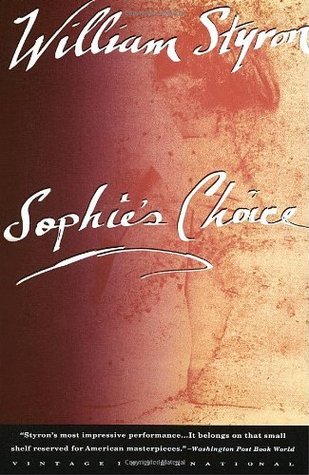
Sophie's Choice - William Styron

Sophie's ChoiceUgh, what a tedious book.  I read this because a) it's supposedly a classic and b) it's on the ALA's banned books list, which means it qualifies for one of my reading challenge categories.  Again, I can see why it was banned: because it involves tons of talk of sex, and the people who like to ban books are terrified of sex.  Also it was apparently banned in Poland because it highlights how anti-Semitic that country was?

Anyway.  The main story here is about struggling writer Stingo, who ends up living in a boarding house where the titular Sophie and her lover, Nathan, also live.  While Stingo tries to write a great Southern novel, he gets tangled up in Sophie and Nathan's disastrous love affair and learns about Sophie's past in Poland during World War II, including her time in Auschwitz.

Stingo is pretty clearly Styron; not a literal version of Styron, but he wants to write about all the same things Styron writes about and Styron uses him to shove his own philosophy about slavery and concentration camps and whatever down our throats.  This is especially easy for him because Stingo is the narrator.  I basically hated Stingo.  He was so boring and pretentious and all he ever thought about was getting laid.  I didn't care about him at all and the best parts of the book were when he was "narrating" Sophie's story, because those parts actually read as normal third-person narration for the most part rather than Stingo's pretentious rambling.

Sophie is someone that everyone falls in love with right away because she's hawt.  No other reason.  This is sad, because I think there were other reasons to love Sophie--but none of the characters actually like her because of them.  Her personal story is deep and moving, and is the story of a non-Jewish inmate of Auschwitz.  She apparently knows how to love unconditionally, given her feelings for Nathan despite his abysmal treatment of her, though some of this is probably her clinging to something that seems stable (even if it's not) after the previous turmoil of her life.  The thing I didn't like about Sophie is that she is an unreliable narrator.  She's told everyone different versions of her story with different details revealed.  Stingo purports to have the true version, but how can we really know?  All of these lies and contradictory revelations that Sophie puts out kind of made me doubt her larger story as a whole, which really isn't something that I think was supposed to happen.

Other problematic things about this include how Nathan's mental illness is portrayed.  He's very clearly unstable from the beginning of the book, but I don't know...something about how Styron tied his (unknown to everyone else until late in the book) diagnosis into his behaviors and used it to just excuse away his behavior seems...not good.  I mean, people with mental illnesses are not dangerous as a rule, and Nathan very clearly was from the very start.

Overall, though, the book just dragged.  I like the parts with Sophie's story, but I knew the ending of that before I started, and so it didn't come as a big, heart-wrenching, shocking moment for me.  Stingo I absolutely hated.  (Did I mention he sexually assaults someone?  They're making out and once he realizes she doesn't want to have sex, he decides to just whip it out and try to get a handjob out of her, even though it's been made pretty clear from her reactions that she's not into it.)  The non-Sophie parts dragged, and I didn't want to read about Styron's philosophy at all.  This was tedious all over, and I'm glad to have it over with.

2 stars out of 5.

Friday, September 2, 2016

The Chosen - Chaim Potok

The ChosenThe Chosen is another book I'm reading as catch-up for the Deliberate Reader book club.  This was the selection for March.  It's an older book, originally published in 1967, though it's gone through several rounds of re-issues; the cover pictured here is from an edition from the 1990s.  The story takes place in the later part of World War II and in the years immediately after it, and follows two Jewish boys living in New York City.  Reuven is our narrator; the son of a professor who writes lots of articles on Judaism and who becomes a prominent Zionist, he wants to become a rabbi when he grows up, despite his father's wishes for him to become a mathematics professor.  The other main character is Danny, who Reuven first encounters during an ill-fated baseball game.  Danny is the son of a Hasidic rabbi and is supposed to become a rabbi himself when he grows up, following in his father's footsteps, though what he really wants to do is study and practice psychology.  Despite the rocky start at the baseball game, Danny and Reuven become friends, and the story follows them through the trials of their friendship as they try to balance the expectations placed upon them with their own hopes and dreams.

This was a really interesting book to me not because of the story itself, but because of what it fundamentally is.  Ultimately, this is a book with Jewish characters set during WWII which doesn't deal with the Holocaust.  The Holocaust is mentioned in passing, once troops reach the camps overseas and news comes back, and some of the older characters are absolutely destroyed by it, but ultimately it plays a very minor part in the story.  I might just be narrowly-read in this area, but in my experience it's fairly rare to find books with Jewish main characters set in this time period that doesn't deal with the Holocaust in a very intimate way.  I actually liked this; while the Holocaust was a horrible, horrible event, it's also very widely-written, and I liked that this book offered a view onto Jewish life as it continued on in the US, despite the ongoing war.  It was just something that I don't see very often, and was therefore a very refreshing read.

The relationship between Danny and Reuven is really the center of this book; the relationships with the fathers are, in my opinion, secondary.  It's Danny and Reuven who shape each other more than their fathers ultimately do, as they encourage each other in different ways, support each other, and help cement what are essentially the opposite fates of what their fathers had intended for them.  In some ways, Danny would have been better suited with Reuven's father, and Reuven better suited with Danny's--though Danny's father raised him in this weird sort of silence, the reasons for which were ultimately explained but didn't really hold water for me, and Reuven blatantly said that would have been terrible for him.  So maybe that pairing wouldn't have worked out after all.  But watching the deviation from their intended paths to their desired ones, even when they were separated, was an interesting process.  It's a character-driven novel, definitely, which means that if you're going to look for a strong plot, there isn't one.  It's very much about Danny and Reuven's development as people rather than being about them actually setting out to achieve a specific goal.  But I think that's the type of narrative that was best suited here, and I ended up really enjoying this one.  It put out a lot of information about Judaism in general and Hasidism more specifically that I wasn't aware of, and so it also functioned as a sort of educational experience.  As I mentioned before, the whole "raised in silence" thing, while it seems like it might be real (I can't weigh in on that) didn't hold up for me, but that's really my only big complaint about this book.

4 stars out of 5.

Friday, August 26, 2016

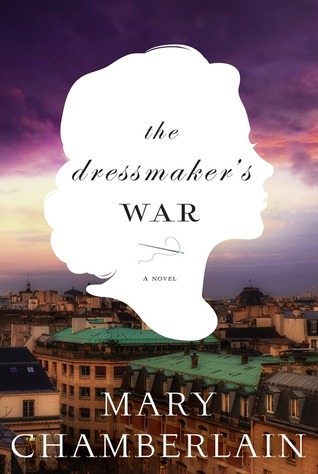
The Dressmaker's War - Mary Chamberlain

The Dressmaker's War
On the eve of World War II, Ada Vaughn is a mannequin for a dressmaker in London.  She has a fair bit of dressmaking skill herself, and hopes to one day open her own fashion house: House of Vaughn, something that she holds in her mind as parallel to Chanel.  She dreams of living a higher-style of life in general, to the point of taking elocution lessons in an attempt to "better" herself from her common origins, living in a small flat with her parents and many siblings.  And when a young man approaches her on the street one day, claiming to be an Austrian count, Ada is completely swept away.  It's a whirlwind romance, but it ends badly, with Ada stranded in Europe after the war begins, with no money and no way to get home.  The series of events that follows leads us in a full circle, back to the prologue and Ada's preparation for her own execution, and serves to read "between the lines" of a story of a young woman swept up in the tide of war.

If I could compare this book to only one other, I would compare it to Hannah Kent's Burial Rites.  The time, location, and characters have absolutely no crossover; they take place more than a century apart, in different countries and to very different people.  But from the very beginning we know--or can at least infer with very little difficulty--that both the main characters, Kent's Agnes and Chamberlain's Ada, are sentenced to die.

We don't know why Ada is sentenced to death.  We have to actually read the story for that.  But the feels of the two books, of the story going back in time to trace the path to the heroine's death sentence, is very similar.  The structures aren't; other than the prologue, Chamberlain's story is told in a very straightforward manner whereas Kent has a few more narrative devices employed.  But there's just this feel to The Dressmaker's War, one that really matched Burial Rites even when there was very little in content to connect the two of them.

Stories of women in WWII are, I think, very few and far between.  There aren't a lot of prominent female historical figures, so finding a good character to write in a historical fiction context can be difficult.  Chamberlain completely invented Ada, but uses her as a lens to view a few other historically-based people that come and go, and to show the overall plight of a woman, and a civilian, stuck in the war.  AS a female civilian, Ada isn't a prisoner of war.  She's just a prisoner.  There's no sort of prisoner exchange for her.  No one knows where she is or if she's even alive.  She's gone through a lot of trauma, and even when she returns home, no one wants to help or support her.  Everyone wants to leave the war completely behind them, even though its consequences haunt every moment of Ada's life.  It's a tragic story, really, and as Chamberlain says in the afterword, Ada didn't stand a chance.  It's the story of untold stories here that's really intriguing, and how those stories were untold not only because people didn't want to talk about them, but because even the people who did want to talk were cognizant of the fact that no one wanted to listen.

That said...I didn't really like Ada as a person or a character.  The only portion of the book I really liked her for was the Dachau portion.  I felt like, under the strain of her situation, she became a much more real and likable person.  For the rest of the book, I found her stuck-up, bratty, and pretty stupid at the same time.  She made all sorts of crazy decisions that, even in a narrative context, just had me rolling my eyes and wanting to shake her, and she made those decisions for reasons that came off as flimsy more than anything.  I though the Dachau portion would really be a turning point for Ada, and that she'd be more sympathetic from then on--but as soon as she left and returned to London, I found that all of her brattiness and poor decision making came roaring back.

Chamberlain does a great job of capturing atmosphere here, and it's interesting to see how clueless Ada was due to her isolation in Germany, but because I didn't really like Ada as a character, this book didn't have the emotional impact it should have.  I liked many of the supporting characters much more than Ada herself, and at the end, quite frankly I wasn't very sad to see her go.

3 stars out of 5.

Wednesday, August 24, 2016

Eve of a Hundred Midnights - Bill Lascher

Eve of a Hundred Midnights: The Star-Crossed Love Story of Two WWII Correspondents and their Epic Escape Across the PacificI recently realized I haven't read a lot of nonfiction this year.  This is actually kind of strange for me because I really like nonfiction, and Eve of a Hundred Midnights is a great example of why.

This is the true story of two news correspondents during WWII.  The first, and main one, is Mel Jacoby, who was a relative of the author's.  Mel worked for his college newspaper and went to China on a study abroad during his junior year, at which point he absolutely fell in love with the country.  After his graduation, he found his way back, working as a reporter for a propaganda station in China's wartime capital.  He continued to move around in various reporting capacities, coming and going from different points in Asia for several years.  Eventually, he convinced a girl, Annalee, who had also worked at the college newspaper, and who he had connected with during a stop back in the United States, to also move to China in a news capacity.  But as the war intensified, Mel ended up stationed in the Philippines, and Annalee ended up joining him there and the two got married.  And then the United States suddenly joined the war, and the two found themselves stuck in the islands, with the Japanese army--who were likely to kill Mel if they caught him--growing ever closer.

This book has a lengthy subtitle, "The Star-Crossed Love Story of Two WWII Correspondents and Their Epic Escape Across the Pacific."  Well, that's part of the story.  It's not all of it, and it's really not even most of it.  The actual escape across the Pacific takes up a relatively small part of the book, and it's probably actually one of the most uneventful portions.  It must have been nerve-wracking at the time, I'm sure, but in retrospect, with more than a half a century between us and the story, it wasn't nearly as exciting as reading about dodging falling bombs in China.  The book also isn't really the story of two star-crossed lovers.  First off, star-crossed implies there was something keeping them from each other, and there wasn't.  Second, Annalee is NOT very prominent in this book.  The focus is definitely on Mel, which is understandable, given the author's relation to him, but it's a bit misleading to make it out like Annalee was more of a player than she was.

Most of the book is really about Mel and how he ended up in Manila prior to the US retreat and Japanese army's arrival.  It's a very interesting story, about living in a war capital, navigating the different censors and political bodies, and seeing war grow ever closer, all the while trying to report the news in a way that no one back home was actually doing.  I really enjoyed this, because it was a perspective that we don't usually get.  Lascher includes a hefty reference section in the back, and it's a pretty good bet that Mel and Annalee actually did think and feel as he portrays them, because he quotes their letters and cables extensively.  Lascher is a very engaging writer, and makes Mel and Annalee's story into just that: a story.  I think he does wax poetic a couple of times; the epilogue is a great example of this.  It's very purple and completely unnecessary to the content of the book.  Overall, though, this was a really great book that offered a fairly unique perspective into a part of the war, and the lead-up to it, that we don't typically get to see.  Very interesting.  I just found myself wishing that the part of the story that was actually advertised had been a little more prominent and gripping!

4 stars out of 5.

Sunday, October 4, 2015

The Monuments Men - Robert M. Edsel

The Monuments Men: Allied Heroes, Nazi Thieves, and the Greatest Treasure Hunt in HistoryThe Monuments Men came to my attention during one of the most awesome courses I took in college, "Indiana Jones in History," which wasn't about Indiana Jones so much as it was about historiography--that is, who gets to tell history and how they form those narratives.  As part of the course, we read The Rape of Europa, which is about the looting of art, sculptures, etc. from locations all across Europe during World War II, as well as the efforts to protect and preserve those same cultural items and to retrieve the ones that were stolen.  It was interesting, and the Monuments Men factored into it, and I consequently didn't really have any interest in reading The Monuments Men because I figured The Rape of Europa had already covered it all.  And then, of course, The Monuments Men became a movie.  I still didn't really have any interest in reading it...until the Popsugar Reading Challenge threw out "A book that was made into a movie."  While I had other books that had become movies, I'd also picked up The Monuments Men when it was on sale on Kindle, so I figured this was as good a time as ever to read it.  And?  Well, it was much, much better than The Rape of Europa.

Don't get me wrong.  Europa was good.  But it was a very academic work, one that was written for more of an art history audience.  It seemed to rely heavily on the reader knowing the names of tons of artists and tons of pieces of art, and its scope meant that it went from place to place very quickly.  The Monuments Men also jumped from place to place, but Edsel did this very purposefully to build tension and cover a select handful of people rather than to just cover as much territory as humanly possible.  Edsel also focuses exclusively on the work of the Monuments Men in the areas of France, Germany, and Austria, mostly from D-Day onward, and the recovery efforts of the few who made it into the Monuments Men's ranks.  By restraining his scope, Edsel manages to make this a narrative history that, while it's well-noted and researched, still manages to be engaging and readable to someone who isn't totally versed in either WWII history or art.  Instead of producing laundry lists of art and artists, Edsel uses a few well-known artists (Vermeer, Michelangelo) and a few iconic pieces of art (The Astronomer) to illustrate his points and keep a continuous narrative.  Consequently, the book is informative while also reading like a gripping war story.

I had two main complaints about this book.  The first was the chapter length.  Edsel's chapters vary wildly in length; some are only a handful of pages long, taking less than five minutes to read.  Others are more than four times that long.  While none of the chapters were bad, the differences in length could be frustrating.  There were many times that I wouldn't start a new chapter because I just didn't have time for it--though if it had been the length of the other chapters, I could have read two or three more.  The other complaint was that, at the end, Edsel suddenly seems to switch from telling a story to solving a mystery.  I didn't necessarily mind the mystery-solving aspect, because most history books do revolve around an argument that tries to "solve" some aspect of history.  However, in most cases, the entire book revolves around building and supporting an argument; any narratives are secondary to the argument.  In this case, it was the other way around.  Most of the book was a narrative, and the argument came out of nowhere at the end, which just seemed...odd.

Okay, there was a third thing, and that was that Edsel suddenly took a moralistic approach at the end.  World War II was horrible on so many fronts.  We know that.  (Well, most of us do.  There are certainly Holocaust deniers out there, but I doubt they'd be reading this to begin with.)  Edsel's random preachy moment at the end, about one of the Monuments Men recovering a painting that he, as a German Jew, had never been allowed to see when it was on display, came across as rather abrupt, and it would have been best if it had been either left out or worked in a bit more subtly...which would have been hard, because the Monuments Man in question really wasn't even involved for most of the story, and instead seemed to have been incorporated only for this purpose.  It was weird.

Despite the rather jarring bits at the end which didn't seem to properly incorporated, I did enjoy this.  The narrative style worked well, and the book as a whole was engaging.  I definitely read on later than I should have on several occasions, because it was just so good.  I might even read this one again.  Maybe.  We'll see.

4 stars out of 5.

Saturday, September 19, 2015

The Thorn Birds - Colleen McCullough

The Thorn BirdsI picked this book up purely for the Popsugar Reading Challenge, to fulfill the category "A book your mother loves."  The Thorn Birds is her favorite book, though I don't remember her reading it or even owning a copy of it.  In fact, I would have never, ever guessed that this was her favorite book--except that when we were in Italy for my sister's wedding last September, my mother got a little tipsy (well, more than a little--she was, to be fair, having an extraordinarily bad week) and got involved in a conversation with an Australian tourist who asked us to take a picture for her.  At some point during the conversation, The Thorn Birds came up.  I obviously assumed that it came up because the book takes place in Australia, so imagine my dismay when I began reading it and found the setting was New Zealand!  Did my other actually not know the difference between Australia and New Zealand?  No, it couldn't be true.  Maybe she just hadn't read the book in a while, and was mis-remembering the setting.  That was entirely possible, wasn't it?  But as I kept reading, I became immensely relieved.  Yes, the book starts in New Zealand, but the setting quickly moves to Australia and stays there for most of the book.  Whew!  What a close call!

The Thorn Birds is the story of the Cleary family.  Originally living in New Zealand, they move to Australia to live and work on Drogheda, a massive sheep farming operation owned by the sister of Paddy Cleary, the patriarch of the Cleary family.  The "main" character in this book, if there can be one more so than others, is Meggie, Paddy's daughter, who is only a few years old when the book begins and is in her fifties when it ends.  Throughout the book, Meggie grows up and experiences all sorts of things, most of them focused around a priest named Ralph who is quickly climbing through the ranks of the Catholic church.  Meggie's mother, Fee, also features prominently, and so do her two eventual children, Justine and Dane.  The rest of the family is present, of course, but typically don't feature as strongly as those few.

The Thorn Birds, because of its sweeping scope of time and location and happenings, is a bit hard to describe, except in that it reminded me immensely of Gone with the Wind.  Now, Gone with the Wind is my favorite book, so maybe it's suitable that The Thorn Birds is my mother's.  Just as Gone with the Wind is a love story but also a powerful historical fiction, a story about people who had gumption and people who didn't, so is The Thorn Birds.  They're very different in time, place, and characters, but they still had a similar writing style and feel to them, which was awesome.  I think this a great book for people who liked Gone with the Wind for the feel and artful writing and are opening to trying something set in a completely different locale and era.  I'll definitely need to obtain a copy of this for my own collection, once the library book goes back to the library.  It's not a book I imagine myself reading often, because it's just too long and heavy for that, but much like Gone with the Wind I can see myself picking it up now and then when I need something that's just plain good.

4.5 stars out of 5!