Pages

Monday, June 20, 2016

Shift - Hugh Howey (Silo #2)

Shift (Shift, #1-3; Silo, #2)Shift is the prequel to Hugh Howey's Wool, which chronicled life inside "the" silo and what happened when a woman sentenced to death beyond its walls discovers that the silo is not alone.  In Shift, Howey goes back--way back.  Centuries back, to when the silos were designed and implemented, as well as running a couple of other timelines.  The book is divided into three parts, called "First Shift," "Second Shift," and "Third Shift," referring to "shifts" that the workers of Silo 1 man.  Each shift follows 2 plotlines.  In the first, newly-elected congressman Donald find himself working on the designs for a silo, which he is told is to be used as emergency housing if something goes wrong at a new nuclear waste containment site.  A century later, Troy wakes up to work his first shift as head of Silo 1 and tries to regain the memories he's lost while dealing with the collapse of another silo.  In the second part, Mission, a resident of Silo 18, finds himself in the midst of an uprising, while Donald is reawakened from his slumber to deal with the uprising.  In the third, Donald wakes again to deal with Jules' escape from Silo 18, while the other plot jumps back in time to the collapse of Silo 17 and the following years to show us the background of Jimmy/Solo.

Some people have reviewed this as being slow, and I admit there's not as much brewing in the background here as there was in Wool, because if we've read Wool, we know where all of this is going.  Still, I found the background here absolutely fascinating.  The downfall of the world as we know it, the workings of Silo 1, the past uprisings of Silo 18, even Solo's background were very interesting to me.  More interesting still are a couple of intrigues that are brought up here but I presume will be more fully explored in Dust, which follows up with Jules on the "present" timeline of the silos.  How far does the ruination actually spread?  Will more than one silo survive this ordeal?  And what will happen when they, it seems inevitably, emerge from their isolation early?  It's an interesting conundrum that Shift lays out, and while I knew where it was all going, the whos, whys, and hows of it all still intrigued me.  There are still some twisty logics and imaginings here, typical of what I've come to expect of Howey, and I was very pleased with the result.

4 stars out of 5.

This book also served as the second half of the "A book and its prequel" category for my 2016 reading challenge.

Wednesday, June 15, 2016

Ruined by Rumor - Alyssa Everett

Ruined by RumorThe Unapologetic Romance Readers group picked this as one of two buddy reads for June, the other being Mariana Zapata's Kulti, which I'll also be reading.  Kulti is a contemporary romance, so Ruined by Rumor was chosen to be the historical counterpart.  The story follows Roxana, who is jilted by her fiance of five years just months before her wedding and weeks after the formal announcement of their engagement to the whole county.  To make matters worse, on the same night she finds her reputation utterly ruined when, in her emotional distress, she cries on and ends up kissing her older brother's friend, Alex, and is seen.  Alex, who has been pining for Roxana for half a decade, convinces her to marry him to save her reputation, and besides, she'll become a countess into the bargain.  Roxana agrees to this "marriage of convenience" and while she finds that she enjoys the physical aspects of this, she doubts her emotional investment in the relationship.  Meanwhile, Alex is thrilled at being married to Roxana but is so terribly awkward that he doesn't really know how to convey it, and when George keeps showing up, he gains some doubts of his own...

Alex was adorable, and definitely the high point of this book.  He really loved Roxana, from the very beginning, and while he was so happy to marry her and save her from complete social ruination, he could tell she wasn't really into it and was trying so hard to not make things awkward for her.  He's not really a dominant personality, which means that the actual interactions between he and Roxana are...again, awkward.  And kind of few and far between, because he's trying so hard to stay out of her way.  He does have a bit of a dominant streak, when his temper flares up, and honestly I found those parts far more interesting to me.  I like sweet, but sweet all the time gets a little bland, you know?

Roxana, on the other hand, was just bland all over.  She was so fixated on George that she was very reluctant to even working on her marriage, and she made some stupid decisions about George and Alex that really came back to bite her even though I couldn't see her logic.  Why keep it a secret?  Nothing happened.  Beyond that, her total resistance to the very concept of being in love with Alex was kind of frustrating.  I understand that she believed herself to have been in love with George very recently, but come on.  Because of Roxana's resistance and because she's the primary POV character in the book--there are parts with Alex as the focus, but not as many--it means that the romance doesn't come across as, well...romantic.  It's basically as bland as Roxana is.  While there are a few good kisses, I didn't really see the whole "falling in love" aspect throughout this book like I would have preferred.

That said, I'd be interested in reading more from Alyssa Everett.  I think my issues with this came largely from the dynamic between the characters, particularly Roxana, rather than from the writing itself.  I'm not sure how many other book she's written, but I might look in the future if I find myself craving some period romance.

2.5 stars out of 5; a pretty "meh" book overall.

Monday, June 13, 2016

A Court of Mist and Fury - Sarah J. Maas (A Court of Thorns and Roses #2)

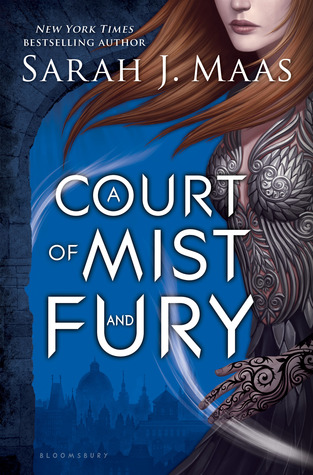
A Court of Mist and Fury (A Court of Thorns and Roses, #2)Wow.  What to say about this book?  Well, let me put it this way: I think Maas has a knack for frustrating first books that she turns around in the sequels.  While I wasn't disappointed with A Court of Thorns and Roses, the first book in this trilogy, I was frustrated with a couple of aspects of it.  First, it was based off a fairy tale, you know, with a supposed "happily ever after," but it was pretty clearly set up to introduced a love triangle in the second book.  Second, Tamlin, Feyre's love interest, was...kind of a controlling bastard.  A very sexy controlling bastard who I let get away with a lot of things because he was cursed, and who really knows how much of all that stuff was the curse, anyway?

Well, let me say this: I should not have let Tamlin off the hook.  He is a royal ass in this book, and you can really see how those controlling behaviors were not just part of the curse, but something inherent in his character.  Not cool.  That makes the whole "love triangle" thing much less of an issue, because it's not actually a love triangle: it's Feyre walking away from an abusive relationship and finding one that's better for her, which is a really interesting dynamic and one that I don't think gets seen a lot in young adult books (though, honestly, this is not young adult; it's marketed as such, but there's some pretty darn adult content in here) let alone fantasy books.  Feyre's feelings on the matter also seem realistic; she blames herself, for a myriad of things, including being interested in someone new so soon after walking away from Tamlin, and for her actions Under the Mountain, though she only did it to save herself and the rest of Prythian.

The other main plot, besides the romance (With Rhysand, who totally grew on me; I get it now, guys, I get it, and that slow burn--ahhhhhh!) deals with the threat pressing down on Prythian in the wake of Amarantha's defeat.  The King of Hybern clearly wants Prythian, and possibly everything else, and Rhysand and Feyre, along with the rest of Rhysand's inner circle, are trying to find a way to stop him.  This book takes us to both of Rhysand's courts and to the Summer Court, and there is some beautiful imagery involved in both.  Feyre is also coming to terms with her new fae-ness, including a startling array of abilities that seem to stem from being "created" by all seven High Lords like she was.  She is, apparently, one of three fae who were "created," though I can't figure out why the other two don't have this same range of abilities, because wouldn't they have to be created in the same way?  Maybe this will come more to light in the third book.  It's definitely hinted that the third created person will have to come into play, given the dynamics there... We'll see.  I'm very intrigued, and think Maas will probably tie this up pretty well.  Maybe.  But the romance and the adventure here hold each other up, and while I was originally frustrated that Maas was subverting the very tales she'd based the first book on, that has since grown on me--the idea that there's another side to the story, and maybe it's even better than the side we know.

That said, this book got off to a bad start.  It's basically Feyre whining about planning a wedding and having a lot of sex with Tamlin.  After the wonderful start of A Court of Thorns and Roses, where Feyre kills the faerie wolf that kicks off the whole chain of events, it was a very weak and frustrating start.  In fact, I almost didn't read this book because of how bad the start was.  Did it get better?  Yes.  Definitely.  But it was a really rough beginning, and while I think the rest of the book ultimately made up for it, those first several chapters were a real struggle to get through, especially because they featured so much of Feyre just submitting to Tamlin's abusive behavior.  It was hard to read, and I put the book down for several weeks before returning to it because of that.  It also features some typical Maas stamps that I really wish she would diversify upon: the blond, kick-butt heroine who loves to read (Feyre learns to read in record time here) and to listen to music and who gains magical powers from pretty much nowhere.  Honestly, it would take only a few nudges to push her entirely into Celaena/Aelin territory, so I hope that Maas manages to keep them unique...but I fear they edge closer together all the time.

It's pretty clear that Maas has grown a lot as a writer from her first book, Throne of Glass, and from when she began writing A Court of Thorns and Roses, which was substantially before A Court of Mist and Fury came out.  In that time, it seems that she's gotten a real knack for plot twists and building up both characters and worlds, and I think that really shows here.  I loved ACOTAR when I read it, but in retrospect it had some issues.  I think ACOMAF resolved a lot of those while having very few of its own (in the large scale), and the third (and final) book in the series has a lot going for it.  I just hope it lives up to that potential.

5 stars out of 5.

Friday, June 10, 2016

Twenty-Six Roses - Tamara Vann (Keeper's Daughter #1)

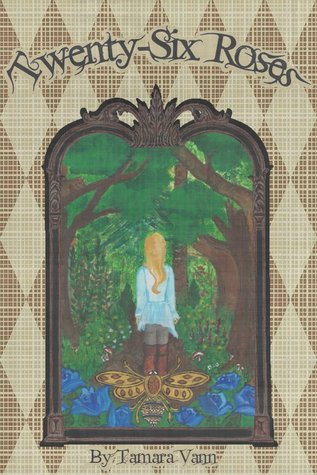
Twenty-Six RosesThings this book does not have to do with:
-Twenty-six roses
-A person who is a "Keeper's Daughter"

The roses are very, very briefly referred to at the end of the book.  But unless the main character, Kara, is not actually the main character, I can see no reason that this series is called "Keeper's Daughter."  Shes' 15, so she clearly doesn't have a daughter, and she's apparently also not the daughter of the person who formerly held the title of Keeper in the world that this book involves.  So yeah, I'm not sure where that comes from.

Now that those things are out of the way...

Twenty-Six Roses is about Kara, whose father dies and whose mother moves herself, Kara, and Kara's little sister Meghan from Colorado to Texas in order to get away from the tragedy.  On one of the first days in their new house, Kara and Meghan find a weird mirror behind a barricaded door in the attic.  Meghan half-falls through the mirror and is injured by something there, and quickly sickens.  When Earth doctors don't seem to be able to help her, Kara goes back to the mirror and enters the world beyond it to find a cure for her sister.  In the mirror, she finds a world where "people" are really human-sized animals, with the exception o of the Marked (like guide and love interest Vargas) who appear to be humans with a few animal-like features such as eyes and teeth.  The world has fairies and menacing creatures called shadow howlers, and it's hinted that there might be more magic but it's not really dealt with.

Actually, while there are some very nice concepts here--fairies who will take over your body and hurt you while having fun, or tempt you off your given path, pendants like the sun and rain that hold some of the properties of their likenesses, and quests to find cures for mysterious illnesses, it left hanging a bunch of things that I, well, find kind of strange, such as...

-A strange woman of a different species entirely shows up in your kingdom and declares herself ruler.  You apparently have no problem with this; there doesn't appear to be any prophecy of any sort to support this or anything like that.  And then that woman goes away, and another shows up a huge amount of time later... And you welcome her, too, even though she pretty much blatantly says that she's not the person you're looking for.  You accept her as your new ruler anyway.  Why?

-Animals are people.  Except they're not?  Sparrows and mice and dogs are people, but rabbits and horses and ponies and phoenixes are not.  Some animals are people, and others are eaten.  Why?  What's the distinguishing factor?

I'm going to set aside the issue of how quickly Kara attaches herself to the new world and Vargas and accepts it all in such a short time, even when her sister is dying back in her own world.  I have some problems with it, but it's a pretty typical trope for this type of book so I'm going to let it go.  What I'm not going to let go is that there's no real conflict in this book.  Everyone Kara meets pretty much bends over backwards in order to help her.  Even though she's lying about who she is, even though they have no real reason to.  Vargas himself just immediately decides he's going to work with her and do everything in his power to help her, even though he knows she's not this new ruler person.  I just can't wrap my head around the logistics of this, or the lack thereof.  It's not addressed at all.  Kara just breezes through the mirror, finds out she's the new ruler of this place, and is just kind of like, "Oh, cool, so help me help my sister, good, kthxbai."  It's just weird.  The background for this setup isn't laid out and isn't a problem at all, and how there's absolutely nothing to oppose Kara once she gets on her way.  There are a few trip-ups, but it's nothing that's actually aimed at preventing Kara from reaching her goal.  Instead, they are things that could have happened to anyone.

Overall, this was a cute, short story, but I think it would have done well with some fleshing out.  The background for the world and Kara's new position in it just isn't there to support the narrative, and while there are some nice concepts, a lack of a strong central conflict (Meghan's illness hardly qualifies as a conflict) means there's also a lack of compelling oomph.

3 stars out of 5.

Wednesday, June 8, 2016

The Exiled Queen - Cinda Williams Chima (Seven Realms #2)

The Exiled Queen (Seven Realms, #2)The Exiled Queen is the second book in the Seven Realms series, and follows newly-minted wizard Han and runaway Princess Raisa as they separately flee the Fells for two schools at the neutral territory of Oden's Ford.  Han is bound for Mystwerk, a school for wizards; Raisa, in disguise, is going to Wein House, which is an academy for warriors.  While Han struggles with his newfound wizardy and ongoing problems with the Bayars and their company, Raisa learns to fight and about other views of the world, and how prejudiced some people are against her home and her throne.

Again, Raisa remained the more interesting character to me, though Han grew on me some more.  I find Raisa's struggles to figure out how to become a good ruler in spite of not actually being a ruler yet fascinating, and also her romantic feelings for Amon despite the magical bond keeping them apart.  Han became much more interesting after arriving at Mystwerk; on the way there, I found him rather bland, but upon arrival he formed several entanglements with various characters, new and old, that have some promise.  In this book, Raisa and Han also cross paths to a greater degree than in The Demon King.  This held a lot of promise, because it seems like it might be building up to a recurrence of the Hanalea/Demon King incident, or at least a play on it.  As I always thought that was a fascinating background story I would like to read more about, I think there's a lot of promise there.  I'm really looking forward to seeing how that plays out in future books.

Because this isn't the first book in a series, it's kind of difficult to talk about too much without spoilers, but I will say this: I really liked it.  Han grew on me much more than he did in the first book; while I still found Raisa's chapters more interesting, probably because she's exactly the type of character I like, I didn't dread Han's chapters or skim through them as much as I did in the first book.  Han's character itself is more interesting now, because I can't quite tell which direction he's going to go; the first book was all about hinting who he was, which was easy to figure out, but it's more difficult to determine who he will be, which is what the focus is now.  Seeing him interact with Raisa is fascinating, too, because there's clearly some chemistry there, and Han is trying really hard in regards to it, but there's that whole covenant against wizards and royalty being involved... Will that hold?  Will Raisa end up with Amon despite the magical bond currently keeping them apart, because of changing circumstances?  Or will she end up with Han, despite his wizard-ness, in some sort of way that subverts the covenant and rectifies the separation of Hanalea and the Demon King a thousand years ago?  The possibilities both appeal to me.  What doesn't appeal to me so much is the possibility of Raisa just turning entirely to duty.  I mean, sure, it would subvert tropes and blah blah blah, but I love me a good romantic HEA, so I would like to see her end up with someone...

The library, for some reason, does not have The Gray Wolf Throne, despite having the other three books in this series, so of course I went out and bought all four of them.  These books are worth it; they're a great fantasy for readers of all ages, with young characters who are still facing some very adult situations, and a full-bodied world that serves as a backdrop.  I think they're much better than the Heir series, and I can see myself reading them over again in the future.

4 stars out of 5.

Monday, June 6, 2016

The Rose and the Dagger - Renee Ahdieh (The Wrath and the Dawn #2)

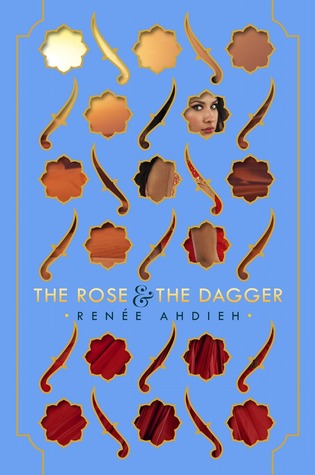
The Rose & the Dagger (The Wrath & the Dawn, #2)The Rose and the Dagger continues the story of The Wrath and the Dawn, finishing it up.  In the wake of the storm and fire that have mostly destroyed the city of Rey, Shahrzad finds herself in the desert with her father, her sister, Tariq, and gathering forces that are preparing to move against her husband and her city.  Ultimately, that's most of what this book is: Shazi city around doing not much at all.  She flies around on a magic carpet a bit, tries to learn some magic of her own--mostly unsuccessfully, except when it most matters, of course--and pines for Khalid, who is still referred to as "the boy-king" in every other sentence, even though he most certainly is not a child.  Oh, and she tries to figure out how to break the curse, except the curse no longer seems to figure that strongly into the plot.  In fact, nothing really seems to figure strongly into the plot.

The Wrath and the Dawn had some compelling romance to propel it, and a mystery lurking in the background to prop it up.  But that's not the case here.  Shahrzad and Khalid are already in love; Tariq is a sham of a third size on a love triangle.  The mystery has all been revealed, and the curse is ultimately wrapped up in a handful of pages.  The most interesting pieces of this, the Fire Temple and the people involved with it, are pushed off to the side as unimportant.  Instead, this broiling political intrigue of "who will win Khorasan?" lurks in the background, but it's really not much intrigue at all.  Ahdieh throws in a near-rape for what I can only imagine was intended shock value, though I thought it fell flat and really had no purpose in the plot at all.  There's another secondary romance that pops up, and is frustrating in the end because the way that it ends is just...ugh.  Really?  There was no point in that.  And Despina is back again, with a Secret Background that is...again, pointless.  It feels like Ahdieh basically wrote some crazy fanfiction and then just made it into cannon.  None of it really held any emotion or any real significance.

And the fragmented sentences!  Oh my.  Did the first book have this many fragmented sentences?  Some would probably say that this is a stylistic choice, and that it may be, but it's a poor one.  It makes every other sentence, and sometimes multiple "sentences" in a row, read as choppy and broken.  They don't flow, and they pulled me right out of the story, such as it was.  Combined with the "not much is really happening" plot of this book, I was left very disappointed in this book as a whole.  The first one wasn't great, but it did have some good potential, and I really hoped to see that nurtured and fleshed out in the second half of the story.  That didn't happen; like in The Mirror King, this book ended up being a disappointing second half to a duology, and I feel like this particular pair of books didn't have a ton to offer in the first place.  The premise itself is absolutely breathtaking, but I think the execution fell flat and the story never really lived up to that promise.

2 stars out of 5.

Friday, June 3, 2016

Street Fair - Jeffrey Cook and Katherine Perkins (Fair Folk Chronicles #2)

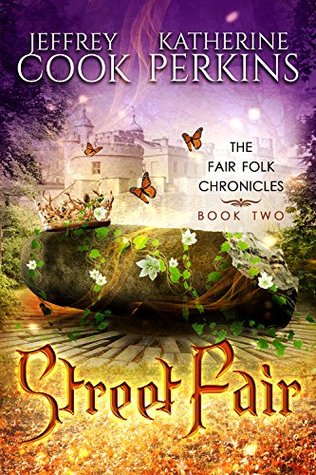
Street Fair (Fair Folk Chronicles, #2)Street Fair is the second book in Jeffrey Cook and Katherine Perkins' Fair Folk Chronicles.  It follows Megan, a teenager who has recently discovered that she's a half-faerie princess, and her friends as the Goblin Market comes to town, and brings with it a host of unforeseen trouble that deals with Gaelic mythology, particularly that of Balor and the Fomoiri.

I had some difficulty with the first of the Fair Folk Chronicles because it really made faeries much more sugary-sweet than they are traditionally said to be.  That's still the case here; despite a bit of a bloodthirsty toast at one point, even the Unseelie court is kind of like a bunch of teenagers who just like to hang around and play pranks on each other rather than be menacing in any meaninful way.  The Seelie court is basically all sweetness and light.  Ashling the pixie continues to annoy me beyond all reason.  However, the story as a whole appealed to me and agreed with me much more, and that's because of the topic.  The integration of the Fomoiri and Balor really hit a sweet spot for me, and I can tell you exactly why: because I associate it with Diane Duane's Young Wizards series, and specifically the fourth book, A Wizard Abroad, which deals with the same subject though in a different way.  That actually really helped re-orient myself regarding how to look at this book.  Until that topic started to come in, I was looking at the Fair Folk books as young adult books, but they're really not.  I can't remember exactly how old the main characters are (though Lani can drive, so they must be about sixteen), but in writing and subject, these books are much more middle-grade than young adult.  There is very light kissing, but also a lot of parental supervision and the whole thing is very clean, which is really more characteristic of the middle-grade than the young-adult age group these days.  The same goes for the Young Wizards books.

As for the book itself... This is obviously much more of a "series" book than the first one is.  It has a plot of its own, albeit one that involves a lot of running around and not actually doing a much, The integration of these parts of Gaelic mythology are pretty cool, and I think it would be a good way to get younger readers interested in such topics.  But it also sets up for a continuance, which the first book in the series didn't.  Book 3 (A Fair Fight) will clearly deal with the set-up from here, and I'm curious to see if the fourth book (All's Fair) will continue on from Book 3 or if it will be more of a standalone story like the the first volume was.  Seeing Megan gain some more control of her abilities, and realize some of the repercussions of dealing with faeries, was pretty neat.  At the same time, though, much of the book did end up reading like set-up for the next one.  Some of the elements also didn't seem to fit for me.  For example, the main villain is known as the Butterfly Collector to the main characters, and apparently is the person who was behind the ruination of Ashling's wings.  But he doesn't seem to have done this more than once; now, I'm not saying that it's not bad to have only done it once, because clearly it was, but why Collector?  That indicates multiple times.  Was this something that was brought up in Book 1 but that I forgot?  If so, disregard, but it was a bit discordant to me.  Also, as I mentioned before, the plot seems to involve a lot of running around and fight scenes, but very little of that actually advanced the plot.  It was more filler until the higher-ups decided to do something--and most of it was incredibly stupid of the characters to do in the first place, something that they acknowledged but then proceeded on with anyway because "there weren't other options" even though there really were.

I'm interested to see where the next book here goes; there are definitely indications that all chaos is about to break loose.  Now that I've been able to re-orient my view of these books, they do agree with me more, and I think these would be good options for middle-grade students interested in mythology-based fantasy--but I would not go so far as to put them as young adult, given that the heavier themes characteristic of young adult books are pretty much entirely absent in this series.

3.5 stars out of 5.