Pages

Showing posts with label sci-fi. Show all posts

Friday, June 1, 2018

The Sparrow - Mary Doria Russell (Sparrow #1)

334176The Sparrow was the Deliberate Reader's book club book for June, for discussion in the Facebook group, and also the sci-fi selection for the year.  It also conveniently slotted into one of my reading challenge categories, for a book set on another planet.

The Sparrow is an interesting and immensely frustrating book.  It is interesting because it is as sci-fi book with a religious bend, and it involves first contacts with another intelligent species elsewhere in the galaxy--something that put me in mind of The Three-Body Problem, though that is a much "harder" sci-fi book than this.  It is immensely frustrating because all I really wanted was to slam these characters' heads, and the heads of their superiors, against a brick wall for being so incredibly stupid and ignorant of the Fermi Paradox.  I highly recommend reading Wait But Why's Fermi Paradox article, but ultimately it boils down to, in the words of Hank Green, "If they're out there, why don't we hear 'em talk?"  That is, if there is intelligent life out there--and statistically speaking, there should be--why do we not hear anything from other, extraterrestrial species?  There are a few different possible answers to this, but the one that always always always seems to come up in sci-fi is, "Because aliens are bad news," meaning that one of the reasons we don't hear from other intelligent species is that they know better than to be broadcasting stuff out into the void, because they know something we apparently don't, like there is something big and bad and willing to hurt us out there.  There are a few other explanations, too, of course, but obviously danger is a big driver of plot in sci-fi novels, so this is the one that comes up a lot.

Well, it turns out that you don't have to be big and bad and able to travel through space to hurt humans.  You just have to sing well enough to get them (us) to come to you (aliens; hi, aliens!).

So, as you have probably figured out by now, this book's central plot revolves around an act of astounding stupidity in which a group of humans, consisting of a Jesuit-led mission, set out to make contact with a newly-discovered intelligent species in the proximity of Alpha Centurai, despite not knowing anything about said other species other than that they exist.  Most of the book takes place significantly after this mission sets out, after the sole survivor (see, we knew it was a bad idea from the beginning) has returned to Earth, and his superiors are trying to figure out what has happened, particularly since the people who rescued him have also gone missing and are, presumably, dead.  The main character is Emilio Sandoz, a Jesuit priest and linguist who is the one to first suggest sending a Jesuit mission to this other planet (BAD EMILIO!) without, you know, anyone with any idea of what should actually be done weighing in.  As a result of the horrible events that take place on Rakhat during the mission, he suffers a crisis of faith, and the timeline of the book set after his return greatly focuses on him trying to answer that great question: if God exists and is both omnipotent and benevolent, then how is it possible that horrible things still happen?

This is a book that aims for spiritual rather than preachy, which was good.  Some of the relationships between the characters were intriguing; watching them grow and change provided the real reason to read this book, because the characters here are emotionally intelligent even if they are naive and lacking a serious dose of common sense.

This is a slow book.  Nothing happens for much of it, and then everything happens in just a handful of chapters.  When I was close to the end of the book, I couldn't believe that it was supposed to be wrapped up in under a hundred pages, because there was so clearly so much left to go.  Russell resolves this by just dumping it all in a narrative Emilio puts forth that takes a few pages; not exactly ideal.  While the dark subject matter could have made for a very heavy read if broken out separately, this particular way of relating events did nothing for the book's pace.

In other problems, the "sci" part of the "fi" is fairly soft, without a lot of technicalities to it, and with a lot of things that left me raising an eyebrow and going, "Hm..."  Sherwood Smith, an author whom I quite admire, noted in her review that the book overall lacks world building, a statement with which I would agree wholeheartedly in its applications to both her version of Earth and to Rakhat.  Much of the book is focused on other characters' fascination with Emilio's celibacy, and so it's not entirely surprising when it turns out the build-up of the entire book ends up being rape, much like in Outlander--but it also raises the question that, when you can write about literally anything in sci-fi, because you have the entire universe to play with, why turn back to rape?  Is there no way to have a crisis of faith without being raped?  Because, ultimately it's that which causes Emilio's breakdown--not any of the other horrible things to which he is witness.

Overall, a book that, while it has some interesting aspects attached to it, is immensely frustrating from conception to finish.  There is a second book that follows this, but I have no interest in reading it; from the book description, it promises to be nothing but more of the same.

2 stars out of 5.

Wednesday, October 25, 2017

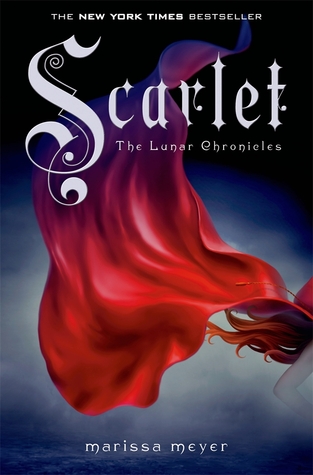
Scarlet - Marissa Meyer (Lunar Chronicles #2)

Scarlet (The Lunar Chronicles, #2)Scarlet is the second book in the Lunar Chronicles series and is the last book of the series I need to review' life's funny like that, innit?

This book both continues Cinder's story as rogue moon princess and introduces a new character, Scarlet.  The main setting here also shifts to France, where Scarlet lives and is looking for her recently-disappeared grandmother, who was also involved with Cinder's relocation from Luna to Earth, though Scarlet doesn't know it.  The new romantic interest for Scarlet, Wolf, also takes the scene, as does Carson Thorne, an American deserter with a stolen spaceship who falls into Cinder's company.  Kai is also still involved, dealing with the drama of Cinder's escape and rising tensions with Luna from the palace in New Beijing.

Cinder starts coming into her own as a moon-princess-badass here, and Scarlet quickly sets herself up as someone who is not to be messed with.  Scarlet is a typical "fiery redhead" character, which is a bit lacking in originality, but at least her hair is only mentioned twice instead of being harped on for the whole book.  Her "Little Red Riding Hood" story is queued up with her signature red hoodie and, of course, Wolf, as well as a brief encounter between Wolf and a street fighter named Hunter.  There's a bit of a twist in this book, one that I don't think was as evident as the "twist" in Cinder, but reading it through a second time it's pretty obvious where the story was going.  Still, I found the story to be enjoyable.  This is also more of a romance than Cinder was, with a strong bond between Scarlet and Wolf from the beginning, even though both admit that it doesn't make sense.

This isn't a very complex story, and I think that Scarlet's part of it actually moves more slowly than Cinder's story initially did.  Meanwhile, Cinder's story picks up pace as she and Thorne flee New Beijing and try to determine their next steps.  Thorne is a delightful character, someone who thinks that he's much more charming than he actually is and with a checkered past that he tries to spin in the best light possible.  This all sets him up wonderfully as a true hero in the next book, when he see him through a different pair of eyes.  Iko also makes a return to the page here, and she is just as wonderful as ever.  Cinder herself is also a stronger character than she was before, gaining a true determination and sense of self that she lacked in the first book.

Overall, this is a great book, a strong continuation of the series and, I think, better than Cinder itself was.  On the re-read, I'm not quite as dazzled with it as I was the first time I read it.  When I do my re-read of Cress, we'll have to see if Scarlet can retain its place as my favorite book in the series or if it will be overturned.

4.5 stars out of 5.

Saturday, September 30, 2017

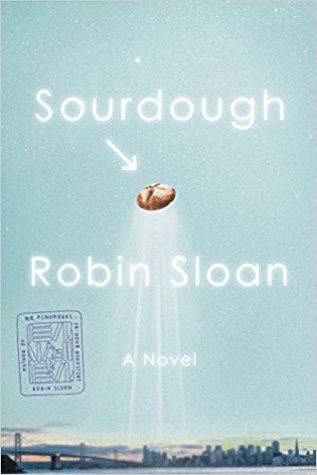
Sourdough - Robin Sloan

SourdoughThis was an absolutely charming book.  From the author of Mr. Penumbra's 24-Hour Bookstore (which I did not realize when I picked it as my Book of the Month), it's a love letter to food and technology (Mr. Penumbra, similarly, was an ode to books and technology) with its own sense of quirkiness set in San Francisco.

The main character and narrator, Lois, works on programming robotic arms.  She has a diet that consists of a nutritional gel called Slurry and little else, until one night she orders a "double spicy" combo of soup and sandwich from a place that's opened in her neighborhood.  The food is a revelation, and she orders it every night--until the two brothers who own the shop encounter visa issues and depart for Europe, leaving Lois their sourdough starter.  Lois feeds the starter and starts to bake with it, producing loaves with strange faces in the crust.  People go crazy for her bread; she tries to sell it at a farmer's market and ends up at the Marrow Fair, an underground market selling radioactive honey from Chernobyl, cookies made from crickets, all kinds of crazy stuff.  But why is the bread the way it is?  And who is Mr. Marrow?

Lois is an utterly likable heroine.  She has good intentions that sometimes go awry, though she gets herself back on track eventually.  The supporting characters here are all charming in their own ways, as well.  The Marrow Fair is an intriguing setting.  Lois' work with robots sets the tone for the story and her knack for sourdough uplifts it, and it's great to see a female character in a STEM field, because that's fairly unusual.  There are also a few nods to Mr. Penumbra in here, showing that the universe the books exist in is definitely same, though this is in no way a sequel to the first book.  Still, the tones definitely match up with each other, so if you read Mr. Penumbra and were left wanting more, this is an excellent book to pick up even if the characters and story are not the same from one to the other.

This was a book that made me want to bake, or teach a robot to bake, and browse farmers markets, and visit San Francisco, and eat cheeses with strange colors in them, and eat honey that glows in the dark, and eat bread that knows how to sing.  There's this sense of whimsy and wonder and whole-heartedness on every page of this book, and it was an absolutely fabulous read.  I'm so glad that I picked it as my book of the month.

5 stars out of 5.

Sunday, September 17, 2017

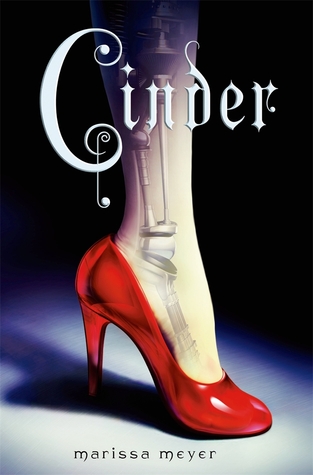
Cinder - Marissa Meyer (Lunar Chronicles #1)

11235712It feels a bit weird reviewing this book so long after I put out my first review on this series, for Cress.  I had read Cinder before, but I wasn't writing reviews at the time, and so this comes to anyone following along a bit out of order.  Cinder was the Unapologetic Romance Readers' theme read of "A sci-fi romance" for September 2017, and I was delighted to have an excuse to re-read it, especially as I'd been in a bit of a reading slump and going back to books I've previously enjoyed always helps with that.

Cinder is, as you can guess from the title and cover, a Cinderella story.  Except this Cinderella is a cyborg.  Injured in an accident she can't remember, Cinder has been left with a mechanical arm and lower leg/foot, with wires in her brain and nervous system and an interface that flashes information over her eyes.  She's also one of the best mechanics in New Beijing, and her business is her step-family's main (only?) source of income.  Oh, and New Beijing, and the rest of the world, are currently being ravaged by a plague with an unknown cause and no cure.  But one day, when Prince Kai stops by Cinder's stall to get an android repaired, Cinder is pulled into a web that she never imagined and that will destroy--or rebuild--her entire life.

I love this story so much.  It follows a very traditional Cinderella structure, but with little flourishes and garnishes that make it seem new.  The pumpkin coach is a decrepit car, the glass slipper is a cyborg foot.  The characters are also wonderful; while Meyer makes Cinder's stepmother absolutely loathsome, the daughters aren't entirely without redemption, particularly Peony, who Cinder actually likes.  And then, of course, there's Iko, Cinder's android sidekick who has a quirky, perky personality all her own.  Adding the plague and the brewing conflict between Earth and Luna adds dramatic tension to a story that traditionally lacks it, and having Prince Kai and Cinder meet and grow closer multiple times before the ball is absolutely necessary--the "love on first site" aspect of Cinderella has never sat well with me, so I appreciate this added relationship building.

That said, this isn't a perfect story.  It has a bit of a cliffhanger ending, which I didn't remember.  Given the narrative arc of the series as a whole, I can see why Meyer had to break it where she did, but it definitely doesn't lead to a satisfying conclusion for this volume.  And while the Cinderella element helps to tie together a story and genre that could otherwise alienate some readers--I probably wouldn't have normally picked up a story about a cyborg--it also means that, despite the flourishes, the plot itself can be quite predictable.  Of course, the story as a whole goes past the Cinderella story, but that doesn't mean that parts of it can't be called from a mile away.

Still, I really enjoyed rereading this.  It's not my favorite book in the series--that goes to Scarlet--nor does it feature my favorite main characters--that would be Cress--but I still think it was a solid intro volume, and would definitely recommend it to others.

4 stars out of 5.

Saturday, August 5, 2017

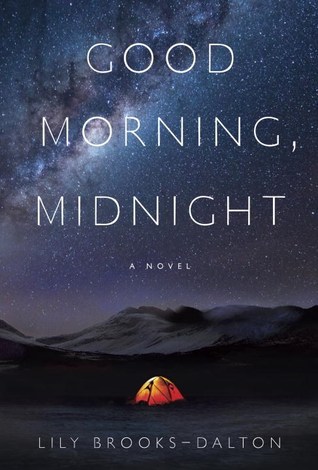
Good Morning, Midnight - Lily Brooks-Dalton

Good Morning, MidnightWow, what a lovely book!  With both a cover and a plot evocative of the equally-lovely Station Eleven from a few years ago, Good Morning, Midnight looks at a few individuals left alive, for various reasons, after the mysterious end of human civilization in the rest of the world.  In fact, the writing styles and feel are so similar that it's easy to imagine that this book takes place in the same world as Station Eleven, just in different physical locations on it.

There are two halves to this book that are told in alternating chapters.  First, astronomer Augie has been left alone--or almost alone--at an observatory in the Arctic Circle after he refused to evacuate with the rest of the staff.  He planned to live out his last days in solitude, until he discovers a young girl, maybe nine or ten years old, named Iris and who appears to have been forgotten during the evacuation.  Augie and Iris try to make a life in the observatory in the silence that the rest of the world has left behind.  Meanwhile, Sully is a communications specialist aboard the Aether, a ship completing the first manned mission to Jupiter and its moons and which is now on its way back to Earth--but they know something is wrong, because Earth has gone silent.  Told over the course of a year, the book is very much a tale of people searching for purpose when the lives that they have known are suddenly, completely, and irrevocably changed.

There are no zombies to fight here, no nuclear hazard zones, no diseases to outrun.  The apocalypse, whatever it was, happened and then was done.  We don't know what caused it.  We just know that something happened, and now the world is silent.  Augie appears to be the last man on Earth, though it's hard to imagine he actually is; certainly other isolated spots would have survived, like maybe in the Antarctic research stations, out in Siberia, high in the mountains--something.  Maybe Augie is just the last man on earth who knows how to use a ham radio.  The writing is simple and beautiful, relying on two extraordinary settings to showcase a story of survival and belonging.  There's some funny business going on in the background that I started to suss out fairly early, but I wasn't quite on track with exactly what it was until close the end, which was nice.  There is a very ambiguous ending--it clears up one part, which is the part that I'd been poking about, but what ultimately happens to some of the characters is left up to the reader to decide, something that I think probably has to be done in a book of this nature and with this particular plot.

It's not a long book, but it was an absolute joy to read.  The characters have depth and dimension and are so perfectly suited for their roles; the settings are evoked with beautiful prose; and the whole thing has such a lovely feel to it that I didn't want it to end.  Is some of the science squishy?  Yes, very.  But this isn't meant to be the next of kin to Andy Weir's The Martian.  It has an entirely different focus and purpose, and with that in mind is set at some point in the future where science has advanced somewhat, making a trip to Jupiter possible in a year and having Voyager I go offline, along with its successors including the fictional Voyager III.  It's not supposed to be a "hard" science book though it definitely falls into the sci-fi genre.  With that in mind, I think it can be forgiven for its squishy science, because the rest of the book more than makes up for that.

I absolutely loved this, and after a string of books recently that were only "okay," it was a pleasure to read.

5 stars out of 5.

Tuesday, August 1, 2017

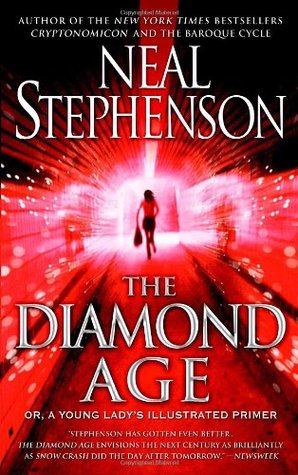
The Diamond Age: or, A Young Lady's Illustrated Primer - Neal Stephenson

The Diamond Age: or, A Young Lady's Illustrated PrimerWhat on earth did I just read?  It was a sci-fi book for sure, but beyond that...what?  Okay, okay, I'll give it to you: I'm not the world's biggest sci-fi fan.  I don't typically seek out sci-fi books.  But I've read quite a few from various places along the spectrum that I quite liked.  Unfortunately, I'm not sure I can say that The Diamond Age was one of them.  Because here's the thing: there's not really a plot in this book until the last 20% and by that time I was so uninvested in the characters and world, having been boredly trucking along for the past 400 pages, that I didn't really care about what happened to them when the plot finally emerged.

The book starts with a character called Bud, who isn't at all important, so don't worry about him.  Ultimately the people you have to worry about are Hackworth, a nanotechnology guru, and Nell, a young girl who inadvertently ends up with one of Hackworth's creations, an intelligent "book" called The Young Lady's Illustrated Primer that adjusts to her and teaches her everything from reading to self-defense.  This could be some sort of bildungsroman, featuring Nell as the character coming of age, but it was really too scattered to be that in a convincing way, and then Stephenson tried to shoehorn in a plot about Feeds and Seeds and a revolution in what we know as China that just felt strange.

Ultimately, what this book felt like was that Stephenson wanted to build a cool world, but then he didn't know what to do about it.  Why are white people suddenly grouped together in a "phyle" named for Atlantis when everyone else gets their own group based on their old ethnicity or nationality?  What's up with all the body mods?  Why on earth did those nanites or whatever they're called have to be transmitted through bodily fluids?  Clearly they didn't have to be, we certainly saw enough that weren't, and Stephenson was apparently just figuring out a way to put some orgies and spontaneous combustion into his book.  (No, I am not kidding.)  Miranda was cool, and admirable, but what the heck was up with the Drummers?  That didn't make any sense at all.  This book read like some sort of bizarre fever dream, and one that probably would have been better off left in the world of sleep.  Like a dream, there were so many parts that could have been very intriguing, but it jumped from place to place on the most tenuous connection and just ended up feeling scattered and like Stephenson just made stuff up as he went along instead of thinking how it could all ultimately be connected--and then, when he needed a way to connect it, threw in a revolution, because hey, why not?

This was the August book for The Deliberate Reader's book club, and seems to have baffled many of the readers teeing it up, including the book club founder herself.  Indeed, the book does have remarkably high reviews given how absolutely schizoid it is; apparently a lot of people found the end worth the read, but there was nothing there that surprised me or made me think that the final events redeemed the rest of the book.

1.5 to 2 stars out of 5, for its potential and the actual stories about Princess Nell in the primer.  The main book was junk.

Thursday, July 27, 2017

Read This, Then That Vol. 3

It's been a long time since I've done a "Read This, Then That" post, but I've just had the most lovely pairing of books that I wanted to share it with you.  Taking a turn to light sci-fi and post-apocalyptic fiction, but with beautiful prose and human elements, let's first take a look at a book from a few years ago.  To start:

Read This...
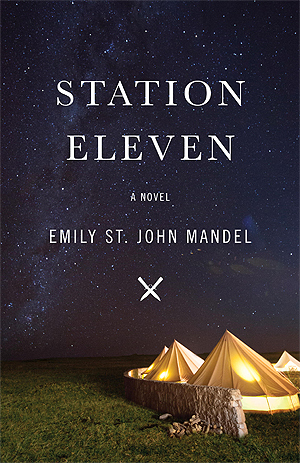
Station ElevenThe world ends with the flu.  Scattered survivors who evaded infection roam the desolated land; they live in airports full of planes that no longer fly and vending machines that have long been depleted.  A travelling theater company provides entertainment for a world that is suddenly and tragically without much to laugh at.  And a custom comic book is at the center of it all.  A startling and yet beautiful look at the sudden disintegration of life and society as we know it, and what what might be left behind once many of us are gone, Station Eleven made waves a few years ago for its stunning prose, wonderful characters, and refreshing take on a post-apocalyptic story.  With no zombies or nukes in sight, Station Eleven is about people far more than it is about plot, though there is a plot there.  The parallels between the different parts of the story are breathtaking, building on each other to a whole that is so much more than the sum of its parts.  There are Star Trek references: "Because survival is insufficient." And honestly, that's what this book is about--not just surviving, but living, even when everything that you've known has come to an end, and how people can come together, remember what was lost, but still move on into the future.  And when you've seen what's happened at the end of civilization in parts of the world we're more familiar with...


...Then That
Good Morning, Midnight...move on to the ones that, to many of us, are Great Unknowns.  Instead of travelling players and ad-hoc museum curators, Good Morning, Midnight focuses on an isolated astronomer left behind in the Arctic Circle when he refused to evacuate the observatory and the crew of the spaceship Aether, on the way back from Jupiter to a world that has suddenly and strikingly gone silent.  This is also a story of parallels, of people desperately trying to reach out and connect--over the radio, physically, emotionally.  And though the circumstances are bleak--the handful of characters on our pages might very well be the last humans alive, and most of them aren't even on Earth--the story manages to be wonderfully hopeful and uplifting.  There is a story of redemption and new beginnings, of overcoming seemingly unyielding odds, and of coming back to a world that it seems like everyone else has, in one way or another, left behind.  It has the same feel as Station Eleven does and it's easy to imagine them taking place in the same world, though of course miles and miles apart and with Good Morning, Midnight having a distinctly sci-fi slant that Station Eleven lacked.  But ultimately, both books come down to this: The world is a strange place.  The universe is an even stranger one.  And people are looking for where they belong in both.

Friday, April 14, 2017

Starfall - Melissa Landers (Starflight #2)

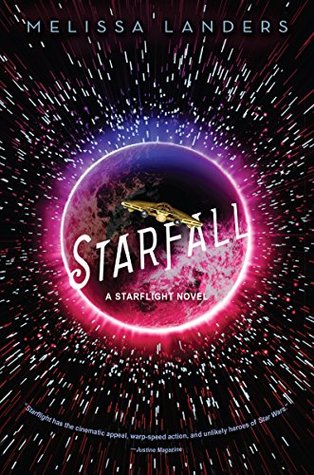
Starfall (Starflight, #2)I read the first novel in this duology, Starflight, a few months ago and absolutely loved it.  Did I have some misgivings about the beginning and how the characters got into each others' presence?  Yes.  Yes I did.  And I brought them up in my review.  But overall, I thought Starflight was a lovely young adult sci-fi romance with a slow burn and a feel that would appeal to those who liked Firefly and Serenity, though Landers' book didn't purport itself to be a substitute for either.  So I had high hopes for Starfall.

Unfortunately, it didn't live up to them.  While there aren't any big, glaring flaws in Starfall, it lacks the magic and pop and sparkle of its predecessor.

The main characters here are Cassia and Kane, two of the shipmates whom we met in Starflight.  Cassia is, of course, a secret princess--as is the way things go.  She fled an arranged marriage on her home world and seems to have started a war into the bargain, and she's been fleeing from bounty hunters called the Daeva ever since--as has Kane, because he helped her escape.  Cassia and Kane are very close, sort of friends-with-benefits sometimes but without the full array of benefits (Landers makes a point of saying that they've never "gone all the way" several times) but their relationship is also fraught with friction because Cassia doesn't really know what she wants.  But when the Daeva get Cassia and haul her back to her home world, she's thrown into the position of becoming a monarch, stopping a war, and putting down a rebellion, all at once, and even when Kane shows up to rescue her--though rescue doesn't end up being needed--it seems like she doesn't have time to pursue any sort of relationship anymore.  And then a mysterious illness starts taking down her people, and she can't figure out how to stop it...

The problem with this book is, I think, that it ultimately got too big for itself.  Starflight had a relatively small and narrow plot, though there was a sideplot that was a bit more expansive.  In Starfall, the big plot--Cassia's political situation and attempts to help her people--are center stage, and the developing and re-developing relationship with Kane is secondary.  The other characters from the cargo ship Banshee also feature much less here than they did in the first book, which was disappointing because the crew was such an integral part of the story, and how their personalities and experiences meshed really contributed to the excellent feel the first book had.  That's largely lacking here, and while the crew does appear, they're supplemented by a variety of other side characters that aren't given much time to develop and so only have superficial personalities, backgrounds, and motivations.  The book also doesn't really feel like a romance at all, even though Cassia and Kane's re-connection is supposed to be such a big part.  Instead, the story mainly consists of them running from place to place trying to solve the mystery of who is wreaking havoc on their home world, and then there's some half-concocted thing about gladiator battles at the end.  Yes.  Seriously.  All of this also contributes to a very weird sort of pacing that was inconsistent and didn't add to the book in any way.

Overall, I didn't feel like this added to the Starflight experience at all.  Starflight was shiny and brilliant and developed a rich universe with potential just waiting to be discovered.  Starfall didn't do any of that, and instead threw much of what made the first book brilliant to the side in favor of a big political plot that dragged.  Continuing with this exact plot but keeping Solara and Doran was the main characters actually probably would have worked better than elevating Kane and Cassia to the starring positions; just that change of perspective would have done worlds for improving this book.  As it is, it's okay, but I can't say it's any better than that.

2 stars out of 5.

Monday, April 10, 2017

Stars Above - Marissa Meyer (Lunar Chronicles #4.5)

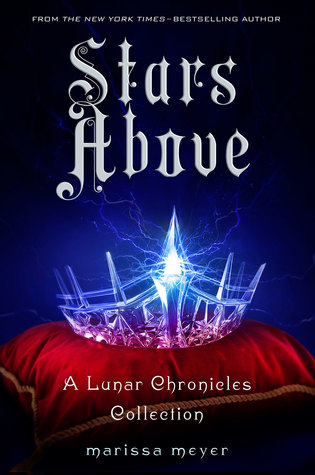
Stars Above (The Lunar Chronicles, #4.5)It's become popular in recent years to YA authors to write a slew of short stories that accompany their full-length works.  Marissa Meyer is no different in that, around the time she released Winter, she also released this volume, Stars Above, comprised of short stories set in the Lunar Chronicles universe.  Most of them deal directly with the main characters from the series.

I'm a firm believer that authors don't "owe" short stories like this to their readers, and that when they're written, they typically don't really add much to the series.  That's definitely the case here.  There are nine stories of varying lengths in this book, and eight of them, while enjoyable, are just fine.  They don't really add anything to the Lunar Chronicles experience that wasn't laid out in the main works.  Yes, the stories expound a bit more upon things that were just mentioned in the main works, but they don't resolve any plot holes or offer any big revelations.

The big exception to this, as other reviewers have noted, is a wonderful gem of a story called "The Little Android."  It deals with none of the characters from the main books, though just as each main heroine's story was patterned after a fairy tale, so is this.  The story here is, of course, "The Little Mermaid," except the mermaid is an android who'd developing a personality and emotions of her own.  It's a beautiful, heart-wrenching story that fits into the world and helps expand on it without feeling the need to pander to fans.  If the stories in the collection had all been like this, I think I would have had a much higher opinion of the book as a whole than I actually ended up with.

The other stories are just okay.  There's one about Michelle Benoit getting Cinder and Scarlet, one about Cinder going to live with the Linh family, one about Wolf becoming a recruit in the Lunar army, one about Thorne while he was in school, one about Cress going to live in the satellite, another with background on Winter and Jacin, Cinder and Kai's meeting from Kai's perspective, and finally one that takes place after the end of the main Lunar Chronicles which details Scarlet and Wolf's wedding.  That was a cute one, but again, nothing that I absolutely couldn't live without and that I hadn't figured would happen anyway.

Overall, this is a cute addition to the series and it looks nice on the shelf, but there's only one real gem here.  Writing short stories is an art that requires a completely different set of skills than writing full-length novels, and if it hadn't been for "The Little Android," I would think that Meyer hadn't quite honed those skills yet.  "The Little Android" absolutely glowed, though, and I wish Meyer had taken the time to expand her universe rather than just her already-established stories, because that universe expansion is definitely what worked best here.

3 stars out of 5 for the whole.

Saturday, April 1, 2017

Dark Matter - Blake Crouch

Dark MatterI'm not a huge sci-fi person, but Blake Crouch's Dark Matter caused quite a stir last year, being nominated for a Goodreads Choice award, selected as a book for Book of the Month (where I obtained it) and also being the April selection for The Deliberate Reader's virtual book club!  It's a book that's pretty impossible to talk about without spoilers, so beware.

The general story follows Jason, a physics professor in Chicago who's kidnapped one night on his way home and wakes up to find himself in a life where people know him, but isn't the life he's led, in a world that's his own, but not.  This is the premise the entire book revolves around: the alternate worlds theory, in which every choice a person makes splits off another, new reality parallel to our own but unreachable in which that person made a different choice at the same point.  The realities are, of course, infinite, because they continue branching off of each other to no end.  Jason's familiar with the theory, having worked on it before he quit research to have a family, and wants to return home to his own reality via the device that an alternate version of himself created, because he wants to get back to that family, particularly his wife Daniela.  On the way, he wanders though various other realities, inhabited by other Danielas, and ultimately inadvertently creates other versions of himself by his choices...all of whom also want to get back to "his" Daniela.

This is a really intriguing premise and overall the book was good, but I didn't find it to be great.  The writing is a little stilted and shaky, mostly consisting of a lot of one-line paragraphs.  And while the proliferation of Jasons and worlds and the possibilities of how different a reality only a few steps away from own could be were fascinating, I felt like, in the end, there were just too many questions left unanswered.  Is our Jason the real Jason, or does he just think he is?  What's going to happen in the new world?  What happens to all the Jasons left behind?  Why aren't the other Danielas good enough for the other Jasons, even though at least one of them was good enough for our Jason?  Crouch doesn't go into any of this, and while I can accept that some of it is probably meant to be left vague as "food for thought" upon the conclusion of the book, I think that there was just too much left up in the air.  It felt like Crouch knew there was too much he couldn't wrap up, so he left it all vague to add to the "mystique" of the book and hoped no one would really notice.

But I did like some of the stuff here.  The idea of the world-hopping was great, as was how the box was ultimately "steered."  I wish more books dealt with alternate-worlds theory; it's so intriguing, and I think it really can be handled well, though it would be difficult to do so.  And I have to say, while I think some of the loose ends don't really have logical conclusions, they do make for great book club discussion material!

3 stars out of 5.

Monday, March 20, 2017

Red Queen - Victoria Aveyard (Red Queen #1)

Red Queen (Red Queen, #1)Red Queen is one of those books that I really didn't have any intention of reading, except everyone was raving about it, so I shrugged and added myself to the library wait list.  Of course the loan came through at the worst time, at the beginning of a month when I started working on various other book club reads, but alas, the timing was it was, so I dug in.

Mare Barrows is a red-blooded commoner in a world ruled by silver-blooded elites who also possess strange powers, like the ability to manipulate water, or fire, or heal people, or shut down others' powers.  Mare's country of Norta is engaged in an ongoing war against the Lakelanders, and every Red who isn't employed when they turn eighteen is conscripted into the army.  Mare's three older brothers are in the war and Mare is resigned to being conscripted, too, though her younger sister has a job as a seamstress.  But when Mare's best friend loses his job when his boss dies, she becomes determined to steal enough money for the two of them to steal away...an act that only results in her younger sister's sewing hand being irreparably broken.  Desperate to repair the damage she's done to her family, Mare tries to steal as much as she can, but inadvertently steals from Norta's crown prince, who instead of punishing her gets her a job at the castle.  But when Mare accidentally falls into the middle of the Queenstrial, when eligible girls from Silver families show off their abilities in hope of winning the hand of one of the princes, it's revealed that she's not just a Red, though she bleeds like one--she has the never-before seen ability to create and manipulate lightning.

Mare ends up posing as a Silver princess, trying to balance her sense of self-preservation with a desire to help her people.  She joins a Red resistance with a hope for changing the status quo and tries to avoid the crown prince's bride, Evangeline, while dealing with her attraction to both the crown prince, Cal, and his younger brother and her supposed fiance, Maven.

I didn't really like this book.  It gets off to a very slow start, the world building is confused, and Mare is not a great heroine.  Much of the book is just Mare going from lesson to lesson and fretting about how everyone will find out she's a lie, and trying to hide her activities by turning of the security cameras that abound in the palace, like everyone else is completely stupid and won't figure out that all the cameras just happen to turn off whenever the girl who can control electricity is up to something.  For the world, it has a mix of magic and technology that could be intriguing, but doesn't really end up working.  Mare remarks a few times that they Silvers don't actually have amazing technology, that it's all manipulated by their abilities--but they have cars, and motorcycles, and apparently nuclear technology?  That doesn't seem like stuff that can be made with magic.  And what makes Silver blood silver, if the thing that causes their abilities isn't what does it?  Because Mare clearly has abilities, too, and her blood is very red.

The "commoner masquerading as a princess" trope is one that I would normally love, but I just couldn't like Mare.  While her loyalty to her family is admirable, she's told repeatedly of exactly what to watch out for, but she refuses to listen to anyone and so is completely blindsided when things don't turn out the way she expected.  And I really didn't like Kilorn, Mare's best friend, as a character, either.  He was just kind of a jerk.  And the supposed romance wasn't really here, either.  Despite Mare repeatedly saying how attracted she is to Cal or how much she cares for Maven, there doesn't appear to actually be anything there.  Maybe there's a tiny bit of something at the end, but it's clearly bound for another love triangle in the next book, and I'm not really sure I have the patience for that.

Overall, I'm not so sure what has people raving about this book.  Some of the supporting characters are interesting--Julian, for example--but while the end fight was cool and made me want to root for Mare, I don't think she's a strong enough central character to carry the series, not with her inability to see exactly what's in front of her face, and the promising world is just a flimsy skin over a logic-less void.  I can't really see myself picking up the other books in the near future, not with another 1600 more interesting books on my to-read list.

2 stars out of 5.

Friday, December 30, 2016

Starflight - Melissa Landers (Starflight #1)

Starflight (Starflight, #1)Starflight has been on my radar for the better part of a year, since I saw it on My Subscription Addiction as a book that came in a subscription box.  (I don't remember which box.)  It's a young adult sci-fi story with a slow-burn romance, which hooked my attention easily because I had recently finished reading the These Broken Stars trilogy, which I enjoyed immensely.

Starflight follows two main characters, Solara and Doran, in their flight across the galaxy.  Solara needs to find someone to hire her as a servant in exchange for paying her passage to the outer rim of the galaxy where there's a job waiting for her as a mechanic.  Doran, the guy who bullied her relentlessly in school, ends up hiring her, though he seems to have done it mostly to torment her even more.  But when he learns that Solara is a convicted felon and tries to toss her off the ship, Solara manages to switch their positions and get them onto another ship, with Doran suffering some memory loss and now in the position of Solara's servant, instead of the other way around.

This memory loss was my one big issue with the book.  It doesn't last long, but for the duration of it Solara gaslights Doran mercilessly, leading him to believe that he's a different person entirely.  Doran's memory comes back in full force and he's furious with her and everything gets resolved, of course, but this was very not cool of Solara to do in the first place.  I can think of a dozen other ways she could have gotten them off that ship and onto the Banshee without gaslighting Doran (even if she did still use the stunner on him) so the fact that she chose this method made me think a lot less of her, which wasn't a great way for the book to get started.

Overall, though, I really liked this book.  The Banshee's crew are fleshed-out and three-dimension with all of them having their own quirks and backgrounds, which serve purposes rather than just being there as props.  And there are sugar gliders!  And of course, not everything is exactly the way it seems to be when Solara and Doran depart the Zenith for the Banshee, and soon they're all renegades running across the galaxy and trying to figure out how they're going to clear their names or escape.  Everything in this book seems to serve a purpose; it's very well-crafted to that end.  And of course the slow-burn romance is wonderful.  And there are sugar gliders!  Well, a sugar glider.

And here's the thing... Yes, I'm going to do it.  I'm going to compare Starflight to Firefly.  Because that's basically what this book is: YA Firefly.  A ship full of misfits of questionable legality travel across the galaxy doing jobs along the way, with two paid passengers who aren't exactly what they seems, etc.  Some scenes draw upon Firefly very heavily; for example, a scene where a medical clinic is raided for supplies.  It goes down differently from the show, but the parallels are there.  And the Daeva seem to be somewhat like not-crazy versions of the Reavers.  And there's definitely a conspiracy going on, too!

This was a great YA sci-fi romance.  I really enjoyed it despite my doubts at the beginning because of Solara's actions--she really does redeem herself throughout the story, as does Doran.  I hope that the other young members of the crew feature as the main characters in the future books, however--I liked Solara and Doran, but at the same time I don't think they would be interesting as main characters for at least another two books.  I think relegating them to the supporting cast and elevating someone else to main is definitely the way to go.

4 stars out of 5.

Sunday, October 23, 2016

Twenty Thousand Leagues Under the Sea - Jules Verne

Twenty Thousand Leagues Under the Sea (Extraordinary Voyages, #6)Twenty Thousand Leagues Under the Sea is an interesting novel because it both has and has not aged well.  On one hand, Verne really nailed down the scientific aspects of the book.  The Nautilus is, of course, a submarine that was beyond its time and is still remarkable in our own for how well it pinned down features of subs that hadn't actually been developed yet.  And then there's the stuff like the pseudo-scuba equipment, and the portable lights for under water, and the deep sea exploration in general.  These are things that are still very much in use and relevant even if their form isn't exactly as Verne portrayed it in his book.

At the same time, though, this book dates back to a time when serials for the masses were the craze and when many people couldn't afford to travel, and things like aquariums weren't really accessible to the general populace.  The endless descriptions of every fish that Aronnax (our narrator) sees really wore on my patience, though they probably would have been remarkable to people who couldn't go to an aquarium or turn on a seven-hour nature documentary series about the oceans.  Still, they didn't really age that well and seemed to take up a lot of page space compared to the actual content.  Things like the mysterious passage under the Isthmus of Suez are also total bunk now and really seem like a reach compared to the more finally-wrought pieces of the book.

The actual "adventure" portions of the book also seemed few and far between.  There are two instances here that I think really stand out: the excursion to the ruins of Atlantis and the maelstrom at the end.  Both of these episodes are rather short, disappointingly so amidst the endless fish descriptions, and it's actually a bit surprising that Verne didn't do more with them.  With Atlantis, there's a lot of walking, a couple minutes of standing in one spot and going "Wow!  Atlantis!" and then a lot of walking back to the Nautilus.  With the maelstrom, there's so much drama building up, and then--suddenly--Aronnax wakes up with all the drama glossed over and done with, and with no memories of what actually happened.  For an adventure novel, it's very strange, and it makes it feel very much like Verne was more comfortable with spouting a stream of locations, distances, and fish species than he was with actually writing action.  There are only two big action scenes here that I can think of: when the Abraham Lincoln actually encounters the Nautilus, and the incident with the giant squid.  Even things that are made out to be big events, like the undersea hunting expedition, are mostly a bunch of walking back and forth.

I can definitely see where some of the appeal of Twenty Thousand Leagues comes from, but while it has some cool components that have lingered, I think that the bulk of the book just drags too much for it to be a really riveting read in the modern era.

2 stars out of 5.

Wednesday, October 5, 2016

The Three-Body Problem - Cixin Liu (Three Body Problem #1)

The Three-Body Problem (Remembrance of Earth’s Past #1)The Three-Body Problem is a Hugo Winner.  That means that, in the sci-fi/fantasy category, it's good.  I will trust other people's judgment on that, for the most part, because I am not a connoisseur of "hard" sci-fi, which this is.  I'm more a StarDoc type of girl, personally, if I read sci-fi at all.  Time-travel isn't bad, either.  This...this was a little "hard" for me, but I still enjoyed it overall.

So, the story is about people making contact with aliens.  It jumps between a couple of timelines: the Cultural Revolution in China and modern-day China, when China and the rest of the world are secretly (as in, the militaries and governments are, but the people don't know about it) preparing for a war against said aliens.  The basic story is this: during the Cultural Revolution, Ye Wenjie is thought to be anti-revolutionary and is confined to a base called Red Coast atop a mountain called Radar Peak, for the big antenna located there.  She works on the systems at the base without really knowing what they do, other than that they broadcast and receive signals from space.  Eventually, she figures out some science that makes it more likely that any signals broadcast into space would be picked up by intelligent life, and sends out a signal because she is increasingly disillusioned by life on Earth.

In the current day, Wang Miao is asked by the military to infiltrate a group of scientists among whom suicide has been rampant.  He refuses, but when strange things start happening to him, including a countdown that only he can see, he relents and agrees.  Along the way, he encounters a strange virtual-reality video game called Three Body, which features a world that is plagued by unstable day/night and season cycles.  Wang sets out to solve the problem of Three Body, and of course gets sucked into the drama surrounding it.

I thought this book had some really interesting parallels between Earth and the alien civilization, Trisolaris, and I actually learned quite a bit about the Three-Body Problem itself, too.  It's a physics problem in which three bodies (in this case, stars) affect each other's gravity and orbits and those of anything else near them--like, oh, planets.  The thing is, no one has actually solved the Three-Body Problem and found a way to accurately predict the movements of every three-body system.  I think this was an interesting way to incorporate the alien civilization into the story, as a group trying to solve the problem for their own self-preservation.  The movement of the timeline between past and present also worked here.  I don't think the author held anything back from a misguided attempt to make us gasp with shock, but instead revealed things in a manner that was surprising, and interesting, but still sensible to both the characters and the reader.

I'm not sure if I'll continue this trilogy; I'm not opposed to it, per se, because this was clearly a very solid book, but I'm not quite sure if it was my cup of tea.  The actual "conflict" also doesn't seem to be very immediate to me, because it's removed by almost five centuries from the main characters, which makes it hard for me to just salivate at wanting to know what comes next.

Overall, I'm going to give it 3.5 stars.  It's well-written (and, I would guess, well-translated, which definitely helps) and has a solid base, but I wasn't totally engrossed.

Wednesday, August 10, 2016

Dust - Hugh Howey (Silo #3)

Dust (Silo, #3)Dust is the final volume in Hugh Howey's Silo trilogy, which began with Wool, jumped backward to prequel Shift, and has now returned to the "present" for the finale.  It picks back up with Jules and Silo 18, Jimmy/Solo and Silo 17, and the folks inside Silo 1.  Jules is engrossed in trying to burrow her way back to Silo 17 to rescue Jimmy and the kids, and all the while dissent is growing in her own silo because she's basically challenging the world order.  Jimmy is waiting for Jules, and then eventually unnerved by what has happened with the silos being connected.  And in Silo 1, the truth is starting to come out about who is awake, who is asleep, and who is dead...and what it might mean for all of them.

I don't think that Dust was the greatest conclusion to this series.  Wool and even Shift were so twisty and full of surprises, and Dust just...wasn't.  The story is pretty straight forward here, with everyone's intentions all out in the open after the drama after the first two books.  While the actual writing hasn't deteriorated in quality, the fact that there weren't as many "OH MY GOD" moments meant that this wasn't as riveting a book as the first two were.  I also had more problems with the logistics of this one; I let a lot go in sci-fi because I am not a scientist and am in no way qualified to nit-pick at the details, but the whole way in which the "apocalypse" had been contained, and that it was contained, just didn't make any sense to me.  I also wasn't sure if this was another thing in which the "apocalypse," such as it was, had only effected the United States, as seems to be the case in many, many books of this genre.

I think that's about all there is to say with this one; I mean, it's very...meh.  I don't think there's ever a big climax.  The most "climactic" event happens probably midway through.  Some people might have found the end, especially with Silo 1, surprising, but I've read another of Howey's books, Sand, which basically solves the same problem in the same way, so there wasn't really anything to turn my head there.  In fact, the repetition actually disappointed me a little.  I think Howey has some good ideas and some really creative settings and dilemmas, but I would have liked to see a different method of problem solving in the end here.

2.5 stars for this one; I enjoyed it, but only marginally more than it being "just okay."

Monday, June 20, 2016

Shift - Hugh Howey (Silo #2)

Shift (Shift, #1-3; Silo, #2)Shift is the prequel to Hugh Howey's Wool, which chronicled life inside "the" silo and what happened when a woman sentenced to death beyond its walls discovers that the silo is not alone.  In Shift, Howey goes back--way back.  Centuries back, to when the silos were designed and implemented, as well as running a couple of other timelines.  The book is divided into three parts, called "First Shift," "Second Shift," and "Third Shift," referring to "shifts" that the workers of Silo 1 man.  Each shift follows 2 plotlines.  In the first, newly-elected congressman Donald find himself working on the designs for a silo, which he is told is to be used as emergency housing if something goes wrong at a new nuclear waste containment site.  A century later, Troy wakes up to work his first shift as head of Silo 1 and tries to regain the memories he's lost while dealing with the collapse of another silo.  In the second part, Mission, a resident of Silo 18, finds himself in the midst of an uprising, while Donald is reawakened from his slumber to deal with the uprising.  In the third, Donald wakes again to deal with Jules' escape from Silo 18, while the other plot jumps back in time to the collapse of Silo 17 and the following years to show us the background of Jimmy/Solo.

Some people have reviewed this as being slow, and I admit there's not as much brewing in the background here as there was in Wool, because if we've read Wool, we know where all of this is going.  Still, I found the background here absolutely fascinating.  The downfall of the world as we know it, the workings of Silo 1, the past uprisings of Silo 18, even Solo's background were very interesting to me.  More interesting still are a couple of intrigues that are brought up here but I presume will be more fully explored in Dust, which follows up with Jules on the "present" timeline of the silos.  How far does the ruination actually spread?  Will more than one silo survive this ordeal?  And what will happen when they, it seems inevitably, emerge from their isolation early?  It's an interesting conundrum that Shift lays out, and while I knew where it was all going, the whos, whys, and hows of it all still intrigued me.  There are still some twisty logics and imaginings here, typical of what I've come to expect of Howey, and I was very pleased with the result.

4 stars out of 5.

This book also served as the second half of the "A book and its prequel" category for my 2016 reading challenge.

Monday, May 9, 2016

Every Anxious Wave - Mo Daviau

Every Anxious WaveFor my reading challenge this year, one of the categories was "The first book you see in a bookstore."  Now, books are expensive these days and I wasn't going to shell out $20+ dollars for a book that I wasn't necessarily going to like.  So I did the next best, and comparable, thing: I went to the DC library website and grabbed the first book that popped up there.  That book happened to be Every Anxious Wave, which is about time travel.

Now, books about time travel and I don't get along, because there's just so much nonsense involved in them.  Time travel is a very complicated subject to tackle in fiction because of the very notion of time paradoxes.  Every Anxious Wave basically ignores these and just goes on its merry way, which really rubbed me the wrong way.  I think there are some very interesting things here, and the characters were intriguing, but time and time again the mechanics of it kept getting in the way of me actually enjoying the story.  Basically, I couldn't see the forest for the trees.  The very idea of a guy finding a wormhole in his closet, and then using that to get rich/get a girlfriend (kind of) was pretty lame, but once Lena entered the picture and started fiddling around it got more interesting.  I didn't actually think their relationship, or lack of thereof, was interesting, but what they were doing with time was...until they started to enter the whole "time paradox" territory, and then it put me off.  Alternate-Lena was more interesting to me, and I think Glory was probably the coolest character of all; the very concept of a girl who spends her entire life time-hopping to "fix" her life because of the mucking about her parents did could have been a compelling story on its own, about how our actions impact others, which was a very minor part of Every Anxious Wave.

The book definitely got better as it went on; at the beginning, Karl was pretty much insufferable to me, going on and on about his bar and his failed rock band and such.  Lena definitely made him a better person.  Watching him trying to stick to his morals while everything crumbled around him provided some unusual fodder, but then the story kind of deteriorated into "guy gets girl, guy loses girl, guy time travels to try to get girl back."  Honestly, I thought the chaos from their fiddling about should have been more pronounced if Daviau wanted to really hammer home the "appreciate what you have" aspects of the novel.  Instead, the general feeling was that mucking about with time travel didn't actually have any real repercussions; a few things changed and a few people went missing, but overall everything was better.  The parts of what people could and could not remember were strange, too; for example, Lena's sister gets "disappeared" and Lena no longer remembers her existence, but when a version of Lena herself disappears, someone other than the person responsible remembers her anyway.  The ripple effect is extremely confined in this book, when it seems like, logically, it would be much more pronounced in a "real" time travel situation.

So, overall, this book was frustrating.  I could see so many interesting components but never felt that they were truly put together or emphasized in the right way to make this an amazing story overall.  The impact here could have been huge, but I think that it ultimately came home to just a "meh."

2 stars out of 5.

Monday, May 2, 2016

Wool - Hugh Howey (Silo #1)

Wool Omnibus Edition (Silo, #1; Wool, #1-5)Guys this book has a prequel.  I am so happy about it.  Why?  Because I was having a really hard time finding books for "A book and its prequel" for my reading challenge, and this fits the bill!  This was originally going to be my "A science-fiction novel" selection, but I'm shifting it over to the book-and-prequel category (along with Shift, the second book/prequel) and I'll put something else in the sci-fi category, maybe The Windup Girl or maybe The Three-Body Problem.  I haven't quite decided.  Either way, I'm super psyched because I was going to end up reading Wizard's First Rule and The First Confessor for the book-and-prequel pairing, but I really didn't want to embark on a super-long series like the Sword of Truth is, so I'm very happy that an alternative just happened to present itself to me.  Whew!

So, on to the actual review.  I read a Hugh Howey book last year, Sand, and absolutely loved it.  And I really liked Wool was well.  I think Howey has a knack for writing post-apocalyptic scenarios.  In Sand, it was a world where water had mostly dried up and people went diving in the deserts that had taken over North America to find what was down there, all the while wondering what was causing the distant booms they could hear--booms that creeped me out more than I think was called for because sometimes you can hear distant booms from my apartment.  Yikes!  (The booms I can hear are the guns at Fort Myer, Virginia.)  In Wool, what exactly happened is a little up in the air, but I'm thinking it's a pretty safe bet it has to do with a nuclear apocalypse.  In the wake of whatever catastrophe it was, humanity--or what was left of it--went underground, living in a massive silo.  The outside is absolutely toxic, and it is a death sentence to step beyond the silo bounds, and so when someone commits a crime, they are sentenced to clean: to go outside and clean off the cameras that show the people of the silo the outside world.  Even though they can't go outside the silo, they are obsessed with the view, and cleanings are cause for both dread (for those who have to do them, and those who love them) and joy (for the people excited for the restoration of the view).  The book starts out with Holston, the sheriff of the silo, who is sentenced to clean himself because he expresses a desire to go outside.  His wife did the same thing three years before, and Holston is finally following her.  It's an absolutely stunning beginning to the book, and it definitely compelled me to keep reading.

Holston, however, is not our main character.  Our "main" character, if one can be determined because there's a little bit of an ensemble cast running about here, is Jules, a mechanic who was born in the middle levels of the silo but moved to the "down-deep" to work on the machinery that keeps the silo running.  She's selected to be Holston's successor, and it soon becomes clear to her and those who surround her that something is very rotten at the silo's heart, and what they've been told isn't necessarily what is true.

It's clear to us as reader's what going on from a very early time in the book, and watching the characters figure it out and survive is interesting.  The "dead" silo was an absolutely fascinating part of the story, and I think it was my favorite.  I wasn't so sure about the romance plot that Howey inserted; I like the characters on their own and don't think a romantic plot was really necessary in order to compel each of them to action.  I wanted to know more about the world outside and how it go there, and was a bit disappointed that information wasn't included, but that was before I realized that there was a prequel, so hopefully that will fill in some of the blanks for me.  The chapters I found the least interesting in this book were honestly the ones about the uprising, because I mean, it was an uprising.  I could kind of figure how that was going.  I wanted more focus on Jules and less on secondary characters, except Walker, because Walker was awesome.  His chapters were great and I think depicting the uprising from just his limited view would have been a really interesting way to go.

One final, quick note: there's a lot of chatter about the title of this book, because Wool does seem like a silly title.  Obviously the cleaners use steel wool to clean off the cameras that monitor the world beyond the silo, but I prefer to think of it in the metaphorical sense (and I'm sure I'm not the first and only one to do this) of the silo residents having had the "wool pulled over their eyes" in regards to what their world and lives are really like.  In that way, I think it's a fitting title and I'm perfectly fine with it, though there were certainly other good options out there.

Overall, a great sci-fi book but not one of my absolute favorites.  I do think Sand was a bit better, maybe because it was more self-contained and had a sweeping sense of scale and majesty that Wool, because of its space constraints, didn't.  4 stars out of 5.

Sunday, April 3, 2016

Welcome to Nightvale - Joseph Fink and Jeffrey Cranor

Welcome to Night ValeAs many people know, Welcome to Nightvale is a popular podcast about a town, called Nightvale, that is weird, and where weird things happen.  Unlike many people, I have not ever listened to this podcast.  I struggle with podcasts in general because I start thinking about something else and then realize I've missed everything that's going on and have no idea what's happening.  But the idea of Nightvale appealed to me, so when I saw this book at the library, I snapped it up!

This Welcome to Nightvale focuses on two main characters: Jackie, the nineteen-year-old owner of a pawnshop that sells back everything for eleven dollars, but offers payments like a good night's sleep, and Diane, a mother working at a marketing firm and who moonlights as a PTA member even though her son finished elementary school years ago.  Diane's son, Josh, is a typical teenager who doesn't know who his dad is, except that he's also a shapeshifter.

Trouble stars for Jackie when a guy shows up at her shop, gives her a piece of paper that says "King City" on it, and then vanishes.  Jackie would have forgotten him right away, except that she literally cannot get rid of the piece of paper.  No matter what she does to it, it reappears in her hand moments later.  Her obsession with the paper and how to get rid of it begins to devour her life.  Meanwhile, two of Diane's coworkers go missing, and only one comes back--and no one remembers the other at all.  And then, of course, Diane's ex and Josh's father, Troy, has begun appearing around town in a variety of occupations.  Diane, knowing that Josh wants to meet his father, is determined to do something about this, but she doesn't quite know what and so resorts to stalking Troy for lack of any better plan of attack.  Diane and Jackie's paths begin to criss-cross and they eventually decide to work together to decipher the mystery devouring their lives.

The plot of this book isn't really anything to write home about, getting dragged to and fro by random occurrences that have no real explanation as to why and how they happen.  It's Nightvale itself that holds the real appeal here.  It's a place where the diner serves invisible pie, where writing utensils have been outlawed and you need a permit to turn on a computer at home, and where the City Council and librarians are the two most terrifying forces around.  Meanwhile, King City lingers at the edge of some people's awareness, but all they really know about it is that it's bad news for whoever goes looking for it.  These things were all, on their own, quite cool, especially the library sequences.  That said, I think this book relies a little bit too much on Nightvale's weirdness to carry the plot, such as it is.  Too many plot points existed as "Oh, that's just the way it is."  I do not favor this sort of explanation in storytelling.  Building a compelling world is difficult, but it has to be done and done well.  Worlds don't have to adhere to our own world's logic, but they should contain a logic of their own.  I didn't feel that Nightvale had any internal logic at all.  All of its aspects, from City Hall to the diner to the library to the taco stand to, well, everything, worked alone, but very few of them worked in conjunction with each other.  It means that Nightvale is a cool veneer to look at but there's nothing really driving it underneath.  This might, of course, be the point, but it's hard to say for sure, and I really didn't like it that much at all.

2 stars out of 5.

Wednesday, February 24, 2016

For Darkness Shows the Stars - Diana Peterfreund (For Darkness Shows the Stars #1)

For Darkness Shows the Stars (For Darkness Shows the Stars, #1)Look at this cover.  Pretty girl in a pretty dress on a field of stars.  A review snipped that says it's a "beautiful, epic love story."  The promise of a society that dwells in faux-historical times but with a science fiction edge.  Can you see what I was looking for here?  I was looking for another These Broken Stars.  I didn't find it, and while I think this book had some strong points, overall I was very disappointed.

Disappointments first, so I can finish up with strong points and end on a positive note, okay?  First off, this is not a "beautiful, epic love story" like that quote says.  It hardly qualifies as a love story at all.  Supposedly, this book is based on Jane Austen's Persuasion, and while I can see the bones there based on Persuasion's description (I haven't read it) I think that Peterfreund could have adapted this so much better than she actually did.  Let me put forth my main problem with showing this book off as a Jane Austen/sci-fi love story: it's not a love story, or at least not one involving two worthy parties.  Kai is a complete ass for like 90% of the book, and all his sweet-talking and letter-writing in the end can't make up for how utterly abominably he treated Elliot throughout.  It seems like, in Persuasion, the heroine ditches the hero because her sister convinces her that he's not good enough for her to marry.  I can see someone being a bastard about that latter.  It's a pretty lame reason to call off an engagement.  But to be so utterly vicious in every way toward a former friend, whom you were never actually romantically involved with, even if the possibility was there, when she refused to run away with you into stars-only-know what sort of trouble when the two of you were fourteen, and instead decided to stay home, do her duty and help all of the people who, in one way or another, depended on her?  And to turn everyone you meet against her, too?  No.  Absolutely inexcusable.  I spent this entire book just praying that Elliot would realize how much better off she would be if without Kai, and get over him and move on, and I am so disappointed that Kai was actually presented as a realistic love interest here.  Not that there's much of a love story at all, because like I mentioned, the two were never actually romantically involved.  It was suggested that they might have been, if things had gone differently, but since things didn't go differently, they weren't.  And so it makes the constant angst and the sudden lovey-doveyness of the end just seem very out of place.

On more minor notes, the early worldbuilding in this drove me crazy, because exactly what all of these strange terms mean and how they came about is not made clear for quite some time, and it left me floundering.  Also, I could not for the life of me figure out where the heck this story was supposed to take place on our own world, geographically, and it drove me crazy.  Does anyone know where these mysterious two islands that survived the apocalypse are?  Anybody?  Bueller?

I think that the apocalypse scenario itself was strong, and that the moral implications of the characters' actions in relation to it, which are brought up time and time again, could very easily be the topic of an intense ethical debate all on their own.  What really is right in this scenario?  (Hint: it's not being emotionally abusive to someone you considered your best friend.  Yes, I am bitter over this.)  And I liked Elliot herself, and her grandfather, and the whole mystique of the Boatwright name and legacy, and the promise of what might be beyond the shores of the two islands.  Honestly, I think this world, and Elliot, had enormous potential in general, and that Peterfreund just went and absolutely slaughtered it with Kai.  He could have been changed in so many minor ways to make him palatable, and a hero worth rooting for, but honestly he really ruined the entire book for me.  I'm willing to put up with a lot of bastardly behavior from a hero if the romance is good and there's at least some logic, no matter how misplaced it is, behind his actions, but that was not the case here.  No delicious romance.  Not a single kiss!  If you're going to write a romance about two eighteen-year-olds, they are allowed to at least kiss at some point, especially after they throw off all the societal restraints confining them in every aspect of life.  One would think any taboos against kissing would go out right with them.  And certainly no logic.  Another possible way this could have been remedied: by having some chapters with Kai as a point-of-view character, instead of Elliot, so that we could see what was actually going on in his head.  This might have made misunderstandings more apparent and Kai more tolerable in general.  But that didn't happen, and so we only have Elliot's POV, and Kai was a total jerk to her all along the way.  There is no redemption here for this.

I plan on reading Across a Star-Swept Sea, Peterfreund's other book in this duology, because I do think there's so much potential here, but I sincerely hope that it offers a better hero, and hopefully more of a love story, than this book did.

2 stars out of 5.