Pages

Monday, September 12, 2016

Empire of the Summer Moon - S. C. Gwynne

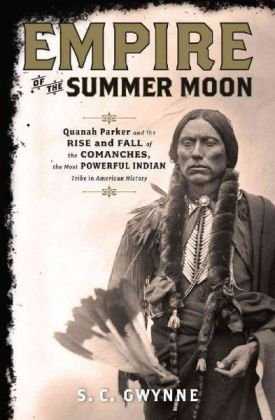
Empire of the Summer Moon: Quanah Parker and the Rise and Fall of the Comanches, the Most Powerful Indian Tribe in American HistoryEmpire of the Summer Moon is another title that came to me through the Deliberate Reader book club.  I was pretty pleased when I picked it up, because as I noted recently I haven't read a lot of nonfiction this year, and this was a nice change.  According to the subtitle, it's about "Quanah Parker and the Rise and Fall of the Comanches, the Most Powerful Indian tribe in American History," which is some interesting capitalization, but that's besides the point.  Let me just put this out there from the beginning: other than a couple of chapters at the end, this book is not really about Quanah Parker.  Parker's relevance is basically that he managed to wrangle the title of "Principle Chief of the Comanches" out of the US Government when the majority of the Comanches had been, finally, confined to a reservation, and he became a leader later in his life and caused a lot of trouble for the government earlier in it.  But beyond that, this book is largely not about Parker, but is more about the Comanches in general, without specifics for any part of it.

It must have been hard to write a book about the Comanches, because really people didn't, and don't, know that much about them.  They weren't a literate tribe and kept themselves fairly isolated, far more so than most of the First Nations we hear about.  The exact degree of isolation depended on the band (there were five within the Comanches) but overall it means that there isn't a lot of documentation from the Comanche side of things.  This means that what Gwynne is forced to rely on is documentation from the American (and Spanish, and Mexican, and Texan) side of things.  The result is that most of the information comes from records of Comanche raids on settlements and the various attempts to hunt down groups of Comanches, either preemptively or for revenge.  The notable exception to this is the few times that people who were taken captive by the Comanches and were either released or adopted into the tribe documented their experiences to some degree, which was a fascinating change.  As for documents from the Comanches themselves?  There are a few letters "written" by Quanah Parker at the end, but that's pretty much it.  Maybe something that a chief said here or there that was recorded by a white guy, but there's not much in that category.

I think this was a fairly good general history; it's hard to be more specific and detailed without that (non-existent) documentation from the Comanche side.  But even the generalities of Comanche life were fascinating.  What did bother me was some of the language that Gwynne uses.  He constantly refers to the Comanches and other First Nations peoples as savages, uncivilized, and lacking in culture.  Well that might all be true...but only if you're looking at it from a standard "white conqueror" viewpoint.  It's such a weird thing because this isn't an old book; it was published in 2010, a year when one would think that the author of a book such as this would know better.  The writing itself is very engaging, and it kept me reading until the end, but I had this constant little squirming sensation in the back of my mind because, uhm, that's not how you talk about people?  Or have I been mis-informed all this time?  Anyway, while the narrative part is good, there is a lot of underlying racism here, and sometimes it's not lying that far under; it's very clearly an instance of "history is written by the victors," in which case victors is, of course, white guys.  Not cool at all.  I think if that had been handled in a proper way, this book would merit a better rating than I'm ultimately going to give it, which has to be...

2.5 stars out of 5.  There was some interesting information here and it really got me interested in a period and area of history in which I hadn't formerly had much interest, but the way it was handled was not the best and it gets a serious knock for that.

Sunday, September 11, 2016

Read This, Then That Vol. 2

Burial RitesRead This...
Start with Hannah Kent's Burial Rites, which is the fictionalized story of the last woman to be publicly executed in Iceland.  We know from the beginning that Agnes is sentenced to death, the penalty for murder.  She's being kept on a small farm, and a young priest comes to listen to her story and essentially take her last confession.  As Agnes' execution looms ever closer, her story comes out, and it's implied that not everything might be as it seems.  This uses non-linear storytelling, jumping from the "waiting for execution" stage back to the times Agnes speaks of, when she worked as a servant on a really strange homestead and became engaged in a series of events that eventually led to a double-murder.  Agnes has apparently been painted as a ruthless killer historically, and Kent strives to humanize her and bring some semblance of doubt into whether she actually committed the murder or not.  Kent doesn't make Agnes a sympathetic character, necessarily, but does make it easier to see things through her eyes even when at times when it's hard to actually feel bad for her.  Ultimately, however, Agnes is a young woman in circumstances that, while they initially seem ideal, eventually spiral beyond her control to devastating consequences.  If you liked Burial Rites, continue on...

The Dressmaker's War...Then That
If you liked Burial Rites, you'll like The Dressmaker's War.  Set more than a century after Burial Rites and taking place in WWII Britain and mainland Europe (mainly Germany) rather than rural Iceland, The Dressmaker's War nonetheless has many of the same "feel" qualities.  It has that same sense of a young woman hoping to find love and advance herself who gets swept up in something that was not what she thought and paying the price for it.  In this book, we also know (or can pretty easily infer) that Ada, the heroine, is about to be executed, but it's unclear exactly for what.  That comes out over the course of the book.  Unlike Burial Rites, The Dressmaker's War uses sequential storytelling, with the exception of the prologue; the rest of the book is kind of set up as the story of what happened to Ada that she wrote down prior to her execution.  There's no sympathetic ear for Ada, unlike there was for Agnes--the reader has to serve that purpose.  But the feel is much the same, and if you liked one, you'll like the other.  I think reading Burial Rites is good because then you get them chronologically--the earlier story first, then the later, and it gives a sort of sense of continuity, of how over more than a century, in some areas, things had not changed that much.

Friday, September 9, 2016

The Perks of Being a Wallflower - Stephen Chbosky

The Perks of Being a WallflowerSo, I had this book picked out to fulfill a "banned book" category for my reading challenge, but ended up swapping it for "a book that takes place in your home state," which is obviously Pennsylvania for me, after another title for that category didn't work out.  But man oh man, after reading this, I can see why it was banned from so many schools and libraries.  It is basically the sum of absolutely everything overprotective parents are afraid of their kids reading: sex, drugs, drinking, homosexuality, swearing...the whole deal.  For the things like drugs and drinking, I don't think the book glorifies them; in the case of smoking and LSD, Chbosky actually puts out there multiple times how bad they can be.  But for the other things, they aren't "glorified," but they're also not pushed into a corner and ignored as if they never existed.  They just are, which is fine because these things do happen in teenager's lives.  Should it have been banned?  No.  But I can see why the bands of people who focus on banning books zeroed in on this one.

Now, for the book itself... It's written like a series of letters from the main character and narrator, Charlie, to some anonymous reader.  Charlie basically uses the letters as a way to "diary" his first year in high school.  He's a quiet, withdrawn kid; one of his teachers points out that Charlie isn't really participating in life, but is more just observing it.  In an attempt to change this, Charlie makes a real effort to start participating, and ends up becoming friends with two seniors, stepsiblings Sam and Patrick.  He has a huge crush on Sam, which she tells him not to do, and he tries very hard to do so, but it still ends up shaping a lot of the book for him.  The main "body" of the book is really just the day-to-day-ness of Charlie coming to terms with coming of age, in a way, and eventually learning to let go of things that have happened in the past and of his friends as they leave for college and their futures, though they remain friends.  It's also a real medley of literary and pop-culture references, from To Kill a Mockingbird to The Rocky Horror Picture Show.  I'm not a huge fan of the letter format, nor am I a big fan of first-person perspectives, but the book was okay, I guess.  I think if I were still a teenager or going through some difficult time in college it might have resonated more.  But I also apparently had a very sheltered adolescence, because even though Charlie never gets in trouble he was in way more "trouble" than I was ever even aware of, all things considered.  But at the same time, I don't think I was sitting back and observing instead of participating, and that kind of does present a skewed view in this book: that in order to "participate," you have to do the things that Charlie ends up doing, and that's not actually the case.  He and his friends spent most of the book behaving in ways that were, frankly, stupid, which makes the cult status of this book a little worrying to me.

And then, just briefly, let's talk about the end.  I'll be honest: I hit the end of the book going, "What just happened?" and had to look it up on Wikipedia because it was left so vague.  It both does and doesn't make sense to me.  First, in the way that it does: Charlie was obviously suppressing things, to a very high degree, and to such a high degree that, even once it all came to light, he still doesn't want to write it down or have to think about it too much.  But at the same time, it didn't make sense because Chbosky had Charlie just come out and talk about so many other things that most people would approach with a greater degree of delicacy, or dance around more, and then suddenly this was the thing that was left in the dark.  You know, the thing that had been affecting Charlie for apparently the whole book?  It just seems strange, and even going back and re-reading the "reveal" sections after I had looked up what exactly had happened, it was still very vague.  I had more a sense of "yeah, I guess I can see that," than of "oh wow, how did I miss that?"

Basically, I think this book has its place, but I definitely wasn't it--and I think the body of the book has a lot more to offer than the ending, left foggy as it is, does.

2.5 stars out of 5.

Wednesday, September 7, 2016

Eyes of Silver, Eyes of Gold - Ellen O'Connell

Eyes of Silver, Eyes of Gold (Eyes of Silver, Eyes of Gold, #1)So, I've been reading yet another book club catch-up, Empire of the Summer Moon, which is about Quanah Parker and the Comanche tribe in the Great Plains area during frontier times.  In addition to talking about Quanah Parker and the Comanches, it talks about the ways the American settlers were trying to claim land and fight Native Americans, including the Comanches, and therefore it talks about the Texas Rangers, and it all put me really in the mood for a western romance.  I don't really know why, as there's pretty much nothing romantic about EotSM.  Anyway, I paged through the few western romances I had on my Kindle, pretty much immediately determined that they were all terrible (that's what I get for free, I guess), paged through the library's Overdrive collection and determined that all of those were terrible (and many bore the names of modern country songs, such as "Save a Horse, Ride a Cowboy") and turned to a Goodreads list of popular western historical romances.  Eyes of Silver, Eyes of Gold was the #1 book on that list, so bit the bullet and bought it.  It wasn't exactly what I was looking for (different setting, slightly different time period, etc.) but I figured I was willing to sacrifice specifics in exchange for quality with the general feel of what I was in the mood for.

This book ended up being a very puzzling one for me.  Not necessarily in a bad way.  It just...was.  The story follows Cord (the eyes of gold) and Anne (the eyes of silver).  Cord is half Cheyenne, the product of his father's second marriage, and has always been looked down upon for his "savage" ways, because he has a temper.  Even his family thinks he's half-wild and pretty much always on the verge of killing someone.  Anne is the daughter of a shopkeeper in their town who has run away from her father, who locked her in a room and attempted to starve her into marrying a gross old guy following a separate broken engagement from when she lived with her aunt in Chicago.  Cord finds Anne sleeping in his barn and, after her learns what's going on, offers to help her get to a town where she can take a train to Chicago to escape her father.  But before they can decide on a course of action, her father shows up with a posse.  Anne is beaten and sexually assaulted (though not raped) and Cord is beaten to the verge of death--oh, and the two end up married in a farce of a ceremony.  Anne's father leaves her in Cord's yard with instructions to beg her way back into her family's household.  But she doesn't; instead, she starts taking care of Cord, nursing him back to health, and the two ultimately agree to stay married, since Anne's reputation is already in tatters anyway, and she's determined to not go back to her father.  But Cord doesn't put much stock in the marriage, thinking that Anne is going to up and leave him any day.

I found Cord's family to be the most baffling part of this book, especially in comparison to the rest of the people of Mason.  His family believes the very worst things about him, when you would think that they'd be more willing to support him, or at least to look at the other side of the issue.  There are some serious issues with communication between the family members here, it's true, but I can't imagine that Cord communicated much better with the people of the town, and once Anne and Cord started showing up there together (proving that he didn't have her tied up in his root cellar) the townsfolk were all much more welcoming and accepting of Anne and Cord's marriage than his own family was.  It was a real mind-bender to me.  Obviously I expected this couple to face a lot of judgment and prejudice, and they did...it just didn't really come from the sources I would expect.  I thought it would come from everyone, or from everyone except Cord's family.  (Anne's family is, it's quickly established, basically completely under the thumb of her terrible father, so I didn't expect a lot of help from that quarter, and there wasn't very much until pretty late in the book.)  The acceptance of the other people that Anne and Cord knew was also a little confusing, because I kind of find it hard to believe that it would have gone like that.  This wasn't some town on the edge of civilization, after all; it was a small town, but still one that was connected and one where reputation obviously mattered, if Anne was so easily "ruined," and yet most of the people accepted the relationship in pretty short order.  Not immediately, but very quickly.

And while this book had romantic elements, I don't really feel that it was an out-and-out romance.  It was another strange blend; there were some romance moments, but a lot of it was Anne and Cord pretty much just living together, and Anne sassing anyone who gave her a hard time.  I liked it, but I'm not sure I'd actually qualify it as a straight-up romance.  That said, the romantic elements do get more pronounced in the second half of the book, and I think after that point it started hitting the "feel" I was looking for more.  Watching Cord and Anne (re)build relationships with their own families and with their respective in-laws was also nice, if, as mentioned before, a little confusing in how the dynamics worked in the first place.  The writing is also of good quality, though there were a few inconsistencies--such as are Frank and Ephraim Cord's half brothers, or his uncles?  Both relationships were mentioned, which left me a little befuddled.  But despite the befuddling elements of this book, I did like it quite a bit, and I'd definitely be interested in reading something else by this author.

3.5 stars out of 5.

Monday, September 5, 2016

I Am Malala - Malala Yousafzai

I Am Malala: The Story of the Girl Who Stood Up for Education and Was Shot by the TalibanSo, let me show my uneducated American-ness for a second here.  I confess that, prior to Malala Yousafzai being shot, I had no idea who she was.  Even after she was shot I had no idea who she was, and I honestly had no idea why it was such a big deal.  Because, in my ignorance, I was under the impression that the Taliban was off shooting schoolgirls all the time.  This, apparently, was not the case.  Malala is a bit of a special instance, due to her advocacy for girls' education--though the Taliban insists that she was shot because she was going against Islam, not because of her stances on education.  Either way, her experiences were the reason I turned to this as my pick for a political memoir for my reading challenge this year.  I didn't really want to read about a run-of-the-mill politician, so Malala's memoir seemed like a good alternative.

Now, this didn't end up being as political as I had anticipated, as Malala basically recounts her entire life story up until the time she was shot, and a period of time afterwards when she was recovering.  It was written before she won the Nobel Peace Prize and before she became such a huge force in advocacy for education around the world.  Still, you can see the seeds of that in this, and definitely see her political origins in Swat, Pakistan, the valley where she grew up.  Her father was definitely a big influence on her, and she emphasizes again and again that no matter how much she admired her father and no matter how much he worked with her on her advocacy, it was still her decision to make her speeches and put herself out there.  She's definitely a strong young woman, and someone to be admired for her firm stance even in the face of being assaulted by the Taliban.

My issue with this was pretty much exactly the opposite of the issue I had with the last memoir I read, Climbing the Mango Trees.  In CtMT, I found that the writing was good, sometimes even beautiful, but the content just didn't interest me.  In I Am Malala, the content is amazing and inspiring, but the writing...well, it reads like a teenage girl wrote it.  Malala has a co-writer listed (Christina Lamb; the listing is unusual, but I like it) but I would definitely say that she was heavily involved in this book because of the way it reads.  It really does sound like a high school essay at many points.  Now, I completely understand that yes, Malala was still in school when she wrote it, but the downside of this authenticity of voice means that the writing oftentimes isn't very engaging.  The life she describes and her growth to an active advocate for education is fascinating, but the writing lends a certain distance to this that, at times, almost makes it read more like a Wikipedia article than a memoir.

Malala is an amazing young woman with an important cause, and I really admire her for that.  I'm glad that I read this, because it gave me a deeper understanding of where she came from and exactly why she's advocating for education--even before the Taliban became involved, she wanted everyone to be able to go to school.  The writing wasn't the most riveting I've ever seen, but I'm still very happy with this as a selection for my reading challenge.

3.5 stars out of 5.

Saturday, September 3, 2016

Reading Challenge Updates

Completed!

-A book set in your home state.  I was originally going to read American Rust for this, and got it out of the library to do so, but within a half hour of reading knew that it wasn't going to work.  The writing style, combined with the immediately heavy content (there's a sexual assault and murder within the first chapter) meant it was definitely not what I was in the mood for.  I switched that title out for Perks of Being a Wallflower, which I had originally slated for the banned book category, as it takes place in Pittsburgh.  It was fine, I guess.

-A political memoir.  I read I Am Malala for this.  Malala is an amazing young woman who advocates for universal education (with an emphasis on education for girls, because girls are often the group that suffers the most in this field) and in her book she relates her childhood, along with how she became an active advocate and a target for the Taliban.  The content here was impressive and inspiring, but the book definitely reads like it was written by a teenager girl.

-A book translated to English.  I didn't end up using either of my original intended titles for this, because I ended up reading The Little Paris Bookshop by chance and realized that it fit this category.  I think it was a beautiful little book, with charming settings and quirky characters, but it wasn't a page-turner by any means.

-A book that was banned at some point.  When I switched Perks of Being a Wallflower to the home state category, it meant I needed to find a new book for this category.  I finally settled on Sophie's Choice, which is also on the American Library Association's list of commonly challenged or banned books, because I already had it on my Kindle.  It was exceedingly tedious.  Do not recommend.

-A self-improvement book.  An Astronaut's Guide to Life on Earth jumped out at me from a list of self-improvement books because one of my friends from college read it recently and rated it quite highly, so I went for that.  Why I don't think it was written with the intention of being a self-improvement book, I can definitely see why it ended up there; it has a lot of little lessons that all of us can apply to our lives, but it's not preachy and doesn't try to shove anything down your throat.  A great read all around.


Still to Come

-A science-fiction novel.  Once again, I'm looking for a new title for this category.  I have a few books in my possession that would fit this, so we'll see which one I'll get to first...  It's likely to be The Three Body Problem or The Windup Girl.

-A book based on a fairy tale.  I adore fairy tales, so this category had a whole bunch of possibilities for me!  I settled on Gregory Maguire's Confessions of an Ugly Stepsister, which is quite clearly an adaptation of Cinderella from the stepsister's point of view.  I read Wicked in high school and found it good but weird, so I'm interested in seeing how this one plays out.

-A National Book Award winner.  I don't really know much about book awards, as I tend to ignore them in favor of reading whatever interests me at the time.  So I had to pull up the list of National Book Award winners to have something to go off for this one.  Most of them didn't really intrigue me (who decides what makes a book award-worthy, anyway?) but I eventually picked The Shipping News off the list as looking at least mildly interesting.

-A book you haven't read since high school.  This is hard.  I tend to re-read books that I like on a fairly regular basis; hardly a year goes by when I don't re-read most of Tamora Pierce's works in a one-week binge.  That said, I know that the last time I read Peter Dickinson's The Ropemaker was in high school, because I then lent it to someone who never returned it.  So I'll read that for this category.

-A book recommended by someone you just met.  I asked the NaNoWriMo Facebook group what they thought I should read this year; one reply was already on the list (Grave Beginnings) but the other was not; therefore, I shall be reading The Machinery by Gerrard Cowan for this category.

-A book written by a celebrity.  Okay, so I saw Elixir by Hilary Duff ages ago, probably when it first came out, but I didn't read it because I was skeptical.  I mean, celebrities writing?  Who does that?  And I'm always convinced it's really a ghostwriter doing the real work.  But now it seems like it's a good time to try this one out.  I was going to read Tina Fey's Bossypants for this, but I'm already reading a comedian's book for another category, so I didn't want to double-dip.

-A book at least 100 years older than you.  I'm actually going to get around to 20,000 Leagues Under the Sea for this one, because I want to read one of the steampunk novels that started it all as research for my own writing.

-A book from Oprah's Book Club.  After much perusal of the complete list (found here) I've settled on Malika Oufkir's memoir Stolen Lives, because the categories this year are sorely lacking in nonfiction and this seems like one of the better titles on the list in general--at least among those that I haven't read yet.

-A book recommended by a family member.

-A graphic novel.  I love Neil Gaiman but am not a huge fan of graphic novels, so I've avoided his Sandman series up until this point, despite buying my boyfriend the entire series for various occasions.  Now seems like a pretty good time to give them a go and start in Vol. 1: Preludes and Nocturnes.

-A book with a protagonist who has your occupation.

-A book of poetry.

-A classic from the 20th century.  I'm going to do Lolita for this one, because I feel like I need to squish a Russian novel in here somewhere.  What really makes a classic, anyway?  I don't know, but this list that I found says Lolita is one.

-An autobiography.  I picked up Papillon by Henri Charriere at a used bookstore in New Jersey (Broad Street Books in Branchville, if anyone out there is in the area; it was absolutely lovely and I look forward to going back the next time we're in the area) but put it down in favor of another title.  Now I wish I'd bought it!  Charriere wrote this book about his wrongful conviction for a crime and his subsequent escapes from prison.  Most autobiographies bore me on principal, but this one actually sounds interesting.

-A book about a culture you're unfamiliar with.  I'm leaning towards Shutting Out the Sun for this one, which is a non-fiction book about Japan's "lost generation."

-A satirical book.  I've partially changed my mind on this one; instead of Thing Explainer, I want to read What If? which uses science to answer absurd hypothetical questions and makes fun of how things work in general in the process.

-A book recommended by your local librarian or bookseller.

-A book you should have read in school.  This I'm going to fill with The Odyssey, which every other English class in my high school read, but my class as a whole did not because our teacher was too busy having raptures about the hero's journey in the Star Wars series to actually assign it to us.

-A book chosen for you by your spouse, partner, sibling, child, or BFF.

-A book published before you were born.  Let's face it: most of history is before I was born.  This means that I have a very wide scope of titles from which to choose.  I'm going to go with the classics and choosing Wuthering Heights for this one.

-A book you previously abandoned.  I'm planning on using Jonathan Strange and Mr. Norrell for this one.  I've had this book for years, and started it at one point, but I just couldn't get into it.  I'm hoping that time will have improved it some for me, just like how I liked Vellum much more when I returned to it years after first purchasing and attempting to read it.

-A book that intimidates you.  For this I've finally settled on The Count of Monte Cristo.  I was planning on reading it for catch-up for a digital book club, but I'm including it here because its sheer length is intimidating.  I don't mind books--love them, really--but I am a tiny bit concerned that adding in a book of such heft so late in the year is going to throw off my timeline for completing the challenge.
Friday, September 2, 2016

The Chosen - Chaim Potok

The ChosenThe Chosen is another book I'm reading as catch-up for the Deliberate Reader book club.  This was the selection for March.  It's an older book, originally published in 1967, though it's gone through several rounds of re-issues; the cover pictured here is from an edition from the 1990s.  The story takes place in the later part of World War II and in the years immediately after it, and follows two Jewish boys living in New York City.  Reuven is our narrator; the son of a professor who writes lots of articles on Judaism and who becomes a prominent Zionist, he wants to become a rabbi when he grows up, despite his father's wishes for him to become a mathematics professor.  The other main character is Danny, who Reuven first encounters during an ill-fated baseball game.  Danny is the son of a Hasidic rabbi and is supposed to become a rabbi himself when he grows up, following in his father's footsteps, though what he really wants to do is study and practice psychology.  Despite the rocky start at the baseball game, Danny and Reuven become friends, and the story follows them through the trials of their friendship as they try to balance the expectations placed upon them with their own hopes and dreams.

This was a really interesting book to me not because of the story itself, but because of what it fundamentally is.  Ultimately, this is a book with Jewish characters set during WWII which doesn't deal with the Holocaust.  The Holocaust is mentioned in passing, once troops reach the camps overseas and news comes back, and some of the older characters are absolutely destroyed by it, but ultimately it plays a very minor part in the story.  I might just be narrowly-read in this area, but in my experience it's fairly rare to find books with Jewish main characters set in this time period that doesn't deal with the Holocaust in a very intimate way.  I actually liked this; while the Holocaust was a horrible, horrible event, it's also very widely-written, and I liked that this book offered a view onto Jewish life as it continued on in the US, despite the ongoing war.  It was just something that I don't see very often, and was therefore a very refreshing read.

The relationship between Danny and Reuven is really the center of this book; the relationships with the fathers are, in my opinion, secondary.  It's Danny and Reuven who shape each other more than their fathers ultimately do, as they encourage each other in different ways, support each other, and help cement what are essentially the opposite fates of what their fathers had intended for them.  In some ways, Danny would have been better suited with Reuven's father, and Reuven better suited with Danny's--though Danny's father raised him in this weird sort of silence, the reasons for which were ultimately explained but didn't really hold water for me, and Reuven blatantly said that would have been terrible for him.  So maybe that pairing wouldn't have worked out after all.  But watching the deviation from their intended paths to their desired ones, even when they were separated, was an interesting process.  It's a character-driven novel, definitely, which means that if you're going to look for a strong plot, there isn't one.  It's very much about Danny and Reuven's development as people rather than being about them actually setting out to achieve a specific goal.  But I think that's the type of narrative that was best suited here, and I ended up really enjoying this one.  It put out a lot of information about Judaism in general and Hasidism more specifically that I wasn't aware of, and so it also functioned as a sort of educational experience.  As I mentioned before, the whole "raised in silence" thing, while it seems like it might be real (I can't weigh in on that) didn't hold up for me, but that's really my only big complaint about this book.

4 stars out of 5.