Pages

Showing posts with label adventure. Show all posts

Friday, December 15, 2017

Robinson Crusoe - Daniel Defoe (Robinson Crusoe #1)

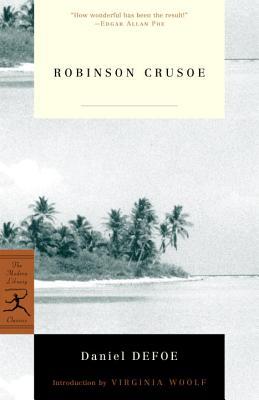
Robinson CrusoeOkay, first off--who the heck knew that Robinson Crusoe actually kicked off a three book series?  I did not know this.  I was not aware of this at all.  Imagine my surprise when, getting to the end of the book, I found that this is continued in not one but two more books.  Oy.

When I needed a pick for a book set in the wilderness for the Popsugar 2017 Reading Challenge, I thought Robinson Crusoe was the natural pick.  It's a classic, and I want to read more of those, and I also had a foggy memory of reading the Great Illustrated Classics version when I was little.  Of course, I didn't realize then that those versions are pared-down significantly and in fact only found this out in the past coupe of years.  Oops.  Anyway, it meant reading the original long-form was a pretty easy decision.

This is a book typical of its genre--the early seafaring or adventuring tale, in which there isn't a strong central plot per se but is more just a character relating his adventures from a point later on in his life.  For our purposes, the character is the eponymous Robinson Crusoe, who tells of his misbegotten youth and many years shipwrecked on a deserted island in the Caribbean.  I suppose you could say the "plot" is that he gets shipwrecked and spends the rest of the book looking for a way to escape, but that's generous at best as most of the book is telling us how he survived on the island, combated fears and threats of native cannibals, etc.  There is a weird segment at the end after he does escape the island and is back in Europe, but that's clearly meant to segue readers into Defoe's second volume and, honestly, can probably be mostly ignored.  It really didn't fit the pacing or themes of the rest of the book at all, and felt very disjointed tacked onto the end as it was.

Because this isn't a book with a strong central plot or a lot of characters to carry the story without a plot, it means it really can be dry and boring.  For much of the book, Crusoe is the only character on the page, and when other characters enter at the beginning and end they are much simplified.  Much of the book is Crusoe telling us of his daily tasks and, to an annoying degree, the religious awakening he underwent while on the island.  Yes, this is a preachy book, which I was not expecting.  And yes, the recitation of the daily facts of life, which are mostly the same from day to day, got really old really fast.  I was kind of hoping Crusoe would make a break for it on the open sea, but alas, that never came about.  Because there are few big, story- or life-shifting events, the book is slow and dry for long expanses at a time.  Also, Defoe kept repeating things, like how Crusoe referred to a part of the island as his castle and another part as his bower--I got it after the first five times, thank you very much.  Maybe he was paid by the word.

Overall, it was fun revisiting this and seeing how much it differed from my childhood version (a lot!) but it wasn't really a riveting read, and I don't think I'm up for two more books of it.

2 stars out of 5.

Wednesday, November 15, 2017

Mutiny on the Bounty - Charles Nordhoff & James Norman Hall (Bounty Trilogy #1)

Mutiny on the Bounty (The Bounty Trilogy, #1)Continuing on with my reading challenge (I'm nearing the end!) I chose Mutiny on the Bounty for the category of a "A book with multiple authors."  It also had the added benefit of allowing me to cross off a book from the list I have pinned up by my desk of every book Rory Gilmore reads, mentions, etc. during the duration of Gilmore Girls

What's important to remember about Mutiny on the Bounty is that is a fictionalized account of the (in)famous mutiny; my edition has a foreword from the authors that goes into their sources, some of the changes they made, etc., but I think it would be easy to think that this was actually a personal account because of the way in which it is written.

In the book, Nordhoff and Norman Hall remove one of the midshipmen from the Bounty and replace him with their narrator, Roger Byam, basing him upon the original sailor but deviating in some respects.  Byam tells the story of how he was invited to join the Bounty's crew for a bit of adventure by its captain, William Bligh, on a journey to Tahiti to gather breadfruit trees for transportation to the Indies, during which he will compile a dictionary and grammar of the Tahitian language for use by others journeying there.  After a paradisaical stay in Tahiti, while en route to the Indies, Bligh's temper seems to get worse and worse and feuds he started with the crew before Tahiti are refueled and exacerbated, culminating in the mutiny, led by the first mate, Fletcher Christian.  Byam is not involved in the mutiny, but is forced to stay aboard the Bounty because there's not enough room for all those loyal to Bligh in the launch he and some of his supporters are forced into.  The rest of the book deals with the aftermath of the mutiny for Byam, and includes two "splits" that break off into the other two books in the trilogy--one book deals with Bligh and the men in the launch, and the other with Christian and some of the mutineers going to the Pitcairn Islands.

This is a classic seafaring story.  Byam is the perfect choice for a narrator because his position allows us to sympathize both with Bligh and the loyalists as well as with the mutineers.  It is, however, a story that is definitely not plot-driven as there is no plot, rather just a tale of how the mutiny came to be and what happened to Byam and the others after.  Not everyone lives; a good number of the crew meet their demise in various ways.  The story seems to proceed in spurts, with Byam sometimes relating every day, sometimes skipping over weeks or months at a time.  He's also not the greatest, abandoning his wife and child in Tahiti in favor of the hope of naval glory back in England--something that was probably a common thought process and motivation for his time and place, but a shitty action nonetheless.  And because the story is based in fact though not entirely factual, the "villain" of the piece, Bligh, never gets his comeuppance.  And because this is a "classic," aka it was written in an earlier time (originally published in 1932) it has that old-timey feeling to it, and the writing can sometimes be dry and seem rambling.  Still, this was an overall enjoyable read and one of the foundation books of its genre.

4 stars out of 5.

Saturday, October 29, 2016

Papillon - Henri Charriere

6882Papillon was my choice for an autobiography for my 2016 reading challenge--and it's a notably interesting one because, while author Henri Charriere insisted its contents were true up until his death, there's some definite room for doubt about large chunks of the book.  Similarities to an earlier book along with the sheer incredibility of some of the events Charriere relates definitely seem to lend themselves to the theory that Papillon is, ultimately, an autobiographical framework (Charriere really was sentenced to life in the French penal colony of French Guiana, and he really did escape and eventually become a Venezuelan citizen) with a lot of narrative embellishments, many of which are suspected to be lifted from the aforementioned earlier work, or perhaps from other inmates with whom Charriere became acquainted during his time in the penal colony.

Basically, Papillon is about a guy who gets sentenced to hard labor for life in French Guiana, and who stages a series of escapes of various levels of elaborateness, sometimes succeeding and sometimes failing, but ultimately never being punished as severely as one would think for his failures.  I mean, think about, the guy's escaped from various prisons four or five times, and you're going to let him just wander around the islands?  Doubtful.  While each incident that Charriere relates is interesting and an adventure in and of itself, all of it added up together, along with the fact that everyone seems to love him--from his guards to the prison wardens to all of the inmates he encounters to a tribe of Native Americans that apparently kill every white person they encounter--really does strain the bounds of incredulity.  It does read like a memoir put together years after the events it depicts actually happened; while there is dialogue included, it seems like it's more rough outlines of conversations than actual conversation, which makes sense, but then at the same time other details that probably wouldn't spring to memory seem to proliferate.  It's a strange imbalance, and it does make me believe that while some of the parts of it are real, others are embellished, lifted, or straight-up invented.

I did still like the book, though.  Honestly, it reads to me like the best parts of The Count of Monte Cristo.  The most interesting bits of that book, to me, were when Edmund was imprisoned in the Chateau D'If and when he made his mistake, before the time-jump to his revenge.  And actually, Papillon references Monte Cristo, though Charriere is referring to Edmund's desire to get revenge on those who wronged him.  Still, it seems like this was a blown-up version of the "imprisonment and escape" sequence, and set in Central and South America rather than France.  I can definitely see the influence there, as well as that of the sources mentioned above.  At the same time, though, it's somewhat of a pity that Charriere apparently felt the need to mash all of these stories into one book.  One would think that the story of an actual escape would be much more riveting for its very truth than a book that's pretty obviously been cobbled together and inflated to make its narrator seem like more of a genius and model person than he really was.  But hey, maybe that story wouldn't have sold well in the time that this book was published, though it almost certainly would have been preferred to audiences of today.

I am going to keep this as my autobiography selection for the reading challenge, because it's presented as such and for a long time it was (and by many, still is) accepted to be a true story.  But I side with the doubters--as much as one wants this to be true, I just can't bring myself to believe that more than a fragment of it actually is.  It's almost as if Jules Verne had taken a day trip on a submarine, written Twenty Thousand Leagues Under the Sea...but then named his main character Jules Verne and insisted that all the events of the book were true, you know?  Still, a good adventure story, and I enjoyed reading it even if I did side-eye it a bit.

3.5 stars out of 5.

Sunday, March 27, 2016

Airman - Eoin Colfer

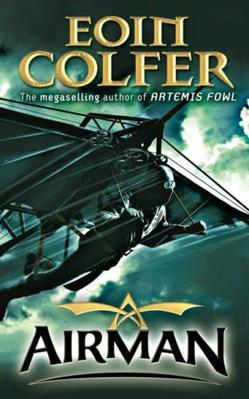
File:Airman.jpgAirman by Eoin Colfer tells the story of Conor Broekhart, a young man living in the fictional mini-nation of the Saltee Islands.  (The Saltee Islands are a real place, but they are unihabited and everything about the Saltees in the book is fictional.)  All his life, Conor has been best friends with the Saltee princess, Isabella, and he has been tutored by a Frenchman obsessed with things such as fencing, karate, and above all aeronautics.  Conor is perfectly okay with this, because he was born in a balloon basket and flying is apparently his destiny.  Hm...

Okay.  I like Colfer.  At least, I remember liking Colfer; I read the Artemis Fowl books when I was younger and enjoyed them quite a bit, though I believe a few more have come out since then.  Those have a very different feel to them than Airman, but that isn't necessarily a bad thing.  Airman is...well, I guess it's kind of historical fiction, but it's also kind of steampunk.  All of the apparatuses Colfer includes are real, or closely based on real machines/inventions, but the setting of the Saltees, the prison, the diamond mind, etc. definitely gives a steampunk flavor.

Story-wise, I enjoyed this but it did not shine.  The plot revolves around Conor being thrown into prison for his supposed involvement in the death of King Nicholas, though really it's because he knows the truth behind the King's death and the Lord Marshall of the Islands, Bonvilain, wants to shut him up while maintaining control over Conor's family, who are very prominent in the Islands and could mess things up for him.  So, at the age of fourteen, Conor ends up in prison, befriends an inmate or two, and begins plotting his escape--which only takes up about half the book, because of course after he's free he has to make things right in the Islands.

Conor himself was an excellent character, as was Linus Wynter, the blind musician who becomes Conor's close friend.  Both seemed well-rounded with specific motives for everything they did, and Conor in particular changed in accordance with his experiences in prison.  That was good; he didn't exhibit any naivete that I might have expected from the hero of a YA novel.  The rest of the cast, though... Bonvilain was weak as a villain, really, because he wasn't any different from any other fictional villain.  He had no original twists, nothing, though I think Colfer TRIED to spice him up by making him part of the Knights of the Holy Cross (Knights Templar).  Isabella was supposed to be an excellent queen, but she kind of fell flat, literally needing to hold someone's hand in order to address her people or her employees.  And then suddenly at the end she's threatening to slice someone in three with a samurai sword.  Uhm, what?  Where did that come from?  And while we were meant to fell sympathy for Conor's parents, they really didn't get enough page time to build up their pain, and all we really saw was Conor's father magically recovering from his grief to aid Isabella.  There were an excess of comically inept side characters, ranging from Otto, the inmate whose greatest pride is his hair; to Pikes, Bonvilain's essentially useless sidekick; to Uncle, a boy who won't take a bath.  The side character with the most potential was probably Sultan, Bonvilain's poisons expert, but he was sadly underutilized and underdeveloped.  I also didn't feel like Isabella and Conor's relationship was believable; it was just kind of stated that it was there, and then Conor came back a completely different person and Isabella didn't have anything to say about that?

And what HAPPENED to Otto and all those diamonds, anyway?!

Overall, enjoyable but lacking some characterization.

3 stars out of 5.

Sunday, June 16, 2013

Graceling - Kristin Cashore (Graceling Realms #1)

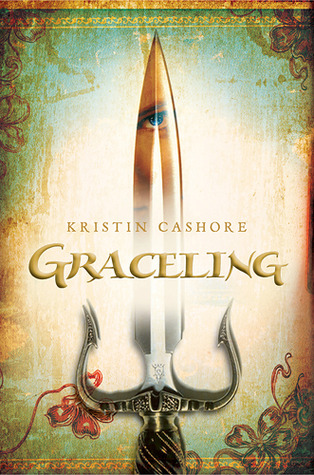
Graceling (Graceling Realm, #1)Kristin Cashore's Graceling takes place in a fantasy world that appears to be without magic, but where some people are born with Graces, special skills of almost any variety.  These people, marked by their different-colored eyes, are abnormally gifted in random areas like swimming, fighting, cooking, dancing, or really anything under the sun.  The protagonist of the story, Katsa, is the niece of a king, and she is Graced with killing.  Her uncle uses her as his strongarm, forcing her to maim or kill people who cross him.  By night, however, Katsa and her friends work to right wrongs committed by Katsa's uncle and the other kings of the seven kingdoms.  On one such mission, they free the kidnapped father of one of the kings, and Katsa encounters another Graceling.  He shows up at Katsa's home court and reveals himself to be the grandson of the very man Katsa helped to rescue.  Greening, or Po, as he likes to be called, becomes quite close with Katsa, and after an upheaval at the court, they leave to find out why Po's grandfather was kidnapped.

First off, I really liked the characters in this book.  Katsa really struggled with coming to terms with herself, her Grace, and where she belonged in the scheme of things.  Po likewise struggled with his own Grace and what it meant for him.  Their relationship was extremely intense, and while it was pretty obvious it was going to happen from the start, it might have escalated form companionship to outright love a little too quickly for my taste.  I also hope that Giddon finds someone in the other two books in the series--I really liked him, and while Katsa was perfectly justified in not wanting to marry him, I'd like to see more of him in the future.  Bitterblue (strange name, even for a fantasy world) was very mature for her age...I AM kind of skeptical about that, but that kid went through some serious shit, so maybe that's behind her mental age?  Leck, as a villain, was weird and scary but not entirely believable because we never really learned anything about him.  Sure, Po and Bitterblue both said some stuff about him, but he only made two on-page appearances, one of which was only a few lines, so it's hard to actually grasp his motivations and how he came to be what he was.

I saw some weaknesses with the time with just Katsa and Bitterblue; it just wasn't that riveting.  And Katsa's constantly calling Bitterblue "child" was downright annoying.  I mean, yeah, Bitterblue's a little kid, but calling her "child" instead of calling her by her name or title ("Princess") just came across as weird.  Also, the similarities between Katsa and Katniss Everdeen from The Hunger Games (K-named warrior girls who are kind of naive about the world and are super good at archery) are striking, but since the books were published at about the same time, I'm pretty damn sure that's purely coincidence.  I think Graceling is also structured a lot better than The Hunger Games; it's self-contained, rather than straggling much longer than necessary across three books.

Probably my favorite non-plot part of the book, however (well, it WAS plot related, kind of) was the culture surrounding the ornaments of the Lienid people.  Absolutely beautifully done.  Well done, Ms. Cashore.  Well done.  The culture of the other six kingdoms, was kind of vague and they were all just lumped together.

Overall, Graceling was a lovely read full of fabulous characters.  It did have flaws, of course, but they were more than compensated for by its high points.  A wonderful book, and I am greatly looking forward to reading Fire.

4 stars out of 5.

Friday, June 14, 2013

The Summer Prince - Alaya Dawn Johnson

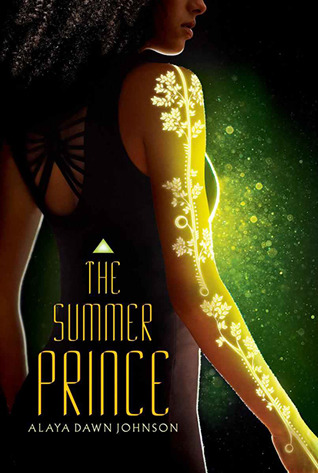
The Summer PrinceI started this book thinking I would love it.  Then partway through I thought that I would like it, because it's very different, but I would be left confused.  And then it broke my heart.

The Summer Prince is the story of Enki and June, Enki and Gil, Enki and the City, and Enki and death.  Enki is the sun in this story, even though he's supposed to be a moon prince; everything revolves around him, completely and irrevocably.  For a long time, I didn't think that there was going to be any romance between Enki and June, that she was going to be sidelined by Enki and Gil, and I would have been okay with that, because it was different, and they were cute, and June was "aware this attachment I feel is the product of emotional investment in the largely stage-managed and manufactured spectacle of the royal election."  I admired her for that, for recognizing that in herself.  But that love transforms over the course of the story, and while, to some degree, I never really believed June and Enki would have a romance, it was so beautiful that I couldn't NOT want it.

I wouldn't say this book is about a revolution.  I would say that it's about art, and love, and inevitability, and the mistakes of history.  It was beautiful in all those ways.

Of course, it DID have flaws.  There are two instances of suicide in this book, and while one is barely mentioned, the other is glorified to what seems like an unhealthy degree.  There is also some lack of description that I find unsettling; I can't really get a clear picture of Palmares Tres in my head because there isn't really any solid description of it.  The whole sacrificial ritual also left me with some confusion; I feel like I absorbed a lot of knowledge about it that wasn't explicitly stated, but I'm still not sure if it's an annual thing or something that only happens every few years, and exactly how it evolved into what it is during the time of the book.  Still, the absolutely heartbreaking beauty of this more than outweighs it, and even parts I thought would be completely unnecessary, such as most of the last part of the book, turned out to fit into it so perfectly that I wouldn't wish them away for ANYTHING.

And the conclusion!  Wow...just...wow.  I sobbed like a baby in the middle of my workplace, but it was worth it.  Completely worth it.

5 stars out of 5.