Pages

Showing posts with label steampunk. Show all posts

Wednesday, May 30, 2018

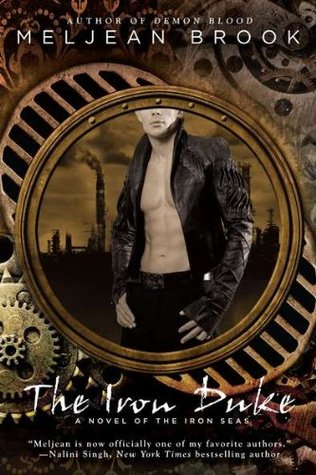
The Iron Duke - Meljean Brook (The Iron Seas #1)

The Iron Duke (Iron Seas, #1)I hadn't taken part in the Unapologetic Romance Readers' monthly reads for several months, just because there was nothing coming up that particularly interested me--or, even if they interested me, they weren't available from the library and were too expensive for me to buy.  I spent a lot of money last year buying book club books that I ended up not particularly liking, and so I've tried to dial it back some this year.  But, the monthly theme for May was "steampunk," a genre I really like, and the club choice of The Iron Duke was available from the library, and so I rejoined the fold. 

This is a book that I liked, but not because of the hero.  The world and the heroine are wonderful, and they carried the weight of the book for a hero who at first seemed like he was going to be okay, but really didn't know how to take "no" for an answer.

Our heroine here is Mina, a biracial young woman in an England that lived under the rule of the Mongol Horde for two centuries (I think).  While under Horde rule, those who lived in England were infested with nanotechnology that allowed the Horde to control them, mainly by freezing them or forcing them into breeding frenzies.  The "hero" of the book, Rhys, ended Horde rule by taking down the tower that broadcasted the signals used to control the populace.  Now, about a decade later, Rhys is known as the Iron Duke and ends up in Mina's sights when a body shows up on his doorstep and a conspiracy begins to unfold around them.  Oh, and Mina doesn't really want much to do with him, and so he is determined to own her.

This is such an interesting world.  While I'm not a huge fan of the "Asian Other" theme that's going on, the concepts in general are interesting.  It's a fusing of nanotechnology and steampunk and genetic modification.  Krakens and megalodons, genetically engineered by the Horde, threaten sea ships and airships trawl the skies.  The European continent is infested by zombies.  Mina and her fellow countrymen might be infested with nanotechnology that can let the Horde control them, but that same technology protects their lungs from the smoke and smog of London, gives them superhuman strength, and lets them heal at a supernatural rate.  And while the Horde kept a death grip on England, there are hints that this might be developed further and shown nuance in other books, though I'm not a hundred percent sure--but Mina tells about an incident when the Horde was fleeing after the downfall of their tower, and some of the Horde tried to take Mina with them, and she believes it was to protect her from a wrathful English populace who hate her because of her Mongol blood.

Mina herself is also a great heroine.  She is committed and willful, but loves her family, wants to do best by her position as an inspector, and is a true Englishwoman despite how she is looked down upon because of her racial background.  She wants to live in peace but knows it might not happen, and doesn't let it destroy her life.  She's traumatized by her own life under the Horde, which has scarred her in regards of sexual intimacy, but is not scared of connection.

But then there's Rhys.  At first, I thought it was just going to be a typical "alpha male pursues woman who rebuffs him" story, but with the awesome world thrown in.  In reality, though, Rhys is a total creep.  This became increasingly apparent as he insisted on manhandling her against her express wishes, culminating in a scene in which he sexually assaults her despite her repeatedly telling him no, and that the experience is triggering harmful memories for her--the word "trigger" isn't used at all, but that is definitely what is happening and what Mina expresses.  But Rhys ignores that and carries on anyway, leaving Mina in a position where she literally has to shoot him to eventually get him off of her.  Then, of course, the book tastes a distasteful turn to "woman falls in love with rapist."  While this is somewhat of a trope in historical period romances--not as much anymore, but you still find it--it seemed particularly egregious here because so much about this world was more progressive than the historical period is takes place in (albeit in an alternate universe) was, and this made it feel even more out of place than it normally would.

This Rhys plot really left a bad taste in my mouth.  I liked the rest of the book a lot--the consensual encounters would have been awesome, had they not been tainted by the earlier one, the world was cool, and I really liked Mina and so, so many of the side characters.  I'm one hundred percent interested in other books in this series.  But this one...I just can't get over the Rhys thing, and so despite my overall liking of the book, I'm going to have to give it...

2 stars out of 5.

Monday, August 21, 2017

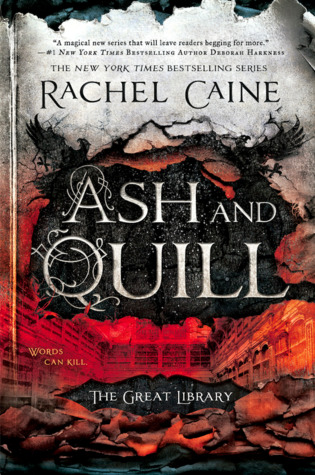
Ash and Quill - Rachel Caine (The Great Library #3)

Ash and Quill (The Great Library #3)
No one with a book is ever alone, even in the darkest moments.

Oh dear.  Oh dear oh dear oh dear.  You know that point where a series starts to go downhill?  A series that you absolutely love?  That you want to succeed more than anything in the world?  I think this might be that point in this series.  Here's the thing.  Ink and Bone was amazing.  Paper and Fire was great.  But Ash and Quill?  It was...good.  And that's all.

This picks up right where the second book left off, with Jess and his band of misfits appearing in Philadelphia, the main Burner stronghold in the American Colonies, after fleeing the Library in Europe.  This change of setting had great promise, but unfortunately the book didn't really deliver.  Jess and his friends spend probably half the book imprisoned in Philadelphia, plotting their escape, and the other half of the book fleeing Philadelphia and trapped in a second location, which they also must plot to escape.  Their plan to fight against the Great Library does not really go anywhere.  Thomas and Jess build not one, but two printing presses.  They build a weapon.  They survive Greek fire attacks on Philadelphia by the High Garda.  There's a sense of pieces moving in the larger world beyond the characters, such as the revolt of several countries, but the main characters don't actually accomplish much, and that leaves this book feeling very much like filler--a third book suffering from second book syndrome, if you will.

The sense of world here is still wonderful, but our characters, with one exception, seem to have stagnated.  Jess and most of his band have failed to evolve in the face of their new circumstances.  They are not allied with the Library or the Burners, but want a middle path, and so find themselves surrounded by enemies.  But Morgan, Jess' love interest and the one possessing magical powers in the group, is the only one who seems ready to rise and twist and change to suit the things that arise in their paths.  Additionally, while the world itself is still interesting Philadelphia is not as riveting a location as Alexandria, Rome, London, etc. have been in the series.  It's pretty much stuck in colonial times, with a few exceptions, and without many of the library technologies seen throughout the rest of the world.  It's a city under siege, but this is never really examined and the city seems to lack the depth of the other locales.  And I'm a bit concerned about the end; it seems very likely the group is going to split up and the next book will need to include multiple perspectives rather than sticking with just Jess, and that seems like it could get messy quickly.

I liked this book, but I didn't love it.  It didn't keep me turning pages or gasping for the next one at the end--a good thing, I guess, since the next one probably won't be out until around this time next year, but a bit disappointing at the same time because it just didn't have the same sparkle as the other volumes did.  The diverse cast remains a draw, but I wish they'd grow a bit more as characters instead of remaining essentially the same people we met in the first book.  Some changes came about in the second book, but in this one... None.  This one wasn't bad, but I do still hope that the next one will be better.

3 stars out of 5.

Monday, March 27, 2017

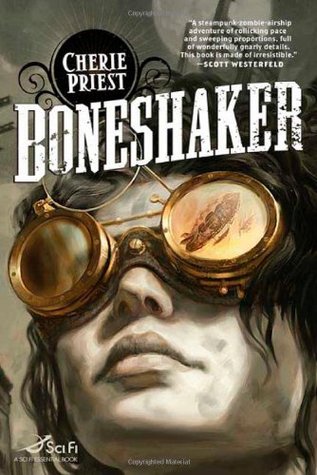
Boneshaker - Cherie Priest (Clockwork Century #1)

Boneshaker (The Clockwork Century, #1)Boneshaker is a book that I both bought a while ago and never had any real inclination to read.  I think I read it after a couple of drinks at the local bookstore/cafe/bar, and then shelved it and only looked at it with mild curiosity from time to time.  This is for one big reason.  While Boneshaker is, quite obviously from the cover, a steampunk novel, it is also about zombies.  And zombies are not really my thing.  They don't scare me, they don't thrill me, I don't find them really interesting at all.  There's something mildly distasteful about fiction that revels in chopping to pieces and blowing the heads off people who were once, you know, people.

But there as a steampunk category for my 2017 reading challenge, and Boneshaker was already sitting there, so off the shelf it came.

Boneshaker is different from most other zombie novels that are on my radar in that it isn't a modern zombie fiction.  Most zombie works are set in our modern world, or possibly in a near-future post-apocalyptic world.  The notable exception to this is probably Pride and Prejudice and Zombies, but that's not quite the same as this because P&P&Z is a parody rather than a "serious" work.  Boneshaker is set in an alternate-universe 1880 in Seattle, Washington.  In this universe, airships and steam engines rule, the American Civil War has been going on for eighteen years, and an early Klondike gold rush spurred a contest to create a mining machine that could bore through ice and rock.  The creator of the marvelous machine, Leviticus Blue, built it in his basement...but when he fired it up, chaos reigned.  The machine destroyed much of downtown Seattle, including several banks that were subsequently robbed, and broke open a seam of mysterious gas called the Blight, which kills some and does more than kill others, bringing them back to life as "rotters" with an appetite for human flesh.  In an attempt to stop the Blight, Seattle was walled off and the survivors began living in an area built up around the wall, struggling to survive in an area which, while separated from the Blight, is still tainted by it.

In the midst of this we find our heroine, thirty-five-year-old Briar Wilkes.  The widow of Leviticus Blue and the daughter of Maynard Wilkes, who's either a criminal or a folk hero depending on who you ask, Briar spends most of her time avoiding her past while doing her best to bring up her fifteen-year-old son, Zeke.  She's never told Zeke much about his father and grandfather, and so he gets it into his head that his father was innocent in the downfall of Seattle...and so he sets off to go into the walled city and find proof.  Briar of course goes after him, and they're separately plunged into a city inhabited by zombies and those too crazy or stubborn to leave, who've started new lives in pockets of clean air cut out underground, and ruled by a mysterious man in a gas mask who bears a striking resemblance in knowledge and mannerisms to Levi Blue, who some suspect may not be as dead as they would hope.

Surprisingly, zombies don't actually play that much of a role in this book, which is something I rather liked.  They're more of an atmospheric threat, and aside from a few scenes of the protagonists fleeing from zombie grasps, they're present more through moans and gasps and the sound of running feet than as creatures that actually get a lot of page time.  Most of the book is actually spent in the underground spaces of Seattle, showing how the inhabitants there survive and building up a sort of historical post-apocalyptic culture in a time when other parts of the world are just fine.  There are apparently some historical inaccuracies that Priest addresses in a brief afterword, regarding the structure of the city itself, but these didn't bother me at all because I really do view this as an alternative universe, in which things can run at a different speed than in our own history--which is basically just as Priest intended.  But maybe if I'd lived in Seattle and was more familiar with its landmarks and their histories, these inconsistencies would have bothered me more.

I liked pretty much all of the characters in this book.  They all inhabit some morally gray areas, necessitated by the time and place in which they live, but the heroes still have moral compasses and it's easy to see how the "villains" got to where they are, without them becoming caricatures of villains.  Zeke is a frustrating teenager without being a total idiot, something that was refreshing to read.  And while Briar hasn't always mad the best decisions in raising him, she definitely did the best she could and what she thought was right at the time.  She doesn't berate Zeke for his decisions, instead focusing on what needs to be done to get them both out while putting his doubts to rest so that he doesn't make the same mistakes in the future.  I had my suspicions about Levi Blue from the beginning, which ended up being spot-on, but Priest had me me second-guessing and doubting myself, which is a real skill.  So the ending didn't shock me, but I liked how it came out nonetheless. 

What I didn't like was that the end was startling lacking in, well, ending.  It's possible it's because this is the first book in a series, but I've looked at the descriptions of the next few, and they feature different main characters and plot lines.  Which is fine--I actually prefer series like that--but it means that there's no resolution to the Blight threat, no plan for what to do about Seattle, etc.  Maybe it comes back later?  I don't know, but even if it does, it seems like a big thing to just apparently drop for several books with no hint of how it's going to be resolved.  There's also no hint of how the zombies become zombies in the first place.  Yes, it's the Blight, which is caused by a gas that comes up from the ground, and it may or may not be caused by buildup from Mount Rainier... But how does it work?

Still, overall I really liked this.  It was different, and while zombies aren't my typical genre, I think they were well-incorporated here...though I'm curious to see what type of logic is going to employed in regards to the actual zombie formation in the first place, if it ever comes back.  The next couple of books have different main characters in different locations with apparently unconnected plots in the same universe, but I'm looking forward to them nonetheless.

4 stars out of 5.

Sunday, October 23, 2016

Twenty Thousand Leagues Under the Sea - Jules Verne

Twenty Thousand Leagues Under the Sea (Extraordinary Voyages, #6)Twenty Thousand Leagues Under the Sea is an interesting novel because it both has and has not aged well.  On one hand, Verne really nailed down the scientific aspects of the book.  The Nautilus is, of course, a submarine that was beyond its time and is still remarkable in our own for how well it pinned down features of subs that hadn't actually been developed yet.  And then there's the stuff like the pseudo-scuba equipment, and the portable lights for under water, and the deep sea exploration in general.  These are things that are still very much in use and relevant even if their form isn't exactly as Verne portrayed it in his book.

At the same time, though, this book dates back to a time when serials for the masses were the craze and when many people couldn't afford to travel, and things like aquariums weren't really accessible to the general populace.  The endless descriptions of every fish that Aronnax (our narrator) sees really wore on my patience, though they probably would have been remarkable to people who couldn't go to an aquarium or turn on a seven-hour nature documentary series about the oceans.  Still, they didn't really age that well and seemed to take up a lot of page space compared to the actual content.  Things like the mysterious passage under the Isthmus of Suez are also total bunk now and really seem like a reach compared to the more finally-wrought pieces of the book.

The actual "adventure" portions of the book also seemed few and far between.  There are two instances here that I think really stand out: the excursion to the ruins of Atlantis and the maelstrom at the end.  Both of these episodes are rather short, disappointingly so amidst the endless fish descriptions, and it's actually a bit surprising that Verne didn't do more with them.  With Atlantis, there's a lot of walking, a couple minutes of standing in one spot and going "Wow!  Atlantis!" and then a lot of walking back to the Nautilus.  With the maelstrom, there's so much drama building up, and then--suddenly--Aronnax wakes up with all the drama glossed over and done with, and with no memories of what actually happened.  For an adventure novel, it's very strange, and it makes it feel very much like Verne was more comfortable with spouting a stream of locations, distances, and fish species than he was with actually writing action.  There are only two big action scenes here that I can think of: when the Abraham Lincoln actually encounters the Nautilus, and the incident with the giant squid.  Even things that are made out to be big events, like the undersea hunting expedition, are mostly a bunch of walking back and forth.

I can definitely see where some of the appeal of Twenty Thousand Leagues comes from, but while it has some cool components that have lingered, I think that the bulk of the book just drags too much for it to be a really riveting read in the modern era.

2 stars out of 5.

Friday, October 7, 2016

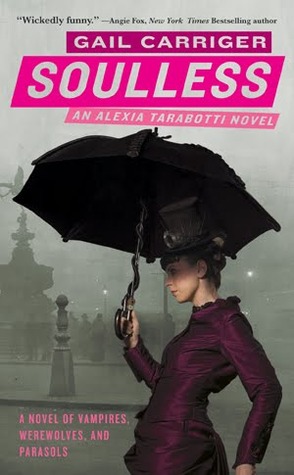
Soulless - Gail Carriger (Parasol Protectorate #1)

Soulless (Parasol Protectorate, #1)For some reason, I thought I'd already read something by Gail Carriger--the name just sounds so familiar.  But scrolling through her titles, that doesn't seem to be the case; Soulless is definitely the first book of hers to come across my shelves.  While it had been on my to-read list for a while, due to some good ratings from friends, I ended up getting around to it because it was the September buddy read for the Unapologetic Romance Readers group.

Soulless was a weird book to me, because it was another of those titles that had all the things I typically like, but when looked at as a whole it didn't amaze me.  What are those things I like?  Romance.  Paranormal fantasy. Victorian steampunk settings.  All of these things are tropes that I typically gush over, and they were all combined here.  In Victorian England, Alexia Tarabotti is soulless, AKA a preternatural--her touch nullifies the abilities and supernatural-ness of, well, supernaturals, the main two varieties being werewolves and vampires.  (Ghosts are also included as supernaturals but we don't actually see any in this book.)  While supernaturals are known the world over, England seems to be unique in the way that they have been integrated into society.  For example, in the United States, supernaturals are executed if they're found out.  Alexia inherited her condition from her Italian father, but her mother and family don't know about.  Who does know about it Lord Maccon, head of BUR.  I have no idea what BUR stands for.  I'm not sure it was ever explained.  But it's a sort of agency that helps to govern the supernatural community.  Lord Maccon (which, honestly, I kept reading as Lord Bacon) is also a werewolf.  Oh, and he has the hots for Alexia, even though they always argue and there was apparently a detrimental incident with a hedgehog.

The book starts out with Alexia encountering a very strange vampire and killing him, opening the door to a whole mystery involving the disappearances of supernaturals and someone hunting Alexia.  And of course, her courtship by Lord Maccon.  But here's the thing: this didn't feel like a balanced book.  It felt like the second halves of two separate books.  The paranormal mystery component came across as rushed, and I felt like we only had the second half of the romance--because for all Alexia and Maccon snipe at each other and profess to not liking each other, they certainly end up making out pretty quickly.  I wish that their earlier interactions--like the hedgehog incident--had been included, because I  think that would have really helped to build the romance in a better way.  As it was, it just felt a bit disconnected, and I also never felt like it integrated in a good way with the mystery plot.  This book also would have benefited from a few chapters entirely from Maccon's point of view to help flesh out BOTH sides of the plot.  Because this fleshing-out, in all aspects, never happened, it really feels like this is just the facade of a story, instead of the story itself...which, considering this book is about 360 pages long, seems rather odd.

The other thing that bothered me was the "soulless" thing itself, because there is absolutely nothing to indicate that Alexia doesn't have a soul.  Everyone seems to think that just because she's logical and keeps her head about her, that means she's soulless.  Oh, and the whole neutralizing touch thing.  But the thinking here just didn't make sense to me--Alexia can clearly think and feel and possesses her own free will, so why wouldn't she have a soul?  I thought this was going to come out more as a realization in the end, that she's not soulless at all, but it didn't.  Consequently, the whole book rests upon what is, ultimately, some flimsy thinking, and it totters precariously on its perch.

I did like the bantering between Alexia and Maccon, and I liked the writing in general.  It was snarky and charming.  I've seen a few people mention they thought less time could have been spent describing what people where wearing, and while I can see the point there--it does take up a significant amount of page time that I think probably could have been used for plot and character development--I rather liked it.  It helps the whole book to read as a sort of lengthy gossip column, which I think is an interesting way of looking at a story.  I'm not sure if that was intentional or not, though.  I think Carriger has an interesting world here, and she could do a lot with it...but I'm not sure that she accomplished it in this particular book.

2.5 stars out of 5.  This had some things I liked but I think the flaws outweighed them, and I'm not really intrigued enough to read the rest of the series.

Saturday, July 23, 2016

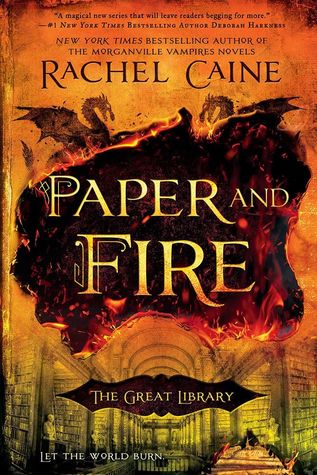
Paper and Fire - Rachel Caine (Great Library #2)

25890355I can't believe I missed the release date for this book!  I'd been hotly anticipating it since reading Ink and Bone earlier this year.  And yet I didn't realize it was released until more than a week after the fact!  Yikes.  Well, I got my little paws on a copy and read it as quickly as humanly possible, and here's the verdict:

It was great.

I don't think it was quite as great as Ink and Bone, but I also don't think it suffered "second book syndrome" which can be a problem with series.  The amazing world continues here, but I don't think it's quite as breathtaking was it was in the first book because it's already fairly well-established.  There also isn't the same sense of awe from the characters due to their new circumstances and surroundings, which means that doesn't transfer to the reader as well.  But the strange quirks of this world ruled by the Library of Alexandria--such as a Paris that is completely populated by Library personnel and French citizens who are forced to take part in historical reenactments of an uprising against the Library--are still dropped here and there, just enough to be a little disorienting and make it clear that no, this is not the world we know.

The plot of this book follows Jess and his friends, who are now employed in different positions throughout the Library in Alexandria, as they try to get information about Thomas and rescue him.  Jess and Glain are recruits in the High Garda, and Dario and Khalila both work in scholarly roles.  Morgan is trapped in the Iron Tower, slaving away as an Obscurist and struggling with the ever-present threat of forced impregnation, but she, too is determined to escape.  (The "threat of forced impregnation" bit is very trope-y, but I think Caine actually handled it well, with many of the Tower's inhabitants, male and female, being against the "program" and others being for it for both logistical reasons like more Obscurists and for more cult-like reasons.  I was so pleased when Caine (briefly) brought in the guy in this scenario, who was clearly just as agonized over it as Morgan was, rather than depicting this as some male-wet-dream-type thing.  Forced sex is not cool for either gender.)  Our group also gets on the move once again here, eventually traveling from Alexandria to Rome and beyond in their quest and its aftermath.  The settings remain breathtaking, with the Iron Tower offering a tantalizing glimpse at what the Library has been hiding for all these millennia, with Rome still showing its pagan roots and using them to hide the Library's nefarious actions, and of course with all the trappings that come with these settings, like the automata, which gain an even more prominent (and, yes, awesome) role in this book than they did in the first.

I'll be honest: a big part of this book hinges on Jess' love for Morgan and his desire to help her, which I totally didn't buy.  I mean, I bought the wanting to help her part, but their relationship honestly doesn't have any chemistry to it, and they feel more like friends, like Jess and Thomas, than potential lovers.  I found the bonds of friends and mentors here much more believable than the romantic ones, though Dario and Khalila and Wolfe and Santi did feel much more natural and complete than Jess and Morgan did.  And again, I think this was an incredibly diverse and awesome cast that were not diverse for the sake of it, but who also weren't painted in as being stereotypes or representations of whole groups.  They're all people, and I think that really works.

Caine's writing in this remained very engaging, but really, it's the world and the thoughts behind it that intrigue me here.  The ongoing discussion about censorship and the power of free thought and speech and press, and how a loss of that can change things, is absolutely fascinating, and it's thrilling to see this discussion being played out in a young-adult-genre novel.  It makes you think.  Who is our Library, what are they really doing?  (I'm not a conspiracy theory fan, I swear, but I think this book is very thought-provoking in this area.)  And, of course, I'm super psyched about where this is headed, because while we have, so far, seen cities in several countries across Europe and Egypt, we haven't yet seen America, which has historically had a basis of the freedoms I've mentioned above, or at least we think that we do, so I'm fascinated with how Caine is going to tackle a Library-influenced America in the upcoming volumes.

This was another great book.  I don't think it was quite as twisty and breathtaking as the first, because it doesn't have quite the same newness, and there were some weirdnesses in logic here (especially with Dario and the High Garda and the Iron Tower; the whole thing just didn't seem to "fit" to me) but I still devoured this and eagerly await the next volume.

4 stars out of 5.

Tuesday, April 5, 2016

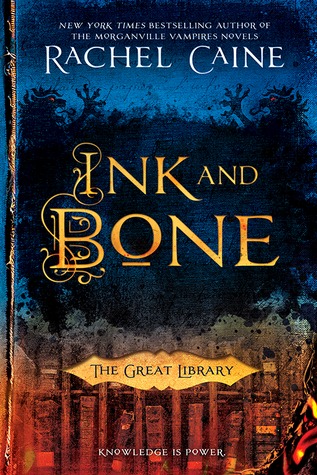
Ink and Bone - Rachel Caine (Great Library #1)

Ink and Bone (The Great Library, #1)Let me start by just saying this: this book was awesome, way more awesome than I anticipated it being.  I've read Rachel Caine before; her Weather Warden series is a great urban fantasy/paranormal romance one, and I've read some of her Morganville Vampire novels, too.  That said, while I've always found her books enjoyable, I've never thought they were absolutely amazing.  This book was amazing.  Of course, like all books, it has a few weak points--but it was such an amazing world with such awesome characters (I am beyond real words here, can you tell?) that I think its strengths far, far outweigh its weaknesses.

The book takes place in an alternate universe in which the Library of Alexandria was never burned, and in fact spawned "daughter" libraries throughout the world.  Across the ages, the Library has become more powerful than anything else, based on the idea that knowledge is power.  An example of how powerful the library is?  Austria pissed the Library off, so the Library destroyed Austria.  Austria does not exist in this world because the Library destroyed it.  The Library owns all original works and disseminates copies via things called "blanks" which are kind of like Kindles with pages and that you can write on.  The whole system works off of a premise of alchemy.  Owning real, original books is illegal and has led to book smugglers making huge profits when they can successfully find and sell a rare or unique copy of a book.  Meanwhile, people called Burners protest the Library's ownership of knowledge and burn books--and themselves--to draw attention to their cause.  Cities and countries aren't quite as we'd imagine them; for example, Wales and England are caught up in a torrid civil war.  And while the book takes place in the year 2025, there is a pseudo-Victorian/steampunk facade on it.  Automatons protect the libraries and secret areas, carriages are driven by steam, and while guns exist other weapons are still very prominent.  Combined, this makes a rich, fascinating world, and I loved how every detail was carefully placed to build the world, rather than just thrown in because it was "cool."

The main character of this book is Jess Brightwell, a young man who comes from a family of book smugglers.  He doesn't want to take over the family business, so his father buys him a chance to get a position in the Library, which he figures Jess will enjoy and which can be used to help the family get their hands on more rare works to sell.  In short order, Jess moves to Alexandria for training, a process that begins with thirty students competing for six spots at the Library.  Jess' classmates feature prominently in the book, and all of them have their own stories, personalities, strengths, and weaknesses; they all read like real people, which can be difficult for supporting characters to achieve.  The same can be said for Scholar Wolfe, their teacher, and his companion Santi, a member of the Library's elite guard.  I mean, seriously, these are awesome supporting characters.  They're not all white!  They're not all straight!  It's an incredibly diverse cast, but a diverse cast that isn't just window dressing for the story.  They're all fully integrated.  The training process takes up a lot of this book, and while it was interesting--it provides a lot of insight into how and why the Library operates and what might be wrong with it--I think the story really picked up when the students, Wolfe, and Santi are sent on a mission to retrieve a cache of rare books from a daughter library that is about to be crushed in the Welsh/English civil war.  It's at this point that we can really start to see that something is rotten at the Library's heart, and what the characters might be up against if they hope to escape or stop it.

Caine's writing in this one is also super absorbing.  The book is in third-person limited, but between chapters we also get to see some documents from various characters that are circulated around or kept in the Library archives.  In the other Caine books I've read, the writing was good but it was never something that blew my mind.  In this one, I couldn't stop reading.  Seriously, I was wandering around the National Mall in the middle of the cherry blossom festival with visiting family looking for somewhere I could sit down so I could read more.  I was a terribly rude hostess, I'm afraid, but hey, that's what a good book can do, and this book wasn't just good, it was excellent.  The plot was tight, the characters real, and the world intricately intriguing.  The story doesn't go quite where the blurb would make one think--really, the blurb refers to the end of the book more than the content--but it was amazing content nonetheless.  I got this from the library, but I'll be buying my own copy--in hardcover, because owning this on Kindle is a little too ironic for my tastes.

5 stars out of 5.  Awesome.

Sunday, March 27, 2016

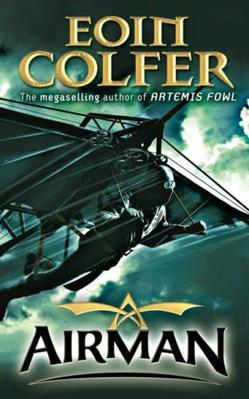
Airman - Eoin Colfer

File:Airman.jpgAirman by Eoin Colfer tells the story of Conor Broekhart, a young man living in the fictional mini-nation of the Saltee Islands.  (The Saltee Islands are a real place, but they are unihabited and everything about the Saltees in the book is fictional.)  All his life, Conor has been best friends with the Saltee princess, Isabella, and he has been tutored by a Frenchman obsessed with things such as fencing, karate, and above all aeronautics.  Conor is perfectly okay with this, because he was born in a balloon basket and flying is apparently his destiny.  Hm...

Okay.  I like Colfer.  At least, I remember liking Colfer; I read the Artemis Fowl books when I was younger and enjoyed them quite a bit, though I believe a few more have come out since then.  Those have a very different feel to them than Airman, but that isn't necessarily a bad thing.  Airman is...well, I guess it's kind of historical fiction, but it's also kind of steampunk.  All of the apparatuses Colfer includes are real, or closely based on real machines/inventions, but the setting of the Saltees, the prison, the diamond mind, etc. definitely gives a steampunk flavor.

Story-wise, I enjoyed this but it did not shine.  The plot revolves around Conor being thrown into prison for his supposed involvement in the death of King Nicholas, though really it's because he knows the truth behind the King's death and the Lord Marshall of the Islands, Bonvilain, wants to shut him up while maintaining control over Conor's family, who are very prominent in the Islands and could mess things up for him.  So, at the age of fourteen, Conor ends up in prison, befriends an inmate or two, and begins plotting his escape--which only takes up about half the book, because of course after he's free he has to make things right in the Islands.

Conor himself was an excellent character, as was Linus Wynter, the blind musician who becomes Conor's close friend.  Both seemed well-rounded with specific motives for everything they did, and Conor in particular changed in accordance with his experiences in prison.  That was good; he didn't exhibit any naivete that I might have expected from the hero of a YA novel.  The rest of the cast, though... Bonvilain was weak as a villain, really, because he wasn't any different from any other fictional villain.  He had no original twists, nothing, though I think Colfer TRIED to spice him up by making him part of the Knights of the Holy Cross (Knights Templar).  Isabella was supposed to be an excellent queen, but she kind of fell flat, literally needing to hold someone's hand in order to address her people or her employees.  And then suddenly at the end she's threatening to slice someone in three with a samurai sword.  Uhm, what?  Where did that come from?  And while we were meant to fell sympathy for Conor's parents, they really didn't get enough page time to build up their pain, and all we really saw was Conor's father magically recovering from his grief to aid Isabella.  There were an excess of comically inept side characters, ranging from Otto, the inmate whose greatest pride is his hair; to Pikes, Bonvilain's essentially useless sidekick; to Uncle, a boy who won't take a bath.  The side character with the most potential was probably Sultan, Bonvilain's poisons expert, but he was sadly underutilized and underdeveloped.  I also didn't feel like Isabella and Conor's relationship was believable; it was just kind of stated that it was there, and then Conor came back a completely different person and Isabella didn't have anything to say about that?

And what HAPPENED to Otto and all those diamonds, anyway?!

Overall, enjoyable but lacking some characterization.

3 stars out of 5.

Saturday, October 24, 2015

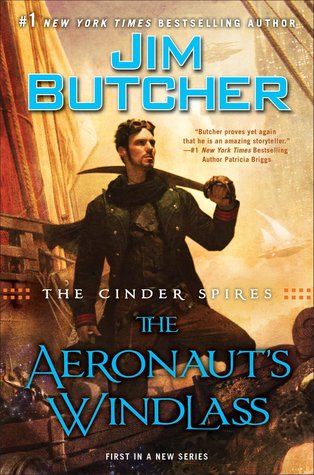
The Aeronaut's Windlass - Jim Butcher (Cinder Spires #1)

The Aeronaut's Windlass (The Cinder Spires, #1)Some people are rabid Jim Butcher fans.  I'm not.  I read Storm Front, the first book in his best-selling Dresden Files series, and while it was good, it wasn't really my thing and I didn't read further.  But when I saw The Aeronaut's Windlass, the first book in his new Cinder Spires series, I was intrigued.  Windlass is a steampunk-inspired fantasy, which is the best sort of steampunk in my view.  I like the fantastical elements that crystals (a la "Atlantis: The Lost Empire") and talking cats and the warriorborn and weird and deadly creatures can add to the mix.

Let me tell you this: I can see Butcher's genius here.  In Windlass, he sets up a mystical world in which humanity lives in a series of far-flung towers called the Spires, each one a state in and of itself.  Captain Grimm is a privateer for Spire Albion, which has long been locked in a trade war with Spire Aurora.  As the book begins, we see a young noblewoman named Gwen march off to join the Spirearch's Guard, and then the trade war with Aurora suddenly turns into a hot war, as Albion is attacked.  Joining Captain Grimm on the page are Gwen, her cousin Benedict, another member of the Guard named Bridget who is technically an aristocrat but doesn't seem to know it, and the cat Rowl.  Turning up a little later are a pair of etherialists, people who can see and manipulate the fantastic energies that power airship, provide light, and generate electricity: Ferus, the master, and his apprentice Folly.  This bunch of misfits teams up to hunt down an invading Auroran force, a story which is both compelling in and of itself and which sets up a future path of conflicts hinted at by Folly's prophetic dreams.

The narrative moves between the main characters, though given that the book's description focuses only on Grimm, I'm moved to believe that he's the character who will be the main in the entire series.  All of the chapters are third-person, and of them I liked Gwen and Bridget best, though I might just be biased towards female main characters.  I liked Rowl's chapters the least; while I found the set-up and idea of intelligent cats interesting, I didn't really like Rowl as a point-of-view character.  He annoyed me more than any other character.

The thing I liked least about this book was the Enemy.  It's set up pretty early on that the group, and Spire Albion in general, is going up against some Big Bad.  The Big Bad is a concept that I really don't like in any book.  I want villains who are multi-faceted and have clear motives other than just "being evil," but that was all Butcher provided in this book.  It's clearly a setup for future books, but he gave me no reason to believe that the villain is a character who will gain any real amount of depth as the series go on.  I hope I'm mistaken, because having a Big Bad as a main antagonist (even if there are other antagonists with their own motives sprinkled throughout, as there are here) tends to remove reality from the story.  All of the biggest and baddest people in history had real, human motives for what they did; Hitler might have hated Jews, gays, gypsies, and a lot of other people, but he also had a genuine desire to improve the lives of the people he viewed as "his."  As we all know, that didn't exactly go well for anyone involved, but still: it is what it is.  Granted, it seems that Butcher's Big Bad might not be exactly human, and therefore it could be argued that he/she/it isn't subject to human motives and emotions, but still.  I hope there's some dimension there than "it's big and bad and wants to destroy humanity" in the future.

There are a few inconsistencies here, too.  The most obvious one that came to mind was when Folly, a character who for the duration of the book had only been able to communicate with people by speaking to a jar of crystals instead, suddenly began talking directly to Grimm with no explanation at all.  Is this going to be something that's explored further?  Folly's mad, and Butcher said so blatantly at several points that her madness should only get worse.  So where does this sudden ability to speak like a normal person come from?  Little things like this don't necessarily ruin the story, but they are a bit jarring when they go directly against what has already been established without any apparent reason for the about-face.

I really like Butcher's new world and look forward to reading about it more, though I imagine it'll be a while until the next book comes out.  Despite its flaws, it seems to be a very unique setting and premise in the current world of fantasy, and I hope he can maximize its potential.

3.5 stars out of 5.

Wednesday, September 16, 2015

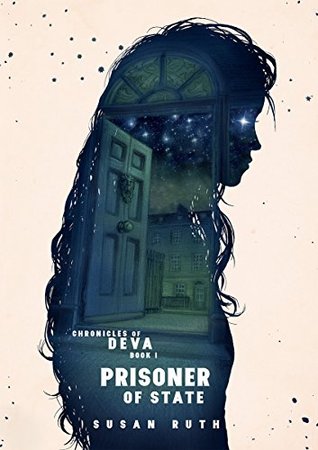
Prisoner of State - Susan Ruth (Chronicles of Deva #1)

Prisoner of State (Chronicles of Deva Book 1)
Susan Ruth is (or was; I can't find her anymore!) a member of the 20,000-member NaNoWriMo group on Facebook, of which I am also a member.  I'm not a very active one, but a good deal of their stuff shows up on my feed, and when Ruth was getting ready to put out Prisoner of State, she posted a few different versions of the cover for the group to see.  That was it: I was hooked.  I have a thing for silhouette covers, especially ones as gorgeous as this, and when Prisoner of State dropped, I scurried off to buy it.  It then sat unread on my Kindle for months because it was buried in the midst of 600 other ebooks.  But I finally dug it up and read it, and let me say this...it was an experience that left me unsure of how I feel about the book as a whole.

This isn't a short book.  It's also not an extraordinarily long one, but it's 400 or so pages of dense content, and a convoluted plot that left me feeling like I needed charts in order to follow it.  Felix Skryker, the main character, makes a variety of notes and charts and family trees in his attempts to unravel the mysteries surrounding Prisoner of State Xanthe Chance, who comes into his care in a whirl of strangeness that permeates the entire novel.  He uses charts to solve the mystery...but I feel like I shouldn't have to use them to just keep track of what's going on.  Part of this is that the threads are all so tangled together, which makes for a realistic mess, but which also makes following the story hard.  It's intensely convoluted, with a ton of names to keep track of.  Some characters (most characters) also go by multiple names and titles, and everyone is also related somehow, which makes it an even bigger mire of trying to figure out who is who and who did what.  But when it came to the characters actually solving the mystery, about 70% of the way through the book, Xanthe decides she's been quite long enough and talks--and then the bulk of the intrigue is done, names and actions and consequences all dumped in your lap over the course of a few pages.

This sudden unraveling has the result of leaving the last 30% of the book feeling rather disconnected.  There's a sudden time-jump of about 5 years, which seems to have been manufactured for the singular purpose of shoving in a pseudo-romance that never really gets off the ground.  One little bit of the mystery is left to be solved here, but it really isn't, with the mystery just vanishing to live (or die?) another day.  This chunk honestly felt like a different book, or like it was fanfiction of the rest of the book.  It seemed to float almost entirely apart from the bulk of the narrative, and that...didn't agree with me.

Now, since I've been negative long enough, let's talk about what I loved about this, because there were definitely aspects I loved.  First, the atmosphere.  Prisoner of State takes place on an alternate Earth which reminded me, more than anything else, of Philip Pullman's The Golden Compass.  There aren't daemons attached to people, but there are flying machines and automata and masters of colleges sneaking around with their own political machinations that muddle everything up for everyone else and religion still factoring heavily in to the point that people can still be accused of heresy even though it seems like the late nineteenth or early twentieth century.  Xanthe also reminded me, in some ways, of The Golden Compass' heroine, Lyra.  Xanthe and Lyra are about the same age and are both thrown into strange situations, though Xanthe has a tragic past and is messed up in ways that Lyra would probably find hard to fathom.  There are also strange occurrences that aren't quite magic going on--the Dislocation Barrier comes to mind.  The barrier cuts Deva and Mercia (part of what we would call the UK) off from the rest of the world, having arrived abruptly at the end of a civil war.  It has turned Deva into a cut-off, dark place, with menaces lurking around every corner.  It's hinted at that the bad actions of Deva's inhabitants even fuel the barrier, in a sort of self-perpetuating cycle because there are a lot of bad actions--it's a very dark book.  It's a tantalizing look at Ruth's world, which is definitely steampunk-inspired but isn't blatantly so, and I wish we'd gotten a few more lush details like that and perhaps a little bit less of the convolutions that made up most of the plot.

I also really did like the writing itself.  Ruth is a very matter-of-fact story teller.  She sometimes falls into the school of telling rather than showing, which we're all warned against these days, but in this particular narrative, I think it works.  It gives it a slightly dated feel, which makes it feel like the book was actually written in the time period in which it takes place.  She also uses this to build up the mystery and then tear it down quickly, which are less skillful, but the style still worked for me as a whole.  It also makes some of the strangeness feel like it belongs, much like Neil Gaiman writes strange things so matter-of-factly that it seems like of course they must be true.

Ruth has some real skill as a writer and storyteller, and I loved her main characters and her world.  I do hope she continues to write these Chronicles of Deva, though I would like to see a little more streamlining as she matures as an author, so that the narrative doesn't leave me with a headache when I step away from trying to keep everything straight.

3.5 stars out 5.

Saturday, July 26, 2014

Chasing the Star Garden - Melanie Karsak (Airship Racing Chronicles #1)

Chasing the Star Garden (The Airship Racing Chronicles, #1)First off, can I just say look at that cover art?  Gorgeous.  Absolutely gorgeous.  I am jealous of Karsak for having such beautiful cover art.

Now, on to the substance.  Chasing the Star Garden follows our narrator, Lily Stargazer, as she tries to unravel the mystery of a kaleidoscope given to her under strange circumstances.  Lily is mainly an air jockey, and the book falls into a series called "The Airship Racing Chronicles," but really, there is very little to do with airship racing here; only two chapters (the first and the last) feature any real racing.  The bulk of the story follows the kaleidoscope mystery.  Lily is also somewhat of an alcoholic (her drink of choice is absinthe) and a user of both laudanum and opium, has two lovers that feature in the story (one of which is a fictionalized version of Lord Byron) and is a little bit into BDSM.  Some of these qualities, mainly the addictions and her behavior regarding them, are rather less than endearing.  For example, Lily has taken so much laudanum at one point that the airship she's supposed to be piloting ends up in trouble because she's high.  However, Lily is well aware that she might be on a bad path, wondering, "If I continued like I did, what would be my end destination?  The answer to that question was not pretty.  I'd stopped asking it long ago."  This self-awareness is rather more endearing, and allows one to root for Lily getting over her issues and finding some meaning in her life.

Character-wise, I rather liked most of them.  Lily and her crew, Jessup and August, as well as Lord Byron and Lily's other lover, Sal, are all great.  Celeste, a courtesan who shows up partway through, was less great.  She was okay, I guess, but overall I found her bland, when her origins and plotline should have lent her an air of mystique.  I liked how Lily's back story unraveled, and maybe Celeste would have been more interesting if she'd had a little more back story or we could see inside her head more--impossible, given the first-person perspective, but still.  I would have also liked to see a bit more integration of the airship racing story, and the characters that went with it, like Cutter the American pilot and Etienne the French pilot.

I did find some plotholes in the main storyline, which revolves around using the mysterious kaleidoscope to search for a statue which was lost during ancient times.  One part of the story involves using another statue to find it, which didn't make sense to me because the guy who carved and placed the statues had nothing to do with the guy who moved one of them, so why would one point to another?  I also didn't really get how the kaleidoscope worked.  There was something about it being "altered," but the random nature of kaleidoscope patterns kind of goes against the idea of them being able to reveal things when pointed in certain directions and at certain objects.  As the book advanced, it took on more of a fantasy/supernatural/mythology air and kind of lost some of its early steampunk flair, with airships being used but not being the focus of the story.  While this didn't really bother me, I can see where it would bother some people who were in it for a thoroughly steampunk tale, so keep that in mind; as the book goes on, the steampunk element is more for atmosphere than it is for actual substance.  Oh, and as far as the "star garden" goes, it just refers to the sky, which is a bit...purple for my tastes.

Lastly, I found the entire final chapter rather abrupt.  The reunion, the abbreviated race, the heroics--it all kind of seemed to jar with the speed of the rest of the story, and felt like Karsak just got tired of writing and wanted to wrap it all up.  While I have no objections to the ending logically or emotionally, the pacing just seemed to be....off.  I would have preferred to see this slowed down and fleshed out a bit more than it actually was.

Overall, however, I thoroughly enjoyed this, and will be picking up the next book of Lily's adventures, Chasing the Green Fairy--though I'd also be interested in seeing books following other main characters in this world!

3.5 stars out of 5.

Monday, December 2, 2013

Haven - A. R. Ivanovich (War of the Princes #1)

11758870Ivanovich's Haven is the story of Katelyn Kestrel, a girl with an uncanny ability to find things who decides she wants to find a way out of her home in Haven Valley to see the Outside, which her people abandoned seven hundred years ago.  She does so with remarkable speed and in the process runs into Rune, a wounded soldier who's so sick he thinks Katelyn is either a delusion or a ghost.  In the process of helping him, Katelyn is captured and taken prisoner in the Outside world, and must escape back to Haven Valley.

I really loved Ivanovich's world.  It's a mix of fantasy and steampunk, with magical abilities existing alongside steamships and things like the Clockwork Ferris Wheel.  I would have liked to see more of the people in Haven Valley, like Ruby and Katelyn's other friends, but I think they might appear more in the second book of this series.  Katelyn herself wasn't exactly a fantastic character.  She was whiny and selfish and for the longest time had no idea about the consequences of her actions.  For example, the character Dylan explains to her that soldiers like Rune are not allowed to have connections; they have no family, no friends, no lovers, and forming those connections would result in death for the involved parties and the recruitment of another child to fill the soldier's place.  Despite that, Katelyn goes on and on about how betrayed she is that Rune won't turn into a mushy pile when he sees her, even after she meets his former younger sister--you know, the type of kid who'd be forced to become a soldier if Rune strayed from the rules.  Katelyn does eventually grow up a bit, but it's not until the very end of the book, and then it was remarkably abrupt.

The romance in this book isn't quite insta-love, but it is perilously close to it.  Rune is, obviously, the main love interest, though there's an almost-love-triangle with Dylan at points.  I wouldn't go so far as to say Katelyn falls in love with Rune as soon as she meets him; rather, she is intrigued by him and wants to help him, very much like Dylan is intrigued by her.  However, her intrigue rapidly ascends into what might be called outright obsession, and two kisses later she's declaring she's in love.  So, not quite insta-love, but almost as bad.  I did like Katelyn and Rune together, I'm just not sure I liked how it was done.  Also, where did Rune get the impression that he and Katelyn had kissed before they ever actually did?  That was never explained.

I'm going to let the whole "knack for finding things" go because that was explained later in the book, and worked into the world.  It was well done, and I approve of the way Ivanovich went about it.  The whole thing with the different levels of command was excellent, and the behind-the-scenes dealing and intrigue that we don't see until very late in the book was awesome.  It's what really forced Katelyn to grow up, and I liked it.

Ivanovich isn't the best writer I've ever read.  Her style is engaging enough, I guess, but she has some grammatical issues that need to be worked out; as they are, they can jar you out of the story, and then you have to work to get settled back in.  Still, a good plot can compensate for a lot, and I think Ivanovich has that.  A lot of the issues I had with this book early on worked themselves out later, and I think I would definitely be interested in reading the second installment of the series.

3.5 stars.