Pages

Showing posts with label classics. Show all posts

Monday, April 23, 2018

Watership Down - Richard Adams

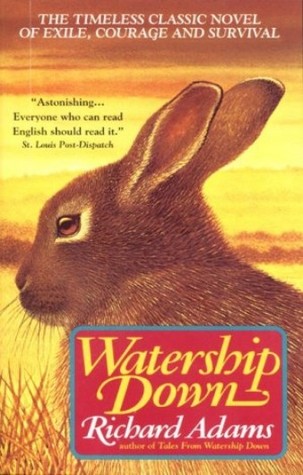
Watership Down (Watership Down, #1)Watership Down is one of those children's books that I never read.  It's not that I disliked books about animals--in fact, I loved the Redwall books when I was younger, and the Narnia books have a good number of talking animals as well.  But for some reason, I thought this was a book about rabbits going to war.  And like in rabbit-y ways--like, basically World War II with rabbits.  I'm not entirely sure where I got this idea, but I think it might have been the title; it just sounds like some sort of distress call from a boat that's been struck by a torpedo: "SOS!  Watership down, I repeat, Watership down!  SOS!"

I finally got around to reading it because it was the Deliberate Reader book club selection for April in the Facebook group.  It also slotted nicely into my reading challenge category for a book that is a parable; while Adams did not intend the book to be a parable, saying that it was just a book about rabbits, it seems it's frequently read as a parable, and that's good enough for me.

The plot here is fairly basic.  Adams builds a society of rabbits, but keeps them in their natural habits and forms; they talk and act and think, but they're not necessarily anthropomorphized in the way that, say, Mickey Mouse is.  Within this society, some rabbits are gifted with seeing; in the warren of rabbits that starts the book, one of these seers if Fiver, the best friend of the main rabbit, Hazel.  Fiver predicts some unknown devastation for the warren, and on his warning, Hazel convinces some other rabbits to leave the warren with them.  They strike out into the countryside, seeking a place to build a new warren.  Along the way they encounter other rabbits who fled their warren, and encounter other rabbits not of their group.  And even when they establish a new home, they can't live in contentment, because without any females, they can't sustain a new colony.  And it's this struggle for survival, both immediately and in the long term, that drives the book.

Throughout the story, Hazel grows from an undersized, un-listened-to rabbit to the leader of the group, using logic instead of emotion and pushing on in the face of fear in order to take the new warren to safety.  We also get to see several different modes of warren society; the home warren, the one they encounter on the way, the one they establish on Watership Down, and Efrafa.  We also encounter other colorful characters, such as General Woundwort and the best character in the entire book, the bird Kehaar.  Human society is glimpsed through the rabbits' eyes and the story is bulked up by tales of the mythical rabbit who was the original rabbit leader, in the style of Br'er Rabbit and other trickster stories.

The writing was surprisingly engaging.  While it got off to a slow start, I soon found myself wrapped up in the story.  I didn't expect to enjoy it nearly as much as I did, but the different types of rabbit societies offered a wonderful study of contrasts, and seeing our core group of rabbits come together and learn to triumph as a cohesive group rather than a bunch of misfits was a great central propulsion.  Hazel was also definitely the proper choice for a central character.  The other two obvious choices would be Bigwig or Fiver, either of whom would have quickly become annoying as a main character--Bigwig because of his impulsivity, and Fiver because of his Timidity.  The other types of animals also held enough difference and interest to not make the book bland, which it could have easily become.

Overall, I was pleasantly surprised by my reading experience.  This is another one I can cross of my classics list, and I even recommended it to a few people who'd had similar misconceptions about the book.  A worthy read.

4 stars out of 5.

Friday, December 15, 2017

Robinson Crusoe - Daniel Defoe (Robinson Crusoe #1)

Robinson CrusoeOkay, first off--who the heck knew that Robinson Crusoe actually kicked off a three book series?  I did not know this.  I was not aware of this at all.  Imagine my surprise when, getting to the end of the book, I found that this is continued in not one but two more books.  Oy.

When I needed a pick for a book set in the wilderness for the Popsugar 2017 Reading Challenge, I thought Robinson Crusoe was the natural pick.  It's a classic, and I want to read more of those, and I also had a foggy memory of reading the Great Illustrated Classics version when I was little.  Of course, I didn't realize then that those versions are pared-down significantly and in fact only found this out in the past coupe of years.  Oops.  Anyway, it meant reading the original long-form was a pretty easy decision.

This is a book typical of its genre--the early seafaring or adventuring tale, in which there isn't a strong central plot per se but is more just a character relating his adventures from a point later on in his life.  For our purposes, the character is the eponymous Robinson Crusoe, who tells of his misbegotten youth and many years shipwrecked on a deserted island in the Caribbean.  I suppose you could say the "plot" is that he gets shipwrecked and spends the rest of the book looking for a way to escape, but that's generous at best as most of the book is telling us how he survived on the island, combated fears and threats of native cannibals, etc.  There is a weird segment at the end after he does escape the island and is back in Europe, but that's clearly meant to segue readers into Defoe's second volume and, honestly, can probably be mostly ignored.  It really didn't fit the pacing or themes of the rest of the book at all, and felt very disjointed tacked onto the end as it was.

Because this isn't a book with a strong central plot or a lot of characters to carry the story without a plot, it means it really can be dry and boring.  For much of the book, Crusoe is the only character on the page, and when other characters enter at the beginning and end they are much simplified.  Much of the book is Crusoe telling us of his daily tasks and, to an annoying degree, the religious awakening he underwent while on the island.  Yes, this is a preachy book, which I was not expecting.  And yes, the recitation of the daily facts of life, which are mostly the same from day to day, got really old really fast.  I was kind of hoping Crusoe would make a break for it on the open sea, but alas, that never came about.  Because there are few big, story- or life-shifting events, the book is slow and dry for long expanses at a time.  Also, Defoe kept repeating things, like how Crusoe referred to a part of the island as his castle and another part as his bower--I got it after the first five times, thank you very much.  Maybe he was paid by the word.

Overall, it was fun revisiting this and seeing how much it differed from my childhood version (a lot!) but it wasn't really a riveting read, and I don't think I'm up for two more books of it.

2 stars out of 5.

Wednesday, November 15, 2017

Mutiny on the Bounty - Charles Nordhoff & James Norman Hall (Bounty Trilogy #1)

Mutiny on the Bounty (The Bounty Trilogy, #1)Continuing on with my reading challenge (I'm nearing the end!) I chose Mutiny on the Bounty for the category of a "A book with multiple authors."  It also had the added benefit of allowing me to cross off a book from the list I have pinned up by my desk of every book Rory Gilmore reads, mentions, etc. during the duration of Gilmore Girls

What's important to remember about Mutiny on the Bounty is that is a fictionalized account of the (in)famous mutiny; my edition has a foreword from the authors that goes into their sources, some of the changes they made, etc., but I think it would be easy to think that this was actually a personal account because of the way in which it is written.

In the book, Nordhoff and Norman Hall remove one of the midshipmen from the Bounty and replace him with their narrator, Roger Byam, basing him upon the original sailor but deviating in some respects.  Byam tells the story of how he was invited to join the Bounty's crew for a bit of adventure by its captain, William Bligh, on a journey to Tahiti to gather breadfruit trees for transportation to the Indies, during which he will compile a dictionary and grammar of the Tahitian language for use by others journeying there.  After a paradisaical stay in Tahiti, while en route to the Indies, Bligh's temper seems to get worse and worse and feuds he started with the crew before Tahiti are refueled and exacerbated, culminating in the mutiny, led by the first mate, Fletcher Christian.  Byam is not involved in the mutiny, but is forced to stay aboard the Bounty because there's not enough room for all those loyal to Bligh in the launch he and some of his supporters are forced into.  The rest of the book deals with the aftermath of the mutiny for Byam, and includes two "splits" that break off into the other two books in the trilogy--one book deals with Bligh and the men in the launch, and the other with Christian and some of the mutineers going to the Pitcairn Islands.

This is a classic seafaring story.  Byam is the perfect choice for a narrator because his position allows us to sympathize both with Bligh and the loyalists as well as with the mutineers.  It is, however, a story that is definitely not plot-driven as there is no plot, rather just a tale of how the mutiny came to be and what happened to Byam and the others after.  Not everyone lives; a good number of the crew meet their demise in various ways.  The story seems to proceed in spurts, with Byam sometimes relating every day, sometimes skipping over weeks or months at a time.  He's also not the greatest, abandoning his wife and child in Tahiti in favor of the hope of naval glory back in England--something that was probably a common thought process and motivation for his time and place, but a shitty action nonetheless.  And because the story is based in fact though not entirely factual, the "villain" of the piece, Bligh, never gets his comeuppance.  And because this is a "classic," aka it was written in an earlier time (originally published in 1932) it has that old-timey feeling to it, and the writing can sometimes be dry and seem rambling.  Still, this was an overall enjoyable read and one of the foundation books of its genre.

4 stars out of 5.

Saturday, November 11, 2017

The Phantom of the Opera - Gaston Leroux

The Phantom of the OperaTrying to scramble through the remains of my reading challenges, I needed a horror romance, and thought the classic The Phantom of the Opera would suit it perfectly.  It's not gory horror; instead, it's very Gothic in feel, with an unseen menace lurking in the shadows and a twisted love propelling a plot that keeps apart two more suitable protagonists.

Written as a relating of the tale behind "true" events (and apparently inspired by some actual true events, though I couldn't find to what degree) the story follows several people in a Paris opera house haunted by a "ghost."  Two new managers have recently taken over the opera and think they're being pranked by their predecessors, while overlooked singer Christine sees the ghost as the Angel of Music who brings her talent to new heights, and the young viscount Raoul views the ghost as a sort of demon leeching away Christine's life and keeping she and Raoul apart.  There are really two love stories here: the one between Raoul and Christine, which started when they were children and is now foundering in the face of the ghost's obsession with Christine; and that between Christine and the ghost, aka Eric, which is sort of love and sort of obsession and sort of sick fascination, all rolled into one.

The writing here is definitely in a "classic" style, which means that it can seem a bit distant and clinical at first, but it gets very engaging as you get used to the style and become immersed in the world of the opera.  And the opera itself is almost a character in and of herself; the opera house is huge, fantastical in ways that I doubt a real opera house could be.  With a lake built under it, floors beyond imagining, and a cast of minor characters that seem as much a part of the building as a limb does part of a body.  Even Eric and the Persian seem like their true purposes are more to be entities of the opera house than to be their own people--their backgrounds never being as fully or satisfactorily explained as Raoul or Christine's own backstories.  It's a very atmospheric feel, with almost the entirety of the story taking place in the opera house and the characters as extensions of it.

One thing to note is that I feel like Leroux read Dracula and was really pulling in inspiration from it at parts--like, you know, Eric sleeping in a coffin, or not being able to go into daylight (except he can???) and so on.  A lot of it had a very vampire-like feel to it, though I never got the sense that Eric was actually supposed to be a vampire.  Just a crazy guy who stalked a woman to the point of no return.  Cool.  Remind me why people root for Christine to end up with this psychopath, by the way?  He's a genius in his own way, to be sure...but you know, a murderer, torturer, and all around madman.  So, not exactly prime romantic material.

Anyway, this was a suitably creepy read to be going through around Halloween, and a good choice for my horror romance category.  I enjoyed it even though some parts weren't as thought-out or fleshed-out as they probably could have been.

4 stars out of 5.

Sunday, July 30, 2017

Jaws - Peter Benchley

JawsThe movie adaptation of Jaws is my sister's favorite movie, and yet I've never seen it.  However, it seemed like a perfect, though scary, read for summer, especially in conjunction with Discovery's Shark Week!  And I have no plans of visiting the ocean this summer, which was even better, because though I logically know the odds of being bitten by a shark are minuscule and that the odds of being killed by one are even smaller, they're still scary.  All those teeth!

As most people know, if you watch Jaws backwards it's a movie about a shark that throws up people until they open a beach.  But if you read the book in its proper sequence, it's about the fictional town of Amity in New York that is plagued by a great white shark that appears off the coast one summer and starts killing people, putting the entire town in danger since the entire town relies on tourism and no tourists want to go to the beach and get eaten by a shark.  It's not really a horror story, but it's definitely a suspenseful one because you're never entirely sure of who is going to live and who's going to die--but you always know exactly what's going on, there aren't any jump scares or things like that, which I think keeps it from falling into the horror category itself.

I was pleasantly surprised by the writing, for the most part, as well as the narration in the audiobook version.  There was a lot of exposition about characters in the beginning which didn't seem necessary, and one very uncomfortable sequence involving some sexual fantasies of two of the characters--I mean, sure, have fantasies, but I certainly wasn't expecting that in this book and definitely hearing them was weird, which makes me think I never want to listen to a romance novel as an audiobook, and it was just so clearly written by a guy--but the book overall was good.  The character of Quint was completely cliched, and it seemed like the affair between two characters was thrown in just to take up space during a time when the beaches were closed and the shark wasn't attacking anyone.  Actually, the more that I list, the more that this book wasn't really good, but I'm still left with the feeling that I enjoyed it; I guess because, even though it had a lot of flaws, it was essentially exactly what it was supposed to be, and has aged surprisingly well for a book that was initially published in the 70s.  Yes, this book and the movie it spawned has caused a lot of trouble for sharks worldwide--but hopefully in modern times people can read it with an eye as to what it actually is--entertaining, but not accurate as to what sharks are actually like.

3.5 stars out of 5!

Wednesday, April 19, 2017

Tender Is the Night - F. Scott Fitzgerald

Tender Is the NightSo, I was having a case of a book hangover after reading Meagan Spooner's new book Hunted, a Beauty and the Beast retelling that I really enjoyed.  (I could seriously go read it again right now, even though I just read it not even a week ago; timelines with reviews are a bit off on the blog due to advance scheduling.)  The cure for a book hangover is, for me, to typically go somewhere completely different so I'm not comparing what I'm reading now with what I was reading then, at least not to such a degree.  So I checked out Krakatoa, and then I picked up Tender is the Night, which I've had on my bookshelf for a while and hadn't gotten to yet.

Before this, the only Fitzgerald book I'd read was The Great Gatsby.  I didn't really like that the first time I read it through, but then I read a nonfiction book about the Fitzgeralds called Careless People and found it really enhanced the reading experience--and I think that having previously read Careless People helped with the experience here, as well, because it's so easy to see where Fitzgerald drew in his and his wife Zelda's own lives to flavor the book.  The vacations on the Riviera, the small and exclusive groups of people being "made over" by the main people in the group, the travelling, the partying, and the angst underlying it all... It's all so evident both in the fiction and in the reality that underlies it.

The story here initially seems to follow Rosemary, a young woman who's made her break as an actress and is taking a vacation on the Riviera with her mother when she meets Dick and Nicole Diver.  She promptly falls in love, or at least states that she does, with Dick, and spends the rest of her vacation going after him.  He eventually gives in, somewhat--and then Rosemary vanishes from the picture and it becomes evident that Dick is actually the main character, not Nicole.  The book goes into his backstory, catches back up with the present, and then proceeds, all along showing that Dick is a terrible person.  He marries Nicole, who was a patient in a mental hospital where he was working, and then proceeds to continue fooling around to various degrees with every pretty young woman who comes his way, most of whom are also his patients in some way or another.  This is both extremely unethical and extremely immoral because not only are they his patients but he is already married.  And while Rosemary should have known better than to go after a married man when she was eighteen, and definitely should have known better by the time she was twenty-two, there's absolutely no excuse for Dick, who was a full adult in control of his full mental capacities for the duration of the story.

But then, Fitzgerald likes writing about terrible people.  The Buchanans in Gatsby, for example; it all seems to come back to some circle of how wealth just leads to decadence and its accompanying decay, possibly in another parallel to the Fitzgeralds' own lives.  Watching these people spiral together and then apart is almost wince-worthy, because you can just see the disaster coming.  All of the drama is also exhausting.  But Fitzgerald is a modern classic for a reason, and it shows through.  He has a clean and simple style of writing, one that I think contributed to my dislike of Gatsby when I read it in school because I simply wasn't old enough or wide-read enough to really appreciate the style.  But now I am, and I can definitely see the merit here.  While I didn't like the characters here, the book was still written in such a way that not liking them was the point and was enjoyable.  I think some other books aim to accomplish this, but don't.  Fitzgerald, on the other hand, managed it perfectly, and that's something that's something to be remarked upon.

4 stars out of 5.

Saturday, February 25, 2017

Emma - Jane Austen

EmmaEmma is the March book of the month for the digital book club over at The Deliberate Reader.  You read the book the month before so that you're done with it (or almost done with it) by the time the discussion month rolls around.

I've read Pride and Prejudice from Austen before, but none of the other ones.  I have to admit that while many people fawn over the Colin Firth film adaptation, I really do like the Kiera Knightley one.  And I liked P&P as a book, too.  I'd also picked up one of those nice, leather-bound (well, probably faux leather) with gold edges collected Austen books over Thanksgiving, so I was looking forward to reading Emma, which also fulfilled a category for both my Popsugar and romance reading challenges.

Unfortunately, I didn't really like Emma.  Most of this is because I didn't like Emma herself.  Austen's books, to my knowledge, all basically revolve around moderately-well-off people looking to marry other moderately-well-off or even well-off people, and the comedies of manners that ensue.  They're mildly mocking of this polite society.  Emma is no different in this.  The eponymous Emma Woodhouse is a young woman who lives with her widowed father, following the marriage and departure of her older sister.  Emma's former governess and companion has also recently married, a match that Emma fancies she helped along, and she decides to start playing matchmaker for others, namely a young woman living at a nearby boarding school, Harriet Smith.

The problem is that Emma is absolutely insufferable.  She can't see anything beyond what she's built up in her own head, and she's incredibly classist.  "Well, of course," you might say.  "Think of her background, the time period!"  But to that I say, No.  Yes, Emma came from a well-off background.  But Harriet, who is a bastard daughter, has no claims to any class, and yet Emma deems the man who loves Harriet, and who Harriet genuinely loves in return, to be too low-born for her.  She has so many pretensions and prejudices that honestly Pride and Prejudice might have been a better title for this one than for the book about Lizzie Bennett!  Austen is perfectly aware of this, of course, and it's part of the point of the book--it's all part of the way that Austen makes a point about the society she writes about.  The other characters are all very skeptical of Emma and her actions and pretensions, raising eyebrows and sometimes working directly to counter her when she gets a little too crazy about the matchmaking.  But Emma was still too annoying, not taking into the consideration the thoughts or genuine feelings of anyone else, instead thinking that she knows better than everyone and that only what she has decided on knows about.

Other than that, the book is charming.  Of course it is.  Austen creates a quaint little village that's embroiled in a series of love affairs (though they are, of course, perfectly appropriate love affairs) and the gossip and entanglements that those affairs bring with them.  Mr. Knightley is a wonderful hero, and definitely too good for Emma; it's hard to say what he saw in her, honestly.  Mr. Woodhouse is completely absurd, which is the point, with his hypochondria and concerns that eating an apple that hasn't been baked three times will lead to an untimely death.  And then there's Jane Fairfax, who is a perfectly bland and boring person until she's not.  All of this was basically exactly I was expected; it was just marred by a main character who I couldn't stand.  Maybe if Emma had actually learned a lesson from all of this, it would have been different, but it wasn't--instead, she just proceeded to get whatever she wanted, regardless of how she walked over other people in order to do it.

I've read Pride and Prejudice, so I know how good Austen can be.  Emma definitely hasn't put me off reading her other works, but this was not the best reading experience I've had.

2 stars out of 5.

Saturday, December 17, 2016

The Odyssey - Homer

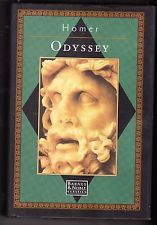
The OdysseyThe Odyssey was my pick for the category "A book you should have read in school but didn't" for my 2016 reading challenge.  Now, strictly speaking, I was never assigned The Odyssey to read.  But every other English class in the 10th grade was.  My teacher was just too busy having raptures about the hero's journey in Star Wars and having us make heraldic crests to actually assign it.  (The only two books we actually read in this class were A Tale of Two Cities and Julius Caesar.)  So, I thought this was a good chance to get around to it.

The Odyssey is the second part of Homer's epics surrounding the Trojan War.  While the first book, The Iliad, covers the war itself up until the Greeks hatch their plan to build the Trojan horse, The Odyssey is about the homeward journey of one of the Greek heroes, Odysseus, and the perils that befall him.  From having his men ensnared by the Lotus-Eaters to having some fall pray to a multi-headed beast while attempting to dodge a whirlpool, bot being kept for years by the witch Circe and the nymph Calypso, it takes Odysseus twenty years to get home from Troy--and all the while his wife is being wooed by other suitors, and his son seems helpless to drive them off.  Telemachus is actually the character we encounter before Odysseus, but he's pretty useless overall.

My translation was the Samuel Butler one, and it did have a few eye-raising moments in it that I'm pretty sure aren't in the original Greek.  It started when the ocean was described as "blue"--this is a word that didn't really exist in ancient Greece, which is why the sea is always being described as "gray" and "wine-dark."  But it really hit me when he described Odysseus' raft as being tossed around like a "shuttlecock," which I'm 100% positive was not a thing in ancient Greece.  So, this translation, while I think it conveyed the story well enough, I wouldn't say it's likely to be 100% loyal to the original.  It's also been converted into a prose format rather than remaining in that of an epic poem.  This doesn't bother me because the rhyme scheme and rhythm of the original are disrupted through translation anyway and I prefer reading prose, but some people might take that into consideration.  (It does seem that Barnes & Noble has switched to a different translation since the book that I read was published, so that's also to be taken into consideration.)

As for the story, while it's a solid tale of gods and monsters and heroes, there were a few things that rubbed me the wrong way.  It was very repetitive; people seem to go from place to place, and in every new place they're asked what they've been up to, and they have to relate all the things they did at the last one.  Also, it must have been terribly convenient for the Greeks to believe in gods that had tendencies to take the forms of people who actually existed--if anyone ever accused you of doing something wrong, you could say, "Oh no, that wasn't me, it must have been a god who looked like me!"  Telemachus and Penelope are just "blah" as characters--though I liked how Penelope had schemed to keep from marrying any of the men continually harassing her, I don't have much to say for her doing not much else but crying for the past twenty years.  It's also a story with a very violent ending, but I expected that.  The only thing that surprised me was how little of the story actually had to do with Odysseus' trials on the way home--from the way people talked about this boo, I'd thought that would be all of the story, when in fact more of it actually has to do with Telemachus going from place to place and Odysseus making up stories so that people won't recognize him and scheming on how to get rid of the suitors in the most violent way possible.  And ow my gosh, if I have to read about "The daughter of morning, rose-fingered Dawn," one more time I might just scream.

Overall, this is something that's worthy of reading, but I think a different translation might be a bit better.

3.5 stars out of 5.

Wednesday, November 23, 2016

Wuthering Heighs - Emily Bronte

Wuthering HeightsWuthering Heights is one of those books that people seem to classify as a classic romance sometimes, but it's really not.  It could be a type of love story, and obsessive one, I suppose--but it's definitely not a romance, not in the modern sense of the word.

At its heart, Wuthering Heights is about revenge for something that's really quite petty.  Though it's told through two different first-person perspectives (a tenant of the house that neighbors Wuthering Heights, and the housekeeper who was intimately involved with the families the book concerns) it's ultimately not the story of either of those people, but rather of Catherine and Heathcliff.  Catherine was the daughter of the Earnshaw family, whose father found Heathcliff and raised him as a sort of foster-son.  Following the father's death, Catherine's brother, who never liked Heathcliff, exiles him to servant status in a sort of reverse Cinderella-type situation.  Meanwhile, Catherine befriends the Lintons, the family who own the house that the aforementioned tenant ends up letting.  She ends up marrying the son of the Linton family and Heathcliff, in a fit of pique because of the marriage and something he heard Catherine say, though he didn't hear the context, decides to ruin Catherine's happiness and the happiness of everyone connected to her.  Because, you know, that's how you show you love someone.

Heathcliff is a complete sociopath.  He hurts animals.  He kidnaps people.  He has no sense of shame or moral compass, and is really a despicable human being all around.  That Catherine was attracted to him isn't the strange part here.  That seems to fall into the realm of "she thinks she can fix him" tropes, which unfortunately are very common in real-life as well.  What's strange is that, ultimately, Bronte seems to have made Heathcliff so despicable that she didn't know what to do with him.  Something had to happen, clearly, for the story to come to an emotionally satisfying conclusion, but Heathcliff was really so terrible that nothing but the most melodramatic of deaths wouldn't really have been suitable for him.  And while melodramatic might have been Heathcliff and Catherine's style, it doesn't actually seem to have been Bronte's.  And so the end has a weird feeling, like Bronte didn't know how else to end it, and so she just...did.  The contrast of the dark, dramatic days at Wuthering Heights and the sudden sweetness and light at the end felt very odd in contrast to the dark and brooding mood that pervaded the rest of the book.

And that mood--that's definitely something that Bronte knew how to do well.  I've never been to anywhere that had moors, but the cold and dark atmosphere of Wuthering Heights the book certainly suited the dark happenings of Wuthering Heights the house.  The one thing that Bronte included that I absolutely could not stand was the servant Joseph.  Bronte gave him this horrible accent that's written phonetically in the book, and I consequently couldn't understand anything he said, even when I attempted to sound it out.  As a result of that, I found myself skipping pretty much everything he said.  It must not have contributed to the book overly much, because I understood everything that went on perfectly without it...which also made me question the usefulness of his inclusion as a character in the first place.  And really, the characters as a whole, other than Heathcliff himself, had absolutely no agency in this book.  Heathcliff was the only one who was ultimately pulling the strings and making things happen, and none of the other characters had any hand in the story's ultimate outcome.  It's one of those things that, as I was reading it, I didn't notice, but now in retrospect I can't help but notice it.  It's kind of like how in the first Indiana Jones movie, the outcome of the plot would have been exactly the same even if Jones had never gotten involved.  It's a story in which the hero's "fatal flaw," rather than any outside force, brings about his ultimate demise.

Overall, there's a wonderful mood here and I can see why it was so popular in its time, and it's a story of revenge that I think ultimately appealed to me more than the other great "revenge" classic, The Count of Monte Cristo.  But there are definite flaws with it--not surprising, really, because it was Bronte's first (and only) novel.  But I think it was still an enjoyable read, and I'm glad I finally got around to reading it.

4 stars out of 5.

Monday, October 24, 2016

The Count of Monte Cristo - Alexandre Dumas

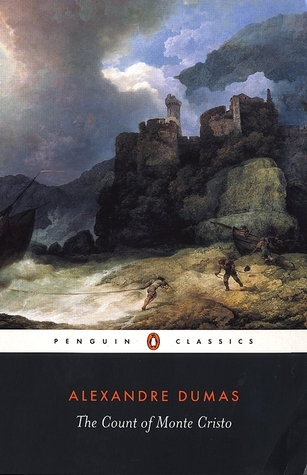
The Count of Monte CristoThe Count of Monte Cristo was my long-awaited pick for the category of "A book that intimidates you" for my reading challenge.  The intimidating factor was the sheer page count; while I like long books, I was a bit concerned about the timing of this long book throwing off my count for the rest of the year.  I mean, it took me almost a year to read my last very long book, Dragonfly in Amber.  But the pressure of having a deadline helped me push through, and I managed it in a decent amount of time--though it did kill my reading numbers for September!

This is a classic, with a classic's story line: Edmond Dantes, in line to be promoted to the captain of the ship he works on, is struck down by the jealousy of one of his crew mates who, with the help of a man jealous of Edmond's relationship with Mercedes, Edmond's fiancee.  Added into the mix, though unwittingly, is a crown prosecutor who hopes to hide his own connections to Napoleon in hopes of advancing himself under the restored monarchy.  Edmond is thrown in prison, where he stays for fourteen years before escaping and seeking revenge on his persecutors with the assistance of a massive fortune he acquires on the tiny island of Monte Cristo.

I didn't really find this book that intriguing.  I found the plot contrived, and that it relied too much on coincidence to move forward--for example, Edmond just apparently sails around the Mediterranean until someone just happens to invite him to Paris?  What?  How is that a valid plan for revenge?  Also, it's repeatedly mentioned that people always comment on how freakishly pale Edmond is, and yet when he puts on a wig and a robe, no one can possibly imagine that it might be him in disguise!  I also felt like it read like a kind of RP or fanfic, in which Dumas was continually going, "You know what would be cool?  IF IT ALL GOT EVEN CRAZIER."  The way that several of the plots tied up didn't really seem to make sense, either.  We never find out what happens with Andrea, Danglars seems to get off lightly compared to the other people Edmond targets, and Edmond keeping Morrel, the son of the man who tried to help him, in sheer agony for a month before bothering to tell him the big reveal with Valentine.  What?  Some of this stuff might have worked better when the book was originally published as a serial, when readers might forget some of this ridiculousness between installments, but getting it all in short order made it stand out a lot.

The portions of the book that took place in the Chateau d'If, the recollection of what happened at Janina, and some other portions of the book were interesting, but reading about Morrel and Valentine swooning all over each other was not intriguing.  Seeing Albert get duped at Carnival was amusing; hearing about everyone's costume changes for every day of it was not.  It alternated between interesting and dreadfully boring, and Edmond lingers in the background for most of the book, taking away the intriguing main character who was so built up early on.  We can see his machinations coming to life, but without seeing him actually do them, I felt like it lost some of the impact.  I liked Edmond, even as he became bitter in prison and began plotting his escape and his revenge.  I didn't really like the Count of Monte Cristo, who felt very one-dimension in comparison to his previous identity.

This book didn't overall leave me as a huge fan of Dumas.  I might read more of him someday, but I won't be diving for another volume of his work anytime soon.

2.5 stars out of 5.

Sunday, October 23, 2016

Twenty Thousand Leagues Under the Sea - Jules Verne

Twenty Thousand Leagues Under the Sea (Extraordinary Voyages, #6)Twenty Thousand Leagues Under the Sea is an interesting novel because it both has and has not aged well.  On one hand, Verne really nailed down the scientific aspects of the book.  The Nautilus is, of course, a submarine that was beyond its time and is still remarkable in our own for how well it pinned down features of subs that hadn't actually been developed yet.  And then there's the stuff like the pseudo-scuba equipment, and the portable lights for under water, and the deep sea exploration in general.  These are things that are still very much in use and relevant even if their form isn't exactly as Verne portrayed it in his book.

At the same time, though, this book dates back to a time when serials for the masses were the craze and when many people couldn't afford to travel, and things like aquariums weren't really accessible to the general populace.  The endless descriptions of every fish that Aronnax (our narrator) sees really wore on my patience, though they probably would have been remarkable to people who couldn't go to an aquarium or turn on a seven-hour nature documentary series about the oceans.  Still, they didn't really age that well and seemed to take up a lot of page space compared to the actual content.  Things like the mysterious passage under the Isthmus of Suez are also total bunk now and really seem like a reach compared to the more finally-wrought pieces of the book.

The actual "adventure" portions of the book also seemed few and far between.  There are two instances here that I think really stand out: the excursion to the ruins of Atlantis and the maelstrom at the end.  Both of these episodes are rather short, disappointingly so amidst the endless fish descriptions, and it's actually a bit surprising that Verne didn't do more with them.  With Atlantis, there's a lot of walking, a couple minutes of standing in one spot and going "Wow!  Atlantis!" and then a lot of walking back to the Nautilus.  With the maelstrom, there's so much drama building up, and then--suddenly--Aronnax wakes up with all the drama glossed over and done with, and with no memories of what actually happened.  For an adventure novel, it's very strange, and it makes it feel very much like Verne was more comfortable with spouting a stream of locations, distances, and fish species than he was with actually writing action.  There are only two big action scenes here that I can think of: when the Abraham Lincoln actually encounters the Nautilus, and the incident with the giant squid.  Even things that are made out to be big events, like the undersea hunting expedition, are mostly a bunch of walking back and forth.

I can definitely see where some of the appeal of Twenty Thousand Leagues comes from, but while it has some cool components that have lingered, I think that the bulk of the book just drags too much for it to be a really riveting read in the modern era.

2 stars out of 5.

Wednesday, February 24, 2016

For Darkness Shows the Stars - Diana Peterfreund (For Darkness Shows the Stars #1)

For Darkness Shows the Stars (For Darkness Shows the Stars, #1)Look at this cover.  Pretty girl in a pretty dress on a field of stars.  A review snipped that says it's a "beautiful, epic love story."  The promise of a society that dwells in faux-historical times but with a science fiction edge.  Can you see what I was looking for here?  I was looking for another These Broken Stars.  I didn't find it, and while I think this book had some strong points, overall I was very disappointed.

Disappointments first, so I can finish up with strong points and end on a positive note, okay?  First off, this is not a "beautiful, epic love story" like that quote says.  It hardly qualifies as a love story at all.  Supposedly, this book is based on Jane Austen's Persuasion, and while I can see the bones there based on Persuasion's description (I haven't read it) I think that Peterfreund could have adapted this so much better than she actually did.  Let me put forth my main problem with showing this book off as a Jane Austen/sci-fi love story: it's not a love story, or at least not one involving two worthy parties.  Kai is a complete ass for like 90% of the book, and all his sweet-talking and letter-writing in the end can't make up for how utterly abominably he treated Elliot throughout.  It seems like, in Persuasion, the heroine ditches the hero because her sister convinces her that he's not good enough for her to marry.  I can see someone being a bastard about that latter.  It's a pretty lame reason to call off an engagement.  But to be so utterly vicious in every way toward a former friend, whom you were never actually romantically involved with, even if the possibility was there, when she refused to run away with you into stars-only-know what sort of trouble when the two of you were fourteen, and instead decided to stay home, do her duty and help all of the people who, in one way or another, depended on her?  And to turn everyone you meet against her, too?  No.  Absolutely inexcusable.  I spent this entire book just praying that Elliot would realize how much better off she would be if without Kai, and get over him and move on, and I am so disappointed that Kai was actually presented as a realistic love interest here.  Not that there's much of a love story at all, because like I mentioned, the two were never actually romantically involved.  It was suggested that they might have been, if things had gone differently, but since things didn't go differently, they weren't.  And so it makes the constant angst and the sudden lovey-doveyness of the end just seem very out of place.

On more minor notes, the early worldbuilding in this drove me crazy, because exactly what all of these strange terms mean and how they came about is not made clear for quite some time, and it left me floundering.  Also, I could not for the life of me figure out where the heck this story was supposed to take place on our own world, geographically, and it drove me crazy.  Does anyone know where these mysterious two islands that survived the apocalypse are?  Anybody?  Bueller?

I think that the apocalypse scenario itself was strong, and that the moral implications of the characters' actions in relation to it, which are brought up time and time again, could very easily be the topic of an intense ethical debate all on their own.  What really is right in this scenario?  (Hint: it's not being emotionally abusive to someone you considered your best friend.  Yes, I am bitter over this.)  And I liked Elliot herself, and her grandfather, and the whole mystique of the Boatwright name and legacy, and the promise of what might be beyond the shores of the two islands.  Honestly, I think this world, and Elliot, had enormous potential in general, and that Peterfreund just went and absolutely slaughtered it with Kai.  He could have been changed in so many minor ways to make him palatable, and a hero worth rooting for, but honestly he really ruined the entire book for me.  I'm willing to put up with a lot of bastardly behavior from a hero if the romance is good and there's at least some logic, no matter how misplaced it is, behind his actions, but that was not the case here.  No delicious romance.  Not a single kiss!  If you're going to write a romance about two eighteen-year-olds, they are allowed to at least kiss at some point, especially after they throw off all the societal restraints confining them in every aspect of life.  One would think any taboos against kissing would go out right with them.  And certainly no logic.  Another possible way this could have been remedied: by having some chapters with Kai as a point-of-view character, instead of Elliot, so that we could see what was actually going on in his head.  This might have made misunderstandings more apparent and Kai more tolerable in general.  But that didn't happen, and so we only have Elliot's POV, and Kai was a total jerk to her all along the way.  There is no redemption here for this.

I plan on reading Across a Star-Swept Sea, Peterfreund's other book in this duology, because I do think there's so much potential here, but I sincerely hope that it offers a better hero, and hopefully more of a love story, than this book did.

2 stars out of 5.

Tuesday, December 1, 2015

Anna Karenina - Leo Tolstoy

Anna Karenina I read War and Peace in school a few years ago, in a great course called "Napoleon vs. Tolstoy," and really enjoyed most of it.  I felt like Tolstoy's characters were great, and that he had a very interesting way of taking on the Napoleonic Wars from Russia's perspective.  Of course, Tolstoy only focuses on upper-class characters, the aristocracy of Moscow and St. Petersburg, and so I was interested in reading more of his works.  Of course, the fact that Anna Karenina was in the process of being adapted into a movie staring Kiera Knightly, who is absolutely lovely, didn't hurt either.  A few years later, I still haven't seen the movie, but I now have read the book, with the intent of using it for the Popsugar Reading Challenge category of "A classic romance."  Now, when I read "A class romance," my mind immediately goes where most people's probably does: Pride and Prejudice.  But I wanted to read something else (though I do love P&P, I didn't want any Jane Austen this time around) and so I picked Anna Karenina, which is really two classic romances in one, and which is different than Austen in a very real way.

See, Anna Karenina doesn't end happily for everyone.  If that's a spoiler... Well, it's not, because the book's been out for ages and at this point I don't think anything can really be a spoiler for it.  But there are two romances involved: Anna's with Count Vronsky, and Levin's with Kitty.  These two couples are intrinsically opposed, and most of the book that focuses on them is composed of parallel scenes: similar setups that show exactly how different the same situations can end up, based on the people who are interacting.  Of course, Tolstoy's female characters tend toward the wildly dramatic and his men towards either extremely glib or extremely grim.  Tolstoy doesn't really seem to do "middle ground" that much; this was the case in War and Peace, too, as I remember.  And Tolstoy is also not only an author, but a philosopher, which means that the book isn't just a story, it's a philosophical treatise.  Now, in War and Peace the philosophy was about Tolstoy's theory of history.  In Anna Karenina, it seems to be something about people's connection to the land, something about the will of the people, and something about the meaning of life, or maybe all three just mixed together.  Philosophy isn't exactly my strong suit, and Levin bonking me over the head with it over and over again didn't sit well with me.

There's not much really to be said about Anna Karenina beyond that, to me.  After all, it's a classic, and most things that are to be said about classics have already been said.  Overall, though, I did enjoy the book, especially the climactic scene at the train station.  The 50 pages of philosophy that followed?  Not so much.

3.5 stars out of 5.

Saturday, September 26, 2015

A Little Princess - Frances Hodgson Burnett

A Little PrincessPart of me wonders why people, including myself, review old books.  I mean, at this point plenty of people have read them and if it's a book this old that's still in popular circulation, then there must be a reason people read it, right?  And then I think, Well, why not?  Write the review.  It's not going to hurt anyone, after all.  And so here we are.

This book has been on my Kindle for years (Literally.  Years.) and I finally dug it out for the Popsugar Reading Challenge, for the category of a "A book more than 100 years old," or something like that.  A Little Princess was published in 1905, which makes it fit that category nicely.  I'd originally planned 20,000 Leagues Under the Sea for that slot, but I really wasn't feeling it when I decided to start another book for the challenge, and so I picked this one up instead.  Several of my friends quite liked it, and it looked like a good, fast read.  Well, it was, but it left me with a few...issues.

A Little Princess is a book that's aimed at young readers, with a distinct message.  If you are good and nice and kind, like Sarah Crewe, good things will happen to you.  However, if you are mean and nasty, like Miss Minchin or Lavinia, good things will not happen to you.  However, when you look at the rest of the book with a bit more adult eye, things get a little murkier.  Sarah is not, of course, the only character.  The Large Family and Mr. Carrisford also factor in, and I had issues with them.  Both the Large Family and Mr. Carrisford are depicted as good, kind people, who want the best for Sarah and are willing to go to great lengths to find her.  Mr. Carrisford goes so far as to provide for Sarah while not knowing who she really is. But why?  Well, because he thinks it's fun.  And while the Large Family are nice, only the little boy (who Sarah calls Guy Clarence and whose real name has escaped me) stops to actually help Sarah, though the whole lot of them see her all the time.  Mr. Carrisford only helps her out of some sense of entertaining himself, not because he really wants to provide for her--she reminds him of, ironically, herself, and he does it for that reason, not because he sees someone who genuinely needs help and decides to provide it.

Honestly, the only real altruistic character in this book, other than Sarah, is the baker woman who gives Sarah more buns than she paid for and ultimately takes in a little beggar girl--this woman does everything she within her slender means to help another poor child, and she does so without expecting any sort of compensation or getting some form of amusement out of it.  The rest of the characters play with Sarah until they find out who she really is, enjoying watching her dance to their tune without her even knowing what's properly going on.  That bothered me, maybe more than it should have.  But A Little Princess clearly isn't meant to be realistic, and so it seemed to me like if the author was going to write about good people providing for others, she should have just done so instead of making the side characters really more manipulative than they seem at first glance.  The more I read, the more their "I'm so good and pure" attitudes, mixed with their really not caring at all, rubbed me the wrong way.

On the surface, this is a great, light read, and good for younger readers who probably won't see the other layers to the story.  But for me, I just couldn't take it as such a pure story, and that bothered me.

3 stars out of 5.