Pages

Showing posts with label magical realism. Show all posts

Saturday, March 31, 2018

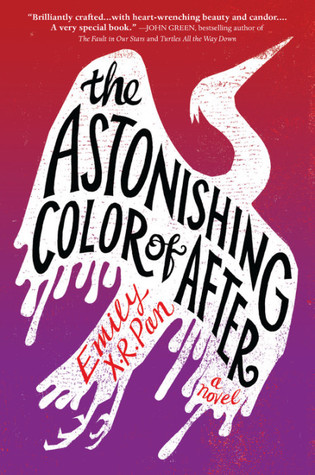
The Astonishing Color of After - Emily X. R. Pan

The Astonishing Color of AfterBook of the Month sometimes has some interesting selections.  They tend to be mostly literary fiction or suspense/thriller; I guess the judges' favored genres tend in this direction.  However, every now and then something very different slips in.  Something like Exit West or this one, The Astonishing Color of After, which has a definitive magical realism bend to it.

The story is about Leigh, whose mother commits suicide while Leigh is finally, finally kissing her best friend, Axel.  But while Leigh's mother might be dead, she is not gone, because Leigh is one thousand percent certain that instead of going away, her mother has become a red bird.  Her father thinks she's crazy, but some strange occurrences as well, and he takes Leigh to Taiwan to meet her maternal grandparents, whom Leigh has never seen due to a rift between them and her mother.  Leigh wants to find her mother, to figure out what she's supposed to know or remember, and finds herself on that quest with her grandmother and a strange young woman named Feng.

This is an interesting take on magical realism.  The things that Leigh experiences are definitely  happening.  They are not in her head.  Other people even sometimes acknowledge them.  But there's a whole aspect to it that only Leigh notices, that only she can see, or only she can remember, and I haven't encountered that in other magical realism books, which tend to have everyday magic more closely woven into the real world as a whole.  I spent a lot of the book flopping between "it's magical realism, no, it's just plain fantasy," but overall I think that magical realism is a more apt descriptor, just given how the magical plays into the story and characters.

Most of this book is set in Taiwan, but there are also flashbacks to parts of other people's lives and Leigh's own evolving relationship with Axel.  I really liked Leigh and Axel.  They're teenagers, and they do stupid things and have stupid fights, but their pull is undeniable.  They have a connection, and despite Leigh shutting down after her mother's suicide, that connection persists and grows even when they're separate and not talking...with a little magical help, of course.  But I think the aspect of this book that most intrigued me was Feng.  I had some idea of who she had to be, but I think Pan did a good job of concealing her true origins and revealing them in a way that wasn't designed to trick you but to make you put together all of the little pieces that had come before.

There were some things I didn't like, however.  First, Leigh's father is horrible.  Not in a typical "Leigh is a teenager and doesn't get along with her father" type of way, but in a "I knew my wife was depressed and so I pretty much abandoned her and my daughter rather than deal with it" type of way.  He hates that Leigh loves art.  He sends her off to a camp that she hates to the very depths of her soul and doesn't tell her anything regarding her mother's health, even though Leigh is the one who cares for her mother, because her father isn't present.  Pan tries to reconcile Leigh and her father at the end, but I am not at all convinced that he would suddenly become so supportive of her, or that he would become an involved father.

Second...can we talk about the pretentious color words?  Pan uses so many descriptive color words that I have never, ever encountered before, and I have a large vocabulary and am widely read.  Which means if I haven't encountered these words, I doubt her target young adult audience has.  I actually started highlighting them as I went through the book, there were so many!  The result is that there would be "[some crazy word] orange" and I would just disregard the descriptor, because "orange" was the part that mattered.  There are so many words for colors and hues and shades that the average reader knows, so I'm not sure why Pan veered away from those and to these spelling bee ones instead.

Overall, I did like this quite a bit.  Leigh's father was awful and the vocabulary was eye-roll worthy at times, but the story itself is solid.  The magical realism is done well, Leigh is a compelling main character, and the setting of Taiwan is a strong one.

4 stars out of 5.

Friday, March 9, 2018

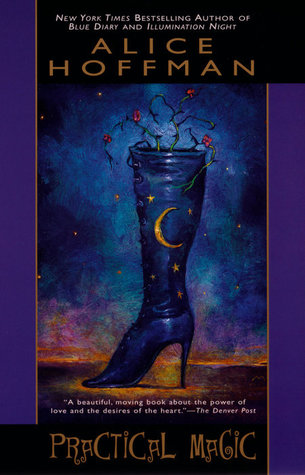
Practical Magic - Alice Hoffman (Practical Magic #1)

Practical MagicOne of the Book of the Month selections last fall was The Rules of Magic, the recently-released prequel to Hoffman's classic Practical Magic, which has also been adapted to the screen in a version featuring Sandra Bullock and Nicole Kidman as the main characters.  I've seen the movie, and liked it quite a bit, and the prequel intrigued me--but I felt like to be on the same page, I should read the original first.

To those who've seen the movie: the book is very different.  But I think they are equally good, in different ways.  The book has less of a focus on the trouble brought on by the vile Jimmy and more of a focus on the relationships between the two sisters, the growing-up of Sally's daughters, and the powerful ways in which love affects all of their lives.  Jimmy and the trouble he brings are still present, but they don't provide the same central propulsion that they do in the movie.  Additionally, while the movie takes place on the island in Massachusetts, the setting moves away from there after the first part of this book, instead being set mostly in a small community in New York where no one has ever heard of the Owenses and never thinks they might be witches, which in itself lends a very different atmosphere to the story.

This book definitely falls into the magical realism category.  Fantastic things happen and are treated as just everyday happenstance, not just by Sally and Gillian and their family but by others around them.  The Owenses might be the source of the magic, but it's not strange in and of itself.  Magical realism tends to have a definite writing style associated with it; not a ton of dialogue, but a lot of prose narrative relating what's happening, probably because the characters commenting too much on the magical events would contribute to breaking the spell, as it were.  That said, the characters still feel real and complete and the events of the book, while of course strange and unreal, still seem to ring true.

The focus of the book here is on the relationships between the characters, with the Jimmy subplot being just that.  The sisters, the aunts, Sally's daughters--the ties between all of them are stretched and warped and torn, and the story here is both that separation and bringing them back together, with a few extra folks thrown in for good measure.  Luckily, this is a definite strength of the book.  Hoffman shows that you can absolutely hate someone for what they've done or what they've pulled you into, but love them and want to help them at the same time.  Additionally, part of the "relationship" aspect of this is Sally and Gillian's relationships with themselves.  Both ultimately fled Massachusetts and the aunts, leaving their whacky childhoods and accusations of witchcraft behind, but are forced to come back to their heritage and embrace it in order to solve the problems that rear their ugly heads.  The climax isn't very climactic in a movie sort of way--there's no possession, no calling of the phone tree, etc.--but is extremely climactic in how you can see Sally and Gillian change.  It might not look monumental, but it certainly feels so.

It's a slow story, a lot of wandering rather than racing, backtracking and then jumping back to the present.  Some people feel like they should have been included more than they were--like Gary!  Where the heck was all of his page time?  Ben got so much in comparison, and even the teenage love interests got more.  But overall, it still felt, well, magical, and I really enjoyed reading it.

4 stars out of 5.

Saturday, December 23, 2017

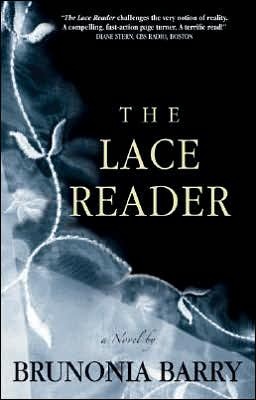
The Lace Reader - Brunonia Barry

The Lace Reader (The Lace Reader, #1)The Lace Reader was my final book for my 2017 Popsugar Reading Challenge.  The category was "A book recommended by an author you love."  An author I love is definitely Tamora Pierce, and luckily for me, she has a list of recommended books up on her website--and I already had The Lace Reader on my Kindle, so it was an easy pick.

The main character is narrator Towner, a self-proclaimed unreliable narrator.  On the very first page of the book, Towner (whose real name is not even Towner) proclaims that she always lies, which about sets the tone for the rest of the book.  However, it's pretty clearly not Towner's fault that she lies; she has gaps in her memory and some apparent delusions, all centered around a traumatic past involving the death of her twin sister and a family member who heads an extremely conservative cult, the kind that believes in burning witches, and who happens to believe that Towner and several of her female family members are witches.  You can imagine how well this family functions.

The story takes place when Towner returns to Salem (as in the Salem Witch Trials) after years of being away in the wake of the death of her aunt, to whom she was very close.  Towner thinks there's something suspicious about Eva's death, as does a local cop who liked Eva and becomes close with Towner.  But returning dredges up all kinds of stuff that was probably better buried, puts Towner back in the path of her crazy, cult-leading uncle, and also entwines her in a missing persons case for a young woman who belonged to the uncle's cult.

The book is divided up into a few different formats.  There are first-person chunks from Towner's perspective, third-person chunks that focus on Detective Rafferty, and also some documents, including snippets from "The Lace Reader's Guide," a sort of journal that Eva kept, and a journal that Towner herself kept while she was staying in a psychiatric hospital following the death of her twin.  I think all of these worked well together, for the most part, and I did like her general writing style.  I think the writing felt fluid and she did a great job building a sense of Salem as a place.  The supporting characters were well done, and for most of the book I liked trying to figure out what was true and what wasn't based on what Towner and the other characters told us.

However.  Ultimately, some of the execution here fell flat.  There were just too many holes left at the end, too many things that seemed to contradict what we'd been told for the rest of the book.  If the things that we find out at the end are true, then a lot of townspeople were just going along with Towner's delusions, which didn't feel like it was the case throughout most of the book.  Yes, people said that Towner was crazy--which she kind of was--but no one seemed to indicate anything that directly contradicted anything that she, as a narrator, presented to us.  And they probably should have.  Even if people weren't willing to say something to Towner's face, she--like the other women in her family--was psychic and could pick up on people's thoughts, which certainly seems like it should have brought something to the surface that wasn't there.  And when things do start coming out in the epilogue of the book, it's kind of a jumble and too many things are left unexplained, and though Towner herself seems to know what's what at the end, we as readers do not, which is strange considering she was narrating.

Overall, I think this is a book that needs more than one read-through; I'd need to go back through it knowing what I did know at the end to try to tease some of the loose pieces out of the earlier portions of the book.  However, I don't think this should be a necessary storytelling device.  I enjoyed this, but think that the structure overall had some issues in the unreliability category.  Still, the writing was good and I'd definitely be open to reading more by Barry.

3 stars out of 5.

Tuesday, October 31, 2017

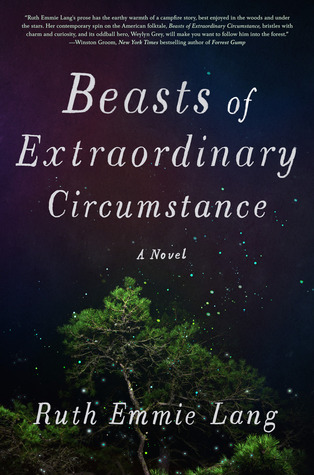
Beasts of Extraordinary Circumstance - Ruth Emmie Lang

Beasts of Extraordinary CircumstanceWhen I saw the Book of the Month selections for October, I'm going to admit, I wasn't entirely thrilled.  There was nothing that really spoke to me, but I needed to get a book from this month so I could get my extras from previous months, so I finally picked Beasts of Extraordinary Circumstance because it seemed to have a magical realism element to it that might be interesting.

I loved it.

This is the story of Weylyn Grey, but Weylyn himself isn't a perspective character until the second-to-last chapter.  Instead, his story is told through the perspectives of other people.  First is Mary Penlore, the girl who first encounters him living in the woods with a wolf pack and buying out every butcher in the area for enough meat for them to survive.  Mary is a recurring character throughout the book, drawn to Weylyn after their first encounters even across years.  Also included are Weylyn's foster sister and her son, his teacher and eventual foster mother, the mayor of a small Mississippi town, one of his coworkers, and a young boy who encounters Weylyn living in the woods years later.  This wide range of perspectives gives insight into Weylyn even though we don't ever hear from him in a first-person perspective--even his dedicated chapter is written in third person, rather than first-person like all of the other chapters.

Mary and Weylyn's relationship, fraught by Weylyn's strange abilities to control (or not control) the weather, is what's really at the heart of this book.  At some points, it seemed like a sweet relationship, like when Weylyn decides to do something for Mary's birthday.  However, I'm ultimately not convinced that it's a healthy one.  Weylyn is fascinated by Mary because she is normal, and he is not.  Mary is fascinated by Weylyn because he is not normal, and she is.  Ultimately, there's not much more to their relationship than that, which is kind of sad, because I wanted them to connect in spite of their differences, rather than because of them.  It just doesn't seem like enough to build a lasting relationship on, or else it would have happened sooner than it did.

There is some beautiful imagery in here; the magical realism certainly helps with that.  Taking fantastical elements in such a normal way means that things like fireflies that make honey that becomes light that becomes an energy source can be mentioned, and incorporated with breathtaking detail.  The wolves are wonderful, Weylyn's house is creepy, and Merlin the pig is adorable.  All of this seems to come to the page effortlessly, making it seem both real and strange at the same time.  Ultimately, this was a wonderful story for the magical realism, for the story, for the characters--but I wish there had been a bit more to the relationship at the heart of it.

4 stars out of 5.

Friday, June 23, 2017

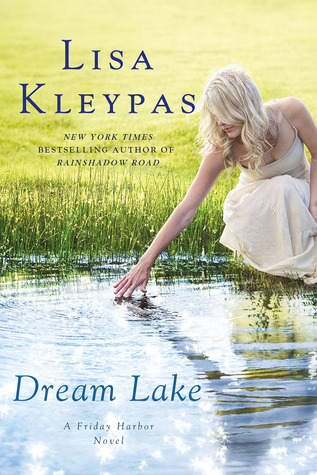
Dream Lake - Lisa Kleypas (Friday Harbor #3)

Dream Lake (Friday Harbor, #3)Dream Lake continues my rather lackluster reading of Lisa Kleypas' contemporary Friday Harbor romance series.  I keep wanting something more from these, but they continue to be...okay.  Not great.  This one, like the second book, follows character introduced earlier in the series.  In this case, the book's hero is the final Nolan brother, Alex, and Zoe, one of the best friends of the previous book's heroine.

It's hard to place this one with where it falls chronologically, because as with the second book, the timeline seems jumbled in relation to the two books that came before.  The events of the second book, Rainshadow Road, are woven very closely throughout this book as the second Nolan brother, Sam, gets it on with Zoe's friend Lucy.  Meanwhile, Zoe and Alex end up together when Alex starts renovating a cottage for Zoe and her grandmother, who has to come live with her because she's started to be affected by dementia.  And it is, I have to say, probably the easiest case of dementia to ever be featured in a work of fiction; while Kleypas mentions some of the difficulties of dealing with a family member with dementia, and Zoe encounters them, it's mostly off-page, and Kleypas neatly ends the whole thing before it can actually get too bad and have Zoe have to really struggle.  Now, I understand, this is primarily supposed to be a romance novel.  However...if you're going to be so half-hearted about part of your plot, why include it at all?  I'm sure there could have been other reasons for Zoe to need the cottage renovated--even ones involving her grandmother!  Maybe there could have been a fire at her grandmother's house or something.  So, Zoe's struggles come from her grandmother.  Alex's, on the other hand, come from a few things--a messy divorce with his ex-wife, his rampant alcoholism, and oh yeah, the ghost that has randomly decided to haunt him.

What I did like here was how Kleypas handled Alex's alcoholism--for the most part.  No one romanticizes it, not even Alex himself, which is a good thing.  And when Alex ultimately decides to quit drinking, he does it because he realizes he doesn't like what he's become.  Is it partially because of Zoe?  Yes, but in a second-hand sort of way, and when it looks like Zoe may no longer be in the picture, Alex still doesn't go back to drinking, even though he wants to.  His family is also skeptical of his quitting, though they're as supportive as they probably can be, given the circumstances and his history.  Of course, just like with Zoe's grandmother's dementia, Kleypas kind of takes the easy way out of some of the aspects of Alex's withdrawal here.  How?  Well, Zoe can cook magic food that helps Alex through it, of course!

There's also the plot involving the ghost who doesn't remember who he was here.  I liked him in relation to Alex--the ghost is kind of Alex's only real "human" contact for much of the book--but adding this on to Alex's struggles and Zoe's as well, even though Kleypas tries to weave it all in, means that the romance really gets pushed to the side.  Zoe and Alex don't get together until pretty far into the book, and then Kleypas really time-skips to the big crisis of "maybe we can't be together" and it all feels very rushed and superficial.  Again, I think it comes back to the jumbled timeline.  Because she chose to overlay this timeline with a lot of the events of the previous book, which didn't make any mention of this going on, it really feels like Kleypas didn't know what she wanted to do and so couldn't weave it all together as tightly as she does in her historicals, which seem to be much more cleanly laid out.

At this point, I'm not sure I'll continue reading this series.  There's only one more book, so maybe I'll just finish it off...but I haven't been very impressed with Kleypas' contemporary romances, at least not these ones.  I know she has another series set in contemporary times, so maybe I'll check that one out instead.

2 stars out of 5.

Friday, March 31, 2017

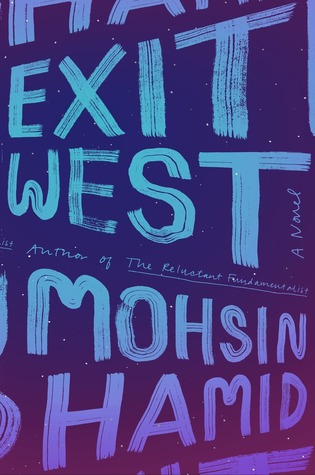
Exit West - Moshin Hamid

Exit West"...when we migrate, we murder from our lives those we leave behind."

Exit West was my March Book of the Month selection.  Promising the story of two lovers forced into an early intimacy by a civil war sweeping their city and their attempts to escape, it seemed particularly fitting for current political situations around the globe.

The protagonists are Saeed and Nadia, two young adults (in their twenties, presumably) living in a city somewhere in the Middle East.  At first I thought it was supposed to be a city (though not necessarily a real one) in Syria, but the further I read the more I became convinced that the actual locale wasn't supposed to matter, because this was a city that could have been any city in that region, and that was the point.  Their city is increasingly torn apart by a civil war, and they are beset with bombs and loss of electricity and checkpoints, and eventually even the loss of Saeed's mother.  Ultimately, the two decide that they have no choice but to leave.

This is where the book gains a magical realism element.  It's actually evident earlier in the book, but it doesn't become apparent as to what's really going on until Saeed and Nadia decide they have to flee.  See, there are doors in this book.  Doors that don't take you where they're supposed to go--like out to your front yard or into your closet--but instead to different places altogether.  The chapters of the book are all studded with little stories about other people in other parts of the world who are stumbling across and using the doors, but that they're actually being transported across vast amounts of distance instantaneously isn't entirely evident until Saeed and Nadia flee through a door, ending up in the Greek islands.

This is the story of people on the move and of the rise and fall of a relationship.  Saeed and Nadia are initially taken with each other, and spend so much time in contact with each other, both physically and virtually.  But as they flee chaos time and time again, their relationship begins to sour and grate and they begin to drift apart, and each "exit west" takes them not only farther from their homes, but farther from each other, even though they don't separate until the very end.  It's a poignant story not only of how people come together and drift apart and stay together sometimes even when they shouldn't, but also of how nativism and xenophobia turns people against each other and presents a harsh face to people who are only looking for better lives.  This clearly isn't our world as it is exactly now, but it's almost our world, and sometimes the difference is only a black door apart.

The premise here is wonderful, and there are some poignant lines as well, such as the one I started this review with.  The ideas here are breathtaking and wonderful.  But I'm not sure the writing style is one that I really liked.  Well, yes, I am sure.  I didn't really like it.  There's very little dialogue and the book is mostly a straight relation of what characters did and where they went and what they felt; much tell and little show.  There are some wonderful passages sprinkled throughout, but overall Hamid covers as a vast amount of time and turmoil in very few pages--231 pages, actually, with large print and line spacing.  It means that there's not a lot of words to convey what needs to be said here, and while parity can be a blessing, I think a little less brevity here could have been a good thing.

Overall, though, this is an important book for our time, and I think it's one that many, many people could benefit from reading.  It offers a perspective that is, to so many of us, lacking, and a view, if people really understood, could help better the world.

4 stars out of 5.

Monday, February 13, 2017

The Magician's Lie - Greer MacAllister

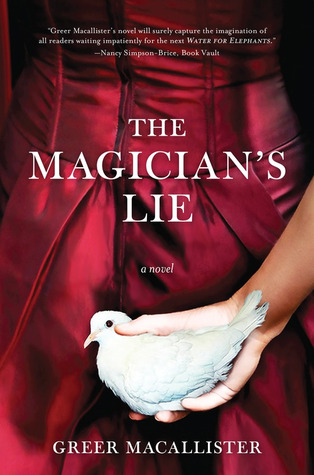
The Magician's LieI got this through my Book of the Month subscription. (I totally recommend this as a subscription service, by the way.)  It's been on my shelf for months and I hadn't gotten to it yet, so it seemed like an excellent time to pick it up for my reading challenge, and particularly for the category of "A book with a red spine."  As you can see, this book has a lovely deep red cover, and the spine matches.

The story here follows Ada Bates, later known as the Amazing Arden.  As a girl, Ada dreams of being a dancer, but those dreams are shattered when she misses an audition with a famous dance instructor because her abusive step-cousin--who believes he has healing powers and is sickly fascinated with Arden--throws her out of a barn loft and breaks her leg.  She eventually flees his abuse, working as a servant for a while and then travelling north to New York City where she eventually becomes a dancer and assistant in the show of the only female illusionist at the time.  The rest of the story follows Ada (Also known as Vivi!  So many names!) as she climbs the ladder within the company, comes to renown of her own, and desperately tries to avoid the twisted cousin into the bargain.

All of this story is told as a sort of flashback, by Arden herself--while she's handcuffed to a chair in the police station of a town in Nowhere, Iowa.  See, the book starts with a magic show...and a murder.  And Arden is the prime suspect.  But the cop who catches her is intrigued by her insistence that she didn't kill anyone and agrees to listen to her story...partially because he starts to notice her strange healing abilities, which he hopes to benefit from himself.

I really enjoyed this book.  With a title like that, you know there's a lie somewhere in it, and I spent a lot of the book trying to figure out if Arden was an unreliable narrator and, if so, exactly what she was being unreliable about.  At the end, the lie itself is so simple, and yet so devastating at the same time because it highlights exactly how much of a victim Arden really was, in both body and mind.  That's the read beauty of this: it shows how someone can be strong and independent, but still a victim.  One is not exclusive of the other and neither one has to define you.  It's a lovely message and one that I think a lot of people will be able to empathize with.

MacAllister also does a wonderful job of building this period.  From Biltmore to New York to Chicago, all around the turn of the century (nineteenth to twentieth), she captures the sense of wonder of a building nation just as magically as she does the illusions on the stage and Arden's powers themselves.  She also leaves a bit of mystery lingering--is Arden the only one with abilities, or are there more?  And if there are more, what sort of abilities are they?  Healing in a more...menacing way?  Second sight?  Is there any chance that the end here isn't really the end, that the story will consider?  It's something to think about and I think it allows the reader to determine the ultimate end of Arden's tale.  Happily ever after...or not so much?

A wonderful story and I really enjoyed it.  Did it blow my mind and call me back to it as soon as I was done?  No.  But it was lovely and elegant and I think it's definitely worth a read.

4 stars out of 5.

Saturday, November 19, 2016

Midnight's Children - Salman Rushdie

Midnight's ChildrenI read Midnight's Children because I needed a book for a category in my reading challenge, "A book recommended by your librarian or bookseller."  Well, I have no idea why anyone would think I actually want to talk to someone, but luckily for me Kramerbooks (a local bookstore here in DC) provides bookmarks whenever you buy a book there, and one of them had a list of books recommended by their booksellers of the past!  Hah!  Midnight's Children was one of these, and I picked it from among the rest for two reasons: the library had it available for Kindle without a huge waiting list, and the elements of magic that the description promised sounded intriguing.

The story is about Saleem Sinai, who is born at the exact moment of India's independence from Britain, and how his fate is tied to that of the country and the other "Midnight's Children," all born within that first hour of independence and who all possess magical abilities.  Saleem is recording the story decades after it begins, with his grandfather, and is doing so because he is starting to actually crack and fall apart, and he wants to record what happened to him and his.

This was an interesting premise and I'm told it's an important book, but it didn't rub me the right way.  I found myself incredibly bored reading this.  Part of this is Rushdie's writing style, which meanders here and there and has many deviations from what I would consider to be "the point."  This fits in with the structure of the book, kind of...it's kind of like when your grandparents tell a story and keep getting distracted.  But Saleem is only 30 years old when this takes place, so it also doesn't make sense.  And then the other part was that it just takes forever to get to the actual "story" part of this, with the events building up to the destruction of Midnight's Children.  The book is divided into three parts, and the third starts 75% through the book, and it was infinitely more interesting than the entanglements of his family.  Part of this is probably because I actually don't know a lot about Indian history.  Saleem's personal history is supposed to be tied closely to, and mirror, that of India as a country, but I only saw the most obvious of those parallels when Rushdie specifically pointed them out.  If my history in this area was more up to snuff, maybe I would have enjoyed it more because I could have followed the more subtle strings that were, as it was, lost to me.

And finally, Rushdie's version of Saleem's life didn't seem to play by its own rules.  The Midnight's Children are supposedly all born with powers--and yet Saleem needs an accident to get his working.  He has another ability connected to his nose, which lets him smell things that most people can't.  For most of the book these are regular scents, but then at the end, when Saleem actually gets around to writing the story, he can apparently smell history to the point that he can relate what happened in his family going back decades before he was born--and yet this isn't connected to his magical "midnight" ability.  He also plays with time, trying to make a point that it's fluid by pinning certain events to drastically wrong dates, but to me this just seems sloppy and makes Saleem into an unreliable narrator, whose whole story can't be trusted.

There were good parts of this.  While Rushdie tends to ramble, some of his prose is absolutely beautiful.  I also loved how, in the third part of the book, he manages to do a really cool duality thing, showing how history has two halves to it.  The concept of the Midnight's Children was also very cool, and I would have loved to see India tied more closely to all of them, rather than just Saleem who actually rather sounded like the most boring of the bunch--especially with the question of whether he really was supposed to be some sort of "chosen one," which seemed unlikely to me, or if he was just full of himself, which seemed rather more likely.  I think this is a book that could also potentially interest people in Indian history, but it was too rambling for me to have that effect.  I believe what other people have said, that this is an iconic book for its time, place, genre, etc., but as a book to just read, it didn't agree with me.

2 stars out of 5.

Friday, November 18, 2016

One Hundred Years of Solitude - Gabriel Garcia Marquez

One Hundred Years of Solitude
This was an exhausting book to read.  I picked it up a while ago at Kramer's Books here in DC, and it sat on the shelf waiting for me to get to it, as many books do.  I'm one of those people who buys books and puts them aside and then never reads them because I'm too busy reading other things.  But I finally decided to go for it for my "A classic from the 20th century" category for my reading challenge, and so out it came.

One Hundred Years of Solitude is the chronicle of the Buendia family over a period of about a hundred years, in the town of Macondo which was founded by one of the family members.  There's a family tree in the beginning of my edition, which was very helpful because the Buendias follow the tradition of using family names, so everyone seems to be called some variation of Arcadio or Aureliano, and I had to keep flipping back to the tree to check who was who and how they fit into the web.  Marquez does make light of this at several points, and the naming convention does fit into the plot, so this didn't annoy me as much as it would have otherwise.

There are two things that really stood out to me in the course of reading the book.  The first is all the magical realism--you know, magical acts that are just treated as matter-of-fact but in a book that doesn't really count as a true fantasy.  From flying carpets to girls ascending into the heavens to the mysterious fertility of the family livestock at one point, and with a dozen other strange things thrown in, there's a ton of it here.  Every time it seemed like things were going to settle down, something else strange would happen just as casually as if it had been someone selling bananas.  The second thing that stood out was the amount of incest in this book.  Dear lord, it's a lot.  It's rather the point of the book, of course--a family that's pretty much in love with itself and whose members keep getting caught up in various romantic entanglements--but it was a bit much for me at some times nevertheless.  I kept having moments of, "But she's your aunt!" and other such mental statements that made me shy away from it a bit.

But what is truly exhausting about this book is the writing style.  While Marquez can write absolutely beautifully, and has a real knack for imagery, what he apparently doesn't like is paragraph breaks.  The paragraphs in this book frequently last for pages, and so there's no sort of mental break as you change gears into the next paragraph.  It was very tiring, and it meant that I had to put the book down more frequently than I probably would have if those long paragraphs had just been broken up a bit more.  There were plenty of places to do it, so it seems like a stylistic choice not to have done so.

As I mentioned before, the writing is wonderful in this.  I could completely picture Macondo as it went through its various stages, from utopia to utter decay, and the people who came and went through it.  And what a start is has!  "Many years later, as he faced the firing squad, Colonel Aureliano Buendia was to remember that distant afternoon when his father took him to discover ice."  It's a very powerful beginning, hinting at both the wonder of things that happen in Macondo, and the tribulations of things to come.  It's an immediate indicator of what an amazing writer Marquez is.  His works have been overall hit or miss with me, but I did enjoy this overall despite the mental fatigue of reading it and the icki-ness of all the incest.  I see what the purpose was for it; Marquez wasn't trying to titillate (at least I don't think so) but show how these relationships led into the downward spiral of a prosperous, powerful family's ruin, and that I think he did wonderfully.

4 stars out of 5.

Friday, December 11, 2015

All the Light We Cannot See - Anthony Doerr

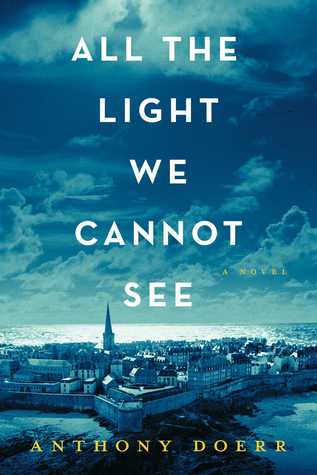
All the Light We Cannot SeeOne of the categories for Popsugar's Reading Challenge for 2015 was "A Pulitzer Prize-winning book," which of course led me to All the LIght We Cannot See.  I did scroll through the list of Prize winners for other options, but out of all of them, this one seemed the most interesting to me, and it got great reviews from regular readers in addition to the Prize-givers, so it seemed like a solid option.

And it was beautiful.  The book takes place during World War II, with short periods and a slightly longer denouement taking place before and after the war, respectively.  There are two main characters.  Werner is a German boy/teenager who gets into a prestigious school for his engineering abilities.  He can fix pretty much any radio, and is soon designing his own, which the Germans use to hunt down resistance fighters in eastern Europe and in France.  The other main character is Marie-Laure, a French girl/teenager who lost her eyesight at a young age and whose father is trusted with taking a copy (or potentially the original) of an infamous diamond with him when he and Marie-Laure flee Paris.  Marie-Laure's father is eventually arrested as a spy, and Marie-Laure unwittingly becomes the guardian of the diamond in his absence.

The diamond itself is the axis on which the story spins.  It lends a fantasy, or maybe a magical-realism, element to the story--is the diamond magic, or not?  Is it a curse, or luck?  Doerr never comes out on one side or the other, making it a real either-or that tantalizes at various parts of the story, sometimes seeming one way, sometimes seeming the other, and we're ultimately left having to make our own decisions on the matter.  The war-time setting lends atmosphere more than anything else, and is cause for some poignant moments that would not have otherwise happened, but most of the plot could easily take place in another point in time, when a group of people is hiding a diamond from someone else who wants it.  That, to me, was good, because it made the story easier to slip into, and while there are some heavy events in this book, Doerr doesn't focus on the aspects of the war that many do: concentration camps, shootings, fighting a resistance.  His focus on a teenager who is in the German army, but tries to distance himself from its doings, and on a French civilian--who ends up helping the resistance, but only in the barest of possible ways--makes the story seem more every-day, makes the characters more real.  Most of us probably can't imagine what it would be like to find a downed pilot, rescue him from a tree, nurse him back to health, and then smuggle him across the border to safety.  However, most of us probably can imagine asking for a loaf of bread and passing off a piece of paper.  Small, simple things, but they make such a difference in this story.

The writing here is absolutely beautiful.  Doerr's descriptions of Marie-Laure's world are wonderful, and Saint-Malo was clear to me even though Marie-Laure couldn't see it to actually describe it.  Werner's parts were lovely, too, though in a more painful way.  His attempts to distance himself from his own actions, a blatant dissociation in order to preserve his sense of righteousness as much as possible when he knows that what he is doing hurts people, was painful at times, especially in regards to his friend Frederick and in his estrangement from his sister Jutta.  At the same time, though, it's easy to see how boys like Werner would have ended up rabid Nazis.  Werner was picked up from an orphanage in a nothing town, saved from a life of mining coal and probably dying young, and instead put into a school where he was treated like he was special, like his knowledge and skills were valued.  That's quite a lure, and it's easy to see how he wanted to vanish into that world--though the niggling conscience instilled by his own morals and his sister never quite left him.

 The only real complaint I have about this book is that the denouement was too long.  This is one of the instances in which I felt there was too much resolution; I would have liked a little more to be left up to our imaginations, instead of multiple time-jumps taking us decades into the future to see where various characters ended up.  A little more mystique in regards to the characters would have matched the mystery tied to the diamond, and tied in a little more meaningfully to me.  Still, though, a beautiful book, and one I would heartily recommend to pretty much anyone.

4 stars out of 5.

Wednesday, July 1, 2015

2 AM at the Cat's Pajamas - Marie-Helene Bertino

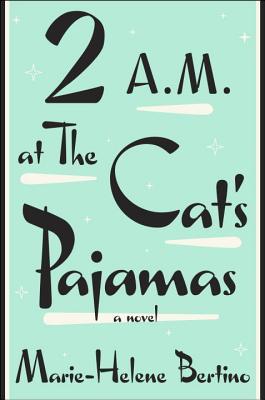
2 A.M. at The Cat's PajamasLight books with ensemble casts of kooky characters seem to be all the rage recently, and this one is no exception.  Since I read Where'd You Go, Bernadette recently, this book reminded me immensely of that.  It's a book with a child as the main character, even though the book is for adults, and the child gets up to all kinds of trouble when the parents aren't looking.  In Bernadette, it was fourteen/fifteen-year-old Bea who got into trouble trying to solver her mother's disappearance; in this one, it's nine-year-old Madeleine trying to fulfill her dream of being a jazz singer.  Madeleine is described by Bertino as "a jerk," and consequently doesn't have any friends.  Most of the people who associate with her in the book are the adults who have stepped in to care for her following her mother's death and her father's descent into a prolonged depression in which he does nothing but listen to old jazz records.  Madeleine goes to school by herself, eats at a cafe down the road by herself, gets her hair done by herself, and ultimately decides to find The Cat's Pajamas, one of Philadelphia's jazz clubs, by herself so that she can make her onstage debut.

Other than Madeleine, the book features Sarina, Madeleine's teacher who is not enjoying her holiday season one bit for a variety of reasons, and Lorca, the owner of The Cat's Pajamas who has just been slapped with a huge fine for violating a large number of city laws and codes in regards to his club.  Sarina sets out to cheer herself up and Lorca and his band of misfits at The Cat's Pajamas try to find a way to cover the fine and save the club as Christmas Eve Eve creeps onward.

The entire story takes place over the course of one day, from about 7am on December 23rd to the wee hours of December 24th.  Despite that, the narrative doesn't seem rushed at all.  Indeed, at some times it got a little too bogged down with Bertino's wordiness.  She takes great lengths to describe scenes, scenes which were intended to make the city of Philadelphia seem as much a character as Madeleine, Sarina, and Lorca, but which in fact only seemed rambling and left me wondering where we were actually going with the words on the page.  These scenes took place mostly at the beginnings of chapters, though there were a few (two describing girls and boys, specifically) that were in the middle of chapters and seemed to derail what was happening around them.

There's also a very slight magical realism note to this story which involves Madeleine's singing.  It's pretty strongly implied that when Madeleine sings, things happen.  Things float.  People do weird stuff.  At first, this seems charming; levitating food and dishware isn't so menacing, after all.  However, it's later implied that Madeleine's voice, when she sings, can cause people to do much darker things--like sexually assault people.  Yes, there is a sexual assault in this book (perpetrated by a woman on a man) and it's hinted at there was another that occurred before the book actually again.  This was weird, and creepy and uncomfortable in the extreme, and did not at all fit with the whimsical, charming narrative that comprised the rest of the book.  I'm not sure if Bertino meant for this scene to be so jarring, or if she meant for it to be lighthearted, and if it's the latter (heck, even if it's the former!) I have to wonder what she was thinking.  Sexual assault by either gender is nothing to be lighthearted about, and it definitely put a damper on the rest of the book for me.  Why this sort of thing happens when Madeleine sings (But not always?  It was used pretty inconsistently.) is also never explained.

This is a good book, with good characters and setting and sometimes wonderful writing--good bones, but I think it needed more polish, and some points more outright thought, for it to be great.

3 stars out 5.