Pages

Showing posts with label book of the month. Show all posts

Thursday, May 31, 2018

Small Country - Gael Faye

Small Country
Genocide is an oil slick: those who don't drown in it are polluted for life.  

Book of the Month has had a few books about the Rwandan genocide recently.  They had The Girl Who Smiled Beads a few months ago, about a woman who fled massacres and lived as a refugee in various camps for years before being granted asylum in the United States; and this month they had Small Country, a translated novel that actually takes place in Burundi, but to which the Rwandan genocide is closely tied.  The genocide is, in fact, the propelling element of the book, though the narrator and main character only briefly sets foot in Rwanda during the course of the book.

The book starts with Gabriel, the main character, living in France as an adult.  His life has obviously been very affected by fleeing from Burundi as a child, and he wonders about it even as his sister refuses to look back.  Then we skip back in time to Gabriel's childhood.  The child of a French man and a Rwandan woman, Gabriel lives a privileged life in Burundi, though his mother is in exile from Rwanda and dreams of either going back there, with the country free, or of moving to France.  He spends his days stealing mangoes and hanging out with his friends, but all around him the environment in Burundi intensifies in tandem with those in neighboring Rwanda, ultimately leading to the breakout of the Burundian Civil War.  Gabriel's mother is a Tutsi and he has family in Rwanda, and so he cannot remain aloof from the events even though he doesn't entirely understand them and his father tries to keep him isolated from politics.  Most of the book is a slow tightening, a gilded cage growing smaller and smaller as conflict grows closer and eventually explodes, driving Gabriel and his sister from their home.

Normally I have some struggles with books in translation.  Something tends to be lost when switching from the original language to the translated one.  Luckily, that was not the case in Small Country (Petit Pays in French).  Sarah Adrizzone is the translator, and she has done a wonderful job of keeping the feel and poetry of the book in translation.  The book does not read as stilted or emotionless, and while there are a few phrases that don't really translate and are kept in French, there's enough of a parenthetical explanation to make the phrase make sense without really jarring the flow of the narrative.

For the story itself, the Burundian Civil War is something I had never heard of, even though it went on for a dozen years.  I'd heard of the Rwandan genocide--and yes, in more contexts than just Hotel Rwanda--but had absolutely no idea that similar ethnic and political tensions were driving a conflict in Burundi.  Faye (and, by extension in translation, Adrizzone) does a wonderful job of showing the tensions while also showing the everyday highs and loves of Gabriel's life in Burundi.  His somewhat idyllic neighborhood, his band of friends, the conflicts with their rival, and how it all slowly descends into chaos are orchestrated masterfully.

Ultimately, however, there is some disconnect in the book.  I can do an ambiguous ending, if it suits the story.  But this was a book in which the prologue did not seem to have any connection to the actual story, and also does not fit with the epilogue--it seemed like the epilogue really should have been broken into two parts and maybe expanded a bit, to serve as prologue and epilogue.  All we really got out of the prologue as it was, was that Gabriel and his sister lived in France, Gabriel liked to sleep around in search of connection, and his sister didn't talk about the past.  While these are important pieces of information, they did not seem woven into the narrative as a whole, particularly in regards to the end of the book.

Overall, a very good read, but I would have liked a bit more connection and resolution between the beginning of the book and the very end.

4 stars out of 5.

Wednesday, February 28, 2018

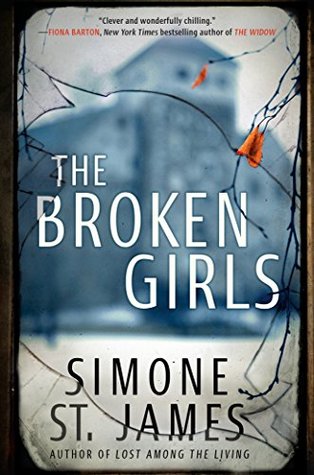
The Broken Girls - Simone St. James

The Broken GirlsThe Broken Girls was my February Book of the Month pick.  Part suspense and part thriller and part ghost story, it was intriguing from the start, following a disappearance, a murder, and a creepy boarding school for unwanted girls in two different time periods.

In the 1950s, four teenage girls share a room at Idlewild, a school for delinquent, disturbed, and just plain unwanted girls.  Katie, CeCe, Roberta, and Sonia all have different backgrounds and different reasons for being at Idlewild, but their shared experience there bonds them and they help each other through the troubles that Idlewild presents, including the specter of Mary Hand who haunts the school and terrorizes its occupants.  In 2014, Fiona is a journalist living in the wake of the murder of her older sister 20 years before.  While visiting the abandoned Idlewild campus, where her sister's body was discovered, she finds out that someone is planning on renovating and reopening the school--plans that go along fine until a body of a former student, missing for decades, appears in a well on the grounds.  Fiona starts digging into the girl and what happened to her, and find some dark secrets lurking in the town and in the past as she does.

This was a properly creepy book.  It's a ghost story, a true one, and while we know all along that the ghost is called "Mary Hand," she's just unknown and distant enough to be truly scary.  After all, the monsters that are the most frightening are the ones we never actually see.  For the less supernatural parts of the story, Sonia's disappearance (because you can figure out pretty quickly that it's Sonia, and so does everyone else) is fraught with horrors of its own variety, the kind that are tied to Nazi death camps, though the strengths of the girls' friendships brings hope--until it doesn't.

As for Fiona and her story line, I really liked it.  She's a reporter who mostly writes fluff pieces but wants to do more, and has the pedigree for it, and takes her chance--both to write a "hard" story and to investigate fuzzy parts regarding her sister's murder--when she gets it.  She doesn't do anything stupid (like charging into dangerous situations) and when trouble finds her, she does her best to deal with it.  I also liked her relationship with Jamie; while they have their issues and the cop/reporter divide is a strong one, they work together and work things out, and I liked how it all unfolded.

Overall, I really enjoyed this.  It is creepy and thrilling all at once, and I was very pleased with it.  The last book I read with a creepy vibe like this was The Night Sister, but that one kind of lost it at the end when the monster became too real on the page.  This one definitely did a better job, and while I think the resolution with Mary Hand was a bit too neat, the rest of it I really, really liked.

4 stars out of 5.

Monday, February 5, 2018

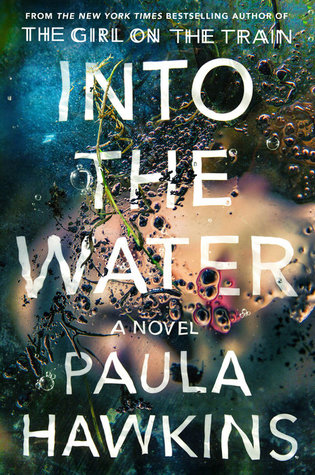
Into the Water - Paula Hawkins

Into the WaterOne of my reading challenge categories this year is a Goodreads Choice Awards Winner, and Into the Water won the category of "Mystery & Thriller" for 2017.  I also already had it as a Book of the Month extra, since I had enjoyed The Girl on the Train

The story here centers around a pair of drownings in a small English town.  Told from the perspectives of a multitude of characters, the plot tries to unravel what really happened with these drownings, who is responsible, etc.

This was not as good a book as The Girl on the Train.  While the central premise--the Drowning Pool, a place both for suicides and to get rid of difficult women--is hypnotic, there are too many point-of-view characters running around to easily keep straight.  Additionally, despite this being a mystery, there's not really a mystery here.  Why?  Because we're pretty much told who is responsible for the events here early on in the book, practically bludgeoned over the head with it for the duration of the story, and GASP!  It's supposed to be a big reveal!  Of course, there is a little twist at the end, but it was nothing earth-shaking or life-shattering.

One thing that Hawkins does get right here is atmosphere.  The small town, the rain, the river, the pool, the way that Jules speaks to her dead sister, the creepy and decrepit mill house--all of it combines for a very spooky feeling.  This would be a good rainy day read.  Or maybe one for when it's storming and the power goes out and you're reading by candlelight.  None of the characters are very likable, either, which also adds to this.  Now, I don't think that characters necessarily need to be likable for a book to be good, but if you feel differently, you might not like this very much.  The pace is slow, which I think suits the story, though the frenzy of characters sometimes makes it feel faster than it really is.

But ultimately, if this book is supposed to be a suspense or mystery novel, it fails.  As I mentioned before, the end is put out there very early on, and the little "twist" can easily be inferred from what we're outright told.  With that in mind, the book is too long by far, because we spend all of it watching the characters bumble around going "Whaaaat?" and wanting to smack them upside the head for their blindness.  By the time someone finally put it together, I was ready to drown the lot of them in the same river that was causing all of the problems.

Overall, not as good, shocking, or suspenseful as I had hoped.  The atmosphere was strong, but not strong enough to sustain the book as a whole.

2 stars out of 5.

Wednesday, January 31, 2018

The Music Shop - Rachel Joyce

The Music ShopOne day this past fall, I got stuck in a Youtube spiral.  You know, you start watching one video--in my case, one of Lea Salonga performing "Own my Own" from Les Miserables--and soon you're going through one related video after another.  I ended up, somehow, in chain of flash mob videos, including one of a performance of the "Hallelujah Chorus" in a food court.  I'm not sure what kind of Youtube spirtal Rachel Joyce got stuck in, but it must have been a similar one, because I feel pretty confident that this book is one of those "What led to this moment?" ponderings.

Set mostly in the late 1980s, the main character in this story is Frank, the owner of a music shop in England that only sells vinyl in a time when CDs are becoming all the rage.  When a young woman faints outside his shop one night, Frank finds himself seemingly tied to her as she comes back again and again, and finally asks him to teach her about music the way he sees it--in a way that was influenced by his eccentric and neglectful mother--though Frank knows there can't be any romance, because Ilse has a fiance.  Filled with quirky characters such as Kit the accident-prone assistant manager, the man who only likes Chopin, the ex-priest Father Anthony who owns a religious souvenir shop, and Maud the grumpy tattoo artist who is secretly in love with Frank, this is also the story of a crumbling but loving community that makes up the nook of Unity Street.  The chapters each focus around a song or cluster of songs, with Frank giving new insight into people on how to live and feel through the music that he finds for them.  But for Ilse, even with her lessons, he hears only silence.

This is a cute story.  Frank's devotion to vinyl isn't blind, he has reasons for it, and hey, vinyl is even making a comeback in our current days, when most of our music is purchased and consumed through our computers and phones!  (This is touched on later in the book, as well.)  I did feel like the "Hidden Track" segment at the end was unnecessary, but maybe that's why it's labeled as a hidden track instead of an epilogue--it's not necessary to listen to it/read it, but you can if you want to.  Though the "sides" of the story, which make up the parts, gave me a very strange mental picture.  Rather than having just two "sides," like a record, there are three or four--which would make a very oddly-shaped record indeed.

The discussions of music that both Frank and his mother, Peg, lead throughout the book are by far some of its strongest points.  They make you think of music in new ways--about the sounds that underlay the main melody, about the way the instruments are used, about the silence that precedes and follows and sometimes pauses a song.  The atmosphere of Unity Street is intriguing--the struggling community being menaced by Big Development, and not really being able to keep going despite their willpower to do so.  The close-knit connections of the people here provide the heart for the story, even when things seem to be going badly.  But some of it is definitely overblown.  Kit's clumsiness, for example, is never ending and completely exasperating, and while it leads to a catalyst for the story, I found myself rolling my eyes in exasperation at him rather than laughing for his antics after just a few chapters.  And the climax of the book, while lovely, definitely stretched the bounds of suspension of disbelief.  Additionally, Frank and Ilse's love (because yes, of course there is love even though Frank is convinced it can't be) is of the instant variety, which means that the back-and-forth between them for most of the book feels excessively dramatic.

Overall, a cute book, but one I'm not sure I would reach for again.  After all, if I want to get the feeling of that climactic scene, I can just head over to Youtube.

3 stars out of 5.

Tuesday, October 31, 2017

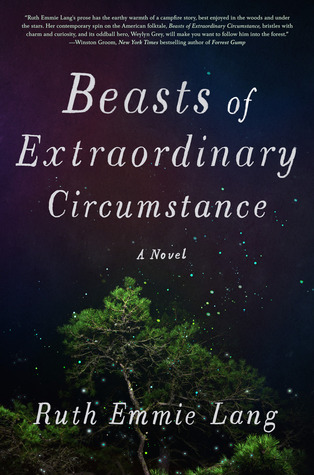
Beasts of Extraordinary Circumstance - Ruth Emmie Lang

Beasts of Extraordinary CircumstanceWhen I saw the Book of the Month selections for October, I'm going to admit, I wasn't entirely thrilled.  There was nothing that really spoke to me, but I needed to get a book from this month so I could get my extras from previous months, so I finally picked Beasts of Extraordinary Circumstance because it seemed to have a magical realism element to it that might be interesting.

I loved it.

This is the story of Weylyn Grey, but Weylyn himself isn't a perspective character until the second-to-last chapter.  Instead, his story is told through the perspectives of other people.  First is Mary Penlore, the girl who first encounters him living in the woods with a wolf pack and buying out every butcher in the area for enough meat for them to survive.  Mary is a recurring character throughout the book, drawn to Weylyn after their first encounters even across years.  Also included are Weylyn's foster sister and her son, his teacher and eventual foster mother, the mayor of a small Mississippi town, one of his coworkers, and a young boy who encounters Weylyn living in the woods years later.  This wide range of perspectives gives insight into Weylyn even though we don't ever hear from him in a first-person perspective--even his dedicated chapter is written in third person, rather than first-person like all of the other chapters.

Mary and Weylyn's relationship, fraught by Weylyn's strange abilities to control (or not control) the weather, is what's really at the heart of this book.  At some points, it seemed like a sweet relationship, like when Weylyn decides to do something for Mary's birthday.  However, I'm ultimately not convinced that it's a healthy one.  Weylyn is fascinated by Mary because she is normal, and he is not.  Mary is fascinated by Weylyn because he is not normal, and she is.  Ultimately, there's not much more to their relationship than that, which is kind of sad, because I wanted them to connect in spite of their differences, rather than because of them.  It just doesn't seem like enough to build a lasting relationship on, or else it would have happened sooner than it did.

There is some beautiful imagery in here; the magical realism certainly helps with that.  Taking fantastical elements in such a normal way means that things like fireflies that make honey that becomes light that becomes an energy source can be mentioned, and incorporated with breathtaking detail.  The wolves are wonderful, Weylyn's house is creepy, and Merlin the pig is adorable.  All of this seems to come to the page effortlessly, making it seem both real and strange at the same time.  Ultimately, this was a wonderful story for the magical realism, for the story, for the characters--but I wish there had been a bit more to the relationship at the heart of it.

4 stars out of 5.

Friday, October 20, 2017

Emma In the Night - Wendy Walker

Emma in the NightEmma In the Night was another Book of the Month selection this month, and looking at it, I was definitely intrigued.  The story is about Cassandra, who vanished with her older sister, Emma, three years ago, and has just reappeared--but without Emma.  As an FBI forensic psychiatrist, Dr. Abby Winter, becomes involved, it becomes increasingly apparent that something is deeply wrong in Cass' family.  Cass is clearly orchestrating something, but what?  And where is Emma?

I pegged a lot of the general twists in this book pretty early on.  It's relatively easy to figure out where the holes in Cass' story are, if you're paying even a semblance of attention.  She pretty much admits in the first chapter that she is an unreliable narrator, telling a story that she has rehearsed, and therefore you can't believe anything she says--so when the "big reveals" come along later in the story, they're not really as shocking, because we as readers know that something was off the entire time.  The way that Cass talks about certain things also lays out a lot of what's happened far before she comes out and says what she wants to say outright; the foreshadowing is pretty clumsy in that regard.

But this was still an interesting story; even though I figured out most of what had happened, I still wanted to know why, and that's something that's not as clear throughout most of the book.  It was definitely what kept me reading.  I also wanted to read more from Dr. Winter, because I love forensic psychology-type stuff.  However, Dr. Winter ultimately disappointed me; the daughter of a narcissist, she specializes in narcissistic personality disorder and quickly pegs Cass' mother as someone else with the disorder, leading her to want more deeply into the family to figure out what happened and why it did.  Seeing all of this unravel from Cass' perspective is interesting; from Winter's, less so.  Dr. Winter also puts forth that people are essentially formed by the time that they're three, and she has research into whether or not daughters of mothers with narcissistic personality disorder can break free of the cycle.  Ultimately, she concludes that Cass has--but it's pretty clear that Cass hasn't.  She might not be a narcissist, but there are still things deeply wrong with Cassandra Tanner.  She ruthlessly manipulated everyone around her, ruined the lives of several people to various degrees, led the FBI on what was, essentially, a wild goose chase, and contributed strongly to the tearing apart of her family--all because she wanted to feel powerful.  That doesn't really seem like someone who's mentally healthy to me.  She also blatantly manipulates a psychological evaluation, which should be a red flag in and of itself, and is something that Dr. Winter notices--but dismisses.

So, while the story itself was interesting here, I felt like Walker kind of fell down on the psychological aspects of it.  There is no happy ending here, only something looming in the distance as I worry about what Cass will do next, because she is clearly not as well as we are supposed to believe.  An interesting unraveling, but one that, in the end, wasn't done as well as it was made out to be.

3 stars out of 5.

Wednesday, October 11, 2017

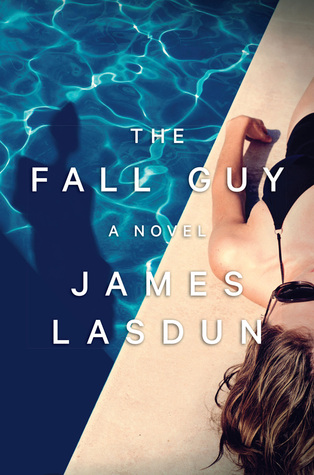
The Fall Guy - James Lasdun

The Fall GuyHmm.... An interesting book, though I'm not sure it was necessarily a good one.  The plot is pretty simple: main character Matthew goes on vacation with his wealthy cousin Charlie and Charlie's wife, Chloe, serving as designated chef as a way of justifying his presence in their guest house.  But as the summer goes on, Matthew finds out something that begins to put increasing pressure on his relationships with both Charlie and Chloe, and which makes them uneasy with him in return.  Another person entering the picture leads to catastrophe.

This is a book that's slow to unfold.  Matthew is not a sympathetic character to begin with, and gets progressively less sympathetic as the book goes on.  Really, the characters in general are meant to be unlikable, but Matthew seemed particularly egregious.  Why?  Because he was dumb, that's why.  He wasn't nasty to hiding things or devious, he was just dumb.  He had all of these very naive visions about the world, despite having apparently lived through a lot, and it made a lot of his actions unbelievable.  It's obvious to us, as the readers, that his relationship with Charlie and Chloe really isn't on good ground to begin with, but Matthew keeps bopping along without picking up on any of the blatantly obvious social clues that float around him, letting him know that he is not, in fact, welcome with them.  Charlie is possibly equally unlikable, but that's just because he's a dick.  (And are seriously supposed to believe Charlie wasn't up to something all summer, too?)  Chloe I actually had more sympathy for, despite her bad behavior.  She seemed more "real" than the other ones and at least some of her actions made sense.

The catastrophic event that occurs near the middle of the book and occupies Matthew for its duration seemed to come out of nowhere, and didn't really fit in with the tone of the rest of the book.  Lasdun makes a genre jump here, and I'm not convinced that it really worked.  Also, there's not really much possibility that this would have gone on for as long as it did, because as I noted above, Matthew just isn't that sharp.  I am glad he got what was coming to him in the end, though it might have been more suitable if the car had run him over instead of having police in it.  Sigh.  Maybe if the book had been told from all three character perspectives and laid more of a chance for someone--or everyone--to be an unreliable narrator, this whole book would have been better, but I don't know.

Overall, a quick read, and not a bad one, but definitely not one that was as good as I thought it would be, and one I don't think I'll return to in the future.

2 stars out of 5.

Saturday, September 30, 2017

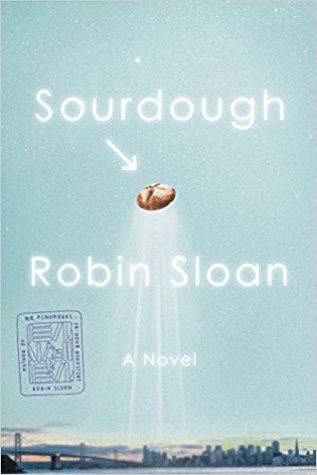
Sourdough - Robin Sloan

SourdoughThis was an absolutely charming book.  From the author of Mr. Penumbra's 24-Hour Bookstore (which I did not realize when I picked it as my Book of the Month), it's a love letter to food and technology (Mr. Penumbra, similarly, was an ode to books and technology) with its own sense of quirkiness set in San Francisco.

The main character and narrator, Lois, works on programming robotic arms.  She has a diet that consists of a nutritional gel called Slurry and little else, until one night she orders a "double spicy" combo of soup and sandwich from a place that's opened in her neighborhood.  The food is a revelation, and she orders it every night--until the two brothers who own the shop encounter visa issues and depart for Europe, leaving Lois their sourdough starter.  Lois feeds the starter and starts to bake with it, producing loaves with strange faces in the crust.  People go crazy for her bread; she tries to sell it at a farmer's market and ends up at the Marrow Fair, an underground market selling radioactive honey from Chernobyl, cookies made from crickets, all kinds of crazy stuff.  But why is the bread the way it is?  And who is Mr. Marrow?

Lois is an utterly likable heroine.  She has good intentions that sometimes go awry, though she gets herself back on track eventually.  The supporting characters here are all charming in their own ways, as well.  The Marrow Fair is an intriguing setting.  Lois' work with robots sets the tone for the story and her knack for sourdough uplifts it, and it's great to see a female character in a STEM field, because that's fairly unusual.  There are also a few nods to Mr. Penumbra in here, showing that the universe the books exist in is definitely same, though this is in no way a sequel to the first book.  Still, the tones definitely match up with each other, so if you read Mr. Penumbra and were left wanting more, this is an excellent book to pick up even if the characters and story are not the same from one to the other.

This was a book that made me want to bake, or teach a robot to bake, and browse farmers markets, and visit San Francisco, and eat cheeses with strange colors in them, and eat honey that glows in the dark, and eat bread that knows how to sing.  There's this sense of whimsy and wonder and whole-heartedness on every page of this book, and it was an absolutely fabulous read.  I'm so glad that I picked it as my book of the month.

5 stars out of 5.

Thursday, August 31, 2017

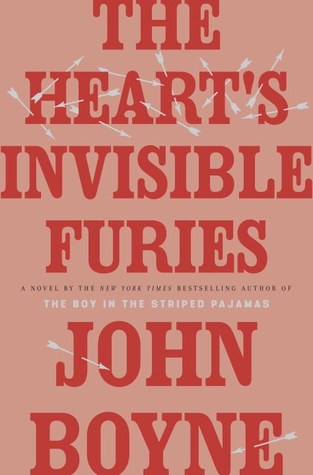
The Heart's Invisible FuriesAnyone who's thinking of reading this book might want to read up on the Bury Your Gays page on TV Tropes, but for those who don't want to or don't have the time, let me sum it up for you: it's quite the cliche in works of fiction that gay characters don't deserve happy endings, and that's basically this book summed up.

Following Cyril Avery from before his birth through to just a few months before his death in seven-year increments, the story is basically that of how a gay man born in 1945 Ireland just after the end of World War II is utterly undeserving of happiness.  Cyril is, of course, not actually undeserving of happiness, but Boyne seems to think he is, and rains down a lifetime of woes upon him.  While Ireland is a country that has traditionally been extremely conservative because of strong Catholic influences, not all of the book takes place there, and yet even in the parts that don't, Cyril is pursued by a cloud of ill fortune.  Just when you think things are starting to look up for Cyril, something else slams down, and usually a succession of somethings.  This is supposed to be spun as a story of the endurance of the human spirit, but really it comes off as another story of, "Oh, isn't it tragic to be gay and to never be able to find true love, or hold it if you do?"

Here's the thing: if this book had just been the first part, I totally would have been onboard with this, tropey as it is, because of the time and place.  1940s to 1960s Ireland was not a great place to be a gay person, particularly a gay man.  It's not that hard to see that.  And if the story had been about Cyril persevering through these conditions to find fulfillment in some way--it didn't necessarily have to be romantically--it would have been good.  But once the story moved on to later times and to places that were more accepting, such as Amsterdam and New York (albeit during the period when AIDs was terrifying the populace) the amount of punishment Boyne heaped on Cyril for being gay and then for accepting who he was seemed utterly excessive.

That said, there were pieces of this that I liked.  We can infer early on in the story that Cyril eventually finds out who his birth mother is, even though he's raised by adoptive parents and constantly told that he's "not a real Avery."  But seeing Cyril and his mother frequently and unwittingly cross paths was charming and a way to keep the narrative going, sometimes drawing in other past characters to reinforce the story's "web."  I liked the scope of the story in its journey through times and place, and the wide variety of characters that Boyne brought in.  But the overall tone of the story seriously struck a wrong note with me, and that's something that I can't really let slide, and honestly I'm disappointed that Book of the Month put this out as a selection.

2 stars out of 5.

Monday, July 31, 2017

American Fire - Monica Hesse

American Fire: Love, Arson, and Life in a Vanishing LandBook of the Month has absolutely been killing it with selections recently; I have loved all of my main selections for the past few months, and it's been great to see more nonfiction that isn't in the style of a memoir.  Killers of the Flower Moon was stunning and terrible, and American Fire is sad and evocative and atmospheric.

This is a nonfiction book, accounting a string of arsons that took place on Virginia's Eastern Shore.  Between November and April 1, sixty-seven buildings in Accomack County burned.  (Well, it was more than that, but the sixty-seven were the related ones.)  As readers, we know pretty much from the beginning who is behind the arsons; Hesse puts it all out there right in the beginning, even on the jacket description.  But of course the people of Accomack don't know, and watching them try to figure out who is burning down their county is fascinating, as is watching the building and decaying relationship between the aronists and how it eventually all unravels in court.

Hesse's book definitely falls into the category of literary nonfiction; it reads like a story, alternating between a chapter or two about the fire departments, police, etc. trying to figure out the arsons, and a chapter about the arsonists themselves.  Hesse uses words to, stroke by stroke, paint the picture of Accomack County, accessed at the north by a road that passes by a gas station sporting a sign, "The South Starts Here."  It's a county that has largely been left behind by the rest of the United States; once the richest rural county in the US, it's now one of the poorest.  Its main employers are Tyson and Purdue.  The fire departments are entirely volunteer, so dispatchers need to call four in order to make sure enough people show up to fight each fire.  And there's no municipal water supply, so the fire departments have to bring their own water with them, and if they run out, their only chances to reload are sometimes ponds.  It's a completely different place from the urban settings that most of the country inhabits, a place that almost felt like it could have been the setting of a Sookie Stackhouse novel if they took place on the Eastern Shore instead of in Lousiana.

It's not a long book, and the narrative style is so readable that I absolutely devoured it in just a couple of hours.  But it shows wonderfully how no single factor in Accomack County or in the arsonists' lives caused the arsons.  Being poor and depressed doesn't make you set fires, and if you do set fires, it doesn't mean that you'll get away with it...but the societal fabric of Accomack County contributed immensely to it.  And, as Hesse points out, it could have happened elsewhere, too.  Such a fascinating look into this county, the arsons, the investigation, all of it.  Highly recommended.

5 stars out of 5.

Monday, July 10, 2017

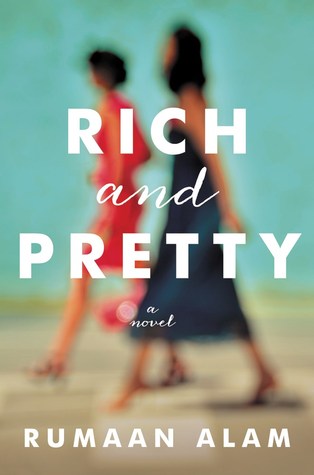
Rich and Pretty - Rumaan Alam

Rich and PrettyRich and Pretty is one of the backlog of Book of the Month books that I had on my back list and finally got around to reading.  It has a pretty dismal rating, a 2.77 on Goodreads as of the time of this writing, and honestly, I think it's pretty well deserved.  Goodreads considers 2 stars an "okay" book and 3 stars a book you "liked," so the majority of people who've read and rated this on Goodreads didn't really enjoy it that much.  And it's a pretty bland book, so that sounds about right.

The story is about two women, Sarah and Lauren, as they move into new phases of their lives.  They've been friends since age eleven, and now in their early thirties Sarah works at a charity shop and is getting married, and Lauren is trying to get a promotion from her job as assistant editor.  They don't see each other much anymore, but when they do they easily fall back into the patterns of their earlier friendship.  But at various points, the differences between them are painfully obvious, such as how Sarah is ready to marry after only having like four boyfriends; Lauren isn't looking for anything serious, and it grates on her nerves when Sarah frowns upon her casual sex.  The title refers explicitly to Sarah and Lauren; Sarah has always been the rich one, while Lauren has always been the pretty one.

The writing is just okay.  While it's a male author writing female main characters, it's not terrible, and terrible is something that I've gotten used to when reading books such as this.  However, Sarah and Lauren are apparently always focusing on their "tits," which is not something I've ever encountered in an actual, living, breathing woman--a fascination with breasts is something I've also come to expect of male authors writing female characters, and that's not any different here.  Sigh.  Sarah, Lauren, and their supporting characters are also just bland.  They're not interesting in any way.  While each of them could have been fascinating, they're all flat and one-dimensional.  Additionally, there's something about the way that Alam writes that just makes me a little nauseous, almost like being seasick; this is something that I also encountered while reading The God of Small Things, and it's not a very pleasant experience.  The sentences can be rambling and hard to follow and sometimes have strange constructions, and just have this "wavy" feeling that was...ugh.  It makes me feel sick just thinking about it.

So, was it a good book?  Not really.  With flat characters and no real plot to speak of, it just didn't intrigue.  I do like character-driven books, and the characters don't even have to be nice or good--but they do have to be interesting.  None of the people here were that, which is unfortunate, and makes it a flop as a character-driven book.

1.5 stars out of 5.

Friday, June 30, 2017

The Seven Husbands of Evelyn Hugo - Taylor Jenkins Reid

The Seven Husbands of Evelyn HugoWow, what a stunning book!  One of the perks of having a Book of the Month subscription is that you sometimes get access to books slightly earlier than their publication date; so, while this was slated to come out on 6/13, I received it about a week and a half early.  Not an advanced reader copy, to be sure, but I was intrigued by the book and happy to get it early.

The story here is about two women: the eponymous Evelyn Hugo, a movie star from the 50s on through the late 80s, and Monique Grant, a reporter for the magazine Vivant in the present day.  Evelyn has given several of her gowns from her starlet days to be auctioned in support of breast cancer research, and she requests that Monique come to give her an interview, presumably about the gowns...until Evelyn reveals to Monique that she actually wants to give Monique her life story to be published by Monique after Evelyn dies, with all of the profit going to Monique herself.  Since Evelyn is pretty much a Hollywood Golden Age icon, there's quite a bit of money to be made there.  Monique is suspicious of Evelyn's motives, but agrees.  And off we go.

Monique establishes pretty early on that the biography is going to have to tackle one main question: for a woman who was married seven times, who really was the love of her life?  That question is actually answered fairly early in the book, but another question not directly relevant to the story remains: why on earth has Evelyn chosen Monique to write this story?

Here are some of the things tackled in this book: the exclusion of bisexuals from the rest of the LGBT community (even though the B is in there), surrendering personal and cultural identity in order to be successful, using sex to get ahead, abusive relationships, different types of love, being able to choose your family, and the right to die.  Wow.  What a lot to tackle, and the author did it wonderfully.  It's pretty much all dealt with in Evelyn's story, rather than in Monique's; though the book starts with Monique, her story is actually a very small slice of the book.  But Evelyn has lived a long time and been through a lot, and as her story unfolds all of her trials and tribulations are woven together wonderfully. Evelyn is a survivor.  She doesn't have a lot of regrets, even though she acknowledges that she made bad decisions.  But she made them to get what she wanted, and she says that's not something she can bring herself to regret.  Monique has difficulty understanding these decisions sometimes, and Evelyn is always prompt about setting her straight, and Monique is always apologetic and open to shifting her worldview to accommodate--exactly what needed to be done for this story to work.

The book is divided into eight sections: one preliminary section and then the seven that focus on Evelyn's time married to each of her seven husbands.  Some sections are longer than others, roughly based on the length of the marriage that the section details.  But despite the setup, Evelyn's story is not defined by men.  She uses them, she loves them, she leaves them, she survives them...but she's a strong woman in her own right who's always striving for something more.  Marriage and motherhood do not define Evelyn; they are simply things she encounters along her journey.

My one complaint about this book is that we were clearly supposed to be shocked by several events at the end: the reveal of why Evelyn wanted Monique to write her story, when the book was going to be released, etc.  But I didn't find any of this shocking, only mildly interesting at best; I think the seeds had been obvious enough in the rest of the book that there wasn't a lot of guesswork actually needed in order to see where things were going.  But it was still a good setup, even if the reveal wasn't as twisty or gasp-worthy as I think it aimed for.

I haven't read any of Taylor Jenkins Reid's other works, but man, if this is an indication of how good they are, I can't wait to start.

4.5 stars out of 5.

Wednesday, May 31, 2017

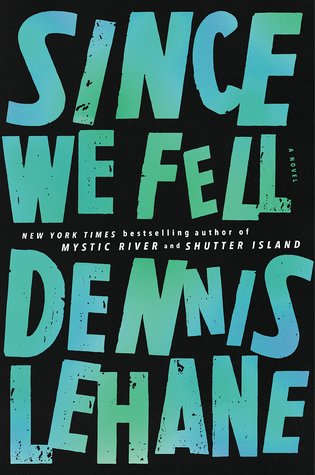
Since We Fell - Dennis Lehane

Since We FellSince We Fell was my May 2017 Book of the Month pick.  Its premise was just too good to ignore--that of a once-well-known reporter, at least in her market, who had a breakdown on the air and became a virtual shut-in, until she runs into someone on a rainy day that sucks her into a conspiracy filled with action and angsty and possibly a little madness, too.  I haven't read either of Lehane's other books, but I'm familiar with the premise of Shutter Island (though I also haven't seen the movie) and thought there was going to be some big twist in here that would make the entire book so riveting.

Unfortunately, there wasn't a big twist, and overall the book disappointed.  I really, really enjoyed the first half of it.  That half follows Rachel through her life, from a girl who doesn't know who her father is to one who finds a stand-in father, to a successful reporter in the Boston market who covers the horrors following the big earthquake in Haiti, and who subsequently breaks down and loses pretty much everything, but then begins to rebuild herself through a relationship with Brian, a man who keeps crossing paths with her throughout the first half.  The second half is the "conspiracy" half, and honestly, it just fell flat.  Probably because it's not a conspiracy at all, it's a con, and that wasn't nearly as interesting.

Lehane can write very well, and I thought he did a female protagonist really well, too.  For some reason it seems like men struggle with writing grown women as characters (flashback to when I read Palace of Treason and the author was constantly talking about the female protagonist's breasts for no relevant reason) but Lehane didn't have any issues along these lines at all.  Rachel comes across as a fully fleshed-out person, and one who isn't dependent on a man either (another common pitfall).  Yes, she relies on Brian and he helps to bring her out of her shut-in status, but when it comes down to it, she's willing to ditch him if she has to in order to survive.  She recognizes it'll hurt, that she'll backslide, and have all sorts of other consequences...but she's willing to do it if that's what needs to be done, and that steel backbone really made me like Rachel.  And Brian, despite what he claims, didn't do it; if Rachel really wanted to be a shut-in, I have every faith that she would have remained one.  Ultimately she changed because she wanted to and felt she needed to.  Brian helped her, but he didn't do it for her, despite how he lays it out.

But despite Lehane's writing and a great central character, I found the ultimate premise of this book to be too hokey.  In the space of a few chapters Rachel suddenly finds herself implicated in two murders even though she's not really responsible for anything, and instead of having a reasonable reaction and going to the police and telling them what's going on, she decides that "Well, this is it, my life is over, better just really go rogue now."  This seemed like such a jump and such a disconnect from her formerly-logical state into some realm of crazy.  And despite the book's description, Rachel isn't crazy.  Events in her life in the first half the book lead to her being agoraphobic and having panic attacks, but she's not actually mentally unstable.  She doesn't hear voices or see things or have crazy impulses, so her being "mentally unstable" doesn't work as a justification for her completely wacky responses in the second half of the book; nor does being in shock, because honestly, being in shock only gets you so far.  Again, it's not like she ended up in some sort of dissociative fugue.

The first half of this book was so strong, and I really enjoyed watching Rachel grow and change, even when it wasn't always good for her, and I liked seeing how Brian's path kept crossing hers and weaving more closely into her life.  Once this whole conspiracy/con thing hit though, that went down the drain.  The suspension of disbelief it asked for was just too great for me to finish the book with any sense of really enjoying it.

2 stars out of 5.

Saturday, April 1, 2017

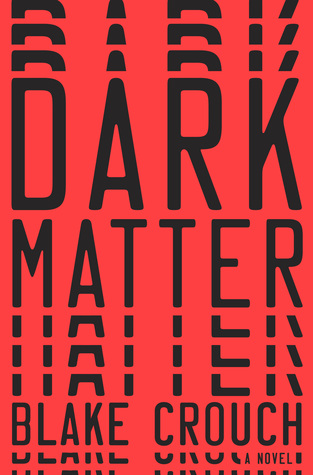
Dark Matter - Blake Crouch

Dark MatterI'm not a huge sci-fi person, but Blake Crouch's Dark Matter caused quite a stir last year, being nominated for a Goodreads Choice award, selected as a book for Book of the Month (where I obtained it) and also being the April selection for The Deliberate Reader's virtual book club!  It's a book that's pretty impossible to talk about without spoilers, so beware.

The general story follows Jason, a physics professor in Chicago who's kidnapped one night on his way home and wakes up to find himself in a life where people know him, but isn't the life he's led, in a world that's his own, but not.  This is the premise the entire book revolves around: the alternate worlds theory, in which every choice a person makes splits off another, new reality parallel to our own but unreachable in which that person made a different choice at the same point.  The realities are, of course, infinite, because they continue branching off of each other to no end.  Jason's familiar with the theory, having worked on it before he quit research to have a family, and wants to return home to his own reality via the device that an alternate version of himself created, because he wants to get back to that family, particularly his wife Daniela.  On the way, he wanders though various other realities, inhabited by other Danielas, and ultimately inadvertently creates other versions of himself by his choices...all of whom also want to get back to "his" Daniela.

This is a really intriguing premise and overall the book was good, but I didn't find it to be great.  The writing is a little stilted and shaky, mostly consisting of a lot of one-line paragraphs.  And while the proliferation of Jasons and worlds and the possibilities of how different a reality only a few steps away from own could be were fascinating, I felt like, in the end, there were just too many questions left unanswered.  Is our Jason the real Jason, or does he just think he is?  What's going to happen in the new world?  What happens to all the Jasons left behind?  Why aren't the other Danielas good enough for the other Jasons, even though at least one of them was good enough for our Jason?  Crouch doesn't go into any of this, and while I can accept that some of it is probably meant to be left vague as "food for thought" upon the conclusion of the book, I think that there was just too much left up in the air.  It felt like Crouch knew there was too much he couldn't wrap up, so he left it all vague to add to the "mystique" of the book and hoped no one would really notice.

But I did like some of the stuff here.  The idea of the world-hopping was great, as was how the box was ultimately "steered."  I wish more books dealt with alternate-worlds theory; it's so intriguing, and I think it really can be handled well, though it would be difficult to do so.  And I have to say, while I think some of the loose ends don't really have logical conclusions, they do make for great book club discussion material!

3 stars out of 5.

Friday, February 17, 2017

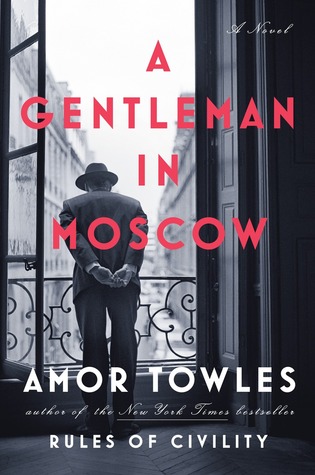
A Gentleman in Moscow - Amor Towles

A Gentleman in MoscowA Gentleman in Moscow was one of my Book of the Month selections back in September 2016, but I hadn't gotten around to reading it yet.  This made it the perfect choice for my 2017 reading challenge category, "A book that takes place in a hotel."  This is because almost the entirety of the book takes place in the Hotel Metropol in Russia.  The main character, Count Alexander Rostov, lives in the hotel when he is arrested by Stalin's administration because of his background.  But instead of being executed, he's sentenced to house arrest in the hotel because of a poem he wrote years ago.  His rooms are downgraded--from a luxurious suite to a tiny attic garret--but he got off easy, and the story follows his life in the hotel as he bonds with staff and visitors, develops a long-lasting rivalry, and makes his life into something of meaning despite the narrow confines of its physical space.

This was an absolutely lovely book.  When Rostov begins to waste away in the hotel, settling into listlessness in the time after his initial sentencing, a nine-year-old girl with a penchant for yellow named Nina pulls him out of his funk and shows him all that the hotel really has to offer.  And as the years go on he transitions from a guest--even under house arrest, he has quite a bit of money stashed away that he can draw on--to a staff member, helping the Boyarsky dining room work as he has always imagined it should.  And he ultimately ends up caring for a young girl left in his hands when her mother goes off to Siberia in search of her husband.  All the while, he tracks the changes in the world through the guests who come and go and the things that happen around him, only venturing outside the hotel's confines once in the several decades he spends there.

The characters here were wonderful.  I could perfectly picture the chef Emile, ruling the kitchens with his giant chopping knife, and Nina in her yellow dress and her passkey on a ribbon around her neck, and little Sofia with her big eyes and solemn face, and Marina the seamstress with her wandering eye and talented hands, and even the characters who come and go, like Mishka and Osip.  And then, of course, there's the Bishop, coming up from being a lowly waiter to the manager of the hotel and wreaking havoc on the hotel and its inhabitants in the process.  The antics that Rostov and his compatriots get up to, from exploring dusty basements for treasure to making illicit French fish stews, are a sort of grown-up, Soviet-era version of that Disney Channel show The Suite Life of Zach and Cody.  But because this is the Soviet era, there's also an underlying sense of danger.  The hostesses are reporting on guests to the Secret Police.  Characters receive the Minus Six, an exile from the six largest cities in Russia.  And there's always the sense that, if Rostov does something wrong, his house arrest might end and he might end up against a wall with a firing squad pointed at him--a fate he just avoided to begin with.

One thing I was disappointed with was the ending.  I do suppose that it fits, in a way, but I was definitely hoping for something else.  I love that Rostov did what he thought was best for everyone else, and then took care of himself, but I was hoping he would take a slightly different path.  And Anna, too.  And that maybe everything could have worked out for Sofia...

Anyway, despite the ending, this was a lovely book, and I tore through it.  It's not packed with action and it's not heavy on plot; it's definitely driven by character and place more than anything else.  If you're looking for a lot of drama and a lot of action, this isn't the book for you.  But for something that has just a touch of grit and a touch of whimsy, all at the same time, I think this is a great choice.

4.5 stars out of 5.

Monday, February 13, 2017

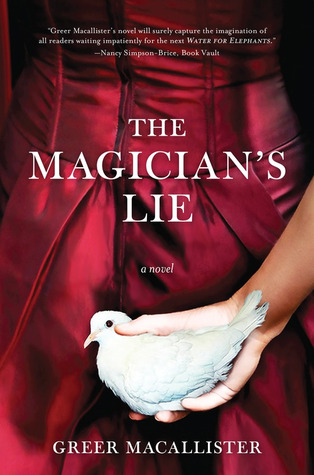
The Magician's Lie - Greer MacAllister

The Magician's LieI got this through my Book of the Month subscription. (I totally recommend this as a subscription service, by the way.)  It's been on my shelf for months and I hadn't gotten to it yet, so it seemed like an excellent time to pick it up for my reading challenge, and particularly for the category of "A book with a red spine."  As you can see, this book has a lovely deep red cover, and the spine matches.

The story here follows Ada Bates, later known as the Amazing Arden.  As a girl, Ada dreams of being a dancer, but those dreams are shattered when she misses an audition with a famous dance instructor because her abusive step-cousin--who believes he has healing powers and is sickly fascinated with Arden--throws her out of a barn loft and breaks her leg.  She eventually flees his abuse, working as a servant for a while and then travelling north to New York City where she eventually becomes a dancer and assistant in the show of the only female illusionist at the time.  The rest of the story follows Ada (Also known as Vivi!  So many names!) as she climbs the ladder within the company, comes to renown of her own, and desperately tries to avoid the twisted cousin into the bargain.

All of this story is told as a sort of flashback, by Arden herself--while she's handcuffed to a chair in the police station of a town in Nowhere, Iowa.  See, the book starts with a magic show...and a murder.  And Arden is the prime suspect.  But the cop who catches her is intrigued by her insistence that she didn't kill anyone and agrees to listen to her story...partially because he starts to notice her strange healing abilities, which he hopes to benefit from himself.

I really enjoyed this book.  With a title like that, you know there's a lie somewhere in it, and I spent a lot of the book trying to figure out if Arden was an unreliable narrator and, if so, exactly what she was being unreliable about.  At the end, the lie itself is so simple, and yet so devastating at the same time because it highlights exactly how much of a victim Arden really was, in both body and mind.  That's the read beauty of this: it shows how someone can be strong and independent, but still a victim.  One is not exclusive of the other and neither one has to define you.  It's a lovely message and one that I think a lot of people will be able to empathize with.

MacAllister also does a wonderful job of building this period.  From Biltmore to New York to Chicago, all around the turn of the century (nineteenth to twentieth), she captures the sense of wonder of a building nation just as magically as she does the illusions on the stage and Arden's powers themselves.  She also leaves a bit of mystery lingering--is Arden the only one with abilities, or are there more?  And if there are more, what sort of abilities are they?  Healing in a more...menacing way?  Second sight?  Is there any chance that the end here isn't really the end, that the story will consider?  It's something to think about and I think it allows the reader to determine the ultimate end of Arden's tale.  Happily ever after...or not so much?

A wonderful story and I really enjoyed it.  Did it blow my mind and call me back to it as soon as I was done?  No.  But it was lovely and elegant and I think it's definitely worth a read.

4 stars out of 5.

Sunday, January 22, 2017

Book of the Month Review

So, instead of doing a typical review today, I instead want to put forth a review of one of my favorite subscription services, Book of the Month--this is my referral link, by the way.  If you are interested in signing up for Book of the Month, you can use that link and I'll earn a free extra book for my next box.  Anyway, I have slight subscription problem.  I get a lot of subscription boxes, most of them makeup and skincare related.  Heck, I even now get my razors delivered (Dollar Shave Club) and I just bought an electric toothbrush where they'll send me a new brush head every 3 months (Quip).  But Book of the Month is probably one of my favorites.  Here's the run-down.

Lucky You: A NovelEvery month, Book of the Month has five new books up for offer.  You choose the one that's of the greatest interest to you, and they ship it.  That's it!  You can choose your book between the first and the fifth of the month, and if you don't choose a book, your subscription will automatically skip the month and you won't be charged.  For the past few months, one of the books they have available is one that's on pre-lease exclusively for Book of the Month members.  For January, this book was Lucky You by Erika Carter, which is due out in March 2017.  For the box, prices range from $14.99/month if you pay monthly to $11.99/month if you pay for a year up front. 

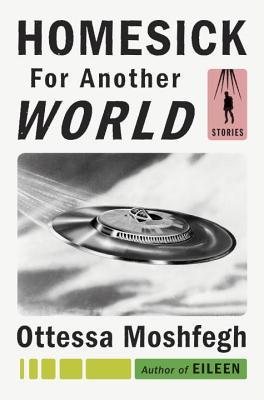
All of the books are hardcover copies and have special Book of the Month branding on the covers and spines, something that they started earlier this year--it makes them look really nice all lined up on a shelf next to each other.  The genres vary greatly because the "judges" for the books change each month.  There's usually a mystery or thriller of some variety, because they're quite popular these days, and the other books vary.  For January, the books were Lillian Boxfish Takes a Walk (featuring an older woman reflecting on her life and the times she's seen in New York City), Lucky You (about three young twenty-somethings going "offline" and looking for purpose), Girls in the Moon (a beautiful young adult novel about music and finding yourself), The Most Dangerous Place on Earth (another young adult novel, but with a darker side about bullying and suicide), and Homesick for Another World (a short story collection). 

Homesick for Another WorldAdditionally, you can add up to two extra books to your box each month for $9.99 each.  They can be books from the month of selection (I got Girls in the Moon and Lucky You for January), books from previous moths, or books from Book of the Month's "Other Favorites" page, which currently includes works by Jillian Flynn, Neil Gaiman, and Anthony Bourdain among others.  $9.99 is a pretty good value for a hardcover book even by Amazon standards, so I get the extra 2 books every month and am slowly working through their previous months.  I don't want all the books they've offered, but a good deal of them seem interesting to me, so I'm picking them up two at a time.  They also tend to include a little "something extra" in each box.  One month it was a magnet, another a crazy straw, another a pair of sunglasses.  This month it was a little, individually-bound copy of Gillian Flynn's ghost story "The Grownup."  If you're interested in discussing the books you read, they also have some social media components worked into the site, but I can't really speak as to how active or informative they are, as I haven't used them personally.

Overall, I love my Book of the Month subscription.  It's a great value and, more than anything else, has forced me to read outside my typical genres.  I've gotten several books through here that, while I thought they just looked "meh," I really ended up enjoying.  Even the books that I haven't loved have always provided an interesting perspective, setting, character, or plot.  I've never felt the urge to abandon a book I got through Book of the Month.  I've even re-arranged a few shelves in order to line up all of my books right next to each other, and they look very handsome there indeed.

If you have any questions about Book of the Month, I'd be happy to answer to the best of my ability, though I don't work there so I can't speculate as to what they might have planned or what their inner workings might be.  And again, if you'd like to sign up, I'd appreciate it if you'd use my referral link here.

Wednesday, November 30, 2016

The Trespasser - Tana French (Dublin Murder Squad #6)

The Trespasser (Dublin Murder Squad, #6)The Trespasser was my Book of the Month choice for November.  Book of the Month tends to stay away from series selections in general, but there have been a few that appeared in the time I've been subscribed; The Trespasser is one of them.  It's the sixth book in French's Dublin Murder Squad series, though it can definitely be read as a stand-alone book, which I suppose justifies its inclusion.

The plot revolves around the main character Antoinette Conway, who finds herself and her partner (Stephen Moran) investigating the murder of a young woman named Aislinn Murray. At first, Antoinette assumes the case is just a domestic, as that's all she and Steve ever get handed.  But they desperately want the case to be something more, something exciting, and the more they dig the more they're shifted between nothing exciting and something that they are not ready to dig into.

In all, this is not a particularly twisty mystery.  I'm not normally good at solving mysteries, but I got a sense of where this one was going pretty early on.  French included enough waffling that I had doubts at a few points, but I never bought into the big red herring, which I normally fall for hook, line, and sinker.  There was also no "big reveal" that left me shocked and awed.  The solution, when it becomes evident, is pieced together bit by bit rather than just slamming into the reader like in some mysteries.  I also expected Antoinette's father to play a bigger role than he ultimately did.  Given that the book starts off with her history of stories about him, it would have seemed like more would be going on there than there actually was.  I didn't necessarily want a tearful, heartwarming reunion, because that would not have been in Antoinette's character, but having it tied in a bit more completely would have been nice.  I was also hoping that something more exciting would happen with Steve, and that he wouldn't be all he appeared--though I think if I'd read the book before this, maybe my perceptions of this one would have been different on this front.

Here are what I think the high points of the book were.  I did like the use of the slang and language here.  Normally I'm not big on phonetic accents, but I think French did well in using just enough slang and phonetically-spelled words to give the story the flavor of setting, but without making the bok a mental exercise to read or creating difficulty in deciphering what the characters were saying.  And while I ultimately didn't like Antoinette as a character (I felt she really did have a victim complex that primarily served as something for everyone, including her, to whine about) I did like the concept of her.  She's the only woman on the Murder Squad and she's a minority to boot.  And ultimately, though she and Steve pursue some crazy theories, she is ultimately the skeptic on the team.  This is refreshing, as female partners on male-female teams in fiction are typically the ones with the crazy ideas.  Antoinette in this respect was very much like Scully from the X-Files; she wanted to believe that there was something crazy going on with the case, but she was ultimately the grounded one on the team.

Overall, I think this was an enjoyable book, but nothing to rave over.  I'm actually very surprised it made the cut for Goodreads Choice nominations for 2016, because there was nothing in that really wowed me.  Still, I found the noms for those awards very lackluster in general, so I guess it fits in.

3 stars out of 5.