Pages

Friday, March 18, 2016

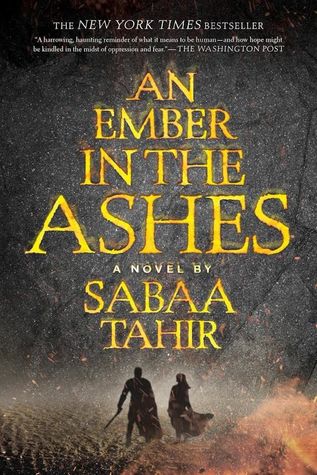
An Ember in the Ashes - Sabaa Tahir (An Ember in the Ashes #1)

An Ember in the Ashes (An Ember in the Ashes, #1)Laia wakes one night to find her brother sneaking in with a sketchbook full of pictures of Martial weapons--which Scholars like them are forbidden to know of.  Minutes later, the Martials show up and kill Laia's grandparents and take her brother prisoner; Laia runs for her life, hoping to find the Scholar Resistance and convince them to free her brother from the Martial prison on the basis that it was resistance members who sold him out, and that they are the children of the Lioness, the resistance's former leader.  Meanwhile Elias, a Martial training to be a Mask, one of the Martial Empire's fiercest warriors, plans to desert his post the day after his graduation from the hellish school known as Blackcliff, where his mother reigns supreme as Commandant and seems to want to kill him, along with pretty much everyone else.  But Elias' plans are shattered when the Augurs, immortal "people" with magic that can read minds and tell the future, proclaim that they are going to select the next Emperor from among four of the newest graduates--and that one of the four is Elias.  Trapped in the Trials, he can't escape if he wants to live, but by staying he risks becoming everything he hates.  And when Laia is sent to Blackcliff to spy on the Commandant for the resistance, their lives start to intersect and intertwine, and they might just be able to bring down the forces aligned against them.

I really liked this book.  I liked both Laia and Elias as main characters and narrators, and I liked the setting that Tahir lay out.  I guess I can see the "ancient Rome" influence that the blurb totes, but it's not really a strong influence.  The fighters in this aren't slaves locked to arena combat, and the arena-style combat that happens isn't really like gladiator combat at all.  This has stronger influences of the Middle East, with creatures like jinn and efrits that lurk in the shadows and come calling at the most inopportune times.  There are a lot of "school" fantasies out there, but this one doesn't follow the normal route of them in that this school is one that the students, and pretty much everyone else, are desperate to escape.  The book also brings up issues like racism, and how Scholars are considered inferior by the Martials, confined to one quarter of the city (like a ghetto), enslaved, and sexually assaulted without most people actually caring about it.  There's also a lot of violence in this book (I'd say it's definitely not for sensitive readers) and considerations of what that violence means, and what it can turn people into, and how good people can also be bad people in different circumstances, and so on.

This isn't high fantasy; the fantasy element does get more pronounced as the story goes on, with the appearance of Augurs, supernatural creatures, and unusual abilities, but the emphasis is on the gritty elements of death and survival rather than on the fantastical ones.  The main characters, for example, don't possess any unusual abilities (at least not yet) and instead have to use their wits, strength, and relationships in order to pull themselves through.  There's a sense that not everyone is who they present themselves as, and the "chosen ones," though that term is never really used, might in fact not be so chosen.  I think there are a lot of interesting dynamics swirling around in the background here, and they come together to make a well-woven story--for the most part.

There are, of course, some flaws.  Tahir seems focused on having not a love triangle, but a love quadrangle, or possibly a love pentagon, which are most definitely even worse than the triangles.  There are some logic flaws, such as why would Blackcliff leave a trail leading directly into the school unguarded, even if it is annoying to use, when they guard every other entrance?  And the trail can't be that annoying to use because two teenage girls use it several times without too much difficultly.  What was up with Laia in that chapter after the third trial?  Why was she even there?  I don't know why the Augers would have done that.  And the timelines can be difficult to follow, too; the chapters jump back and forth between Laia and Elias narrating, but that means that sometimes more time passes in one than in the other, and the narrative has to jump backward in order to catch up instead of just progressing.  I found myself going, "Wait, what's going on with Elias/Laia at this point?" several times because the chapters don't line up as neatly as they should; having a few in a row from one narrator or the other wouldn't have hurt the book at all, and would have made it easier to follow.

Still, the flaws don't detract that much from the overall reading experience, and overall this a great book.  I'm definitely looking forward to reading the sequel.

4 stars out of 5.

Wednesday, March 16, 2016

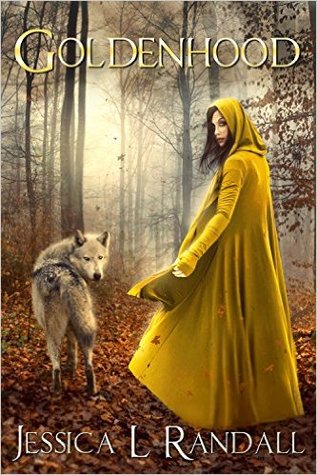
Goldenhood - Jessica L. Randall

GoldenhoodWhen I saw that Jessica L. Randall had a fairytale adaptation to her name, I was super excited.  I liked the charm of her Obituary Society book (I have the second one and just need to get around to using it) and was thrilled to see her turn her pen to a fairytale.  Granted, it was Red Riding Hood, which isn't the most exciting to me, but still.  So, how did it hold up?

It was okay.  The story is about Elise, who comes from a family where the women are said to be witches.  Her grandmother supposedly set wolves on her grandfather, killing him; her mother walked off into the woods and was never seen again; and her aunt serves as the village wisewoman, trying to put aside any witchy tendencies, but the townspeople won't really let her.  Elise herself is inexplicably drawn to the woods, and only the golden cloak she wears--a cloak that was once her mother's--keeps her tethered enough to resist the forest's call.  But as she begins having dreams that hint that something is hiding in the woods, waiting for her, farm animals begin showing up dead and a massive wolf is spotted around the town, Elise might not be able to resist the woods after all--not if she wants to survive with her family intact.

This wasn't a terribly twisty book; everything is laid out all nice and neat and there aren't any big surprises.  There were a few times when I went, "Really?  Oh, okay," but nothing that had my jaw dropping in shock or awe.  Elise is a nice girl but not, I think, a particularly intriguing one; her little sister, Rosie, might have actually been more interesting had she been a bit older.  (Rosie is Red Riding Hood, paired with Elise's Goldenhood.)  Most Riding Hood adaptations tend to have one thing in common, which is werewolves, because that's the obvious place to go with it, and this isn't really any different in that respect.  There's a light romance story line, but nothing too series; one sweet kiss is really as far as it goes.  I thought the end would tie up a bit more neatly with Elise wanting to embrace magic and the title of witch or showing the villagers how things could be, with care, but it didn't go that way; instead, everyone tells a bunch of conflicting stories that everyone believes anyway, and no one questions any of the weird stuff that happened, which was kind of strange.  Okay, really strange.  That was a bit of a plot hole, really.

This is a short book, at 129 pages, which was another reason I picked it up; it helped fill in my "A book under 150 pages" category for a reading challenge.  But I think Randall could have taken the time to add some more pages and flesh things out a little more, and the story would have benefited from it.  It also would have benefited from another round of line edits; there are multiple instances of quotation marks in random places and typos such as "ee'll" instead of "we'll".  It's nothing major, but enough to show that the book isn't really as polished as it could have been.  Overall, it's not my favorite short fairy tale adaptation.  That title still goes to Jill Myles' The Scarecrow King.  But this was good, and I'd be interested in seeing other adaptations from Randall now that she has a bit more experience under her belt to work with.

3 stars out of 5.

Monday, March 14, 2016

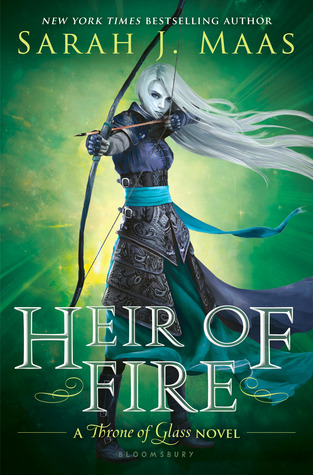
Heir of Fire - Sarah J. Maas (Throne of Glass #3)

Heir of Fire (Throne of Glass, #3)I have to admit, Sarah J. Maas surprised me with this one.

At first, I thought I was going to hate Heir of Fire.  The book starts with heroine Celaena, an unstoppable assassin and secret princess, yadda yadda yadda, basically reduced to the status of a drunk wallowing in her own self-pity.  This is not a flattering depiction, obviously, and since Celaena spent most of the first two books in the series entrenched in a "woe is me" act, I was convinced that I was about to see an escalation of it on a massive scale.  This did not hold much appeal to me, and I actually put the book aside for a bit to read something else because I was so frustrated.  But I've always thought that Celaena's story as a whole had a lot of potential, even if the girl herself was pretty much insufferable, so I went back and started reading again.  And what do you know?  I liked it.

Heir of Fire finds Celaena in Wendlyn, the continent across the ocean from Adarlan.  She's been sent there to kill the royal family and find a way for Adarlan to invade through Wendlyn's supposedly-impenetrable barrier reefs.  Instead, she has decided to wallow in her self-pity for not being able to save her friend and her country and all of the stuff that happened in her childhood and Crown of Midnight.  But then!  But then Rowan, a Fae under the orders of Celaena's many-times-great-aunt Maeve, the Fae queen, shows up and drags Celaena off to meet Maeve herself, who tells Celaena she'll answer her questions, but only once Celaena proves herself worthy by mastering her magical abilities.  Maeve sweeps off, and Rowan starts trying to whip Celaena into shape.  For the most part, this is not an interesting process (which is probably why Maas bulked it out with all the other story lines) but the idea behind it is fascinating, because this is where I think Celaena actually started to become a likable character.  It's like Maas realized how insufferable Celaena was and spent the later half of Crown breaking her down so that, in Heir, she could rebuild her.

Granted, this isn't an entirely successful rebuilding.  When I finally got to the deep, dark thing that Celaena swears will make her snap if she faces it, I was left going, "Huh?  That's it.  Lame.  So many worse things have happened to you, and you've done so many worse things yourself, and that's your dark secret?"  She certainly still has her whiny, bitchy moments, her extreme pettiness that hurts the people around her for really no reason at all.  But for the most part, I think Celaena has actually become a character with potential and who can carry a story all on her own, without the need of a cast of characters supporting her every action--a transformation that was necessary because she was the only main character in Wendlyn.  Everyone else was still back in Adarlan.

Let's talk about those Adarlan people for a minute.  We have Chaol and Dorian, of course, at odds after the events of the second book, but we also have three new characters: Manon, the heir of the Blackbeak clan of Ironteeth witches; Aedion, Celaena's cousin who is now one of the King of Adarlan's prized generals; and Sorcha, a healer who works in the palace.  As things begin to unravel and wind together at the same time, we learn that Manon's job of becoming a wyvren rider, along with the rest of the Ironteeth witches (who were very cool in general) might be revealing her to have more of a heart and conscience than she would like to admit; that Aedion isn't all that she appears; and that Dorian isn't still hopelessly hung up on Celaena, which was nice to see.  I like when characters have relationships that don't work out, and move on to other people, because that's how life is.  In the first two books of this series, I really felt that these other characters were the people who made the story likable in the face of Celaena's awfulness; now, however, I found them to be, overall, pretty boring, and I always wanted to skip ahead to see how Celaena's transformation was going instead.  There were some intriguing bits in Adarlan, mostly at the end, but the Adarlan-based stories weren't nearly as compelling as the process of Celaena actually becoming a heroine.

I also think that this book could have ended about fifty pages sooner, total.  There were some really dull denouement bits at the end for all the story lines, and while some interesting things happened, I think they could have been backed up into the earlier parts of the book and the boring bits chopped without it really suffering any damage at all.  I guess Maas didn't want to leave readers with a cliffhanger, which I respect because cliffhangers are the worst, but I think it could have been worked out to have a conclusion, if maybe an implied one, without all the outright revelations at the end.

Still, I think this book was much stronger than the first two on the basis of Celaena alone.  The story greatly diverged from the Fictionpress version here (which made me a little sad, because I liked poor crazy Cindrillion, who dressed her mice and bird friends by breaking their limbs so that they'd fit into the clothes she made them; disturbing, yes, but also an interesting Cinderella dynamic) but I understand why Maas is going farther and farther away from the draft, still taking a few key things that happened but weaving what's pretty much an entirely new story from them.

I just wonder if the ending will be the same...

4 solid stars out of 5.

Friday, March 11, 2016

The Water Knife - Paolo Bacigalupi

The Water KnifeThe Water Knife is basically a story of the people of the American southwest and what happens to them when water starts drying up, droughts begin taking over, and the scramble liquid becomes all-encompassing.  The "water knife" of the title is not an actual knife, but the main character, Angel.  He is a water knife in the sense that he "cuts" water; that is, he works for a woman named Catherine Case, known as the Queen of the Colorado River, who enforces the water rights of Las Vegas vehemently.  Angel is one of her posse who goes out and takes down anyone who's trying to siphon Case's water away, cutting off the flow by any means necessary and leaving people and places to die in his wake.  He is very, very good at what he does, which makes him the perfect candidate for a mission Case wants completed: find out what's happening with a rumored score in Arizona, and if there are water rights up for grabs, grab them.

Our other two main characters are Lucy and Maria, who live in Phoenix--Angel's destination.  Phoenix is slowly being devoured by the desert, dust storms coming more frequently and lasting longer, the water only for the very wealthy; those who aren't wealthy are basically living off the mercy of the Red Cross.  Everyone with sense and ability is getting out, but getting out is hard because the other states have closed their borders to refugees from the waterless states.  Maria is originally from Texas, which has been completely destroyed by natural disasters, and she wants to leave Arizona, too, but can't afford a "coyote" to smuggle her across the border into another state.  She and her friend Sarah are basically doing all they can just to stay afloat--Sarah by working as a prostitute, Maria by selling water from Red Cross pumps at hiked-up prices at a construction site.  Lucy, on the other hand, can leave whenever she wants; she's not from Arizon, but has moved there to further her career as a journalist and document Phoenix's descent, which she does quite faithfully via the hashtag #PhoneixDownTheTubes.  But Lucy gets more than she bargained for when one of her friends, who'd spent recent days talking about a big score and a way to California, turns up dead.  Furious, Lucy aims her pen at everyone she's resisted targeting for so long, completely disregarding her own safety in a city that has basically become a dog-eat-dog world.

As Angel searches for water rights and Lucy searches for the truth, their paths and that of Maria begin to weave in and out of each other.  It's an extremely dangerous place, Bacigalupi's Phoenix, People get shown, blown up, fed to hyenas, and all sorts of other unpleasant things.  This is a very violent book; I'd really say it's not for the faint-of-heart.  There is also an "attraction" plotline, which I hesitate to call a real romance because the characters like each other, are intrigued by each other, and are definitely attracted to each other, but they're still also perfectly willing to stab each other in the back if necessary, and neither of them is really sure what their involvement is.  "Romance" typically implies some sort of resolution, which this didn't have and I don't think will have, given that, to my knowledge, there's not going to a Water Knife #2.

The path of this book is twisty and turning, with things spiraling in around each other but everything still interlocking quite well.  I didn't see any gaping plotholes; Bacigalupi's world seems very tight.  This is, however, a book that lacks a lot of resolution.  There's no world-saving going on here, so if you're the type of person who likes to leave a book with everything wrapped up in a neat little package, this is not for you.  It's definitely a "it's the journey, not the destination" that counts type of book.  In the end, the world (or at least the American southwest) is still pretty much screwed, but I'd come to care about the characters and have hope for their individual futures more than I did for the world at large.  It was a type of ending that, yes, would suck if it were reality (which it very well could become; that is the scary part about books like this) but I think fit the narrative perfectly.  It also read, to me, as basically a prequel to Dust by Hugh Howey.  Put together, I think the two are a really good sci-fi story about what might happen when we start running out of water.  It is not, however, a book that goes along with the misleadingly-titled (but lovely) What the World Will Look Like When All the Water Leaves Us.

An excellent book, but a violent one and one that is scary in its foreboding of a likely reality.  Sensitive readers be warned!

4.5 stars out of 5.

Wednesday, March 9, 2016

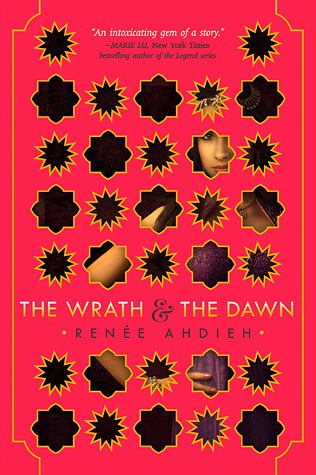
The Wrath & The Dawn - Renee Ahdieh (The Wrath & The Dawn #1)

The Wrath and the Dawn (The Wrath and the Dawn, #1)Here is the thing: I absolutely love the story of Scheherazade.  It's not a very known tale, so for those of you not following along, I'll summarize.  Once upon a time there was a caliph who found his wife had been unfaithful to him.  As punishment, he beheaded her, and every day after that he took a new bride and beheaded her the following morning.  Eventually, the daughter of one of his viziers, Scheherazade, volunteered to become his next bride.  The night before her planned death, she begged the caliph for a chance to say goodbye to her sister.  He granted her request, and as he waited in the next room, Scheherazade began telling her sister a story.  By the time the dawn came, she'd reached a cliffhanger.  The caliph, entranced by the tale, demanded that she finish the story, but she refused, saying it could only be told by night.  Begrudgingly, he allowed her to live until the next night so she could finish the story and he could know the ending.  The next night, she finished the story...and began a new one, also ending in a cliffhanger at dawn.  The cycle repeated itself for a thousand and one nights, at the end of which the caliph had fallen in love with Scheherazade and did not kill her, instead letting her live on as his queen.

I've been longing for a good Sheherazade story for a long time, but there have always seemed to be a few problems in the way.  First off, it's pretty hard to make a guy who wants to kill the heroine for something someone else did a viable love interest.  That's really, really difficult.  He has to have damn good reasons for that, and maybe not even then will that be okay.  Second, Scheherazade's whole story is stories within the story, which means the bulk of her story isn't even actually about her.  While this can give an author a lot of room to create, it also means there isn't much of a framework to use as a guide.  I think Ahdieh managed to conquer these roadblocks very well and create what is, for the most part, a very intriguing story.

Ahdieh's Shahrzad, aka Shazi, volunteers to become the next doomed bride of the caliph (constantly and annoyingly referred to as the boy-king) in order to avenge her best friend, one of Khalid's former victims.  She plans to make him put off her execution for long enough to find a way to kill him instead.  Shahrzad is, of course, good at pretty much everything.  Wall-climbing, witty banter, archery, ect...it all falls within her grasp (except swordplay, though she picks that up within the course of a few paragraphs, too).  These skills are all put to use in keeping herself alive--until she doesn't really need them to keep herself alive anymore because Khalid falls in love with her pretty early in the story and then she's not really in danger anymore.  There's still danger around, and intrigue, because she still doesn't know why he killed all those girls, but her own life isn't directly on the line which does tend to lower the tension a bit.  The story is bulked up by the introduction of Shahrzad's former love interest, Tariq, who vows to rescue her from Khalid's evil clutches, and the integration of magic into what was initially portrayed as a Ruritanian-type setting; you know, a fake kingdom, but this time in the Middle East instead of in Europe.

I think this book had a lot going for it.  There are some great kissing scenes, some scenes that blatantly allude to other stories (particularly Aladdin, which we are all, of course, more familiar with from the Disney adaptation than from the original Arabian Nights story, which is actually set in China), and the elements of Scheherazade that prove so problematic are adapted to make the whole story much more palatable, though it takes a while for them all to come out--for much of the book, I was going, "Okay, I get that part, but this whole thing is still not okay."  In the end, it's kind of a moral quandary, which I'm sure Ahdieh's going to tie up in a bow in the second book, The Rose and the Dagger (due out in May).  That said, I still had a few issues with this.

First, Shahrzad's clothes are a topic of constant discussion.  Now, I love pretty clothes as much as anyone and probably more than some, and I think discussions of pretty clothes have their place in books like this.  Clothes are used to shock and awe, and to bulk up a character's appearance to others or make a character appear like something they are not.  However, there are times in this book when Shahrzad's clothes have no bearing on what is happening and still are described at length; for example, there's a part where she's basically pacing in her room and Ahdieh spends several paragraphs describing her clothes and jewelry.  I thought, at first, that this was going to tie into the Bluebeard story integrated into the narrative, because Bluebeard's last wife (in some versions) wears a diamond necklace that falls into a pool of blood and therefore betrays her for doing something she was told not to do.  That didn't happen, and it left the whole outfit description thing pretty pointless.  I don't think these descriptions should have been cut entirely, but I think they could definitely have been narrowed down; we didn't need a day-by-day account of what she was wearing.  "She dressed and went to do blah-blah" could have easily fit in for "She dressed in this and that and the other, with a necklace made of and a belt of and bangles of..."  Do you get my point?

Second, I hated Shahrzad's handmaiden, the Greek girl who I despised so much that I have entirely blocked her name out of my mind.  (It's Despina, I think?  Maybe?)  She was supposed to be this complex side character with a personality and story of her own, which she was, but she was also this really terrible example of how stereotypes can come alive in books.  Despina is in Khalid's service as a slave, even though there's absolutely nothing slave-like about her, and she comes from Enlightened Greece which is apparently completely different from places like Khorasan where they still have things like slavery anyway!  Gasp!  And she's always saying things like "Hera help me" or whatever, which were annoying...her whole "Greek" thing was really stupid and made me really, really hate her.  I don't know why Greece even had to come into it other than as a way to introduce a "civilized" country where rulers don't chop off the heads of their wives every morning.

Third, there is a lot of waffling here.  I hate waffling unless it's done really, really well.  And there's a lot of refusing to tell people about important things for really stupid reasons, too.  "Tell her!" "I don't want to!" is about the gist of it.  Which, of course, leads to a lot of misunderstandings.  This is very much a book where communication is the key to all of the problems; the problems could have been worked out a lot sooner if the characters had just talked to each other.  Hell, the story could have been avoided entirely if Khalid had just talked to his people.  Granted, he probably would have been offed, but hey, you gotta do what you gotta do in order to preserve your kingdom, right?  And it ended with a lot of waffling in a really weird place.

There was some really lush storytelling here, in places, and some good handling of the original story's central problems for being a viable retelling/romance, but I think Ahdieh added in her own problems that kind of even the scales for it.  I'm still eager to read the second book, but I hope some of these problems are resolved in it.

3.5 stars out of 5.

Monday, March 7, 2016

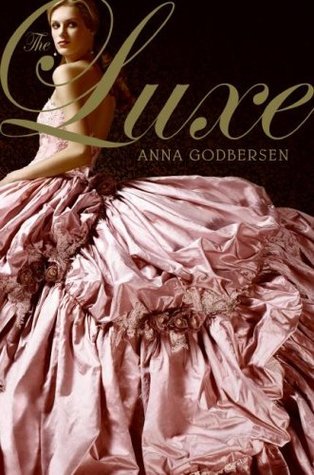
The Luxe - Anna Godbersen (The Luxe #1)

The Luxe (Luxe, #1)Anna Godbersen's Luxe series is one that I started years ago, when I was still in high school and all the books hadn't been released yet.  I read the first three, but by the time the fourth one came out it wasn't on my radar anymore, and I consequently missed how the whole dramatic affair ends.  Because that's what this series is: a dramatic affair.  Basically, it's a soap opera for teenage girls set in 1899 and the first year or two of the 1900s, with New York high society playing all the leading parts.  It's definitely a drama more than a romance, because while there are romantic elements the real intrigue is all of the plotting and scheming and double-crossing the character do to each other.

Our main characters are four young ladies in their teenage years: Penelope Hayes, sisters Elizabeth and Diana Holland, and the Hollands' maid Lina Broud.  Penelope, Elizabeth, and Diana are all high society, while Lina is of the servant class and is left looking from the outside at all of their grand doings.  The story begins and ends with Elizabeth Holland's funeral, and the middle bits fill in all of the events leading up to it.  The Holland family, recently out of mourning for the late Mr. Holland, has been ruined by the mess of debts that Mr. Holland left behind.  Mrs. Holland informs Elizabeth that it's her duty to marry someone filthy rich in order to preserve the family.  This has a dual negative effect: the man Mrs. Holland has picked out is Henry Schoonmaker, who Elizabeth's best friend Penelope wants to marry (though she hasn't told Elizabeth this yet) and it also interferes with Elizabeth's own ongoing love affair with the family coachman, Will.  And Will is also the (unknowing) object of Lina's affections, and Lina hates Elizabeth because Will loves Elizabeth and not her!  Scandal!  Scandal all around!  And then, to add even more scandal, when Henry shows up in the Holland home, he and Diana become ridiculously attracted to each other!  Gasp!  Swoon!

Let me be clear: this is not a complicated book, nor a serious one, nor is it something that should be read for serious historical consideration.  This is basically what I imagine a turn-of-the-twentieth-century Gossip Girl would look like (though I have never read Gossip Girl; it just seems to give off that vibe).  It's something that's light and fluffy but filled with drama.  There are no real twists and nothing that's going to make you scratch your pretty little head in an attempt to understand it.  All of the characters are pretty much abysmal people in one way or the other, with the exception of Diana who is overall a very nice girl and is really too good to be mixed up in all of the dramatic back-stabbing and double-crossing surrounding her.  But--and this is key--it's pretty evident that they're all terrible people from the beginning.  There's no leading you on and then having one person slap someone with some terrible action.  Everything is very obvious which I think is important when you're writing terrible characters but you also want people to like your book, unless you're writing a mystery or thriller (which have more leeway in this department because TWISTS) which this is most definitively not.  If there is a real heroine of this series, it's her.  The writing is, consequentially, exactly what you'd expect from this type of book aimed at teenage girls.  It's nothing stellar, and at least in the e-book version there are some serious formatting issues with dialogue that can make it very hard to tell who's talking at some points; I can't remember if that's the case in the print version or not.  But I still think it's perfectly readable and enjoyable, and overall is exactly what it's meant to be.  I can't wait to finish this series and also start on Godbersen's other period series, which I expect to be filled with just as much drama as this.

Four stars out of five.

Sunday, March 6, 2016

Fire and Hemlock - Diana Wynne Jones

Fire and HemlockDiana Wynne Jones used to be one of my favorite authors when I was younger, but for some reason I never actually read Fire and Hemlock or the Howl's Moving Castle books, which might arguably be her most famous due to the Miyazaki move that drew inspiration from, but was not a direct adaptation of, the first of the series.  Fire and Hemlock popped up on my radar fairly recently when I read a rather scathing review of Sarah J. Maas' A Court of Thorns and Roses, which is part Beauty and the Beast and part Tam Lin.  That reviewer (Nenia Campbell, the review is here) rather thought ACOTAR sucked, and recommended Fire and Hemlock as a Tam Lin retelling in its place.  I rather liked ACOTAR, but I've generally found books that Nenia recommends to be excellent, so when I saw this was available as an e-book from the library I was pretty excited.

While I think that this was a well-written book, with everything woven together very well, I would not recommend it for people looking for something similar to ACOTAR.  Fire and Hemlock is much more middle-grade than ACOTAR, which is very definitely young adult verging on adult.  Fire and Hemlock is set up differently, with Polly trying to figure out why she's suddenly realized she has two sets of memories and what she can do to fix it; much of the book is told in a sort of series of prolonged flashbacks, detailing Polly's "hidden" set of memories.  These heavily feature Mr. Lynn, who Polly ran into when she was ten and accidentally crashed a funeral.  Their lives got tied together then, and they kept associating with each other.  Polly developed feelings for Mr. Lynn which was a weird sort of dynamic because she was fifteen at the oldest when she saw him last, and he was an adult from the very beginning.  When she eventually figures out what happens, she goes off to fix it, of course, just as any proper young spunky heroine would.  This has a lot of cool fantasy elements to it, but it lacked the one thing I was really hoping to find (and, given Polly's age in the book, this is a good thing): romance.

Here's the thing: ACOTAR is sexy.  Fire and Hemlock is not.  This is, in reflection, a good thing, because a sexy element in Fire and Hemlock would be very Lolita-esque, which is super super weird and not okay.  That said, when the book opened with Polly being nineteen, I thought I was going to be in for a good romance, though not necessarily a steamy one like Maas'.  After all, Fire and Hemlock dates to 1985, and Wynne Jones never struck me as a particularly steamy writer to begin with.  But I thought there'd be something sweet here, and really, I was a bit befuddled by how the whole thing came together.  Because Polly's crush is apparently actually true love, and its reciprocated?  Again, the whole age thing just made this super weird for me, and I couldn't really enjoy it as much as I wanted to.  I think that, had Polly been older for the duration of the book, this would have worked much better for me even without a strongly-pronounced romantic element.  As it was, it just kind of creeped me out a bit.  Age-gap romances can have a lot going for them, but not really when one of the participants is ten.  Granted, the "romantic" element grows as Polly gets older (she doesn't fall head-over-heels for Lynn from the beginning) but she's still young enough that it's disconcerting.

Diana Wynne Jones is a fantastic author, and I definitely still intend to read the Howl's Moving Castle books, but Fire and Hemlock was not for me.  It had some really intriguing elements, like the dual sets of memories, but some of the things (like how Polly always knew what to do "by instinct") didn't convince me and the relationship aspect weirded me out far too much for me to really enjoy the book.  The last bit, when Polly was older, was much more comfortable than the majority of it when they were in the flashback phase.  It was just kind of icky, even though nothing icky actually happened.  I don't know.  It just didn't sit well with me.  I won't be reaching for this one again.

2 stars out of 5.