Pages

Friday, April 29, 2016

Dream Stalker - Amy Hopkins (Talented #1)

Dream Stalker: Talented: Book 1Dream Stalker is Amy Hopkins' first book, and is also the first in a series focusing on witches and wizards, collectively known as the Talented, who live in London.  The main character is half-blood Emma, who has minor Talent due to her mixed ancestry and runs a tea shop where she sells teas both normal and enchanted along with the help of her inherited boggart, Gibble, and her dog, Lenny.  But Emma's peaceful, tea-filled existence is jeopardized when a dream stalker begins targeting half-bloods with the goal of stealing their Talent and gifts for himself.  When Emma becomes his next target, she finds herself teamed up with full-blood Talent Harrod and his fully mortal brother Martin in order to figure out who's doing the killing and stop him.

I think this was a great world and a story that had really good bones, but it needs a lot more polish to be a good book overall.  Emma's tea shop is charming, Harrod and Martin were enjoyable characters, and Gibble turned out to be one of the most interesting "people" in the book once more information about him came out.  The world itself is interesting; it's Earth as we kind-of know it, but witches, wizards, and supernatural creatures collectively known as Otherworlders (like boggards, fae, giants, and so on) live some-what integrated lives.  Everyone is aware of everyone else's existence, even if they don't necessarily like them.  Half-bloods like Emma get the short end of the stick in it all, because they're kind of caught between the mortals and the Talented, which is a neat way to approach prejudice and discrimination (for example, if half-bloods want to visit the walled-in area of London where full-blooded Talents live, they need to show paperwork and their movements are tracked) but didn't really seem to make sense because, while people were campaigning for mortal inclusion, it didn't seem like any half-bloods had really bothered to speak up for themselves.  The Otherworld and the dream worlds were very well-done, with laws and happenings of their own that the story obeyed rather consistently.

But overall, consistency is something that's lacking in this book.  At one point, it's five half-bloods who have been targeted before Emma; at another it's six.  Harrod's last name changes from Passar in the early chapters to Umbers in a later one.  Emma says that two of the victims were her close friends, and yet there's not really any evidence of her having real friends other than possibly Harrod and Martin, once they meet; she seems to have many acquaintances, but no one she regularly talks to or involves in her life other than Gibble and her dog.  There's also a desperate need for an editor with an eye to the use of grammar, particularly in regards to dialogue.  Problems with punctuation in regards to dialogue abound in this book--and I'm not talking about general comma usage, which people are horribly divided on in general.  I'm talking about improper use of periods and commas at the end of people speaking, before the dialogue tag, like "Blah blah blah." Harrod said, which should be "Blah blah blah," Harrod said.  This is extremely standard and I have to think that, to some degree, Hopkins knows it, because in some places it's correct.  In others, not so much.  Some dialogue is missing ending punctuation entirely.  Hyphens are used where em- and en-dashes should be; there's not a real "dash" used properly anywhere in this book.  Things like Talent, various races, and the Otherworld are capitalized at some points and not at others, as if Hopkins couldn't decide if she wanted them to be proper nouns or just regular nouns.  After I finished reading, I did a quick re-run through of the book's first five chapters, just scanning to see what jumped out at me, and highlighted twenty-five instances of these errors.  There were probably more I missed.  They were all so obvious that really just one more quick line edit would have fixed them and made the book appear much more polished as a whole.  Sure, professionally-published books put out by the Big Four houses sometimes contain mistakes, but not on a scale even similar to this.

I also think that, lovely as the plot was, parts of it could have used fleshing out.  There are two parts where I really would have liked to see more of this: in regards to the "big reveal" about who the villain was, and in regards to what happened in the dream world.  First, though the villain does appear at one point earlier in the book, he is not really woven into the story as a whole until it's revealed what he's up to.  It seems like Hopkins wanted us to be feel betrayed by this person, but Emma didn't really have enough of a relationship with him for that to happen.  Seeing him worked a little more fully into the plot would have gone a long way toward maximizing the "twist" factor when the time for the reveal came.  Second, though I think the dream world at the end was overall very well done, possessing that sort of weird and disjointed logic that so often occurs in dreams, the part with the rat didn't feel fleshed out to me.  Was it a real rat or not?  That was never made clear, and it seemed like something more was going to be made of him, but it never was.  It just kind of fell off, and Emma let it go as if nothing had ever really happened.  Like the villain, I would have liked to see this worked in a bit more; a little more fleshing out on those two things would have made the story as a whole feel a bit more consistent and cohesive.

Overall, this was a good story but not a good book.  The world and characters have so much potential but sloppy formatting and editing and a poor eye to detail left me wanting more and wondering if I should bother with the second book, Barrow Fiend.  I'll probably try the sample to see if these problems have been resolved, because it should be apparent within that sample range.  There's so much potential here, it was somewhat disappointing to see it so roughly finished.

3 stars out of 5, but if it gets an update to resolve some of its finishing issues I would revise that upward.

Wednesday, April 27, 2016

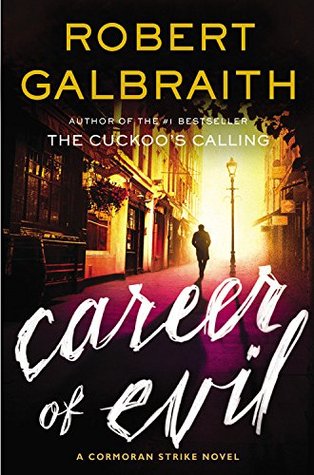
Career of Evil - Robert Galbraith (Cormoran Strike #3)

Career of Evil (Cormoran Strike, #3)I am so bad at figuring out mysteries.  I swear, I'm the absolute worst.  I had a theory all throughout this one, but it is a good thing I am not a detective, because it was dead wrong.  As always, I fell for the red herring.  To be fair, though, Galbraith/Rowling can do a really subtle red herring; at points I felt like some bits were heavy-handed, but I'm starting to think that this is just a technique used in the mystery genre to keep you looking away from the real decoy, so that the truth jumps out at you from around the corner when it comes.

Let me back up.

So, Career of Evil is the third book in "Robert Galbraith," aka J. K. Rowling's, Cormoran Strike mystery series, about an ex-military private detective who has solved a few noteworthy cases in the relatively recent past, but is still struggling to keep his business above water.  Joining him is Robin, his assistant who really wants to be more of a partner due to a long-buried love of mystery solving.  The first two Strike novels involved murders, as does this one, but this one goes in two directions that the previous ones didn't: the pasts of the two main characters, and serial killers.  In this book, Robin herself becomes a target, stalked by a serial killer who we get perspective chapters from now and then.  Additionally, Galbraith starts to really lay out the pasts of the characters that brought them to where they are, in what I think is more detail than in the previous two novels.  The Cuckoo's Calling and The Silkworm both had some of Strike's background in them, but very little of Robin's; that comes out more here, along with increased detail about Strike, amidst a slew of relationship problems for Robin and an increasing tension between her and Strike on several different levels.

Honestly, the characters are what fascinate me about these books more than the plots.  The murder mysteries are fun to try to solve, even if I never get them right, and are always just chilling enough without straying into territory that could be considered cheesy and overblown.  But Rowling has always had a knack for developing really believable characters, and she's carried that skill over into her Galbraith persona, making Strike and Robin three-dimensional characters who are more than just the sum of their parts.  Even the secondary and tertiary characters that appear here are nuanced to a degree that I think is rarely seen in fiction, which is nice.  It makes the story as a whole very complex and helps to create a full-bodied world that supports the story rather than just acting as backdrop.

But I still hate Matthew.  I know that is the point, but I hate him and I hated the chapters where I had to read about him for more than a minute or two because he was so terrible.  Also, this book relied very heavily on Blue Oyster lyrics, and it kind of made it feel like a fanfic.  Not that fanfics are bad (I've read some really excellent ones) but it seemed off from the tone of the first two books.

Overall, this series has maintained solid 4-star ratings from me, and that's true for this one as well.

4 stars out of 5.

Monday, April 25, 2016

The Midnight Assassin - Skip Hollandsworth

The Midnight Assassin: Panic, Scandal, and the Hunt for America's First Serial KillerI adore crime shows.  Law and Order (the original one, with McCoy!) is amazing, and is Bones, and then, of course, there is the best of them all: Criminal Minds.  (NCIS and all of its spin-offs are terrible.  Do not talk to me about them.)  Criminal Minds focuses specifically on serial killers, a group of murderers which is both terrifying and fascinating.  Of course, in Criminal Minds they always get their man in the end, but in real life things aren't always so neat and tidy, especially in periods which pre-dated modern forensics.  The most famous historical serial killer is probably Jack the Ripper, but he wasn't the first person who sort of (and this is totally creepy to say but is true) revolutionized mass murder.  That honor appears to have gone to the Midnight Assassin, a serial killer who terrorized Austin, Texas starting in 1884 before up and vanishing.  This was four years before Jack the Ripper made his kills in London and about a decade before H. H. Holmes built his murder hotel to capitalize on the World's Fair in Chicago.  Unlike Holmes and like Jack the Ripper, the Midnight Assassin was never caught, despite killing at least seven people, and maybe a couple of more outside of Austin.

Skip Hollandsworth uses The Midnight Assassin to lay out the events of 1884 and 1885 that terrorized Austin.  Someone started breaking into the quarters of servant women and killing them with an axe, and then moved on to several more prominent members of the community.  Of course, it wasn't until well-to-do white women, instead of black servant women, started dying that anyone really took notice.  Racism was rampant in the day and Austin presumed that it had to be a black man, or maybe even a roving band of black men, who were behind the killings, even though at least one person said they thought the killer was white.  Two people were tried for two separate murders, despite there being little to no evidence that they were actually involved.  The whole thing was basically a debacle, with no one really having any idea of what was actually going on.  In fact, no one was ever actually caught, and when Jack the Ripper began killing women in London people thought that it might be the Austin killer, relocated to England.  This theory doesn't hold much water in modern times because the Austin killer and Jack the Ripper had very different styles, which is (and I can tell you this as a super-experienced watcher of Criminal Minds) pretty indicative that they weren't the same person.  Serial killers, we all know, tend to use the same method over and over again.

What's sort of weird with that book is that Hollandsworth lays out a bunch of false trails that I kept thinking were going to evolve into a theory about who the killer actually was, but they never did.  For example, the bits about the insane asylum seemed like they were going to result in one of the patients there at least being accused of the murders, even if they turned out to be innocent, but that never actually happened.  Consequently, I was left perplexed as to why such emphasis was placed on the asylum and its staff and inhabitants in the first place.  It seemed liked Hollandsworth wanted to tell this story, but there really wasn't enough source material to bulk out a cohesive theory, so he settled for just including random other happenings around Austin, like the asylum and the recounting of lots of parties.  The elections, at least, tied in to the story, because the scandal of the murders impacted them in a huge way.

Ultimately, though, this is an unsatisfying book because there's no theory.  Hollandsworth mentions at the end that he's still hoping more evidence will arise that might point to who the killer was, but I would have liked to see him take a stab at "solving" the case anyway and at least trying to support any idea he might have had.  As it was, the book ended on a "Yeah, we just can't know" note, which was kind of annoying because it meant the book was basically an expanded version of the Wikipedia page on the killings, without any substantive thought added into it.  Compared to the last book I read about a serial killer, Eric Larson's Devil the White City, The Midnight Assassin just ended up falling flat.

3 stars out of 5; a fascinating series of events, but nothing to elevate the book as a whole to another level.

Friday, April 22, 2016

The Stranger's Obituary - Jessica L. Randall (Obituary Society #2)

The Stranger's Obituary (The Obituary Society, #2)The Stranger's Obituary is the second book in Jessica L. Randall's Obituary Society series, which may or may not be the last book in the series--so far #2 is as far as it goes.  It takes place in a town called Auburn, Nebraska where weird things happen.  There's a little girl named Juniper who can find lost things, some very spooky happenings that affected the heroine of the first book, Lila, and now we get to see some more weirdness.  Mina Fairchild is linked to music; when she hears a song associated with a person, she can see what happened to that person when they listened to it.  And her mother had strange abilities of her own.  Oh, and there's a ghost plaguing Mina's starlet sister, Bernie, who has returned to Auburn after a bad breakup with her Hollywood boyfriend, who is a real piece of work.

Mina and Bernie have other problems, too.  Mina is a shut-in; she writes a travel blog, but she has never actually been to any of the places she writes about.  In fact, she hasn't left Auburn since her mother brought her and Bernie there ages ago.  Bernie might be a starlet, but she left in a bit of a rush after stealing from her brand-new fiance for reasons that she's never been able to really explain to anyone.  Now that she's back, she wants to try to make amends, but things are, of course, a little more complicated than that.  Meanwhile, a body has turned up in quiet Auburn, which has also been swamped by tourists and journalists trying to get a glimpse of Bernie living a small-town life.

My thoughts on this book are similar to my thoughts on the first book.  It needs another light round of line edits; I saw a few words that I think were supposed to be other ones, and then there were a couple of instances where it seemed like Randall got confused with or forgot who was supposed to talking, which made some of the dialog not really make sense.  I would point to the specific instances of these, but I can't, because I think that, much like Auburn, this book is haunted.  It possessed  my Kindle and, once I opened it, literally wouldn't let me read another book.  It took away all the functionality of the Kindle except turning the pages.  I couldn't go to the menu, or even change how my progress was displayed on the bottom of the screen.  If I wanted to get out of the book, I had to hard restart the Kindle to get back to the home screen.  I thought this might have just been a problem with the download, so I deleted the book and re-downloaded it, but it kept happening, so I think it's something up with the actual file on Amazon.  This isn't Randall's fault at all (I presume something went wrong with the file conversion on Amazon) but it certainly made me reluctant to re-open the book after finishing it in order to pull specific examples.

The other thing that I also didn't love was the romance.  Bernie's romantic plot is great, with the revival of something with her former fiance, even though she's not ultimately sure what she wants from it.  Their interactions were wonderful, and you can tell that there's definitely chemistry between them even if they still might want different things.  Mina's romantic plot, on the other hand, seems to have been added just for the sake of it.  Her interactions with her romantic interest are few, and he does come off as stalker-y.  Again, I think this could have been remedied with the book being just a tad longer so their interactions could have been both more numerous and more nuanced.  The few prolonged scenes they did have were sweet, but overall I didn't think it worked.

Unlike the first book, I think the supernatural element fit in well here.  It was more fully woven into the story, and the feel of Auburn was better flushed out with it.  The things that happen in Auburn aren't big, grand supernatural things; they're small, cute ones that can still manage to be a little creepy, but they really fit in perfectly with Auburn's small-town, slightly-outdated vibe.  The Obituary Society itself makes a reappearance, too, and gives us a tiny bit of insight into how the events of the first book are still resolving themselves, and the members help Mina start to re-integrate herself into society.  She's not really an agoraphobe, as is suggested by one character; she's more like an extreme introvert, but with some motivation behind it which comes out later.  She's not actually afraid of going outside, and she does; she goes out, and talks to people, she just...doesn't like to.  I think Mina and Bernie both grew a lot as characters in this book, and Auburn was, again, very well-developed.

Like The Obituary Society, this was a very solid book.  4 stars out of 5, and I hope she writes more in this wonderful town.

Modern Romance - Aziz Ansari

Modern RomanceI'm not entirely sure why I read this book, other than a coworker said it was good.  I'm not really in the "romance" market right now, having been in a relationship for four years and not planning to end it any time soon, and the world of "modern romance," involving sexting, Tinder, online dating, and so on, which is what a lot of this book covers, has never really been something that intrigued me.  But the concept in general as interesting enough, I guess, because I saw it at the library and picked it up...though this probably isn't something I would have gone out and purchased.

In Modern Romance, Aziz Ansari, or someone ghostwriting much of it for him (I'm always so skeptical about books written by celebrities; not that they actually could write a book, because why wouldn't they be able to, but that they actually had the time to write a full book instead of just signing off on it and maybe putting a few touches here and there.  Maybe this is unfair of me, but I can't seem to shake it.) examines how romance has changed in "modern" times, basically since the rise of the internet and the smartphone.  It's a surprisingly academic work, undertaken with the help of some big focus groups and some scientists of various disciplines (who, interestingly, do not have their names on the cover).  They look at what romance was like for the generations who grew up and married before the internet and smart phones and online dating and the phenomenon known as "emerging adulthood" and how that has changed since all of those things came about, and to some degree how romance works in other places around the world, too.  They look at how we find partners, how we get in touch with partners, and so on, all the way to the "settling down" portion.  Along the way, they go to Tokyo and Buenos Aires and Paris, and even briefly Doha, to look at dating in those places, too.  But much of the focus is on how our phones have become so entangled in our love lives.  There were some interesting points here but nothing that I thought was really, really groundbreaking; I think if you thought through most of these things on your own, you'd come to the same conclusions, and the conclusions are basically what you'd expect.

Ultimately, the conclusion seems to be that finding your "soulmate" is now the desirable thing, rather than someone you can just be happy with, which was a thing in many of our parents' generations, and that there are a lot more choices now because the digital world has opened up and allowed us to connect with so many more people in so many new ways, and that can make the search for a "soulmate" even harder than it would initially seem.  There are some funny quips throughout this, but it is definitely not a humor book on the whole, so if you're looking for a comedy book here, you'll be disappointed.  Also, there were a few bits that I could have done without, like Ansari recounting the experience of using a Japanese masturbation toy.  I get it, people masturbate, it's healthy, blah blah blah.  That doesn't mean I want to read about someone I don't know doing it in more detail than I really felt comfortable with.  I'm never going to be able to watch Parks and Rec without thinking about that now.  It's ruined it for me.

Overall, I'd shelve this book as "mildly interesting but not compelling."

2.5 stars out of 3 for sheet interest level.

Wednesday, April 20, 2016

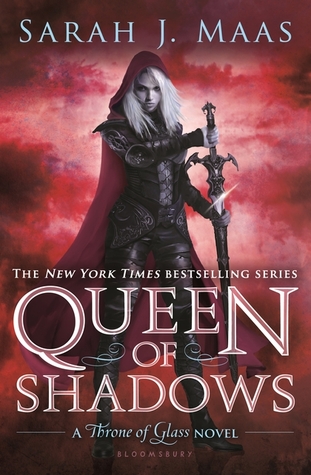
Queen of Shadows - Sarah J. Maas (Throne of Glass #4)

Queen of Shadows (Throne of Glass, #4)So, as you can find in my reviews or pretty much anywhere else on the internet that deals in book reviews, the Throne of Glass series got off to a rough start.  Throne of Glass introduced us to hidden princess/kick-butt assassin Celaena Sardothien, who despite being entered into a competition to fight for her life spent most of her time playing piano, wearing pretty dresses, and eating sweets that just appeared in her room.  You know, despite the fact that people wanted her dead...  There were some cool fantasy aspects to it, but overall it was rather lackluster.  However, the general consensus has been that the series has drastically improved over time--and I have to agree.

The third book in the series, Heir of Fire, ended with Celaena (now known by her real princess/queen name of Aelin, by which I will refer to her from now on) heading back to Adarlan after gaining control over her magical abilities in the realm of Wendlyn and getting a kick-butt blood-sworn fae companion in the form of Rowan.  Now, Aelin is actually back, and she has a list of things to accomplish.  First, she needs to rescue her cousin Aedion from certain death.  Second, she needs to get back a Wyrdkey which is currently in possession of her former master, Arobynn Hamel, the King of Assassins.  Third, she needs to either save or kill Dorian, who has been possessed by a demon, courtesy of his father.  Fourth, she needs to free magic, and kill the king, and...uh, list keeps going on.  But Aelin is now equipped to handle it, with or without magic, because of the events of Heir of Fire.  She's now a heroine who I can actually root for, and a heroine who very obviously starts to become not just an assassin or a lost princess, but a queen.

Meanwhile, the Blackbeak witch Manon is going out of her mind with frustration and boredom in Morath, where she and her witches await orders.  But as they wait, sinister things start to arise at Morath--things that impact the witches.

Queen of Shadows is a book in which things come together.  Manon and Aelin encounter each other, Rowan comes to Adarlan, Chaol and Aelin must work together once again, and Aelin's path to reclaiming her realm starts to become clear.  But that doesn't mean that everything is resolved.  Nope.  In fact, Maas drops a real bombshell at the climax of the book, revealing that all of the troubles up until this point have only really been the tip of the iceberg.  I have mixed feelings about this, because on one hand, it's very cool and very clear that things are about to go to hell in a handbasket quite quickly from here on out.  But on the other hand, I think that revelation could have pretty much been cut out, along with the bits about what's going on in Morath, and we still could have had a pretty satisfying conclusion to the series.

Now, the other thing that bothered me about this book: the ending dragged so much.  The last ten or so chapters all seemed like they could have been satisfying final chapters for this book, but they just kept on appearing.  Every character needed two or three chapters to wrap up what happened to them, which seemed excessive.  I think some of those could have easily been trimmed, or maybe shifted to the start of the next book instead.  As it was, I kept thinking the book was over, but it wasn't, and it kind of soured the end a bit for me.  It's like with the movie Lincoln.  You know, that amazing shot where he puts on his hat and walks down the White House stairs to go off to see the performance at Ford's Theater, that shot that would have been such a lovely, dignified ending, because we all know what happened afterward.  But that shot wasn't the ending: it then had to go on for another then minutes of his kid screaming and shots of him dead on a bed, which were completely unnecessary because it wasn't a movie about Lincoln's assassination.  This book was like that.  It was great, until the end, which then just went on way too long.

Finally, let me briefly speak about Rowan and Aelin, who seem to be a point of some contention among Throne of Glass fans.  I like Rowan.  He is awesome.  I totally support him and Aelin (Though that kiss at the end; what?  You built it all up for just THAT?).  That said, I still like Chaol and I don't hate the idea of him and Aelin together (this is the other main pairing right now, guys) but I do see how they have some serious issues with each other at this point, issues that are going to take two more books to resolve in their entirety if they can be resolved.  Right now, Aelin and Rowan seem like a more solid pair, connected as they are, though it'll be interesting to see how/if Maas resolves the whole "one is immortal and one isn't" thing if they stay together.  That said, I'm not placing all my bets on it, because Aelin has had three love interests in four books so far (and a fourth in the prequel novellas) and I wouldn't be surprised if something happened to introduce another suitor into the fray--though so far most blatant love triangles have been avoided, which I appreciate.

Overall?  A solid book.  It went on a bit too long past the climax, making the ending seem really interminable, but the story itself was great.  Things kept tying back into each other, and more very cool worldbuilding bits were brought up--the bones of the god of truth, anyone?  Still, I think it would have been easy for the series, with a few modifications, to end here, and while I'm sure the final two books will be good, I'm hoping that continuing this storyline doesn't end up being something we regret.

4 stars out of 5.

Tuesday, April 19, 2016

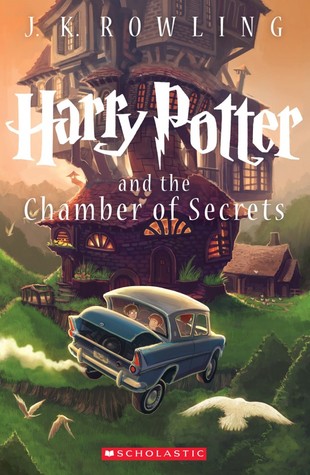
Harry Potter and the Chamber of Secrets - J. K. Rowling (Harry Potter #2)

Harry Potter and the Chamber of Secrets (Harry Potter, #2)As everyone who hasn't been living under a rock since the 1990s is aware, Harry Potter and the Chamber of Secrets is the second book in J. K. Rowling's Harry Potter series, in which the eponymous Harry Potter continues his studies at Hogwarts School of Witchcraft and Wizardry and takes on the dark magic master Lord Voldemort, as is his destiny.  What is there to say about this book that hasn't been said hundreds of times already?  Not much, so I'll make this fast.

Unlike Harry Potter and the Sorcerer's Stone, which was all I remembered it being, I didn't like Chamber of Secrets as much as I did the first time or two I read it; now, granted, the most recent time I read it was six or seven years ago, but still.  It starts off with quite a bit of re-hashing what happened in the first book, which isn't something I'm really a fan of; if you absolutely need to recap things because it's been a while since your last book came out and you can't expect people to re-read it before moving on to the second, I still think you can work in a summary in a manner that's a bit more complex than "This happened.  Now this is happening." 

Anyway.  In Chamber of Secrets, Harry goes on with school while dodging somewhat questionable "rescue" attempts by the house elf Dobby and trying to figure out what's happening to students (and a cat) who keep turning up petrified, all while hearing voices that no one else can hear.  The Defense Against the Dark Arts teacher for the year is Gilderoy Lockheart, who is absolutely fabulous in pretty much every sense of the word; not downright evil on the inside, like Quirrel was, but with his own sinister twist that makes his shiny demeanor all the more interesting.  On the other hand, I didn't like Dobby...at all.  Really.  I honestly don't see what everyone finds so endearing about Dobby.  He has terrible ideas of how to go about saving someone and honestly, nothing in this book would have been any different if Dobby hadn't stepped in; he's a minor inconvenience, at best, not an integral part of the book's structure or plot.

Also befuddling to me is why the Chamber of Secrets go opened at all.  Now, with some spoilers for everyone who has been living under a rock since the 1990s: as the rest of us know, Tom Riddle's diary ends up being one of the seven Horcruxes in which Voldemort put a part of his soul.  Somehow this diary manages to suck the life out of people who write in it, and gives sixteen-year-old Tom Riddle a semblance of life in the process.  Lucius Malfoy plants the book in Ginny Weasely's belongings, and so the whole Chamber of Secrets fiasco gets started when she begins to unwittingly pour her heart out to it.  But what does bringing back a partial, sixteen-year-old version of Voldemort actually accomplish?  Closing Hogwarts?  Was that the end goal here?  Because, honestly, that's a pretty lame end goal.  Was it to destroy Harry?  Because that doesn't really seem like it was ever going to be accomplished without Harry actually going down to the Chamber which was, apparently, not part of the plan.  Was it to bring Voldemort back?  But we know that couldn't work because the Horcrux might keep him from dying entirely, but it can't actually bring him back, we see how that is accomplished in Goblet of Fire and it's quite a bit more complex than getting an eleven-year-old to write in a diary.  I'm completely befuddled at this point.  Honestly, it seems like Lucius Malfoy did it just to be...well, bad.  And impress the Dark Lord who he doesn't even know is still around.  What?  I'm confused.  That doesn't seem like the best use of his evil energies, quite frankly.

Don't get me wrong; we all know that Rowling is a great storyteller and has some wonderful characters and world-building in her head (though sometimes I wonder how much of it was actually planned out in advance and how much she just went along with, and how much we have over-analyzed these books).  But, for this one, I feel like it was just a way to kill Harry's second year while waiting for something more interesting to come along, and that it was worked in much better later in the series than in this book itself.  Still, a quick and enjoyable read, if one that's more palatable in the context of the whole than on its own merits.

3 stars out of 5.